IMPLICATIONS FOR INTERVENTION IN INTRACTABLE CONFLICT
This section offers some general propositions or guidelines for intervention. The set of guidelines given here has been informed by the work of Morton Deutsch, Dean Pruitt, Paul Olczak, Heidi Burgess, Guy Burgess, John Paul Lederach, Herbert Kelman, and Michael Wessells.
The guidelines are useful for resolving many types of conflict, but they have particular relevance for addressing intractable conflict. All should be considered important; however, they are presented here in a crude chronological sequence to suggest that the initial guidelines be emphasized in the earlier stages of intervention.Guideline 1: Conduct a Thorough Analysis of the Conflict System Prior to Intervention
Generally speaking, there are three phases in approaching such complex conflicts effectively: the problem-analysis phase, the problem-engagement phase, and the problem-resolution phase (Fisher, 1994). They are rarely sequential and are often cyclical in practice, but problem analysis should be carefully thought through so that the resulting initiatives directly address the dynamics of intractability relevant to the case. Given the complexity, character, and interrelatedness of the many causal factors of intractable conflict previously outlined in this chapter, it is paramount that the intervenor take the time to begin with a comprehensive analysis of the situation. Our tendency to act before fully comprehending the system of a conflict often exacerbates it. This type of error was depicted in the John Sayles film Men with Guns, in which a physician who desires to alleviate the suffering of mountain peasants victimized by civil war introduces a team of young medical doctors into their villages. This well-meaning act backfires by inciting the suspicion of the government’s army that the doctors are aiding the peasant revolutionaries; the army retaliates, and the result is more harm inflicted on the peasants.
Ideally, assessment of an intractable conflict situation should be systemic in scope (considering important elements of the history, context, and dynamics), informed and verified by those directly involved with the conflict, and reassessed over time as important changes occur.There are an increasing number of analytical frameworks that are useful for analyzing conflict systems (see Coleman, Bui-Wrzosinska, Nowak, and Vallacher, forthcoming; Lederach, 1997). Pruitt and Olczak (1995) offered a simple yet comprehensive framework for use in analyzing and approaching intractable conflict. Their MACBE model is an eclectic, multimodal systems approach to addressing social conflict that traces the source and potential resolution of a conflict to changes in five distinct yet interdependent “subsystems” of the individuals involved: their motivation, affect, cognition, behavior, and surrounding environment. Highly escalated conflicts entail hostile elements in all five components. Motives are to harm or destroy the other; the affect is hostile and rage-filled; cognitions include negative stereotypes, perceptions, and a large measure of distrust; behaviors are violent and destructive; and the environment is usually polarized. The model views these five modes of experience as interactive and working with “circular causality,” affecting and being affected by changes in the other modes. This feeds the escalation of the system through internal conflict spirals. The authors of the model argue that to address “seemingly intractable” conflicts most effectively, one must understand the interrelationship of these experiences and look to produce changes in several, if not all, of these modes.
Take, for example, a seemingly intractable family dispute between a stepfather and a stepson. The conflict sprang from myriad identity and resource-based issues, persisted for several years, affected the entire family system, and eventually reached a stage where interactions between the disputants alternated between autistic hostility and violence.
The family was referred to mediation by the police, and the mediator eventually involved a family therapist. This team of intervenors found it useful to separate those aspects of the conflict that were cognitively based (distrust and stereotypical misperceptions), feeling based (rage and fear), behaviorally based (lack of effective conflict-resolving skills), motivationally based (unwillingness to engage), and environmentally based (schisms among the broader family system). The intervenors found these distinctions, in light of the interrelatedness of these issues, useful in proposing a comprehensive strategy for intervention.Guideline 2: Given the Complexity of Intractable Conflict, Analysis and Intervention Must Be Embedded in a Multidisciplinary Framework
Because of the multidimensionality of intractable conflicts, it is imperative that intervenors understand the system of the conflict from various perspectives and approach it comprehensively. Well-intentioned psychosocial interventions (as well as political or economic interventions) that are ignorant of political, economic, and cultural realities can be ineffective or have disastrous consequences. However, the narrow specialist training in disciplines, the difficulty of employing diverse methods, and the lack of incentive to work across disciplinary boundaries makes a multidisciplinary approach to these conflicts particularly difficult to realize.
A nuanced reading of ongoing conflicts can be facilitated by a process of reframing the conflict through multiple frames (such as systems, realism, human relations, pathology, and postmodernism), organized around the objective of specifying the particular systemic dynamics of a given conflict. Reframing is both schematic and evaluative, as analysts move back and forth through various perspectives to garner the most comprehensive and useful reading of the current situation. However, such a reading must be pragmatic; it must lead to insights for change. As Morgan (1997) writes, “Effective readings are generative.
They produce insights and actions that were not there before. They open new action opportunities. They make a difference” (p. 372).For example, take the conflict erupting on U.S. college campuses between proPalestinian and pro-Israeli faculty and students. Employing a superordinate frame of systems to begin our analysis orients us to a view of the system as a whole and asks what is the nature of the general patterns emerging on these campuses? It shifts our analysis away from particular actions, encounters, and outcomes, toward an awareness of the internal dynamics and trends unfolding over time on campus and beyond. Then, the realist frame asks what roles do politics and power play in establishing the state of intractability? Are external political groups instigating tensions to bring attention to their cause? Are internal groups playing up ethnic differences to mobilize altogether different agendas? Changing frames make other aspects salient. The human relations frame asks do particular social conditions contribute to malignant relations between people and groups that are maintaining the problem? Are there other aspects of these relationships, beyond ethnic or political differences, that contribute to attributions of hostility of the other? The postmodernist frame emphasizes meaning construction around the events, suggesting we pay special attention to the stories told of the conflict. It reminds us that each of the stories told are likely to be partial truths, not completely invalid, but biased in their representation of the causes, responsibilities, heroes, and heroines of the past and present. The medical frame might alternatively focus on the often overlooked role that individual and collective trauma play in the unfolding patterns of the conflict. It asks how do past (or recent) experiences of exposure to suffering, the loss of loved ones, and chronic health problems affect responses to the situation?
Multidisciplinary teams of scholar-practitioners are often best suited to operationalize this type of eclecticism, when informed by individuals with direct experience of the conflict and the setting.
This allows us to benefit from the many insights of scholarship and practice in divergent areas, as they apply to the understanding of patterns of destructiveness within specific conflicts. However, such teams often require training and leadership to bring their individual perspectives in line with the objectives of a systemic approach. But, by broadening our understanding of the conflict, it becomes possible to increase our range of options for intervention.Guideline 3: Initial Concern for the Intervenors Should Be to Foster an Authentic Experience of “Ripeness” Among Disputants or Among Key Representatives of Each of the Groups Involved in an Intractable Conflict
The MACBE model recommends a sequential method for intervening in intractable conflict that begins by addressing ripeness (a willingness to deescalate). In fact, there is a general sense among scholars and practitioners that one of the first and most critical challenges conflict resolvers face when working with malignant conflict systems is in helping disputants to cross their own social psychological barriers to making peace with their enemy (Pruitt and Olczak, 1995). When destructive and escalatory dynamics have become normalized, ripeness should be viewed as a commitment to a change in the nature of the relations of the parties from a destructive orientation toward a more constructive state of coexistence with potential for mutual gain (Coleman, 1997).
Lewin (1947) developed a model for conceptualizing change in systems that offers important insight into these processes (see also Chapter Twenty). He wrote that “the study of the conditions for change begins appropriately with an analysis of the conditions for ‘no change,’ that is, for the state of equilibrium” (p. 208). Lewin indicated that a state of “no social change” refers to a state of “quasi-stationary social-equilibrium,” that is, a relatively constant state. Therefore, to better locate and comprehend the various paths to ripeness in a conflict it is valuable to attempt to understand the dynamic forces that keep a conflict in a state of “unripeness.” During the Cold War, for example, the combination of fear, misunderstanding, mutual distrust, propaganda, and investments in military industry between the United States and the USSR acted to contain the conflict at a costly level for a prolonged period of time.
Lewin offered two basic methods for bringing about change in the direction of the status quo of a system: by adding forces in the desired direction of the change or by diminishing the opposing forces that resist the change. Typically, the change forces that can be added to induce ripeness include threats and the use of physical force; the perception of a hurting stalemate (suffering losses in a conflict that cannot be won); the experience of a recent or near catastrophe; and the awareness of an impending catastrophe or deteriorating position (Zartman and Aurik, 1991). Adding change forces to the conflict system induces a state of increased tension that is accompanied by “greater fatigue, higher aggressiveness, higher emotionality, and lower constructiveness” (Lewin, 1947, p. 26). Obviously, this is risky in the already high-tension state of an escalated conflict process. Therefore, it may be beneficial to initially consider the alternative method of removing the resistance forces opposing ripeness, thereby facilitating it while lowering relative tension. As the MACBE model suggests, there are multiple avenues available to achieve this. In fact, even small (but vital) changes in any one of the modes can potentially have a large impact on the system. Thus, a shift in one’s thinking (such as new insights or a change in attitude) can lead to new feelings and behaviors that subsequently change the context. Likewise, a unilateral conciliatory action might affect one’s sense of possibility in an otherwise rigid situation, leading to an increased willingness to consider other risks.
Returning to the family conflict previously described, several key factors contributed to unfreezing both the adolescent’s and the stepfather’s resistance to ripeness and moving them toward resolution of their conflict. The mediation process (to a small degree) and the individual counseling sessions (to a larger degree) allowed both parties the cathartic experience they needed to ventilate their feelings and feel heard and respected by understanding third parties. This helped them both get over their intense blaming of the other and to begin taking some responsibility for their respective situations. These experiences also helped to establish some trust between the parties. The counselors and mediator also modeled and discussed the use of appropriate social skills for dealing with anger and when engaged in conflict. This helped the parties begin to see alternative methods of responding to each other. Finally, the adolescent’s counselor involved other key members in family therapy as a means of educating them to their role in the conflict and making them part of the solution. These interventions worked in combination to move the parties toward ripeness and resolution.
Through identifying and removing the obstacles (such as distrust, rage, and lack of skills) that act to resist ripeness, it becomes possible to create or enhance a disputant’s commitment to peace without increasing the overall level of tension in the system. Resistance obstacles differ in their amenability to change and in the level of impact they have on the system. Intervenors would benefit from targeting the obstacles that are of high importance and most amenable to change.
Guideline 4: Initially, Orient Disputants Toward the Primary Objective of Defining a Fair, Constructive Process of Conflict Engagement, and Away from the Objective of Achieving Outcomes That Resolve the Conflict
The work of Burgess and Burgess (1996) on intractable conflict has identified a subtle but important reframing of the approach to these problems. They contend that, because of the zero-sum nature of most intractable conflicts, confrontation over the core issues at stake is inevitable and comprehensive resolution is unrealistic. However, they argue, the processes need not be destructive. Consequently, they advocate that conflict resolvers working in such a situation emphasize creating a process of confrontation that the disputants find to be both effective (in terms of minimizing the negative costs of the conflict and maximizing the benefits) and fair or just (in terms of broad moral concerns). They suggest that conflict resolvers see this as a shift to an incremental approach to resolving conflict, which has the potential of reducing the damage of the conflict process despite the lack of any ultimate resolution.
To a large extent, this is what emerged with the Good Friday peace agreement in Northern Ireland, where a political process was established (home rule and a power-sharing arrangement between the communities) whose agenda it was to tackle some of the substantive problems associated with the conflict (such as disarming the IRA). I suggest that this emphasis on establishing a constructive process might be a particularly useful strategy in the early phases of a conflict resolution process to create a sense of possibility, but that eventually, if the stakes are high, the disputants will demand a focus on the substance of their concerns.
Guideline 5: Elicitive Approaches to Conflict Intervention, Particularly When Working Across Cultures, Tend to Be More Respectful of Disputants, and More Empowering and Sustainable Than Prescriptive Approaches
There is a current concern among scholars and practitioners about whether the models in use in many conflict resolution interventions are implicitly oriented toward Western males and are therefore not sufficiently sensitive and respectful of “differences” (of gender, race, culture, class, and so on) in how conflict is understood, approached, and ideally resolved. (For additional discussion of the relation between culture and conflict, see the next part of this volume.)
Responding to these concerns, some scholars have recommended an “elicitive” approach to conflict resolution across cultures (Lederach, 1995). They contend that “prescriptive” approaches to intervention, which view the intervenor as the expert and the participants as passive recipients of predetermined knowledge, models, and skills, are often inappropriate. They endorse another type of approach, where the local, cultural expertise of the participants is elicited and emphasized and where the intervenor and the participants together design interventions that are specifically suited to the problems, resources, and constraints of the specific cultural context. An elicitive approach not only corrects for the bias of a prescriptive approach but also is experienced as empowering by the participants in that it respects, embraces, and accommodates the voices of local people. It can also foster great commitment to the peace process by those involved and therefore lead to plans and initiatives with prolonged sustainability.
Guideline 6: Short-Term (Crisis-Management) Interventions Need to Be Coordinated and Mindful of Long-Term Objectives and Interventions
Intractable conflict sometimes brings on an extended period of crisis and intense human suffering. It is often these events that capture the attention of outside parties (such as the police, the media, and the international community). When this occurs, intervenors typically focus their efforts on containing the immediate crisis and stopping the violence. This form of crisis management is, of course, essential. However, it is often carried out with little thought for the implications for the larger conflict system and longer-term peace objectives.
Lederach (1997) describes the various time frames inherent in the aspects of peace work. Short-term crisis intervention work (such as emergency relief and humanitarian aid) orients intervenors to immediate, life-saving tasks that typically occur in a framework of two to six months. Short-range planning (such as preparation and training to reduce the likelihood of recurring violence) requires forward thinking, looking ahead one or two years. The longer-term perspective, which Lederach defines as “generational thinking” or thinking twenty-plus years out, is uncommon in peace work but used by some to visualize peace and social harmony between disputants and to identify the steps necessary to reach such an idealized state. Nested between short-range planning and generational thinking is what Lederach refers to as “decade thinking” (five to ten years), where fundamental social change can be designed and implemented.
Lederach encourages practitioners to see each time frame as nested in the longer-term schemas and to be mindful of the impact of crisis management and short-term planning on long-term objectives. He suggests that thinking in terms of decades can help coordinate peace work in a manner that links the immediate experience of crisis intervention with initiatives toward a better future where such problems can be prevented. This broad time frame is more realistic when addressing protracted conflicts that have been in existence for several generations and may take that long to resolve effectively.
Guideline 7: Establish the Conditions, Initiate, and Sustain Constructive, Nonlinear Change
Change in complex systems of conflict is nonlinear. In other words, a change in any one element of the conflict (like attitudes) does not necessarily constitute a proportional change in others; such changes cannot be separated from the values of the various other elements that constitute the system (Coleman, forthcoming). So, changes in any one member of a distressed family (such as a commitment by the stepfather to remain nonviolent) may or may not impact the other elements of the system (such as the level of family dysfunction), depending on the different attributes of the members, the nature and the degree of the change, and the nature of the relationships between members. Accordingly, complex systems often exhibit spontaneous, novel, and creative activities that are not completely predictable from circumstances, interventions, or previous events. Thus, initiating change in complex systems requires that interveners have humility, for such change is often unpredictable and uncontrollable. Nevertheless, Gersick (1991) suggests that fundamental change in patterns of systems can be brought about through three interrelated processes: establishing the conditions for radical change, initiating the change, and creating the conditions that sustain the change.
Figure 24.1 provides a schematic overview of nine categories of strategies for initiating constructive changes in situations of protracted conflict, organized
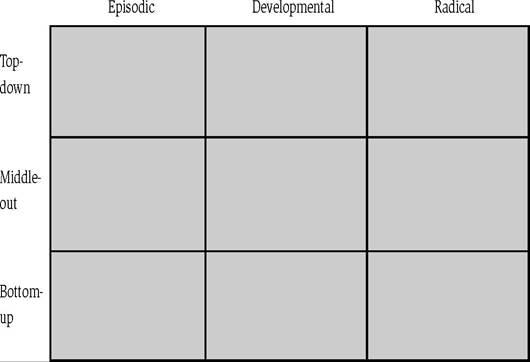
Figure 24.1 Systemic Change Initiatives
around two dimensions: type of change initiative and level of intervention. Change initiatives can have three types of effects in social systems: an episodic impact, which is direct and immediate but typically short term or superficial; a developmental impact, which takes time, perhaps years, to unfold in a system but can have substantial affects over time on the quality of the patterns of interaction; and a radical impact, which is often dramatic, altering the pattern of the system. Change initiatives can also differ categorically by the level of the agent of change. Three general levels are: top-down, involving leaders and elite decision makers; middle-out, involving key midlevel leaders and community networks and structures; and bottom-up, relating to grassroots organizations or the masses directly.
Episodic initiatives at all three levels are typically responses to crises associated with conflicts that attempt to quell outbreaks of violence or suffering. These initiatives, such as military or police intervention or direct humanitarian aid, can lessen the intensity of the destructiveness of the conflict but typically do little to interrupt the strong hostile patterns that characterize protracted conflicts. Developmental initiatives can have an eventual impact on the pattern of a conflict, but such effects are typically gradual, particularly when they are initiated at lower levels of the system. A popular midlevel, developmental approach to initiating change in societal conflicts involves working with middle-range leaders through interactive problemsolving workshops. (See Fisher, 1997.) Finally, radical initiatives attempt to trigger fundamental shifts in conflict patterns (from destructive to constructive) through small but important changes. For example, Gersick (1991) argues that such changes can be brought on by the attraction of influential newcomers to a system (typically young or unsocialized outsiders) who are often drawn by a crisis in a system and who are less obligated, constrained, and resistant to change, and thus better able to initiate frame-breaking changes in the mind-sets of stakeholders.
Guideline 8: The General Intervention Strategy Must Integrate Appropriate Approaches for Issues Rooted in the Past, the Present, and the Future
Intractable conflicts tend to revolve around concerns from the past, the present, and the future, but most interventions are oriented toward present concerns. In addition, anthropologists have found that members of distinct cultures often differ in the relative importance that they assign to events of the past, present, or future. For intractable conflict to be resolved effectively, the intervention approach must be respectful of these time orientations and capable of addressing the salient issues from different temporal dimensions.
Working with conflicts rooted in the past can be complicated by such factors as bias in memory recall, blocks in memory retrieval because of trauma, and the fundamentally different experiences of the past that exist across cultures in terms of the role and importance of ancestors and the effects of the past on one’s present life. There is great need for innovation in developing new (or perhaps embracing old) methods for addressing such problems. Developing expressive and symbolic processes such as truth and reconciliation commissions, town meetings, dialogue sessions, and family and couples counseling to support mediation processes are all attempts along these lines. These processes are often time-consuming, with the focus of such initiatives less on action and more on healing, forgiving, and reconciling. Ultimately, conflict practitioners need to develop enhanced capacity for understanding the power of the past, as well as the patience and tolerance that some of these approaches demand.
There are several methods recently developed for addressing future concerns (see Chapter Thirty-Three for a discussion of Future Search methods). One such practice developed by Elise Boulding (1986) is called focused social imaging. The approach is quite simple. The workshop actively involves participants who are parties to a dispute (such as Arab and Israeli youths). They begin by identifying some of the shared social concerns regarding the conflict (such as reducing community violence or improving community health services). The participants are then asked to temporarily disregard the current realities of the situation and to step into the future. They are asked to put themselves into a future approximately twenty to thirty years from the present, in which their concerns have been effectively dealt with. As the participants begin to develop some sense of the social arrangements and institutions in this idealized future, discussion ensues. Together, they begin to create a vision for a community that has the institutions and relationships necessary to effectively address their shared concerns. Then the participants are asked to move slowly backward in time and to begin identifying the steps that would precede establishment of such institutions and relationships. This is both a creative and a critical process of examining the achievement of their ideal future in the context of the circumstances that are likely to exist between the present and such a future. Ultimately, this process results in both a vision and a plan for making the vision reality. It also can serve to open up the participants’ awareness of options and approaches to the current conflict that they previously found impossible to imagine.