Key Findings
4.1 The Impact of Child and Youth Participation in Peacebuilding
Before I was not interested about what was happening to me and I did not care about others.
I did not like the way I was, and I rejected myself and others.
Now, I take more care of myself and I am interested in the common well-being, I can control myself without medication and I am kinder to others. I value myself and others.A 16-year-old girl from Armenia, Colombia
The evaluation results revealed that child and youth peacebuilders have contributed to impact in four key areas: (1) young peacebuilders often became more aware and active citizens for peace, (2) young peacebuilders increased peaceful cohabitation and reduced discrimination, (3) young peacebuilders reduced violence, and (4) young peacebuilders increased support to vulnerable groups. A few of the changes under each of these key impact areas, particularly the changes concerning children and youth as aware and active citizens, were experienced by males and females of different ages participating in different peacebuilding initiatives across different regions. Other changes were more localized resulting from specific peacebuilding initiatives carried out by children or youth, often in collaboration with adults in particular geographic areas.
Theme One: Young peacebuilders often became more aware and active citizens for peace. This prominent theme covered numerous impact subthemes emerging from individual changes, development, and actions. Child and youth involvement in peacebuilding helped them develop as individuals and become more responsible citizens. Practicing peacebuilding not only allowed young people to improve their peacebuilding skills, more broadly, it contributed to their more effective positive involvement in their communities. Participants highlighted that individual changes and actions resulted in positive impact at community, family, and school levels.
The transformation of young people into more aware and active citizens for peace seemed to start as they became more aware of peace as a concept and possibility. They then began to hope and believe in peace in their families, communities, and nation. This energized young people to acquire the knowledge and skills necessary to do so. As their knowledge and skill improved, both through training and through practicing peacebuilding action, young people's confidence in their ability improved. This dynamic process increased their commitment to peacebuilding which increased their peacebuilding actions and improved their knowledge, skills, and confidence. These young, skilled, and confident peacebuilders applied their developing capacity throughout their daily lives and, thereby, became aware and active citizens for peace. This development process was critical for increasing the impact of their peacebuilding actions.
Children and youth become aware of their peacebuilding ability. In DRC a
13- year-old boy from Goma wrote, “I had no vision for peace,” and a 14-year-old boy from Bukavu explained, “I lost all hope for peace.” A 14-year-old girl from Kitchanga was afraid “the war would never end,” and a 14-year-old boy from Bukavu confessed, “my heart was not interested in the question of peace.” Their responses implied that they had a different mindset in the past. Now they recognized the importance of peace and they believed in a peaceful future.
In Nepal, participants from all four districts evaluated mentioned increased positive thinking and that they take more responsibility. Children and youth described how they used to have negative thinking that “children and youth could not contribute to positive change” as mentioned by a 17-year-old adolescent from Nawalparasi.
In Colombia responses also indicate changes in young people's mindsets, attitudes, values, and perceptions that resulted in significant peacebuilding impact at community, family, and school levels.
For example, A 14-year-old girl from Cali described how she “used to think [she] was superior and fought at school. Before, I was a very fighting girl and I did not want to know about peacebuilding.”Young peacebuilders became personally committed to peace and practice peacebuilding actions, more responsible and capable. The changes in thinking and attitude were consistently noted as the precursor to young people practicing peacebuilding actions. The next step from a changed mindset is changed behavior.
Children and youth who were engaged in peacebuilding programs showed increased personal commitment to peace and took individual peacemaking actions. First, they wanted to learn more about peacebuilding. For example, a 13-year-old girl from Kitchanga, DRC, expressed increased interest in peace publications, and a 12-year-old girl from Goma similarly explained that she watched documentaries on peace now and wanted sustainable peace.
Second, young people practiced peacebuilding actions. “When I meet children fighting, I do everything possible to sensitize them and build a climate of peace,” a
14- year-old boy from Goma, DRC, explained. A 13-year-old girl from Kitchanga confirmed being capable to mediate between people with land conflicts. In Nepal a
15- year-old girl described how “children and youth who are involved in peacebuilding see their responsibility and work to reduce violence, abuse, and exploitation and to end child marriage, conflict, and social ills.”
Third, participants also expressed that children and youth became more responsible and capable as a result of their peacebuilding involvement. For example, in the districts of Goma and Kitchanga in the DRC, and to a lesser extent in the district of Bukavu, children and adolescent participants said that before their participation in peacebuilding, they only thought about fighting and stealing. Now, these children and adolescents have become peaceful actors. “I don't fight anymore, I hit the drums of peace,” wrote a 12-year-old boy from Goma.
A 14-year-old boy from Goma explained that, “even if someone provokes me, it's peace I seek with him.” They further described how they go to school, study, and help with housework now and that they have become polite and respectful and listen to others, including their family, parents, peers, and teachers. They are interested in their advice and follow them when they can. Similar personal changes were described by children and youth in Colombia and Nepal. In Nepal, increased respectful communication with elders, parents, and peers was described by participants of all age groups in each of the four districts. According to a 14-year-old girl child from a child club in Mahottari “I used to not to listen to my parents and give negative response, now I realize and give respect to elders.”This personal development to be more responsible and considerate children and youth helps them to stay focused and engaged and to collaborate with others in their peacebuilding efforts. Young people's peacebuilding mindset, commitment, actions, and increased responsibility and skills not only improved their peacebuilding impact but also freed them to play more active roles as productive citizens in whatever ways they chose to do so.
Theme Two: Young peacebuilders increased peaceful cohabitation and reduced discrimination. Cohabitation moves beyond coexistence, toward peaceful dynamic relationships within and between diverse groups, resulting in identifying and supporting norms such as interethnic marriages, visiting or studying inter- ethnically, and intergenerational civic collaborations. Children and youth contributed significantly to increased peaceful cohabitation within and between a variety of different groups.
In Nepal, sociocultural beliefs and traditions have contributed to discrimination based on age, gender, ethnicity, and caste. Ethnic and caste discrimination has been one of the root causes of conflict and violence in Nepal (Save the Children et al. 2008). Furthermore, gender and age discriminations contribute to domestic violence against women and children, different forms of gender-based violence, as well as cultural forms of violence including early marriage and chaupadi practices in which menstruating females are expected to sleep outside of the home during their menstruation.
Child and youth peacebuilders prevent and address different forms of discrimination due to age, gender, ethnicity, and caste which contributed to increased peaceful cohabitation. Other available secondary data reports provide additional case examples of child clubs' efforts which have reduced discrimination based on caste and ethnicity (CCWB and Consortium 2012; Save the Children 2013a; O'Kane 2003).Child, adolescent, and youth from all four districts of Nepal mentioned that they have increased understanding of caste and ethnicity through their engagement in peacebuilding and that there is a gradual reduction in caste discrimination. Previously they used to treat each other differently, but through their peacebuilding they have started to treat and see everyone equally. Systematic peacebuilding efforts by youth to address caste discrimination and “untouchability” were illustrated in a community in Rolpa district where youth had initiated and mobilized collaborative efforts engaging village officials, political parties, and women's groups to declare their village as “untouchability free.” Through their efforts, changes in perceptions and thoughts and traditional practices among children, youth, and adults have been achieved. Different castes are now able to visit and eat in each other's homes and drink from the same water source, and children are allowed to play together.
Children and youth in Nepal also emphasized changes in gender relations and reduction in gender discrimination which is being brought about by their participation efforts. A female youth shared how “Girls participation was less accepted by society, but now we are seeing how this has changed... Before girls were not encouraged to leave their home and they were expected to marry at a young age. Now children and parents attitudes have changed.... Girls are now more able to participate in social issues. There are positive changes at the individual level and in society.”
There was wide reporting that CYP improved relationships between children and youth and also with their parents and elders.
Other studies also provide evidence of positive changes in social norms regarding the place and roles of children (Central Child Welfare Board [CCWB] and Consortium 2012; Theis and O'Kane 2005; O'Kane 2003). Furthermore, collaborative efforts by the Government of Nepal, UN, and civil society agencies are supporting increased institutional support for child clubs and increased opportunities for child and youth participation in local governance (CCWB and Consortium 2012; UNDP 2014). Specific efforts to promote Child Friendly Local Governance are also being supported in 61 districts, 18 municipalities, and 317 village development committees (UNDP 2014).In Colombia participants emphasized improved cohabitation and reduced violence at family, school, and community levels. Children, youth, and adults from eight of ten CYP initiatives described positive changes and impact in terms of reduced violence and peaceful cohabitation.
“The neighborhoods were united as one community,” explained a group of children from Cali when describing a 2012 march against violence. Children and young peacebuilders stressed that regardless of the invisible borders created by gangs and other groups, they dared to take advantage of community spaces and promote peace in different neighborhoods. In the Montes de Maria region, participants underscored the significant impact of cultural activities to unify communities. “Youth communities have widened their knowledge, their stigmas of mistrust have decreased, and they have reconciled between each other,” explained a 23-year-old male youth from Macayepo.
In the paper, Youth Violence Prevention in Colombia (2014), Pracher argued that projects should focus on long-term collaborative programming, violence prevention, and youth empowerment and emphasize sports and arts activities. This report highlighted how different peacebuilding initiatives effectively implemented these strategies and engaged communities to increase peaceful cohabitation and prevent youth violence (Backer and Guerra 2011, pp. 31-33).
In its National Policy on Peacebuilding and Family Coexistence 2005-2015, the Colombian Institute of Family Welfare (Instituto Colombiano de Bienestar Familiar (ICBF)) underlined how preventing and addressing intra-family violence requires an intersectoral strategy focused on individuals, families, and communities. (The Colombian Institute of Family Welfare is a Colombian state entity, which works for the prevention and comprehensive protection of infancy, childhood, adolescence, and well-being of families in Colombia.) Promoting values of peaceful coexistence and equipping families with tools to peacefully solve conflicts were highlighted as key strategies (ICBF 2005, pp. 9-10). Evaluation participants were part of peacebuilding initiatives working at the community, family, and school levels. They all recognized how crucial it was for them to learn to use dialogue, instead of fighting to resolve conflicts. The values and skills acquired during different processes were applied in their homes and significantly improved their cohabitation.
In DRC, body map FGDs revealed that children and youth were highly ethnicized. Ethnic hatred was especially pronounced in Kitchanga where 163 responses expressed ethnic hatred out of a total of 181 responses expressing such hatred during all body map FGDs. Participants mentioned 256 times that CYP initiatives reduced discrimination or increased peaceful cohabitation. (This is not the number of participants highlighting this impact as some participants commented more than once about reduced discrimination and/or increased peaceful cohabitation.) Of these 256 responses 179 were given in Kitchanga. Additionally, the majority of draw and writes from Kitchanga expressed the positive change of increased peaceful cohabitation. For example, a 15-year-old boy gave the title for his vivid and colorful picture below, “All tribes are the same” (Fig. 1).
Participants in Goma similarly mentioned that there is less tribalism and that people of different ethnic groups have started appreciating each other. “I am not tribal anymore,” said a 13-year-old girl from Goma. “Certain very extremist tribes have understood today that only love counts. They marry each other, which was impossible before. They’ve understood that ethnic segregation has no importance,”
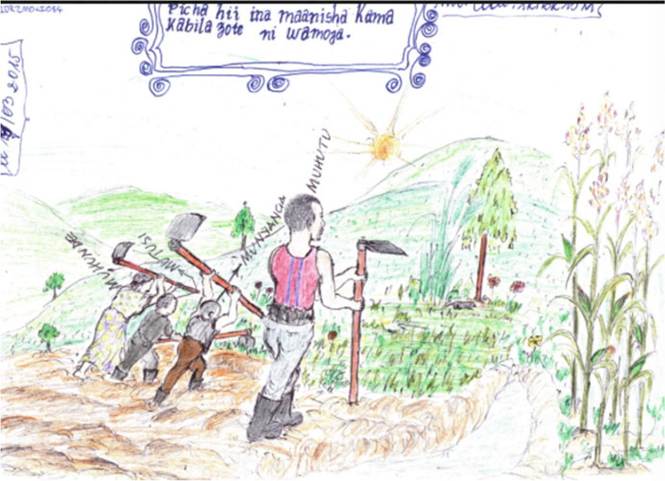
Fig. 1 All tribes are the same. Drawing of people of different tribes, ages, and gender farming together harmoniously, drawn by a 15 year old boy in Kitchanga, DRC. On top is written, “all tribes are the same”
an 18-year-old adolescent from Goma explained. In fact, interethnic marriage was mentioned several times by participants.
Theme Three: Young peacebuilders reduced violence. Child and youth peacebuilders prevented and reduced different forms of violence and exploitation as evidenced by evaluation participant’s claims and supporting research. The type of violence reduced varied significantly in each country. Following are just some of the examples of reduced violence in each context.
In Nepal, reduced violence against children, women, or men and creation of a more peaceful environment were widely reported by evaluation participants. This included reporting of reduced gender-based violence and domestic violence, including reduced scolding of children by their parents. Children and youth also described positive changes in their own behavior and attitudes to be less violent as a result of participating in their CYP initiative. Reduced alcohol use and associated domestic violence and fighting in two communities was reported. In one such community, collaborative efforts by youth clubs, women’s groups, and local officials resulted in the declaration of an alcohol-free VDC. (In Nepal, the lower administrative part of its Ministry of Federal Affairs and Local Development is the Village Development Committee (VDC). Each district has several VDCs. Each VDC is further divided into several wards depending on the population of the district; the average is nine wards.) Reduced early marriage was reported by children, adolescents, and youth from six child clubs (2 Doti, 2 Rolpa, 1 Nawalparasi, 1 Mahottari) and four youth clubs (3 Rolpa, 1 Doti). Interagency research on child marriage in Nepal carried out in 15 districts identified how, “the activities of child clubs, adolescents and girls were found to be very useful in preventing child marriage” (Plan Nepal et al. 2012, p. 10).
In DRC, CYP appeared to reduce violence of different kinds in all three LET areas. In Kitchanga, participants suggested there was success peacefully resolving and reducing a number of individual land conflicts. This impact came about through peace education on the land law and the importance of solving conflicts peacefully, as well as through mediation of existing land conflicts. Children and youth were especially involved in awareness-raising efforts, while some youth also mediated conflicts. Acts of land conflicts signed, and actual recuperations of land, were mentioned by several organizations as evidence. Children and youth also reduced sexual- and gender-based violence by raising awareness on gender equality within families, schools, and communities and by addressing forms of sexual exploitation.
In Colombia, a clear difference was discerned between participants under 18 and youth participants. There was an observable majority of children and adolescents (10-17-year-olds) stressing that they had learned to dialogue instead of fighting, to respect their relatives and peers, and to recognize their own emotional feelings. By contrast, youth, and adults, directed their responses on impacts that increased integration between communities and improved communication within families. More than 50% of answers under the category of reduced conflicts and violence in schools and families (n=94) used terms related to “communication” to describe how children and youth had experienced greater peace in their relationships at home and in school. Dialogue, listening to others, using proper language, and expressing their feelings are considered as the main strategies they learned and used through their involvement in peacebuilding activities. Participants from Cali described how bullying significantly decreased in their school and led to decreased school dropout.
Theme Four: Young peacebuilders increased support to vulnerable groups. In Colombia, DRC, and Nepal, CYP increased assistance offered to vulnerable groups. Following are some examples.
In Colombia, in the Montes de Maria region, the Antonio Restrepo Barco Foundation created a multipurpose fund providing child and youth groups and organizations with crucial support to develop sustainable and income-generating projects. These initiatives positively impact the society by supporting recycling and trash collection youth brigades, creating a playground for disabled children, creating music schools, and offering economic opportunities for children and youth in a region highly affected by poverty and unemployment (Fundacitin Restrepo Barco 2008).
In DRC, children and youth implemented concrete activities to allow children and youth to develop in safe environments in all three sites. In Bukavu, child and youth peacebuilders claimed to have improved the conditions of children in prisons and reduced the number of children there in the first place. A 34-year-old adult supporter from Bukavu explained that there is now an “acceptance [by prison authorities] to liberate children from prisons.” Also, “children find food now,” an 18-year-old male youth claimed, and “children have their own space in the prison,” a 22-year-old female youth confirmed. In Goma and Kitchanga, children and youth have contributed to reunifying children and their families who were separated by war and supporting their reintegration in families and communities.
In Nepal, participants reported increased reintegration of conflict-affected children and youth. Dialogue and interaction programs among young people who were part of armed groups and youth club members in Mahottari led to increased understanding of their motives and needs. Increased reintegration support of conflict-affected children and youth in their communities, schools, and families as a result of child and youth club initiatives was also reported by others (Binadi 2011; Save the Children Nepal 2008; Save the Children et al. 2008, 2013a).
4.2 Factors Influencing Child and Youth Peacebuilding Impact
Eleven key factors have been identified which hinder or enable the impact of child and youth peacebuilding efforts. To varying degrees, each of these factors can both positively and negatively influence CYP impact depending on the context and different circumstances. Furthermore, there is a strong interplay and dynamic relationship between each of these factors contributing to the cumulative successes or, conversely, the cumulative barriers preventing or limiting the impact of peacebuilding efforts.
1. Attitudes, motivation, and commitment of children and youth and their organizations. Good role models, effective communication, teamwork, and the responsibility and commitment of individuals were identified as key success factors. Children and youth were motivating each other, accessing information, and organizing themselves in their own clubs, associations, and movements to organize peacebuilding and violence prevention initiatives. As described by an 18-year-old female in Nepal, “in our child club we raised our voices against child abuse, exploitation, trafficking, and use of drugs. We conducted many awareness-raising programs, collected small funds which were used to buy stationery for children from the poorest families to help them to continue their study. We also organized debates and quizzes on children’s issues.”
A lack of commitment and interest by children and youth was described as significant hurdles to successfully implementing peacebuilding programs. When only a few children and youth were actively participating and when sufficient preparation was not undertaken for their peacebuilding activities, their initiatives struggled to have significant impact. Reasons for limited participation in peacebuilding initiatives were varied. For example, in Nepal reasons included a lack of parental support for their children to participate, difficulties in reaching children and youth from the most remote communities, insufficient information and awareness about peacebuilding, a lack of local government support, and poor communication and internal conflicts within the clubs. Shyness, rivalry, a lack of information sharing, and disrespectful communication were identified as hurdles in Colombia.
2. Capacity, knowledge, skills, and experience of children and youth. Through their CYP initiatives, some children and youth in different contexts have gained increased opportunities to access training on child rights/women’s rights, peacebuilding, conflict management, and leadership skills. A male youth in Nepal described, “leadership development in children and youth is effective as children and youth have more confidence and skills to raise their voices about problems affecting them in their communities to concerned stakeholders, so that the concerns can be solved.” Children and youth peacebuilders in Colombia emphasized the importance of disseminating their learning among their peers so that wider numbers of children and youth could be mobilized and engaged. In the well-functioning associations and clubs, children and youth had improved leadership, communication, analysis, and problem-solving skills which enhanced their competencies as peacebuilders.
Insufficient capacity building and efforts to consider conflict analysis findings when developing their peacebuilding or violence prevention initiatives has also contributed to some ineffective efforts. For example, some village cleaning and water tank building initiatives by children and youth in Nepal were organized under the name of peacebuilding, but they were not very effective in contributing to peace as they did not identify or address the underlying causes of conflict. Furthermore, some local-level income generation activities with female youth were not effectively contributing to peace, as they were not accompanied by peacebuilding awareness. Such findings are reinforced by an earlier multiagency study in Nepal (Care Nepal 2012) regarding the importance of conflict analysis and theories of change.
3. Family attitudes and support. Parental support for children’s participation in peacebuilding was crucial. When there was a general lack of parental support for child peacebuilding efforts within the community, there tended to be lower morale among children and less active participation from girls and boys. Parental permission was also important for female youth in the Nepali context, as they faced more restrictions in terms of their mobility compared to male youth. In addition, some families who were most affected by poverty tended to be more reluctant to allow their sons and daughters to engage in peacebuilding activities, as they felt their time could be better spent contributing to the family livelihood. Findings from the evaluation exhibited positive indications that children and youth peacebuilders in a number of locations were gaining increased support from their parents for their CYP efforts.
4. Cultural attitudes, beliefs, and practices. Cultural attitudes and traditions concerning gender equality, marriage within tribal groups, and inheritance rights were mentioned as factors affecting peacebuilding efforts in the DRC. For example, cultural attitudes regarding male inheritance negatively affected efforts to promote gender equality. Similarly, in Nepal traditional cultural attitudes, beliefs, and practices toward gender, caste, ethnicity, and age were deep-rooted and contributed to different forms of discrimination and cultural violence, including early marriage. It has been recognized that social norms take time and persistent effort to change (ActionAid et al. 2012; O’Kane 2003) and that restrictive social norms and attitudes toward children, girls, women, and other marginalized groups hinder opportunities for meaningful participation (ActionAid et al. 2012).
5. Key stakeholders motivation, commitment, and support. In some communities in Colombia, the DRC and Nepal children and youth reported a lack of willingness and commitment from the local government authorities and other relevant stakeholders to engage children and youth in peacebuilding. Thus, children and youth in some areas felt unsupported and were less able to address direct, cultural, and structural forms of violence without support from adults. In some communities in the DRC, some youth and children faced hostility and negative reactions to their peacebuilding efforts from key stakeholders. For example, in Kitchanga certain local chiefs prohibited awareness-raising activities and mediations on land conflicts due to vested interests.
In a number of communities in Nepal and in some communities in Colombia, close collaboration with key stakeholders (in schools, communities, local authorities) has increased the successful impact of CYP.
6. Awareness raising, sensitization, and campaigns among key stakeholders. Significant awareness raising and sensitization on peace, nonviolence, different forms of violence, as well as positive roles that children and youth can play in peacebuilding have been required with community members, parents, elders, and officials to change the attitudes and practices that contribute to violence and conflict. Awareness-raising activities in schools, communities, municipalities, and districts have been a key component of peacebuilding initiatives by child and youth peacebuilders in diverse locations in Colombia, DRC, and Nepal. In the Nepali context, national and district level campaigns on Children as Zones of Peace, School as Zones of Peace, and Child Friendly Local Governance have played an enabling role in creating more widespread awareness on issues relating to peace, nonviolence, participation, and respect for rights. The media (radio, television, and new forms of social media) has also played an important role in raising awareness and sharing information about peacebuilding and good governance initiatives among the general public.
7. Culture, theater, arts, and sports as a means of engaging children and youth. Creative methods are being effectively used to engage and sustain the motivation of children and youth in peacebuilding and to promote awareness and peacebuilding messages. Cultural arts, theater, drawing, poems, games, quizzes, debates, speeches, singing, and dancing were identified as effective approaches for children and youth to show their talents; to express their views and messages on peace, violence, and conflict issues concerning them; and to build social relations among groups. Children aged 10-14 years old in Colombia expressed their wish to participate in fun and artistic peacebuilding activities, for example, by “writing songs about peace with our thoughts” or “organizing more games so that children can have fun.” Furthermore, participation in cultural programs was also identified as important approach to empower girls and female youth in Nepal. As described by one of the female youth members: “Female participation in cultural programmes is important to increase young women's self confidence, and these young women can be a source of inspiration for other girls and women in their community.”
8. Existence and implementation of government laws, policies, strategies, and provisions. In line with the UN Convention on the Rights of the Child, numerous laws, policies, and directives have been developed to protect people from different forms of violence and discrimination including child marriage, child labor, trafficking, discrimination, etc. Furthermore, there are increasing development of laws and regulations supporting children and youth participation in decision-making processes concerning them. In Colombia, a recent law has also mandated incorporation of the topic of peace in all school curriculums. However, despite provisions for child and youth representation in various local governance structures concerning them in Nepal, there continues to be a lack of provision for child and youth representation in Local Peace Committees, which have formal mandates to consolidate peace from the community level, to provide a common forum for people to resolve conflicts and disputes locally, and to directly address the impact of conflict. In addition, some parents, community members, and sometimes even local government officials remain unaware of relevant laws and policies, and there is insufficient implementation and monitoring of laws and policies, especially at the local levels.
9. Financial and material support given to CYP efforts. Child and youth peacebuilders in the DRC emphasized that financial means allowed them to reach a larger number of participants in peacebuilding, in more numerous and remote places. For example, in Bukavu, participants mentioned the need for funds to organize more multiethnic debates and to do more peace education. It was suggested that while financial means were important, financial support should also go hand in hand with peacebuilding, capacity building, and other inputs. In Colombia, while participants affirmed that long-term financial and logistical support was needed, they placed more emphasis on the importance of the support from stakeholders, particularly the need to increase and strengthen partnerships with the state institutions, as well as with other public and private institutions. Child and youth clubs in Nepal are increasingly gaining access to financial and material support from the local government; and they are influencing local government planning and budgeting processes which is increasing the sustainability of their efforts. Yet, many CYP initiatives continued to face challenges in securing sufficient material and financial support for their CYP initiatives in Nepal.
10. Income generation support for marginalized groups. In Nepal evaluation participants reported that efforts to reach and engage marginalized youth and children in their CYP efforts were more successful if their programs included income generation or skill development opportunities for youth or family members. The evaluation revealed the importance of approaches which are conflict sensitive and the importance of analyzing the unintended economic impact of child and youth peacebuilding activities on families, particularly the most marginalized families, so that risks and negative impacts can be avoided. For example, in efforts to ban alcohol production in Doti, it was found that some of the most marginalized families who gained an income from alcohol production left the community when alcohol production was banned. An adult male supporter from Doti stressed that “The families who used to make local alcohol as an income generating source, after the declaration of alcohol free VDC, have to bear economic loss. They have to move to another place, this not only have negative impact in their livelihood, but also in the education of their children.”
11. Conflict, political instability, and insecurity. In the context of Eastern DRC, violence and conflict were identified as an important hindering factor. Implementation of peacebuilding activities created risks for child and youth peacebuilders. In addition, the experience and fear of violence and destruction, often with ethnic connotations, influenced the readiness of community members to accept peacebuilding messages. Political insecurity, armed conflict, and strikes were also reported as hindering factors to CYP initiatives in Nepal. During the period of armed conflict, some child and youth club activities were stopped due to insecurity and associated risks (Save the Children et al. 2008). Furthermore, in recent years political strikes have created delays and adjustments to child and youth peacebuilders plans and activities.
5