A Model of Strategic Conflict
As mentioned, many researchers have investigated interpersonal conflict. We hold that conflict involves several facets, each of which must be discussed for a presentation of where conflict can be affected by human agency.
By “control” then, we do not imply a monolithic force that places other people in irrevocable positions and then dictates their movements. Instead these facets can be seen as “events” that provide opportunities for people to think and act mindfully. Our model emphasizes how people can strategically manage conflict at each event—from the very beginning of conflict until it concludes. Our model illustrates these events in linear form for educational purposes. Finally, the reader might see that we do not have a place labeled “conflict resolution.” We believe that even if a conflict is not “resolved,” it can be successfully managed strategically in a way that maximizes outcomes.Each event in the model points to different features of conflict that one wants to control. These include episodic control, personal control, attribution control, goal control, strategy control, and interaction control—terms suggested by Brant Burleson (Note 1 in Canary, 2003). Moreover, each event in conflict implies its own strategic objective. Most people do not think of having different strategic objectives for the same conflict. However, people attempt to take control of conflict events as they happen, in addition to attempting to control the final outcome. Here are the various conflict events and their related control objectives:
| Conflict Event | Strategic Objective |
| Conflict Instigation Personality Differences | Episode control of factors that instigate conflict Personal control of individual differences |
Interpretation of Conflict Attribution control of how to explain conflict
| Goal Emergence | issues Goal control of how one obtains and maintains goals |
| Message Production | Strategy control over communication strategies and tactics |
| The Other’s Response | Interaction control within conflict episodes |
Return to Previous Points Control issue determined by which previous event
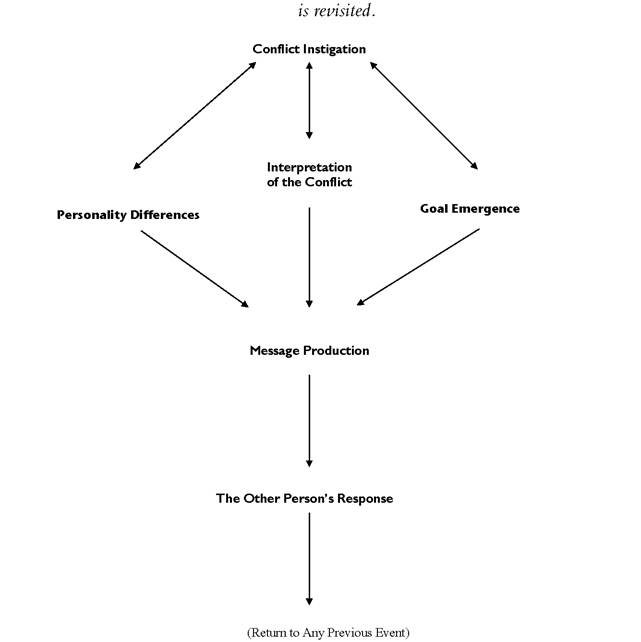
FIGURE 1.1 Model of Strategic Conflict