Nonviolence Principles in Buddhism
Nonviolence (Ahimsa) is a cardinal guiding principle in Buddhism. Simply put, nonviolence in Buddhism means not to harm anyone through physical, verbal, and mental actions. Harmful or violent actions belong to the category of negative actions or negative karma.
Physical actions (e.g., beating and torture), verbal actions (e.g., threat and hurtful speech), and mental actions (e.g., harmful intent and malicious thought) are violence. Nonviolence means not to indulge in physical, verbal, and mental harmful actions. A clear case of nonviolence involves positive/peaceful motivation and concomitant physical and/or verbal action. In a conflict situation, if one, out of respect, intentionally refrains from saying and/or doing anything (e.g., verbal or nonverbal emotional abuse) to hurt, the conflict partner is considered a nonviolent practitioner. A clear case of violence involves negative motivation and harmful physical and/or verbal action. Intentionally abusing someone physically and/or verbally is violence. If individuals act physically and verbally out of anger, hostility, malicious thought, and antagonism, their actions constitute violence. However, if they act physically and verbally out of the motivations of love, altruism, compassion, and kindness, their actions could be recognized as nonviolence practices. In light of these, individuals can choose to take a nonviolence stance, as Gandhi did and the Dalai Lama does, out of the motivation of compassion and kindness.Violence and nonviolence are primarily defined in terms of negative or positive motivation of those who perform the actions (Gyatso, 1991, 1999; Tsong-Kha-pa, 2000). According to Buddhism, the ultimate test of whether or not an action is violent can be judged by investigating the motivation/ intention of the actors. A model is presented (see Figure 26.1) to describe four possibilities concerning nonviolent and violent practices.
Quadrant 1 consists of nonviolence practice that is positive in terms of both motivation and action as in altruistically motivated peace talks. Quadrant 2 consists of nonviolence practice with positive motivation but perceived negative behavior such as altruistically motivated social activism and self-immolation (see later section). Quadrant 3 consists of pseudoviolence practice with negative motivation but perceived positive behavior. Finally, Quadrant 4 consists of violence practice with negative motivation and negative behavior such as discrimination and torture motivated by anger and hostility. Of these, Quadrants 2 and 3 challenge the notion—seeing is believing, but not necessarily so.Regarding Quadrant 2, caring doctors may have to use invasive measure to help their patients, or caring teachers may admonish or whack students on their back or upper arms for their well-being and lessons in some cultural contexts (some Buddhist monasteries). Their behaviors may look violent, but they
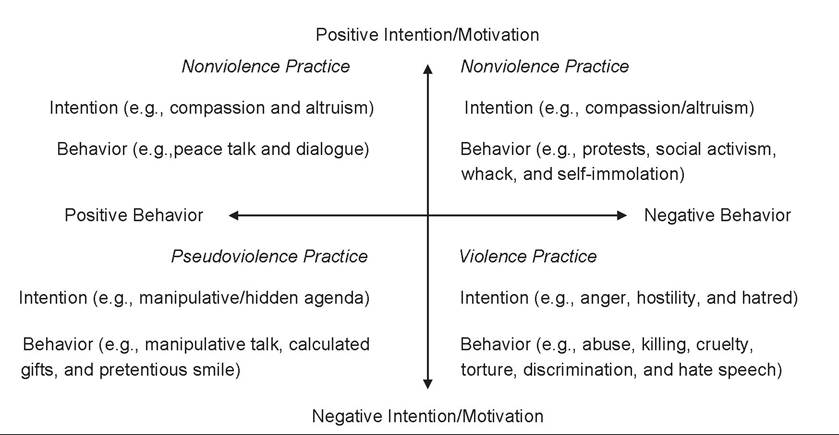
Figure 26.1 Nonviolent Practice Versus Violent Practice Model: Four Quadrants
are not from positive motivational point of view. In the Nalanda Tradition of Buddhism, there are many meditational deities such as Yamantaka, Mahakala, and Shri Devi who look fierce and wrathful and hold weapon-like symbols (see Rhie, Thurman, & Taylor, 1996), but these deities are not considered angry or violent. These are regarded as wrathful manifestation of great compassion and enlightened wisdom to subdue negative afflictions such as anger and lust in human mind. Relatedly, Quadrant 3 also challenges our senses because seemingly peaceful physical and/or verbal action look and sound good, but due to negative motivation, they constitute violent practice as in manipulative sweet talk to hurt others. These cases indicate that the standards of violence or nonviolence in Buddhism are different from conventional understanding of such actions. Having the motivation of compassion does not require individuals to follow certain established religions. Compassion has a secular nature.