OVERVIEW: PERSON, PROCESS, AND PRODUCT
The three perspectives on creativity in conflict—person, process, and product—can be seen as guides for the analysis of how people can get to integrative agreements. Simonton (2003, 2004) and Runco (2004) outlined these three perspectives in the study of creativity in scientific achievement.
The present paper is an extension of that framework to the study of social conflict and reflects as well other works in the broad study of creativity (for example, Amabile, 1993; Mumford, 2003; Sternberg, 1999). In many ways, the development of integrative agreements in social conflict is a subdomain of group creativity (compare Paulus and Nijstad, 2003).The perspective on the person includes case studies of famous negotiators and mediators (for example, Kolb, 1997), as well as studies of negotiator personality characteristics (such as Gunnthorsdottir, McCabe, and Smith, 2002), and studies of basic features of human cognition as they affect negotiation (Kahneman and Tversky, 1995).3 The perspective on the process reflects the social psychological focus on circumstances that evoke motives, incentives, and processes of problem construal and problem solving, a perspective originated by Deutsch (1973, this volume), Druckman (1977), Kelley (1966), Pruitt (1981, 1998, this volume), and developed in recent days by Ross and Ward (1995) and Carnevale and De Dreu (2005; De Dreu and Carnevale, 2003).
The perspective on the product that can emerge from social conflict and its creativity is the least studied and is the focus of this paper. In negotiation, the creative products perspective is founded in Follett’s (1940) descriptive writing as well as Walton and McKersie’s (1965) notion that “... bargaining is not just a process of dividing up existing resources but is also a process sometimes used for creating additional values or mutual benefits” (p.
23). An important advance in the creative products perspective was Pruitt’s taxonomy of integrative agreements (1981; see also Pruitt and Carnevale, 1982, 1993; Pruitt and Kim, 2004), which is reflected in theoretical work by Hopmann (1996) and descriptive work on “deal development” by Lax and Sebenius (1986, 2002).Integrative Agreement as Creativity
Herbert Simon (2001) wrote, “We judge thought to be creative when it produces something that is both novel and interesting and valuable” (p. 208). This multiple component definition is seen in other writing as well; for example, Sternberg and Lubart (1999, p. 3) focus on creativity as being original as well as appropriate, and Smith (2005) emphasizes that a creative idea must have some bearing on reality as defined by “professionals in the domain at issue” (p. 294). In social conflict, creativity is sometimes equated with cooperation and problem solving, that is, as the opposite of competitiveness (Thompson, 2005, p. 174). But creativity can be applied to competitive intent as well, that is, the motives extant in a given situation can drive the form and expression of creativity.
The positions taken on the issues in conflict and negotiation often reflect underlying interests, the parties’ values and needs (Burton, 1987; Fisher, Ury, and Patton, 1991). The search for underlying interests is one aspect of problem finding and problem solving, which is defined, in negotiation, as “any effort to identify a formula that will satisfy both sides’ aspirations” (Pruitt and Kim, 2004, p. 189). As a result, the possible end product of problem solving, an integrative agreement, can be characterized as “efficient,” “optimal,” or “rational” (Smith, 2003), although the interesting question is what are the basic structures of agreement, and their characteristics, that give them value of one form or another.
Compromise Versus Integrative. Some agreements are better than others and this is seen in Follett’s (1940) distinction between compromise and integration, a distinction that has carried through to most major treatises on negotiation and social conflict (for example, Deutsch, 1973; Pruitt, 1981; Walton and McKersie, 1965).
A compromise is a superficial treatment of differences that typically has each side give up something, meeting midway between opening positions. Integration “means that a solution has been found in which both desires have found a place, that neither side has had to sacrifice anything” (Follett, 1940, p. 32); integrative agreements give greater collective value to the parties and can be seen as the product of a process of creative thinking (Pruitt, 1981).Of course not all situations have equal integrative potential. The conflict between Al Qaeda and the United States has little such potential (see Deutsch, 2006 for a discussion of difficult conflicts). On the other hand, there are conflicts that appear not to allow the possibility of integrative potential but, with creativity, can be resolved constructively. Consider, for example, two siblings who quarrel over the possession of a single family heirloom; they think only one can have it. However, as the example given by Deutsch (Chapter 2 of this book) indicates, there are several creative solutions to such a conflict. Another well-known example is that of the story of two sisters who quarrel over an orange that they both want: they could reach a compromise by simply cutting the orange in half and each taking half. However, with some openness and search for information, they might discover that one sister wanted the orange for its juice and the other wanted the peel for baking cakes. Clearly the integrative solution of one taking all the juice and the other taking the entire peel is the better solution. In Follett’s words, “Integration involves invention, and the clever thing is to recognize this, and not to let one’s thinking stay within the boundaries of two alternatives which are mutually exclusive” (p. 33). And this raises the question about the relative merits of an integrative agreement over a compromise.
Settlement Versus Resolution. The distinction between compromise and integration is about the differences at hand, about the issues faced at the moment and whether or not they are treated in a superficial manner.
An analogous distinction can be made about the broader relationship between the parties in conflict: settlement versus resolution. A settlement is an agreement of the issues at hand and may even be an integrative agreement that ends an extant conflict, but it may leave other issues in the broader relationship between the parties unresolved. Resolution is more substantive: it is an agreement in which most or all issues “are cleared up” (Pruitt and Kim, 2004).The Conflict Management System. An optimal state for any relationship is the achievement of a conflict management system, a set of procedures for fostering integrative agreements in the resolution of extant and future differences. Sometimes conflict management systems are devised in an explicit manner, where the parameters are highly structured and negotiated, as when a labor contract has an organizational dispute resolution system that entails a mix of procedures such as negotiation, mediation, and arbitration (Bendersky, 2003). At other times, conflict management systems develop informally, even tacitly, and entail adoption of procedures or norms on how future conflicts will be handled in a mutually beneficial manner. Cooperation in establishing such systems has a parallel in instrumental cooperation in social dilemmas, which are efforts by people to increase the likelihood that others will cooperate and share resources and thus foster collective welfare (Yamagishi, 1986).
Conflict Needs Creativity and Creativity Needs Conflict. The potential of constructive conflict is to produce positive personal and social change (Deutsch, this volume). To do so, conflict must be handled in a way that stimulates creative solutions and avoids the negatives of destructive conflict. A main advantage of creative, integrative agreements over compromises is that they foster stability of relationships (Follett, 1940; Pruitt, 1981; Thomas, 1976). There are other advantages as well: the larger organization or society will benefit if the constituent groups and individuals reach high-value agreements (Pruitt and Carnevale, 1993); also, unless the agreement is integrative, designed to satisfy the parties’ major interests, there might be no agreement at all.
Conflict is an important element of creativity. Sometimes productive change would not occur without conflict. Follett (1940) told the story of an improvement in a work environment that occurred as a direct result of a conflict, and the improvement would not have occurred had the conflict not occurred. Two groups of workers, dairymen, fought over who would have access to a loading and unloading dock: “If the Dairymen’s League had not fought over the question of precedence, the improved method of unloading would not have been thought of. The conflict in this case was constructive. And this was because, instead of compromising, they sought a way of integrating” (p. 34). Coleman and Deutsch (this volume) make the important point that the “status quo” might favor an unjust system, and conflict provides the impetus for powerful parties, who favor the status quo, to make change.
The idea that conflict—or tolerance of conflict—is a precursor to creativity is well-known and part of several broad theoretical statements in social conflict. The dual-concern model, for example, holds that “concern of own aspirations”—which specifies the degree of personal importance of the issues in conflict—is an important determinant of problem solving and integrative outcomes; it provides the impetus for people to stick it out in conflict and explore various options that will satisfy their own aspirations (Pruitt, 1981). In her concept of integrate, Follett (1940) put it this way: “A friend of mine said to me, ‘Open-mindedness is the whole thing, isn’t it?’ No it isn’t; it needs just as great a respect for your own view as for that of others, and a firm upholding of it until you are convinced. Mushy people are no more good at this than stubborn people” (p. 48).
John Dewey (1922) tells us that, “Conflict is the gadfly of thought. It stirs us to observation and memory. It instigates to invention. It shocks us out of sheeplike passivity, and sets us at noting and contriving. Not that it always effects this result; but that conflict is a sine qua non of reflection and ingenuity” (p.
300). Indeed, there is supporting evidence: conflict can enhance creativity (Nemeth, Personnaz, Personnaz, and Goncalo, 2004) and innovation (Postmes, Spears, and Cihangir, 2001). Beersma and De Dreu (2005) report that the positive effects of conflict on creativity depend on the nature of the task, and De Dreu and Nijstad (2005) suggest that it depends on whether the domain of judgment is in or outside the realm of conflict.Creative Products: The Structure of Integrative Agreements
The products, or outcomes, of negotiation and social conflict can be creative, meaning that they are—to paraphrase Simon—novel, interesting, valuable, and appropriate in having a bearing on settlement or resolution. Past work by Dean Pruitt identified five basic types of integrative agreements, called expanding the
pie, nonspecific compensation, logrolling, cost cutting, and bridging (see Pruitt, 1981, Chapter 5; see also Pruitt and Carnevale, 1993, p. 198; Pruitt and Kim, 2004). These five can be augmented; indeed, there are three additional types (including compromise) that derive from a close look at the underlying dynamics of integrative agreements.
The nature of integrative, creative conflict outcomes is greatly affected by the type and difficulty of the problem faced by the parties in conflict. Figure 19.1 presents a classification schema called the Agreement Circumplex4 (Carnevale, forthcoming).
The classification schema provides a starting place for understanding the structure and dynamics of integrative agreements. It has value regarding theory— the underlying dynamics of each type of integrative agreement is distinct—and it has practical value in that it can serve as a checklist for negotiators and mediators interested in reaching creative, integrative, high-value agreements.
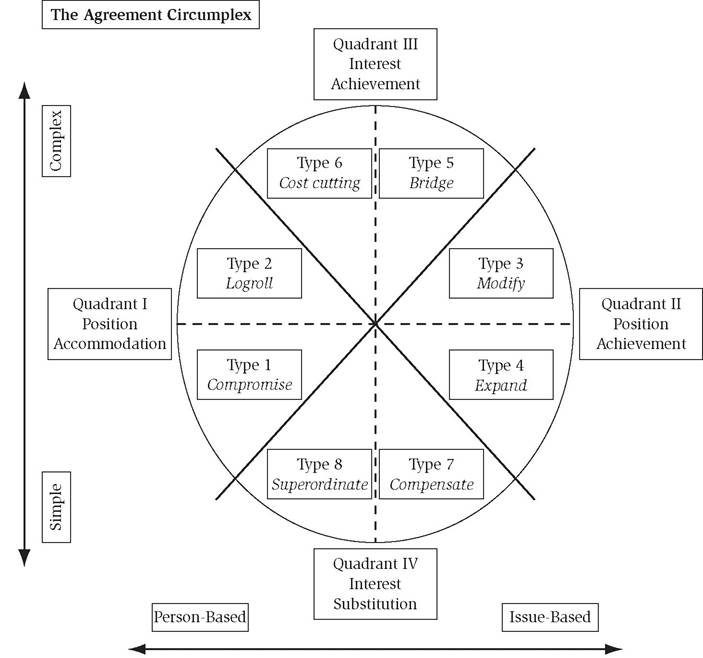
Figure 19.1 The Agreement Circumplex.
Source: Author.
The schema proposes that agreements can be categorized as one or another of four main types (each with two subtypes). The key distinction in the schema is that between the parties’ positions and the parties’ underlying interests. The four main agreement types, related to each other as the four quadrants of a circumplex structure, are identified by the main goal that each entails. In a following section, I describe in greater detail the types of products in the Agreement Circumplex.
I: Accommodate the Parties' Positions. There are two forms of position accommodation wherein the parties’ initial demands on the issues are accommodated: simple compromise and logrolling. Compromise is meeting halfway on the issues, and logrolling is giving up one issue in exchange for getting what one wants on another more important issue.
II: Achieve the Parties' Positions. In position achievement each party gets exactly what is stated in its initial demand. For example, in a dispute over a resource, if the resource is doubled, the parties each get exactly what they want, that is, their initial demands are met. There are two forms, one driven by an increase in the resource and the other driven by modifying the resource so that it now fits what the parties want.
III: Achieve the Parties' Underlying Interests. Interest achievement has two forms, bridging and cost cutting. In both cases, the parties’ underlying interests are met. In the former, a novel alternative arises, whereas in the latter, one (or both) parties’ reasons for resistance are met and overcome. Often, some exploration of underlying interests is required; indeed, an analysis of interests that underlie interests may not be sufficient (Pruitt and Kim, 2004): “it will often be necessary to seek the interests underlying these interests, or the interests underlying the interests underlying these interests, and so on” (p. 199). Often there is a hierarchy of interests. For example, in a dispute between a father and son over whether the son can buy a motorcycle, the son wants the motorcycle because he has an underlying interest of wanting to impress the girl next door. The father’s interest in not wanting his son to have a motorcycle is that he does not want to hear the noise. It may be that, at a deeper level, the boy’s interest is self-esteem or other identity-related concern (compare Rothman, 1997); certainly the father has no problem with his son having high self-esteem. Perhaps this self-esteem can be achieved via another means, for example, golf lessons for the son so that winning a golf trophy can impress the neighbor. The point is differences often take on a new character, and the appearance of opposition can diminish at a deeper level of interest. (See Fisher, Ury, and Patton, 1991, p. 74.)
IV: Substitute the Parties' Underlying Interests. There are two forms of interest substitution, often bilateral as in superordination, or unilateral as in compensation. In the case of compensation, the one party who is indemnified for acceding to the other's demand has its interest replaced by the interest manifest in the compensation. In the case of superordination, this happens with both sides—both give up their initial interests in favor of that which is gained in the superordination, and the form of the superordination does not need to be the same for each side. However, disputants often make vicarious comparisons of what is gained by compensation, especially if it comes from a mediator. (See Carnevale, 1986, 2002.)
Person-Based Versus Issue-Based. At the left side of the circumplex, logrolling and compromise entail fitting the parties to the issues under discussion; that is, they involve an element of one side moving toward the other side, simply giving in, either on each issue or with some sense of the priorities among the issues. The term person-based refers to the focus on fitting the persons to the issues and this is done via concessions or issue trades. The change that leads to agreement stems from the person modifying her position on the issues in the conflict.
At the right side of the circumplex, modify and expand entail fitting the issues under discussion, or the resources, to the parties; that is, an element of search for additional resources or investigation into the nature of the issue is required. The term issue-based refers to the focus on fitting the resources or issues to the persons. The change that leads to agreement stems from a change in the issue or resource under discussion. Bridging, cost cutting, superordination, and compensation have elements of both person and issue bases.
Simple Versus Complex. What are the information requirements for that particular type of agreement to occur? Either they are simple, meaning not much, or complex, meaning that the information requirements are extensive. Simple agreements do not require a close look at the concerns that underlie the parties' positions, concerns that may involve goals, values, principles, or needs. Complex agreements do. Bridging, cost cutting, logrolling, and modifying the resource, in particular, may require extensive conceptual work, skill, expertise, learning about what the parties want or do not want, and bringing this information into the set of agreement alternatives. The parties may be able to do this on their own; often they need the help of a third party. For a logrolling solution, information about the parties' priorities is useful so that one can trade a concession on one issue for concession on a lower-priority issue. Often it is difficult to get such information, particularly when trust is low. In a solution via cost cutting, information about the costs or reservations felt is useful, and it may take some doing to uncover this. Bridging often needs a deep understanding of both parties' underlying interests.
This is not to imply that compromise, or searching for more of a resource, or compensation, or superordination can occur without some thought. To the contrary, knowing when to compromise is often a delicate skill that if not handled well may cause the other to expect even more (compare Hilty and Carnevale, 1993). Knowing what a person values is key for any compensation scheme. And superordination requires an understanding of the parties’ values and interests apart from the extant set of differences defined in the issues. The information requirements for expanding the pie are small in the sense that all one needs to know is what the other demands. Of course, even here some information is needed; certainly one needs to know what is available in the environment. But the point is these outcomes, which reside more at the surface of interests and positions, are shallow and are more simply achieved than outcomes that reflect hidden interests, needs, values, and desires, which lurk at depths often hidden well below the extant positions.
Complexity in negotiation can be managed via a mental operation called unlinking (Pruitt, 1981; Pruitt and Carnevale, 1993). Sometimes, differences of interest are a bundle of connected demands, goals, aspirations, and values that are seen as inseparable from other demands, goals, aspirations, and values; it looks like there is just one issue. Unlinking entails breaking the bundle into smaller parts. Hopmann (1996) calls this “disaggregation” and Fisher (1964) calls this process “fractionation.” Lax and Sebenius (1986, p. 108) refer to it as a process of converting “one issue into more than one.” Through unlinking, the smaller parts might then be realigned, or prioritized, and form the basis of tradeoffs, or a new alternative might emerge, as seen in the following examples.
The Types of Products in the Agreement Circumplex
1. Compromise. A compromise is defined as a middle ground on an obvious dimension connecting the parties’ initial offers (Pruitt and Carnevale, 1993, p. 16). A compromise is largely viewed as a nonintegrative, noncreative form of agreement, not novel, not interesting, and not all that valuable (but likely valuable as an agreement when none other is available and when agreement is better than no agreement). Compromise serves as a useful baseline to which to judge more integrative options; thus, it will be useful to include compromise in an organizing framework.
2. Logrolling: Trading High- and Low-Value Issues. When a conflict involves differences across a set of issues, and the issues differ in their relative importance to the parties, the difference can be traded for one another. This is possible especially if one of the issues is more important than another issue for one party, and the other side has the opposite preference ordering on the issues; thus, as a set, the differences on the issues are complementary. In the trade, each side gets what it wants on its high-priority issue and gives in to the other on its low-priority issue; this gives greater value in the agreement to each side individually—and to them collectively—than each getting something in the middle on the issues or making no deal at all. Lax and Sebenius (1986) describe this as “the trading of differences.” Suppose Carsten has an apple and a pear, and really loves pears but is just okay on apples. And Esther also has an apple and a pear, and really loves apples but is just okay on pears. Each is better off, and they are better off together, if they exchange a whole apple for a whole pear. The compromise solution, “50/50,” the middle ground would be an exchange of half an apple for half a pear.
3. Modify the Resource Pie. When a conflict is about how a resource is shared or divided, one solution is to figure out a way to modify the resource so that both parties can achieve their objectives. There is a reconfiguration of the existing resource. Follett (1940) gives an example: “A Dairyman’s Co-operative League almost went to pieces last year on the question of precedence in unloading cans at a creamery platform. The men who came down the hill (the creamery was on a down grade) thought they should have precedence; the men who came up the hill thought they should unload first. The thinking of both sides in the controversy was thus confined within the walls of these two possibilities, and this prevented their even trying to find a way of settling the dispute which would avoid these two alternatives. The solution was obviously to change the position of the platform so that both up-hillers and down-hillers could unload at the same time” (pp. 32-33). In this case, it took an element of ingenuity to figure out how the resource, the platform, could be modified so that both sides could have what they wanted.
4. Expand the Resource Pie. When a conflict is about how a resource is shared or divided, a simple but powerful solution is to simply increase the amount of the resource. The resource may be about money, space, time, an object, or any resource. Two units of an organization vie over a limited budget, or two managers both want the nicer corner office, husband and wife have a week of vacation but one prefers going to the beach and the other to the mountains, siblings quarrel over who will inherit the nice antique chair. It is essentially a supply problem, with the supply exceeding the demand. An integrative solution is achieved by simply increasing the resource—get a larger budget, find a second nice office, get two weeks vacation, find a second chair. Each side achieves exactly what it wanted.
Sometimes the increase in the resource, or the idea for modifying the resource, comes from a third party (the “integrator consultant” from Follett, 1940; or the “3-D move” from Lax and Sebenius, 2002). Imagine if the Dairyman’s Co-operative League decided to double the size of the unloading platform. In this case, the supply of the resource (the platform) expands to provide enough for both parties to be satisfied. Each gets what it wants from an influx of resources. Consider the story told by a student: “My sister bought this adorable shirt that I always borrowed without asking; we often get into conflict over ‘sharing’ clothes (I usually just take hers). To solve this situation, my mother intervened and bought me the exact same shirt that my sister had, so that instead of us arguing over the single shirt, we each had our own.”
Modifying the resource pie—or expanding it—can succeed when the difference of interest is about an opportunity cost—the up-hillers were not able to unload when the down-hillers unloaded and vice versa. Increasing the resource or modifying it is not workable if what one side wants will make the other suffer; for example, if one sister could not stand seeing the other sister wear that style shirt, getting another shirt is pointless. In this case, the problem is not a shortage of shirts.
5. Bridge the Interests. Perhaps the most creative form of integrative agreement is that referred to as bridging. In bridging, a new alternative is devised that gives the parties what they want in terms of the interests that underlie their positions. A husband and wife had a one-week vacation, but one wanted to go to the mountains and the other wanted to go to the beach. They talked about the reasons for their preferences, and they learned that that one wanted to do freshwater fishing, and the other wanted to play volleyball in the sand. With a search for new alternatives, they discovered a resort that had both freshwater fishing and sand volleyball. Each gave up their initial demand and became enthusiastic about the new option that gave them both what they really wanted. The interesting feature of the agreement was not that each side gave in, or that they made a trade on low- and high-priority issues, or one side was compensated or had its costs cut, but rather a new alternative emerged, via discussion and exchange of information about underlying interests, and these interests were completely met.
A search model (Simon, 1957) guides the discussion and discovery process. Sometimes a distinction is made between low- and high-priority interests, with the higher getting the weight of the attention in the search (Pruitt, 1981). The important dimension that distinguishes bridging is the focus on the underlying interests or reasons, or concerns, or values that generate demands and positions. If those can be met, the demands and positions are satisfied.
There are several types of bridging formulae, including alternation (Pruitt, 1981). In alternation, the parties take turns, which is especially useful when there is a time constraint. (With only one week of vacation, two people cannot do what they both want—go to the beach as well as go to the mountains—so this year they go to the beach and then next year they will go to the mountains.) Another bridging formula is the contingent agreement, which entails building unknown futures into the agreement, which is especially useful if the parties differ in their expectations about the future. For example, one person thinks that the weather is going to be great at the beach, but the other thinks it will be horrible; so, they build weather in as a contingency, that is, if the weather is good, they go to the beach, but if the weather is bad they head for the mountains.
Lax and Sebenius (2002) give several interesting examples of contingent agreements including the earnout, in which a buyer and seller of a company structure the agreement to reflect their different appraisals of future earnings or risk. The more optimistic party gets a future payment contingent on the future income; the less optimistic party is happy with the arrangement because he thinks that the future income will not be so much. “Without the earnout, an otherwise mutually beneficial deal may well languish” (p. 17).
6. Cut the Costs. If one party is resistant to agreement because what the other proposes has costs, and these costs can be identified and reduced, then agreement is likely. The agreement is integrative not due to a change in position or trade-off on issues, but because one party does not suffer so much. Cost cutting is a form of compensation, but it is specific in the sense that the compensation addresses the exact value that formed the basis of resistance. An example was provided by a student: “I had the habit of staying up really late at night to finish assignments for class, and eventually finish my work at around 3 a.m.; but my roommate would go to sleep much earlier than that. I tried very hard to keep the light from my desk shining near my roommate’s bed, but unfortunately she had difficulty sleeping at night and she asked me not to stay up so late. I felt bad for keeping her awake... I went out and bought her an eye mask so that the light wouldn’t disturb her as she tried to sleep. She thanked me, used the mask, and was able to sleep through the night while I was still able to continue burning the proverbial midnight oil!”
In their discussion of “dealcrafting,” Lax and Sebenius (2002) give an interesting example of joint cost cutting: two manufacturing companies, in a jointventure deal, pooled their resources so that each had lower costs; as a result, they made greater profit—individually and together—than they would without such a deal. In Pruitt’s words, joint cost cutting is “reducing the cost to both parties of baking a pie of fixed size.” Sometimes the costs are cut by the parties themselves, and sometimes by third parties. Sometimes the costs are associated with precedents and future implications, in which case those precedents can be decoupled (Pruitt, 1981).
7. Compensation (Nonspecific). With nonspecific compensation, one side goes along with what the other wants and does so because it receives something of value. What it receives is outside the extant issues and thus “nonspecific” to the matter at hand. For example, the sister who wants to wear the other’s shirt offers to do all the other’s house chores for a day, and the shirt- wealthy sister agrees; she finds that the compensation overcomes her resistance to loaning out her shirt. Often what one party receives is itself subject to negotiation about what is appropriate compensation. Foa (1971) developed a theory of resources about how suitable one resource is for exchange with another (for example, money, love); the theory posits that resources that are closer to one another conceptually (for example, how tangible they are, such as money and goods versus money and love) are more likely to be exchanged. In any compensation scheme, it is very useful to know what the other values, as well as a way to calibrate appropriate amounts of compensation.
Logrolling can be seen as a form of nonspecific compensation, where one side’s concession on its low-priority issue is compensation for the other side’s concession on the other’s low-priority issue; in this case, the parties stay within the set of issues rather than reach out for new issues or dimensions of value.
8. Superordination. Sometimes agreement is reached when the differences in interest that gave rise to the conflict are superseded or replaced by other interests. The use of compensation, as described, is a form of this but usually applied to just one party to a conflict; the compensated party gives up its resistance because the interest served by the compensation replaces the initial interest that drove its resistance to the other’s demand.
In superordination, both parties drop their initial interests and positions in light of changed circumstances or goals, a revised view of the conflict, or an enticing new opportunity. Consider two children quarreling over a TV show to watch; but then they hear the ice cream truck go by, and they both have a new interest in ice cream that replaces their interest in the TV, and the quarrel about the TV ends. Sometimes a third party affects the change in interest, as when a parent offers the quarreling children a trip to McDonald’s®. Or the couple trying to decide on the location of a vacation-mountain or beach—decides instead to not take a vacation but instead use the week for buying new furniture and redecorating their house. In these cases, new matters arise that replace or supersede the interests that gave rise to the initial differences. Sometimes the added costs in a “hurting stalemate” redirect the parties’ interests away from that which drove their initial positions (Zartman, 2001).
Agreement by superordination has a parallel in the effect discovered by Sherif and Sherif (1969) in their famous field studies of intergroup conflict. Using a summer camp for boys, they created the conditions for groups to compete with one another and saw the competition escalate to overt hostility. They discovered that the escalation reversed when the children had a superordinate goal, that is, they had a common objective that required them to work together cooperatively. One such goal was created when a camp water tower ostensibly collapsed, and the groups of boys, who were thirsty, needed to work together to get it fixed. As a result, the conflict between the groups lessened and the relationships between boys across the groups improved. Considerable evidence points to the multiple effects of superordinate goals; for example, they can help bonds form between people across groups. But an important effect is that the superordinate interests overshadow or supplant the initial interests that led the groups to fight in the first place.
Perhaps the most powerful form of superordinate interest is working together to fend off a common enemy. Third parties often know this and use this in the effort to foster cooperation, as Kissinger mentioned to Israeli and Egyptian leaders that a real threat in the Middle East was intervention by the Soviet Union (Rubin, 1981). Another form of superordination is the common enticing opportunity: the possibility of a higher standard of living, better hospitals, cleaner water, access to international capital for better roads, and so on might supplant some of the concerns that gave rise to the initial differences in a conflict. The new matters become so important that they eclipse the original matters, and the result is cooperation and agreement because people make gains on other, important dimensions of value.
Creative Products from Creative Persons in a Creative Process
Much of the behavioral research in social conflict and negotiation is about delineating the relationship between characteristics of the people involved, the processes that occur, and the outcome (the products) (compare Simonton, 2003, p. 490; 2004). Social psychologists who study negotiation and social conflict tend to emphasize how people interact in and are affected by context and environmental constraints, for example, negotiating as a group or alone or negotiating under high time pressure. (See chapters by Deutsch, Coleman, Pruitt, Dweck, Krauss, Thompson, and others, all in this volume.) Much of this work is designed to understand the conditions or circumstances that either (a) move people from the pursuit of destructive aims in conflict, from contentious, win-lose pursuit of asymmetric outcomes, to problem-solving processes and balanced agreement, or (b) move people from pursuit of simple compromise agreements to the more creative, integrative forms of agreement. But there is a third set of questions, not at all well-addressed in the empirical literature, and this is about the conditions or circumstances that move people to pursue one form of integrative agreement over another. This is a matter of predicting the type of integrative agreement that will emerge, given that one will emerge in the first place.
Flexible Thinking and Idea Generation. One set of processes that is likely to encourage the more information-rich, complex forms of integrative agreement is related to the notion of flexible thinking. Lewin (1951) wrote that conflict can produce a “freezing” of cognition, and subsequent evidence supports this. For example, Carnevale and Probst (1998) had people expect to enter a cooperative or contentious negotiation; just before doing this, they evaluated material that assessed cognitive organization, for example, a “functional fixedness” task and a task that had them rate category exemplars. The fixedness task required, for a creative solution, that people separate two concepts normally fixed, for example, the concept “box of tacks” is separated so that the box can be used as a platform to hold a candle, which solves the task. People who expected contentious conflict were less likely to “unfix” the concepts and less likely to see creative solutions. In the category exemplars task, people rated the goodness of items such as “camel” as examples of the category “vehicle.” People who expected contentiousness rather than cooperative negotiation were less likely to see a camel as an example of the vehicle category. Both effects suggest that expected contentiousness can produce a narrowing of vision and a general change in cognition that extends beyond that associated with the particular items.
Of course, as mentioned earlier, conflict can, under other conditions, enhance creativity (compare Beersma and De Dreu, 2005; De Dreu and Nijstad, 2005), and this suggests that the trick is to manage the process so that positive effects emerge. One way of generating creative alternatives in conflict might stem from “brainstorming” (Osborn, 1957), particularly if assisted by a third-party mediator. A mediator may be able to foster conditions in which people feel comfortable listening to one another and do this in an “active” way (Kressel, this volume; Pruitt and Carnevale, 1993). Sometimes a third party can help uncover information, especially in private meetings with one side, the caucus. The caucus is an effective third-party vehicle for uncovering the parties’ concerns, and there is evidence that problem-solving discussions start in the caucus and then migrate to joint sessions (Welton, Pruitt, and McGillicuddy, 1988). Caucuses may help attenuate biases and assumptions, for example, the assumption that interests are completely opposed, an assumption that so many studies have shown can interfere with the development of integrative agreements (for example, Pruitt and Lewis, 1975).
The Mix. Another set of processes likely to encourage the more informationrich forms of integrative agreement is the mixture of people and strategies on each side of the negotiation table. A good deal of work now points to the notion that mixtures of strategies and mixtures of types of people can be especially effective in negotiation. For example, groups tend to be more contentious in negotiation, more likely to hold onto aspirations, and yet be better at problem solving (Morgan and Tindale, 2002). Moreover, a mixture of hawks and doves on one side is more likely to produce an integrative agreement in between-group negotiation (Jacobson, 1981). A similar effect is seen in the “good-cop/bad-cop” strategy (Hilty and Carnevale, 1993): the tougher partner (the “bad-cop” or the “hawk”) conveys an image of firmness that cannot be exploited, whereas the more cooperative partner (the “good-cop” or the “dove”) conveys an impression that cooperation will succeed, that agreement can be reached. The mix is more effective than either is alone.
But the mix is not always sanguine: sometimes dissention on a negotiation team is an impediment to effective between-group negotiation. Consider the comment made by former Middle East envoy Dennis Ross, on Palestinian leader Yasser Arafat at Camp David in July 2000: “What’s more, in the completely closed environment of Camp David, he did nothing to control the fratricidal competition in his delegation, effectively giving license to those who were attacking other members who were trying to find ways to bridge the differences” (Ross, 2001). It seems reasonable to suppose that people who try to bridge differences between groups will need leadership support and should as well be protected from the “spoilers” who have a less cooperative agenda. Carnevale (2005) argued that mediators should work to foster within-group cooperation, solving problems within each side, in the effort to facilitate between-group negotiation.
An interesting perspective on the mixture of group process is found in Cronin, Argote, and Kotovsky’s (2002) analysis of partitioning cognition in group problem solving. These authors found that groups were better—had more insight and better insight—when they divided roles among the group members so that one person in the group focused on the design of a problem solution and the others in the group focused on implementing the design. Such partitioning has quite a history in the study of group creativity (March, 1991). The Cronin et al. paper, as well as others in the group creativity area, suggests that the literature in negotiation and social conflict and in group creativity have considerable points of contact and considerable potential for integration.
Locations for Creativity. Coleman and Deutsch (Chapter 18, this volume) note that time and space are essential elements of creative problem solving, that people need sufficient time to open up and be creative, as well as a physical space: “A new environment (particularly a confidential one) can allow disputants some degree of freedom to try out new perspectives, behaviors, or ways of working with a problem” (p. 408). The right environment can provide the opportunity for incubation and play. Creativity scholars suggest that incubation is especially helpful for insight problems such as integrative agreements (Simonton, 2003, p. 486). It may be helpful for negotiators to “take a break” and let ideas incubate. If “play becomes the midwife of creative change,” then the problem becomes how to implement play in the heat of conflict. Again, one mechanism for this is the use of the caucus, with a third party holding a private meeting with one side of the dispute.
Seeing the Other's Point of View. The ability to take the point of view of the other is an important element of the collaborative, creative enterprise, and this is seen clearly in the clever experiments developed by Gruber (1990; Chapter 17, this volume). Sometimes, however, the point of view of the other is a detriment: in some cases, too much information about the other can interfere with agreement, particularly when that information underscores large value differences (Rubin, 1980).
Cooperative and Creative. There is evidence that some people are more likely to be creative in conflict than others. Pruitt and Lewis (1975, Experiment 2), found that asking and giving truthful information about the issues were positively related to integrativeness of the agreements but only for negotiators who were high in cognitive complexity (which reflects an individual’s consideration of alternative conceptions of situations and better use of information for decisions). It was interesting that the overall levels of information exchange did not differ between high- and low-complexity negotiators, suggesting that the high-complexity negotiators had a lower threshold for information, that is, they were able to understand more with less. De Dreu and Carnevale (2003) argue that persons who have epistemic motives—a desire to better understand the world—will be especially adept at avoiding biases and being creative in negotiation.