Spatialization of Childhood
The spatialized approach to child protection should be understood in part as the extension of practice commonplace in the humanitarian field more generally. As such, it is motivated by similar considerations as evident in encampment discussed above: considerations that include the institutional needs of implementing organizations, the political agendas of host nations and donors, and the imposition of certain (usually Western-originating) norms upon disparate (usually non-Western) populations.
In addition, there are ideas and practices relating to children within EuroAmerican societies that prompt the use of enclosed space for the protection of young people living in settings of political violence and natural disaster. The separation and enclosure of childhood itself from the larger “adult world” has been a defining characteristic of many such societies since at least the late nineteenth century, becoming ever more evident in the decades since. Thus, current spatialized child protection efforts need also to be understood in relation to this recent history within the settings from which contemporary humanitarianism emerged.
The proposition that childhood should be conducted away from the contaminating effects of the “adult world” is particular to a tradition of European thought that finds its genesis in the Romanticism of Jean Jacques Rousseau (1762). However, it was not until the late nineteenth and early twentieth century that such separation became a social reality among the masses. On one hand, children were withdrawn from industrial work, partly due to moral concern but also as a result of various material factors (Zelizer 1985). On the other hand, the establishment of mass, compulsory schooling was driven by a mixture of motives that included the wish to curtail delinquency among unemployed young people from the “dangerous classes,” the surveillance needs of the state, and an aspiration to give children a “proper” childhood (Hendrick 1997, p.
46). A key feature of such a childhood was its separation from “adult life”:Childhood and adulthood...became almost opposites of one another. If adults were burdened with responsibilities, children should be carefree. If adults worked, children should not work. If adults had to live in towns, children were entitled to contact with nature. (Cunningham 1995, p. 160)
During the twentieth century, particularly in the latter decades, the separation of children from adults and their enclosure within “appropriate” spaces increased considerably. Sociologists have drawn attention to the “islanding of children” within many Euro-American societies, whereby “children have been systematically excluded from the former mainlands of urban and suburban existence, especially the streets and other public spaces” (Gillis 2008, p. 316). The reasons proffered for the increasing containment of children within designated spaces are complex, relating in the view of some to the conditions of postmodernity and a sense of rootlessness among adults (Jenks 1994). The spate of moral panics witnessed in recent years and the emergence of discourse around “stranger danger” are also implicated in such enclosure (Valentine 1996, 2004). Ignoring both the lack of evidence that children are at any greater risk than in previous times as well as the proof that they are most likely to experience harm within the home, such “islanding” continues.
The regulation of young people’s access to public space is also motivated by the converse concern: that they may be a source of risk to others (Valentine 1996, 2004). As we shall see, this concern has considerable salience in the context of the occupied Palestinian territories, notably for the Israeli authorities who invariably treat young Palestinians on the street as a security threat. The system of curfews, checkpoints, and permits introduced by the government of Israel to manage the movement of Palestinian civilians living under occupation has specific consequences for children in their quest for leisure opportunities, education, and family interaction.
In the late 1970s, social psychologist Bronfenbrenner suggested a model of child development that captured the spatialized thinking around childhood extant at that time and increasingly since (1979). This “ecological model” depicts the child at the center of a series of concentric circles each of which represents a level of social interaction at an increasing distance: from “family,” at the most immediate level, to “state” and other macro level duty bearers at the outer circles (Fig. 1). Since the early 1980s this model has been used for diverse purposes that include child participation and child protection. In respect of the latter, a key task for each of the identified duty bearers is to secure the space implied by the gaps between the lines through removing the threats to children.
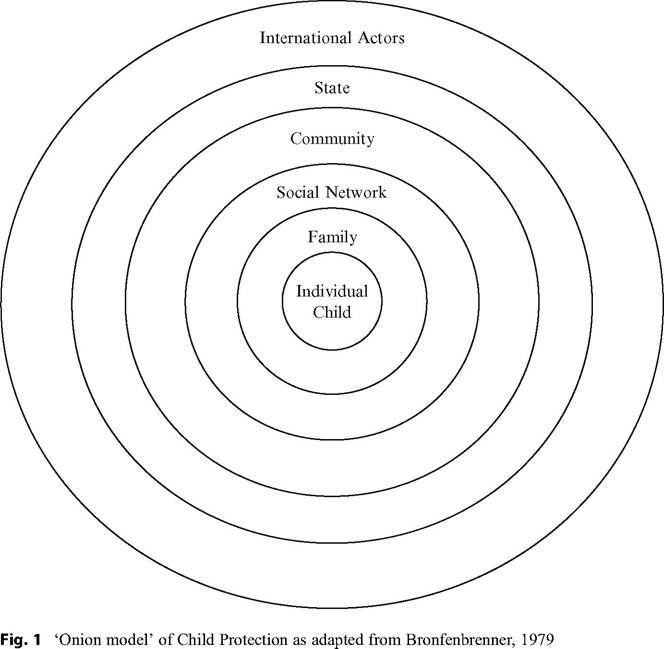
The ubiquity of Bronfenbrenner's model not only reflects existing assumptions but has also served to naturalize further the spatialized thinking around child protection. The influence of this model can be seen in the notion of “protective environment” employed, often implicitly, within social work practice in Western Europe and North America (e.g., Jack and Gill 2010). The significant role of social work expertise in the development of child protection in emergency settings has been an important means by which the model of Bronfenbrenner has become central to ways of thinking in this field. Permutations of the basic figure appear in numerous handbooks and presentations seeking to guide current practice (e.g., Ager 2011). According to the model, family and community constitute the primary duty bearers, securing an immediate locale within which protection is best achieved. A major focus of humanitarian organizations is to strengthen the protective functioning of these duty bearers through interventions that typically include psychosocial work, family reunification, and creating referral networks to alert duty bearers at outer levels when problems occur within the family or community. As shall be seen, in the oPt the basic topography of this model is brought into question. However, before turning to consideration of the protection of Palestinian children, the spatialization of child protection practice in humanitarian efforts generally needs to be considered.
4
More on the topic Spatialization of Childhood:
- Spatialization of Childhood
- Spatialization of Child Protection in Emergencies
- Spatialization of Child Protection in the oPt
- Contents
- Conclusion
- Harker C., Horschelmann K. (Eds.). Conflict, Violence and Peace. Springer,2017. — 456 p., 2017