THEORIES OF AGGRESSION AND VIOLENCE: FROM DISPOSITION TO CONTEXT
While aggression does not inevitably lead to violence and violence can occur without aggression (such as in natural disasters) the terms are closely related. In popular usage, aggression can be confused with assertion—the bold, energetic pursuit of one’s goals.
The psychological definition of aggression makes clear that it is negative behavior: “any form of behavior directed toward the goal of harming or injuring another living being who is motivated to avoid such treatment” (Baron, 1977, p. 7). A public health definition of aggression as selfdirected violence, interpersonal violence, or collective violence is broader in scope and describes aggression’s biological, social, cultural, and political roots and its enactment (World Health Organization, 2002).Aggression and violence occur at every societal level. In individuals, they can occur as suicide and self-mutilation; in interpersonal relationships, as rape and deliberately passing on infectious disease; within and between families, communities, regions, ethnic groups, and nations as struggles for political control and liberation. Envisioning these societal levels as points along a linear dimension of increasing size and social complexity does not fully capture the strong influence that large social levels (for example, ethnic, national, or religious communities) exert on such smaller levels. Like handcrafted, wooden Russian matryoshka dolls, smaller units—individuals, families, or communities—are nested within larger communities that are themselves nested within regions and nations. This nested model (see Figure 23.1) captures how culture, expectancies, and socially shared understandings from one level infuse and influence others. Individual aggression is more likely when one’s peer group, family, community, or society encourages or expects it. Although the influence among levels is bidirectional, an individual is usually less able to influence the cultural norms of larger social groups, such as her society, than vice versa.
The nested model depicts contextual influences on aggressive and violent behavior, but it is highly simplified. Some levels are “thicker” and more influential than “thinner,” less influential levels. In addition, multiple sources of influence contribute to aggression and violence.1 Individuals are nested in families as well as other close groups, such as friends and teams. Each context influences beliefs, attitudes, and behavior. These various influences may be congruent or discrepant. As the next section describes, aggression also results from internal as well as social influences.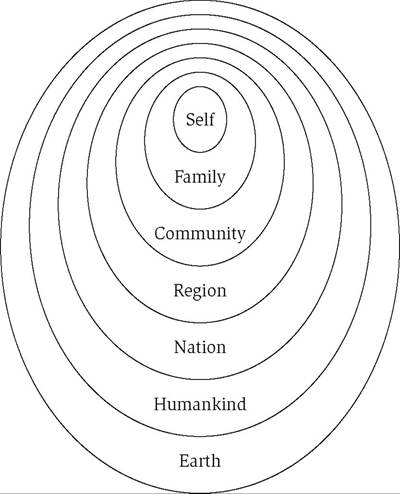
Figure 23.1. Nested Societal Levels.
Evolution, Sociobiology, and Physiology
Evolutionary theories describe the emergence of aggression and violence in conditions that protohumans may have faced. Informed by studies of animals and human groups in pre-industrial societies, these approaches describe aggression and violence as an adaptive, hardwired, physiological predisposition that has evolved over millennia (compare Waller, 2002).
Sociobiological research examines aggressive behavior among insects, fish, birds and, from these observations, extrapolates the meaning of aggression for humans. For animals, aggressive behavior is pragmatic: to obtain food, acquire or maintain leadership, or protect young or the flock. Intraspecific aggression benefits a species when it disperses members and promotes survival during catastrophes or periods of resource scarcity that kill off species members in one locale. But once adaptive behaviors do not invariably remain useful. Even if aggression and violence were adaptive for humans at one time, they may not remain so and should not be viewed as an inevitable product of our evolutionary ancestry (Eibl-Eibesfeldt, 1974).
Among humans, the physiological predisposition to aggress can be aroused by adverse environmental circumstances. In Shakespeare’s (1595) Romeo and Juliet, Benvolio warns Mercutio that on “these hot days, is the mad blood stirring” (Act 3, Scene 1).
Research concurs. Interpersonal and mob violence increase in adverse environmental conditions when hot spells, extremely low temperatures, foul odors, excessive noise, or crowding make life unpleasant. Alcohol and drugs also provoke aggression and are implicated in domestic abuse, vehicular death, and more than half of reported homicides. Adverse environmental conditions, alcohol, and drugs do not inevitably result in violence but they do reduce self-restraint. Reduced restraint along with frustration, misperception, and poor communication can lead to violence. Though there is little doubt that people have inherited the potential for aggression, they have also inherited the potential for altruism, cooperation, and, most important, the potential for thoughtful problem solving for choosing behaviors suitable for attaining desired goals.Deviance
The predisposition for aggressive behavior is associated with a number of abnormal physiological conditions including neurological deficits, abnormal neurotransmitter levels (for example, serotonin and monoamine oxidase [MAO]), hormonal imbalance, birth trauma, brain tumors, exposure to such toxic substances as lead, and various medical disorders. Compared with nonviolent offenders, criminally violent individuals are more likely to have experienced significant head injuries and exhibit neurological impairment. Physiological deviance can cause aggressive behavior, but aggression can also cause physiological deviance. High levels of the male hormone, testosterone, can be a consequence as well as a cause of domineering behavior (American Psychological Association, 1996).
Psychological deviance, such as schizophrenia and antisocial personality disorder, are sometimes associated with violent behavior. Antisocial personality disorder describes individuals who lack guilt and are grossly selfish, callous, irresponsible, and impulsive—characteristics that can lead to destructive conflict and violence. Some kinds of violence, such as rampage killings, gain wide media coverage although they account for only 0.001 percent of all killings.
One hundred cases of rampage violence from 1949 to 1999 examined by the New York Times indicate that popular, simplistic explanations (that is, the killer was a disgruntled employee) fail to capture the serious mental health problems associated with this type of killing (Fessenden, 2000). The tragedy of rampage killings is that perpetrators often give ample and specific warnings about their desperate mental state and their murderous intentions beforehand but these warnings go unheeded. Preventative social services and responsive civic services could have prevented some of these rampages.People with mental illness can be stereotyped as violent, but they are no more likely to be violent than people in the general population. Some people with mental illness behave violently toward themselves and others when they are off medications or when they abuse drugs or alcohol (like people in the general population), but most do not. And like people in the general population, people with mental illness are sensitive to situational factors that constrain aggressive and violent behavior.
In spite of common stereotypes and fears, deviance does not account for most violence. Many people without physiological or psychological disorders behave violently, as exemplified by Holocaust bureaucrats and slave owners. In their society they were considered normal and were highly regarded because of their loyalty to their family, group, or cause. As the section on morals will discuss, this sense of responsibility and loyalty can itself inspire violence.
Disposition and Context
Disposition (also called personality or temperament) influences how an individual perceives and responds to conflict. Some people are unflappable; others are easily irritated. Although a hostile environment might provoke aggressive responses in anyone, people labeled “aggressive” see hostility in ambiguous circumstances, tend to react offensively to minimal provocation, and initiate overt aggression.
The media describes teens who perpetrate multiple murders, such as the 1999 Columbine High School massacre, as harboring pent-up grudges and being explosively angry and at the “point of no return” (Egan, 1998, p.
22). While these descriptions are plausible, they rely on disposition and understate the contribution of context. Attention to social context emphasizes the availability of semiautomatic weapons; an adult culture that ignores or is insensitive to adolescent needs and warning signs; a pop culture of violent rap lyrics, video games, television, and Internet sites (Huesmann, 1986); and a culture in which violence is an easy, attractive, and acceptable option for resolving conflict (Fainaru, 1998; Mifflin, 1999). Clearly, both disposition and context are important. Troubled youths with easy access to weapons, lax supervision, and a violent culture can be a lethal combination.Dispositional explanations for aggression are not limited to individuals. In intergroup, institutional, interregional, and international conflict, dispositional explanations simplify conflict by depicting an opposing group’s culture as malevolent. This allows conflict participants and bystanders to view an entire political or ethnic group, or even an entire country, as dangerous, unprincipled, or evil.
Dispositional explanations for violence can also focus on individuals and societies. The Third Reich’s policy of genocide was partially the result of Adolf Hitler’s pathological but effective mix of demagogy, charisma, and anti-Semitism and, at the state level, the Third Reich’s elitist, racist, and homophobic ideology. The Third Reich was also effective because it was supported by many ordinary individuals, groups, and institutions. Psychologically, it is easier to view political leaders or parties as causal agents rather than to see the more complex and larger context with its prevailing and anticipated economic conditions; political institutions; available and scarce resources; conflict resolution practices; laws and legal procedures; and the degree to which the society is open or closed to new groups, traditions, and ideas. This complex understanding of aggression and violence implicates ordinary people who are harder to label as dispo- sitionally evil.
Motivation
Motivational theories describe aggression as resulting from blocked human needs. Biological needs for food, water, and shelter are basic and must be met before higher needs can be satisfied for social attachment, self-esteem, creativity, understanding, self-actualization, and spiritual transcendence (Maslow, 1970). Basic needs are inborn, but family and cultural values shape how they are expressed and met. Though frustrated needs can result in competition, anger, and aggression, frustration also motivates constructive behavior. Frustrated biological or safety needs can mobilize war or community cooperation, and frustrated love needs can prompt self-destructive behavior and stalking or inspire other creative energies. Motivation theory focuses on an individual’s needs, but social groups (for example, families, communities, states) also have basic needs for environmental resources (for example, land or clean water), security, and positive identity. These needs are at the heart of many protracted deadly intranational and international conflicts.
Frustration and Arousal
In 1939, a group of psychologists sparked controversy when they asserted that frustration causes aggression (Dollard and others, 1939). Building on earlier psychoanalytic ideas, they defined frustration as a state that emerges when circumstances interfere with a goal response. Their work spurred considerable research examining the relationship between frustration and aggression. This research found that frustration activates the readiness to aggress, but it does not inevitably result in aggression; frustration can also generate constructive problem solving. Nor does aggression always result from frustration. It also results from competition, greed, and fear. A number of factors, including negative and positive feelings, past events, understandings about the situation (that is, what is happening, who is to blame), and displaced hostility, mediate the effect of frustration on aggression (Berkowitz, 1993).
Context, too, matters. Guns, knives, or axes, have destructive potential in their own right and can be powerful contextual cues that spark violence. As Leonard Berkowitz (1968) quipped, “The finger pulls the trigger, but the trigger may also be pulling the finger” (p. 22). Frustration and arousal can lead to relative deprivation (Crosby, 1982), the sense of injustice that emerges when individuals or groups compare their lot with others. When these comparisons reveal that one’s own group is disadvantaged compared with similar groups, they can result in shared frustrations and the conviction that fairness has been violated. This can precipitate political unrest and violence (Gurr, 1970).
Gender
Both women and men experience intimate violence. In the United States, nearly
5.3 million women ages eighteen and older experience intimate personal violent assaults each year, and 3.2 million men experience such assaults. Many consist of pushing, grabbing, shoving, slapping, and hitting, but approximately
1.3 million women and 835,000 men are physically assaulted by an intimate partner annually (Tjaden and Thoennes, 2000). Women are particularly vulnerable to violence in societies characterized by inequalities between men and women, rigid gender roles, and legal and cultural norms that support a man’s right to sex (Levinson, 1989). They are also vulnerable in violent societies when torture-murders of young women reach epidemic proportions but go unchecked by civic authorities (New York Times, 2005; Ciudad Juarez also has experienced an epidemic of such murders).
Ninety percent of murderers in the United States are male, but when context, intensity, and type of violence are considered, the relationship between gender and violence is more complex. Women are increasingly charged with offenses against children, but they spend far more time with children than men, and men inflict more severe harm on children. Male-to-female and female-to-male violence assault rates are similar, but females inflict less physical injury unless weapons are used. The decline of intimate partner violence in recent years is primarily the decline of women killing men. This decline coincides with improvements in women’s economic status and the increased availability of protective services for women, including legal advocacy and shelters, indicating how social programs can reduce violence.
Children learn about gender roles in violent conflict by watching adults. In Bone Black, bell hooks (1996) describes domestic violence from her perspective as a child:
Out of nowhere he comes home from work angry. He reaches the porch yelling and screaming at the woman inside—yelling that she is his wife, he can do with her what he wants. They do not understand what is happening. He is pushing, hitting, telling her to shut up. She is pleading—crying... Yelling, screaming, hitting: they stare at the red blood that trickles through the crying mouth. They cannot believe this pleading, crying woman, this woman who does not fight back, is the same person they know. The person they know is strong, gets things done, is a woman of ways and means, a woman of action. They do not know her still, paralyzed, waiting for the next blow, pleading. They do not know their mama afraid (pp. 146-147).
Research identifies some gender differences in aggression style among children. For boys and girls, direct, physical aggression toward peers is common until age two. Direct aggression then declines as children mature but it remains more common among boys. As direct aggression declines, indirect aggression (such as badmouthing, gossip, smear campaigns, and socially isolating peers, also called relational aggression) becomes more common for boys and girls but remains more common among girls. Indirect aggression can inflict psychological and social damage. Attention to girl-on-girl bullying and aggression in the media (for example, the film Mean Girls) suggests that girls are getting meaner and more violent. This trend, however, has not been substantiated by research (Brown and Chesney-Lind (n.d.)). Researchers are only beginning to explore women’s voice, anger, and resistance to better understand women’s experience with, understanding of, and response to danger and violence (Fine and Weis, 2003).
Behaviorism and Conditioned Responses
From a behavioral perspective, aggression is not a genetically predetermined response. It is a response conditioned by stimuli that have been rewarded. Past reinforcement of aggression by praise, satisfaction, or attention increases the likelihood that an individual will employ aggressive responses; punishment decreases this likelihood. In the most primitive sense this behavior is learned but it is learned behaviorally rather than cognitively.
Criminal justice systems seek to strengthen the link between violence and punishment. The negative reinforcement of punishment is an effective deterrent only under specific circumstances: if the salience and certainty of punishment are high, if it occurs quickly after the offensive behavior, and if it is of considerable magnitude. This was demonstrated in a social experiment in which Minneapolis police officers responded to domestic violence with either on-the-spot arrest or counseling. Their responses were randomly assigned. Arrest, the punitive response, was a more effective deterrent of further domestic abuse even if the arrest was very brief (Sherman and Berk, 1984). While execution is commonly justified as a deterrent to violent crime, it inhibits homicide briefly. Following an execution, homicide rates drop but then rise above previous baseline rates. This suggests that execution advertises killing as a problem-solving strategy more effectively than it deters violence (Phillips and Hensley, 1984).
Social Learning
Social learning theory describes aggression as a way of interacting with others and solving social problems that is learned from watching influential role models enact aggressive behavior. Observation then segues into behavioral imitation (Bandura, 1983; Cairns, 1996; Staub, 1989). Media violence can contribute to social learning. It not only can desensitize viewers to violence and convey norms that justify violence, but it can also teach aggressive scripts for dealing with problems. Social learning is evident in copycat crimes following films or news with grotesque content.
Children learn essential survival skills from adults and older peers. Violence is then acquired as social learning gleaned from the local and wider culture as Geoffrey Canada (1995) describes:
If you wonder how a fourteen-year-old can shoot another child his own age in the head, or how boys can do a “drive-by-shooting” and then go home to dinner, you need to know you don't get there in a day, or week, or month. It takes years of preparation to be willing to commit murder, to be willing to kill or die for a corner, a color, or a leather jacket. Many of the children of America are conditioned early to kill and, more frighteningly, to die for what to an outsider might seem a trivial cause. (p. 35)
Using nonviolent approaches to conflict, such as discussion and negotiation, in difficult social relations also requires social learning. Unskilled talking can escalate conflict. Constructive talk with an adversary takes communication and interpersonal and conflict resolution skills. These skills are more likely to be acquired, used, and effective if they have been taught and demonstrated at home, at school, in the workplace, in the community, in the media, and in the larger society (Opotow and Deutsch, 1999).
Social Cognition
Our understanding of ourselves is inevitably limited and what we know about others is even less complete. Although we can assume our understanding of a social situation is factual and accurate, it is often based on fragmentary information, inferences, and assumptions that can be biased and self-serving.
Social cognitions help us make sense of ourselves, other people, and our experiences. They include subjective interpretations about what is happening, labels for people and circumstances, and if-then scripts that hypothesize causality. Social cognitions are the way we process information, make decisions, and solve problems (Fiske and Taylor, 1991). From the perspective of social cognition theory, aggression results from hostile thoughts, fantasies, imagery, imagined intentions and from considering a limited rather than a full range of behavioral options. Less violent behavior can result from new ways of thinking about oneself, others, and the context. It can also result from envisioning alternative constructive responses to conflict.
Social cognition research describes social understanding as a sequential process. A person codes a social experience, selects an apt behavioral response, and enacts it based on rules that have been acquired during socialization and past social experience. Cognitive biases, deficiencies, and errors can occur throughout this process, from erroneously encoding cues to inadequately searching for responses, ineptly applying social mores, and bungling selected responses. As the next section describes, flaws in this process can result in two kinds of aggression.
Social Competence
Research on social competence in children differentiates between reactive and proactive aggression (Dodge and Coie, 1987). Reactive aggression is striking back in response to perceived provocation. Its behavioral symptoms include misreading others’ intentions, short-tempered volatility, and overreacting to accidental annoyances or affronts. It can result from chronic exposure to life-threatening dangers, such as domestic or social violence or the death of loved ones. These experiences disrupt a child’s sense of security and can lead to hypervigilance, unwarranted fear responses, and hostile attributions when faced with a minor provocations or ambiguous statements. Treatments include increasing the child’s awareness of situations that trigger aggressive response, increasing the ability to understand others’ behaviors and intentions accurately, anger control training, and exposure to admired role models who handle challenge without resorting to aggression or violence. Close, satisfying relationships characterized by reciprocity, cooperation, and competent communication about feelings can help children use assertive but less aggressive responses to challenges they face.
Proactive aggression is the initiation of verbal and physical aggression. It is such instigating behavior as domineering or bullying. Proactive aggression results from social experiences in which violence is reinforced as the preferred response. Coercive child-rearing practices and repeated observation of aggression in the media, in the community, and at home can give rise to proactive aggression. Proactively aggressive children may be able to accurately perceive others’ behavior and intentions but they respond with a limited repertoire (fight or flee) or evaluate an aggressive response positively (“This will show them that I can take care of myself”). They may also attempt a nonaggressive response but encounter difficulty enacting it and bumble into aggression. Treatment for proactively aggressive children includes learning nonaggressive problem-solving strategies, receiving consistent punishment for aggression and reinforcement for nonaggressive responses, and raising their awareness of longterm negative outcomes of aggression and long-term positive outcomes of nonaggression.
Culture
Culture is the learned behavior of a group of people that includes their shared languages, core beliefs, norms, values, and traditions. Culture is evident in the way people use materials and resources, in their social relationships, and in their political, legal, and economic institutions. Because culture shapes patterns of thought and influences biological propensities by valuing particular kinds of behavior, it influences the form and intensity of aggression and violence.
There is cross-cultural variation in acceptable kinds and levels of aggression. Peaceful societies are characterized by tolerance in child rearing, acceptance of self-expression, and support for institutionalizing humanistic values. Violent societies are characterized by multiple forms of aggression including homicide, theft, competition at work, strict child-rearing practices, sexual repression of women, and punitive approaches to human behavior at all periods of an individual’s life from infancy to adulthood (Russell, 1972).
In some cultures, aggression is celebrated in entertainment and recreation. Roman gladiator contests are now viewed as depraved and cruel, but contemporary spectator events such as boxing, wrestling, and cock, bull, and dog fighting applaud aggression and violence. In some sports, brawls, playing dirty, and fan violence are part of the thrill. Aggression is also a key ingredient in participatory recreational activities such as hunting and its high-tech analog, laser tag. As a Business Week article states:
Why just daydream about demolishing your competitors? You may find more satisfaction in rubbing out rivals for sport at one of the increasingly popular places where you can wage war games for a modest fee. More and more business managers and employees act out their aggression these days at the country’s 500 laser-tag arenas, where opponents in sci-fi-style gear shoot at each other with laser guns. (Berman, 1998, p. 22)
Nelson Mandela maintains that violent cultures can be turned around by individuals, communities, and governments, as happened in South Africa (World Health Organization, 2002). This transformation depends on changing durable aspects of the culture, including the way that social, legal, political, and economic structures normalize social hierarchies, power arrangements, and access to social and material resources by groups within the culture. Among the many influences exerted by culture, moral influences are potent. They influence obligations in social relations among individuals, groups, and at larger levels of analysis. Morals influence the kinds of aggression that are noticed or ignored, deplored or celebrated, and perceived as fair or unfair.
More on the topic THEORIES OF AGGRESSION AND VIOLENCE: FROM DISPOSITION TO CONTEXT:
- Interpersonal Violence in Sport
- SUBJECT INDEX
- The security of the Polis and the vain fears and desires
- References
- Introduction: The Nature of Conflict and Conflict Resolution
- CHAPTER QNE Glanvill