THEORY AND RESEARCH
Use of mediation in its myriad forms far outstrips systematic research on the process. Nonetheless, with increased use has come widening understanding. Our knowledge of mediation as a social psychological process has three major sources: extrapolation from theories of conflict (for example, Deutsch, 1973; Fisher, Ury, and Patton, 1981), empirical research (for example, Kressel and Pruitt, 1989; Conflict Resolution Quarterly, 2004), and the in-depth “case wisdom” of practitioners (Kolb, and others, 1994; Moore, 1996).
In this chapter, my primary goal is to give a concise account of what this collective literature has to tell us about the factors influencing the use of mediation and what happens during the mediation process, particularly in terms of mediator behavior. Since I first summarized these matters for the initial edition of The Handbook of Conflict Resolution, the practice of mediation has continued to grow and research to flourish. Among the major developments has been the unprecedented expansion of mediation programs within the federal government, the appearance of comprehensive surveys of the effectiveness of mediation in numerous conflict domains, and a greater, if still incomplete understanding of the great variety of mediation styles and their relationship to the differing social contexts in which conflict occurs. It is in describing and summarizing these developments that the current chapter differs most from its predecessor. I begin with what is known about the efficacy of mediation and the types of conflict for which it appears most (and least) effective.1
The Efficacy of Mediation
The rise in mediation services over the last two decades has generally occurred in the context of offering disputing parties an alternative to traditional use of lawyers and the courts. The proponents of mediation have argued that it should provide superior outcomes because it is based on a model of cooperative conflict, rather than the win-lose orientation of the adversarial legal system, and because it involves the parties directly and actively in searching for solutions to their differences rather than imposing a solution on them.
This intensive participation, it is argued, should lead to psychological commitment to whatever agreements are reached, as well as to agreements that are enduring because they well reflect the needs and circumstances of the disputants. Much of the research on mediation has sought to evaluate whether these and other presumed advantages of mediation reliably occur.Research on mediation’s efficacy has distinctive strengths and weaknesses. The critical reaction has been well articulated by Beck and Sales (2001), in their incisive review of studies of divorce mediation, arguably the most highly developed area of mediation research. Among the problems Beck and Sales note are the generally small sample sizes, the failure (or inability) to randomly assign disputing parties to mediation or control conditions, the absence of standardized mediation protocols and checks on mediator adherence to such protocols, the paucity of well-defined outcome measures and the atheoretic, one-shot nature of most studies (as opposed to more theory-driven, programmatic research). Reviews of research in other domains of mediation have expressed similar concerns. (Compare Conflict Resolution Quarterly, 2004, number 1-2.) The research record also ignores almost entirely the types of informal mediation that occurs outside traditional legal settings, such as within families or friendship circles or among coworkers.
On the positive side, the cumulative record on mediation’s efficacy is extensive— involving assessments of many thousands of disputes across numerous domains of conflict and employing a wide array of methods. This large and methodologically diverse literature is remarkably consistent in its overall picture of mediation as an imperfect, but highly useful and satisfying adjunct or alternative to more traditional means of conflict management. (It is also worth noting that, despite it shortcomings, mediation research compares favorably in its vigor and extensiveness to the far more limited empirical record on the conflict management behaviors and impact of lawyers, judges, arbitrators, and governmental administrators.)
The most positive results are in terms of client satisfaction, settlement rates, and compliance with the agreements reached.
On the order of 70 to 90 percent of disputing parties who have tried mediation say they were pleased with the process, would recommend it to a friend, think it should be available to others in similar circumstances, and things of this kind. Even for those who fail to reach agreement in mediation, the satisfaction rate is typically above 75 percent. These results compare favorably with public satisfaction with kindred services, such as use of attorneys (66 percent) and the role of the courts (40 to 50 percent).Mediation also fares reasonably well in terms of its ability to produce a formal settlement agreement, with settlements occurring in the 40-80 percent range across a variety of settings, the median being about 60 percent. These may appear modest figures in contrast with the 90 percent settlement rate achieved by attorneys without recourse to judicial intervention, but it is important to remember that the settlement figures for mediation include many intractable cases in which attorneys have already tried and failed to produce settlement. Evidence on the rate of compliance with mediated agreement is also generally favorable. For example, in small claims disputes, compliance with mediated agreements has been reported in 81 percent of the cases, compared to 48 percent for those using traditional adjudication.
In small claims disputes there is also evidence that mediated agreements are more likely than adjudicated ones to include nonmonetary provisions, immediate payment of at least some money, and provisions for installment payments— i.e., more detailed agreements designed to improve the likelihood of compliance (Wissler, 2004). Similar findings have been reported in management of disputes between divorcing parents (Kelley, 2004). Although there are occasional nonconfirmatory, contradictory findings, there is also evidence that, compared to adjudication, mediation produces more compromise and more equal sharing of resources.
The record is more equivocal for mediation as an instrument for saving time and money.
A few studies report appreciable savings for mediation compared to more adversarial traditional methods (for example, the Air Force estimates it saves $14,000 and 276 labor hours by using mediation rather than formal grievance procedures for resolving employee complaints); the evidence from other studies is more uncertain. Thus, in general civil cases, Wissler (2004) reports a few studies finding in favor of mediation and a nearly equal number finding no cost savings compared to adjudication. Part of the difficulty in drawing firm conclusions is due to the complexity of making cost comparisons and the lack of appropriate comparison groups (Dukes, 2004).Perhaps the most ambitious claims made for mediation is that it can be a vehicle for personal and social change. When mediation began to expand significantly beyond its industrial relations base in the 1970s, such claims were often extravagant. The research record paints a more modest but still favorable picture.
Impact on Individuals. Mediation is not intended to be psychotherapy and even in areas such as divorce mediation, where its aims are broadly psychological, there is no evidence that it can improve psychological adjustment in measurable ways. However, useful personal consequences of the mediation experience have been documented. Thus, offenders participating in victimoffender mediation have been found to have lower levels of offending than they did before or compared with a similar group of offenders who did not meet with their victims (Umbreit, 2004). The most extensive effects on individuals have been reported from peer mediation programs in the elementary schools (Jones, 2004). Compared to students without such training, students who have served as peer mediators have been found to have improved social skills (including an improved capacity for handling conflicts at home and outside of school), decreased aggressiveness, a greater capacity for perspective taking, and higher academic achievement. (These effects, however, are much less frequently found at the middle and high school levels.)
Improvement in Relationships.
Studies of court-connected mediation of civil disputes (other than divorce) find little consistent evidence for an ameliorative impact of mediation (Wissler, 2004), but in other domains there are more positive results. While the evidence is limited, in studies of environmental mediation respondents are more likely than respondents using traditional approaches to report improvements in their capacity to discuss controversial issues, to work more productively with the other, and to resolve differences more easily (Dukes, 2004). Bingham (2004), makes a similar point for the evidence on mediation versus arbitration in the resolution of employee grievances. In divorce mediation, mediating parents are more likely than parents relying exclusively on lawyers and the courts to report an increased capacity to work together as parents and a reduction in parental conflict. In one of the rare studies employing random assignment, Emery and others (2001) report that compared to fathers who litigated custody or visitation, fathers who were assigned to mediation remained more involved with their children not only after the first year postdivorce but as long as twelve years later.Social Impact. The capacity of mediation programs to alter wider social environments has been relatively little studied, but ameliorative effects have been reported. Peer mediation in elementary schools has been associated with student and teacher perceptions of improved classroom climate and with decreases in classroom management problems, discipline referrals, and suspension rates. Research on the impact of the U.S. Postal Service’s implementation of a nationwide mediation program for dealing with employee grievances reports a significant impact on the USPS conflict management system, including a reduction of complaint caseloads and the number of chronic complainants (Bingham, 2004).
It is also noteworthy that in several domains mediation programs may have spurred enhanced receptivity to additional forms of conflict management and social collaboration.
Thus, peer mediation in the schools has expanded into the related areas of peace education, violence prevention, social and emotional learning, and antibias education (Jones, 2004); victim-offender mediation has become part of a larger movement of restorative justice (Zehr, 2004); environmental conflict resolution has expanded to include conflict assessment, consensus building, facilitation of strategic planning, and community-based conservation (Dukes, 2004).Conditions for Effective Mediation
Mediation is not a magic bullet for resolving any and all conflicts. The accumulating evidence suggests that mediation is most apt to be successful in conflicts occupying a general middle range of difficulty. I have selected six factors from among those associated with decreased probability that mediation will produce agreement.
High Levels of Conflict. In empirical studies of mediation, a high level of conflict is the most consistent factor associated with mediator difficulty in helping the parties reach agreement. The measures of conflict intensity that correlate negatively with settlement include the severity of the prior conflict between the parties; a perception that the other is untrustworthy, unreasonable, angry, or impossible to communicate with; and the existence of strong ideological or cultural differences.
Low Motivation to Reach Agreement. In industrial mediation, mediator perceptions that the parties have low motivation to resolve the conflict have been found negatively associated with the probability of settlement; mediation of disputes between nation-states has been closely linked to what is referred to as a “hurting stalemate” (Touval and Zartman, 1989). There is evidence that divorce mediation tends to fail if one spouse has a high level of continuing psychological attachment to the partner or refuses to accept the decision to divorce.
Low Commitment to Mediation. It is a widespread conviction among experienced labor mediators that the chances for agreement are reduced if only one of the parties requests mediation services; empirical studies confirm this. The settlement rate is also lower if the chief negotiators are unenthusiastic about mediation or do not trust the mediator.
Shortage of Resources. Mediation is especially unlikely to succeed under conditions of resource scarcity, as studies of labor and divorce mediation have documented. Resource scarcity presumably limits the range of mutually acceptable solutions that can be found and may reduce the motivation of both the parties and the mediator to search for them.
Disputes Involving “Fundamental Principles.” Several lines of evidence support the long cherished notion of experienced mediators that disputes involving matters of “principle” are especially difficult to resolve. This has been documented for international disputes (when ideology is at stake), for labor mediation (when the dispute is about union recognition as opposed to wages), and in mediation of environmental conflict (where disputes about general policies are half as likely to be resolved compared to site-specific conflict).
Parties of Unequal Power. It is widely felt by practitioners that disputes in which one side is much more powerful than the other (more articulate, more self-confident, better able to withstand the economic and political consequences of a stalemate) are among the most difficult to mediate. The belief is given a measure of support from studies of the mediation of conflicts as disparate as those between warring states and between warring spouses.
It is important to note that mediation often succeeds in disputes with one or more of these characteristics. This is because the skillful mediator may be able to modify some of them in a favorable direction. It is also true that parties in such disputes may attain notable benefit from mediation even if they do not succeed in reaching an agreement: issues may be clarified, the opponent may be humanized, or partial agreement may be reached. Nonetheless, even in isolation, these factors are bound to present the mediator with serious challenges. Collectively, they suggest why the practice of mediation is so stressful and why mediator burnout is a well-recognized phenomenon.
Factors Determining Use of Mediation
Conceptually, mediation should be helpful in any conflict in which the basic framework for negotiation is present (Moore, 1996). The framework includes these elements:
• The parties can be identified.
• They are interdependent.
• They have the basic cognitive, interpersonal, and emotional capabilities to represent themselves.
• They have interests that are not entirely incompatible.
• They face alternatives to consensual agreement that are undesirable (for example, a costly trial).
Mediation is especially likely to prove useful whenever there are additional obstacles that would make unassisted negotiations likely to fail:
• Interpersonal barriers (intense negative feelings, a dysfunctional pattern of communicating)
• Substantive barriers (strong disagreement over the issues, perceived incompatibility of interests, serious differences about the “facts” or circumstances)
• Procedural barriers (existence of impasse, absence of a forum for negotiating)
Although many disputes meet these formal criteria, getting mediation started turns out to be something of a challenge. In interpersonal disputes of all kinds, one-third to two-thirds of those given the opportunity to use formal mediation decline it. It is also apparent that in work settings where informal mediation could be used (as by a manager), the would-be mediator declines to intervene, looks the other way, or chooses to employ power and authority rather than the skills of facilitation. Characteristics of the social environment, the disputing parties, and the potential mediator are among the variables that determine whether or not mediation occurs.
Characteristics of the Social Environment. Anthropologists have shown that in many nonindustrial societies the community is frequently unwilling to tolerate the disruption in social life that would be triggered by intense conflicts between clans having many cross-cutting kinship ties. In such cases, much social pressure may be brought to bear for the parties to mediate, and powerful community leaders are likely to be involved in making sure that mediation occurs and that the parties take it seriously.
There are, of course, notable instances in our own society in which mediation is socially mandated, as in labor laws that require mediation once bargaining has reached an impasse. Less formal but equally powerful mandates occur, as when a judge to a small claims or divorce dispute “suggests” to the parties that they try mediation before proceeding to a judicial hearing. One of the important research findings is that such pressure does not appear to decrease the effectiveness of divorce, small claims, or neighborhood mediation.
In work settings, the environment may work for and against the use of mediation. Support for the process comes from, say, an organization’s need to get work done by means of a task force comprising individuals or groups with equal standing and no common superior. Conflict frequently erupts in such a group and poses an opportunity for informal mediation for a manager with conflict resolution skills. On the other hand, although the modern organization is comfortable with the notion of conflict with its competitors, it is often much less disposed to acknowledge that conflict exists within the organization. Managers often behave accordingly, preferring conflict-avoidant strategies to mediation. They are inclined to bolster these approaches by defining conflicts as being rooted in the parties’ personalities and thus not amenable to resolution.
The most extensive analysis of the pervasive importance of social forces on the likelihood that mediation services will be used comes from studies of the reaction within federal agencies to the government’s ambitious efforts to promote alternative dispute resolution methods, beginning with the enactment by Congress of the Administrative Dispute Resolution (ADR) Act in 1990. The act did not require, but strongly encouraged all federal agencies to consider using alternative dispute resolution. The response was highly uneven, with some federal agencies implementing ambitious and widely used mediation programs and others reacting in a much more tepid or resistant manner. Nabatchi (forthcoming) and Bingham (2004) describe the panoply of social factors associated with this diverse response.
Part of the variability in response was due to the legislation itself, which provided no sanctions for failing to implement ADR programs and no additional funding to mount them. In addition, although the legislation designated the Federal Mediation and Conciliation Service and a newly created Working Group on ADR to facilitate the spread of ADR programs, neither had much authority, experience, or resources to do so.
Despite this ambivalent initiative, the use of mediation to resolve employment disputes has gained wide acceptability within the U.S. Postal Service, the federal government’s largest employer. Among the reasons: the long, well- established history of employment mediation within the federal government; the largely intraorganizational nature of employment disputes, which allows agencies such as the Post Office to reap the benefits of ADR directly; the development of a unified and heavily promoted nationwide system of mediation; and strong external pressure to implement ADR (for example, the General Accounting Office and the Equal Employment Opportunity Commission both strongly pressed the Postal Service to do a better job of resolving EEO complaints).
By contrast, mediation programs have been largely resisted in the area of civil enforcement (for example, environmental disputes). In this domain there was a very limited prior history of mediation and no external “champions” pressuring federal agencies to use mediation. In addition, such cases typically involved powerful external actors (e.g., citizens groups, other agencies of government), many of whom exercised either political oversight or the ability to expose the agency to unfavorable publicity in highly complex, controversial, and polarized disputes.
Perceptions of the Disputants. A decision to mediate often depends on the parties’ attitudes toward alternative means of attaining their objectives. Thus, a nation may choose to mediate when the human and financial costs of continuing conflict become too high; divorcing parents may mediate as a preferred alternative to the expense and unpredictability of relying entirely on lawyers and the court. In divorce mediation, a modicum of goodwill also appears helpful in making the commitment to mediate. Compared to nonmediating divorcing couples, those who choose mediation have a more positive view of their spouse, more optimism about the prospects for cooperating as parents, and greater willingness to accept responsibility for the marital breakup.
The choice of mediation may also hinge on whether a party perceives that the mediator has leverage with the adversary. Thus, industrial mediators report that management sometimes prefers a mediator with whom the union is very comfortable if they perceive that the union is being inflexible. In the sphere of international mediation, the classic illustration is Egypt’s eagerness to have its 1974 dispute with Israel mediated by the United States because of its known affinities with and strong economic influence over Israel. Receptivity to mediation may also be a function of the justice orientation of the party; a disputant with a strong desire for revenge is likely to find mediation unappealing because of the wish to retaliate.
Characteristics of the Potential Mediator. The crucial distinction here is between contractual and emergent mediation. In contractual mediation, the mediator is an outsider with whom the parties contract for the specific purpose of helping them resolve their dispute. The contractual mediator’s relationship with the parties usually ends when the mediation ends. Moore (1996) points out that this form of mediation is common in cultures with an independent judiciary that provides a model of fair procedures and use of third parties as impartial decision makers.
In emergent mediation, the parties and the mediator are part of a continuing relational set with enduring ties to one another. Emergent mediation is found in families, friendship groups, organizations of all kinds, and international relations. Emergent mediators often have a strong vested interest in the outcome of the dispute (for example, family stability), are usually willing and able to mobilize considerable social and other pressure toward resolving the conflict, and maintain ongoing ties to the parties after the mediation effort ends.
In the contractual case, getting mediation started is comparatively straightforward. All that is required is that the disputants (or a party such as the court that controls their interests) decide on mediation. In emergent mediation, by contrast, potential mediators may decline to serve even if the parties wish assistance, or the parties themselves may need to be persuaded to mediate. For these reasons, mediator characteristics are especially important in determining whether emergent mediation occurs.
Third parties may choose to mediate if important interests of their own are at stake. Thus, in organizational settings managers are willing to take on the mediational role if an important agreement between organizational task forces is being negotiated; in an international conflict, nation-states are willing to mediate to protect or extend their own spheres of influence. Whether in international politics or in communal affairs, powerful mediators with self-interested motives for mediating a conflict are more likely than less powerful ones to be able to convince (or oblige) the disputants to make use of their services.
There is also some evidence about variables that deter third parties from mediating. In organizational settings, mediation does not appear to be a popular choice among managers, despite some lip service to the contrary. Speculation about why this is so includes lack of training in mediational skills for managers and the perception that the informal mediational role is not generally valued in organizations or may not be highly visible to the would-be mediator’s superiors. There is also evidence that third parties decline to mediate if they feel there is little likelihood of a win-win solution (little common ground) or if they are not concerned about whether the parties attain their aspirations.
Mediator Behavior
It is impossible to give a universally accurate account of what transpires in mediation since the process occurs across so many domains of conflict and since mediators often strive for quite contrasting goals, ranging from settling the
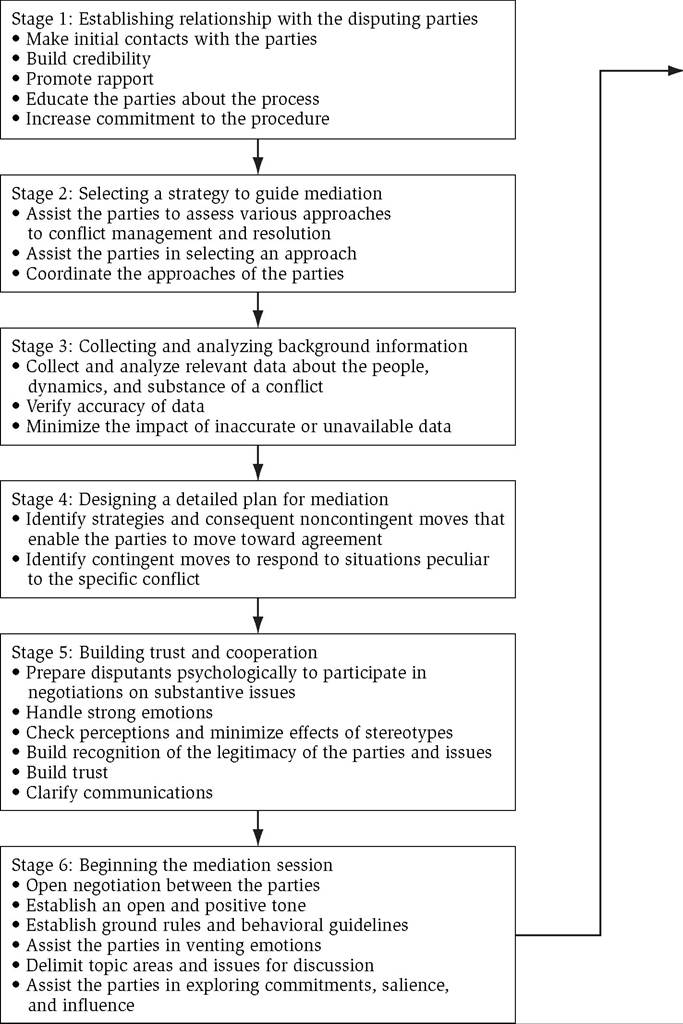
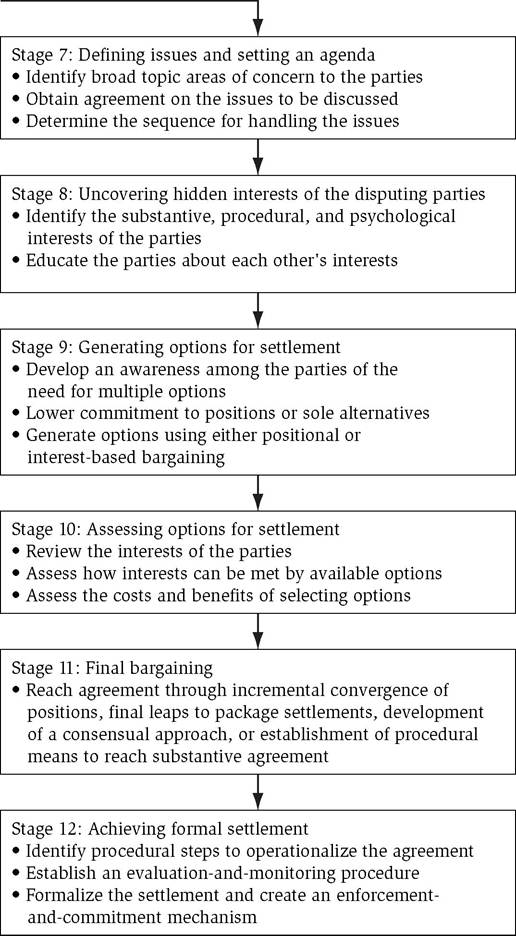
Figure 32.1 Twelve Stages of Mediator Moves.
Source: C. W. Moore, The Mediation Process, 2nd ed. San Francisco: Jossey-Bass, 1996, pp. 66-67. Reprinted by permission.
substantive issues narrowly defined to accomplishing broad relational, psychological, or social objectives. It is also becoming increasingly evident that differences among mediators are not idiosyncratic, but are shaped in systematic ways by the social context in which they work and the types of disputes they handle. In an important sense all mediation is “local.” (I shall consider this issue in more detail in my subsequent discussion of mediator style).
Despite these matters, researchers and reflective practitioners have captured certain regularities in mediator behavior. Most of the knowledge on this subject is derived from studying the contractual mediator operating in what may be loosely described as a problem-solving model, oriented to ending a dispute with legal or quasilegal overtones, as in a labor conflict or divorce.
In describing mediator behavior, I use a typology that I first developed while studying experienced labor mediators. With modifications, the typology has also been used to describe other forms of mediation (Kressel, 1972, 1985; Kressel and Deutsch, 1977; Kressel and Pruitt, 1985; Carnevale, Lim, and McLaughlin, 1989). It divides mediator behavior into reflexive, contextual, and substantive strategies. Mediator behavior also varies in the degree of assertiveness, a dimension that cuts across these three categories. Here I am not attempting a comprehensive catalogue in each area but rather trying to convey the overall flavor. The reader wishing detailed accounts may consult the works cited in this paragraph.
Before proceeding, I want to make two preliminary observations that may be helpful. First, any typology of mediator behavior involves obvious oversimplifications. Mediation is a fluid, multifaceted activity in which the same act may serve several purposes. Second, it is commonplace among practitioners that successful mediation is a structured activity proceeding in distinctive stages, with various mediator behaviors predominating in each stage. Empirical evidence supports this general proposition, although the precise number and characteristics of such stages may vary considerably, depending on the nature of the parties involved, the complexity of the conflict, and the skills of the mediator. Thus, Figure 32.1 presents Moore’s twelve-stage model (1996) for professional mediators dealing with complex conflicts, while Exhibit 32.1 (Deutsch and Brickman, 1994) presents a simpler stage model for students, parents, or other nonprofessionals to use in mediating simple conflicts.
Reflexive Interventions. By reflexive intervention, I refer to mediators’ efforts to orient themselves to the dispute and to establish the groundwork on which later activities will be built. Of necessity, they are of primary importance early in mediation, although they occur throughout. Establishing rapport and diagnosis are the most important of the reflexive strategies.
Absent rapport with the parties, mediators can hope to accomplish little. Among the many things mediators can do to establish rapport, we may include
Exhibit 32.1 A Mediation Outline for Parents.
I. Introduction
1. Get the quarreling children’s or adolescents’ attention.
2. Ask them if they want help in solving their problem.
3. If they do, move to a “quiet area” to talk.
4. Explain and get their agreement to four rules:
• Agree to solve the problem.
• Do not use name calling.
• Do not interrupt.
• Be as honest as possible.
II. Listening
5. Decide which child will speak first.
6. Ask Child #1 what happened, how he or she feels, and his or her reasons.
7. Repeat what Child #1 said so that Child #2 can understand.
8. Ask Child #2 what happened, how he or she feels, and his or her reasons.
9. Repeat what Child #2 said so that Child #1 can understand.
III. Solution
10. Ask Child #1 what he or she can do here and now.
11. Ask Child #2 what he or she can do here and now.
12. Ask Child #1 what he or she can do differently in the future if the same prob
lem arises.
13. Ask Child #2 what he or she can do differently in the future if the same problem arises.
14. Help the children agree on a solution they both think is fair.
IV. Wrap up
15. Put the agreement in writing, read agreement out loud if necessary, and have both sign it.
16. Congratulate them both.
Source: Deutsch, M. and Brickman, E. “Conflict Resolution.” Pediatrics in Review, 1994, p. 21. Reprinted by permission.
giving a convincing and credible introduction to the mediation process and the role of the mediator, conveying sincere concern about the dispute, showing empathic understanding of each side, and behaving evenhandedly. Although rapport building is a central tenet of the practitioner community, it does not receive wide attention from researchers. Such strategies are associated with favorable outcomes in studies of labor mediation and mediation of interpersonal disputes in a community justice center.
Maintaining neutrality toward the parties and impartiality about the issues is often invoked as the sine qua non of rapport building and effective mediation generally, but as we have seen, many mediators (especially those of the emergent variety) hold decided preferences and biases and are often selected by the parties for precisely this reason. Perhaps more crucial than neutrality and impartiality is mediator acceptability, the route to which appears to be through rapport-building activities.
Before they can intervene effectively, mediators must also educate themselves about the dispute and the disputing parties. Among the diagnostic tasks we may count deciding—with the parties’ input—whether or not mediation is an appropriate and mutually acceptable forum (in a case of extreme power imbalance or where there is a history of violence and intimidation, it may not be), separating the manifest from the latent (and more genuine) issues, identifying the real leaders and power brokers (in complex, multiparty disputes), and understanding the relationship dynamics between the parties. Among the mediator’s common diagnostic tactics are use of sustained interrogatories (often in conjunction with separate caucuses with each side, where “sensitive” questions can be asked easily) and keen observation of the parties’ behavior in joint sessions.
Contextual Interventions. Contextual interventions refer to the mediator’s attempts to produce a climate conducive to constructive dialogue and problem solving. This class of strategy embodies the traditional view that a mediator ought to be a catalyst and facilitator, not an arm-twister or proponent of a specific solution. Among the contextual strategies, we may include improving communications, establishing norms for respectful listening and language, managing anger constructively, maintaining the privacy of negotiations, educating the parties about the negotiating process, and establishing mutually acceptable procedures for fact finding. There is evidence that many of these behaviors, especially those associated with improving communication flow, are associated with favorable mediation outcome.
Structural intervention, such as deciding who should be present at negotiation sessions and conducting separate meetings with the parties (caucusing), may also be used as a method of “climate control.” Using the caucus is both common and somewhat controversial. The majority of practitioners see caucusing as an essential mediation tool for managing intense emotions, getting at sensitive information, and overcoming impasse. But some mediators avoid the caucus on the grounds that it fosters distrust between the parties, places an undue burden on the mediator for maintaining confidentiality, and engenders secrecy and scheming. Research on mediation of interpersonal disputes in a community justice center (Pruitt, McGillicuddy, Welton, and Fry, 1989) documents that mediators spent approximately one-third of their time in caucus and tended to do so when hostility was high and positions rigid. Although the caucus was used by many disputants as an occasion to bad-mouth the other side to the mediator, the results were a strong decline in direct hostility between the parties and an increase in problemsolving activity. More equivocal results for the caucus have been reported in labor mediation under particularly unfavorable conditions (unmotivated parties, large positional differences, and high hostility), where mediators sometimes fared better by eschewing the caucus altogether.
Substantive Interventions. Substantive interventions refer to tactics by which the mediator deals directly with the issues in dispute. All mediators are obliged to deal with the issues in some way, although some philosophies of the mediator’s role deemphasize a substantive, problem-solving focus in favor of relational objectives, such as increased understanding of self and other (Bush and Folger, 1994). Competence at formulating an overarching strategic direction for the negotiations—a flexible plan for reaching agreement informed by a sound understanding of each party’s interests, constraints, and limitations—is considered a central cognitive ability for the mediator in models that emphasize a problem-solving focus (Honoroff, Matz, and O’Connor, 1990). Certain contexts appear to promote a substantive focus for the mediator. This appears to be the case for mediators who work directly in the shadow of the law, such as divorce mediators or judges who elect to play a mediational role as part of pretrial conferencing.
Research on mediator behavior suggests three distinct but overlapping substantive domains for mediator activity: issue identification and agenda setting, proposal shaping, and proposal making. Mediator interventions in all of these domains have been associated with favorable mediation outcomes, although the pattern is not always uniform.
There is also increasing awareness of the importance of substantive activities aimed at increasing the probability that agreements reached in mediation are implemented and complied with. The risk of noncompliance may rise with increasing number and complexity of the issues, the number of parties involved, the level of tension and distrust between the disputants, the strength and number of internal factions within each party whose cooperation is needed to implement the agreement, and the length of time during which the obligations set forth in the agreement must be performed (Moore, 1996). Among the important substantive activities of the mediator in this final stage of agreement implementation, we may include assistance in selling the agreement to various constituencies, help in developing criteria and procedures for monitoring and evaluating compliance, procedures for dealing with intentional or unwitting noncompliance, encouraging a return to mediation if disagreements arise during the implementation stage, and preparing the parties to maintain their agreements in the face of opposition and resistance from extremist factions (Coleman and Deutsch, 1995).
Assertiveness. Assertiveness refers to how forcefully the mediator behaves in the reflexive, contextual, or substantive domain. It describes a continuum ranging from mild and nondirective at one end to forceful and highly directive at the other. Assertive behavior is most common in the substantive domain. Mediators frequently engage in arm-twisting to persuade reluctant parties to accept particular agreements, particularly during the later phases of mediation. Reflexive and contextual activities are not generally insistent, but even here mediators can act forcefully to overcome obstacles. Thus, judicious diagnostic questioning can yield to demanding and pointed interrogatories if the mediator suspects dishonesty or concealment; interventions aimed at improving the flow of communications and fostering mutual understanding can become stern and confrontational if one or both parties persist abrasively or provocatively.
Although the practitioner literature conveys a decidedly ambivalent attitude about behaviors at the assertive end of the spectrum, it is clear that pressure tactics are commonly used, especially if the dispute involves very high levels of tension and hostility, if a mediator’s own interests or values are at stake, if the mediator is under strong institutional pressure to avoid the costs of adjudication, or if the mediator wields power over the disputants (a far-from-rare occurrence in some settings, as with judicial mediators). It is also clear from the research literature and more than a few case studies that assertive and even downright heavy-handed and coercive mediator tactics are often effective in producing settlements, particularly if conflict is intense and positions badly polarized. What is not yet clear are the long-term effects of exercising such pressure, particularly on compliance and future willingness to use mediation.
Mediator Style
Although most empirical studies of mediator behavior have focused on discrete intervention of the kinds just summarized, it is clear that mediators also have distinctive stylistic leanings. Mediator style refers to a cohesive set of strategies that characterize the conduct of a case. Mediators typically have an espoused commitment to a particular approach to the mediation role, but there is evidence that they are often unaware of their actual stylistic (behavioral) inclinations and that many of them tend to enact the same style from case to case, despite variety in issues and dynamics.
Research on mediator stylistic preferences is still in its early stages and any summary is bound to oversimplify and ignore significant areas of overlap among mediators practicing in broadly different styles. However, a discussion of mediator stylistic differences alerts us to the distinctively different worlds of practice encompassed by the term “mediation” and the extent to which practice is powerfully shaped by context and experience. Most stylistic accounts portray the mediator acting in either a problem-solving or relational style.
The problem-solving style has long been the dominant mediation approach and, until fairly recently, the presumptive “official” style of nearly all mediators. It gives priority to unblocking the parties stalled efforts to reach agreements (the “problem” to be solved) through the mediator’s active grappling with the issues in the form of shaping and making proposals and the liberal application of pressure tactics. The style is often combined with skepticism about the parties’ ability to deal with each other and a corresponding sense that the mediator needs to do the lion’s share of the work, often through caucusing. The problemsolving approach frequently characterizes mediation of highly polarized disputes in which the costs of unabated conflict are onerous or when the time available for mediation is limited. Within the problem-solving mode three major stylistic subtypes can be identified: facilitative, evaluative, and strategic.
In the facilitative subtype (Riskin, 1996) mediators focus on helping the parties identify and express their underlying interests and needs, on the assumption that so doing will bring to the surface underlying compatibilities or areas for trade-offs and compromises. Mediator neutrality is emphasized, both in regard to the parties and to how issues are resolved (as long as agreements are acceptable to all sides). This is the classic integrative approach to agreement seeking enshrined in Fisher, Ury, and Patton’s (1981) best-selling, Getting to Yes. It is also the most popular philosophy of the mediator’s role, albeit one that is frequently contradicted by empirical studies of mediator behavior. The facilita- tive approach appears to be most often used in complex disputes involving parties with an ongoing relationship (for example, divorcing spouses) and multiple tangible and intangible issues.
The evaluative subtype (Riskin, 1996) is a more distributive version of the problem-solving approach. In this variant the mediator’s implicit assumption is that the primary obstacle to settlement is the parties’ unrealistic confidence in the validity of their respective positions. A primary job of the mediator is to provide the parties with a more balanced and realistic positional assessment. The approach is often highly directive and appears most common in settings where the disputants have no ongoing relationship, are contending around a single issue, usually money (for example, in small claims or general civil court cases), and where there is an emphasis on speedy resolutions to conserve time and money (as in many court settings). The model is often favored by mediators used to exercising considerable decision-making authority (such as judges or former judges).
The strategic subtype is far less commonly discussed in the mediation literature, perhaps because it rests on an assumption alien to the labor relations and legal traditions from which professional mediation arose: namely that destructive conflict is often the result of powerful latent causes of which the parties are unaware. A primary focus of the strategically oriented mediator is to help the parties identify such causes and modify them to the extent necessary to produce agreements on substantive issues. The approach is associated with mediators who have had training in disciplines where the notion of latent causes is familiar (e.g., psychotherapy or organizational development) and who work with parties who are deeply interdependent and have the time, capacity, and motivation to engage in the requisite analytic work.
Strategic approaches were first reported in divorce mediation (Kressel, and others, 1994), where they are sometimes referred to as “therapeutic” models (Irving and Benjamin, 1995; Johnston and Campbell, 1988; Smyth and Moloney, 2003), but they appear viable in organizational contexts as well. In intensive case studies I conducted with Howard Gadlin and his colleagues at the Office of the Ombudsman at the National Institutes of Health (NIH) (Kressel and Gadlin, 2005), the strategic approach was the “default” intervention style. The NIH ombudsmen had become adept at recognizing and addressing three primary latent causes of dysfunctional conflict: impaired communication patterns (typically avoidance or coercion), a blocked trajectory toward scientific autonomy in the mentor-protege relationship, and systemic dysfunction (for example, ineffectual leadership) in the unit in which the conflict was occurring. The preference for the strategic model appeared to be significantly augmented by the ombudsmen’s repeated opportunities as institutional “insiders” to develop expertise in recognizing these latent causes, their formal responsibility for facilitating systemic change within NIH, and their regular consultation with each other in the management of cases.
Relational Styles. In contrast to problem-solving styles, relational styles focus less on agreement making and more on opening lines of communication and clarifying underlying feelings and perceptions. Relational styles are of relatively recent origin and gain at least some of their impetus from a dissatisfaction with the perceived limitations of the problem-solving approach. They tend to be optimistic about the parties’ ability to manage their own affairs and emphasize the need of the parties to work through to their own solution. The orientation is ordinarily combined with interest in improving the parties’ long-term relationship and has a strongly humanistic flavor. Transformational (Bush and Folger, 1994), narrative (Monk and Winslade, 2001) and victim-offender mediation (Umbriet, 2001) are examples.
Transformational mediation is perhaps the best articulated, and certainly the most popular, of the relational approaches to the mediation role. It is popular in community mediation settings and has served as the basis for the U.S. Postal Service’s ambitious and successful approach to managing employee grievances (Bingham, 2003). The transformational mediator’s allegiance is to the twin objectives of empowerment and recognition. Empowerment refers to strengthening each party’s ability to analyze its respective needs in the conflict and to make effective decisions; recognition refers to improving the capacity of the disputants to become responsive to the needs and perspectives of the other. The approach is avowedly critical of mediator activities to produce settlement, direct problem solving, or substitute mediator judgment or analysis for that of the parties. All of these activities are felt to narrow the parties’ opportunity for selfreflection, mutual recognition, and enhancement of autonomy.
Despite the polemical tone that often characterizes discussions of problemsolving and relational styles, the degree to which they occur in their “pure” forms in actual practice is largely undetermined. Polemical claims notwithstanding, there is also no empirical evidence for preferring one mediation style over another. Comparative studies, pitting well-defined stylistic models against each other in disputes with well-delineated characteristics, have yet to be conducted.
Another interesting question is the degree to which mediators adjust their style in relationship to dispute characteristics. Research on the subject is limited. In labor mediation there is evidence for both stylistic invariance (Kolb, 1983) and stylistic flexibility (Shapiro, Drieghe, and Brett, 1985). A flexible approach would seem desirable, since disputes can very widely, even within the same domain. (See Chapter Thirty-Seven of this book for a discussion of “contingent” approaches). In the NIH study ombudsmen had a preference for the strategic problem-solving approach, but switched to a narrower tactical approach (facilitative or evaluative) depending upon a diagnostic assessment of whether or not latent causes were fueling the conflict and of the parties capacity and motivation to address such matters if they were present.