Introduction
Constitutional law is concerned with the role and powers of state institutions and with the relationship between the citizen and the state. In essence a state's constitution is the collection of rules that determines those roles and powers, and which provides safeguards to that relationship.
Purposes of a constitution
Defines (limits) Government power.
3 Guardian of fundamental rights.
3 Provides a covenant, a symbol and aspiration for a nation.
3 To deceive?
Definitions of a constitution
Narrow - a single document or series of documents containing all the basic rules of a state.
Broad - rules, wherever written or unwritten, that determine the creation and operation of governmental institutions.
If we define a constitution narrowly, as a written document or series of documents, then Great Britain has no constitution. However, if we take a broader definition of a constitution, namely, the existence of rules determining the creation and operation of governmental institutions, then clearly Great Britain has a constitution. It is not alone amongst modern democracies in its omission: Israel and New Zealand also have no central constitutional document.
The history: written or unwritten
When we think of a constitution we probably first think of a written document or series of documents. The seminal written constitutions were those that followed the American War of Independence (1775-83) and the French Revolution (1789). Following on from these examples, most modern democracies have adopted written constitutions in one form or another. A common characteristic of written constitutions is that they were drawn up to make a clear historical break with the past, frequently a break with previous imperial power.
Great Britain on the other hand, besides the constitutional upheavals of the second half of the 17th century, has seen no break in its constitutional history since 1066.
Consequently, Britain's constitution is the product of a gradual and peaceful evolution. This evolution started with such historical legal documents as the Magna Carta (1215) and continues through to Acts of Parliament of the modern day, such as those establishing devolution and the Human Rights Act (1998). Since the Bill of Rights (1689), statute law has increasingly shaped the constitution. However, as we shall see, much of the constitution is rooted in the common law. For example, many of the central principles that govern the powers of state institutions and their relationship with the individual citizen have emerged from case law. Lastly, much of what is considered constitutional law is in fact non-legal conventions and practices, which have also developed from particular historical origins.
Characteristics of the UK constitution
This division between written and unwritten constitutions is somewhat superficial - no constitution is exclusively written or unwritten. There are more crucial differences we can identify between Britain's unwritten (or uncodified) constitution and the codified constitutions of most modern democracies.
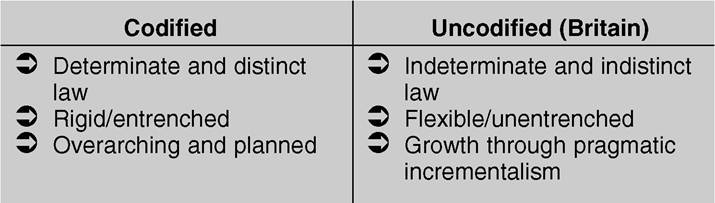
Indeterminate and indistinct
Britain's constitution is a mixture of:
statute;
3 case law;
political practices or conventions;
detailed procedures.
But we cannot point precisely to what is or is not of constitutional relevance. In contrast to codified constitutions, there is nothing to distinguish constitutional law in the UK from any other law. For example, certain Acts of Parliament may be regarded as constitutionally important, such as the Acts of Union or the Human Rights Act, but these Acts are no different in status from the Dangerous Dogs Act.
‘The Constitution is what the judges say it is', is a famous quote from a former Chief Justice of the US Supreme Court, Charles Evans Hughes. This is equally, if not more, apparent in the UK, where much of the constitution, and in particular
the limits of governmental power, has or have been defined by the courts in case law.
Nevertheless, English judges are unlikely to be so forthright.Lastly, the UK's uncodified constitution is made even less determinate by the fact that much of it is governed by unwritten convention and practice that has evolved and continues to evolve over time. We shall look at conventions in more detail under ‘Sources of the constitution', below.
Flexible/unentrenched
Whether a constitution is flexible or rigid is determined by the ease with which it can be amended. The constitutional laws under a codified constitution are invariably given special protection from subsequent appeal or amendment. That is to say, they are ‘entrenched'. This may be by full entrenchment, such that the substance of certain laws can never be changed. For example, parts of German (Basic) Law are entrenched in this manner, such that they can never be repealed or amended unless there is a complete break with the existing legal order in Germany. Alternatively, there may be partial entrenchment by the inclusion of stringent procedures to be followed before any change may be made. For example, any amendment to the US Constitution must be proposed by a two-thirds majority in both houses of Congress, or by a national convention called at the request of two-thirds of the state legislatures. Once the change is proposed, it must be ratified by three-quarters of the state legislatures (Article V).
By comparison with this, the UK's constitution is highly flexible. As we shall see when looking at ‘Parliamentary sovereignty' in Chapter 2 below, in theory there are no legal restraints on Parliament's powers - it can pass, repeal or amend any law by a simple majority. Importantly, no Parliament can lay down irreversible rules that bind future
Parliaments. We will examine non-legal and political restraints on Parliament, as well as restraints imposed by membership of the EU, later; however, at this stage, suffice it to say that no law can be ‘legally’ entrenched in the UK.
Growth through pragmatic incrementalism
The absence of a written constitution enables the body of constitutional law in the UK to be changed and added to with the minimum of constitutional formality.
Consequently, the constitution has grown freely in response to the needs of the time. This has led to a gradual and pragmatic growth. On occasion changes may be very great, such as when the UK joined the European Communities in 1973. Changes more often will be less dramatic, for example, when a particular judgment is given in a case of constitutional importance.Characteristics revealed in recent changes
The recent major constitutional changes undertaken by the Labour Government readily exemplify the flexible characteristics of the constitution. From the point of view of the constitutional law student, the general election of May 1997 is of considerable significance, in as much as it produced a Government committed to major constitutional reform. The reform programme in the 1997 Labour Manifesto included:
3 incorporation of the European Convention on Human Rights into UK law;
a Scottish Parliament;
a Welsh Assembly; devolution for Northern Ireland;
a strategic authority for London; reform of the House of Lords; modernisation of the House of Commons;
3 new electoral systems;
3 a Freedom of Information Act;
3 more accountable and democratic local government;
3 regional chambers leading to directly elected regional assemblies in England.
The Labour Government elected in May 1997 moved with extraordinary speed to implement this extensive programme. Amongst the raft of constitutional legislation, the following may be highlighted:
3 the Human Rights Act 1998;
3 the Scotland Act 1998;
3 the Government of Wales Act 1998; and
3 the Northern Ireland Act 1998.
Also, following a referendum in May 1998, the Greater London Authority Act was passed in November 1999, and the first elections for the Greater London Authority and London Mayor were held in May 2000. The first stage of the reform of the House of Lords was implemented by the House of Lords Act 1999. Electoral reform included the European Parliamentary Elections Act 1999, and local government reforms were made under the Local Government Act 2000.
There was also the Freedom of Information Act, passed in November 2000.However, not surprisingly, the whole of the 1997 Labour Manifesto’s constitutional programme was not implemented in a single term. At the time of Labour’s re-election on 7 June 2001, the following commitments to reform remained unfulfilled:
3 second stage reform of the House of Lords;
3 modernisation of the House of Commons;
a referendum on voting system for the House of Commons;
3 regional government in England.
In Labour's second term, there has been a certain ‘cooling off' after the dramatic changes of the first term. The second stage of reform of the House of Lords has stalled, as outlined in Chapter 5. There have been limited measures introduced to modernise practices in the House of Commons, but the underlying issues of accountability and dominance of the executive have not been addressed, and are not likely to be. The crucial referendum on changing the voting system in the Commons has also been delayed indefinitely. As regards regional government in England, the Government introduced a White Paper, Your Region, Your Choice, and subsequently, in November 2002, the Regional Assemblies (Preparations) Bill into Parliament. However the reforms are still in their infancy. The Bill will enable regional referendums to be held, but the precise nature of the powers or functions regional assemblies would have, if they were established, is still undecided. Nonetheless, the constitution of the UK continues to grow through lesser but still important developments, such as the setting up of a new Department of Constitutional Affairs and the consequent removal of the Lord Chancellor's role in government. The significance of the reforms that have been undertaken and those yet to be completed will be considered in due course.