Sources of the constitution
In an unwritten constitution, as we have already said, it is difficult to be precise about which rules - statutory, common law or conventional - are to be included under ‘constitutional' law.
One cannot be expected to learn by rote a catalogue of all statutory, common law and conventional sources that bear upon constitutional issues. However, it is important to have a broad overview of the main elements that make up the constitution. The sources are commonly divided between the legal and non-legal.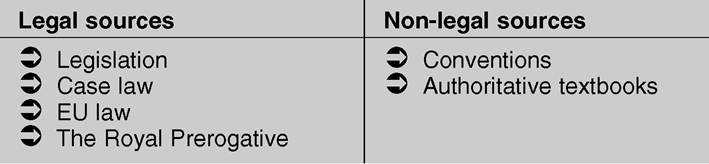
Legal sources
Legislation
Legislation is of primary importance in defining the roles and powers of state institutions and in upholding the freedoms to be accorded to individuals. The constitution is built upon principles enshrined in several major statutory sources. Historical examples would include:
3 Magna Carta (1215) - this placed limits upon monarchical power and gave protection for liberties to be enjoyed by ‘freemen of the realm'. It is now of symbolic importance only.
3 The Petition of Right (1628) - this forbade the imposition of loans and taxes by the King without the consent of Parliament.
3 Bill of Rights (1689) - this moved the balance of power away from the Crown and provided for the emergence of Parliament as an autonomous and supreme legislature.
3 Act of Settlement (1700) - this clarified the line of succession to the throne and gave security of tenure to judges (protected salaries).
3 Acts of Union (1536-43, 1707) - these united Wales, England, and subsequently Scotland under one Parliament of Great Britain.
There are a great many more examples that could be included: the Habeas Corpus Act, the Ireland Act, the Reform Acts, the Parliament Acts, the Statute of Westminster - and the list goes on.
The importance of legislation has grown increasingly in modern times, with common law sources being gradually superseded by legislative provisions.
The most striking example of this is the Human Rights Act 1998, which has for the first time put the protection of fundamental human rights on a statutory basis. Other recent Acts of major constitutional importance would include the Acts establishing devolution. We will look at these examples in more detail later in this book.Case law
Parliament’s will is supreme in making the law, but it is the judiciary who interpret the law to fit within the constitutional framework. It is through their interpretations of the law, both statutory and common law, and through their powers to review secondary legislation that much of constitutional importance has been decided. It is judicial precedent that provides us with the definition of the relationship between the institutions of the state - the Crown, the executive, Parliament and the judiciary - and the relationship between the state and the individual.
Development of the common law The development of common law rules by judges has provided much of the fabric of constitutional law. The old case of Entick v Carrington (1765) is often quoted as an example. In that case the common law was developed to protect an individual’s rights and to restrain exorbitant governmental power. Entick, a critic of the King, had his house raided and private papers removed under a general warrant. The House of Lords ruled that such a warrant was illegal. Lord Camden made it clear that if the Government was to interfere with an individual’s rights, it would have to point to specific statutory or common law powers. In these circumstances there were none, and therefore to take personal papers in this manner amounted to a trespass.
Statutory interpretation Judicial input is also made through statutory interpretation. This may be best illustrated by the extent to which judges are willing to interpret legislation in favour of protection for fundamental rights. For example, in R v Secretary of State for the Home Department ex p Simms and Another (1999), the Home Secretary had imposed a blanket ban excluding visits to prisoners by journalists for interviews.
The policy was found to be unlawful in so far as it interfered with freedom of speech. The House of Lords did not favour the Home Secretary’s interpretation of the relevant legislative provision and indicated that in the absence of express language in the legislation, the courts will presume that Parliament’s intention is not to infringe the basic rights of the individual. This active protection of fundamental rights has been given added impetus by the enactment of the Human Rights Act 1998. Indeed, examples of subsequent cases, such as R v A (2001), suggest that the courts may be even more radical in their interpretations to protect human rights, ‘reading down’ unambiguous statutory provisions and implying words to ensure compatibility with Convention rights (see Chapter 6).Judicial review Judicial review provides an important source of case law for the constitution. It is the review of acts, decisions and omissions of public authorities in order to establish whether they have exceeded or abused their powers. As such it is an important factor in limiting the powers
of government and state institutions. We will examine judicial review in detail in Chapter 7.
EU law
EU law as a source of constitutional law may be found in: treaties;
regulations; and directives.
The European Communities Act 1972 and the subsequent Treaties of the European Union govern the UK’s membership of the EU and have great significance for the constitution. By acceding to the EU (formerly the EC), the UK has had to accept the supremacy of EU law. This position raises an obvious conflict with the traditional doctrine of parliamentary sovereignty (see Chapter 2, below). It is important to understand the means of enforcement of EU law, the institutions, and the relationship with domestic law. These matters will be examined in detail in Chapter 3.
The Royal Prerogative
Examples of prerogative powers include:
the right to prorogue Parliament;
3 the right to give assent or dissent to bills;
3 the right to appoint the Prime Minister;
3 the declaration of war;
3 the making of treaties;
3 the prerogative of mercy.
The Royal Prerogative as a source of law has its origins in the historical powers of a monarch to act unfettered by Parliament. Today, such power's arenowhevvilycurtailddand it is now accepted that no new prerogative powers can be created (BBC v Johns (1965), per Diplock LJ). The vast
majority of these powers are now exercised by the Government in the name of the Crown. They relate mostly to political rules and, as such, while the courts do rule on the existence and scope of these powers, they are reluctant to interfere with their exercise. These powers are considered more fully in Chapter 2 in the context of the other fundamental concepts underlying the constitution.
Non-legal sources
The non-legal sources of constitutional law are:
3 conventions; and
3 authoritative textbooks.
Authoritative textbooks
Authoritative texts, such as the writings of Dicey, Blackstone, Jennings and later commentators, are a non-legal source of constitutional law. However, the most important non-legal source is constitutional conventions.
Conventions
Much of the constitution is regulated not by law but by conventions. These unwritten obligations are central to the operation of the constitution: they govern the exercise of discretionary powers and regulate many practices in the workings of central government. In contrast to legal rules, the courts do not enforce these obligations that lie at the heart of the constitution. Hilaire Barnett summarised the meaning of a constitutional convention as:
a non-legal rule which imposes an obligation on those bound by the convention, breach or violation of which will give rise to legitimate criticism; and that criticism will generally take the form of an accusation of ‘unconstitutional conduct'. (Constitutional and Administrative Law (2002))
It may be added that conventions exist to some extent in all constitutions, whether written or unwritten. They are the non- legal rules necessary to regulate the legal rules of a constitution, or, as Sir Ivor Jennings put it, they put flesh on the dry bones of the law.
Examples of conventions are:
Conventions relating to the executive
• the sovereign must not exercise power without advice from the executive,
• the monarch must choose the leader of the majority party in the House of Commons as Prime Minister,
• the Prime Minister and the Chancellor must be members of the House of Commons,
• if a ‘vote of confidence' is lost the Government must resign.
Conventions relating to the legislature
• the monarch must assent to Bills passed by the Houses of Parliament,
• the House of Lords must ultimately defer to the Commons,
• money Bills can only be introduced in the Commons and by a Government minister,
• ministers are individually and collectively responsible to Parliament.
Conventions relating to the judiciary
• judges must not be active in party politics,
• MPs shall not criticise the judiciary.
Characteristics of conventions The characteristics of conventions are that:
3 they are non-legal - the courts will not enforce them;
3 they are evolving;
3 they are flexible;
3 there is no set sanction for breach.
The uncertainty of conventions It should be noted that conventions change over time, with some falling into disuse and others emerging, and others simply evolving to meet the accepted practices of the day. An example of this flexibility and uncertainty will be seen when we examine the convention of individual ministerial responsibility in Chapter 4. The classic doctrine was that the minister was responsible for every action of his department and that he must answer for any failings. The modern convention has changed to reflect the growth in the size of ministerial departments, and subsequent decisions of ministers have reflected a less wholehearted acceptance of responsibility.
The effect of breaching conventions Conventions are binding only in so far as the participants feel obliged to follow them. While some conventions seem likely never to be breached in modern Britain, such as the convention that the monarch will assent to a Bill duly presented to her by Parliament, other conventions have been broken, and with differing results.
For example, collective ministerial responsibility is a convention that requires the inner circle of government to speak with one collective voice publicly on policy and for cabinet ministers not to disclose cabinet discussions. In 1975, the cabinet of the Labour Government was deeply divided over whether or not to continue membership of the European Community. In the circumstance the Prime Minister ‘lifted’ the convention, allowing cabinet members publicly to advocate their differing views. Upon resolution of the issue, the convention was fully reinstated. No consequences followed from the breach. This illustrates the
adaptability of conventions in contrast with the rigidity of laws. A differing consequence of breach occurred when a convention broke down in 1908, when the House of Lords rejected a Finance Bill of the Commons. The then convention required the House of Lords ultimately to give way to the Commons, particularly on financial matters. Legally, at that time the Lords enjoyed equal powers with the Commons. The response to the breach was the enactment of the Parliament Act 1911, restricting the Lords to a power of delay, in effect placing the convention on a statutory basis. In conclusion, there is no hard and fast rule as to what ramification follows from the breach of a convention.
Conventions and the courts As they are non-legal rules, the courts have no jurisdiction to enforce conventions, though they will recognise their existence. For example, in Attorney General v Jonathan Cape Ltd (1976), a cabinet minister sought to publish his diaries revealing cabinet differences, contrary to the convention of collective responsibility (see above). The court recognised the existence and importance of the convention and the constitutional obligation it imposed, but publication could not be prevented simply on the basis that it breached such a convention, as the courts had no powers to enforce conventions. The court did consider other grounds for an injunction within its jurisdiction, namely, breach of confidence coupled with the public interest, but in the circumstances the injunction was refused. However, the important point was the position taken on conventions. Similarly, in Reference re Amendment of the Constitution of Canada (1982), the Supreme Court of Canada, in a lengthy consideration of the relationship between law and convention, also recognised the existence of conventions, but also confirmed the courts' inability to enforce them. The court nonetheless highlighted the constitutional importance of conventions:
It should be borne in mind, however, that, while they are not laws, some conventions may be more important than some laws. Their importance depends on that of the value or principle which they are meant to safeguard. Also they form an integral part of the Constitution and the constitutional system... constitutional conventions plus constitutional law equal the total Constitution of the country.
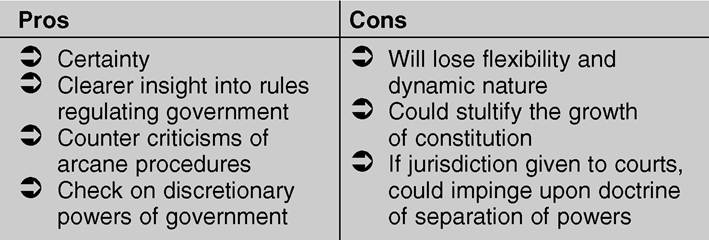
Should they be codified? A common question for students is to assess the pros and cons of codifying conventions. It is most often argued that codification is undesirable due to the loss of flexibility and the impingement upon the doctrine of separation of powers (see Chapter 2).
More on the topic Sources of the constitution:
- Sources and Examples Used in Writing Constitutions
- To What Legal System Does Mongolian Law Belong?
- Introduction
- The Substance of Constitution-Making
- Differences between the Constitutions of 1960 and 1992
- Conclusions
- Reform?
- A Prolegomenon: Imperative of Constitution-Making and Creating a New Constitutional Order
- NIGERIA: PLURALISM AND THE POLITICS OF ISLAMIZATION
- TANZANIA