Fundamental concepts underlying the constitution
An understanding of the fundamental concepts underlying the constitution and the interplay between them will provide the essential basis for answering the majority of questions posed in public law exams.
The fundamental concepts are:3 Rule of law.
Separation of powers.
Royal Prerogative.
Parliamentary sovereignty.
The rule of law
The essence of the rule of law is that is that no man is above the law, and that all individuals should be equal to all others under the law and not subject to arbitrary rule. Moreover, the concept signifies pre-eminent principles that underpin just societies and that ensure the liberty of the individual.
Dicey's rule of law
The concept has had many interpretations in political theory. They have varied depending upon the advocate’s political view of the purpose of law and the functions of the state. A student may be asked to identify a common thread in the various interpretations of the concept. A common starting point is the formulation put forward by AV Dicey in Introduction to the Study of the Law of the Constitution (1885). He identified the rule of law as having three main aspects or principles:
3 ■. no man is punishable. except for a distinct breach of law established in the ordinary legal manner before the ordinary courts of the land.
3... every man, whatever be his rank or condition, is subject to the ordinary law of the realm and amenable to the jurisdiction of the ordinary tribunals.
3.. the general principles of the constitution are with us as the result of judicial decisions determining the rights of private persons.
The first principle
Dicey's first principle requires that governments should only use powers clearly defined by statute or the common law, and that they should be restricted from using arbitrary or discretionary powers to interfere with the liberty of the individual.
The classic example of this principle is found in Entick v Carrington (1765), where the seizure of personal papers from the home of a critic of the King under a ‘general' warrant was ruled unlawful.The requirements of clarity in the law and freedom from arbitrary rule were expanded upon by Joseph Raz in The Rule of Law and its Virtue (1977), where he stated that laws should be publicised, reasonably stable, non-retrospective, non-contradictory, and that the courts should be accessible and staffed by an independent judiciary. Furthermore, in case law one finds that the judiciary will frequently refer to ‘the rule of law' in terms of the fair administration of justice.
In modern Britain, the principle that government should be constrained from arbitrary use of its powers is universally accepted. However, it may be argued that Dicey's principle is breached in so far as the extent of government powers is not always clear. Many such powers emerge from legislation, both primary and secondary, that is frequently widely drawn and lacking in precision. In the criminal sphere, one may point
to current legislation providing broad and ill-defined prohibitions on an individual’s activities, for example, under recent terrorist legislation or under the Criminal Justice and Public Order Act 1994. Furthermore, in contrast to the protections offered to Mr Entick, many wide discretionary powers exist under current legislation for state officials to interfere with an individual’s property, for example under s 20(c) of the Taxes Managemen t Ac11970(entrywi thwarrant to obtain documents): see R v Inland Revenue Comrs ex p Rossminster Ltd (1980). It may be argued that Dicey’s principle needs to be modified in the light of the requirements of modern government.
The second principle
The second principle is equality of all before the law. In particular, governments and their officials should have no special exemptions or protections from the law and should be subject to the ordinary courts of the land.
Dicey was particularly suspicious of the French system of administrative courts that dealt with legal challenges to the government.This principle may seem difficult to square with the fact that all individuals are not equal in terms of their legal rights and powers. Clearly, certain individuals have additional legal powers or have a particular legal immunity, such as MPs, judges, minors, the police and members of the armed forces. Therefore, the principle may more aptly be described as requiring that ‘all should be equally subject to the law, though the law to which some are subject may be different from the law to which others are subject’. The importance of this second principle was underlined in Re M (1993). In this case, Kenneth Baker, the then Home Secretary, argued that a mandatory injunction imposed by the court requiring him to procure the return of a deported asylum seeker, was made without jurisdiction on the basis that he was a minister of the
Crown and the Crown had immunity from injunctions under the Crown Proceedings Act 1947. In rejecting these arguments, Lord Templeman held that:
... The judiciary enforce the law against individuals, against institutions and against the executive. The judges cannot enforce the law against the Crown as monarch because the Crown as monarch can do no wrong, but judges enforce the law against the Crown as executive and against the individuals who from time to time represent the Crown... [T]he argument that there is no power to enforce the law by injunction or contempt proceedings against a minister in his official capacity would, if upheld, establish the proposition that the executive obey the law as a matter of grace and not as a matter of necessity, a proposition which would reverse the result of the Civil War.
The growth of administrative law through judicial review, and the creation of statutory tribunals dealing with particular areas of law such as employment law, would also have concerned Dicey. However, one might argue that the judicial review of public authorities is still undertaken by ‘ordinary’ judges in the ‘ordinary’ courts of land, albeit subject to different procedures and criteria.
Furthermore, the decisions of most statutory tribunals may be challenged in the ‘ordinary’ courts of appeal.The third principle
The third principle relates particularly to Britain’s unwritten constitution and concerns the protection of individual rights. Dicey argued that the rights of an individual are only securely protected through specific judicial decisions in cases brought before the courts. This reflected Dicey’s mistrust of the general protection of such rights offered by a written constitution or a Bill of Rights. His view was that it is only where the courts will enforce a particular constitutional right
that it can have value. He argued that the mere presence of a written constitution offered little where governments chose to disregard it.
This principle is the most frequently criticised as being inaccurate and outmoded. Particular criticism is made of Dicey's view that a Bill of Rights was no more than a pious declaration that no one would enforce. While this may have been the case in 1885, Bills of Rights in developed modern democracies provide clear and powerful protection for fundamental rights. Indeed, in Britain the enactment of the Human Rights Act 1998, incorporating the European Convention on Human Rights into domestic law, recognised that the common law on its own provided insufficient protection for fundamental rights. Surely, it is argued, rights are best protected through a combination of judicial decisions and legislation.
Further principles of the rule of law
Some would argue that Dicey's formulation of the rule of law is too limited in that it is concerned only with the legality of powers and their exercise. Other formulations of the concept go further, to include requirements of positive provision for the well-being and dignity of the citizen in society. For example, the Declaration of Delhi 1959 recognised that:
The rule of law is a dynamic concept, for the expansion and fulfilment of which jurists are primarily responsible and which should be employed not only to safeguard and advance the civil and political rights of the individual in a free society, but also to establish social, economic, educational and cultural conditions under which his legitimate aspirations and dignity may be realised.
The separation of powers
The constitutional jigsaw
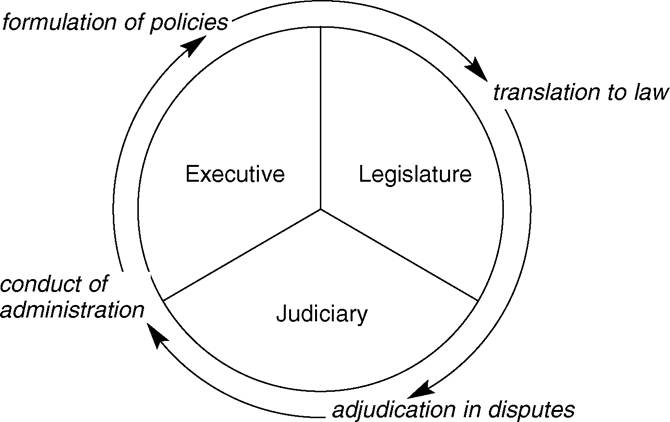
In any state, there are three primary bodies: the executive, the legislature, and the judiciary. The principle of the doctrine of separation of powers is that there should be a clear demarcation in function between each of these bodies, and equally the powers of each should be held in check by the others.
As will be seen, under the constitution of the UK there are important departures from the classic doctrine.
The classic doctrine
The doctrine of separation of powers can be traced back to Aristotle, who proclaimed the virtue of power being distributed between the three primary bodies. However, the classic expression of the necessity for a separation of functions is that of Baron Montesquieu in De 'Esprit des Lois (1748):
When the legislative and executive powers are united in the same person, or in the same body of magistrates, there can be no liberty... Again, there is no liberty if the power of judging is not separated from the legislative and the executive. If it were joined with the legislative, the life and liberty of the subject would be exposed to arbitrary control; for the judge would then be the legislator. If it were joined to the executive power, the judge might behave with violence and oppression. There would be an end to everything if the same man or the same body, whether of the nobles or of the people, were to exercise those three powers, that of enacting laws, that of executing public affairs and that of trying crimes or individual causes.
Montesquieu recognised that in any workable system the separation could not be absolute and that there would be some overlap between the different elements: neither
should exercise the whole power of the other branch of government'. Therefore, his meaning was not that the legislature and the executive should have no influence over each other, but rather that neither should exercise the whole power of the other.
Montesquieu's doctrine formed the basis for the division of power in the written constitution of the United States. In the US, Congress holds the legislative power and is elected separately from the President. The office of the President holds the executive power: the President and his advisers cannot be members of the Congress. Judicial power is held by the Supreme Court.The doctrine in the United Kingdom
Fusion of the executive and legislature
The first thing to note in the UK is that there is a near complete fusion of the executive and the legislature. The executive is primarily identified as the Prime Minister and his cabinet. By convention, they must be members of the House
of Commons or the House of Lords. This is a clear departure from the doctrine. The Government will of course have a majority in the Commons, and therefore the executive dominates the legislature. This is what led Lord Hailsham to refer to the arrangement as an ‘elective dictatorship' (The Dilemma of Democracy (1978)). However, supporters of the arrangement point out that it has never led to tyranny. There are many ‘checks and balances' in the system, such as the convention of accountability, which requires Government ministers to justify their actions and the actions of their departments to Parliament. The judiciary also exercise control over the use of executive powers by means of judicial review. Ultimately Parliament controls the executive in so far as it can withdraw its support, but where there is a large majority this control may seem illusory. There are also the many procedures for calling the Government to account through questions and debates on the floor of the Houses, and also through the various Select Committees. Lastly, it may be noted that the executive are heavily outnumbered in Parliament: of the 659 MPs, only approximately 100 are Government ministers, including up to 20 who are appointed to the cabinet.
The independence of the judiciary
To a large exten t the judiciary form aseparatebody,for example, judges are barred from becoming members of the House of Commons. In the UK, we seek to achieve the independence of our judiciary by offering them security of tenure under The Act of Settlement 1700. This is elaborated upon in the Supreme Court Act 1981, which provides that judges are removable only in circumstances of serious misbehaviour, and only by Her Majesty on an address presented to her by both Houses of Parliament. In effect senior judges cannot be removed for political reasons.
Furthermore, their salaries are paid from a consolidated fund that is not subject to political control. This independence is to ensure that judges dispense justice according to their judicial oath - ‘according to the laws and usage of this realm, without fear or favour, affection or ill-will'.
The legislature and the judiciary
The legislature makes the law, the executive carries it out, and the judiciary interprets and applies it. In its simplest terms, those are the lines of demarcation in the respective functions.
Clearly, under the doctrine of parliamentary sovereignty, the judges cannot question the validity of an Act of Parliament. In other words, they have no power to disregard or reject a statute, even where it is unjust or unpalatable. As Lord Diplock put it:
Where the meaning of the statutory words are plain and unambiguous it is not for the judges to invent fancied ambiguities as an excuse for failing to give effect to its plain meaning because they themselves consider that the consequences of doing so would be inexpedient, or even unjust or immoral. (Duport Steels Ltd v Sirs (1980))
But what if the words are not ‘plain and unambiguous'? In such circumstances, Lord Bingham explained:
The essential function of the court is then to declare the law which it infers that Parliament intended to make, or would have made if it had addressed the point at all. (The Courts and the Constitution (1997))
Nevertheless, the senior judges have also stressed that such inferring of Parliament's intention should not extend to judicial legislating. For example, in Re Wand B (Children: Care Plan) (2002), the Court of Appeal interpreted provisions in the Children Act 1989 to include a duty on local authorities to be
subject to ‘starred milestones’, in other words, that they were required to implement care plans within time limits. There was no such express provision in the legislation. The House of Lords ruled that this interpretation went beyond the boundaries of legitimate interpretation.
The borderline between interpretation and judicial legislating is not always clear, particularly with activist judges such as Lord Denning, who frequently pursued his interpretative role in a highly creative manner. There are added complexities when one considers the interpretative provisions under the European Communities Act 1972 and the Human Rights Act 1998, which provide powerful authority for the courts to interpret legislation to fit with EU law or the European Convention on Human Rights (ECHR). For example, in R vA (2001), in order to ensure compatibility with Article 6 ECHR, the House of Lords implied words into a statute that were plainly contrary to Parliament’s original intention. We will consider this and other examples of the impact of EU and ECHR law later in the book.
Recent reforms
Historical negations of the doctrine of separation of powers include:
3 the position of Lord Chancellor;
3 the ‘judicial’ House of Lords; and
3 the appointment of the most senior judges.
The Labour Government has recently addressed a number of these historical negations of the doctrine within the UK constitution. These include the oft-cited example of the office of Lord Chancellor, whose former position as a member of the executive, the legislature and the judiciary was in flagrant breach of the doctrine. The position seemed even more
untenable in the light of the Human Rights Act 1998 and the requirements of judicial independence under Article 6 ECHR. Another glaring anomaly is the position of the ‘judicial’ House of Lords, which sits as a ‘committee’ within the ‘legislative’ House of Lords. Lastly, the Government is to address the issue of senior judicial appointments, which previously were made by Her Majesty after consultation with the Prime Minister (following recommendations by the Lord Chancellor).
The initial step in reform was taken in June 2003, when the Prime Minister announced the creation of a new Department for Constitutional Affairs. The department incorporates most of the responsibilities of the former Lord Chancellor’s Department, but with new arrangements for judicial appointments and an end to the previous role of the Lord Chancellor as a judge and Speaker of the House of Lords. Once the reforms are confirmed by legislation, the post of Lord Chancellor will be abolished. The Secretary of State for Constitutional Affairs is a conventional cabinet minister and head of department. Further reforms are to include:
3 establishment of an independent Judicial Appointments Commission, on a statutory basis, to recommend candidates for appointment as judges;
3 creation of a new Supreme Court to replace the existing system of Law Lords operating as a committee of the House of Lords. The new Secretary of State for Constitutional Affairs will not be a member of the Supreme Court;
3 reform of the Speakership of the House of Lords. The Speaker will be elected by the Lords themselves and will be independent of the executive, much like the present Speaker in the House of Commons.
The Royal Prerogative
... Every act which the executive government can lawfully do without the authority of an Act of Parliament... (AV Dicey, Introduction to the Study of the Law of the Constitution (1885))
Under both written and unwritten constitutions, commonly there exist powers that the executive can exercise without the passage of legislation. Such powers may be referred to as ‘inherent executive powers' or ‘prerogative powers'. Historically, in Britain, such powers are termed the Royal Prerogative in that they are rooted in the original preeminence of the monarchs who could rule and be obeyed in preference to all others.
History
In the early history of the constitution the power of the monarch had very few limitations. Parliament was summoned and dismissed at the monarch's behest, and to a large extent was impotent in controlling his or her prerogative powers. Over the centuries, these powers were gradually eroded. The erosion began with the curbing of the King's powers to impose direct taxes without Parliament's consent. The power of the King to dispense justice and determine cases without judges was rejected in Prohibitions Del Roy (Case of Prohibitions) (1607). Similarly, in the Case of Proclamations (1611), the court held that the King had no power to proclaim or change the law. The power of the King to raise money for the navy in times of emergency, by indirect taxes and without Parliament's approval, was also denied by the Ship Money Act of 1640, reversing an initial decision of the courts (Case of Ship Money (R v Hampden) (1637)). Finally, the Bill of Rights 1689 and the Act of Settlement 1700 curbed the monarch's power as never before. From that time forward,
parliamentary sovereignty was established over the Crown and prerogative powers were abolished or curtailed as Parliament determined. Importantly, no new prerogative power could be claimed by the Crown thereafter (see BBC v Johns (1965)). Therefore, Royal Prerogative powers are ‘the residue of the discretionary or arbitrary authority, which at any time is legally left in the hands of the Crown' (AV Dicey).
The majority of such powers are now exercised by the executive in the name of the Crown, or are exercised by the Crown under the advice of the executive.
Examples of prerogative powers
The following powers are personal to the sovereign:
the right to appoint the Prime Minister;
3 the right to dissolve Parliament;
3 the right to give assent or dissent to bills.
The Queen has the power of choosing or dismissing the Prime Minister and deciding whether or not Parliament should be dissolved. In practice the choice of Prime Minister after an election is governed by the convention that the monarch will choose the leader of the party (or coalition of parties) best able to command a majority in the House of Commons. If a Prime Minister resigns through ill-health or old age it may be presumed that the governing party would put forward a new leader to be chosen by the monarch. As to dismissing a Prime Minister, it is inconceivable that a monarch would exercise such a power in modern Britain.
The monarch's power to dissolve Parliament of his or her own volition has not occurred since 1835, and in modern Britain would most likely be regarded as unconstitutional. In practice, it is only on the advice of the Prime Minister that dissolution will take place. By convention, the Prime Minister will seek dissolution if a vote of confidence is lost in the Commons.
By convention, royal assent will be given to those bills duly passed by both Houses of Parliament.
The following powers are exercised by the executive in the name of the Crown:
3 the declaration of war;
3 the making of treaties;
3 the disposition of the armed forces overseas;
3 the prerogative of mercy;
3 the granting of honours.
The majority of prerogative powers are exercised by the executive in the name of the Crown. The above list is far from exhaustive. In addition, many senior appointments in the armed forces, the security services, the civil service, the judiciary and the Church are made under the Royal Prerogative.
The prerogative power to commit troops to war has come under recent examination in the cases of Sierra Leone, the former Yugoslavia and, most recently, Iraq. In the case of Iraq, the Prime Minister sought and obtained a majority in the House of Commons on the issue of whether or not to commit the troops. In theory, however, the prerogative power could have been exercised without this mandate.
In a discussion document in 2003, the Commons Public Administration Committee advocated that the use of the Royal Prerogative should be investigated by MPs before it actually takes place. However, a Bill that sought to introduce greater parliamentary oversight over the exercise of prerogative powers, the Prime Minister (Office, Role and Functions) Bill 2001, was dropped after the first reading. Thus, the Royal Prerogative remains an important and large, uncontrolled source of powers for the Government.
Judicial control of the prerogative powers
The prerogative as subject to the common law
Regarding judicial review of prerogative powers, the original approach was that the courts could inquire into whether a particular prerogative power existed or not and, if it did exist, they could inquire into its extent. But once the existence and the extent of a power were established, the courts could not inquire into the propriety of its exercise (see Attorney General v de Keyser’s Royal Hotel Ltd (1920)).
From this early position the courts have gradually shown greater willingness to review the exercise of prerogative powers. In Chandler v DPP (1964), it was confirmed that the courts would not review ‘the proper exercise of discretionary powers' but, in a new development, they would intervene to correct ‘abuse or excess in the exercise of prerogative power'. A more radical change of approach was noted in the landmark case of R v Criminal Injuries Compensation Board ex p Lain (1967). The Board had been set up not by statute but by executive action under the prerogative, and on that basis it was argued that it was immune from the review of the courts. The House of Lords rejected that argument, stating that the Board should be subject to review just as if it was set up under statute. The important point made was that the question of whether a particular power was reviewable or not depended not on the source of the power (that is, prerogative power or statute) but on its subject matter. Clearly, it would not be proper for a court to review powers touching on certain subject matters, such as the making of treaties, the defence of the realm, the prerogative of mercy, the grant of honours, the dissolution of Parliament and the appointment of ministers.
This approach was confirmed and amplified in Council of Civil Service Unions v Minister of State for Civil Service (the
GCHQcase) (1985). Following a series of disruptive industrial disputes, the Government relied on its prerogative power (an Order in Council) to withdraw the right to union recognition at the government intelligence centre GCHQ. This decision was challenged. Lord Diplock confirmed that administrative decisions taken under prerogative powers are subject to judicial review in the same way as those taken under statutory powers (that is, on the same grounds of ‘illegality’, ‘irrationality’ and ‘procedural impropriety’). But much as in ex p Lain (above), the court recognised that the review of administrative decisions taken under prerogative powers is limited to subject areas that are ‘justiciable’. Examples of ‘non-justiciable’ subject areas would include decisions taken to protect national security. According to Lord Diplock, ‘It is par excellence a non-justiciable question. The judicial process is totally inept to deal with the sort of problems which it involves’. In the GCHQ case, the House of Lords decided that the evidence of possible dangers to national security outweighed any legitimate expectations of the employees, and the Government’s right to determine the terms and conditions of employment was therefore lawfully within its prerogative powers.
Statute and the prerogative
In a number of cases the courts have made clear that where a statute is enacted to regulate a matter previously falling under the prerogative but not expressly abolishing the prerogative, the statute will prevail. In Attorney General v de Keyser's Royal Hotel Ltd (1920), the owners of the hotel claimed compensation for war-time damage pursuant to the Defence of the Realm Act 1914. The House of Lords ruled that the Government’s decision to award a lesser discretionary sum under prerogative powers was unlawful; the statutory provision had superseded the prerogative
power. However, their Lordships made clear that the Government could choose to repeal the statute, such that the prerogative powers would again come into operation, or else the Government might enact new legislation to provide for awards of a lesser amount. This is what occurred following the case of R v Secretary of State for the Home Department ex p Fire Brigades Union (1995), where the court had ruled unlawful the decision of the Secretary of State not to implement a statutory scheme of compensation for victims of violence in favour of a scheme providing lesser payments. In response, the Criminal Injuries Compensation Act 1995 repealed the previous statutory scheme and provided for payments in accordance with the scheme preferred by the Secretary of State.
Parliamentary sovereignty
Historically, the rise of parliamentary sovereignty coincided with the gradual erosion of the prerogative powers of the Crown. As we have seen, by the end of the 17th century the powers of the Crown had been reduced to a residue. The Bill of Rights 1688 and the Act of Settlement 1700 declared Parliament as the supreme law-making body. Thereafter, no new law could be enacted without the consent of both Houses of Parliament.
AV Dicey
The classical definition of parliamentary sovereignty in relation to the UK Parliament is provided by AV Dicey:
The principle of parliamentary sovereignty means neither more nor less than this, namely, that Parliament thus defined has, under the English constitution, the right to make or unmake any law whatever; and, further, that no
person or body is recognized by the law of England as having the right to override or set aside the legislation of Parliament. (The Law of the Constitution (1885))
Legal and political limits
At the outset it is important to point that out that Dicey's description of parliamentary sovereignty is concerned only with the legal limits of Parliament's powers and should not be confused with the question of whether there are political or moral limits to Parliament's powers. For example, a Parliament may be legally capable of repealing the right of women to vote, or enacting laws that require all blue-eyed babies in France to be put to death, but of course politically it is impossible that such laws could be passed - any government is ultimately dependent on its electoral mandate. Nevertheless, the fact that Parliament would not pass abhorrent or electorally unpopular legislation has no bearing upon what it is legally entitled to do. In Dicey's view, legal sovereignty was held by the ‘Queen in Parliament', while political sovereignty was vested in the people.
Legal sovereignty
From Dicey, we can deduce the doctrine of parliamentary sovereignty in its legal sense to have three elements:
3 Parliament is competent to legislate on any matter.
3 No Parliament can bind future Parliaments or be bound by its predecessors.
3 No court or other person can pass judgment upon the validity of Parliament's legislation.
Competence to legislate on any matter
Parliament's omnicompetence has been traditionally demonstrated by first pointing to its ability to determine its
own length and composition. In effect, Parliament is its own master and is subordinate to no other. For example: the Septennial Act 1715 and the Prolongation of Parliament Act 1944 extended the life of a Parliament; the Parliament Acts 1911 and 1949 curtailed the powers of the House of Lords; and the House of Lords Act 1999 altered the composition of the House of Lords.
Furthermore, in case law we find no instance of the courts seeking to review Parliament’s right to legislate, even if in breach of international law (Cheney v Conn (1968)), or when introducing retrospective legislation (War Damages Act 1965), or when legislating extraterrestrially (War Crimes Act 1991), all areas in which one would intuitively seek limits, if there are any, to Parliament’s sovereign powers.
Another area that raises questions is devolution. For example, does the Scotland Act 1998, which devolved substantial legislative powers, divest Westminster of its competence to legislate in those areas? The answer to this in the legal sense is clearly ‘No’. In fact, the Act expressly provides that it ‘does not affect the power of the Parliament of the UK to make laws for Scotland’ (s 28(7)). Whatever the political inhibitions, there is nothing in the act of devolution that invalidates the UK Parliament’s right to legislate on any matter.
In British Coal Corporation v The King (1935), the Privy Council considered the position where independence was granted to a dominion, here Canada, under the Statute of Westminster 1931. The court recognised that the power of the Imperial Parliament remained ‘in theory unimpaired’ and, in theory, the granting of independence could be reversed. Of course politically this will never occur, but again the case recognises there are no legal limits to Parliament’s competency.
No Parliament can bind future Parliaments or be bound by its predecessors
It is this aspect of Dicey's definition that gives rise to the most debate. The orthodox view is that no Parliament can enact rules that limit future Parliaments. In other words, there is no means of entrenching or protecting legislation such that future Parliaments will be bound. The Acts of Union, the Human Rights Act and the European Communities Act have no greater legal status or protection from repeal than the Vinegar Act (repealed) had.
Express and implied repeal
Parliament may enact a law that expressly repeals any previous law, and the courts must give effect to the latter provision (express repeal). Where Parliament enacts a law that does not expressly repeal an earlier statute but is in conflict with it, the courts will follow the latest statute in time under the doctrine of implied repeal of the earlier statute. Furthermore, in two cases, Vauxhall Estates Ltd v Liverpool Corporation (1932) and Ellen Street Estates Ltd v Minister of Health (1934), the court considered a statute (Acquisition of Land (Assessment of Compensation) Act 1919) that expressly excluded the doctrine of implied repeal, providing that any conflicting provisions of later statutes should have no effect. The later Housing Act 1925 provided lesser, and therefore conflicting, provisions for compensation. The court held that the exclusion of the doctrine of implied repeal under the 1919 Act could have no effect because ‘the legislature cannot, according to our constitution, bind itself as to the form of subsequent legislation', and therefore the provisions of the later Act were applied.
However, the position is not completely certain. Some constitutional theorists argue that Parliament could prescribe
special procedures for passing future legislation that could be made binding on future Parliaments. They rely on the Privy Council decision in Attorney General for New South Wales v Trethowan (1932). In 1929, the outgoing government of NSW, through its majority in Parliament, enacted legislation providing that the legislative (‘upper’) chamber could not be abolished without a two-thirds majority in both chambers and the support of a public referendum. In 1930, the incoming government sought to repeal the protective legislation and abolish the upper chamber without regard to its provisions. The Privy Council held that the later Parliament was bound by the ‘manner and form’ requirements of the earlier legislation. The judgment referred to s 5 of the Colonial Laws Validity Act 1865, which provides that the legislature of NSW had full powers to legislate for its own constitution, but also expressly provides that it may prescribe the manner and form in which laws are passed.
There is no equivalent example in the UK and the orthodox view is that the Trethowan case is irrelevant here since, unlike the ‘subordinate’ NSW legislature, the UK Parliament is sovereign and its powers are not derived from any statute. Nonetheless, it may be noted, there is nothing to prevent Parliament from creating special procedures to be followed before legislation is passed. For example, s 1 of the Northern Ireland Act 1998 provides that any legislation to remove Northern Ireland from the UK would require the holding of a prior referendum. However, under the UK constitution this guarantee of a referendum provided by the 1998 Act could be repealed by subsequent legislation. We again return to the difference between what a legislature is legally entitled to do and what would be politically acceptable.
No court or other person can pass judgment upon the validity of Parliament's legislation
The legislature makes the law and the courts apply it. Underlying the doctrine of parliamentary sovereignty is the rule that the courts will not question the validity of an Act of Parliament. This rule is not defined in any statute, and in this sense the doctrine is rooted in the common law, as it is the judges who uphold Parliament’s sovereignty by obeying the rule:
... the duty of the court is to obey and apply every Act of Parliament, and... the court cannot hold any such Act to be ultra vires. Of course there may be questions about what the Act means, and of course there is power to hold statutory instruments and other subordinate legislation ultra vires. But once an instrument is recognised as being an Act of Parliament, no English court can refuse to obey it or question its validity. (Manuel v AG (1983), per Megarry VC)
The position may be contrasted with the powers of the Supreme Court in the US, which has the power to decide whether or not legislation conforms to the US constitution.
Perhaps the most common issue in this area for students to consider is the impact of both EU law and the Human Rights Act 1998 on Dicey’s third principle.
European Communities Act 1972 The impact of European law on parliamentary sovereignty is always a topical issue for students. The European Communities Act 1972, s 2(4) provides that ‘any enactment passed or to be passed... shall be construed and have effect subject to the foregoing provisions of this section’. The ‘foregoing provisions’ are those in s 2(1) of the Act giving effect in the UK to directly effective EU law. In effect, directly effective EU law takes precedence over a domestic statute.
In applying these provisions, the courts have sometimes had to strain the meaning of statutory words, or read nonexistent words into a statutory provision, in order to give effect to superseding EU law. Usually, this will be contrary to Parliament’s original intention. However, the use of constructive or purposive statutory interpretation in this manner is said not to be contrary to the doctrine of parliamentary sovereignty in as much as the courts are but implementing Parliament’s will under the 1972 Act (Macarthys v Smith (1981), per Lord Denning MR).
On occasion a statute will be so baldly inconsistent with directly effective EU law that the court will be unable to construe a compatible interpretation. Controversially, in such circumstances the inconsistent provisions of that statute must be ‘disapplied’ by the court (R v Secretary of State for Transport ex p Factortame (1990)). Plainly, this would appear contrary to Dicey’s third principle. However, once again the concept of parliamentary sovereignty is said to remain undisturbed, since the court is simply fulfilling Parliament’s intention under the 1972 Act to legislate compatibly and, furthermore, it is always available to Parliament to repeal the 1972 Act outright. If the European Communities Act 1972 was repealed, the ‘disapplied provision’ would return again to full force and there would be no basis for the courts to question its validity. This and other aspects of European law are considered in detail in the next chapter.
Human Rights Act 1998 After much debate during the passage of the Bill regarding the impact on parliamentary sovereignty, the Government decided not to include in the Human Rights Act (HRA) 1998 any power to disapply or strike down primary legislation. In dismissing the approach under the European Communities Act 1972, the Government differentiated between the UK’s ‘absolute’ obligations under
EU law as opposed to those under the ECHR. Furthermore, ECHR law is not directly effective in the manner of EU law.
Consequently, the powers of the court under the 1998 Act are described as ‘interpretative only'. Section 3(1) of the HRA 1998 provides a ‘rule of construction' to apply to past as well as future legislation:
So far as it is possible to do so, primary legislation and subordinate legislation must be read and given effect in a way which is compatible with the Convention rights.
We may contrast the limited obligation in the statutory words of s 3 of the HRA 1998 - ‘So far as it is possible to do so - with the total obligation in s 2 of the European Communities Act 1972 - ‘... shall be construed...’ (see above). Lord Irvine (the then Lord Chancellor) explained the interaction of ss 3 and 4 of the HRA 1998 in the House of Lords:
Section 3(1) requires legislation to be read and given effect to so far as is possible to do so in a way that is compatible with Convention rights. Section 3(2) provides that where it is not possible to do so... that does not affect its validity, continuing operation or enforcement. This ensures the courts are not empowered to strike down Acts of Parliament which they find to be incompatible with Convention rights. Instead section 4 of the [Act]... introduces a new mechanism through which the courts can signal to the Government that a provision of legislation is, in their view, incompatible. It is then for government and Parliament to consider what action should be taken.
Thus sovereignty is very much maintained intact. A declaration of incompatibility may put political pressure on a Government to change the law, but it does not impose any legal duty to do so. Further details of the impact of the HRA 1998 are examined in Chapter 6.