The European Union
European integration
European integration is based on four founding treaties:
Treaty establishing the European Coal and Steel Community (ECSC), which was signed in Paris in 1951.
The original members were Germany, France, Belgium, Italy, Luxembourg and The Netherlands.Treaty establishing the European Economic Community (EEC).
Treaty establishing the European Atomic Energy Community (Euratom), which was signed (along with the EEC Treaty) in Rome in 1957.
Treaty on European Union, which was signed in Maastricht in 1992, organising the newly named ‘European Union' into three ‘pillars'. The most important pillar is that of the European Community (replacing the EEC) which is governed by Community law. The second pillar provides for common areas of foreign and security policy. The third pillar provides for common areas on justice and home affairs. The second and third pillars are not governed by Community law but are achieved through intergovernmental co-operation.
Three pillars of the European Union

The founding treaties have been amended on several occasions, particularly following the accession of new
Member States. The United Kingdom acceded in 1973. Other major treaties include the following:
3 The Merger Treaty 1965 merged the then three European Communities under a single set of institutions. The ‘institutional triangle' now consists of the Commission, the Council and Parliament, and these are flanked by two more institutions - the Court of Justice and the Court of Auditors.
3 The Single European Act 1986 (a European treaty, not a domestic Act) set out a timetable for the removal of all barriers to trade between the Member States, and to turn the ‘common market' into a genuine single market in which goods, services, people and capital could move around freely.
The Single Market was formally completed at the end of 1992.
The Treaty of Amsterdam 1997 amended and renumbered the Articles of the EU and EC Treaties. One of the main purposes of this Treaty was to simplify the decision-making procedures within the European Union. The Treaty substantially boosted the elected European Parliament’s supervisory powers over the Commission. The European Parliament now must approve the appointment of the Commission, which has been the subject of its criticisms. The Treaty also extends the areas in which decisions can be taken by a qualified majority, and encourages closer ties with national parliaments. One development has occasioned considerable debate, whereby Member States that intend to establish closer cooperation may make use of the institutions, procedures and mechanisms laid down in the Treaties, subject to the provisos specified. This ultimately opens the way for a multi-speed Europe, albeit with limitations.
3 A single European currency managed by a European Central Bank was introduced in 1999. The single currency - the euro - became a reality on 1 January 2002, when euro notes and coins replaced national currencies in 12 of the then 15 countries of the European Union. The United Kingdom has continued to exercise its ‘opt-out’.
The Treaty of Nice 2001 was primarily concerned with preparation for the enlargement of the EU. A consolidated version of both the EU and EC Treaties was adopted. In a declaration of the future of the Union at Nice, it was stated that the following issues needed to be addressed in the lead up to the next intergovernmental conference in 2004: a more precise delimitation of powers between Union and Member States; the status of the Charter of Fundamental Rights; simplification of the Treaties; and the role of national parliaments in the European system.
3 Further changes will result from the activities of the Convention on the Future of Europe chaired by Giscard d'Estaing. The duty of the members of the Convention is to write a Constitution for Europe.
A draft has already been presented. Major changes will also ensue from the Treaty on the Accession of 10 new Member States, which was signed in April 2003 and enters into force on 1 May 2004.Legal doctrines of EU law
3 Attribution of powers.
3 Subsidiarity.
3 Proportionality.
Article 5 (as inserted by the Maastrichf Treaty 1992) of the EC Treaty provides three central legal principles:
[1] The Community shall act within the limits of the powers conferred upon it by this Treaty and of the objectives assigned to it therein.
[2] In areas which do not fall within its exclusive competence, the Community shall take action, in accordance with the principle of subsidiarity, only if and in so far as the objectives of the proposed action cannot be sufficiently achieved by the Member States and can therefore, by reason of the scale or effects of the proposed action, be better achieved by the Community.
[3] Any action by the Community shall not go beyond what is necessary to achieve the objectives of this Treaty.
Attribution of powers
The principle of attribution of powers, contained within the first sentence of the Article, provides that the Community is entitled to act only when it is given the express power to do so.
Subsidiarity
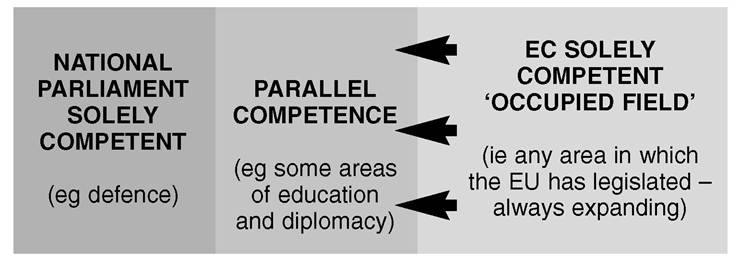
The principle of attribution of powers is supplemented by the key concept of subsidiarity. According to this concept, as it may be understood in its strict legal sense, the Community not only has to show that it has the power to act, but must also justify why it and not the Member State should act. There is, however, an important qualification on the operation of this principle, in that it cannot be applied to matters falling within the Community’s exclusive competence, sometimes referred to as the occupied field. In short, it is intended to operate only in relation to those areas where the Community has a parallel competence with Member States.
Proportionality
The third principle, that of proportionality, as expressed in the last sentence of Article 5, applies not only to areas of parallel competence, but also to areas of exclusive competence.
It requires that the measure of Community action must be in proportion to the objective being pursued.Examples of competences in EU law are shown the diagram below.
Sources of Community law
3 Primary sources
• The Treaties as amended
3 Secondary sources
• Regulations
• Directives
3 Other sources
• Recommendations and Opinions
• Decisions of the European Court of Justice (ECJ)
Article 249 of the EC Treaty defines the different types of legislation:
A regulation shall have general application. It shall be binding in its entirety and directly applicable in all Member States.
A directive shall be binding, as to the result to be achieved, upon each Member State to which it is addressed, but shall leave to the national authorities the choice of form and methods.
A decision shall be binding in its entirety upon those to whom it is addressed.
Recommendations and opinions shall have no binding force.
Therefore, only regulations, directives and decisions (and of course Treaty Articles) are legally binding, and only these can create rights on which individuals may rely before a national court or before the ECJ, Treaty Articles and regulations are directly applicable, in other words they become part of the domestic law of Member States without any implementing action being taken, whereas directives require implementation by domestic legislation.
The ECJ is the final arbiter on Community law. Under Article 234, national courts may seek a preliminary ruling from the ECJ on matters of Community law relevant to the case before them.
Supremacy of EC law
The supremacy of EC law is a doctrine that has been developed by the ECJ: there is no express provision in the Treaty as to whether Community law or nationa I law is to have priority.
In Costa v Enel (1964), the ECJ stated that the EEC Treaty, unlike any ordinary treaty, created a legal system that by virtue of accession became integral to the legal systems of the Member States.
Furthermore, by entering into the Treaty, the Member States had limited their sovereignty, in so far as the national courts were bound to apply EC law in preference to conflicting domestic legislation.In the Simmenthal case (1978), it was further clarified that every national court must
apply Community law in its entirety and protect rights which the latter confers on individuals and must accordingly set aside any provision of national law which may conflict with it, whether prior or subsequent to the Community rule.
Supremacy of EC law in the UK
In the UK there is a dualist approach to international law, which means that international law cannot become part of the domestic legal system until it is incorporated by an Act of Parliament. Therefore, in order for Community law to become part of the UK's domestic law, it had to be incorporated by the European Communities Act (ECA) 1972.
Section 2(1) of the ECA 1972 provides that directly applicable EC law is given effect without the need for further domestic legislation. Section 2(2) provides for the making of delegated legislation in order to implement EC obligations that would not otherwise be directly applicable. Section 2(4) provides that all subsequent UK legislation is to be construed and have effect subject to the provisions of s 2(1) and (2). Section 3 instructs the courts to decide any issues of Community law ‘in accordance with the principles laid down by... the European Court'. The 1972 Act therefore appeared to give effect to the supremacy of EC law.
However, doubts still remained as to what would actually happen if a domestic Act were passed after 1972 containing provisions inconsistent with Community law. Would s 2(4) of the ECA 1972 prevail and the conflicting domestic legislation be set aside? How could this be squared with parliamentary sovereignty?
Possible conflict with parliamentary sovereignty
As we saw in Chapter 2, the traditional view of sovereignty as advanced by Dicey is that Parliament is omnicompetent, and that no Act of Parliament will be invalidated by the courts.
Furthermore, it is always open to Parliament to repeal any previous legislation, and that in the case of conflict between two Acts of Parliament, the later repeals the earlier, and that therefore no Parliament could bind its successors. In short, there is no means for the entrenchment of legislation. Did this mean that the ECA 1972 was subject to the doctrine of ‘implied repeal'? For example, would the provision in s 2(4) of that Act that ‘any enactment. shall be construed and have effect subject to [Community law]' be overridden by subsequent inconsistent legislation? Clearly, if it were overridden, that would not be consistent with the supremacy of EC law as expressed in Costa v Enel (1964).
The courts managed for many years to avoid the issue of a direct confrontation between EC law and domestic law, through the use of strong principles of statutory interpretation. Lord Denning MR explained the basis of this approach in Macarthys v Smith (1979):
In construing our statute, we are entitled to look to the Treaty as an aid to its construction; but not only as an aid but as an overriding force. If on close investigation it should appear that our legislation is deficient or is inconsistent with Community law by some oversight of our draftsmen then it is our bounden duty to give priority to Community law. Such is the result of s 2(1) and (4) of the ECA 1972.
Examples of such an approach include Garland v British Rail (1983), where a literal interpretation of a provision of the Sex Discrimination Act 1975 appeared inconsistent with Article 141 (then Article 119) EC (equal pay). However, the House of Lords was able to construe the provision in a manner consistent with the Article. This purposive approach to interpretation was taken further in the cases of Pickstone v Freemans plc (1989) and Litster v Forth Dry Dock (1990), where additional words were implied into domestic legislative provisions to ensure compatibility with Community law. However, it may be noted that Lord Denning MR in Macarthys did go on to state that if Parliament deliberately passed an Act with the intention of negating a provision of the Treaty, the courts would have to follow the statute.
The leading case in the UK on the question of sovereignty is R v Secretary оf State for Transport ex p Factortamel.M (No 2) (1991), which involved a direct conflict between UK legislation and Community law in a dispute involving fishing rights. The Merchant Shipping Act 1988 and its subordinate legislation sought to limit the extent to which foreign nationals could register as British vessel owners in order to prevent what was called ‘quota hopping'. The provisions were
challenged on the basis that they were in breach of Community law on a number of grounds, most obviously that they discriminated between EU citizens on the basis of nationality.
First, the House of Lords ruled that where it was established by the ECJ that a provision of domestic law was in breach of Community law, the provisions of Community law would prevail. On a further question of whether, pending a decision of the ECJ on the issue of breach, a national court could set aside domestic legislation by way of interim relief, the House of Lords ruled (reversing an earlier decision) that it could. The latter part of the decision followed a ruling of the ECJ that required national courts to set aside domestic legislation in such circumstances as existed in this case, namely, where the applicants would otherwise suffer very severe and irrecoverable damage.
On the question of sovereignty, Lord Bridge had this to say:
Some public comments on the decision of the Court of Justice, affirming the jurisdiction of the courts of the Member States to override national legislation if necessary to enable interim relief to be granted in protection of rights under Community law, have suggested that this was a novel and dangerous invasion by a Community institution of the sovereignty of the United Kingdom Parliament. But such comments are based on a misconception. If the supremacy within the European Community of Community law over the national law of Member States was not always inherent in the EEC Treaty it was certainly wel I estabiished in the jurisprudence of the Court of Justice long before the United Kingdom joined the Community. Thus, whatever limitation of its sovereignty Parliament accepted when it enacted the European Communities Act 1972 was entirely voluntary. Under the terms of the 1972 Act it has always
been clear that it was the duty of a United Kingdom court, when delivering final judgment, to override any rule of national law found to be in conflict with any directly enforceable rule of Community law. Similarly, when decisions of the Court of Justice have exposed areas of United Kingdom statute law which failed to implement Council directives, Parliament has always loyally accepted the obligation to make appropriate and prompt amendments. Thus there is nothing in any way novel in according supremacy to rules of Community law in areas to which they apply and to insist that, in the protection of rights under Community law, national courts must not be prohibited by rules of national law from granting interim relief in appropriate cases is no more than a logical recognition of that supremacy.
Conclusion
In summary we may say that the doctrine of implied repeal, under which inconsistencies between later and earlier legislation are resolved in favour of the later legislation, does not apply to clashes concerning Community and national law. If Parliament ever does wish to derogate from its Community obligations then it will have to do so expressly and unequivocally. The reaction of our national courts to such an unlikely eventuality remains to be seen. (See further P Craig, EU Law and National Constitutions: The UK (2003).)
Lastly, it is argued that parliamentary sovereignty is maintained by the very fact that any UK Parliament has the legal power to repeal the ECA1972. If it did so the constraints of Community law would be removed and all previously ‘disapplied’ legislation, such as the Merchant Shipping Act 1988, would return into full force. However, except in the unlikely event of repeal of the ECA 1972, the supremacy of EU law over domestic law will remain of fundamental constitutional importance.