The executive
Introduction
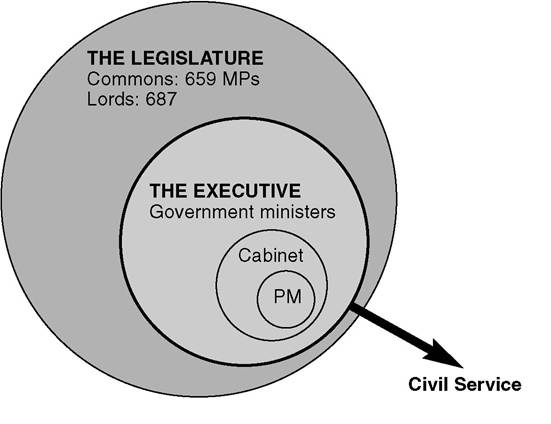
While we primarily identify the executive as the Prime Minister and his chosen Government ministers, the personnel of the executive in fact includes the staff of all Government departments and all civil servants.
The primary functions of the executive are to execute and formulate policies and to implement legislation. Beyond Government departments, the civil service undertakes the day-to-day administration of executive powers, such as the police force, which administers law and order, or the army, which undertakes the defence of the nation. However, in this chapter we shall use the term ‘the executive' in its particular sense, that is, to refer to those members of central Government holding executive power.Central Government
Appointment and powers of the Prime Minister
The appointment of the Prime Minister is by the monarch according to the convention that the monarch must appoint the MP who is best able to command a stable majority. Once appointed, the Prime Minister will appoint his cabinet. Constitutionally, the monarch makes the appointments to the cabinet on the advice of the Prime Minister. The Prime Minister also chooses which Government departments should be represented in cabinet, though certain ministers, such as the Chancellor of the Exchequer, the Foreign Secretary and the Home Secretary, will always hold a seat in cabinet. The recent creation of a Department of Constitutional Affairs and the discontinuance of the Lord Chancellor’s Department demonstrate the extent of the Prime Minister’s powers in this regard. It is also for the Prime Minister to decide whether cabinet members should remain in office.
Origins of the cabinet
The origins of cabinet government lie in the17th century and the creation, by King Charles II, of a small cabal of privy counsellors in order to alleviate the frustration of working through the full Privy Council.
Thus, far from being created by statute, the cabinet merely evolved out of the Privy Council and is still technically one of its committees. At first, the members of the cabinet were important court officials and not responsible to Parliament. However, in the 18th century, parliamentary power steadily increased and it became politically expedient for the monarch to choose as close advisers politicians with sufficient influence in Parliament to secure the passage of measures, and especially financial measures, through the legislature.By the time of the Reform Acts of 1832 and 1867, the power of the monarch to appoint ministers without taking the advice of leading parliamentary figures was effectively
lost. With the expansion in the electorate came a growth in party politics. The cabinet then began to emerge as the dominant political body within the constitution, representing in government the collective leadership of the party that was able to command a majority in the House of Commons.
From this growing dominance of the cabinet emerged two conventions of the constitution, which are crucial to the working of modern cabinet government. The first is that ministers of the Crown are accountable, both collectively and individually, to Parliament; the second, that the Crown must act only as ministers advise it to act.
Out of the prominent party figures within the cabinet, it was inevitable that a leading figure would be recognised. It is from this that the office of Prime Minister evolved. Thus, as with the cabinet, its existence and powers are defined only by convention.
Exercise of executive power
Cabinet government
As the central decision-making body, the cabinet holds great power. We noted in Chapter 2 that there is a near complete fusion of the executive and legislature, such that the executive in effect now dominates the legislature. Lord Hailsham examined the progressive growth of executive power when he delivered The Dimbleby Lecture, entitled ‘Elective dictatorship', in 1972.
Lord Hailsham traced the movement within our constitution from medieval monarchy to modern democracy, and noted:There has been a continuous enlargement of the scale and range of Government itself. The checks and balances, which in practice used to prevent abuse, have now disappeared.... Until comparatively recently Parliament consisted of two effective Chambers. Now for most
practical purposes, it consists of one. Until recently, the power of the Government within Parliament was largely controlled either by the Opposition or by its own Backbenchers. It is now largely in the hands of the Government machine. Until recently, debate and argument dominated the Parliamentary scene. Now, it is the whips and the Party Caucus... Debate is becoming a ritual dance, sometimes interspersed with catcalls.
Prime ministerial government?
A lot of recent debate surrounds the relationship between the Prime Minister and the cabinet, and has focused on the apparent dominance of the Prime Minister over cabinet colleagues. It is argued that, having moved from parliamentary government to cabinet government, we have now moved to prime ministerial government. Supporting such a view, ex-cabinet members such as Mo Mowlam and Claire Short have expressed frustration at the side-lining of the cabinet, arguing that the Prime Minister has become increasingly presidential, and that the role of cabinet has been replaced by an inner coterie of unelected advisers. However, commentators such as Peter Hennessy, in The Prime Minister: The Office and its Holders since 1945 (2001), concludes that the extent of prime ministerial dominance will depend very much upon the individual personality of the incumbent Prime Minister and that broad generalisations should not be drawn. Furthermore, he submits that little has changed in recent times, in that the Prime Minister is still ultimately dependent on the consensus of his cabinet and his party to remain in office. The resignation of Margaret Thatcher in 1990 reveals how even a powerful Prime Minister can lose office through the loss of support amongst her cabinet.
Ministerial responsibility
There are two central conventions under the constitution to ensure the executive’s accountability to Parliament, and ultimately to the electorate:
3 Collective ministerial responsibility.
Individual ministerial responsibility.
Collective responsibility
Government must speak with one voice.
Cabinet discussions are confidential.
The Government must resign if it loses a ‘confidence vote’.
Government must speak with one voice/confidentiality
The underlying rationale to this convention and the convention of confidentiality is the need for the Government to present a united front. The classic expression of the importance of collective responsibility in this regard remains that of Lord Salisbury:
For all that passes in Cabinet, every member of it who does not resign is absolutely and irretrievably responsible... It is only on the principle that absolute responsibility is undertaken by every member of the Cabinet, who, after a decision is arrived at remains a member of it, that the joint responsibilities of Ministers to Parliament can be upheld and one of the essential responsibilities of parliamentary responsibility established. (Official Report, HC, 1878)
At basis, all members of the cabinet must accept and publicly defend decisions made in cabinet, or else resign. Furthermore, the convention of confidentiality allows members of the cabinet to discuss things freely, in the knowledge that any disagreement will be protected from the
public gaze. On occasions the convention of presenting a united front has been suspended, most notably in 1975 for the period of the referendum on continuing European Community membership, where cabinet members were permitted to campaign on either side. More recently, the Major Government ‘agreed to differ' on the single currency issue, uniting under the agreed ‘wait and see' formula.
It may be noted that owing to the modern expansion of government and in order to relieve the pressure on the full cabinet, most decisions are not made in cabinet but in smaller cabinet committees.
There are both permanent and ad hoc committees, and nowadays they constitute the heart of Government policy-making. The Prime Minister determines the identity and composition of these cabinet committees, and most are chaired by leading members of the cabinet. The convention of collective responsibility equally applies to these committees, in that their recommendations must, in normal circumstances, be accepted by the cabinet. This extension of the principle of collective responsibility has been criticised, in that members of the cabinet will frequently not be party to the decision made by a cabinet committee. For example, Michael Heseltine resigned in 1986 following a decision made by a cabinet committee on the future of the Westland Helicopter company, and after Margaret Thatcher had refused to have the matter discussed in the full cabinet.Confidence rule
A Government must resign if it loses the support of the elected chamber. The principle is that where a confidence vote is tabled and lost by the Government, the Prime Minister must resign and seek the dissolution of Parliament. The convention is of crucial significance to the operation of the UK constitution. It goes to the very heart of the relationship between the executive and the legislature. Some would argue
that it is too unwieldy a power for Parliament to use effectively, in so far as it is an ‘all or nothing' decision to support or not to support; nonetheless, it is the ultimate guarantee that the executive acts with the authority of Parliament.
The convention can actually serve to strengthen the position of the executive. Thus, when John Major and his cabinet suffered a defeat in Parliament in July 1992 on a motion relating to the Maastricht Treaty on European Union (largely at the hands of backbench ‘euro-sceptic' rebels), he was able to restore his authority by putting down a motion of confidence for the following day. The motion inevitably secured a majority, as the rebels within his party knew that its defeat would have led to the dissolution of Parliament and the possibility of the Labour Party winning the ensuing general election.
Individual ministerial responsibility
On a day-to-day level much of the administration of executive powers and policies is carried out by the civil service, both in government departments and more widely in the provision of public services. How is the exercise of these powers to be made accountable to Parliament? One of the important features of the civil service is its claim to political neutrality. In particular, civil servants in government departments are meant to remain as the anonymous ‘advisers' of government ministers. It is felt that without such anonymity their position of permanency within our constitution would be threatened.
To protect this position off anonymity an d neutrality, ministers are expected to take responsibility for the civil servants under them. Therefore, ministers are not only responsible to Parliament in a collective sense for the policies of the Government as a whole, but are also responsible in an individual sense for their own actions and those of their
departments. In effect, ministers stand as the link between the civil service and Parliament. They will do so by answering parliamentary questions, by introducing and defending Bills, by participating in debates in Parliament and by appearing before Select Committees (see Chapter 5, below).
But are ministers constitutionally responsible for every action undertaken by their civil servants, and what does accepting responsibility entail? The question was central to what has become known as the ‘Crichel Down Affair'. In 1939, the Air Ministry compulsorily acquired Crichel Down, an area of farmland in Dorset. After World War II, the land was transferred to the Ministry of Agriculture, which refused a request from the original owners to repurchase it. This refusal was accompanied by misleading replies and the matter was taken up in Parliament. In 1954, following an inquiry which found ‘inefficiency, bias and bad faith' on the part of some officials, the minister, Sir Thomas Dugdale, accepted responsibility and resigned.
The most important constitutional aspect of this affair is the subsequent statement by the Home Secretary, Sir David Maxwell-Fyfe, in the House of Commons, on the question of when ministers must accept responsibility for the actions of their civil servants. The Home Secretary made it clear that such a constitutional duty existed where the civil servant was carrying out either Government policy or the explicit orders of the minister. If a civil servant caused delay or made a mistake, but not on a major issue of policy, or not where individual rights were seriously affected, the minister must again acknowledge responsibility and ensure that corrective action was taken within the department. The minister was deemed not to be under such a constitutional duty where, otherwise than as above, the minister had no previous knowledge and disapproved of the action taken by the civil servant. This leads us to the second issue, that is, having taken responsibility for
the actions of their civil servants, when are ministers under an obligation to resign?
It is notable that subsequent to the Crichel Down Affair there have been many instances of serious departmental failings that were not followed by ministerial resignations. Indeed, the only clear example of a resignation for a departmental failure since Crichel Down is that of Lord Carrington, who resigned as Foreign Secretary following allegations that the British forces were ill-prepared for the Argentinean attack at the start of the Falklands War. This has led some to suggest that the Crichel Down Affair represents the ‘high water mark' for the classic doctrine of individual ministerial responsibility.
For example, in 1984, following a break-out of terrorists from the Maze Prison, James Prior, the then Northern Ireland Minister, refused to resign despite calls to do so. In parliamentary debate, the minister distinguished between his responsibilities for policy matters as opposed to operational matters. He asserted that he could not be held responsible for the failure of officials to carry out orders or procedures as instructed. Michael Howard adopted much the same reasoning in refusing to resign in 1994, following escapes from Whitemoor Prison. More recently, Stephen Byers resisted calls for his resignation after the failure of his department to make progress with plans for improvements to the transport infrastructure. He did eventually resign in 2002, though it is argued that this was more in response to pressure from the press than any obligation under the convention.
Other recent examples of ministerial resignations appear to result more from the failings or indiscretions of the ministers themselves than from the actions of their civil servants. For example, Edwina Currie resigned after creating a furore by stating that the majority of eggs in the UK were infected with salmonella. Nicholas Ridley similarly resigned after making
inappropriate remarks about another Member State of the EU. Personal scandals would appear to provide the most common cause of resignation in recent times, such as in the cases of Cecil Parkinson, David Mellor, Jonathan Aitken, Peter Mandelson and Ron Davies.
In conclusion, it may be said that the size and complexity of modern government departments, as well as the frequently short tenure of ministerial office, make it impractical for a minister to assume responsibility for every decision taken. Furthermore, much has changed in the operation and structure of the civil service since Crichel Down. For example, much government departmental work has been ‘hived-off’ to semi-autonomous Next Step agencies responsible to their own chief executives.
The obligation to resign appears to play little part in the modern doctrine. Indeed, in Ministerial Accountability (1996), Sir Richard Scott, referring to the statement of Sir David Maxwell-Fyfe, argued that resignation is not ‘at the heart of an effective system of Parliamentary accountability’. It was his view that the resignation of a minister served for nothing in bringing a clear account of events before Parliament. He believed that, rather than resignation, what lay at the centre of the doctrine of ministerial responsibility was ‘An obligation of ministers to give, or to facilitate the giving, of information about the activities of their departments and about the actions and omissions of their civil servants’.
In the next chapter we consider further means by which the executive is held to account, in particular the parliamentary oversight provided by Select Committees and the judicial oversight provided by judicial public inquiries.
More on the topic The executive:
- Reform?
- 7.5.2 REGULATIONS
- Glossary of Terms
- 3.3.1 RESEARCHINGSTATUTORYISSUES
- Abstract
- The End of the NRPB
- Public Interest Litigation (PIL): A Deficit for Democracy, Dying Working Class Politics and the Emergence of Middle Class
- The Four Key Elements of the British Empire
- EXERCISE
- In Defence of a Five-Power Constitution