The legislature
The UK Parliament is composed of the Crown, the House of Lords and the House of Commons. At the end of this chapter we will also examine the devolution of power to the Northern Ireland Assembly, the Scottish Parliament and, to a lesser extent, the Welsh Assembly.
The House of Commons
The functions of the House of Commons
The functions of the House of Commons are:
to represent the views and grievances of all sections of society;
3 to scrutinise the executive;
3 to legitimise Government actions.
State of the parties at January 2004
| Party | Number of seats |
| Labour | 408 |
| Conservative | 163 |
| Liberal Democrat | 54 |
| Scottish National Party/Plaid Cymru | 9 (SNP 5/PC 4) |
| Democratic Unionist | 5 |
| Sinn Fein | 4 (have not taken their seats) |
| Social Democratic & Labour | 3 |
| Independent Unionist | 3 |
| Ulster Unionist | 3 |
| Independent/other | 3 |
| Speaker and 3 Deputies | 4 (do not normally vote) |
| Total | 659 |
| Government majority | 161 |
Composition and procedure in the House of Commons
There are 659 MPs divided across the two sides of the House, reflecting the adversarial nature of business in the House of Commons.
Both sides of the House have front and backbenchers. The Speaker, acting with political impartiality, regulates the proceedings and controls debates in the House. The Speaker chooses who is allowed to speak in debate and will seek to respect the rights of minorities to participate. He or she also has powers of censure.As we have already noted, under the constitution, Parliament ultimately exercises control over the Government in so far as it can withdraw its support. The very survival of the Government depends on this day-to-day support for its legislative programme. To counterbalance this parliamentary power, certain practices have developed over time to ensure that the Government of the day can count upon its legislative support.
The whips
With the growth in enfranchisement and universal adult suffrage came the corresponding growth in political parties. Originating as a loose association of like-minded individuals elected to office, these political parties soon developed an infrastructure and whip system. The purpose of the whip was (and still is) to maximise party effect by ensuring a disciplined collective vote on legislative matters.
It might be thought that it is not unreasonable for a Government comprising ministers drawn exclusively from members of one political party, predominantly within the House of Commons, to expect the support of colleagues committed to implementing the same election manifesto. Nevertheless, there has been criticism that the demands of party loyalty have done much to undermine the individuality of
elected representatives, who, far from calling the executive to account for its legislative proposals, may be seen to act as mere lobby fodder for the party machine they serve.
Allocation of Parliament's time
On 75% of the days on which Parliament sits, Government business takes priority. The Opposition is allocated 20 days in each parliamentary session in which they can determine the business of the day. However, the main constitutional purpose of the Opposition is to probe and call the Government to account.
Opportunities for others outside government to initiate debate are limited. Standing orders provide an opportunity to initiate an emergency debate, propose a Bill under the Ten Minute Rule o rspossor aPrivateMember’s Bill. Furthermore, at the end of the day's business, members may initiate an adjournment debate on local or personal issues.Clearly, parliamentary time is at a premium, and it is the task of the Leader of the House (responsible to the Prime Minister) to ensure that such time as is available is maximised to ensure the smooth passage of the Government's legislative programme for the parliamentary session. To this end, the Government has considerable procedural powers at its disposal, including the guillotine (allocation of time motion), under which the time made available for debate at one or more stages of a Bill can be restricted.
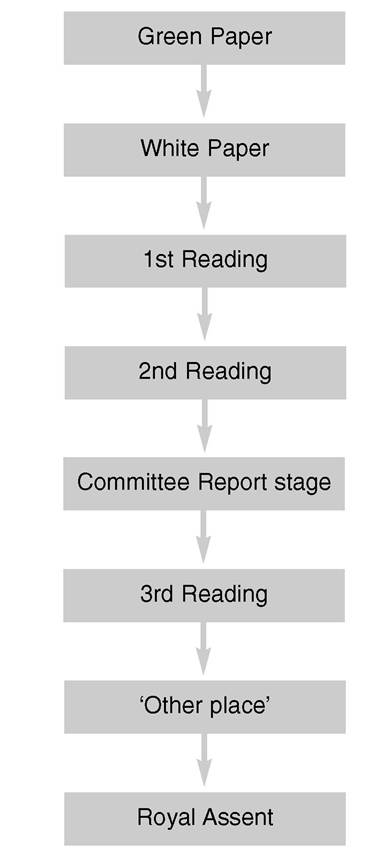
Legislative steps (through both Houses)
The planning of future Government legislation begins within cabinet and cabinet committees. Normally, prior to the introduction of a Bill on matters of public importance, there is a Green (that is, consultative) Paper and/or a White Paper (that is, a statement of policy). Formal stages of the legislative process begin with a First Reading (formal introduction of the
proposal). This is followed by a Second Reading (where the principles of the Bill are considered). After its Second Reading, the Bill progresses to a committee stage. This usually takes place in a Standing Committee, but may be taken in Committee of the whole House or a special Standing Committee. The committee must consider each clause and Schedule of the Bill, agreeing or disagreeing to a motion that it ‘stand part' of the Bill. The committee may also consider amendments to the Bill. Following this, the Committee reports to the House. Finally, the Third Reading and vote completes the Bill's passage through the House of Commons. The Bill then progresses to the House of Lords, where, although procedures vary, the stages are much the same as in the Commons.
Once the Bill has received a Third Reading in the Lords, and agreement is reached between both Houses on any consequent amendments, it is presented for royal assent, which, by convention, should not be withheld.
Legislative steps by which a Government Bill becomes an Act of Parliament
Other legislation
Private Bills and Hybrid Bills Different parliamentary stages apply to Private Bills (which are promoted by individuals or bodies and generally relate to matters of private as opposed to public or general interest) and Hybrid Bills (which relate to matters of general interest, but in reality affect only the interests of certain individuals or organisations). Such Bills have limited success in becoming law but often serve to make a political point. The procedures involved and the statistics of their success are available on the House of Commons website (via www.parliament.uk).
Delegated legislation Statutory instruments (SIs) are a form of legislation that allows the provisions of an Act of Parliament subsequently to be brought into force, or altered without Parliament having to pass a new Act. They form the great bulk of the legislative provisions that become law in any session. They are also referred to as secondary or subordinate legislation. The scope of these powers varies greatly: on the one hand they may simply be technical, in so far as they provide the date on which different provisions of an Act come into force, or they may change the levels of fines or penalties for offences; on the other hand, they may provide much wider powers, for example, many parent Acts are drawn broadly, leaving secondary legislation to fill out the details. SIs are just as much a part of the law of the land as an Act of Parliament. However, it will be noted, in contrast to primary legislation, that the courts can question whether a minister, when issuing an SI, is acting within the powers actually given by the parent Act.
Parliamentary scrutiny The parent Act determines whether an instrument is subject to parliamentary procedure. Some SIs are not ‘laid’, and as such are not subject to any parliamentary procedure and simply become law on the date stated in them. Such instruments are, in general, not contentious. However, many SIs are subject to parliamentary control. The various procedures to be followed are laid down in the Statutory Instruments Act 1946.
To help with theparliamentary examinationofS I sthe re is a Joint Committee of both Houses on Statutory Instruments (sometimes called the Scrutiny Committee). This Committee may, like other Select Committees, take oral or written evidence from the responsible Government department on any instrument it is considering. The Scrutiny Committee does not consider the merits of any SI. It is responsible for ensuring that a minister’s powers are being carried out in accordance with the provisions of the enabling Act.
Scrutiny of the executive through parliamentary questions
Parliamentary question time in the House of Commons provides one of the principal means by which information can be obtained from ministers about their department, and necessarily underpins individual ministerial responsibility and accountability. Questions may be put to ministers for either oral or written answers.
Prime Minister’s Questions (PMQs) occur once a week for 30 minutes. The questions posed by members should concern matters for which the Prime Minister carries responsibility and not matters that fall within an individual minister’s responsibility. Generally, however, questions will concern overall Government policy in areas such as the economy, or foreign affairs or health. The strength of PMQs lies in the lack of notice given and the fact that the Prime Minister must be able respond to questions concerning any area of Government policy.
Scrutiny of the executive through Select Committees and public inquiries
The Select Committees of the House of Commons provide a more in-depth means to scrutinise the executive.
Select Committees take various forms; some, for example, scrutinise proposed legislation, such as the European Legislation Committee or the Joint Committee (that is, of both Houses) on Human Rights. Departmental Select Committees are most obviously concerned with the issue of accountability. These were introduced in 1979 as a result of dissatisfaction with the previous means of monitoring departments. The committees have broad powers to examine the work of a department in any area they think appropriate. The extent to which Government can be called to account by these committees was exemplified by the Foreign Affairs Select Committee’s examination of the decision to go to war in Iraq in 2003. The Committee rigorously questioned many of the leading participants, including the Foreign Secretary and the Prime Minister’s then special adviser Alistair Campbell.Nevertheless, some would argue that Select Committees are not effective enough in bringing Governments to account. For the most part Government departments do co-operate with Select Committees, but ministers cannot be compelled to attend before the committee or to answer specific questions. Limitations were particularly apparent following an investigation in 1992 by the Select Committee on Trade and Industry into the ‘arms to Iraq’ affair. The investigation concerned the supply of equipment to Iraq that allegedly could be used for military purposes. The Committee wished to establish information relating to the export licences, but was frustrated by a lack of co-operation from the Government. Separate judicial proceedings were brought against the directors of Matrix Churchill for obtaining these export
licences without revealing the military nature of this equipment. At the trial it emerged that the Government was fully aware of these exports and had known all along of the intended use of the equipment. The scandal led to a judicial inquiry by Sir Richard Scott. Sir Richard's 1,800 page Report made a number of important findings, not least that Parliament had been ‘deliberately' misled by Government ministers and that the Matrix Churchill trial ‘ought never to have commenced'. There was also particular concern at the use of public interest immunity certificates during the trial to withhold information ‘in the public interest', though the Report accepted that the Government had no intention of allowing innocent men to go to jail. In his assessment of the Scott Report, Professor Vernon Bogdanor noted: ‘... perhaps the deepest lesson of the Scott Inquiry is that Parliament is in danger of losing its capacity to bring ministers to account.'
The need for public inquiries?
The willingness of senior cabinet members, and even the Prime Minister himself, to appear before Select Committees in recent times perhaps suggests that some of the lessons of the Scott Inquiry have been learnt.
However, concerns regarding the effectiveness of Select Committees were once again voiced in the course of the Hutton Inquiry. The inquiry was established to investigate the suicide of Dr Kelly, a scientist and senior adviser, following the publication of a dossier on Iraqi weapons capabilities. The investigation concerned the issue of whether or not the relevant dossier had been ‘sexed up' by Downing Street to further the case for war. A BBC journalist reported that this was Dr Kelly's view. The Government vehemently denied the allegation. The allegation had been investigated by both the Foreign Affairs Select Committee and the Intelligence and Security Committee. Some have argued that the subsequent
judicial inquiry uncovered a great deal more of the background to the matter and was more revealing of the ‘machinations' within Government than the Select Committees' reports, thereby criticising the Select Committees' effectiveness at getting to the bottom of matters in executive actions. However, this criticism perhaps overlooks the different mandate of the Hutton Inquiry - ‘to conduct an investigation into the circumstances surrounding the death of Dr Kelly' - and the need for a wide-ranging public investigation where events have led to death. By contrast, the Intelligence and Security Committee's remit was limited to an examination of ‘whether the available intelligence, which informed the decision to invade Iraq, was adequately and properly assessed and whether it was accurately reflected in government publications'.
The House of Lords
The functions of the House of Lords
The functions of the House of Lords are:
3 as a forum for debate on matters of public interest;
3 revision of Bills from the House of Commons; initiation of Bills;
3 consideration of delegated legislation;
3 scrutiny of the executive;
3 Select Committee work;
3 as the Supreme Court of Appeal.
Composition of House of Lords at January 2004 (by type)
Archbishops and bishops 24
Life Peers under the Appellate Jurisdiction Act 1876 27
Life Peers under the Life Peerages Act 1958 (109 women) 537 Peers under House of Lords Act 1999 (4 women) 92
TOTAL 680
Composition of House of Lords at January 2004 (by party strength)
| Party | Life Peers | Hereditary | Bishops | Total |
| Conservative | 160 | 49 | 209 | |
| Labour | 181 | 4 | 185 | |
| Liberal Democrats | 59 | 5 | 64 | |
| Cross bench | 146 | 33 | 179 | |
| Archbishops and | ||||
| Bishops | 24 | 24 | ||
| Other | 7 | 7 | ||
| TOTAL | 553 | 91 | 24 | 668* |
* Excludes 12 peers on leave of absence.
Power and influence of the Lords
Parliament is bicameral, that is, it consists of two legislative chambers. The House of Lords is still referred to as the Upper House. At one time this accurately reflected its significance in relation to the other chamber, the House of Commons. But the continuing growth in democracy led to the elected lower chamber acquiring increasing significance until, at the
beginning of the 20th century, it successfully challenged the Upper House for constitutional supremacy.
Prior to 1911, the House of Lords enjoyed equal powers with the Commons over legislation, except that, by convention, the Lords would not veto any financial measures. However, in 1909, a conflict arose when the Lords rejected a Finance Bill in breach of the convention. As a result of this conflict the Parliament Act 1911 was passed, which abolished the House of Lords' right to reject Money Bills and limited the time for which it could hold such Bills in review to one month. Furthermore, the Lords' rights to reject non-Money Bills was also abolished and replaced by a power to delay such Bills for a two-year period. Following further conflicts, the Parliament Act 1949 reduced the power of delay over non-Money Bills to one year. In reality the Parliament Acts are infrequently used, first, because the House of Commons accepts a great many of the amendments made in the Lords and, secondly, because the House of Lords is necessarily cautious about subverting the democratic authority of the Commons. Recent examples of the use of the Parliament Acts are the European Parliamentary Elections Act 1999 and the Sexual Offences (Amendment) Act 2000.
The importance of the House of Lords' function as a revising chamber should not be underestimated. Often the debate on legislation is far more in-depth and of a far better quality than in the House of Commons. The debate in the Commons on legislation is frequently marred by an adversarial approach and by party political point scoring. The debate in the Lords is usually more constructive than this, the quality of the speeches is high and overall the Lords have tended to be more liberal over social and moral rights. Some would argue that this results from the fact that the Lords do not currently have an electorate to please and that they are not subject to Government pressure to the same degree as their colleagues in the Commons. For example, the whips are
less domineering and there is less use of the guillotine in debates. Thus, the members of the House of Lords are perhaps more readily able to view things in terms of the national interest than are their elected colleagues, who are obliged to take constituency and party interests into account. However, it has long been thought an anomaly that an unelected and unrepresentative chamber with its origins in patronage should hold power within the constitution.
Reform of the House of Lords
| 3 Reform and proposals for reform: | |
| • | Parliament Act 1911 |
| • | Parliament Act 1949 |
| • | Leave of Absence Act 1958 |
| • | Life Peerages Act 1958 |
| • | Parliament (No 2) Bill 1969 (dropped after second reading) |
| • | Peerage Act 1963 |
| • | House of Lords Act 1999 |
3 Further proposals:
• A House for the Future - Royal Commission’s Report (2000)
• The House of Lords, Completing the Reform - White Paper (2001)
• Joint Committee of House of Lords Reform (2002—)
- First Report (December 2002)
- Second Report (April 2003)
- Government’s response (July 2003)
• Constitutional Reform: Next Steps for the House of Lords - White Paper (2003)
The first phase of reform
Labour abandoned its abolitionist stance at the 1992 general election, and instead committed itself to the reform of the
House of Lords in its 1997 Manifesto. In 1998, there were 759 hereditary peers out of a total membership of 1,272. The first phase of reform, completed in Labour's first term, saw the removal of the majority of these hereditary peers under the House of Lords Act 1999. Ninety-two peers were allowed to remain for a transitionary period, though their right to sit will be axed at the next stage.
Concurrent with this legislation, proposals were made for an Appointments Commission; this began work in May 2000. It consists of representatives of the three main political parties and four independent figures. The Commission's present role is to make recommendations on non-party appointments, previously under the control of the Prime Minister. However, party appointments remain unchanged. It should also be remembered it is still the Prime Minister who passes on all recommendations to the Queen.
In April 2001 the Appointments Commission announced 15 nominations to the cross benches (dubbed ‘the people's peers'). The announcement received criticism in the press on the basis that those nominated were the kind of establishment figures who might well have been nominated under the old system. However, it is doubtful whether the phrase ‘the people's peers' adopted by the media correlates to the Commission's criteria for application. A date for a second round of appointments is yet to be set, but the Commission continues to accept nominations.
The second phase
The 2001 Labour Manifesto stated that the Government would complete the second phase of House of Lords reform by implementing the conclusions of the Royal Commission led by Lord Wakeham: A House for the Future (January 2000). A key recommendation of the Lord Wakeham's Report was the creation of a statutory Commission responsible for all
appointments to a second chamber, not just cross benchers. This effectively would end party political appointments. Political parties could continue to submit names to the Commission, but there would be no guarantee that the Commission would decide to accept these nominations. Also of importance in the Wakeham recommendations were the proposals for a ‘significant minority' of elected members.
Following on from this, the Government presented a White Paper to Parliament in November 2001 - The House of Lords, Completing the Reform - based on the following principles:
3 The House of Lords should remain subject to the preeminence of the House of Commons in discharging its functions.
3 No group in society should in future have privileged hereditary access to the House.
3 The House of Lords' principal functions should continue to be to consider and revise legislation, to scrutinise the executive, and to debate and report on public issues.
3 Membership should be separated from the peerage, which would continue as an honour.
3 The House of Lords' political membership should be broadly representative of the main parties' relative voting strengths as reflected in the previous general election.
3 Its membership should be largely nominated, including a significant minority of independent members as well as members elected to represent the nations and regions within the UK.
3 There should be increased representation of women and those from ethnic minority backgrounds.
3 There should be a statutory Appointments Commission to manage the balance and size of the House, to appoint the independent members, and to ensure the integrity of those nominated by political parties.
As regards composition, the White Paper proposed that the House of Lords would eventually consist of:
3 120 independent members appointed by the Appointments Commission;
3 120 directly elected members;
3 16 bishops;
3 at least 12 Law Lords;
3 a balance of not more than 332 nominated political members where the number available to each party is determined by the Appointments Commission.
The reaction of the press and many MPs to the White Paper was hostile. Despite the reform package being largely based on the recommendations of the Royal Commission, Lord Wakeham himself indicated that he would not back the proposals as they stood. This was due to the omission of certain key recommendations, including his recommendation for an independent Appointments Commission responsible for all appointments. By contrast, under the White Paper, party political appointments remained to over half the House. In addition, Lord Wakeham had recommended fixed terms for the elected element of as long as 15 years. The White Paper proposed just five-year terms. According to Lord Wakeham this was inappropriate for a revising chamber.
There followed continued division within Parliament and the Government itself, particularly over the issue of whether Lords should be elected or appointed and, if elected, to what proportion of the House. In a change of mind, the Prime Minister himself advocated a position contrary to the White Paper in supporting a fully appointed House of Lords.
With these continuing difficulties the White Paper's proposals on reform were abandoned. Instead, the Government passed the next stage on Lords reform to
Parliament. A Joint Committee of both Houses on reform was established, ‘in the hope that we can forge the broadest possible parliamentary consensus for the way forward'.
However, the Joint Committee has met with little success in establishing consensus. Its First Report in December 2002 proposed a number of different compositions for the House of Lords, with varying numbers of elected members, ranging from fully appointed to fully elected. In February 2003 a vote was taken in both Houses on the various ratios, but other than the Lords themselves voting in favour of a fully appointed chamber, there was no consensus achieved on what composition was desirable. The basic objections to each alternative may be summarised as follows:
3 A fully appointed House would amount to no reform at all as it would perpetuate the system of patronage that reform had sought to address.
3 A fully elected House, on the other hand, would challenge the primacy of the House of Commons and undermine the current bicameral system of Parliament.
3 A hybrid House of partly elected, partly appointed members would create a position where some members would have a greater mandate than others, and would be a fudged, constitutionally unstable compromise.
The result has been that reform has been stalled, or, as the Joint Committee put it in its Second Report in April 2003, ‘Even if the engines have not actually fallen off the train, their thrust has been diminished'. However, the Joint Committee goes on to state that maintaining the status quo is unacceptable, and furthermore asserts that despite the lack of consensus on composition, there are many areas in which there is consensus, such as the value of maintaining the House's traditional legislative, revising and scrutinising functions. The Committee goes on to recommend that the
debate should be widened beyond the narrow issue of numerical composition, and states its purpose to be:
... to wrestle with the objections to the past options we have put forward and endeavour to devise an electoral model which meets them - one which is democratic, which will lead to a membership which will make it both effective and legitimate, but which will ensure that the second chamber neither duplicates the composition of the Commons nor receives a mandate from the electorate which allows it to challenge the Commons' primacy.
The Committee proposes to look to models of indirect election to the second chamber and/or of election by secondary mandate (for an explanation of these models see the Second Report). In considering the way forward the Committee lists five qualities that it seeks to achieve in a reformed second chamber:
3 legitimacy;
3 representativeness;
3 no domination by any one party;
3 independence;
3 expertise.
While consensus has not been achieved on the question of whether the Lords should be appointed or elected, the Government has nonetheless pushed ahead with other reforms. In June 2003, it produced White Papers on the abolition of the post of Lord Chancellor and the establishment of a Supreme Court and a Judicial Appointments Commission. In September 2003, the Government introduced a further White Paper, Constitutional Reform: Next Steps for the House of Lords. Its proposals are said to mark ‘the next, but not the final, stage of Lords reform'. Proposals include the removal of the remaining hereditary peers and the transfer of many of the
Prime Minister’s powers of appointment to a newly empowered Appointments Commission. The paper proposes that the Commission will determine the number and timing of appointments to be made to the House; select independent members entirely; and oversee party nominations, including vetting them on grounds of propriety. Clearly, this falls short of the promised second phase of reform, though the Government promises to consider further major reform in its next manifesto.
Devolution
Since coming to power in 1997, the Labour Government has brought about changes in devolved government in Scotland, Wales, Northern Ireland and London. However, Parliament at Westminster still retains its sovereignty and the Acts of Union have not been repealed:
3 The Scotland Act 1998 was passed by Parliament pursuant to a referendum in September 1997. The resulting Scottish Parliament, which first met in 1999, has law-making power over the legal system, police and the penal system, economic development, industrial assistance, education and training, and also has taxvarying powers. It is elected every four years and elects a First Minister from among its number who then appoints an executive.
3 The Government of Wales Act 1998 was passed following a poor vote of approval in a referendum of Welsh people in 1997. The Welsh Assembly has no taxvarying power and can make only secondary legislation. Its function is mainly to carry out the executive functions of the old Welsh Office. It is elected every four years and is headed by a First Minister elected from the Assembly who then appoints Assembly Secretaries.
3 The Northern Ireland Act is primarily different because of the circumstances in which it was born, as it is intended to take into account the varying sections of the community that it represents. To this edd there isan Assembly, North-South Ministerial Council, British-Irish Council and British-Irish Inter-Governmental Conference. The arrangements for devolved government were set out in the Good Friday Agreement, which had been agreed as a result of the peace process. The new institutions have not had an easy ride since power was devolved on 2 December 1999. Following another crisis in the peace process, the institutions of the devolved government in Northern Ireland were suspended, resulting in the reimposition of direct rule. There had been three short suspensions in 2000 and 2001, but a fourth, indefinite period of suspension began in October 2002. Elections to the Assembly were held on 26 November 2003; however, the Assembly remains suspended.
3 The Mayor of London has a wide range of specific powers and duties, and generally may do anything to promote the economic and social development of London. The Mayor is scrutinised by the London Assembly and together they make up the Greater London Assembly. Both are elected every four years.
Recent developments
A White Paper on regional assemblies in England appeared in 2002 but proposed only limited powers for elected regional assemblies. Proposed powers might include control of EU funds, housing funding allocations, tourism, heritage, museums, library functions, arts and sport funding. Following on from this, the Regional Assemblies (Preparations) Act 2003 was passed, but it deals only with referendums and electoral boundary reviews, and leaves the decision as to
what powers a regional assembly would have, if established, to later legislation. Despite the Government's continuing commitment to regional government in England, the process is likely to be prolonged.
Following the successful ‘bedding down' since devolution, a reshuffle in June 2003 remodelled the devolution arrangements at Westminster and Whitehall. The announcement saw the ending of full-time cabinet positions for the Scottish and Welsh Secretaries. The Scotland and Wales Offices have now been relocated within the newly created Department for Constitutional Affairs. It should be remembered that devolution does not alter the normal election of MPs to Westminster from constituencies in Scotland, Wales and Northern Ireland, though MPs may also hold seats in the regional parliament or assembly.
Electoral law
General election results 1979-2001
| 1979 | 1983 | 1987 | 1992 | 1997 | 2001 | ||
| Labour | Votes (%) | 36.9 | 27.6 | 30.8 | 34.4 | 43.2 | 40.7 |
| Seats (%) | 42.4 | 32.2 | 35.2 | 41.6 | 63.3 | 62.5 | |
| Conservative | Votes (%) | 43.9 | 42.4 | 42.3 | 41.9 | 30.7 | 31.7 |
| Seats (%) | 53.4 | 61.1 | 57.8 | 51.6 | 25.0 | 25.2 | |
| Liberal* | Votes (%) | 13.8 | 25.4 | 22.6 | 17.8 | 16.8 | 18.3 |
| Seats (%) | 1.7 | 3.5 | 3.4 | 3.1 | 7.0 | 7.9 | |
| Others | Votes (%) | 5.3 | 4.6 | 4.3 | 5.9 | 9.3 | 9.3 |
| Seats (%) | 2.5 | 3.2 | 3.6 | 3.7 | 4.8 | 4.4 |
* 1979: Liberal; 1983/1987: Liberal/SDP; 1992: Liberal Democrats.
First-past-the-post
The electoral system used in the UK for elections to the House of Commons is the single member constituency with simple majority system, also known as the first-past-the-post system (FPTP). The candidate who gets the largest number of votes is elected as Member of Parliament for that constituency, regardless of whether he or she has more than 50% support. The party with the most seats in Parliament, regardless of whether or not it has a majority across the country, normally becomes the next Government.
The advantages of this system are that it is a simple system for the voter to understand and, generally, it produces the clearest majorities. Clear majorities make for more stable government. However, on the other hand, ‘landslide elections’ are also more likely to occur, which can lead to an unaccountable executive. A greater criticism of FPTP is that the overall percentage of seats obtained in Parliament by a party is not proportionate to its overall percentage of votes in the country. The system works in such a way that if a party is consistently in second or third place across the country, it may have a substantial number of votes overall but obtain very few seats. For example, the Liberal parties in 1983 obtained a quarter of votes cast and yet obtained only 3.5% of seats in the House of Commons. By contrast, larger parties that win many constituency seats with less than 50 % of the vote gain a disproportionate number of seats. In 2001, Labour obtained 40.7% of the votes in the UK but 62.5% of the seats in Westminster. Targeting marginaI constituencies in recent elections has enabled the Liberal Democrats to improve their ratio, but to many it remains an unsatisfactory return on votes cast.
Another argument against FPTP is that it renders a large proportion of votes ineffective. Only one MP is elected in each constituency, and therefore votes for unsuccessful candidates
are simply wasted (in contrast to most Proportional Representation systems - see below). This may be a cause of voter apathy. In ‘safe seat' constituencies, voters may feel that there is no point casting their vote at all, such as Conservative voters in Durham or Labour voters in Kensington.
Alternative systems
Most alternative systems are designed to make the number of seats won by a party more proportionate to the distribution of votes cast. Note that the generic term Proportional Representation (PR) is used for any system that introduces greater proportionality than FPTP.
Alternative electoral systems
| Single-member systems | Multi-member systems | Mixed systems |
| 5 First-Past-the-Post (FPTP) 5 Alternative Vote (AV) 5 Supplementary Vote (SV) | 5 Single Transferable Vote (STV) 5 Party List Systems | 5 Additional Member System (AMS) 5 The Alternative Vote Plus (AV+) |
Following the election in 1997, the Labour Government set up an Independent Commission, under the chairmanship of Lord Jenkins, to consider alternatives to FPTP. The Report summarised some of the main alternatives systems as follows:
The Alternative Vote (AV). The Alternative Vote, which like FPTP is based upon single member constituencies, is a majoritarian system. Winning candidates must secure the support of over half the voters in a constituency. The vote is exercised by recording
preferences against the candidates on the ballot paper. If no candidate receives more than half of the votes cast on the first count of first preference votes, the candidate who received the fewest first preference votes is eliminated and the voter's second preferences are distributed between the other candidates. This process continues until one candidate has achieved an overall majority. (A hybrid of this system is recommended for Westminster by the Jenkins Commission's Report - see below).
3 Supplementary Vote (SV). The Supplementary Vote system is similar in method and purpose to the Alternative Vote system, the key difference being that, under SV, voters are limited to indicating a first and second preference. Where candidates receive more than half of the first preference votes cast on the first count, they are deemed elected. If not, all but the top two candidates are eliminated and the second preferences on the ballot papers of the eliminated candidates are examined. The candidate with the greatest share of the resultant vote is elected. (This system is used to elect the Mayor of London.)
3 Single Transferable Vote (STV). The Single Transferable Vote system is essentially preferential voting (as in AV) in multi-member constituencies. Voters are able to rank as many candidates, both within parties and across different parties, as they wish in order of preference. Any of those candidates who reach a certain quota are deemed to have been elected. The surplus votes of candidates elected on the first count and the votes of those with fewest votes after subsequent counts are distributed on the basis of preferences to the remaining candidates until sufficient candidates reach the quota and are, as a result, elected. (This system is used in Northern Ireland, both for
local elections and elections to the European Parliament (MEPs).)
List Systems. There are many variations of this system. However, the basic model is quite simple: rather than voting for a specific candidate, electors vote for a party in a multi-member constituency or region, or sometimes a whole country. All the votes are counted and each party receives seats in the constituency in the same proportion as the votes it won in that constituency or region. Each party has a list of candidates, ranked according to the party's preference, published on the ballot paper. Candidates will be elected in order of that ranking. (This system was used in mainland Britain for elections to the European Parliament in 1999; note that Northern Ireland used STV.)
The Additional Member System (AMS). This is a mixed system: basically, AMS is a combination of the FPTP system and a list system. The purpose is to retain the best features of FPTP while introducing proportionality between parties through party list voting. Under AMS, voters cast two distinct votes - the first for a constituency candidate and the second a party vote. The allocation of additional members then serves to correct the disproportionality that arises from the election of single constituency candidates. (This system is used to elect members to the Scottish Parliament, the Welsh Assembly and the London Assembly.)
Electoral reform for Westminster
In considering reform for Westminster elections, the Jenkins Commission assessed each of the systems against the background of four ‘requirements'. These were:
3 broad proportionality;
3 the need for stable government;
3 an extension of voter choice; and
3 the maintenance of a link between MPs and geographical constituencies.
As the Commission pointed out, these four ‘requirements' are not entirely compatible.
In its conclusions, the Jenkins Report (1998) recommended a mixed system, that is, an AV system with a ‘top up' from a List System. The proposed system was termed Alternative Vote Plus (AV+). As with AMS, voters would have two votes - one for a constituency MP (elected on AV basis) and the other for a party of their choice. The Report suggested that 80-85% of MPs would be elected to their single seat constituency on an AV basis. In addition, to mitigate any disproportionality, a further 15-20% of MPs would be selected from a regional list according to the party vote.
The Government renewed its commitment to the reform of elections to Westminster in its 2001 election manifesto. It proposed to review the Jenkins proposals in the light of the experience of the new electoral systems already introduced for devolved government, the London Assembly and the European elections. It proposed that a referendum should be held before any changes are made at Westminster. Initial hopes that this would occur in the Government's second term have now evaporated. However, the positive reactions to the introduction of ‘PR' type systems elsewhere in the UK have created the impetus for further reform (see further www.prcommission.org). A major concern with the current system remains voter apathy and poor turnouts.
Parliamentary privilege

Both Houses of Parliament claim for their members privileges which, according to Erskine May's Parliamentary Practice, are necessary to each House, and without which they could not discharge their functions. Traditionally, Parliament claimed to be the sole and exclusive judge of its own privileges and of their extent (Parliament Case (1609)).
Privilege and the courts
The courts have recognised the existence of privileges and their necessity. In Stockdale v Hansard (1839), all the privileges required for the ‘energetic discharge' of Parliament's functions were conceded by the court ‘without a murmur or doubt'. In Prebble v Television New Zealnnd Ltd (1995), the Privy Council confirmed that the courts will not allow any challenge to be made to what is said or done within the walls of Parliament in relation to its legislative functions and the regulation of its established privileges. However, the courts have taken the view that it is for them to determine whether a matter before them truly falls within the realm of parliamentary privilege, especially if the rights of third parties are involved. In other words, it is not for Parliament alone to decide that privilege may be claimed in a particular case in order to exclude the jurisdiction of the courts. In R v HM Treasury exp Smedley (1985), Donaldson MR stated:
[It] behoves the courts to be ever sensitive to the paramount need to refrain from trespassing on the province of Parliament, or, so far as this can be avoided, even appearing to do so... I would hope and expect that
Parliament would be similarly sensitive to the need to refrain from trespassing upon the province of the courts.
Privileges
Freedom of speech
Foremost of the privileges is freedom of speech in Parliamentary proceedings, provided by s 9 of the Bill of Rights 1689. The effect of this privilege was described by Cockburn LCJ in the case of exp Watson (1869):
It is clear that statements made by Members of either House of Parliament in their places in the House, though they might be untrue to their knowledge, could not be made the foundation of civil or criminal proceedings, however injurious they might be to the interest of a third party.
For a recent example see R v A (2002), where an individual failed in her attempt to seek redress in the courts against an MP who during parliamentary proceedings referred to her and her family as ‘neighbours from hell'. The MP gave the woman's precise name and address, and consequently the family received hate mail and abuse and eventually had to be rehoused. The case also failed before the European Court of Human Rights (A v UK (2003)), where in finding that there was no breach of Article 6 or Article 8 of the ECHR, the Court commented that parliamentary immunity was a widely accepted principle that served the legitimate aim of ensuring freedom of speech in Parliament and was proportionate in the circumstances. The Court also commented that a victim of defamatory remarks made in Parliament was not entirely without redress as internal procedures of censure did exist, but redress was not a matter for the courts.
No immunity attaches to statements made outside Parliament. Press coverage, to the extent that it fairly and accurately reports parliamentary debates, is generally
protected by a form of qualified privilege which is lost only if the publisher has acted ‘maliciously’.
Parliament’s right to control its own proceedings and composition
A central privilege is Parliament’s exclusive right to control its own proceedings and composition. It is for Parliament alone to decide its procedures, and to decide whether to follow or depart from them. Even where Parliament administers its internal proceedings on the basis of an erroneous interpretation of statutory law, the courts have no power to interfere (Bradlaugh v Gossett (1884)). Neither will courts interfere with a decision by Parliament to exclude a duly elected member from the chamber (see Allighan’s Case (1948) - a member was excluded for misconduct). Similarly, refusing an application for judicial review, the court indicated that it had no authority to challenge the decision of the Speaker to exclude members of Sinn Fein who refused to take the oath of allegiance to the Crown. The European Court of Human Rights also ruled the case inadmissible. However, the Government has recently allowed Sinn Fein members to use facilities at Westminster without swearing the oath of allegiance, though they remain barred from taking their seats.
Freedom from civil arrest
Members of both Houses enjoy freedom from civil arrest. There is no immunity from the provisions of criminal law. However, since there are now very few arrestable civil offences, the practical importance of this privilege is in providing an exemption from being summonsed as a witness.
Breach of privilege or contempt
Parliament also has the power to punish for contempt. Any act or omission that obstructs or impedes either House in the performance of its functions may be treated as contempt. Contempt may include acts that tend to diminish the respect due to Parliament and to lower its authority. It is for Parliament to decide how to punish a breach of privilege or contempt. Parliament has the power to commit individuals to prison, although the last time such a power was exercised was in 1880.
Parliamentary standards
Following on from the constitutional principle that Parliament remains free to regulate its own affairs without executive or judicial interference, it must also be responsible for regulating the standards of conduct of its members and for disciplining misconduct.
In 1994, following a number of highly publicised cases concerning government ‘sleaze’, the Committee on Standards in Public Life was established to deal with broad concerns about ethical standards. Following recommendations of the Committee’s First Report, a Parliamentary Commissioner for Standards was appointed to investigate complaints about MPs. The Commissioner will only investigate complaints regarding:
3 breaches of the Code of Conduct for Members of Parliament (see below);
3 failure to register or declare relevant financial interests or benefits, as required by the rules laid down by the House;
3 advocacy, where the member has a relevant financial interest;
3 participation in delegations where the member has a relevant financial interest.
Following an investigation, the Commissioner will report to the Committee on whether the complaint is substantiated, and the
Committee will then decide what action to take, such as whether to suspend the MP.
The seven principles of public life
| Selflessness | Integrity | Objectivity | Accountability | Openness | Honesty | Leadership |
These principles come from the First Report of the Committee on Standards in Public Life:
3 Selflessness. Holders of public office should take decisions solely in terms of the public interest. They should not do so in order to gain financial or other material benefits for themselves, their family, or their friends.
3 Integrity. Holders of public office should not place themselves under any financial or other obligation to outside individuals or organisations that might seek to influence them in the performance of their official duties.
3 Objectivity. In carrying out public business, including making public appointments, awarding contracts, or recommending individuals for awards and benefits, holders of public office should make choices on merit.
3 Accountability. Holders of public office are accountable for their decisions and actions to the public and must submit themselves to whatever scrutiny is appropriate to their office.
3 Openness. Holders of public office should be as open as possible about all the decisions and actions that they take. They should give reasons for their decisions and restrict information only when the wider public interest clearly so demands.
3 Honesty. Holders of public office have a duty to declare any private interests relating to their public duties and to
take steps to resolve any conflicts arising in a way that protects the public interest.
3 Leadership. Holders of public office should promote and support these principles by leadership and example.
Current concerns
The Committee on Standards in Public Life continues to report and make recommendations on many areas of parliamentary and government practice that raise ‘current concerns'. For example, in its Ninth Report (2003) - Defining the Boundaries within the Executive: ministers, special advisers and the permanent Civil Service - the Committee addresses and makes recommendations on the topical issue of the appointment and status of special advisers.