The individual and the state
In Chapter 1 constitutional law was described as being concerned with the role and powers of state institutions and with the relationship between the citizen and the state. In this chapter we examine the relationship between the individual and the state, in particular the protections given by the common law and statute to the freedoms and liberties of the individual within the state.
The entire landscape of this relationship has been crucially changed by the Human Rights Act 1998. We will examine the Act and its impact in some detail here, but for a full study guide the student is referred to the comprehensive LawCard on Human Rights (2003).Historical basis for the protection of fundamental rights and liberties
Historically, the protection of an individual’s fundamental rights and liberties in the UK, like the constitution itself, has lacked the certainty of a written declaration such as might be found in a comprehensive Bill of Rights. Apart from the protections provided by the four great statutes enacted to regulate the relations between the Crown and people - the Magna Carta of Edward I (1297), the Petition of Right (1627), the Bill of Rights (1689), and the Act of Settlement (1700) - containing general provisions to ensure the peaceful enjoyment of one’s property, as well as freedom from illegal detention, duress, punishment or taxation, and apart from specific legislation conferring particular rights, the rights and liberties of the individual in the UK are not expressly defined in any distinct law or code. The changes to this position
brought about by the enactment of the Human Rights Act 1998 are considered below, but it is important, first, to understand the underlying position.
Residual rights and liberties
The starting point of our domestic law is that every citizen has a right to do what he likes, unless restrained by the common law or by statute.
(AG v Observer Ltd and others (1990), per Sir John Donaldson MR)Pursuant to the doctrine of parliamentary sovereignty, in English law there can be no set of legally entrenched, fundamental, positive rights existing beyond Parliament’s countermand. Traditionally in English law, the iiberties of the subject were merely implications drawn by the courts from two principles, namely:
3 that you could do anything you wanted, provided there was no law against it; and
3 that you could be assured that your individual rights would not be interfered with by a public authority unless there was express legal authority to do so under statute or the common law.
It is in this sense that the liberties of an individual are ‘residual’, as AV Dicey termed them, rather than fundamental and positive in their nature. However, Dicey’s view was that this negative approach to defining liberties provided a more robust basis for their protection than would be afforded by a positive declaration of such rights in a constitutional document such as the Declaration des droits in France. He pointed to the protection afforded to such rights and liberties in the UK, where the courts strictly and precisely defined the extent to which they might be interfered with under the existing statutory and common law, in contrast to the
protection afforded by what was, in his view, the vague words of a positive declaration of such rights. In short, precisely defining the permissible limitations to such rights was more valuable and enforceable, in Dicey's view, than defining the rights themselves.
Dicey's contention was that constitutional documents such as the Bill of Rights in the US and the Declaration in France were not automatic guarantees of the rights they contain, and indeed that they were little more than pious declarations in the absence of institutions with the willingness and integrity to apply them. As Dicey pointed out, many freedoms, such as the freedom of the press, were maintained with much more alacrity in the UK during the 19th century than, for example, in France, where the constitution of 1791 proclaims freedom of expression and the liberty of the press, and yet whose great writers were often published abroad due to restrictive press laws enacted in France after the revolution.
Dicey's thesis in modern Britain
Dicey's thesis on residual rights depended, however, upon the premise that laws would only ever impose narrow and tightly defined areas of liability, that Parliament would be an important check upon executive powers, and that the judiciary would construe laws strictly against any public authority seeking to interfere with an individual's liberties.
Dicey's thesis becomes less convincing in contemporary UK law. There has been much legislation that is not tightly or narrowly drawn in areas that may encroach upon civil liberties. Examples include the Criminal Justice and Public Order Act 1994 and the Anti-Terrorism, Crim eandSecurity Act 2001. The growth of executive power has also led to criticisms that neither Parliament nor the judiciary are effective in ensuring that public powers are exercised in a
manner protective of rights and liberties. Lord Bingham expressed the judiciary's powerlessness to protect fundamental rights in the absence of a ‘higher' law:
The elective dictatorship of the majority means that, by and large, the government of the day can get its way, even if its majority is small. If its programme or its practice involves some derogation from human rights Parliament cannot be relied on to correct this. Nor can judges. If the derogation springs from statute, they must faithfully apply the statute. If it is a result of administrative practice, there may well be no basis upon which they can interfere. There is no higher law, no frame of reference, to which they can properly appeal. (‘The ECHR: time to incorporate' [1993] LQR)
Furthermore, Bills of Rights in many countries have proven to be far more than pious declarations and to be effective and important protections for the rights they contain. At the end of the 20th century, it was Britain, instead, that seemed to have lost an effective means of securing the rights and the liberties of its citizens. In an article in 1996, Ronald Dworkin lamented the loss of the culture of liberty in Britain:
Great Britain was once a fortress for freedom.
It claimed the great philosophers of liberty - Milton and Locke and Paine and Mill. Its legal tradition is irradiated with liberal ideas: that people accused of crime are presumed to be innocent, that no one owns another's conscience, that a man's home is his castle, that speech is the first liberty because it is central to all the rest. But now Britain offers much less formal legal protection to central freedoms than most democracies do, including most of Britain's neighbours in Europe. These democracies have written constitutions that guarantee individual freedom, and their judges are charged with ensuring that other public officials, including legislators, respect those rights. (Does Britain Need a Bill of Rights?)
Significance of the European Convention on Human Rights
It was stated above that the doctrine of parliamentary sovereignty prevents the entrenchment of fundamental rights in English law, but it is still the fact that the UK is party in international law to instruments such as the Universal Declaration on Human Rights (UDHR) and the European Convention on Human Rights (ECHR). The latter is of particular significance in that it has an enforcement mechanism - a citizen can go to the European Court of Human Rights (ECtHR) in Strasbourg to enforce his or her rights under the Convention against the UK.
However, prior to incorporation of the ECHR into domestic law, there was no means for an individual to enforce such rights in the national courts. This is due to the ‘dualist’ approach to international law inherent in English law. Under this approach, pursuant to the doctrine of parliamentary sovereignty, domestic and international law are entirely distinct and separate, governing different areas and relationships, and different in substance. Furthermore, international law is ‘inferior’ in so far as it can only ever become part of domestic law by being incorporated by further domestic legislation. In the UK the legal system is entirely dualist and there are no provisions for international law to be ‘self-executing’.
So, for example, prior to incorporation of the ECHR, in Malone v Metropolitan Police Commissioner (No 2) (1979), Vice-Chancellor Megarry stated that ‘the Convention is not law here’. (For further details of the dualist approach to international law, see Chapter 3.)An aid to interpretation
While the courts had no jurisdiction to enforce the rights under the Convention, nonetheless, the ECHR was still an
important aid to the interpretation of ‘ambiguous’ domestic legislation. In R v Secretary of State for the Home Department ex p Brind (1991), Lord Bridge enunciated the basic law of interpretation:
... But it is already well settled that, in construing any provision in domestic legislation which is ambiguous in the sense that it is capable of a meaning which either conforms to or conflicts with the Convention, the courts will presume that Parliament intended to legislate in conformity with the Convention, not in conflict with it.
In the period leading up to the Human Rights Act 1998, the courts relied increasingly on the Convention in construing legislation in favour of protecting fundamental rights: see, for example, the decision of the Court of Appeal in Derbyshire County Council v Times Newspapers Ltd (1993). Nevertheless, the limitation remained: the courts had no jurisdiction to enforce Convention rights. If the meaning of a statute was clear and unambiguous, the court had to give effect to it, whether or not it derogated from fundamental rights: see R v Inland Revenue Commissioners ex p Rossminster Ltd (1980).
For an overview of the structure of the European Convention on Human Rights, see LawCard on Human Rights (2003).
Human Rights Act 1998: positive entitlements
The Human Rights Act (HRA) 1998 is the culmination of a long campaign for the incorporation into domestic law of the ECHR. The Act is generally regarded as providing an ingenious solution to the problem of protecting fundamental rights while maintaining parliamentary sovereignty.
However,
the radical changes in UK law produced by the Act should not be underestimated.
According to Lord Irvine, the origins of the Act are to be found in the Government’s perception that:
... the traditional freedom of the individual under an unwritten constitution, to do himself that which is not prohibited by law, gives inadequate protection from misuse of power by the State, nor any protection from acts or omissions by public bodies which harm individuals in a way that is incompatible with fundamental rights. That is why we were determined to introduce a rights based system under which people’s rights were asserted as positive entitlements expressed in clear and principled terms. (Government’s Programme of Constitutional Reform (1998), lecture by Lord Irvine)
New protections
The 1998 Act introduced new protections for fundamental rights:
3 a strong new rule of construction; and
3 declarations of incompatibility.
New rule of construction (s 3)
In line with the doctrine of parliamentary sovereignty, the Act does not empower the courts to strike down incompatible primary legislation. The approach is ‘interpretative’ only. Section 3 requires that:
So far as it is possible to do so, primary legislation and subordinate legislation must be read and given effect in a way which is compatible with the Convention rights.
As noted above, previously the court was only enabled to take the Convention into account in resolving an ambiguity in a
legislative provision. According to the Lord Irvine, this new rule of construction
goes far beyond the [previous] rule. It will not be necessary to find an ambiguity. On the contrary the courts will be required to interpret legislation so as to uphold the Convention rights unless the legislation itself is so clearly incompatible with the Convention that is impossible to do so.
Further, he approved the use of the same interpretative techniques as used to ensure that domestic legislation complies with EC law:
... even when this requires straining the meaning of words or reading in words which are not there. (Tom Sargant Memorial Lecture (1998))
On this basis we can see that the Act provides a powerful new basis for the courts to protect fundamental rights in the cases before them. For example, in R v A (2001), the House of Lords adopted an extremely creative interpretative approach by reading implied words into a legislative provision. The case concerned the interpretation of s 41(3)(c) of the Youth Justice and Criminal Evidence Act 1999, which in rape cases provides that, where consent is in issue, evidence of any sexual behaviour of the complainant will not be admissible. The House of Lords read into s 41(3)(c) an implied qualification that evidence that is necessary to ensure a fair trial under Article 6 ECHR should not be rendered inadmissible by the section, and therefore such evidence could be adduced in relationtoth eissuo ofnonne nt. Touse Lord Steyn's words, this was an interpretation ‘which linguistically will appear strained'. It was clearly contrary to the ‘unambiguous' intention of the legislature.
Declarations of incompatibility
Primary legislation As has already been stated, the 1998 Act provides no basis for the courts to strike down primary legislation. However, s 4(4) provides that:
If the court is satisfied—
(a) that the provision is incompatible with a Convention right, and
(b) that (disregarding any possibility of revocation) the primary legislation concerned prevents removal of the incompatibility,
it may make a declaration of that incompatibility.
Lord Irvine explained the impact of s 3 and s 4 taken as a package:
The [Act] sets out a scheme for giving effect to the Convention rights which maximises the protection to individuals while retaining the fundamental principle of parliamentary sovereignty. Section 3 is the central part of the scheme. Section 3(1) requires legislation to be read and given effect to so far as is possible to do so in a way that is compatible with Convention rights. Section 3(2) provides that where it is not possible to do so... that does not affect its validity, continuing operation or enforcement. This ensures the courts are not empowered to strike down Acts of Parliament which they find to be incompatible with Convention rights. Instead s 4 of the Act... introduces a new mechanism through which the courts can signal to the Government that a provision of legislation is, in their view, incompatible. It is then for government and Parliament to consider what action should be taken. (HL, Report stage of the Bill)
The expected approach to the making of declarations was outlined by the then Home Secretary in the House of Commons:
We expect that, in almost all cases, the court will be able to interpret legislation compatibly with the Convention. However, we need to provide for the rare cases where that cannot be done...
Where a declaration of incompatibility is made under s 4, the Home Secretary continued:
... it is likely that the Government and Parliament would wish to respond to such a situation and would do so rapidly. (HC, 3 June 1998)
Subordinate legislation As previously, the court has jurisdiction to strike down subordinate legislation on normal ultra vires grounds (see Chapter 7), though the Act introduces a new basis to do so if the subordinate legislation is incompatible with a Convention right. However, it should be noted that s 3(2)(c) creates a distinction between incompatible subordinate legislation where the parent Act prevents removal of the incompatibility, and incompatible subordinate legislation where that is not the case. In the case of the former, the subordinate legislation remains valid, since to hold otherwise would be to disregard a provision of primary legislation, though a declaration of incompatibility may be made under s 4(4) (see above).
Other important provisions of the HRA 1998
3 Power to take remedial action (s 10).
3 Statements of compatibility on the face of new legislation (s 19).
3 Functional definition of public authorities (s 6).
3 Inclusion of courts and tribunals as ‘public authorities’ (s 6(3)).
3 Special provisions in relation to Article 10 ECHR (freedom of expression) and Article 9 ECHR (freedom of thought, conscience and religion) (ss 12 and 13).

Remedial action (s 10)
Section 10 is an important innovation of the HRA 1998 and provides fast-track procedures for amending legislation either
(i) where a declaration of incompatibility has been made, or
(ii) in response to a finding of the ECtHR.
In normal circumstances any amendment to legislation must be made by Parliament, but in some circumstances the Government will want to bring legislation into line with human rights requirements more quickly than the normal parliamentary process allows. In such case a remedial order to amend legislation (primary or secondary) may be made by a minister. It may be made only after the appeal process has been exhausted, and there must be ‘compelling reasons' to do so.
Statements of compatibility (s 19)
Section 19 is one of the novel features of the Act and is potentially very important. Ministers are required to make a statement on the face of all new Bills as to whether the provisions of the new legislation are compatible with the Convention. The requirement should have a significant impact on the scrutiny of draft legislation within government. Where such a statement cannot be made, parliamentary scrutiny of the Bill is likely to be intense.
Limits of claims under the Act
The limitations of the Act should not be forgotten:
Limited to public authorities - no ‘direct' horizontal effect (s 6).
3 Claimant must be a ‘victim' (s 7).
3 Declarations may be made only by higher courts.
Declarations are not a remedy for a claimant.
3 No obligation to amend legislation in response to a declaration.
3 Derogations permissible.
Victims and public authorities
Section 7 provides that a claim may be brought only by a ‘victim’, and this therefore precludes claims by pressure groups (compare this with the position in ordinary judicial review proceedings considered in Chapter 7). Furthermore, Convention rights can only be enforced against ‘public authorities’, as defined in s 6(3), and therefore such rights cannot be directly relied upon in proceedings between private parties. This led to some anomalous results, such as in R (Heather) v Leonard Cheshire Foundation (2002). The Foundation, a private charity, provides accommodation for the disabled: some of their homes are funded by the local authority; some are not. The court held that only those residents of homes funded by the local authority could rely on their Convention rights; the other residents could not.
Indirect horizontal effect
Much has been made of the inclusion of courts and tribunals under s 6(3)(a). This inclusion requires them to act compatibly with Convention rights, and therefore, it is argued, this creates what has been called an ‘indirect’ horizontal effect. In other words, although the parties in private proceedings will not be able to rely on Convention rights directly, the courts have a duty to apply the law compatibly with Convention rights in those proceedings. That duty includes both interpreting legislation and developing the common law in line with the Convention, in effect giving the Act horizontal application.
That legislation will be interpreted compatibly with Convention rights in private proceedings is uncontroversial,
but the extent to which the common law will be developed in such proceedings to protect Convention rights is less clear. In considering the impact of the HRA 1998 in Douglas v Hello! (2001), Sedley LJ posed the question: does s 6(3)(a) simply require the courts' procedures to be Convention-compliant, or does it require the law applied by the court to give effect to Convention principles, even where proceedings are between private parties? He was unwilling to answer the question in respect of all Convention rights, but in relation to Article 8 rights Sedley LJ's view was that the impetus of the HRA was such that the existing common law doctrine of breach of confidence could be developed to protect Article 8 rights.
Declarations of incompatibility
Only the higher courts have the power to make a declaration under s 4; yet where is the incentive for the ‘victim' to take the matter to the higher courts where that court remains obliged to enforce incompatible primary legislation? It is important to underline that a declaration does not provide a remedy for the ‘instant' claimant. For example, in R (H) v Mental Health Review Tribunal (2001), under provisions of the Mental Health Act 1983, the Review Tribunal could release a mental health patient from detention only if it satisfied itself that the patient was not suffering from mental disorder, rather than positively being satisfied that he was so suffering. In effect this placed the onus of proof on the restricted person, and as such could not be construed by the court as compatible with Article 5 of the Convention, and a ‘declaration of incompatibility' was made. The fact that the tribunal was obliged to act incompatibly by primary legislation meant that its actions remained lawful, and therefore there was no successful cause of action for the applicant. However, this case generated the first remedial order under s 10 of the HRA
1998, and subsequent review of H's detention placed the burden of proof on the tribunal.
Furthermore, it is important to remember that where a declaration of incompatibility is made, there is no obligation on the minister or Parliament to amend the relevant legislation. For example, the penalty regime imposed on lorry drivers for carrying illegal entrants under the Immigration and Asylum Act 1999 was held to be incompatible with the ECHR in International Transport Roth GmbH vSecretaryofStatefor the Home Department (2002). However, there have been no moves by the Government to remedy or amend the legislation.
Derogation
Article 15 ECHR provides that:
In time of war or other public emergency threatening the life of the nation any High Contracting Party may take measures derogating from its obligations under this Convention to the extent strictly required by the exigencies of the situation, provided that such measures are not inconsistent with its other obligations under international law.
Under this Article, the Government derogated from Article 5 (right to liberty) in respect of provisions in the Anti-terrorism, Crime and Security Act 2001 for the indefinite detention, without charge, of suspected international terrorists. The fact that Convention rights can be derogated from in this manner has caused much concern amongst civil libertarians.
Limitations of the ECHR itself
Brief mention should be made of the inherent limitations to the protections afforded by the ECHR:
3 the age of the Convention;
3 its wide-ranging exceptions; and
3 the missing rights.
The age of the Convention and its wide-ranging exceptions
The ECHR is over 50 years old, and it is argued that at times the meaning of the text is stretched to a point of distortion in order to protect particular rights. For example, Article 8 has been held to provide adult gay men with protection from prosecution for consensual sexual intercourse (Dudgeon v UK (1981)), an interpretation that would not have occurred to those who drafted the Convention. There are also a number of anachronisms in the ECHR, including the right under Article 5(1)(e) to imprison vagrants, alcoholics and those likely to spread infectious diseases. There is also the criticism that the many of the Convention rights, such as the right to freedom of expression or family life, are qualified by a number of exceptions primarily tailored to the interests of state institutions.
Missing rights
The absence of certain rights from the Convention has also been highlighted. For example:
3 the ECHR is limited to civil and political rights as opposed to social and economic rights;
there is no ‘right to know';
3 there is a limited right to trial for immigrants and asylum seekers;
3 there is only a weak right to privacy;
3 there are no specific rights for children; the anti-discrimination Article is weak.
The absence of a ‘right to know' was much debated. Public scrutiny both of policy formulation and of the basis of decision taking is central to securing civil liberties and ensuring that a ‘rights based culture' develops within Government itself. Partially in response to these arguments, and in order to supplement the Human Rights Act, the Labour Government did introduce the Freedom of Information Act (FOIA) 2000, though it is not in force until 2005. This is a positive development from the previous position where there was no legal basis to obtain information, but the FOIA is severely limited, particularly regarding access to Government information, which is heavily guarded by class exemptions and a ministerial veto. See ‘A little bit of singing and a little bit of dancing: the FOIA and open government', Student Law Review, 2002, by Graham Arnold.
Judicial review
In Chapter 7 we examine in further detail the impact of the HRA on judicial review, and in particular its impact upon the traditional grounds for review.
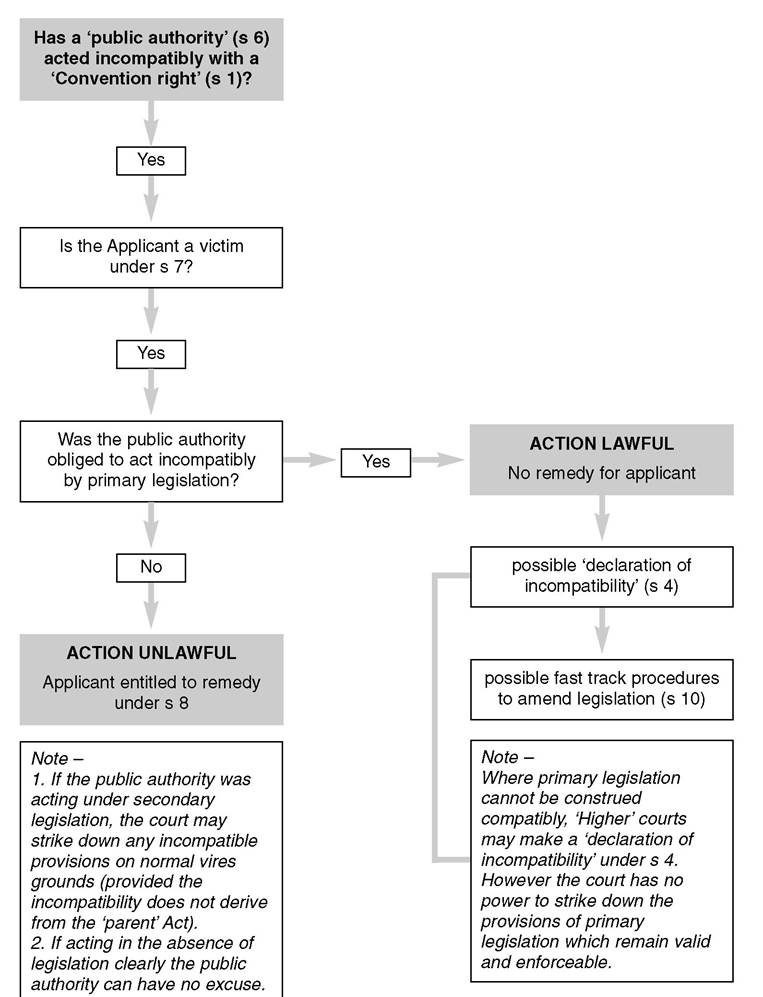
Summary: raising Convention rights under the HRA 1998
The chart opposite summarises the operation of the Act.
6 The individual and the state
Particular areas of restriction
Having examined the general landscape for the protection of rights and liberties in the UK, you should also consider specific restrictions on rights and freedoms imposed by statute and the common law. Such restrictions are generally imposed in the ‘public interest'. We briefly examine examples in the following contexts:
3 Freedom of expression.
3 Freedom of association and assembly.
3 Police powers.
3 National security and official secrecy.
Freedom of expression
The right to freedom of expression, particularly the freedom to criticise public bodies, is regarded by the courts as fundamental (Derbyshire County Council v Times Newspapers Ltd (1993)). However, the right, as laid down in Article 10 ECHR, is subject to certain restrictions on grounds of:
3 national security;
3 censorship;
3 contempt of court;
3 defamation;
3 public order; and
3 privacy.
Free speech is positively encouraged in a number of ways, such as in the absolute privilege of Members of Parliament and in the qualified privilege and defences to defamation available to newspapers, radio and television broadcasts and other media. Article 10 ECHR, as now incorporated by the HRA 1998, sets out the right in positive terms. Nevertheless, the right is limited by such restrictions as are
necessary in a democratic society, in the interests of national security, territorial integrity or public safety, for the prevention of disorder or crime, for the protection of health or morals, for the protection of the reputation or rights of others, for preventing the disclosure of information received in confidence, or for maintaining the authority and impartiality of the judiciary. (Article 10(2) ECHR)
Similarly, under existing statute and common law, free speech is restricted by competing public interests. Examples include: ф National security. The criminal law provides restrictions, for example: offences under the Official Secrets Acts 1911 and 1989; treason; sedition; incitement to mutiny or disaffection. The state can also restrict free speech under the doctrine of confidentiality: see AG v Jonathan Cape Ltd, AG v Times Newspapers Ltd (1976) regarding the publication of diaries of a cabinet minister.
3 Censorship. There are a number of restrictions on obscene and corrupting or otherwise offensive material. For example, see the Children and Young Persons (Harmful Publications) Act 1955; Obscene Publications Act 1959; Theatres Act 1968; Indecent Displays (Control) Act 1981; Public Order Act 1986, s 20.
3 Defamation law also provides restrictions on freedom of speech by imposing criminal and civil liability for slander or libel.
3 Interests of the fair administration of justice. See the Contempt of Court Act 1981 and other common law restrictions on interfering with the course of justice. In R v Sherwood ex p Telegraph Gruup (2001), the Court of Appeal indicated that restrictions on media coverage of court proceedings were a matter of balancing Article 10 rights and Article 6 rights (right to a fair trial).
3 Public order restrictions. Provisions under the Public Order Act 1986 restrict the use of offensive or threatening words or material inciting racial hatred.
There has been much debate about the impact of the HRA 1998 on the freedom of the press and the clash with rights to privacy. Lobbying from press organisations resulted in s 12 being added to the Act. Section 12 applies where the court is considering whether or not to grant an injunction against publication - for example, restricting a newspaper from publishing photographs that may intrude upon an individual’s privacy. In such circumstances, s 12(4) requires the court to have ‘particular regard’ to Article 10 rights, taking into account whether or not the material is already in the public domain, whether there are any public interest reasons for publishing, and having regard to any privacy code such as the Press Complaints Commission’s code which outlines standards of behaviour to be expected of the press. The intention of the section was to bolster the freedom of the press against claims of privacy, however it has not deterred the courts from expanding the common law to protect Article 8 rights where press intrusions are excessive. See Douglas v Hello! (2002).
Freedom of association and assembly
3 Breach of the peace.
3 Public order.
3 Proscribed organisations.
Article 11 ECHR provides that:
Everyone has the right to freedom of peaceful assembly and to freedom of association with others, including the right to form and to join trade unions...
However, once again, the right is qualified by such public interest restrictions as are ‘necessary in a democratic society’.
In addition, these freedoms are subject to regulation by both common law and statute. The common law removes certain rights from a person who commits or who threatens to commit a breach of the peace: see R v Howell (1982). There also are several statutory offences that limit the right to free assembly. The Public Order Act 1986 provides for offences of riot, violent disorder, affray, causing fear of or provoking violence, or causing harassment, alarm or distress. Under s 11 of the Act, the police have powers to regulate demonstrations and may apply to have them prohibited. Also, s 1 of the Public Order Act 1936 makes it an offence to wear a uniform in any public place, or at any public meeting, signifying association with any political object. Furthermore, special restrictions apply to associating with quasi-military organisations and other proscribed organisations deemed to be detrimental to the interests of the state (as listed in Sched
2 to the Terrorism Ac t 2000).
Police powers
3 Stop and search.
3 Arrest.
3 Seizure of property.
3 Detention.
A balance has to be struck between an individual’s civil liberties and the requirements of the administration of the criminal justice system, including the provision of police powers. The Police and Criminal Evidence Act (PACE) 1984 was introduced with the aim of putting police powers on a clear statutory footing and at the same time providing greater procedural safeguards for suspects:
3 ss 24 and 25 provide for the powers of arrest;
3 s 17 provides power to enter a home to effect an arrest;
3 s 18 provides that, immediately after arrest, if there are reasonable grounds, an officer may search premises for evidence;
3 s 19 provides power to seize items in relation to an offence;
3 the Act also sets out detailed provisions on the purpose and time limits of detention of a suspect at a police station.
A number of other statutes also provide legal powers of ‘stop and search', such as the Misuse of Drugs Act 1971.
Rules are made under PACE 1984 that constrain the police in the operation of these formidable powers. In addition, under the Act, a number of Codes of Practice have been issued. The Codes do not have the force of law but represent an important means of regulating the use of police powers:
3 Code A: stop and search procedures.
3 Code B: searching of premises.
3 Code C: interviewing and detention.
3 Code D: identification procedures.
3 Code E: tape recording of interviews.
National security and official secrecy
3 Official secrecy.
3 Interception of communications.
3 Emergency powers.
3 Terrorism.
Security of the state
The security of the state is of the greatest importance, both to the individual and to the state. On the other hand, the rights and freedoms of individuals may be curtailed in the pursuit of
such security. The state may justify interference with civil liberties on national security grounds in a wide range of areas, for example in the removal of the right to union membership at GCHQ in CCSU v Minister of State for Civil Service (1985), or in the deportation of an individual in R v Home Secretary ex p Cheblak (1991), or in the tapping of private telephone calls in R v Secretary of State for the Home Department ex p Ruddock (1987).
Official secrecy
Areas of official secrecy provide particular curtailments on the freedoms of individuals. Official secrets are protected by a number of statutes. The Official Secrets Acts (1911-1989), besides providing severe penalties for activities connected to spying and sabotage, also place severe restrictions on an individual’s freedom of expression. A person who is or has been a member of the security or intelligence services is guilty of an offence if without lawful authority he discloses any information relating to security or intelligence obtained in the course of his service. A person prosecuted under the 1989 Act cannot rely on the defence of making a disclosure in the public or national interest: see R v Shayler (2002). In relation to official secrets, the restriction on press publication is governed by the voluntary ‘DA’ (Defence Advisory) notice system.
Interception of communications
Rights and freedoms are also subject to restrictions authorised under the Regulation of Investigatory Powers Act 2000. The Act provides powers to the Secretary of State to authorise covert surveillance, including the interception of private communications, in ‘the interests of national security’ and for ‘the purpose of preventing or detecting serious crime’.
Emergency powers
Additional powers are available to the state in times of emergency, such as when serious civil unrest occurs in peacetime or in times of war. Such powers may lawfully encroach upon rights and freedoms. In peacetime emergencies, the Emergency Powers Acts 1920 and 1964 confer on the Government such powers and duties as may be deemed ‘necessary for the preservation of the peace'. In wartime, the Defence of the Realm Acts 1914-15 conferred wide powers on the Government to make regulations in the interests of defence and public safety. It should be noted that there are also specific ‘emergency' provisions for Northern Ireland contained in Patt V I I of theTerrorism Act 2000, providing additional powers to the authorities there.
Terrorism
There has been a considerable amount of legislation designed to counter terrorism both in Northern Ireland and on the mainlandi including flee Terrorism Act 0000 an d ttieAnti- terrorism, Crime and Security Act 2001. The legislation provides for a number of terrorist offences, and also prohibits membership, support or association with regard to proscribed organisations. It is also an offence for a person to collect, make a record of, publish, communicate or attempt to elicit information which is of a kind likely to be useful to a person committing or preparing an act of terrorism, There are extended police powers to deal with suspected terrorists, including additional powers of arrest, search, seizure of property, and powers to demand the removal of facial coverings or face paint for the purposes of identification, as well as powers to cordon off and close highways. Following on from the terrorist attack in New York on 11 September 2001, the 2001 Act provides additional powers to strengthen
security in aviation and nuclear industries. Of particular controversy with regard to civil liberties issues are the provisions in the Act for the extended detention of suspected international terrorists under Part 4, ss 21-32. Under the provisions, a foreign individual certified by the Secretary of State to be a suspected international terrorist may be detained indefinitely without charge in circumstances where either a legal impediment derived from an international obligation, or a practical consideration prevents deportation. These provisions required the Government to derogate from Article 5(1) ECHR. Detention under the provisions is regularly review by the Special Immigration Appeals Commission (SIAC), but detention is excluded from judicial review.