Judicial review
Introduction
Judicial review is the process by which the courts exercise a supervisory role over the acts and omissions of public bodies in the field of public law.
The process, grounds and remedies of judicial review
| Preliminary Issues | Grounds | Remedies |
| 0 Procedure 0 Permission 0 Delay 0 Standing 0 Public law body? 0 Public law issue? | 0 Illegality O HRA illegality 0 Irrationality 0 Procedural impropriety | 0 Quashing order 0 Prohibitory order 0 Mandatory order 0 Damages 0 Injunction 0 Declaration |
Meaning of judicial review
Section 31 of the Supreme Court Act (SCA) 1981 and Part 54 of the Civil Procedure Rules (CPR) 1998 provide the rules applicable to judicial review.
Applications for judicial review are heard by the Administrative Court, a subdivision of the Queen's Bench Division of the High Court, staffed by judges experienced in this type of claim. The powers of review are only available against public bodies in relation to their public functions and a claim can only be brought by a person with ‘sufficient interest' in the matter (s 31(3) of the SCA 1981).CPR r 54.1(2)(a) provides:
(a) ‘claim for judicial review' means a claim to review the lawfulness of-
(i) an enactment; or
(ii) a decision, action or failure to act in relation to the exercise of a public function.
Constitutional limits of judicial review
Later in this chapter we will consider the constitutional limits to the judicial review of enactments, particularly in respect of primary legislation. However, at this stage, it should be noted that, in principle, judicial review is limited to a review of the lawfulness or legality of a decision by a public body - in general the courts do not review the merits of a decision, or consider whether a more appropriate decision should have been taken.
(The exception is the limited merits-based review allowed under the principles of Wednesbury unreasonableness and proportionality - see below.) This distinction is a fundamental principle of public law in the UK. The traditional view is that the courts will ensure that public bodies act legally within their powers - or intra vires - and that they observe the rules of natural justice (see below), but within those boundaries the public body should not have the merits of its decisions challenged by the courts. This deference to executive and administrative decision-making is in line with the constitutional doctrines of parliamentary sovereignty and the separation of powers. In principle, public bodies derive their authority from Parliament and ultimately from the electorate, and it is not for unelected judges to step into their shoes (per Laws LJ in R v Secretary of State ex p Mahmood (2001)). The judges have frequently stressed the necessity of this limitation upon the powers of review. The purpose of judicial review was summarised by Lord Hailsham in Chief Constable of North Wales Police v Evans (1982):In every case... the purpose of [judicial review] is to ensure that the individual is given fair treatment by the authority to which he has been subjected and that it is no part of that purpose to substitute the opinion of the judiciary or of
individual judges for that of the authority constituted by law to decide the matters in question. The function of the court is to see the lawful authority is not abused by unfair treatment and not to attempt itself the task entrusted to that authority by the law.
Distinction between review and appeal
From the above, we can establish that there is a clear distinction between review and appeal. In an appeal, the court will have the power to decide whether a decision was right or wrong and, if wrong, it is generally permitted to substitute its own decision for the erroneous one. By contrast, in judicial review the court is limited to a supervisory role, in so far as it is concerned not with the decision itself but with the decisionmaking process.
If the court finds the latter to be flawed then it may quash the decision, but it will then be for the decision maker to reconsider the decision, and there is no guarantee that it will not reach the same decision again, albeit with a corrected decision-making process.An application for judicial review
There are four principal questions to be answered:
3 Which public bodies or persons are amenable to judicial review?
3 Is the decision, act or omission challenged amenable to judicial review?
3 On what grounds does judicial review lie?
3 Who can apply?
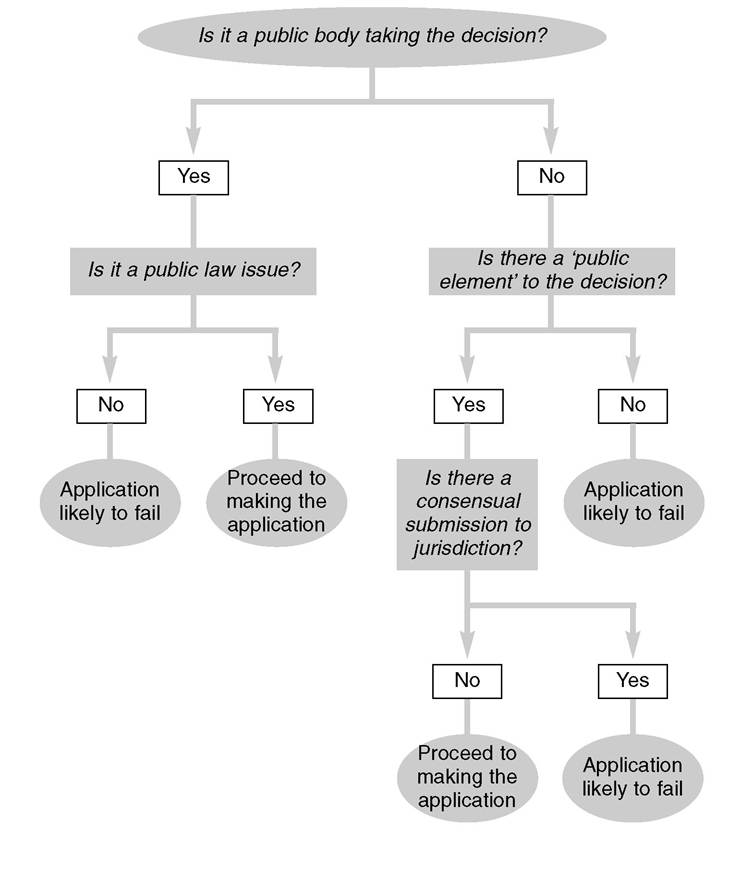
Public bodies or persons amenable to judicial review
A claim for judicial review may be brought against inferior courts, tribunals, or any body or person performing public
duties or functions. The powers exercised by those public bodies or persons may be:
3 powers derived from statute;
3 powers derived from the prerogative; or
3 powers involving a sufficiently ‘public element'.
Powers derived from statute or the prerogative
Persons or bodies that exercise powers derived from statute are generally regarded as public bodies amenable to judicial review. A major milestone was the decision in R v Criminal Injuries Compensation Board ex p Lain (1967), where the court confirmed that judicial review was not limited to bodies set up under statute but extended to a body exercising powers under the prerogative. However, those bodies or persons exercising powers under the prerogative are amenable to judicial review only if the issues raised are ‘justiciable' (Council of Civil Service Unions v Minister for the Civil Service (1985) - examples of ‘injusticiable' issues include foreign policy, national security and military deployments).
Powers involving a sufficiently public element
Other bodies that do not exercise powers derived from statute or the prerogative, may still be amenable to judicial review if the powers exercised are of a sufficiently public nature (R v Panel on Take-overs and Mergers ex p Datafin Ltd (1987)).
In this milestone case, the Court of Appealhe I d thatthTTake- over Panel was amenable to judicial review despite the fact that it was a self-regulatory body operated by the City whose powers derived neither from statute nor the prerogative, and was ‘without visible means of legal support'. The court indicated that in determining whether such a body was amenable to judicial review it would consider such factors as:the importance and public nature of its functions;
3 whether its powers were underpinned by statutory provisions;
whether it was woven into the fabric of Government regulation; and
whether in its absence the Government would likely have had to legislate to provide for such a body.
Therefore, in R v Advertising Standards Authority ex p The Insurance Service pic (1990), the Advertising Standards Authority was subject to review on the basis that, in its absence, its function would have to be exercised by the Director General of Fair Trading.
As in ex p Lain, the court in Datafin stressed that in addition to looking at the source of the power, the court was entitled to look at the nature of the power.
By contrast, judicial review was not available to challenge bodies dealing with purely religious matters (R v Chief Rabbi of the United Hebrew Congregations ex p Wachmann (1992)), or bodies regulating horse racing (R v Disciplinary Committee of the Jockey Club ex p Aga Khan (1993)) or football (R v Football Association ex p Football League (1993)). In ex p Wachmann, Simon Brown J concluded that the decisions of the Chief Rabbi were not open to review because ‘to attract the court's supervisory jurisdiction there must be not merely a public but potentially a governmental interest in the decision making power in question'.
Approving the decision in the Wachmann case, Hoffmann LJ observed in exp Aga Khan that religion ‘is something to be encouraged but is not the business of government'. In the latter case the Jockey Club was also found not to be subject to judicial review because it did not form part of a system of governmental control.
The court was also influenced by the fact that the Club's source of power was contractual and that a private law remedy was available to the applicant. Further
examples would include private educational bodies, which are unreviewable in respect of their academic policies, although state schools and colleges are reviewable.
It is a well-established principle that judicial review cannot be used to regulate the decisions of bodies that derive their authority from contract or from a consensual submission to jurisdiction by the parties. For example, in R v Insurance Ombudsman Bureau ex p Aegon Life Insurance Limited (1994), the Bureau was held not to be amenable to judicial review on the basis that its jurisdiction was dependent on the contractual consent of its members and its remedies were of a private law nature. This appears to be so even where the relevant body has monopolistic powers, or where in relation to a particular industry or activity the person concerned effectively has no choice other than to sign up to a contract to be bound by a body's rules or regulations: see R v Panel of the Federation of Communication Services Ltd ex p Kubis (1999), concerning dealers in the mobile telephone industry.
Judicial review of public functions only
Judicial review is only available to challenge public bodies in respect of their public functions. Judicial review therefore cannot be used to enforce a purely private law right, such as a contractual right, against a public body (R v East Berkshire Health Authority ex p Walsh (1985)).
Inferior courts and tribunals
Judicial review is available to challenge the lawfulness of acts or omissions by inferior courts and tribunals. The superior courts are not amenable to judicial review (that is, the High Court, the Court of Appeal and the House of Lords).
Against whom does judicial review lie?
Is the decision, act or omission challenged amenable to judicial review?
As we have seen, r 54.1(2)(a) of the CPR provides that a claim for judicial review means a claim to review the lawfulness of:
3 an enactment; or
3 a decision, action or failure to act in relation to the exercise of a public function.
An enactment
Of course, under the doctrine of parliamentary sovereignty, the courts have no jurisdiction to question the validity of primary legislation and the courts will not investigate the internal proceedings of Parliament to investigate whether or not an Act of Parliament has been correctly enacted (Pickin v British Railways Board (1974)). However, the courts do have jurisdiction to determine whether an Act of Parliament is compatible with EU law, and where appropriate they must disapply conflicting provisions of domestic legislation in favour of the relevant EU provisions (R v Secretary of State for Transport ex p Factortame (No 2) (1990)). In addition, under the Human Rights Act (HRA) 1998, the courts have jurisdiction to determine whether an Act of Parliament is compatible with the relevant rights incorporated from the European Convention on Human Rights. However, under the HRA the courts are limited to making a declaration of incompatibility and are expressly excluded from disapplying or setting aside primary incompatible legislation.
Judicial review is available to challenge subordinate legislation on any of the grounds for review (see below). Exceptionally, the courts have declined to review subordinate legislation, despite the existence of grounds for review, in circumstances where the subordinate legislation relates to the
implementation of national economic policy and is subject to the approval of Parliament: see R v Secretary of State for the Environment ex p Hammersmith and Fulham LBC (1991).
A decision, action or failure to act
Rule 54.1(2)(a)(ii) of the CPR provides a wide jurisdiction for the courts to control the exercise of public power. This reflects the broad view taken by the courts, in previous case law, of the measures that may be subject to judicial review. For example, the courts have granted judicial review against decisions affecting people's liberties, rights, interests, expectations, or the receipt of state benefits. The courts have also allowed claims of judicial review against other types of measures, such as ‘recommendations' by doctors that mentally ill patients should be detained in hospitals (R v Hallstrom and another exp W (1986)) and ‘guidance' given by a Secretary of State to local authorities (R v Secretary of State for the Environment ex p Lancashire CC (1994)). In other cases the courts have been willing to allow claims for judicial review against policy decisions of central and local government and other public bodies, particularly where an individual's fundamental rights were affected. For example, in R v Secretary of State for the Home Department ex p Simms (1999), the House of Lords allowed a claim for judicial review against a blanket ban imposed by the Secretary of State on oral interviews of prisoners by journalists. Such a policy was held to be unlawful on the basis that it deprived a prisoner of a fundamental right, namely, the right to seek through oral interviews to persuade a journalist to investigate the safety of his or her conviction and to publicise any findings in an effort to gain access to justice.
In general, the courts are reluctant to impose limits upon the types of public power that are susceptible to judicial review. In circumstances where the courts consider review of
the particular public power inappropriate, they are unlikely to deny the availability of judicial review but instead may indicate that it is available only in exceptional circumstances or refuse permission as a matter of discretion. In addition, even where a claim of judicial review might otherwise lie, the courts have referred to certain matters or issues as being ‘injusticiable’ - in that they are matters on which the courts are not equipped to judge. The most obvious example is where the exercise of a public power raises issues of national security (Council of Civil Service Unions v Minister for the Civil Service (1985) (the GCHQ case). In this case the Union was challenging the right of the Prime Minister to disallow trades unions operating at GCHQ - an organisation involved in surveillance for national security purposes. The court held that the PM’s actions were reviewable but, in this case, interests of national security left the court unable to intervene. See also R (Campaign for Nuclear Disarmament) v Prime Minister and others (2002). Questions of foreign policy or military deployment, such as in Iraq, are examples of injusticiable matters.
Ouster clauses
A further point to note: a statute will occasionally attempt to ‘oust’ the jurisdiction of the court by expressly excluding decisions of certain public bodies from the scope of judicial review. The courts have construed such ‘ouster clauses’ strictly, and have often found ways to circumvent them. For example, in Anisminic Ltd v Foreign Compensation Commission (1969), s 4 of the Foreign Compensation Act 1950 excluded orders or determinations of the Foreign Compensation Commission (FCC) from judicial review. In order to circumvent the exclusion, the court held that in making a particular determination the FCC had acted outside its jurisdiction and in consequence this ‘purported’ determination was in fact a nullity. As a nullity, the court was able to hold that it was not entitled to the protection of the
1950 Act, which only protected ‘determinations'. This interpretation was clearly contrary to Parliament's intentions.
On what grounds does judicial review lie?
Illegality.
Irrationality.
Procedural impropriety.
Lord Diplock's threefold classification
In the GCHQ case, Lord Diplock provided a threefold classification of the grounds for judicial review:
Judicial review has I think developed to a stage today when... one can conveniently classify under three heads the grounds on which administrative action is subject to control by judicial review. The first ground I would call ‘illegality', the second ‘irrationality' and the third ‘procedural impropriety'. That is not to say that further development on a case by case basis may not in course of time add further grounds. I have in mind particularly the possible adoption in the future of the principle of ‘proportionality' which is recognised in the administrative law of several of our fellow members of the European Economic Community
By ‘illegality' as a ground for judicial review I mean that the decision-maker must understand correctly the law that regulates his decision-making power and must give effect to it. Whether he has or not is par excellence a justiciable question to be decided, in the event of dispute, by those persons, the judges, by whom the judicial power of the state is exercisable.
By ‘irrationality' I mean what can by now be succinctly referred to as ‘Wednesburyunreasonableness'... It applies to a decision which is so outrageous in its defiance of logic or of accepted moral standards that no sensible person who had applied his mind to the question to be decided
could have arrived at it. Whether a decision falls within this category is a question that judges by their training and experience should be well equipped to answer, or else there would be something badly wrong with our judicial system....
I have described the third head as ‘procedural impropriety' rather than failure to observe basic rules of natural justice or failure to act with procedural fairness towards the person who will be affected by the decision. This is because susceptibility to judicial review under this head covers also failure by an administrative tribunal to observe procedural rules that are expressly laid down in the legislative instrument by which its jurisdiction is conferred, even where such failure does not involve any denial of natural justice.
Lord Diplock’s classification has been cited with approval in many subsequent cases. However, we should note his prediction of the development of other grounds for review. As he correctly foresaw, the principle of proportionality has increasingly been adopted as a doctrine by the domestic courts (we will examine the doctrine in connection with ‘irrationality’ below). Furthermore, the HRA 1998 is now generally accepted as providing a fourth ground of review, ‘breach of a Convention right’, though it may be argued that this ground is simply a new aspect of ‘illegality’.
Illegality (doctrine of ultra vires)
Lord Diplock used the term ‘illegality’ to embrace a number of different grounds upon which a public body would be subject to judicial review. The most important would include:
3 exceeding jurisdiction;
3 failing to direct itself correctly in law (errors of law);
3 failing to fulfil a statutory duty;
3 acting for an improper purpose;
failing to take into account all relevant considerations, or failing to disregard irrelevant considerations;
3 delegating the exercise of discretionary powers to another unless there is clear authority to do so;
3 fettering discretion;
excessively interfering with fundamental rights.
Errors of law Regarding errors of law, previously the position was complicated by the courts differentiating between errors of law by an inferior court, or tribunal or public authority ‘within jurisdiction' (which were not reviewable) and errors of law that took them outside their jurisdiction (which were reviewable). However, the general approach subsequent to the case of Anisminic Ltd v Foreign Compensation Commission (1969) is that almost all errors of law are now subject to judicial review. The case also made obsolete the historic distinction between errors of law on the face of the record (for example, an error in the actual order of a judge) and other errors of law (for example, an error in the reasoning behind the order). The position now is that any misdirection in law would render the relevant decision ultra vires and a nullity: see Page v Hull University Visitor (1993). However, the courts are still required to distinguish between errors of law and errors of fact. In exercising their functions, public bodies evaluate evidence and reach conclusions of fact. The court will not ordinarily interfere with the evaluation of evidence or conclusions of fact reached by a public body that has properly directed itself in law. Errors of fact will be reviewable only where the error is so excessive as to render the decision unreasonable, or the error relates to a ‘jurisdictional' fact. The latter arises where the jurisdiction of the decision-maker depends on the existence of a particular fact or facts. Such facts may be described as jurisdictional or precedent facts.
Improper purpose The exercise of a discretionary power for a purpose other than that for which it was granted is unlawful. Wheeler v Leicester City Council (1985) provides an example of where the court found the public authority to have acted for an improper purpose. Leicester rugby club had a licence to use a recreation ground administered by the council. In 1984, three members of the club were invited to join an international rugby tour of South Africa. The council, which was vehemently opposed to sporting links with South Africa, required the club to adopt and endorse the council's anti-apartheid stance and actively to campaign against the international tour and dissuade its members from participating in such a tour. The club stated that it agreed with the council in condemning apartheid in South Africa, but indicated that its role in relation to its members was purely advisory and that it was neither unlawful nor contrary to the rules of the club for members to join the tour. Subsequently, the three members took part in the tour. In response the council passed a resolution banning the club and its members from using the recreation ground for 12 months. The House of Lords held that the council's use of its statutory power to ban the club was a misuse of power because its purpose was to punish the club when it had done no wrong. See also Congreve v Home Office (1976).
An authority may act for mixed motives, some authorised and some not. The general approach of the courts in such situations is to hold that the action will be lawful if the authorised purpose is the true and dominant one. On the other hand, if the unlawful purpose materially influences the decision-maker, the action will be unlawful because irrelevant considerations will have been taken into account. See R v Inner London Education Authority ex p Westminster City Council (1986). There is often overlap between acting for an improper purpose and failing to take into account
relevant considerations, or failing to disregard irrelevant considerations.
Relevant and irrelevant considerations A public authority’s powers must be exercised consistent with the conferring statute. The exercise of a power will be unlawful where, on a proper construction of the relevant statute, the decision-maker has failed to take account of relevant considerations, or has taken into account irrelevant considerations. What is or is not a relevant consideration in any case will vary greatly according to the context.
The courts have held that local authorities can take into account their own limited resources in deciding whether they owe a duty to make provisions for the needs of an individual (R v Gloucestershire County Council ex p Barry (1997)). However, the impact on an individual’s fundamental rights is also a relevant consideration.
An order of a magistrate or tribunal taking irrelevant factors into account, or failing to have regard to relevant factors, will be quashed (R v Horseferry Road Magistrates’ Court ex p Pearson (1976)). Similarly, the immigration authorities must have regard to relevant factors and ignore irrelevant factors in the exercise of their statutory powers (R v Immigration Appeal Tribunal ex p Bastiamplllai (1983)).
Unlawful delegation and fettering discretion Decisionmakers may also have acted unlawfully if they fail to retain their decision-making power. Decision-makers may fail to retain discretion in one of two ways. First, they might delegate their decision-making power to someone else, contrary to the maxim delegatus non potest delegare. The rule is that a statutory power must be exercised only by the body or officer on whom it has been conferred, unless delegation is expressly authorised by the statutory words or by necessary implication.
However, in Carltona Ltd v Commissioner of Works (1943), the court held it to be acceptable for a senior official to sign the actual notice requisitioning a factory in time of war, even though the power of requisition had been given to a body headed by a minister, on the basis that the minister was accountable for the actions of the civil servant under the convention of ministerial responsibility. Similarly, in Oladehinde v Secretary of State for the Home Department (1990), the House of Lords held that the Secretary of State could validly authorise immigration inspectors to take decisions on his behalf to deport persons from the United Kingdom under the Immigration Act 1971. Generally, the powers of public authorities are lawfully exercisable by their servants or agents. Furthermore, local authority functions may be delegated either to officers, or to committees or sub-committees of the authority. Courts will have regard to considerations of practical convenience.
Secondly, decision-makers must not ‘fetter’ their discretion by adopting an over-rigid rule or policy in relation to its exercise. An authority may legitimately adopt general rules or policies in relation to the exercise of its discretion, provided they are consistent with the purpose of the enabling legislation and not unjust. However, the authority must be prepared to consider making an exception to the general rule if the circumstances of a particular case warrant it. In British Oxygen Co Ltd vMinisterofTccnooloyy (1971), BOC applied for a grant under statutory provisions to fund the purchase of metal cylinders required to store pressurised gases, which it manufactured. Individually the cylinders cost £20. The Board of Trade had a policy of denying grants for plan t items costing less than £25 and decided that the cylinders were not eligible for a grant. In giving judgment Lord Reid stated:
The general rule is that anyone who has to exercise a statutory discretion must not ‘shut [his] ears to the application’ (to quote from Bankes LJ in R v Port of London
Authority ex p Kynoch Ltd (1919)). I do not think that there is any great difference between a policy and a rule. There may be cases where an officer or authority ought to listen to a substantial argument reasonably presented urging a change of policy. What the authority must not do is to refuse to listen at all. But a Ministry or large authority may have had to deal already with a multitude of similar applications and then they will almost certainly have evolved a policy so precise that it could well be called a rule. There can be no objection to that provided the authority is always willing to listen to anyone with something new to say...
In British Oxygen the court held that the Board of Trade had adequately considered the merits of BOC’s application and therefore had not applied its policy in an over-rigid manner.
Illegality under the Human Rights Act 1998 As has already been mentioned, following the implementation of the HRA 1998, a new category of challenge has been introduced that could be put under the general banner of ‘illegality’, or alternatively regarded as a free-standing ground for challenge.
The only exceptions to the obligations imposed on public authorities by the HRA 1998 to comply with Convention rights are set out in s 6(2), that is, where:
3 the authority could not have acted differently; or
3 the authority was acting under primary legislation and that legislation cannot be given effect in a way that is compatible with Convention rights.
In deciding whether a decision or action is compatible with a Convention right, a judge will need to consider several factors:
whether a Convention right is raised and whether it has been interfered with;
3 whether that interference is ‘in accordance with the law' or ‘prescribed by law';
3 whether the interference serves a legitimate aim as listed in some of the Convention Articles. For example, Article 10 defines legitimate aims as:
... formalities, conditions, restrictions or penalties as are prescribed by law and are necessary in a democratic society, in the interests of national security, territorial integrity or public safety, for the prevention of disorder or crime, for the protection of health or morals, for the protection of the reputation or rights of others, for preventing the disclosure of information received in confidence, or for maintaining the authority and impartiality of the judiciary.
Finally, the judge will need to assess whether the interference is proportionate to the aim pursued. See the comments on proportionality below.
Irrationality
Irrationality and the Wednesbury principle Prior to Lord Diplock's third classification of ‘irrationality' (see above), this ground for review was traditionally referred to as ‘Wednesbury unreasonableness'. A decision of a public authority is open to challenge on this ground if the court is satisfied that the decision is ‘so unreasonable that no authority could ever come to it' or ‘so absurd that no sensible person could ever dream that it lay within the powers of the authority' (Associated Provincial Picture Houses Ltd v Wednesbury Corporation (1948)). In effect, the ground provides a limited basis for the courts to challenge a decision on its ‘merits'. However, the level of review inherent in the Wednesbury principle is notoriously low. The threshold of ‘irrationality' is a high one, and in the past the courts have been very reluctant to hold that a decision-maker crossed it.
Nevertheless, in recent years the courts have shown themselves to be more willing to question the rationality of decisions, particularly in circumstances where an individual’s fundamental rights are in play. No doubt this was partly in anticipation of the incorporation of Convention rights under the HRA 1998. The courts developed a principle of ‘anxious scrutiny’ or ‘super- Wednesbury1 review where such rights were in play. The principle is that where fundamental rights are adversely affected, the court will require more by way of justification before it is satisfied that a decision was reasonable. In R v Ministry of Defence ex p Smith (1996), the court reviewed a decision to discharge a number of individuals from the army on the basis of their homosexuality. The Government’s core argument was that the presence of homosexuals in the armed forces would have a substantial and negative effect on the operational effectiveness of the armed forces. With some reluctance, the Court of Appeal held that the decision of the Ministry of Defence was justifiable, but approved the following approach:
The court may not interfere with the exercise of an administrative discretion on substantive grounds save where the court is satisfied that the decision is unreasonable in the sense that it is beyond the range of responses open to a reasonable decision-maker. But in judging whether the decision-maker has exceeded this margin of appreciation the human rights context is important. The more substantial the interference with human rights, the more the court will require by way of justification before it is satisfied that the decision is reasonable in the sense outlined above.
It should be noted that subsequently the applicants took their case to Strasbourg and, in Smith v United Kingdom (No 1) (1999), the ECtHR held that there had been a violation of Article 8 ECHR (right to private life) and Article 13 ECHR (right to an effective remedy). The Court held that the ‘irrationality’ test in judicial review provided an insufficiently effective means of scrutiny in the circumstances. This questioning by the ECtHR of judicial review as an ‘effective remedy’ in this and a number of other cases has been the source of much debate.
Proportionality Since the HRA 1998 came into force, there has been considerable discussion about its impact upon the Wednesbury test. The law in this area is still developing, but the position appears to be that where a breach of a Convention right is in issue, the traditional test is no longer applicable and its place taken by a new test of proportionality adopted from European jurisprudence.
Proportionality is not entirely alien to judges in the UK. In R v Goldstein (1983), Lord Diplock famously summarised the concept into everyday language: ‘You must not use a steam hammer to crack a nut, if a nutcracker would do.’ However, the test for proportionality adopted from EC law and from the jurisprudence of the ECtHR is considerably more developed and complex. The courts will ask:
3 whether the action pursued a legitimate aim;
3 whether the means adopted to achieve that aim were appropriate;
3 whether less restrictive means could have been adopted to achieve that aim; and
3 whether overall the interference with an individual’s rights is justified in the interests of a democratic society.
The House of Lords considered the impact of the HRA 1998 on judicial review in R (Daly) v Secretary of State for the Home Department (2001), and in particular the difference between Wednesbury unreasonableness and proportionality. Lord Steyn observed that the intensity of review was greater under the proportionality approach. Whilst in many cases
there is an overlap between the traditional grounds of review and the approach of proportionality, he suggested that there were three concrete differences:
First, the doctrine of proportionality may require the reviewing court to assess the balance which the decision maker had struck, not merely whether it is within the range of rational or reasonable decisions. Secondly, the proportionality test may go further than the traditional grounds of review inasmuch as it may require attention to be directed to the relative weight accorded to interests and considerations. Thirdly, even the heightened scrutiny test developed in Smith is not necessarily appropriate to the protection of human rights.
In addition, Lord Cooke commented,
I think the day will come when it will be more widely recognised that [the Wednesbury case] was an unfortunately retrogressive decision in English administrative law, in so far as it suggested that there are degrees of reasonableness and that only a very extreme degree can bring an administrative decision within the legitimate scope of judicial invalidation
However, in British Civilian Internees Far Eastern Region v Secretary of State for Defence (2003), the Court of Appeal held that until the House of Lords expressly declared otherwise, the Wednesbury test does continue to survive, and is the correct test to apply in a case which does not involve Community law and does not engage any question of rights under the ECHR.
Procedural impropriety
Grounds for judicial review exist:
where there has been a breach of the common law rules of natural justice; or
3 where there has been procedural unfairness; or
3 where there has been a failure to comply with any statutory procedural obligations; and
3 where an applicant has a legitimate expectation of being treated in a certain way by a public authority, even though there is no other legal basis to support a claim for such treatment.
Natural justice
Natural justice comprises three basic principles:
3 No man is to be a judge in his own cause (nemo judex in causa sua).
3 No man is to be condemned unheard (audi alteram partem).
3 A decision-maker has a general duty to act fairly.
These rules are concerned with the manner in which the decision is taken rather than with whether or not the decision is correct.
Natural justice and procedural fairness Historically, the common law rules of natural justice developed in relation to decision-making in the courts. Therefore, traditionally the principles were applied only in proceedings concerning judicial or quasi-judicial decisions. However, in Ridge v Baldwin (1964) the obligation to observe natural justice was held to extend to administrative decision-making. In Ridge, the court held that a police authority’s decision to dismiss a chief constable was procedurally unfair in that it failed to provide the applicant with a proper opportunity to challenge allegations made against him.
In determining the standards required of a decisionmaking process, the judges have used the terms ‘natural justice’ and ‘fairness’ interchangeably. They favour the use of
the latter, particularly when denoting the standards required in administrative decision-taking. See Re K (H) (An Infant) (1967).
It must be remembered that the rules of natural justice, or of fairness, are not ‘cut and dried'. They vary infinitely, as Lord Denning put it in R v Secretary of State for the Home Department exp Santillo (1981). What fairness demands will depend upon the nature of the individual's interest, the impact of the decision, whether the decision is preliminary or final, the subject matter of the decision, the terms of any relevant statutory provisions and all the circumstances of the case. For example, decisions over the granting of licences will depend upon the status of the applicant. In Mclnnes v Onslow Fane (1978), the court indicated that procedural protections are at their highest where the decision deals with the forfeiture of a licence and at their lowest where the decision deals with a mere first-time application for a licence. A higher standard will normally apply where the relevant decision affects a person's fundamental rights, or liberty or property, or where a person is dismissed from public office.
In general, it may be said that the required standards of fairness will rise as one moves from merely administrative decisions towards decisions exercising a judicial or quasijudicial function. See Doody v Secretary of State for the Home Department (1993), where the courts considered the standards of fairness to which mandatory life prisoners were entitled in respect of the decision made by the Secretary of State when fixing the penal element in a mandatory life sentence.
Examples of procedural requirements Procedural protections might include the right to be given prior notice of a decision. See Cooper v Wandsworth Board of Works (1863), where Cooper was entitled to be given prior notice of
an intention to knock down his house. The court may require that sufficient time be given to prepare a case in response to allegations. In R v Thames Magistrates Court ex p Polemis (1974), the decision by a magistrate to refuse an adjournment, requested by Polemis to respond to a criminal charge for which he had received the summons only that morning, was quashed. The maxim audi alteram partem requires that every person be given a fair hearing; whether that includes an oral hearing depends upon the possible sanctions to be imposed upon the applicant and the likelihood that oral evidence would help to resolve issues of fact: see R v Army Board of Defence Council ex p Anderson (1991). In R v Secretary of State for the Home Department ex p Tarrant (1984), the court indicated that the applicant might have a right to request legal representation depending on such issues as the seriousness of the charge and whether points of law are raised, but also the need for reasonable speed in the adjudication. There might also arise a duty for the decisionmaker to give reasons, to show that the matter has been properly considered, but the courts will not impose such a duty where it might place an undue burden on the decisionmaker.
Some statutes prescribe procedural requirements for the exercise of a particular statutory power. For example, there may be provisions for the composition of a decision-making board, or obligations to consult, or to conduct an inquiry, or to consider objections, or to give reasons for a decision. Where a statute provides a mandatory procedure it must be followed. However, it appears that where a provision is construed as merely directory, substantial compliance will suffice (Coney v Choyce (1975)).
Note that Article 6 ECHR provides particular rights where a pubic authority makes a ‘determination of civil rights and obligations’. An applicant is entitled to:
a fair and public hearing within a reasonable time; an independent and impartial tribunal established by law; judgment pronounced publicly, unless the public interest overrides such a right.
Legitimate expectation A person may have a legitimate expectation that that he or she will be given a hearing, or consulted before a decision is taken. Such a legitimate expectation might arise because an applicant has relied on a promise or previous conduct by a public authority. In the GCHQ case, the court indicated that the Unions had a legitimate expectation of being consulted prior to the implementation of major changes affecting the staff, but in the particular circumstances, the interests of national security overrode those legitimates expectations. In exceptional circumstances, a legitimate expectation may not merely ensure that the individual is consulted but may even ensure that a benefit he or she enjoys is not removed. In R v North and East Devon Health Authority ex p Coughlan (2000), a disabled applicant had been given a clear promise that a nursing home would be her ‘home for life'. Subsequently the home was closed by the local authority. The court held that the decision of the authority was unfair on the basis that it frustrated the applicant’s legitimate expectation. It may be argued that the doctrine of legitimate expectation is being expanded here not only to supervise the manner by which a decision is reached, but also to require the authority to reach a particular decision. This aspect of the doctrine is likely to develop on a case-by-case basis.
The rule against bias Nemo judex in sua causa (‘No one should be a judge in his own cause’) is taken to mean that adjudicators must not have (or be seen to have) a pecuniary, family or professional interest in the outcome of a decision.
There are two broad categories of case:
3 where the adjudicator has either a direct pecuniary or a proprietary interest in the matter; and
3 where there is a non-pecuniary interest, such as a friendship or professional connection, or there is an appearance of bias by reason of conduct or behaviour.
In the first category of case there is an irrebuttable presumption of bias and the adjudicator is automatically disqualified (Dimes v Grand Junction Canal Proprietors (1852)). This category of case was recently extended in R v Bow Street Metropolitan Stipendiary Magistrate ex p Pinochet Ugarte (No2) (1999). The House of Lords held that automatic disqualification was not limited to cases where there was a pecuniary or proprietary interest, but would also apply in cases where the judge's decision would lead to the promotion of a cause in which the judge was involved together with one of the parties. The Law Lords had ruled (by a majority of 3:2) that Pinochet did not enjoy immunity from arrest pursuant to international warrants to enable extradition to Spain. Amnesty International had been allowed to intervene in the proceedings; they clearly supported the cause for extradition. Lord Hoffman (one of the Law Lords hearing the case) chaired a charity (AIC), a sub-organisation within Amnesty International. On the basis of this involvement, the House of Lords ruled that he was automatically disqualified and set aside their earlier decision.
In the second category, the adjudicator will be disqualified where there is a ‘real danger' of bias on his or her part (R v Gough (1993)). It is generally unnecessary to establish the presence of actual bias. A modest adjustment to the ‘real danger' test was adopted by the House of Lords in Porter v Magill (2002). The adjustment reflected concerns that the test as it stood put too great an emphasis on the court's view of
the danger of bias rather than the view of an ordinary observer. Lord Phillips' formulation in Re Medicaments and Related Classes of Goods (No 2) (2001) was cited with approval:
The court must first ascertain all the circumstances which have a bearing on the suggestion that the judge was biased. It must then ask whether those circumstances would lead a fair-minded and informed observer to conclude that there was a real possibility, or a real danger, the two being the same, that the tribunal was biased.
Standing: who can apply for judicial review?
Procedural bars: exclusivity principle An application for judicial review must surmount special procedural bars designed to protect public authorities. In particular, the applicant must satisfy the requirements of permission, standing and a short time limit. These protections are said to be necessary in order to prevent disruption to administrative processes without good cause and to ensure that the Administrative Court is not overburdened with inappropriate claims.
Consequently, in O’Reilly v Mackman (1983) it was held that it was contrary to public policy and an abuse of process for an individual to use a private action to challenge a decision by a public body on the basis that it infringed rights protected in public law, since to do so would avoid the procedural restraints imposed on an application for judicial review.
However this ‘exclusivity principle' has been criticised in so far as it has led to the striking out of meritorious cases on purely procedural grounds. As a consequence, more recent case law has avoided its rigid application, particularly where cases involve both public and private law elements (Roy v Kensington and Chelsea and Westminster Family Practitioner Committee (1992)). Furthermore, in Trustees of the Dennis
Rye Pension Fund v Sheffield City Council (1997), Lord Woolf MR, while confirming the general rule that the procedural constraints should not be avoided, nonetheless indicated that the court should not be overly concerned with the distinction between public and private law rights, and that a court should be slow to strike out a case on the basis of the exclusivity principle, particularly if the choice of proceedings had ‘no significant disadvantages’ for the parties. For example, if a claim were brought by way of private proceedings when it should have been brought by way of judicial review, but the applicant would nonetheless have satisfied the requirements of permission in an application for judicial review, that would be an indication that there was no significant disadvantage to the public authority. See also Clark v University of Lincolnshire and Humberside (2000).
The test for permission Section 31(3) of the Supreme Court Act 1981 provides that the court will not grant permission to proceed with a claim for judicial review ‘unless it considers that the applicant has a sufficient interest in the matter to which the application relates’.
The test for sufficient interest or standing involves a two- stage process:
3 The courts will consider an application for permission in the first instance without a hearing and on the basis of the papers before them. The purpose at this stage is to eliminate hopeless, frivolous or vexatious cases and to ensure that it is a claim fit for further consideration at a substantive hearing. The courts generally avoid making a detailed assessment of standing at this stage, except to filter out claimants who are no more than ‘meddlesome busybodies’ (R v Monopolies and Mergers Commission ex p Argyll Group plc (1986)).
If permission is granted at that stage, the court may revisit the question of standing at the substantive hearing where it may be considered in the light of the full factual and legal context of the claim (R v Inland Revenue Commissioners ex p National Federation of Selfemployed and Small Businesses Ltd (1982)).
Standing In considering the question of ‘sufficient interest', the court considers the relationship of the claimant to the matter and all the circumstances of the case. If the claimant has a direct personal interest in the matter then generally he or she will have sufficient interest. The courts have taken a broad approach to what constitutes a ‘personal' interest. Individuals affected by the action or decision in question will normally have standing. For example, in R v Her Majesty’s Treasury ex p Smedley (1985), a taxpayer had sufficient standing to challenge a government undertaking to pay a contribution to the European Community. In R v Selby District Council ex p Samuel Smith Old Breweries (2000), a landowner within a greenbelt in the vicinity of a proposed development had sufficient standing, even though not directly affected by the development.
Even where there is no direct or personal interest, the court may still exercise its discretion to grant permission where a public-spirited claimant seeks to raise a matter of general or public interest. For example, in R v Secretary of State for Foreign and Commonwealth Affairs ex p Rees-Mogg (1993), Lord Rees-Mogg was granted permission to challenge the lawfulness of the UK’s ratification of hie Treaty on European Union, though the claim failed at the substantive stage.
Claims for judicial review are often made by representative bodies campaigning on particular issues. The courts have taken an increasingly liberal approach to standing in these
types of application. In R v Secretary of State for Social Services ex p Child Poverty Action Group (1990), the CPAG was held to have standing sufficient to commence proceedings relating to the interpretation of social security legislation. Where there is a strong public interest case, pressure groups have been granted standing. Greenpeace had sufficient interest to seek review of an inspectorate’s decisions relating to radioactive waste from Sellafield. On the question of whether or not to grant standing, judges appear influenced by factors such as the likely absence of any other challenger, the expertise of the challenger, the importance of vindicating the rule of law and the prominence of the challenger as an adviser on the relevant matters. In R v Secretary of State for Foreign and Commonwealth Affairs ex p World Development Movement (1995), the WDM had sufficient standing to seek review of the Foreign Secretary’s decision to use overseas aid money to fund the Pergau Dam project in Malaysia. The applicants were advisers on overseas aid, and in their absence there was no other challenger with the expertise to question the viability of the project. By contrast, in R v Secretary of State for the Environment ex p Rose Theatre Trust Co (1990), the pressure group was refused standing despite its being set up to preserve the remains of the Rose Theatre. It was argued there was no legal merit to the group’s case. The decision was criticised by Sedley J in Rv Somerset County Council ex p Dixon (1997), where he stated:
Public law is not at base about rights, even though abuses of power may and often do invade private rights; it is about wrongs - that is to say misuses of public power; and the courts have always been alive to the fact that a person or organisation with no particular stake in the issue or the outcome may, without in any sense being a mere meddler, wish and be well placed to call the attention of the court to an apparent misuse of public power.
Human Rights Act: ‘sufficient interest’ and ‘victim’ tests Where judicial review is on grounds of breach of a Convention right, the current ‘sufficient interest' test will have to be reconciled with the test under the HRA 1998. Section 7 of the Act requires that only a ‘victim' (as per Article 34 ECHR) may rely on Convention rights. This would appear to exclude challenges by representative bodies or pressure groups on human rights.
To assess the position requires reference to the relevant case law of the ECtHR. ‘Victim' appears to cover both those directly affected and those ‘at risk' of being affected. In Campbell and Cosans v UK (1982), children attending a school where corporal punishment was practised were treated as ‘victims' even though they had not been punished. In Sutherland v UK (1998), an applicant claimed that the age of consent for homosexuals in the UK violated his rights under Article 8 ECHR. He had never been prosecuted, nor had the domestic authorities expressed any interest in doing so, nonetheless it was held that he was directly affected and therefore could claim to be a victim for the purposes of the Convention. It appears, however, that there must be a reasonable likelihood that the applicant would be subject to the impugned measure.
In addition, representative bodies have qualified as victims in certain cases. Unincorporated associations may be regarded as ‘victims'. In Christians Against Racism and Fascism v UK (1980), a broad association of religious groups was regarded as a ‘victim' when a procession it planned was banned. However, representative bodies campaigning on behalf of others are unlikely to satisfy the victim test.
It is possible that a challenge by way of judicial review may involve both Convention and standard grounds. In such cases it may be that the applicant will face two separate tests.
Delay A procedural bar of great practical significance is the requirement that a claim for judicial review must be made promptly, and in any event within three months from the date upon which the claim arose (CPR r 54.5). This may be contrasted with the six-year limitation that applies to ordinary civil litigation.
The test is promptness, and this may not be satisfied simply because the claim is brought within the three-month time limit (R v Independent Television Commission exp TVNI Ltd (1991)). The ‘promptness’ test may yet be open to challenge on the grounds that it breaches requirements under the ECHR: see R v Hammersmith and Fulham LBC ex p Burkett (2002).
The court retains a discretion to grant permission even where a claim is not brought within the three-month time limit. However, the courts have recognised that public law claims require strict adherence to the time limits relating to judicial review proceedings (R v Institute of Chartered Accountants in England and Wales ex p Andreou (1996)).
Under the old rules for judicial review (RSC Ord 53) the courts refused to extend the time limit where the delay was the fault of the claimant’s lawyers (see R v Secretary of State for Health ex p Furneaux (1994)). However, other factors outside the claimant’s control, such as delay in getting legal help, may provide a good reason for extending the time limit (R v Stratford-upon-Avon District Council ex p Jackson (1985)). The courts may accept that there is a good reason if the claimant was unaware of the decision or action under challenge, provided he or she applied expeditiously once he or she was aware of it (see R v Secretary of State for Transport ex p Presvac Engineering Ltd (1991) and R v Secretary of State for the Home Department ex p Ruddock (1987)). The courts will be more inclined to grant an extension where issues of general
public importance are raised (for example, ‘phone tapping' in ex p Ruddock).
Even where there are good reasons to excuse a delay, the court may still refuse permission, or refuse to grant a remedy at the substantive hearing, if it considers it inappropriate to do so on the basis of prejudice to third parties or detriment to good administration (see R v Dairy Produce Quota Tribunal ex p Caswell (1990) and R v Brent LBC ex p O’Malley (1997)).
Other reasons for refusing permission The granting of permission is a matter of discretion, and the court will not normally grant permission where the claimant has an adequate alternative remedy available. For example, where a structure for appeal exists under statute, judicial review should not be used as a means of circumventing this (see R v Secretary of State for Social Services ex p Connolly (1986)). Exceptionally the court may grant permission, even where an alternative remedy is available, if there is some other reason why judicial review proceedings are appropriate: see, for example, R v Hereford Magistrates’ Court ex p Rowlands (1998). Permission may also be refused where the claim is purely academic, or where the claimant has suffered no real injustice.
Remedies
In a claim for judicial review the court may grant one of the following remedies:
The prerogative orders (CPR r 54.2):
• quashing order (formerly certiorari);
• prohibiting order (formerly order of prohibition);
• mandatory order (formerly mandamus).
3 Other remedies (CPR r 54.3):
• injunctions;
• declarations;
• damages.
Prerogative orders
3 A quashing order quashes an unlawful decision of a public authority. Where a decision is quashed the court has power to remit the matter back to the decision-maker.
3 A prohibiting order restrains a public authority from acting outside its jurisdiction or otherwise abusing its powers.
3 A mandatory order requires a public authority to carry out its judicial or other public duty. A mandatory order cannot be used against the Crown (s 40 of the Crown Proceedings Act 1947) but can be used against a minister of the Crown (see M v Home Office (1994)).
Other remedies
3 Section 31(2) of the SCA 1981 provides that, in a claim for judicial review, the courts may grant an injunction (including interim injunctions) or a declaration, either in addition to or instead of the prerogative orders, where it is ‘just and convenient' to do so. A declaration is a statement of the legal position in the matter before the court. It may simply declare the true construction of a statute, or that an administrative act is invalid. A declaration lacks coercive power, but public authorities will normally respond to a declaration by rectifying their actions.
3 Damages may be awarded in conjunction with any of the other remedies, but a claimant may not seek damages alone in a claim for judicial review. Furthermore, damages will be awarded only if they could have been
awarded in an ordinary claim, that is, in a private law claim or a claim under the HRA 1998. See, for example, R v Enfield Borough Council ex p Bernard (2002). In other words, the judicial review procedure does not create any new right to damages, but simply provides a means to claim damages which otherwise would have to be claimed in separate proceedings.