The Four Key Elements of the British Empire
The first key element was the naval empire of fortresses, islands, and sea routes.[2196] Essentially, this was the empire of defense, protecting the British Isles and Britain's world trade.
By the eighteenth century, the Royal Navy had 40,000 men permanently stationed in the Western Approaches, the sea routes that led into the English Channel and the southern Irish coast, countering French and Spanish sea power in the Atlantic and, more distantly, in the West Indies. This was an enormous logistical enterprise that made the navy one of the first complex multinational companies. In addition to the Atlantic and Caribbean routes, protecting the slave trade and the West Indian sugar plantations—essential parts of the wealth of England, as William Pitt put it in the 1760s—these forces and fortresses also protected Britain's lucrative routes to the East. Here in Barcelona, I hardly need to point out that Britain's naval empire in the Mediterranean was one of its first zones of power. Gibraltar was taken in the 1690s, Malta in 1802. Beyond these two armed settlements, there was a whole string of fortresses and sea routes, which by 1900 stretched through Suez and Aden to the Indian Ocean, and on to Singapore, Hong Kong, and the Pacific Ocean. It is no accident that this naval-fortress empire of defense and aggression is the one that has survived longest. Think of the Malvinas/Falklands or Diego Garcia in the Indian Ocean used by British and American forces in the 1993 and 2003 Gulf wars. Think of Gibraltar, of Akrotiri in Cyprus, a jumping-off point for Lebanon today. Hong Kong, one of the farthest flung island fortresses, was only returned to China in 1996, actually by an Oxford classmate of mine, Chris Patten.What were the ideologies that maintained this naval-fortress empire? They were, first, devotion to the crown in its authoritative mode within Parliament; second, Protestantism—a sensibility that derived from the conflict with Catholic empires in the sixteenth century and caused the Navy to support Parliament during the English civil war of 1641-1650.
Third, this element of empire was underpinned by a notion of the executive power of the royal governor or ship's captain that gave him powers outside the common law. The governor or captain could make slaves, seize labor, and deprive Britons of liberties that were inviolable on British soil. These royal and naval executive powers became contentious issues in the late eighteenth and early nineteenth centuries, when Britons abroad demanded to be treated as free subjects and not as indentured people.A second element of British imperial power—and remember here that I am talking of “ideal types,” in practice they were intertwined—was settler colonialism. This was the huge outflow of Britons and Irish abroad from the first settlements in the north of Ireland in the seventeenth century, through to the large efflux of population to the Americas, Australasia, and southern Africa in the nineteenth and early twentieth centuries.[2197] Even after the independence of British Asia, many of its former servants and commercial residents moved off not to the home country, but to Australasia, South Africa, or Rhodesia. Historians of British imperialism have been transfixed in recent years by Asia and Africa—the empire of writers such as Kipling and Somerset Maugham, Conrad and Rider Haggard. But much more important to many contemporaries were the so-called white dominions. My maternal grandfather abandoned his family to go to work in Canada. There are Baylys in New Zealand. It was dominion troops—along with the Indians I’ll discuss later—who saved the empire during the South African War of 1899-1902 and the two world wars. This old military connection in the English-speaking world is still maintained today by the conservative Australian government, which has sent troops to Iraq and Afghanistan, though the American alliance is now more important to it. In addition, the dominions were critical to the economy of the empire after 1850. For instance, in the 1890s, Australia with a population of no more than four million people consumed about as much British textile exports as India with a population of 250 million people.
Huge amounts of British capital were invested in Australasia, South Africa, and Canada throughout the period. Horses and corn from Australia and South Africa maintained the empire during war and peace, and goods went not only to Britain, but also to India and other non-white colonies.My theme is that various ideologies of empire were as formative, and as much a contribution to the longevity of empire, as economic, military, or political factors. The ideologies that sustained the white settler colonies comprised a kind of “possessive individualism,” the notion of the rights of Britons and a powerful racist exclusionism.[2198] Recently, economists connected with the World Bank have pointed to what they specifically call the “colonial origins” of modern prosperity.[2199] This might seem astonishing in today’s postcolonial atmosphere. What they mean by “colonial,” however, are white colonists. They are pointing to these colonists’ determination to subvert the aims of the authoritarian central power of London and its local representatives. The economists praise the colonists’ capacity to invest and build “new Europes” abroad. The best example of this was, of course, the American colonies themselves. But early Australia also saw a revolt of white settlers against royal governors—in this case represented in the iconic figure of Captain William Bligh, formerly the disciplinarian captain of “HMS Bounty.” Thereafter, Australia, New Zealand, and Canada were among the first to enfranchise women, to create local welfare states, and to enshrine the rights of the citizen in constitutions. In a sense, settler colonialism in the British Empire was the last refuge of “civic republicanism,” which, according to J. G. A. Pocock, was adapted from Renaissance Florence to seventeenth-century England and then to the United States.[2200]
But let’s not become too romantic. These settler societies, whether in the Americas, Australia, or southern Africa, were highly racist.[2201] Most of the worst examples of the expulsion or extermination of native peoples, pace the World Bank, were perpetrated not by crown forces or by royal governors, but by white colonial irregulars.
It was settlers who began the New Zealand wars of the 1860s against the Maori. During the South African War, British and Dutch settlers were equal in the atrocities perpetrated on the black population. This, of course, had been foreshadowed in the Caribbean slave plantations. Here small groups of white settlers ruled over and abused large slave populations. It was ultimately royal governors, with evangelical supporters in Britain, who emancipated the slaves. Even in the Thirteen Colonies, a major source of conflict between the crown and the local population had been the Americans' suspicion of the royal governors' hostility to slavery and lack of concern about Catholicism. These other expansive settler colonies, distantly under the crown, helped hold the empire together until the 1940s, when they gradually ceded their external allegiance to the United States.I will say less about my final two “elements of empire” because they feature strongly in the latter part of my talk. These were, first, directly ruled imperial provinces and, second, indigenous monarchies held in an alliance of inequality with the crown. By imperial provinces, I mean not so much a series of territories but a mode of government over peasants or tribal-peasants of non-European origin. Imperial provinces within the British Empire emerged quite late, at the end of the eighteenth century when the East India Company, a corporate enterprise within the British state, annexed large areas of territory in Asia to enhance its security and pay for its local armies. The style of government depended on a colonial bureaucracy working through native intermediaries, collecting cash revenue or in some cases produce.[2202] This type of imperial province was later extended to parts of Southeast Asia, such as Malaya, and in the late nineteenth and early twentieth centuries to Africa and the Middle East, as Britain sought to preempt its European rivals in these regions.
The bureaucratic paternalism of the colonial province has been seen as the classic form of British imperialism.
It was lauded in the writings of Kipling, and more recently by conservative British historians such as David Gilmour.[2203] It was vigorously attacked by nationalists, and more recently postcolonial theorists, who charge the rulers of imperial provinces of exploiting the peasantry to the point of famine and handing them over to unscrupulous landed magnates. Certainly, the key ideologies that animated this element of empire were conservationist. They evoked a quiescent and child-like rural population, uneducated and dependent on British officials who became, in the Hindi phrase ma-bap, mother and father, to them. Development in this vision was not the realm of the activist state, but at best, moral improvement through local cooperative societies that would break down the supposedly impermeable barriers of caste or tribe. Scarcity and famine in this ideology was not the result of official neglect but of the lack of self-control of Indians and Africans, who propagated too many children and wasted their resources on expensive marriage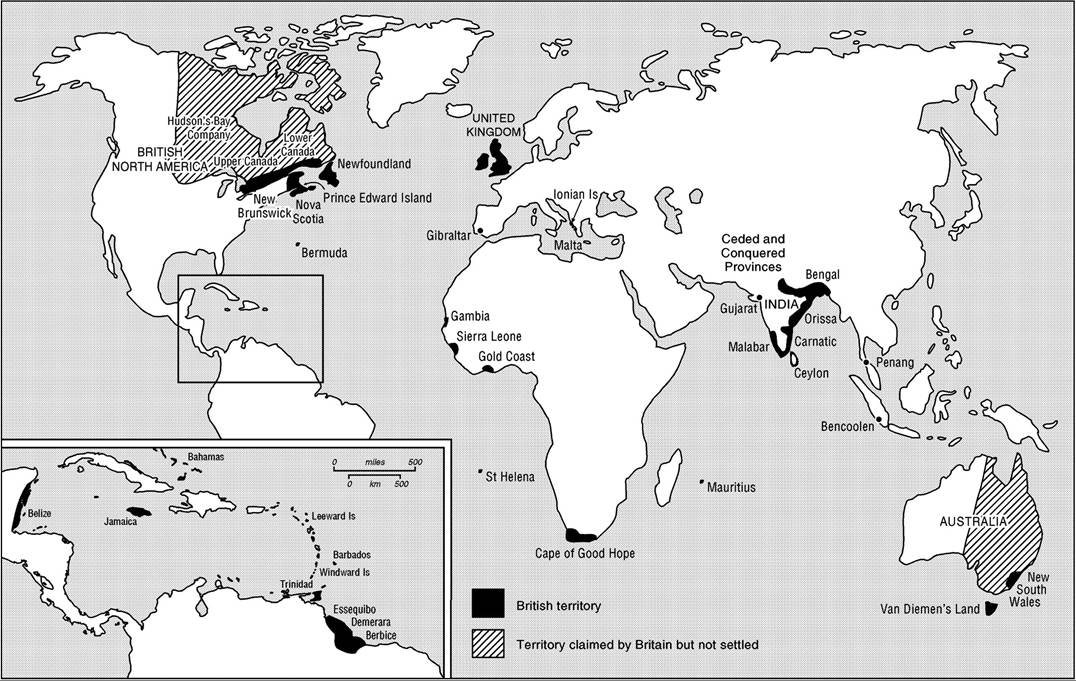
Map 33.1. The British Empire, 1815.
Source: Porter, 1999, The Oxford History of the British Empire, vol. III, The Nineteenth Century, map 1.1, p. 2. Copyright: Oxford University Press.
DECONSTRUCTING THE BRITISH EMPIRE 927
feasts or religious ceremonies. Famine was a “natural” phenomenon in a Malthusian sense; it acted to balance out excessive population growth. The best the state could do in famine conditions was to stimulate private charity and institute temporary relief works. In this vision, commerce and the towns were suspect. The Indian or Arab trader was viewed with the disdain customarily directed at Jews in some parts of Europe. On the other hand, commerce must be free enough to force the peasant to bring his product to market and allow British manufactured goods to penetrate into the villages. Above all, while the integrity of the village community was lauded, labor must be “free” to move.
It was required to fill the ranks of indentured labor drafted in to Assam tea plantations or to some of the commercial island economies: Mauritius, the West Indies, and South Africa. Above all, the villages of India, Nepal, and East and West Africa should be open enough to provide a constant stream of men from so-called martial races who underpinned Britain's position as a world power. British taxpayers' money had to be spent on the Royal Navy. Others, and above all, Indians would support Britain's armies with their taxation.This set of ideologies, adapted to the colonial province, worked at two levels. It was inculcated into young civil servants through training at Oxford and Cambridge universities and increasingly supported by localized anthropological ideas of caste, tribe, and martial races.[2204] At a higher level, it was legitimated by the laissez-faire economics and civilizational paternalism of philosophers such as Adam Smith, David Ricardo, and J. S. Mill. This group of theorists, often subject to crude reduc- tionism, remained in vogue in colonial government long after democratization in Europe had pushed governments toward socialistic and interventionist policies. It is important to note also that some indigenous elites—especially landlord and chiefly classes selected out for favorable treatment by the rulers—also adhered to this form of liberal ideology. A developmental state would not only increase taxation on them, but it would undermine the sense of difference and privilege that sustained their social status.
The final element of empire and imperial ideology that I want to discuss is the protected indigenous monarchy. A whole host of Asian, Pacific, and African elites—war chiefs, revenue contractors, commercial intermediaries, even religious authorities—were bundled into the category of indigenous royalty by the British rulers.[2205] In part this was done in order to deflect resistance by retaining a mirage of indigenous control. But it was not purely an instrumental phenomenon. Most Britons and many Asians and Africans believed that monarchy was the natural state of civil society. Under Queen Victoria, the British monarch became the mother of all other monarchs across the empire. The British and non-European class structures were merged in what David Cannadine has called an ideology of “orna- mentalism.”[2206] Even today, and for different reasons, many in Canada and Australia
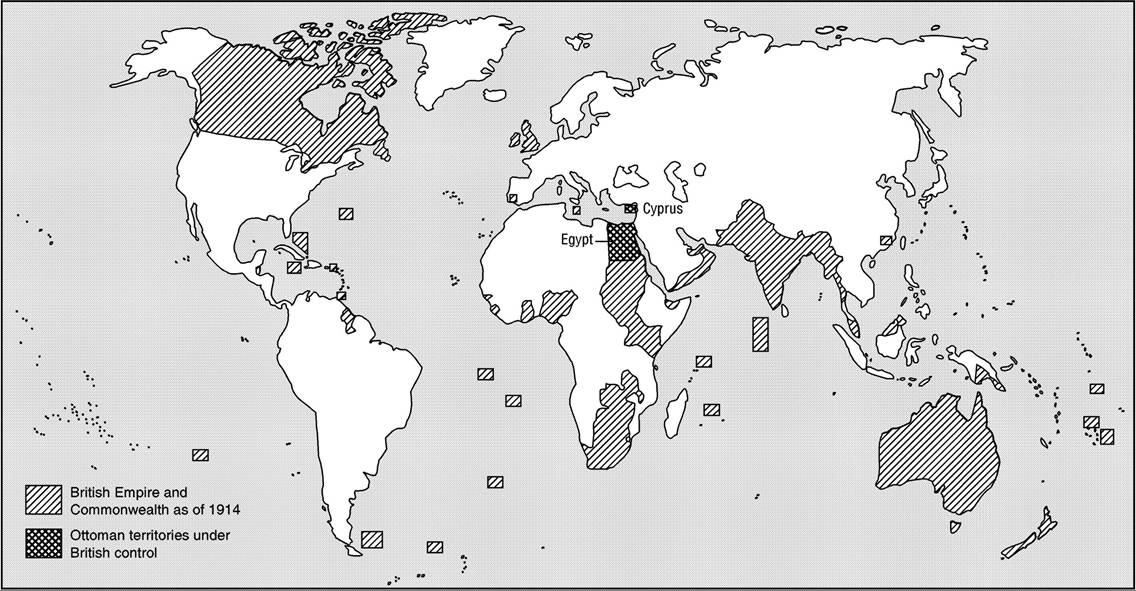
Map 33.2. The British Empire, 1914.
Porter, 1999, The Oxford History of the British Empire, vol. III, The Nineteenth Century, map 1.2, p. 3. Copyright: Oxford University Press.
DECONSTRUCTING THE BRITISH EMPIRE 929
find it difficult to distance themselves from the British monarchy. It was recently reported that when Nelson Mandela first met the late Queen Elizabeth the Queen Mother, he prostrated himself before her, the last symbolic representative of the British Empire at its widest extent.
Yet this was more than a drama of nostalgia. Indigenous monarchies saved money compared with the imperial province. Moreover, they could be milked of resources. The princely state of Mysore provided something like 15 percent of the British Government of India's revenue before 1947. In 1914, 150,000 well-trained Indian princely troops were made available to the British government and fought in Iraq, Palestine, or France. The Gurkha regiments which fought in every major British war between the Indian mutiny of 1857 and the Malvinas/Falklands campaign and now in Afghanistan, were a kind of tributary gift from the Nepal monarchs to the British crown.
More on the topic The Four Key Elements of the British Empire:
- THE THEORY AND PRACTICE OF EMPIRE-BUILDING
- The Long Nineteenth Century
- The Sects of Hinduism
- Appointment and Dismissal of Government
- 16 The Crisis of Modernity
- Hansen’s New World