The Sects of Hinduism
The most prevalent devotional sects in Hinduism are Vaishnavism, Shaivism, and Shaktism. Each features veneration of one of the major deities at the center of Hindu cosmology. The devotees of these sects are called Vaishnavas (devotees of Vishnu and his avatars), Shaivas (devotees of Shiva), and Shaktas (devotees of the Great Goddess, Devi).
Within each of these sects are numerous individual orders that differ in the sacred texts and saints they revere, their modes of worship, and their philosophical orientation.Vaishnavism
Vaishnavas worship Vishnu and his consort (wife) Lakshmi as supreme. Vishnu mercifully intervenes in the world through his avatars (such as Rama in the Ramayana and Krishna in the Mahabharata) and is inseparable from his beloved Lakshmi, who is the goddess of auspiciousness and good fortune. For Vaishnavas, Vishnu is the source of all existence. These ideas about Vishnu’s fundamental nature are expressed in myths and poems that invoke him as the lord who created the universe.
Hindus worship Vishnu in a number of different forms. He is often depicted reclining with Lakshmi on a thousand-headed serpent that floats on the cosmic ocean. From his navel rises a lotus, upon which Brahma the creator god is seated. Visually, this image asserts that the world is bom from Vishnu and that he is its sole originator and sustainer. Brahma, Vishnu, and Shiva constitute a triad of gods whose roles are, respectively, to create, preserve, and dissolve the universe as it moves through cycles. For Vaishnavas, Vishnu is not just the preserver but the supreme God who performs all three roles.
In Hindu sacred art, Vishnu typically is shown holding objects in his four hands that symbolize his powers and characteristics. In his upper right hand, he holds a flaming discus (symbolizing the sun and omniscience); his upper left hand bears a white conch shell (the moon and creativity).
In his lower right hand, he holds a mace (power), and in his lower left hand, he holds a lotus (purity). Most Vaishnavas have special devotion for Vishnu’s avatars, Rama and Krishna.Shaivism
Shiva is the destroyer and at the same time a benefactor. He embodies both the ideal of ascetic renunciation and sensual participation in the material world. Beyond being the god of spiritual insight and of yogis and ascetics, Shiva is also the god who destroys the universe at the end of time before a new cycle of creation can begin. Most Shaivas worship Shiva as a god with no beginning or end who transcends time but also presides over its endless cycles. Some Shaivas emphasize that Shiva is also a family man, to be venerated with his divine queen Parvati and their two sons, the divine princes Ganesha and Skanda.
Shiva is usually depicted sitting in deep meditation on Mount Kailasha in the Himalayas, with a tiger skin wrapped about his waist and wearing serpents for jewelry. His third eye is turned inward in meditative contemplation, and he wears the crescent moon and the holy river Ganges in his matted hair. A common symbol of Shiva is the linga, an abstract phallic symbol that represents his creative potential. His consort Parvati is also believed by Shaivas to represent the creative energy of the universe.
Shaktism
The cults of the Great Goddess venerate her as the supreme cause and end of the universe. Although she has many names and many forms, the Great Goddess is most often referred to as Devi, Mahadevi, or Shakti. Devotees of the goddess are referred to as Shaktas.
The primacy of Devi is definitively asserted in the fifth century ce. Sanskrit text called the Devi Mahatmya (“The Greatness of Devi”), which, as noted previously, is part of the Markandeya Parana, posits that the supreme cause of the universe is feminine. The text argues for Devi’s greatness through three main myths, the most important of which tells how she killed the buffalo-headed demon, Mahisha, who threatened the world and whom even the gods Vishnu and Shiva were not able to vanquish.
To Shaktas the goddess is all-powerful and pervades the entire universe. She is the one who creates, preserves, and destroys the universe in harmony with the rhythms of cosmic time. The Devi Mahatmya teaches that the goddess is eternal and that she manifests herself over and over again in order to protect the universe as a mother would her child.
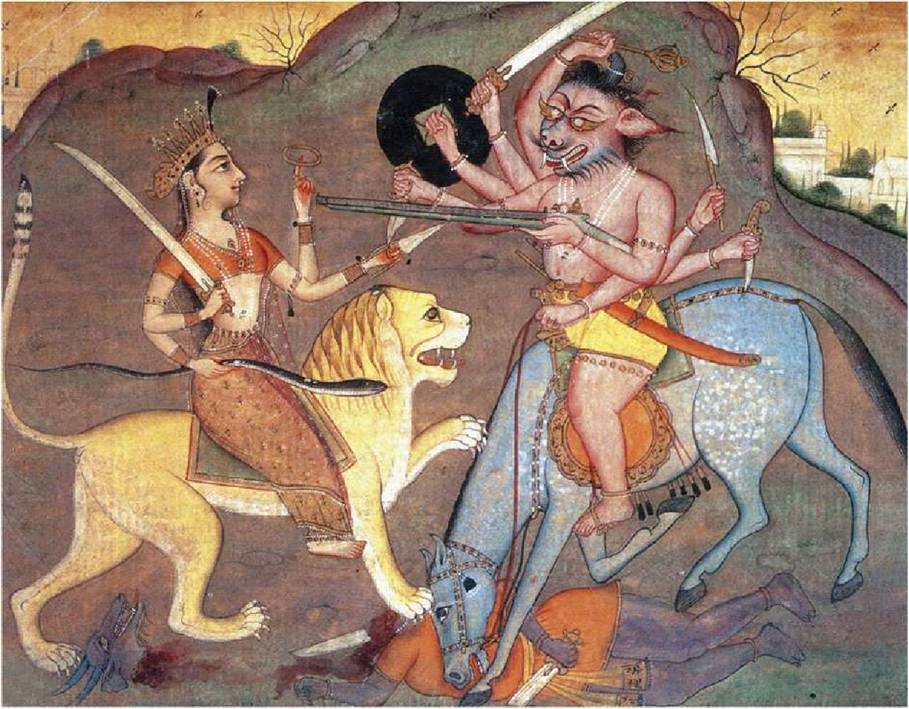
Accompanied by a legion of other goddesses and fierce creatures and riding a lion, Devi, in the form of the goddess Durga, protects the world by battling the buffalo demon Mahishasura. (The buffalo is associated with Yama, the god of death.) Pallava period, seventh century, Mahishasura Mardini Cave, Mamallapuram Tamil Nadu, India.
Shaivas and Shaktas have much in common, as Shiva and Devi (also called Parvati) are believed by both sects to be married to each other. So the difference between Shaivism and Shaktism is a matter of emphasis regarding the importance of each of these two primal forces. For Shaivas, Shiva is pure consciousness that pervades all existence, and Devi is his creative (but subordinate) power. In contrast, Shaktas believe that Shiva is entirely passive and that Shakti is the creative energy that constitutes and governs the whole of existence. Thus, the Shaktas say that “Shiva without Shakti is shava” (Sanskrit, “a corpse”), an idea that is iconographically represented in the form of the goddess Kali dancing upon the inert body of Shiva.
Video: Devotion to Kali
[Please note: You must be using an online, browser-based eReader in order to view this content.]
Gurus, Saints, and Sages
Entire sects of Hinduism are constantly forming around the veneration of gurus, saints, and ascetics. In the words of one scholar, “saints still remain... as they have always been, the generating centers of Hindu religion.”— The fully enlightened are regarded as being the most immediate means of accessing the divine reality directly, either to obtain material and mundane blessings or to receive spiritual teaching to quicken one’s own journey toward moksha.
Some saints are venerated as embodiments of God, others for being humble and perfectly surrendered devotees.Gurus are sometimes powerful religious authorities who preside over well-established institutions in which the divine authority of a guru has been passed down to his senior disciple in an unbroken lineage for many generations. Certain important gurus and saints have been responsible for the formulation of the specific philosophical orientation of various sects and monastic orders, making interpretation of sacred texts and belief more systematic and consistent. We have noted, for example, the founding roles of Shankara, Ramanuja, and Madhva in, respectively, the Vedanta schools of Advaita, Vishishta-Advaita, and Dvaita. The roles of guru as founder and authority are characteristic of Hindu movements outside of India, such as the International Society for Krishna Consciousness (commonly known as the Hare Krishna Movement) and Transcendental Meditation—both of which are explored in Chapter 14. Transcendental Meditation is also featured in this chapter’s Global Snapshot box.
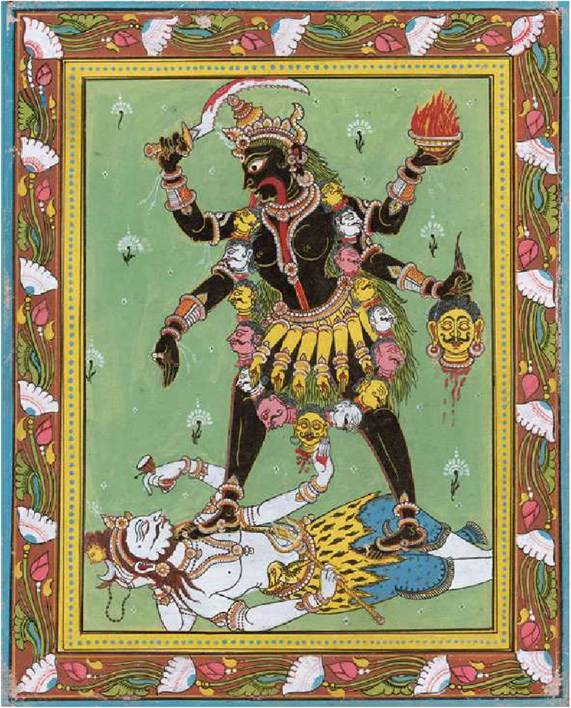
A modern painting of the goddess Kali, whose name means both “Black” and “Time,” dancing on the body of Shiva. From the Indian state of Odisha.
Self-Assessment 4.1
[Please note: You must be using an online, browser-based eReader in order to view this content.]
The History of Hinduism
Hinduism is a vibrant tradition that has exhibited dynamic change and a willingness to embrace innovations in thought and practice. At the same time, Hinduism has preserved many of its most ancient elements to the present day, cherishing some traditions that go back more than 3,000 years.
The history of Hinduism can be traced back to the Indus Valley Civilization (c. 2600-1700 все) and to the Indo-Aryan peoples who composed the Vedas (c. 1200-900 все).
The Indus Valley Civilization
As its name suggests, the Indus Valley Civilization developed along the Indus River, which flows through modem Pakistan.
It reached its developmental peak between 2300 and 2000 все, when its thriving cities, such as Harappa and Mohenjo-Daro, enjoyed a high standard of living. Archaeological excavations at Indus Valley sites have yielded evidence of trade with regions as far away as Mesopotamia and impressive skill in metallurgy, handicrafts, and urban planning. The archaeological finds include a vast number of stone seals that were perhaps used to stamp products for trade. These are decorated with depictions of animals and people and with a script that has not yet been deciphered.Some scholars believe that in the Indus Valley seals we can detect very early elements of Hinduism. For example, the most famous seal has been called the Proto-Shiva seal because its central image may be an archaic form of Shiva. The male figure is seated in a yoga posture, wears a buffalo-homed headdress, is surrounded by animals, and appears to have three faces. Later images of Shiva often show him meditating in a yoga posture, being in the company of animals, and having three faces. Of course, without a decipherment of the script it is difficult to understand fully this and other images depicted on the seals.
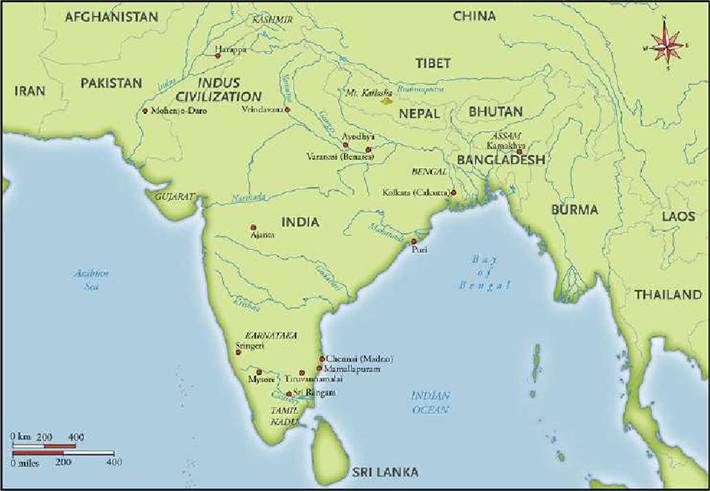
Significant sites in the history of Hinduism.
Click here to learn more in an interactive map.
Archaeologists working in the Indus Valley have also discovered a number of terracotta figures depicting women. Some scholars have identified these as representations of a mother goddess. It may be that the widespread worship of goddesses in later Hinduism originated in the veneration of female deities in the ancient Indus Valley Civilization.
id="Picutre 61" class="lazyload" data-src="/files/uch_group79/uch_pgroup305/uch_uch7255/image/image061.jpg">
The Proto-Shiva seal. The male figure, sometimes called the “Lord of the Animals,” is surrounded by various totemic animals, such as an elephant, a tiger, a rhinoceros, a water buffalo, and two antelopes or deer.
During the eighteenth century bce, there was a sudden decline in the Indus Valley Civilization. Scholars are uncertain as to what caused the decline, although climate change that disrupted agriculture is cited as a likely contributing factor.
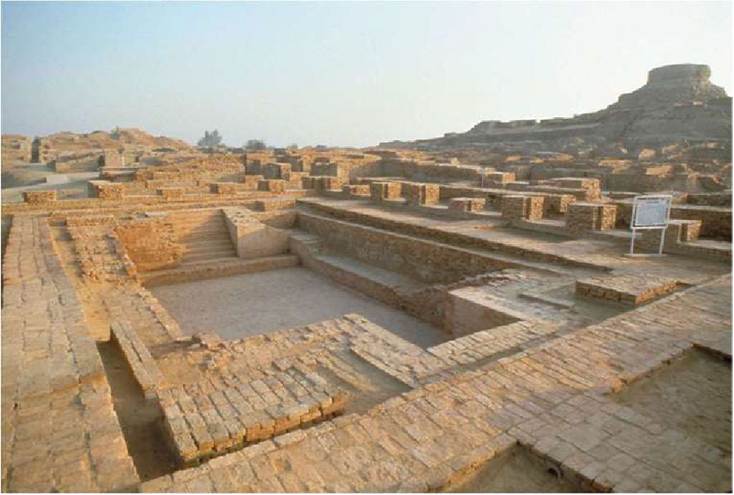
The great bath can be seen amid the ruins of the ancient cityscape of Mohenjo-Daro, an important city of the Indus Valley Civilization. A towering granary can be viewed in the distance.
Who Are the Aryans?
The English linguist Sir William “Oriental” Jones (1746-1794) described how Sanskrit, Latin, Greek, and several other ancient languages shared a common linguistic ancestor. These languages are referred to as “Indo-European” and probably stem from a lost language we call “Proto Indo-European.” Jones’s discoveries astounded Europeans, who soon learned that Sanskrit was closest to the original language spoken by the earliest Indo-Europeans.
The ancient speakers of Sanskrit who moved into the Indian subcontinent around 1500 bce referred to themselves as the Arya—that is, those who are “noble,” “cultivated,” and “civilized.” Today, we call them Indo-Aryans or, more simply, Aryans—although this use of the term is more specific (and accurate) than the general label “Atyan race” as used by the Nazi Party in the twentieth century. Skilled in handling the horse and chariot, the Aryans were a warlike and nomadic people who were well prepared to make themselves the dominant elite soon after they entered the Indian subcontinent.
Like other Indo-European peoples, the Aryans revered the horse, placed special importance on sacrifice, and organized their society into a three-part structure. For the Aryans, sacrifice was a means to maintain order in the universe. The priests (brahmins) who conducted sacrificial rituals occupied the top rung of the social order because of the religious power they wielded. The rulers and warriors (kshatriyas) were equally important. Last were the traders and farmers (vaishyas). As the Aryans did not place a great deal of emphasis on agriculture, one can see why the vaishyas would occupy a lower social position. The servant class (shudras) probably derived from the indigenous people at the time of the Aryan immigration. This social structure has remained fundamental to Indian society until today.
The Aryans, who eventually settled across northern India, have left us a body of texts composed in Sanskrit, of which the earliest example is the Vedas. It is to the era of these texts that we now turn.
The Vedic Period
Ritual was of ultimate importance in Vedic times, as rites of sacrifice were performed to sustain the cosmic order and please the gods. Much of ritual sacrifice involved the pouring of offerings into a sacrificial fire as Vedic hymns were recited. Although the construction of their fire altars became quite elaborate, Indians of the Vedic period inherited from their nomadic ancestors a very “portable” religion with no fixed buildings or icons and with sacred knowledge maintained by priests.
In Vedic times, as today, fire was considered a god. Known as Agni, he was the mouth of the gods and the gateway to the celestial realms, so offerings were magically transported through Agni to whichever god was invoked.
In Vedic mythology it is Indra, god of lightning, thunder, and rain, and the virile god of fertility itself, who, as the most powerful, is king of the gods. More hymns in the Vedas are addressed to Indra than to any other god, but in later Hindu tradition and mythology he is somewhat comical: haughty, proud, and often drunk. Many of the Vedic gods continue to play a part in the later Hindu pantheon but endure only in a subordinate status.
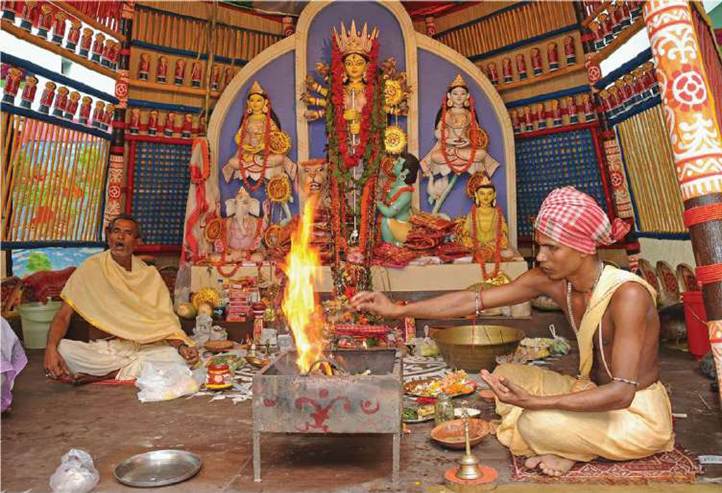
/Kyajna or fire sacrifice, one of the most archaic of Hindu rites, is performed by priests before an image of Durga during the Durga Puja festival in Kolkata. India.
In the later Vedic period, philosophical innovations began to supplant the older Vedic emphasis on sacrifice. It is in hymns from the later period that Vedic religion begins to take a decisive turn, slutting away from an emphasis on myth, cosmology, and sacrifice to a keener interest in philosophy and introspection. In these hymns, the perception of the nature of existence emerges as being more important than upholding the cosmic order through sacrifice. Late Vedic hymns mark a transition toward what would be the philosophical revolution of the speculative texts known as the Upanishads.
During the time of the Upanishads (c. 900-200 все), contemplative and philosophical reflection became more widespread. Many philosophers moved from urban areas to the forest in order to lead simpler lives. Some lived as hermits, some lived in colonies of contemplatives, and others practiced strict ascetic disciplines in the solitude of the jungle. Still others became wanderers, going from town to town begging for food and engaging in lively philosophical debates.
The Age of the Guptas
Most scholars characterize the time of the Gupta Empire (c. 320-540 ce) as a period of remarkable creativity. The Guptas, who ruled much of northern India, patronized the arts, sciences, religion, and literature. Their reign was an era of relative peace and prosperity, often described as “the Golden Age of India.”
The Gupta rulers practiced religious tolerance and sponsored groups and institutions associated with Buddhism, Jainism, and other religions. The Guptas, who were themselves Hindus, promoted Hinduism and sought to organize society in accordance with Hindu beliefs. Thanks in part to Gupta patronage, the worship of Vishnu and Shiva became increasingly popular during this period, which also saw a shift from worship at open-air sacrificial altars to worship in temples. As temple institutions arose, so did special forms of temple art and architecture. These developments quickened the spread of bhakti and the emerging devotional sects.
A very significant religious development during the age of the Guptas was the rise of devotional Hinduism. The two great Sanskrit epics, the Ramayana and the Mahabharata, had been completed and were well established by this time. As we have seen, these epics are concerned with political problems, dynastic successions, duty, and obligations. But they also feature the exploits of the gods and have much to tell us about popular deities and avatars and forms of devotion to them. Composition of the Puranas commenced during this period, indicating the growing popularity of devotional Hinduism.
The Development of Bhakti
The devotional aspects of Hinduism became increasingly popular under the Guptas, but they took on new life in southern India between the sixth and ninth centuries ce through an ecstatic form called bhakti marga, the path of devotion. This movement eventually spread all over India, changing and adapting to new regional and linguistic circumstances. Devotion now came to be expressed through poetry, art, architecture, and temple building. Bhakti was instrumental in the development of the various sectarian orientations of Hinduism and in its vibrant temple cultures.
By the late fifth century ce, Buddhism (Chapter 5) and Jainism (Chapter 6) were deeply entrenched in southern India. Bhakti arose as a challenge to these traditions. Over the next four centuries, wandering poets roamed the countryside and converted royalty and commoners alike to the devotional ethos of bhakti. Royal patronage for Jainism and Buddhism waned, and kings sought legitimacy through poets’ songs that praised the kings as the representatives of the gods Shiva and Vishnu. The religious networks forged by the itinerant poets sometimes developed into political networks and strengthened alliances between religion and politics.
By the twelfth century, the bhakti movement had transformed once again, becoming an adversary of caste and gender prejudice. In this new transformation, practitioners of bhakti often rejected ritual and temple-based worship, insisting that the body is itself a temple and that God dwells in every individual. Many scholars argue that the bhakti movement had such a far-reaching impact because it was egalitarian, revolutionary, and frequently anti-brahmin. Bhakti poet-saints represented a variety of caste backgrounds. Furthermore, rather than using Sanskrit, the language of the Vedas and of priestly authority, the bhakti poets used vernacular languages such as Tamil, Kannada, Marathi, and an early form of Hindi. The bhakti poets asserted that caste and other circumstances of one’s birth did not determine one’s access to God. Rather, it was the quality of one’s surrender to God that mattered.
How does the criticism of special knowledge and power wielded by brahmins compare to criticism of the power of priests and religious authorities in other religions?
>,
Tantra
Bhakti was not the only revolutionary new development to challenge the strictures of gender and caste. Tantra, another new system, emerged alongside it. Making use of symbols, rituals, yogic postures, breathing techniques, mantras, and other spiritual practices— sometimes in shocking or forbidden ways—Tantra offered the possibility of sudden liberation from samsara. Likely having arisen among mystics in the northern Indian region of Kashmir and perhaps also in eastern India, by the seventh century Tantra had come to influence not only Hinduism but Buddhism and Jainism as well.
Tantra (Sanskrit, ‘loom”) assumes the interweaving and interconnectedness of all things. These include pure consciousness, which is identified with Brahman or Shiva, and material reality in its most basic state, which is identified with Shakti. Similarly, samsara and moksha are understood not as two different things but as aspects of a single continuum of being. For practitioners of Tantra, the material world is a manifestation of the divine energy associated with pure consciousness. Their spiritual practices are said to give them the ability to manipulate or channel that energy in order to gain liberation. Unlike the ascetics who renounced the material world and its sensual pleasures, practitioners of Tantra made use of material things and the senses as the means by which to transcend them. For them, moksha could be found in the midst of everyday experience.
Tantric practitioners taught that the ritual transgression of social boundaries could create ideal conditions for transcending the egocentric self and achieving instantaneous moksha. Recognizing that people’s egos are embedded in caste identity and in taboos regarding purity and pollution, practitioners of Tantra performed rituals in which they identified their bodies as deities, ritually consumed meat, fish, and wine, and engaged in ritual sex with low-caste partners.
As Tantra increased in popularity, it also became increasingly secretive. While many were attracted by the promise of achieving liberation in this life, others alleged that some practitioners exercised seductive magical powers and that others suffered mental breakdown. For these reasons, along with disapproval of rituals that violated social conventions, Tantra for the most part remained hidden during its later development.
Hindus and Muslims During the Mughal Dynasty
One of the first sustained encounters between Hindus and Muslims in India was initiated by the raids of Mahmud of Ghazni (Afghanistan) early in the eleventh century ce. Mahmud repeatedly raided the subcontinent, annexed states headed by Hindu, Buddhist, and Jain kings, and made the kings his vassals. His most famous incursion involved the looting and destruction of the great temple of Shiva in Somnath (1025). According to Muslim sources, more than 50,000 defenders of the temple were killed, and its immense wealth was taken back to Ghazni. These Muslim accounts also speak of the forced conversions of Hindus to Islam. Contemporary Hindu nationalists often point to this early encounter with Islam as the beginning of centuries of oppression and persecution under Muslim rule.
The Mughal Dynasty was established in India in 1526, by which time Islam already had a strong foothold there, particularly in the northern regions. The Mughals were Muslim rulers of Turkic-Mongol origin. The Mughal Dynasty endured until 1857, although it reached its apex of power in the eighteenth century, declining thereafter with the rise of British influence. Under the Mughals, a complex relationship existed between Hinduism and Islam. Some Mugjial emperors were hostile to religions other than their own and to Hinduism and Jainism in particular. Others, such as Akbar (1542-1605), were open to them. Akbar encouraged dialogue with representatives of different religions at a weekly salon. He even invented his own religion, the “Divine Faith” (in Arabic, Din-I-Ilahi), which incorporated elements of various religious traditions including Hinduism, Islam, and Zoroastrianism. Akbar was a clever political strategist who understood non-Muslims as subjects rather than infidels, counted Hindu kings among his closest advisors, and married the daughters of Hindu kings to cement political alliances with them. Good relationships between Mughal emperors and high- ranking Hindus helped to produce a vibrant pluralistic culture.
Under the Mughals, the conversions of Hindus to Islam do not appear to have been forced. Instead, Hindus converted for a variety of reasons, the most common one being improved economic and social standing and sincere belief in the teachings of Islam. There were also conversions of Muslims to Hinduism, especially when Muslims married into Hindu families.
Some of the greatest Hindu thinkers, poets, and philosophers lived during the time of the Mughals. The influential poet-saint Tulsidas (1532-1623), a member of Akbar’s court and a devotee of Rama, wrote the Ramcharitmanas, an epic retelling in Hindi of the original Sanskrit Ramayana. The Muslim weaver-mystic Kabir (c. 1440-1518) was inspired by a Hindu teacher and composed poetry that seamlessly combined Hindu and Islamic philosophical ideas, while at the same time critiquing the social policies of Hindu and Muslim rulers.
Colonial Critique and the Hindu Reformers
When employees of the British East India Company established an imperial presence in India in the late eighteenth century, they initially adapted themselves to local customs and practices. They learned regional languages, married into local families, and even embraced local religious beliefs. One particularly colorful example is Charles Stuart (1758-1828), an Irish general in the Bengal Army (“Bengal” in this case refers to the area of eastern India between the Bay of Bengal and the Himalayas). Stuart was such an avid admirer of Hinduism that his colleagues nicknamed him “Hindoo Stuart.” His book, Vindication of the Hindoos (1808), was intended to discourage the ever-growing support for British missionaries who sought to convert Hindus to Christianity. When these missionaries tried to embarrass Stuart by calling attention to aspects of Hindu mythology that seemed strange to Westerners, he eloquently wrote in response: ‘Whenever I look around me in the vast region of Hindoo Mythology, I discover piety in the garb of allegory: and I see Morality, at every turn, blended with every tale; and, as far as I can rely on my own judgment, it appears the most complete and ample system of Moral allegory that the world has ever produced.”—
But not everyone involved with the British East India Company admired Hindu beliefs and customs. Many felt that the “primitive backwardness” of Hindu belief was enough to warrant colonial intervention. By the middle of the nineteenth century, and certainly after the 1857 Indian Uprising (referred to as the “Mutiny” by British chroniclers, but as the “First War of Independence” by many Indian historians), the attraction to Hinduism and Indian culture represented by figures such as “Hindoo” Stuart and the linguist William “Oriental” Jones (whom we met earlier in this section) began to fade. As the commercial and administrative presence of the British East India Company gave way to the colonial control of the British Crown, critiques of Hinduism became an increasingly important means of exerting political power over the subcontinent.
One of the major effects of the British presence on Hinduism was a shift to English as the common language of religious written discourse (although Sanskrit retained its role as the primary priestly language). Other major effects on Hinduism resulted from the prevalence of Christianity and its Bible. In the nineteenth century, Hindus began to reassert the place of the Vedic texts, especially the Upanishads, as the authoritative foundation of their religion. This trend toward a more book-based religion continued, although by the early twentieth century, it was the Bhagavad Gita rather than the Upanishads that emerged as the most popular text of Hinduism. To this day, Hindus tend to regard the Bhagavad Gita much as Jews and Christians regard the Bible.
By the mid-nineteenth century, amid the movement to reassert the authority of the Vedic texts, English-educated Hindus took up the work of reform as a response to colonial critiques of Hinduism. They, too, began deriding Hinduism’s many gods, erotic symbolism, temple worship, and rituals as crass corruptions of the purity of the authentic Hinduism embodied in the Vedas and Upanishads. They sought to transform Hinduism from within.
One of these reformers was Ram Mohan Roy (1774-1833), a member of a wealthy Bengali brahmin community who in 1828 established the Brahmo Samaj (Community of Brahman Worshipers) as a neo-Hindu religious organization open to all, regardless of religious orientation. Roy believed that British rule offered India considerable opportunities for progress, and he devoted his life to religious, social, and educational reform. He was particularly concerned with issues involving the protection of women, such as child marriage, polygamy, dowry, and the practice of sati, an upper-caste practice in which a widow immolated herself on her husband’s funeral pyre. This ritual suicide was believed to bring great honor to the family and to raise the status of the dead widow to that of a goddess. Roy campaigned for the abolition of sati, arguing that there was no scriptural basis in the Vedas for this practice. Finally, in 1829, sati was made illegal in Bengal. Roy was among the first members of the Indian upper classes to visit Europe, traveling there in 1830 to ensure that the British would not overturn the sati law. He died in 1833 and was buried in Bristol.
Another influential reformer was Dayananda Saraswati (1824-1883). Having become a wandering monk early in life, Dayananda studied under a blind sage who urged him to campaign for a return to what he considered the pure and original Vedic religion. Following his advice, Dayananda rejected the epics and Puranas as departures from the purity of the Vedas and spoke out against all aspects of temple tradition, image worship, and pilgrimage. In 1875, he founded the Aiya Samaj (the Noble Community) as a “Vedic” religious organization whose social reform platform condemned child marriage and untouchability while promoting the equality of women. Dayananda rejected social hierarchies based on jati; rather, he believed, caste status should be based on one’s character, which the organization would determine in a public examination. Although Dayananda Saraswati, like Ram Mohan Roy, favored a return to Vedic religion, his Aiya Samaj distinguished itself from Roy’s Brahmo Samaj in its encouragement of Hindu nationalism, anticipating the more extreme Hindu nationalist groups that would appear in the early twentieth centuiy.
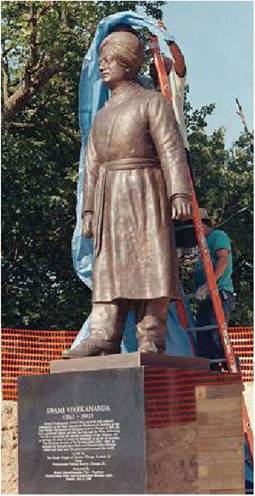
Temple volunteers unveil a statue of Swami Vivekananda at the Hindu Temple of Greater Chicago, Saturday, July 11,1998, in Lemont, Illinois. The statue honors Vivekananda as “the first man to bring Hindu religion and the practice of yoga to America.”
Other figures, less influenced by colonial and Christian critiques of Hinduism, were not as concerned as Ram Mohan Roy and Dayananda Saraswati with reforming Hinduism in ways that would appeal to the West. One of these figures was the enormously popular Bengali mystic, Ramakrishna (1836-1886). A devotee and temple priest of the goddess Kali, Ramakrishna devoted himself to spiritual exercises drawn from different religious traditions, including Vaishnavism, Advaita Vedanta, Tantrism, and even Islamic Sufism and Roman Catholicism. These served as the basis for his teaching that all religions are directed toward the experience of a God who creates religions to suit the spiritual needs and tastes of different peoples. Seen in this way, Hinduism could claim the same legitimacy as any other religion.
Among Ramakrishna’s disciples was Narendranath Datta (1863-1902), a former law student who took monastic vows during Ramakrishna’s last days and was thereafter known as Swami Vivekananda. In 1886, shortly after the death of Ramakrishna, he oversaw the founding of what would become the Ramakrishna Math, an order of monks devoted to the teachings of Ramakrishna. Swami Vivekananda had an enormous impact on the representation of Hinduism in the West, particularly in the United States. In 1893, he visited the United States to speak on behalf of Hinduism at the World Parliament of Religions in Chicago. Quoting from the Bhagavad Gita, he represented Hinduism as a tolerant and universal religion. Like his teacher, Ramakrishna, Vivekananda asserted that all religions are true. His stirring speech proved a milestone in changing Western attitudes toward Hinduism. It also ensured his fame in America, and he went on to establish the Vedanta Society of New York. Today, Vedanta Societies throughout the world are dedicated to the study, practice, and promotion of Hinduism.
Gandhi and the Struggle for Indian Independence
Mohandas Karamchand Gandhi (1869-1948), a towering religious, political, and social reformer in India, recast many Hindu ideas in the service of the fight for Indian independence. Bom into a middle-class family of merchants, Gandhi was an English-educated lawyer and a deeply religious man. As a law student in England, he had read the Bhagavad Gita, and it had a profound impact on him.
Gandhi’s political career began in South Africa, where he worked as a lawyer. It was here, in a struggle against racial discrimination, that he began to develop his political philosophy of nonviolent resistance. He characterized nonviolent resistance as satyagraha (Sanskrit, “grasping the truth”) and explained that its strength lay in converting wrongdoers to justice rather than striving to coerce them.
Gandhi returned to India in 1915 to join the fledgling Indian independence movement, which sought to free India from British colonial rule. Deeply influenced by the American writer Henry David Thoreau (1817-1862), especially his thoughts on civil disobedience, Gandhi established an ashram (a place of religious seclusion) to train freedom fighters. The ashram chose as its motto a statement from the Upanishads: satyamevajayate, “the truth alone will prevail.” Like his Upanishadic forebears, Gandhi believed that truth could be sought only through selfless service and humility, which could in turn be achieved by disciplining the body through fasting and celibacy.
Gandhi did not hesitate to criticize certain Hindu beliefs and practices, particularly that of vamashrama dharma, the ancient system by which society was ordered into various classes or castes. He worked tirelessly to abolish untouchability, calling the untouchables Harijans (“Children of God”), thereby seeking to increase their respectability. Gandhi also strove to improve the status of women.
Gandhi’s charisma and influence were so great that even in his lifetime he was revered as a saint or Mahatma (Sanskrit, “Great Soul”). A lifelong Hindu, Gandhi also advocated the universality and truth of all religions and sought throughout his life to reconcile Hinduism and Islam. Tragically, on January 30,1948, he was assassinated by Nathuram Godse, a Hindu nationalist who thought Gandhi was too accommodating of Muslims. Godse was later executed for the crime despite the pleas of Gandhi’s two sons and Jawaharlal Nehru (1889-1964), India’s first prime minister, who believed that violence would dishonor everything Gandhi represented. After decades of struggle, Gandhi had lived to enjoy just five months of freedom after Great Britain had partitioned colonial India into the independent states of India and Pakistan in mid-1947.
Hindutva and Hindu Nationalism
Whereas reformers such as Ram Mohan Roy, Vivekananda, and Gandhi sought to build bridges with the West through calling attention to the commonalities between Hinduism and other religions, other figures, such as V. D. Savarkar (1883-1966), insisted on the distinctiveness of Hinduism. Savarkar called this concept hindutva (Sanskrit, “Hindu-ness”), a term he coined in a 1923 pamphlet. For Savarkar, hindutva was a force to unite Hindus in repelling all dangerous foreign influences. As president of the Hindu Mahasabha, a Hindu nationalist political party that embraced this concept, Savarkar argued that India was an exclusively “Hindu Nation.”
In 1925, the Rashtriya Swayamsevak Sangh (RSS; National Volunteer Corps) was founded. Although it has presented itself as a Hindu cultural organization, its members have a long history of political actions that have intensified communal tensions, precipitated violence, and propagated religious intolerance. The founder of the RSS, K. B. Hedgewar (1889-1940), was himself inspired by V. D. Savarkar’s concept of hindutva. The RSS was meant to be a training ground for the self-empowerment of Hindu youth who were committed to defending a Hindu nation from the perceived threat posed by the Muslim world. Gaining independence from oppressive foreign rule can often rob nationalist movements of their momentum, but this was not the case in India after 1947. Hindu nationalists continued to be a major force in that country. The political backlash following Gandhi’s assassination led many Mahasabha members to leave the party and ally themselves instead with a new political organization, the Bharatiya Jana Sangh (Indian People’s Alliance), which was founded in 1951. Its founder, Syama Prasad Mookerjee (1901-1953), had been a member of both the Mahasabha and the RSS. Bharatiya Jana Sangh was a Hindu nationalist party specifically created to oppose the Indian National Congress, the more moderate party of Jawaharlal Nehru and Mahatma Gandhi. In 1981, the Bharatiya Jana Sangh became the Bharatiya Janata Party (BJP). Today, the BJP and the Indian National Congress are the two major parties in India’s political system. In 2014, the BJP won a landslide victory in India’s national election. Prime Minister Narendra Modi has been one of the party’s most visible leaders.
Today, organizations espousing Savarakar’s hindutva ideology are under an umbrella group called the Sangh Parivar (Family of Associations). The RSS is the cultural wing, the BJP is the political wing, and the Vishwa Hindu Parishad (VHP; World Hindu Council) is the religious wing of the Sangh Parivar. The RSS continues to attract mostly lower-middle-class male youth, who feel empowered by the strong sense of cultural identity that it advocates. The RSS has awakened a deep sense of cultural pride among Hindu youth, but in recent years some of its members have been leading participants in sectarian violence against Muslims.
Hindu Nationalism and Violence
In 1991, the BJP led a pilgrimage around India gathering bricks to build a temple to Rama in Ayodhya, India. This was to be no ordinary temple. The pilgrims claimed that a fifteenth-century ce Islamic mosque called the Babri Masjid had been erected over an older Hindu temple that marked the exact birthplace of Rama. Their purpose was to tear down the mosque and build a grand Rama temple in its place. Members of Sangh Parivar rallied around the cause, which culminated in 1992 with more than 200,000 participants converging on Ayodhya and demolishing the mosque with their bare hands. RSS youth then targeted the local Muslim community, destroying other mosques, ransacking Muslim homes, raping Muslim women, and murdering Muslim men. The backlash of these events echoed throughout India and Bangladesh, resulting in more than a thousand incidents of riots and communal violence perpetrated by both Hindus and Muslims. By the time calm had been restored, more than 4,000 people had been injured and at least 1,100 had lost their lives. In a highly significant new stage in the ongoing saga of the Ayodha site, Prime Minister Narendra Modi in August 2020, initiated construction of a new Hindu temple. Opponents regard this, and many other moves on the part of the Prime Minister and his BJP party, as dangerously inflammatory and unfair to the Muslim majority, who also face the prospect of being legally declared of less stature in terms of Indian citizenship than Hindus and members of other religious traditions.
The BJP has also employed less aggressive strategies in its campaign to create a thoroughly Hindu India. For example, in the 1980s and 1990s, it attempted to rewrite Indian history by distributing new school textbooks throughout India. These textbooks reflected the BJP’s vision of India as a Hindu nation and Hinduism as a unified, monolithic tradition. Most important, and dangerously, this historical revisionism minimized Muslim contributions to the development of India and described India’s Muslim rulers as foreign invaders. The RSS also has a strong presence in the Hindu diaspora communities in Europe and North America. Many Hindu emigrants send their children to RSS youth camps to give them a sense of their Hindu identity and cultural pride.
GLOBAL SNAPSHOT
From India to Iowa: Hinduism in the Heartland
About 90 million Hindus live outside of India, making for an extensive diaspora with a great variety of Hindu communities. In the United States alone, there are well over 2 million Hindus. In Iowa, Hindus account for less than 1 percent of the population (the states with the highest percentage, at about 2 percent each, are California and Delaware).1 And yet the Hindu diaspora is well represented there, with organizations that promote very different ways of practicing Hinduism.
The Des Moines Balagokulam is one of over 140 meeting centers in the United States of the Hindu Swayamsevak Sangh (HSS), which is historically rooted in the Rashtriya Swayamsevak Sangh (RSS; National Volunteer Corps), the conservative organization inspired by hindutva. HSS, as it states on its website, “is a voluntary, non-profit, social and cultural organization" that "aims to organize the Hindu community in order to preserve, practice and promote Hindu ideals and values.... We encourage maintaining Hindu cultural identity in harmony with the larger community."2 True to its RSS roots, HSS is highly conservative in orientation, seeking to preserve traditional beliefs and practices among those living in the diaspora.
About a two-hour drive southeast of Urbandale, Fairfield (pop. 9,750) is home to Maharishi University of Management, founded in 1971 as Maharishi International University. This is one of the original institutions of Transcendental Meditation (TM), the new religious movement—or so most scholars would call it; the organization itself denies that it is religious—established by Hindu guru Maharishi Mahesh Yogi (1918-2008), who taught many Westerners, including the Beatles and the Beach Boys, how to meditate. Like HSS, Maharishi Foundation USA (the official name of the TM organization) is nonprofit, although there is a fee for learning Maharishi's unique method of meditation. Whether or not labeled as “religious," TM is highly innovative relative to most traditional forms of Hinduism.
For more details on TM and other diasporic movements inspired by Hinduism, see the section “The Rediscovery of Eastern Religious Thought” in Chapter 14.
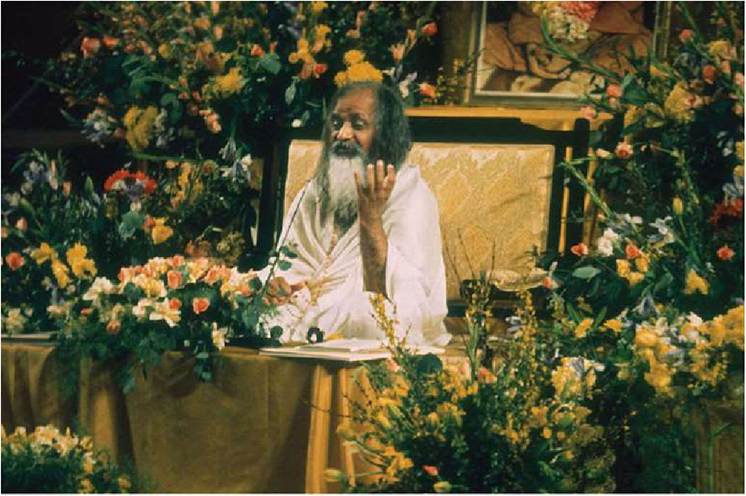
Maharishi Mahesh Yogi.
VISUAL GUIDE
Hinduism
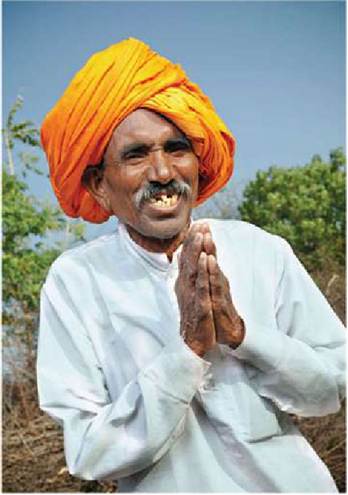
In Hinduism, folding one's hands and offering salutations by saying “Namaste* (nom-us-tay) is a simple way of giving a respectful greeting, as well as saying, *1 bow to the divine in you.”
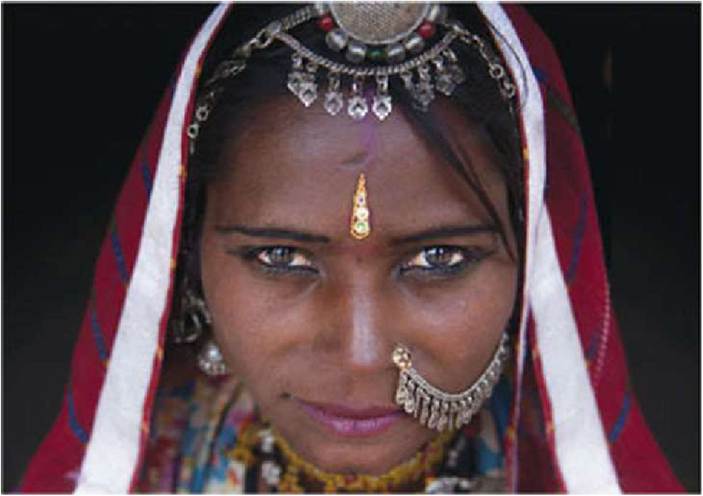
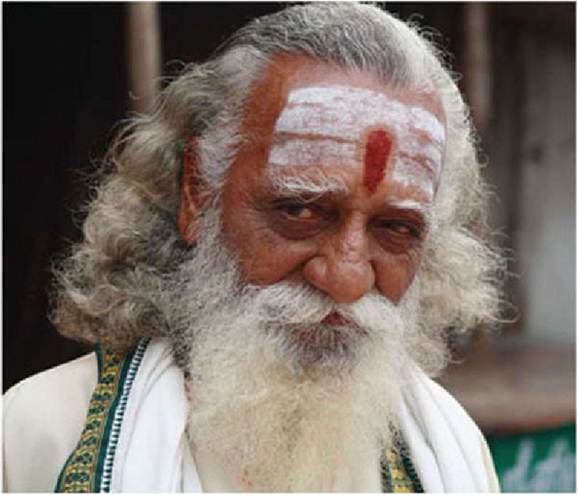
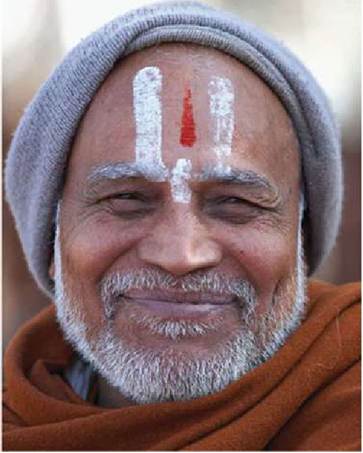
Hindu forehead markings: bindi, tripundra, and namam. Hindi (drop) is a decorative mark on the forehead signifying auspiciousness. An additional "dot" is often applied by married women to the top of the head where the hair is parted. The mark between the eyes signifies the “third eye” (perception beyond ordinary sight). Some forehead markings denote sectarian affiliation, such as the three horizontal lines worn by worshippers of Shiva and the vertical V of the worshippers of Vishnu. The red “drop” in the middle represents Lakshmi, the goddess of fortune.
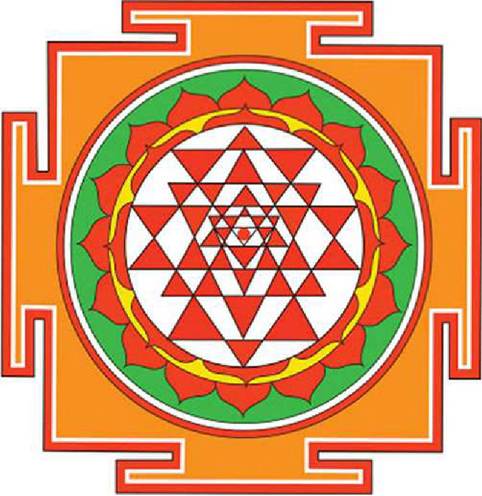
The mandala (Sanskrit, "circle”) is a sacred device that varies in form and function: to map cosmology, to embody deities, to serve as talismans, or to facilitate meditative contemplation.
Self-Assessment 4.2
[Please note·. You must be using an online, browser-based eReader in order to view this content.]
hi
https://www.hssus.org/about-us
More on the topic The Sects of Hinduism:
- Hinduism as a Way of Life
- The Teachings of Hinduism
- Jainism and Hinduism
- Cosmology
- Subsequent Developments
- An Eternal Succession of Tirthankaras
- Conclusion
- Impact of Stambheswari on Other Cultures
- The Impact in the East
- Forms of Worship