Conclusion
With the entry of different panths the equality of tribal life is being fragmented into caste and class. We can see that the Rathwa discriminates against the Nayak and Tadvi. Even the panths have been unable to break this and one may see this clear divide in the night jagaran.
The political and economic class is also becoming clearly distinguished with their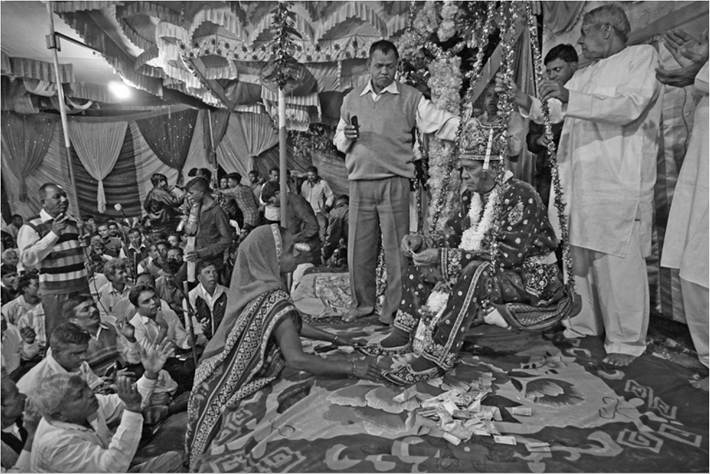
Figure 16.7 A Guru of Pragat Purshottam is Seen Weighed in a Balance
Source: Author
social status. With the integration of the Adivasis into various sects the outside world look at them as ‘Backward Hindus' as they have adopted Hindu customs and practices much later motivated by various gurus of different sects. The upper caste groups of Indo Aryan origin treat them as a backward class, though being part of the same sect. One may see that many Adivasis from the Pavi Jetpur area work as cleaners and labourers in Swaminarayan temples across western and northern India. Few have qualified to be sants (guru) of higher status. But mostly this has always kept them low in social status as compared to the higher caste communities. Thus, the element of casteism has evolved with the activeness of the Hindu forces promoted by various panths in the region.
The practice of the traditional customs and rituals depends on the memorisation of the past and clan genealogies which the new generation see as primitive and backward. For example, the practice of commissioning a Pithora painting is a symbolic enactment of the past. This ‘past' has been marked as backwardness and a reason for poverty and distress among the Adivasis by the active Hindu panths. Condemning indignity has been at the heart of the Sangh Parivar23 to claim native rights over the land. Thus, they call Adivasis Vanvasis which is synonymous with the word ‘jungW, which is perceived as intended to suppress the Adivasis in terms of caste hierarchy, religious practice, and development parameters.
The nomenclature may be about the identity on the basis of the place of residence. But this has been used in its figurative meaning having a derogative connotation. This latter meaning creates an inferiority complex leading to adopting one of the Hindu sects which guide them to a path of development and a new identity. But in recent times this has conflicted with the reservation system in which the Rathwa are being categorised as OBC (Other Backward Castes) for having converted their caste surnames to Rathwa Koli. To assert their true identity the community has been protesting and trying to assert their true tribal identity on occasions, but this has been a symbolic visual representation rather than imbibing the true identity of being an Adivasi.In recent years there have been incidences of illness, distress, and accidents which have made the Adivasis regret distancing themselves from their ancestral deities, local gods, and goddesses. The local badvos have also warned the community of further hardships and severe repercussions if they distance themselves from the rituals. Thus, in the last few years there have been various ceremonies for the re-installation of the forgotten deities (Pithora and Gam Shai) and resumption of rituals. Being committed to their bhagat identity, many have found a middle path in which they worship the Hindu deities and follow the spiritual leaders of various sects, as well as performing their age old rituals. Here the animal sacrifice has largely been replaced by coconut breaking and liquor replaced by water offered through sea-shell (conch) and neem (Azadiracht indica) leaves. The village potters have also witnessed a rise in demand for terracotta horses. All this shows that there is a renaissance of past practices (of invoking the spirits), but all blended with Hindu traditions instructed by the panth gurus. Thus, faith around panth gurus dominates religious thinking among the Adivasis in the public domain, but has not led to the wholesale abandonment of their traditional beliefs which coexist in the private domain as a form of insurance policy.
Notes
1 Rath Vistar or Rathbistar means an inhabitant of a forest or hilly region.
2 Also spelled as Rathawa, Rathva, Rahava, Rathia, and Rathiya.
3 Comprises five small princely states of Rajputs.
4 The word ‘Adivasi’ represents the indigenous tribes who have been inhabitant of the land for ages. Here Rathwa are sub-group of Bhils who have been indigenous tribes of western India, whereas in the Indian Constitution these communities have been categorised as ‘Scheduled Tribes’.
5 Pithora are pictorial histories of the community. They keep changing with time.
6 The horse became representative of ancestors and spirits, and is used as a terracotta votive offering and finds expression in the Pithora paintings of the Rathwa (see Figure 16.1).
7 Mixture of Gujarati and Malvi. The Rathwas are believed to have migrated from Malwa as many folklore references indicate this claim.
8 Mahuwa (Madhuca longifolia) is a source of secondary income for the Adivasis. Its flower (used for making liquor) and pods (used to extract edible oil) are sold in the market.
9 In the context of the Adivasi the ‘outside world’ refers to the land that falls outside their geography, generally marked by a mountain or a river in their region.
10 Homo erectus or the ‘upright man’ is an extinct species of archaic human from the Pleistocene period dating back to two million years ago. They are considered to be the first recognisable members of the genus Homo. They became extinct around 17,000-108,000 years ago (see Mitra 2015:9).
11 These Rajput clans fled to interior jungles merging with the Bhils and Koli, as has been a case with the Rathwas of Chhota Udepur.
12 Guru Govindgiri is known for Bhil uprising at Mangarh on the border of Banswara (Rajasthan) during October-November 1913 in which hundreds of Bhils were killed by the British forces (see Behera & Verm 2022:376-380).
13 Holy fire which is kept alive (burning) continuously.
14 Residential schools. Presently run by various Trusts in different parts of Gujarat.
15 This is more political in nature rather than social.
16 In Sankheda and Pavi-Jetpur taluka, they are also known as Baria Kolis.
17 Particularly at Kanwat and Chhota Udepur.
18 Specialist artists within the Rathwa community who are always male.
19 The shops are not selling bow and arrow, chicken, meat publicly. Similarly, sale of liquor is banned.
20 Region falling in Rajasthan, Gujarat, and Maharashtra inhabited by the Bhils and their subgroups.
21 Karta does not have a gender, race, body form, or figure. It is believed to be one god.
22 Along with the politicians.
23 Word used to represent Bajrang Dal, Vishva Hindu Parishad and Rashtriya Swam Sevak (RSS).
References
Behera, Maguni Charan and Dinesh Narayan Verm. “Reform and Resistance for Freedom: Tribes against the British Rule in India”. In Tribe, Space and Mobilisation: Colonial Dynamics and PostColonial Dilemma in Tribal Studies, 365-397. Singapore: Springer Nature, 2022.
Davi, Tako. ‘Relevance of Tribal Religion - An overview’. In Understanding Tribal Religion, 9-17. New Delhi: Mittal Publications, 2004.
Jain, Jyotindra. Painted Myths of Creation-Art and Ritual of an Indian Tribe. New Delhi: Lalit Kala Academy, 1984.
Mitra, R.P. Prehistoric Population of India, Symposium on People of India. New Delhi: Department of Anthropology, University of Delhi, 2015.
Nilsen, Alf. ‘Subalterns and the State in the Longue Duree: Notes from "The Rebellious Century" in the Bhil Heartland’. Journal of Contemporary Asia 45 no 4 (2015): 574-595.
Ratnagar, Shereen. Being Tribal. New Delhi: Primus Books, 2010.
Tilche, Alice. In Search of an Adivasi Worldview: Identity, Development and the Adivasi Museum of Voice in Western India. London: SOAS, University of London, 2011.
More on the topic Conclusion:
- Conclusion
- Conclusion
- Conclusion: are there any markets out there?
- Conclusion
- Conclusion
- Conclusion: the difficult design of tort law
- Hare C., Neo D. (eds.). Trade Finance: Technology, Innovation and Documentary Credit. Oxford University Press,2021. — 417 p., 2021
- Fligstein Neil. The Banks Did It: An Anatomy of the Financial Crisis. Harvard University Press,2021. — 334 p., 2021
- FIVE COMPONENTS OF LEGAL COMPETENCIES
- Preliminary steps