Forms of Worship
The Sanskrit word puja is commonly used to describe worship in Hinduism. In its simplest form, puja involves making some offering to the deity (such as fruit, incense, or flowers).
The deity is then believed to partake of the devotion inherent in the offering. The material aspect of the offerings left behind is thought to be infused with the deity’s blessing.Puja can be simple or elaborate. Along with material items, offerings can consist of washing or clothing the image of the deity, greeting it, prostrating oneself before it, and similar gestures. Puja can be offered almost anywhere—before a home shrine, at a temple, at pilgrimage sites, by sacred trees or rivers, at roadside shrines, or within temporary structures specially made for a specific rite. Rituals maybe carried out as an expression of love for the deity, in a rite of passage, in celebration of a holiday or festival, when asking for blessings, in order to create an atmosphere of peace and harmony, or in propitiation of the gods in times of trouble. Ritual occasions are ideal for maintaining and strengthening community ties.
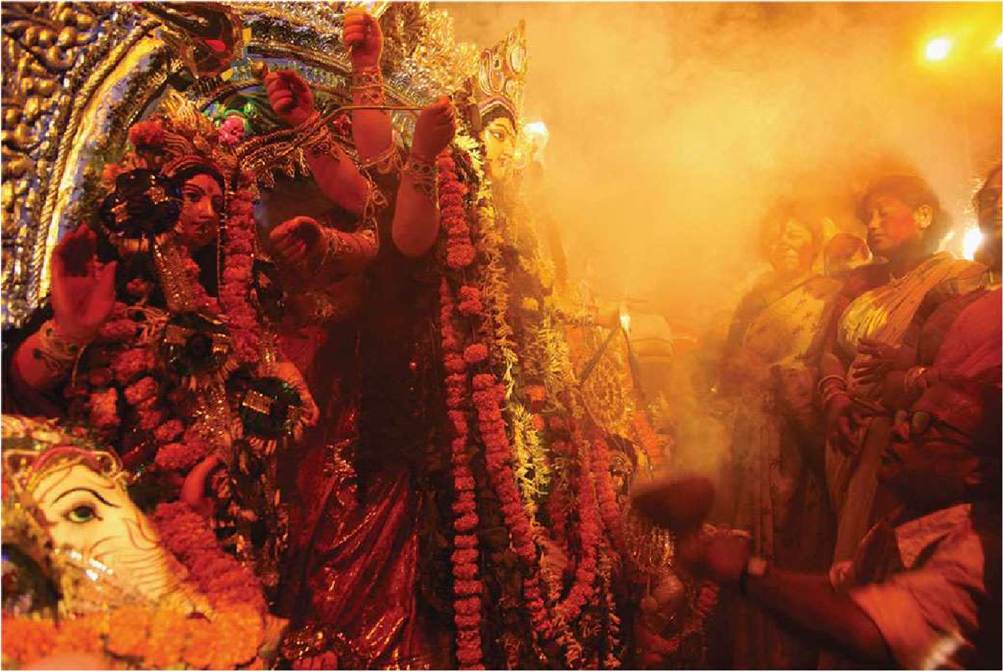
Clouds of incense billow from a censer as devotees pray before a multiarmed clay icon of Durga (upper center), Ganesha (lower left), and other deities. This is the final opportunity for darshan, as the icon is about to be dissolved by immersion into the Ganges River at the conclusion of the festival of Durga Puja. Kolkata, India.
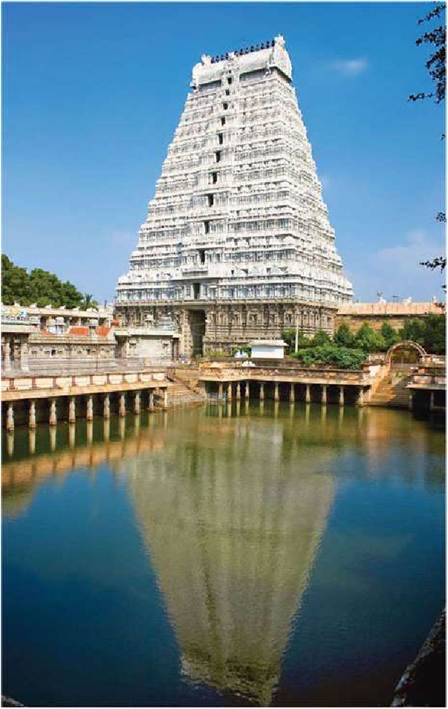
The majestic gate of a Shiva temple in southern India is reflected in one of the two ritual bathing tanks found within its precincts. These towers are erected in the four directions and are often covered in sculptural imagery that refers to the sacred myths of the gods venerated within.
Arunachaleswar Temple, Tiruvannamalai, India, eleventh century.Certain forms of Hindu worship are so popular as to deserve special attention, especially arati, mantras, and sacrifice.
Arati
A common form of puja, arati involves an offering of light. Arati is so common that some Hindus use the term arati rather than puja to refer to worship generally. A lamp fueled with ghee (clarified butter) or camphor is lit and waved in a clockwise direction in front of the deity. The five flames used in arati symbolize the five elements (earth, water, fire, air, and ether), as well as the totality of the universe. This waving of the lamp is thought to remove evil influences and to return the object or recipient of the offering to an auspicious state, regardless of any negative thoughts or desires that might have been projected onto it. At the end of the ritual, participants wave their hands over the flame and touch them to their foreheads, taking the divine light of the deity into their innermost being.
Mantras
Nearly all rituals in Hinduism are accompanied by the recitation of mantras. These are ritual formulas used to produce a spiritual effect. Mantras can be used for a variety of reasons: to heighten awareness of God, to enhance the efficacy of an offering, to aid the practice of meditation, or to produce some magical effect. Mantras are usually—but not always—in Sanskrit.
The mantra that we have considered previously, OM, is prominent throughout Hinduism. The intonation of OM, the sound through which the universe is manifested, is thought to attune the mind to the essence of reality. Various Hindu sects use specific mantras especially suited to them. For example, the most important mantra for Vaishnavas is Om Namo Narayanaya, which means “obeisance to Narayana” (another name for Vishnu). For Vaishnavas, this mantra articulates the relationship between God and the devotee while also asserting the unity of Vishnu. Reciting and contemplating the mantra is an act of devotion that brings the devotee closer to Vishnu.
Sacrifice
Fire sacrifice has been an essential component of Hinduism since the Vedic period. Sacrifice usually involves building an altar, kindling a fire, feeding it with ghee, and casting offerings (milk, cereals, fruits, flowers, etc.) into the fire while chanting mantras. Although fire sacrifice is usually performed by a brahmin priest, these rites can be performed by any married uppercaste man. A fire sacrifice is a crucial component of life-cycle and temple rituals.
Although sacrifice has persisted as an important feature of Hindu worship through the centuries, perspectives on the relevance and meaning of sacrifice have varied. In the Vedic period, sacrifice was seen as essential to maintaining cosmic order. This is the reason that one of the most important Vedic myths describes the universe as being born from the sacrifice of the cosmic man. The Upanishads, however, tend to diminish the relevance of sacrifice as an effective means of liberation from samsara. These texts argue that the true sacrifice takes place internally, with the breath itself fueling an inner sacrificial fire that awakens one to knowledge. The Bhagavad Gita follows in this line of interpretation, asserting that it is the surrender of the fruit of action that is the true meaning and purpose of sacrifice.
In the earliest period, the sacrifice of animals was an important aspect of Hindu ritual. However, over time (and particularly under the influence of Jainism and Buddhism), animal sacrifice ceased to play a role in upper-caste sacrificial rituals. In such sacrifices, coconuts and pumpkins came to act as substitutes for the animals. Animal sacrifice continues to play a significant role in folk Hinduism.
More on the topic Forms of Worship:
- The Mantramarga
- European Influence on Indigenous Forms of Ritualised Violence and Sacrifice
- The History of Zoroastrianism
- Fear and Harmony in Athanasius’s Against the Heathen
- Structure of Devgudi
- The Process of Aryanisation and Brahminisation
- 25.0 Introduction
- KARAITES
- CHAPTER FOUR Town and Country Urban devotions and rural rituals
- Study of Selected Rituals of the Kuki Traditional Religion