CHAPTER FOUR Town and Country Urban devotions and rural rituals
‘I am told by the haruspices that I must rebuild the temple of Ceres which stands on my property; it needs enlarging and improving, for it is certainly very old and too small considering how crowded it is on its special anniversary, when great crowds gather there from the whole district on 13 September and many ceremonies are performed and vows made and discharged.
But there is no shelter nearby from rain or sun, so I think it will be an act of generosity and piety alike to build as fine a temple as I can and add porticoes – the temple for the goddess and the porticoes for the public.’ PLINY1This is an extract from a letter written by Pliny the Younger to his architect Mustius. Pliny was an inveterate writer of letters, many of which were directed to the emperor Trajan when the author held the appointment of imperial special advisor in Bithynia (Asia Minor). Pliny was born in the early AD 60s at Comum (Como) in northern Italy. On the death of his uncle, he inherited his estate in the same region. The letter to Mustius about Ceres’ dilapidated shrine on Pliny’s land reveals fascinating details concerning temple ownership and its attendant responsibilities, as well as pilgrimage and ritual in the Italian countryside. Equally interesting is Pliny’s stated reason for renovating the shrine on his estate: a command from haruspices, professional seers who acted as intermediaries between the spirit and human worlds. The letter goes on to discuss the refurbishment of the temple, proposing the use of marble and other expensive materials, and the replacement of a wooden image of Ceres, so old that it was falling to pieces, with a more permanent statue of stone. Urban centres and sylvan spaces
‘No one shall have gods to himself, either new gods or alien gods, unless recognized by the State. Privately they shall worship those gods whose worship they have duly received from their ancestors.
In cities they shall have shrines; they shall have groves in the country and homes for the Lares.’ CICERO2The high-flying writer, rhetorician and politician Marcus Tullius Cicero set out his opinions on how religion should work in his ideal state, within an Italian context, in his law manual, the De Legibus. Without going into the minutiae of what exactly Cicero meant by ‘shrines’ or ‘homes’ for the Lares (the household spirits), the interest of this piece lies in the distinctions he makes between holy spaces in towns and in the countryside. At first glance, it appears that he advocated built sanctuaries only for urban environments, and believed that rural worship should take place in natural locations. Cicero wrote De Legibus in the mid-1st century BC, while Pliny’s description of his rural shrine to Ceres dates to more than a hundred years later. The sanctuary that Pliny planned to restore on his country estate was definitely a temple-building, so it hardly conforms to Cicero’s guidelines on country worship. It is telling, too, that such authors as Lucan,3 Tacitus,4 Dio Cassius5 and the Elder Pliny6 talked about sacred groves as barbarous places in Gaul and Britain, where Druids lurked and dark sacrifices were carried out. So Cicero’s view was markedly divergent from those of this group of later authors. The latter were likely simply using the theme of Druidic groves as ammunition in their emphasis on barbarity, making a false distinction between the ‘order’ of civic worship and the ‘wildness’ of the foreigners on the western edge of the Roman Empire.
The Greeks and Romans perceived a firm distinction between cities and the countryside, the latter often viewed as wild and chaotic, in contrast to the settled order of urban spaces. In his disturbing and contrapuntal play The Bacchae, the Greek tragedian Euripides uses the tensions between nomos (order) and physis (disorder) to explore attitudes associated with both gender and species.
To nomos belonged cities, civilization and men; physis was the realm of chaos, women and beasts. This kind of thinking likely affected the reportage of ‘barbarian’ ritual practices of Gaul and Britain in Classical literature, as taking place in sinister secret woodland places where dark, chaotic things lurked and the trees dripped with the blood of human sacrificial victims, all seemingly anathema to the urbane, educated and ordered Roman mind. But for Pliny the Younger at least, the rural position of a sanctuary was no bar to its possession of a formally built structure, adorned with costly marble and stone statuary.In Roman Britain, too, both urban and countryside shrines conformed to similar architectural formulae. In some instances, it is possible to identify pre-existing Iron Age sanctuaries, sometimes nebulous in form and often discerned not by the presence of a structure but only by the remains of ritual activity beneath or alongside Roman sacred buildings. A perception common to both urban and rural sanctuaries was that building structures on holy ground represented an ‘invasion’ of spiritual space, and it may well be that foundation-rituals played a major role in the establishment and consecration of religious buildings. But one feature that is likely to have distinguished certain country shrines from city temples is that of pilgrimage. The location of certain rural sanctuaries in Gaul and Britain, at about a day’s walk apart, and sometimes visible from each other, suggests that the sacred journey was an important way of congregating to worship deities in non-urban areas.7 Of course, some city temples, too, attracted their pilgrim-devotees. The great temple to Sulis Minerva at Bath (see Chapters 5 and 6) is a good example of a Romano-British town-shrine that drew supplicants from Gaul and beyond as well as from elsewhere in the province of Britannia.
The Romans built imposing, Classically styled temples in both cities and the countryside in Britain.
These were large rectangular structures built on platforms (podia), reached by steps leading to pedimented entrances supported on columns.8 A popular architectural form for temples in Roman Britain and Gaul – but solely confined to these provinces – was the type today known as ‘Romano-Celtic’, simply by dint of its distribution. These shrines could be circular, polygonal, rectangular or square, but all shared the common feature of concentricity. They varied considerably in size but were generally small compared to temples of the Classical type. They had an inner cella, the holy of holies, that only the priest could enter, typically surrounded by a public roofed portico with open walls for the display of votive objects by dedicants. Archaeologically, this structural footprint can be identified by the more solid inner wall-foundations, built to support the two-storeyed cella that stood inside the less robust walls of the gallery or portico.9 Romano-Celtic temples were used as centres for worship and ritual all over Britannia, whether in major cities, like Caerwent, tribal capital of the Silures in South Wales, or remote rural areas, such as Woodeaton, Oxfordshire, a shrine deliberately positioned between the two powerful tribes of the Catuvellauni and the Dobunni.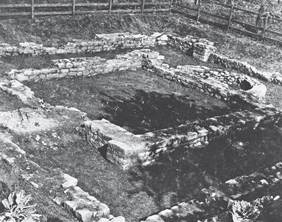
The foundations of a late Romano-Celtic temple at Caerwent, South Wales. Urban hymns
John Creighton10 draws attention to the formulaic layout of Roman towns, in which public buildings, including temples, were positioned so as to enable prominent citizens to perambulate between the forum and basilica, the public baths, the library and the favoured place of worship, with just the right amount of distance between them to enable the patron, followed by his clientes, to show himself off to the populace. So the location of temples in major cities was not always dictated according to strictly spiritual criteria.
Verulamium
During the later Iron Age, what was later to become the Roman town of Verulamium was called Verlamion.11 It was a major centre of the great Catuvellaunian tribe, that same tribe whose king, Cassivellaunus, had confronted Caesar’s invading army with a huge phalanx of war-chariots in the mid-1st century BC. A hundred years later, in about AD 55, a man of the highest status, probably the tribe’s chief or king, died and his funeral was conducted at Folly Lane, Verlamion, with great solemnity and ceremony. We do not know his name, but his body lay in state for some time, surrounded by elaborate grave-furniture, and then he was burnt on a huge pyre, along with large numbers of artefacts, including pottery vessels and metal goods. An enclosure was built around his cremated remains and, flanking its entrance, the bodies of three women were interred, possibly after being sacrificed to honour the dead man’s spirit and accompany him into the afterlife.12
When the new Roman town grew up and its public buildings – including several temples – were constructed, its orientation was clearly focused on that earlier burial-site, as if it retained a powerful significance even in the new order of romanitas. What is more, in the 2nd or 3rd century AD, a large sanctuary was built at Folly Lane, perhaps on the site of a cenotaph to that long-dead chieftain. A grisly feature of this Roman shrine was a deep shaft, one of several, dug in front of the temple-building, in which the deliberately defleshed skull of an adolescent boy was interred, upright, with a puppy and a whetstone (see pp. 17–18). The gruesome, bloodstained head was then displayed for a time outside the temple before being interred in the shaft nearby.13 The proximity of this deposition to an important sanctuary and the singular treatment of the skull make it difficult to argue that this was anything other than ritual activity involving human sacrifice. So it looks as though such barbaric (to the Romans) rites were still taking place well into the Roman period, even in one of the principal towns of Roman Britain, a municipium, which gave the people of Verulamium so-called Latin Rights – not quite as prestigious as the full Roman citizenship accorded the coloniae (towns built for veterans of the Roman army), but still ‘a little piece of Rome, far far away’.14
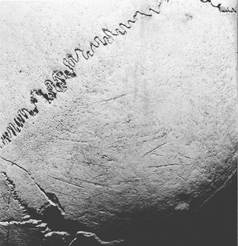
Detail of the boy’s skull found at Folly Lane, Verulamium, showing the marks of the defleshing knife.
Cirencester (Corinium)
Unlike Verulamium in southeast England, the tribal capital of the Dobunni at Corinium (Cirencester) in the Cotswolds has revealed no unequivocal architectural evidence for temples. There were formal ritual structures: the tombstone of Bodicacia (see Chapter 2) was found in close proximity to a square, walled cemetery, perhaps a mausoleum, built in the late 1st or early 2nd century AD, but no shrines per se have been discovered in Corinium. However, there is abundant iconographical evidence in the form of a rich group of stone images that must once have adorned sanctuaries. The 1972 excavations at Price’s Row in Watermoor Road revealed the presence of 4th-century Roman shops built in a line. Outside one of these was a row of sculptures, including depictions of a mother-goddess or Mater accompanied by three Genii cucullati (hooded deities), an altar dedicated to Mercury and the Matres and the carving of an eagle along with a column-base.15 Significantly, nearly all these stones had been broken in antiquity: the eagle’s head had been taken off, and the column-base had been deliberately halved.16 Is it possible that these sculptures came from a lost – or destroyed – temple and that their fragmentation and redisposal were associated with religious tensions, intolerance and the reappropriation of old, curated images?
Even more evocative of a city shrine here is a group of stone carvings from the Ashcroft area of the Roman city, found in 1899. Nearly all these sculptures were dedicated to the Gallo-British cult of the Three Mothers, who are depicted with babies, small children or the fruits of the earth. An inscribed altar dedicated to the ‘Suleviae’ also comes from the site; these were versions of the mother-goddess worshipped also at Bath, their name perhaps deriving from that city’s principal deity, Sulis. The cucullati are represented here too, as are other deities, including a hunter-god.17 Neil Holbrook has suggested that this group of sculptures may, like the stones from Price’s Row, have been originally located at a temple-site elsewhere, and redeposited as a cache after the shrine was either sacked or fell out of use.18 Both the Matres and the cucullati were venerated among the rural Dobunnic population as well as in the tribal capital. These deities were overtly associated with fecundity and prosperity: their portrayal with small children and fruit or bread represents a relationship with their worshippers that included requests or thanksgiving for good harvests and the gift of healthy offspring.
Cirencester was a vividly religious Romano-British town. Its inhabitants worshipped divinities that ranged from the decidedly Gallo-British antlered god Cernunnos (whose cult is explored in Chapter 7) to the Roman State gods that included Jupiter, Mercury, Minerva and Diana. But even Roman gods had their ‘Celtic’ side. In Gaul and Britain, Mercury acquired an indigenous consort, Rosmerta, and she is represented with him in the town,19 alongside other, more conventional depictions of the god.20 Mercury’s popularity here may be explained by the fact that in Britain and the Gallic provinces his principal function was as a god of commercial transactions, so people running urban businesses would naturally have been attracted to his cult. Rosmerta’s name is Gallic and means ‘goddess of prosperity’, and so she complemented the concerns of her divine partner.
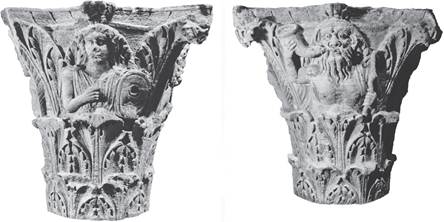
Two views of Bacchic figures carved on the capital of a Jupiter-column from Corinium. On the left is a Maenad grasping a tympanum (drum); on the right is Silenus holding a rhyton (drinking horn). Ht c. 106 cm (42 in.).
Jupiter, lord of the Roman gods, wielder of thunder and ruler of the sky (see Chapter 5), was also worshipped in Cirencester, but his cult, too, was touched by traits whose origins lay in Gaul. Fragments of a ‘Jupiter-Giant’ column reveal Jupiter’s veneration as a sky-horseman at Cirencester. These monuments were especially popular in eastern Gaul and in the Rhineland, where they were frequently set up by soldiers on the limes (the military frontier zone that formed the imperial boundary in Germania). Jupiter-Giant columns present a wonderful blend of Roman and non-Roman iconography and religious thinking. They consist of a rectangular or polygonal base stone, decorated with (usually) Classically inspired divine images and a dedicatory inscription to Jupiter. Above this a tall pillar, topped by a Corinthian capital, soars towards the sky, and on its summit is a sculptured group, and this is where the mixture of Gallic and Roman culture shows itself. The carved group represents a primeval battle between good and evil, light and dark, sky and underworld: typically, Jupiter is depicted as a horseman, the front hooves of his mount trampling a prone ‘giant’, a sub-humanoid figure with a large head and its lower limbs replaced by snakes.21 The sky-rider wields Jupiter’s thunderbolt and his shield wards off the giant’s evil gaze. But the Roman Jupiter is never mounted, and this Gallic version sometimes bears a solar wheel instead of a shield (see Chapter 5). Cirencester is rare in its evidence for one of these monuments in Britain. The surviving stones include an elaborate Corinthian capital upon which Classical gods, such as Bacchus, disport themselves among the acanthus leaves, and a rectangular base bearing a dedicatory inscription that reads:
‘To Jupiter Best and Greatest, His Perfection Lucius Septimius… governor of Britannia Prima, restored [this monument], being a citizen of Rheims.’
And on another face:
‘This statue and column erected under the ancient religion Septimius restores, ruler of Britannia Prima.’22
This inscription packs a lot of information into a few words. It tells us that the monument, including a column and the statue of Jupiter, was dedicated by a very high-status person from Rheims, a Roman city in northeastern Gaul, who must have commissioned its construction after AD 296 when the emperor Diocletian split Britain into four provinces.23 Septimius was making a conscious decision to resurrect an obsolete cult that had been at its most popular in the Rhineland from the mid-2nd to 3rd centuries. It is clear from this inscription, and from other evidence such as the tombstones of the Roman cavalrymen Genialis and Dannicus, who hailed from these regions,24 that Cirencester enjoyed a close association with Rhenish communities. It is likely that the antlered god Cernunnos was also imported by individuals from eastern Gaul, where his cult was especially popular.
Great Chesterford
Very different from the official Roman municipium at Verulamium and the civitas (tribal) capital at Cirencester was the small walled town of Great Chesterford in Essex. A high-status burial and a rectangular timber shrine, predating a Roman temple, at the site provide evidence of late Iron Age religious activity. Soon after the Claudian conquest a Roman fort was built here, either before or because of the Boudican revolt, strategically located at the junction between two powerful tribes – the Catuvellauni and the Trinovantes,25 both of whom were heavily involved in the Boudican rebellion. But the military site was dismantled less than two decades after its construction, as the threat of revolution had subsided, and in its place a town grew up, with public buildings, houses and, towards the end of its life, a town wall, erected in the 4th century, presumably in response to a real or perceived threat.26 A mile to the east of the town a religious precinct was established, its focus a Romano-Celtic temple built on the site of the Iron Age sanctuary, thus making a deliberate statement of engagement with its Iron Age past. The siting of the original shrine may have been chosen because of its proximity to a stream, and there are hints that a sacred tree or grove stood nearby, the latter possibly an artificial structure with trees or tree-trunks planted close together to replicate a natural grove. Close to the Iron Age sanctuary and to its north was a pit containing two complete ceramic vessels buried in about AD 60–70.27 The shrine’s position on this inter-tribal boundary may also have been deliberate, occupying a neutral territory where ceremonial assemblies and tricky negotiations, perhaps conducted by priests – even Druids – may have taken place. After all, Caesar draws attention to the role of the Gallic Druids as arbitrators in disputes.28
The Roman temple that succeeded the Iron Age shrine was built directly on top of it in the late 1st or early 2nd century AD, shortly after the Roman town was established. It was a substantial structure of traditional Romano-Celtic rectangular form, with an outer portico ambulatory and a taller cella inside, the sanctuary-building surrounded by a temenos, or external sacred precinct, bounded by a stone wall. The cella and the outer ambulatory were both decorated with mosaic floors. The archaeological evidence for ritual activity here chimes with the pattern of use discerned in other Romano-British and Gallo-Roman temples in so far as the active area seems to have been the temenos rather than the innermost shrine itself. Its interest lies in its evidence for highly organized and repetitive acts of worship that must have been controlled or overseen by a (probably resident) professional clergy.
Central to the ritual activity here was the deliberate deposition of special objects – particularly ironwork – and the whole or partial bodies of animals, mostly newborn chicks and the right sides of lambs in pits. The remains of sheep-pens in the precinct indicate a concern for convenience: apparently pilgrims could come to the sanctuary empty-handed and select and purchase an animal for slaughter, rather than bringing their sacrificial lamb with them from home. Analysis of the bones revealed signs of butchery, leading to the conclusion that the animals were killed and partially consumed in acts of commensality (ritual feasting), wherein the cooked sacrificial meat was shared with the gods. Clearly the people involved in these ritual practices considered the right side of the animal the more valuable and efficacious part of the body; it was therefore given to the gods while the less favoured left side was eaten by the worshippers. Cattle were also used in the ceremonies, but in a different way from the lambs: the skulls of five cows and a horse, all with their lower jaws missing, were carefully placed upside-down in a hole outside the precinct.
There is other evidence for how visitors used the shrine, for little gold and silver plaques in the form of feathers or leaves were left by pilgrims as offerings. This type of object was a comparatively common gift found on many Romano-British temple-sites, and again it seems likely that these could be bought in a special shrine-shop near the temple.29 This sanctuary fell into decline in the 3rd and 4th centuries AD, and while attempts were made to refurbish it late in its life, their success was limited and the building gradually fell into disuse during the early 4th century.30
Not all the religious activity at Great Chesterford took place in this one temple. There were other sanctuaries in and around the town, and the habit of depositing offerings in pits was repeated in many parts of the built-up area and its environs. Some of these offerings – including pottery, money, animals, human foetuses and personal objects such as cosmetic sets – may well have been foundation deposits, made to bless new shops or dwellings. But one religious item stands out as a public monument rare in Roman Britain: the remnants of a Jupiter-column, part of an octagonal base saved from its use as a cooling-trough in a smithy in 1803 by a local antiquarian named Foote Gower. (Half a dozen fragmentary Jupiter-columns are known in Britain, compared to over two hundred in eastern Gaul and the Rhineland.) Four carved heads depicting Classical deities can be seen, each set within an arched niche: their identities are uncertain, for the stone is very worn, but at least one may represent Jupiter and others may be the faces of Mars or Mercury and Venus or Luna. Its original provenance is unknown, but when complete it would have towered over the town, at a height of some 15 m (46 ft),31 just as its fellow did at Corinium, dominating the landscape for miles around. If the pits and shafts that were dug throughout the town seem to reflect a preoccupation with underworld spirits, the Jupiter-column represents an ebullient hymn to the lords of the sky. There are many other signs of the ritual activity that took place at Great Chesterford, including a whole range of deposits in ritual shafts, but one object is worthy of special mention: the ceramic thuribulum (incense-burner) found in the mid-19th century,32 not unlike the ones from the ‘Druidic’ shrine in Chartres (see pp. 29–32). This vessel provides a chink in the door to imagining the experience of worshipping in the town, for its use involved the burning of aromatic and quite possibly mind-altering substances that could lull devotees into a trance-state in which they received visions of the spirit world. Rural worship
In July 2016 I went with my small a cappella choir to sing Choral Evensong at the tiny 12th-century church of Llanfrynach near Cowbridge in the Vale of Glamorgan, South Wales, an annual summer event. The church stands in the middle of a field, its medieval village deserted after the ravages of the Plague, and it has no electricity supply, so we sang by the dimming light of the windows and by candlelight. It occurred to me as I crossed the field, with its tall nettles and long damp grass, that Romano-British pilgrims approaching rural temples would have experienced something very similar. The countryside was a hive of religious activity in Roman Britain. Sanctuaries ranged from isolated wayside shrines to monumental temples that enjoyed a wide-ranging reputation and to which pilgrims flocked from far and wide. The rural sanctuaries considered here provide a curious contrast to the urban temples of Verulamium and Great Chesterford, where it is unclear to which deities they were dedicated. The shrines at Nettleton Shrub, Wanborough and Lydney were all built for the worship of specific divinities: Apollo Cunomaglus at Nettleton, a sun-god, perhaps Jupiter-Taranis at Wanborough and Nodens at Lydney.
Nettleton Shrub
‘Life is a series of adoptions’33
It is by no means always possible to tell which god or gods were venerated at temples in Roman Britain, particularly in the absence of epigraphic dedications or iconographic representations. Fortunately, both survive at the temple at Nettleton Shrub in Wiltshire,34 and so we know that the principal deity worshipped here was Apollo Cunomaglus, his composite Roman and native British name a proclamation of his cross-cultural identity. ‘Cunomaglus’ means ‘Hound-Lord’, so the cult at Nettleton was tapping into Apollo’s function as a hunter. The temple was built deep in beautiful countryside but was situated on a Roman arterial road, the Fosse Way, and so would have attracted travellers making the journey between the two important towns of Cirencester and Bath, the former being the tribal capital of the Dobunni, and the latter a major religious settlement as important, in its way, as Canterbury Cathedral or Westminster Abbey are today.
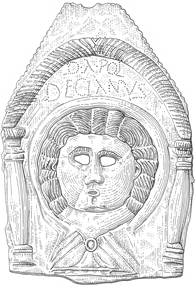
Reproduction of an inscribed bronze plaque depicting the young sun-god Apollo from the temple of Apollo Cunomaglus at Nettleton Shrub, Wiltshire. Ht 11 cm (4¼ in.).
The dedication of the temple to a god with a native name strongly suggests that local people were worshipping him prior to the Roman conquest.35 Before the temple itself was built at Nettleton, a military base was established in the AD 40s. But a few decades afterwards, a round stone shrine was constructed on the site of a spring, and there is evidence of ancillary buildings in its environs, including a strong-room, a meeting-hall, what may have been a resident priest’s house and a hostel where weary pilgrims who had travelled from afar could stay overnight in the hope of receiving dream visions from the gods, as at the shrine at Lydney. This sanctuary went through several phases of minor alteration and refurbishment, and major new construction work took place in the mid-3rd century, when an octagonal podium was built surrounding the original circular temple. But soon after the construction of this platform, fire destroyed the sanctuary, and it was replaced by a bigger, more solid and elaborate octagonal temple-building, its arcades and painted wall-plaster displaying the increased popularity and prosperity of the cult-centre. Other buildings adorned Apollo’s sacred space here, including a second temple of rectangular design. After the sacred precinct fell into disuse in the early 4th century, attempts were made to restore the cult as part of the mid-4th century pagan revival seen elsewhere in the southwest of the province, probably triggered by the apostate emperor Julian, who made a short-lived attempt to veer away from the Christianity adopted and disseminated by Constantine earlier that century (see Chapter 9).
Of the many votive finds from the main temple, the most revealing is an inscribed altar that reads ‘Deo Apollini Cunomaglo Corotica Iuti Filia VSLM’ (‘to the god Apollo Cunomaglos Corotica, daughter of Iutus, willingly and deservedly fulfilled her vow’).36 Another dedication took the form of a small bronze pedimented plaque depicting the head of a young god with an inscription from a suppliant called Decimius to the god Apollo.37 Many pilgrims left their mark at Nettleton. Two other rural divinities associated with hunting – the Roman Silvanus and Diana – were worshipped here, along with Mercury and his Gallo-British consort Rosmerta, showing that shrines like this need not be the exclusive domain of a single deity. Visitors to the sanctuary offered coins, jewelry and other personal items to the presiding god or one of his divine companions, including human and animal figurines, together with pottery and glass vessels. Signs of heavy wear in the entrance are testament to the shrine’s popularity over centuries and sponsorship by people with money to spend on elaborate stone architecture and painted walls at a wayside shrine.
Why was Apollo Cunomaglus’s sanctuary such a popular focus of pilgrimage and worship? The hound-motif suggests hunting, and that would be fitting for a rural shrine. But what of Apollo himself, and was there a deeper symbolism associated with dogs? In order to resolve these issues, Nettleton’s physical proximity to the thermal-spring sanctuary at Bath, sacred to Sulis Minerva, is relevant in more than one respect. Not more than a day’s walk from each other, the cults of both Apollo and Sulis were associated with light, heat and spring-water, and each may have been on recognized and regular pilgrim-routes. The Classical Apollo was, first and foremost, a sun-god, and Sulis’s name suggests that she, too, was a solar deity (see Chapters 5 and 6). Sulis was principally concerned with healing, the hot springs a magnet for sick pilgrims. But Apollo, too, was concerned with health for, according to Classical mythic tradition, he was a wielder of plague, so he may have been propitiated in aversion ceremonies by suppliants anxious to avoid disease. Dogs were also connected with healing cults in the ancient world. The great medicinal sanctuary and theatre dedicated to Asklepios at Epidaurus in the Peloponnese38 was dedicated to healing (ear complaints in particular, perhaps because of the astounding acoustics of the temple-theatre), and its priests kept live dogs because of the legendary therapeutic properties of their saliva. So, against this cultural backdrop, it is valid to theorize that Nettleton had a role as a sacred place of healing. The personal items the pilgrims left here included things they wore, such as brooches, bracelets and pins (for clothing or hair), these last being votive objects perhaps – because of their phallic shape – associated with the desire for pregnancy.39
Wanborough
The discovery of the temple-site at Wanborough, Surrey, is noteworthy for both positive and negative reasons. While the excavation of the shrine produced a wealth of evidence for the activities of both worshippers and – importantly – clergy, the systematic and greedy looting of the site, particularly of its huge assemblage of coins, by metal-detectorists robbed the temple of some of its most significant finds. This is not an out-and-out criticism of metal-detector users. Indeed, the introduction of the Portable Antiquities Scheme in the late 1990s has encouraged increasing and fruitful cordiality between museums and other heritage bodies and metal-detectorists in Britain. Most of the latter are responsible individuals interested in the past for its own sake. Unfortunately, Wanborough was the victim of a less worthy minority who sold what they found for monetary gain,40 so a great deal of information about this rich site has been lost.
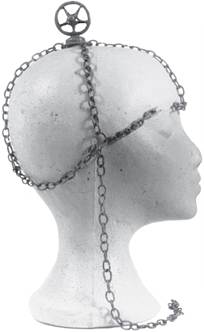
One of the bronze chain-and-wheel headdresses from the temple at Wanborough, Surrey.
The Wanborough temple-complex has several idiosyncracies, not least of which is the huge number of Iron Age and Roman coins deposited as offerings. But the really important material comprises the highly revealing group of liturgical regalia, including sceptres and headdresses, testament to a thriving clerical presence at the shrine. The headdresses are particularly fascinating because in the absence of inscriptions at the site, they provide clues as to the nature of the presiding deity; the wheel-symbols forming the apex of the ritual headgear are associated elsewhere with the Romano-Celtic sky-god Jupiter-Taranis.41 These ‘crowns’ consist of fine bronze chains supporting the wheel-models, presumably mounted on caps made of leather or textile.
There was probably a shrine at Wanborough in the late Iron Age, though no trace of this early building has survived, and the first locus sanctus may have been ephemeral, perhaps focused on a sacred grove or tree. Very soon after the Roman conquest a large coin-hoard was buried here, comprising a mixture of Iron Age and Roman issues. Then, in the mid-2nd century AD, a number of large dedication-deposits were made in advance of the construction of the temple itself. The most prominent features of these foundation offerings were redeposited Iron Age coins (perhaps as a way of expressing the shrine’s rootedness in the ancestral past) and the liturgical regalia. Soon afterwards the temple of typical Romano-Celtic form was built, with a square inner cella surrounded by an ambulatory. Two hundred years later the temple was deliberately demolished.
The presence of sceptres and unusual headdresses at Wanborough invites further consideration, for it is rare for such a concentration of priestly regalia to be found at a Romano-British temple-site. It is possible only to guess at what kind of ceremonies and festivals were celebrated here, but the number of pieces suggests that they included processions in which several clergy took part, each resplendent in their wheel-surmounted headdress. When new, the chains and wheels would have glinted like gold in the sunlight, fitting tributes to a god who, though linked to the Roman Jupiter, had his ancestry in the Gallo-British cult of the sun.42 The temple at Wanborough had a relatively short life but a rich one, full of pageantry and benefiting from wealthy pilgrims who left pots of food and liquor as well as personal items and, of course, money. So many coins were found here that the temple may, like many Classical sanctuaries, have acted as a community treasury.43
Lydney
‘To the god Nodens: Silvianus has lost his ring and given half its value to Nodens. Among those who are called Senicianus do not allow health until he brings it to the temple of Nodens’44
The lead plaque upon which this inscription was written was found at the imposing stone temple at Lydney Park, Gloucestershire, built high above the river Severn in the late 3rd or early 4th century AD. The sanctuary was dedicated to the British god Nodens, whose name is philologically connected to an Irish god-king, Nuadu, who is chronicled in the early Irish myths.45 The plaque belongs to a group of objects known as defixiones, or curse tablets. These vengeful messages were used by aggrieved parties to implore or demand divine punishment – frequently in the form of ill-health – from the gods for personal crimes such as theft.46 The Lydney curse is especially interesting, for someone called Senicianus lost a gold ring inscribed with his name far away at Silchester in Hampshire, where it was found early last century. Was this the malefactor who stole a fellow pilgrim’s ring on Nodens’ holy ground? It would be nice to think so, and to speculate whether the god’s hand stretched out far enough to punish him.
The temple at Lydney was built late in the Roman period but, like other shrines in southern England,47 it was deliberately sited inside a defunct Iron Age hillfort. Iron mining took place here too, and two votive objects associated with the mine consisted of miniature miner’s picks, each made of iron,48 though most model implements made for religious offerings were of bronze.49 Of the other numerous votive objects, including personal possessions, such as pins, rings and brooches, among the most revealing were two more inscribed dedications to Nodens, both on sheet-bronze plates,50 and no fewer than nine small votive images of dogs, including a beautiful figurine of a recumbent deerhound.51 The last-mentioned group suggests that, like Apollo Cunomaglus at Nettleton, Nodens was a hound-lord, perhaps associated with hunting. But the presence of votive dog-figurines may have other meanings. The link between these animals and healing has already been considered, and at least two other gifts brought by pilgrims suggest a therapeutic aspect to Nodens’ responsibilities: a figurine of a pregnant woman clutching her abdomen, and a model arm, its fingers displaying a malformation due to iron deficiency, a problem that might well have been alleviated by drinking or bathing in the red, iron-rich water of the stream flowing through the site. An oculist was present at Lydney, leaving behind him a stamp from a pot of eye ointment, enhancing the notion that Nodens was a divine healer. There is also evidence at Lydney for an abaton or dormitory, where a sick pilgrim might stay overnight in the hope of a healing vision from the god.
The finds from Lydney demonstrate the presence of professional clergy here. They wore chain headdresses, similar to those from Wanborough, and the regalia of one consisted of a splendid bronze diadem depicting one of the sun-gods, Apollo or Sol, standing in a quadriga (a four-horse chariot) and armed with a flail.52 We are fortunate in being able to put names to individual religious officials who presided over the rites at Lydney, for the cella of the sanctuary was adorned with a beautiful mosaic pavement depicting the Severn Bore (the great tidal wave that sweeps down the river at particular times),53 together with dolphins and other water creatures. It bears a highly informative inscription telling visitors to the temple that one Titus Flavius Senilis dedicated the mosaic to Nodens’ holy place. Senilis calls himself a ‘superintendent of religious rites’. The man who supervised the laying of the mosaic was Victorinus, but he was not simply a craftsman, for the inscription mentions that he was an interpres;54 it is highly likely that this means he was an expert in reading and interpreting the dreams and visions of pilgrim-visitors and of decoding the obscure messages that came from professional oracles who had the ear of the god (see Chapter 6).
So what sort of god was Nodens? Was he primarily a healer-deity, or a hunter (as implied by the deerhound figurine)? Could he have been involved with both? Was he also a god of water, the sun and iron-production, as some of the deposits from the site suggest? The cult of Nodens seems to have been complex and multifaceted. The temple was situated in an area that, even today, is rural and remote. Yet it was a sophisticated, Classically styled building, with resident clergy and a rich variety of sacred objects. The apparent ambiguity of Nodens may be explained partly by a small figurine that seems to be highly significant, depicting a dog with a human face.55 Shape-shifting was a common phenomenon in Gallo-Roman and Romano-British cult imagery, and this statuette may well represent the involvement of shamans in ritual activities. Shamans traditionally act as conduits between the material and spirit worlds, and they often have animal-helpers who facilitate such transitions. Shamans are frequently associated with healing because in antiquity (as in some traditional societies today) disease was commonly thought to have been caused by the intervention of maleficent spirits, whom the shaman sought to control.56 It may be that the idea of transformation is key to understanding the complexities of Nodens’ cult at Lydney. In hunting, life and death are exchanged, and in many traditional hunting communities, venery is hedged with ritual and taboo to ensure that the killed animal’s spirit is appeased and that the herd of deer, or the slain hare, would return to the earthly world reborn. Ideas of transition between states may also explain the two votive inscriptions at Lydney to Mars Nodens.57 Chapter 6 explores the manner in which the traditional role of Mars as a warrior-god, patron of soldiers, was reinterpreted in Britain and Gaul as that of a fighter against illness. Such perceptions were underpinned by ideas of changed states: from life to death in hunting and war to transformation from sickness to health.
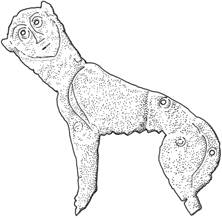
Reproduction of a bronze figurine of a dog with a human face, from the temple of Nodens at Lydney, Gloucestershire. Ht c. 6.5 cm (2½ in.).
More on the topic CHAPTER FOUR Town and Country Urban devotions and rural rituals:
- CHAPTER FOUR Town and Country Urban devotions and rural rituals
- Shrines and temples
- Worked-Out Numerical Exercise for Solving the Classical AD-AS Model with Misperceptions
- REAL RIGHTS AND PERSONAL RIGHTS
- Ritual Instruments Used by Female Priestly Attendants
- CONTENTS
- Anaemia in pregnancy