CHAPTER FIVE Cosmology in Roman Britain Sky, earth and water
‘When mistletoe is discovered it is gathered with great ceremony, and particularly on the sixth day of the moon, because it is then rising in strength and not one half of its full size.
Hailing the moon in a native word that means “healing all things” the Druids prepare a ritual sacrifice and feast beneath a tree and bring up two white bulls. A priest wearing a white robe climbs the tree and with a golden sickle cuts down the mistletoe, which is caught in a white cloak…’ PLINY1This famous passage by Pliny the Elder hints at the part played by observation of the natural world in Gallo-British belief-systems. Although Pliny was making specific reference to Gallic Druids, both he and Caesar mention their influence in Britannia. What is so telling about Pliny’s comments is the emphasis on the moon’s physical properties: its changefulness and its gleaming whiteness. The moon’s brightness is acknowledged in the white robes of the priests, the choice of white bulls for sacrifice and the attraction to the pale luminescence of the mistletoe berries.2 The ‘golden’ sickle was almost certainly gilded bronze, but its pale, shining surface and the curved shape of its blade would seem, once more, to reflect the character of the rising moon.
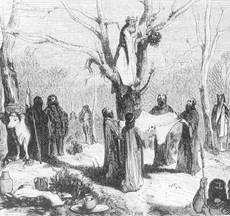
Antiquarian picture of Pliny’s Druids cutting the mistletoe from the sacred oak on the sixth day of the moon. Songs to the moon
The river Witham in Lincolnshire has long been recognized as a place where Iron Age Britons came to offer precious gifts, including decorated military equipment, to the gods.3 But archaeologists became particularly interested in the region when, in 1981, a metal-detectorist found part of a sword inlaid with red coral. This led to the mounting of an excavation on the north bank of the river at Fiskerton that revealed something very odd indeed: rows of wooden posts that formed a timber trackway over the low-lying boggy ground.
It was possible to date the trackway very accurately by means of dendrochronology (tree-ring dating), which determined the very year that the trees used were felled. The result was quite startling, for a pattern of continuous construction was revealed. Over a period of one hundred and fifty years beginning in 457 BC the posts were removed and replaced every twenty years or so, during ten episodes of activity, and although not every timber post used in the causeway fits the pattern precisely, it has been possible to identify a rhythm of renewal that would appear to have broadly coincided with lunar eclipse events4 and continued until the 4th century BC.The focus on Fiskerton as a sacred site was not confined to the wooden causeway. In the later Iron Age and Roman periods, people were making offerings here in the form of martial equipment, ornaments, two log-boats and part of another whose form suggests a Roman date.5 A more sinister find, made during the excavations in 1981, was part of a human skull whose owner received a deadly head-wound from a sword.6 While it is impossible to be certain, it is entirely feasible that the despatch of this individual – probably a young man – was an act of human sacrifice, and that the body was cast off the causeway into the water, maybe during the Roman period, in the same fashion as other votive offerings. It would be rash to make a firm assertion that all this ritual activity was associated with the moon, but sacred memory can be long, and if the renewal of the trackway was a ritual connected with lunar eclipses, it may be that the continued sanctity of the site also had links with the moon. Archaeological evidence from the European continent may corroborate such a theory. Certain Iron Age iron swords or daggers from central Europe are ornamented with gold inlaid symbols representing full and crescent moons.7 An Iron Age silver coin from Drayton, Hampshire, depicts a galloping horse, above which is a motif that seems to depict either a crescent moon or a moon in the process of eclipse.8 Finally, Caesar’s observation that Gallic people counted time by night rather than by day supports the theory that night possessed a particular significance, at least in Gaul (see Chapter 10).9
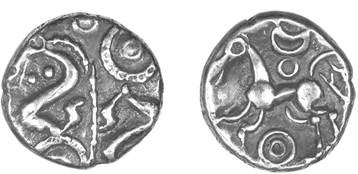
Iron Age silver coin from Drayton, Hampshire, depicting a horse beneath a crescent, or partially eclipsed, moon.
Diam. c. 2 cm (¾ in.).In the summer of 2016, a cave explorer in the Gower Peninsula in southwest Wales found human bones trapped beneath a roof-fall, along with a small copper-alloy statuette (see p. ix). The figure stands some 10 cm (4 in.) high; its gender is uncertain, but probably female, to judge by the absence of obvious male genitalia. Its head is overly large and its physiognomy, with its lentoid eyes, wedge-shaped nose and the slit of a mouth, betrays its local, perhaps Iron Age, manufacture. But most striking is the huge crescent headdress it wears, and it is tempting to interpret the image as that of a moon-deity. Between its feet is a small hole, probably for the insertion of a staff, suggesting that the figurine was carried in ceremonial processions or other ritual activities, perhaps taking place in the torch-lit darkness of the cave.10
The Romans introduced the moon-goddess Luna to Britain. A vivid relief-carving from the thermal-spring sanctuary of Sulis Minerva at Bath shows Luna in front of a lunar crescent, a riding whip in her hand. The stone formed part of a temple-pediment and would have been visible to anyone visiting the shrine.11 One of the votive finds from the reservoir of the main hot spring was a silver moon-pendant,12 probably once attached to a sceptre carried by a religious official in processions or other religious duties. There is little evidence that Luna was a popular goddess in Roman Britain, but in the temple to Sulis at Bath at least, with its emphasis on heat and the sun, Luna played a prominent role, demonstrating that worshippers recognized the importance of acknowledging the moon as ruler of the night skies. Gods of the heavens
‘Those who propitiate with horrid victims ruthless Teutates, and Esus whose savage shrine makes men shudder, and Taranis, whose altar is no more benign than that of Scythian Diana…’ LUCAN13
‘Teutates who inspires terror with sacrificial blood, and whose altar bristles with weapons, is called Mercurius Teutates in the language of the Gauls.
He was venerated with human blood. Esus Mars is appeased thus: a man is suspended in a tree until his limbs fall apart in a bloody sacrifice. They propitiate Taranis Dis Pater by cremating several men in a wooden trough’. BERN SCHOLIAST ON LUCAN14In AD 60, the Roman poet Lucan published the first three books of his epic poem the Pharsalia, commemorating the last great battle for leadership of Rome, between Julius Caesar and Pompey in 48 BC at Pharsalus in Thessaly. In the first passage quoted here, he describes three Gallic gods encountered by Caesar’s army near Massilia (Marseille): Teutates, Esus and Taranis. The second, more detailed account is by a medieval Swiss author from Bern, writing his commentary on the Pharsalia in the 9th century AD. The latter presumably drew on ancient texts that are now lost. All three fearsome deities feature – albeit rarely – in the epigraphic record of Britain and Gaul.15
Lucan’s first two deities bear Gallo-British names that reflect their status: ‘Teutates’ means ‘tribe’, the name being cognate with the Irish tuath, and ‘Esus’ means ‘lord’. Both are thus associated with titles of rank, rather than particular abilities or affinities. Taranis is different, for his name is functional: it means ‘Thunderer’, from the Celtic word for thunder (surviving in the Welsh taran). While the medieval Bernese ‘scholiast’ conflates Taranis with the Roman Dis Pater, god of night and darkness, the few surviving inscribed dedications refer to him either alone or coupled with Jupiter. Of these, the sole British example is a sandstone altar with a now virtually illegible inscription from the legionary fortress at Chester.16 It was found in the mid-17th century while a cellar was being excavated for a householder named Richard Tyrer, and it is probably because he kept it in his garden for over twenty years that the inscribed surface is so worn. The dedication was made to: ‘Jupiter Best and Greatest Tanarus, Lucius Bruttius Praesens, of the Galerian voting tribe, from Clunia, princeps of Legion XX Valeria Victrix, willingly and deservedly fulfilled his vow, in the consulships of Commodus and Lateranus’.
The inscription, fortunately transcribed before being worn away, is full of information: the dedicant was a centurion who hailed from Spain.17 The slight variation in the deity’s Gallo-British name is probably due to a mistake made by the scriptor (the text drafter) or the ordinator (the stone-cutter), either (or both) of whom may never have seen the god’s name in writing, being quite possibly illiterate and reliant on dictation from a third party.18The altar to Taranis/Tanarus from Chester is indicative of how far interconnections between Roman and provincial religion could develop. Here was a high-ranking citizen soldier, a leader of men in the Roman army, yet he openly proclaimed his allegiance to a foreign Gallic sky-deity whose cult he clearly perceived as being suitably coupled with the highest of the Roman State gods. As was considered in Chapters 2 and 3, the veneration of Jupiter by the military blended religion with politics, the latter being closely associated with repeated declarations of loyalty to the emperor and the spirit of Rome by army personnel, however far they were from the imperial centre.
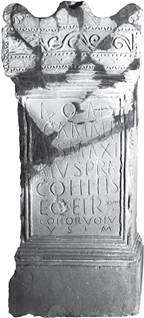
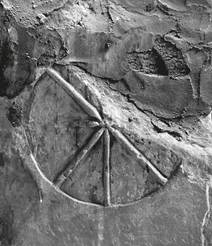
Altar dedicated to Jupiter Optimus Maximus set up by soldiers at Maryport, Cumbria, with detail of the Gallo-British solar wheel. Ht 79 cm (31 in.).
And was it this same hybrid sky-lord, Jupiter Taranis, whose wheel-symbol was surreptitiously carved on the sides or the backs of altars overtly dedicated to Jupiter Best and Greatest at forts on Hadrian’s Wall, such as Castlesteads, Maryport and Birdoswald? And what did this wheel represent? Did it belong to Jupiter’s chariot, rolling thunder across the heavens? Or was it the motif of the Gallo-British sun-god, whose flaming wheel depicted solar force?19 The wheel as a sacred symbol was deeply entrenched in Gallo-Roman religious thinking, and it was present in Roman Britain, too, albeit less commonly.
In the 3rd century AD, an individual deposited a hoard of religious bronzes in a pot at Felmingham Hall, Norfolk. The vessel contained a range of priestly regalia and figurines, including ravens, a model wheel and a human head apparently radiating light and surmounted by a crescent moon,20 this last lending credence to the interpretation of the wheel as a celestial symbol. In Gaul and the Rhineland, the horseman depicted on the summit of Jupiter-columns sometimes carries a sun-wheel in place of the more usual shield (see Chapter 4).21 The sky-god used the solar disc as a means of combating the ‘dark side’ represented by the human-snake monster.The complex symbolism demonstrated in the representation of the sky-father clearly reflects its one-time background in ancient mythology. Two striking objects from Roman Britain perhaps allow a glimpse into the story behind the celestial cult of Britain and Gaul. Each is part of a ceremonial sceptre. One comes from a temple at Farley Heath, Surrey: a sheet-bronze strip originally wound around a wooden stave, it depicts a range of images including wild and domestic animals, a ‘smith-god’ carrying a long-shafted hammer and a pair of tongs, and a human head associated with a sun-wheel and a thunderbolt.22 The other sceptre-piece comes from a sacred hoard at Willingham Fen in Cambridgeshire. This sceptre-head was cast in bronze and contains what must relate to a hidden story of light and darkness told in images: a god with a solar wheel, accompanied by an eagle and the head of a bull with three horns (see Chapter 7), grinds an underworld monster into the ground underfoot.23
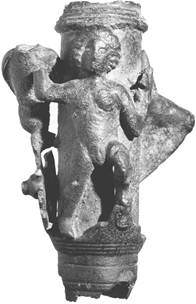
Bronze sceptre-terminal depicting the solar wheel-god with his eagle, a triple-horned bull’s head and underworld creature trampled beneath the god’s foot, from Willingham Fen, Cambridgeshire. Ht 12 cm (4¾ in.). Earth matters
Sun- and sky-cults were necessarily closely associated with the land: put at its simplest, the sun, rain, storms, drought, heat and cold have direct consequences for the fertility and well-being of livestock and crops, and thus for the communities that rely upon them. It is no surprise, then, that Romano-Britons acknowledged these connections in religious representations. A stone carving from the Cotswolds near Cirencester depicts three mother-goddesses seated in a niche in whose gable is a solar wheel.24 The female images on this stone are simple or stylized in form and their ‘Britishness’ is emphasized by their over-large heads.25 Each woman holds a product of the harvest – probably bread or fruit – in her lap. At the other end of Roman Britain, at Netherby near Carlisle in Cumbria, the stone figure of a Genius loci (a spirit of place) carries a solar wheel in place of the patera or offering-plate usually held by such figures.26 Both carvings appear to reflect the need to propitiate the spirits controlling the sun, and the earth’s consonant fertility.
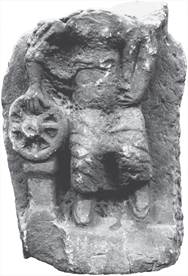
Stone carving depicting a Genius whose usual patera (offering-plate) is replaced by a solar wheel, from Netherby, Cumbria. Ht c. 43.5 cm (17 in.).
The sacred marriage
A prominent theme in early Irish mythology is the notion of sacral kingship, wherein the divine female personification of the land wed the mortal king in order to secure and enhance the land’s prosperity. This holy union was symbolized by the goddess’s act of passing a wine-cup to her mortal spouse. But the goddess was fickle and, if her royal husband was not up to the mark, she abandoned him for a more likely partner, thus ensuring that the land continued to flourish. For under a miserly and ineffective king, Ireland’s fertility was doomed to fail.27 Although the Irish myths were assembled in written form during the medieval period (between about AD 800 and 1200),28 it is likely that they contain grains of material from earlier, pre-Christian times. It is certainly true that both sculptures and epigraphy in Roman Britain (and Gaul) reflect divine partnership. In certain Gallic sculptures depicting such couples, the male deity actually holds a cup of wine, as if to indicate his legitimation as king by his consort.29 What is particularly interesting is that, where the names are recorded, the goddess frequently bears a local Gallo-British name, while that of her consort is more often of Roman derivation, or he might have a Roman and a local name (see Chapter 11). Perhaps the female partner represented the spirit of the land, joined in marriage to an intrusive, foreign (Roman) partner. Rosmerta and Mercury (see pp. 228–29) are a good example of this pattern of representation. On one image of the couple from Gloucester, the god is portrayed in fully Roman form, with his signature emblems of caduceus (herald’s staff), purse and cockerel, while his consort’s imagery owes much less to Classical tradition and is far more inventive. And, in the context of the ‘sacred marriage’, her symbolism is telling, for she holds a small skillet poised over a casket of ale, perhaps ready to hand to her partner, chiming with the Irish mythic union between goddess and king.30
A pilgrim called Peregrinus from Trier in the Moselle Valley set up an inscribed dedication to his local gods, Loucetius Mars and Nemetona, while visiting the thermal-spring sanctuary at Bath.31 The name ‘Loucetius’ comes from a Gallic god of light, often twinned with Mars, perhaps because of his common function in the western provinces as a healer and protector.32 Nemetona’s name reveals her identity as a goddess of the land, and specifically of the sacred grove or nemeton. Several Gallo-British place-names have this word as their root, including Vernemeton (‘the most sacred of groves’) in Nottinghamshire.33 The pairing of a god of light with a goddess of the land chimes with the connection between the solar wheel and the mother-goddesses or Genius loci mentioned earlier; perhaps the appearance of the sun-symbol with these earth-spirits is a way of expressing the partnership depicted more overtly with Loucetius and Nemetona.
Earth mothers
The most prominent evidence for deities connected with the fertility of livestock, crops and humans is provided by the popular cult of the Matres or mother-goddesses, so often depicted in triplicate. We have touched upon their cult in Chapters 3 and 4, and the habit of multiplying gods by three is considered further in Chapter 7. But the mother-goddess cult, as presented especially in southwest England, repays investigation here in terms of the way the goddesses were depicted. Divergences of style in the iconography of Cirencester and Bath betray the mind-set of the sculptor or the patron who commissioned it (or both). The little schist plaque from Bath34 depicts three female figures standing side by side (and looking irresistibly like the ‘three little maids from school’ in Gilbert and Sullivan’s Mikado). They have disproportionately large heads, large bulging eyes, bare torsos from the waist up and long pleated skirts. They are not identical: the position of their hands and arms is different, and they are of slightly different sizes, the largest occupying the central position. Their underdeveloped breasts and youthful physique suggest they are young girls, possibly adolescents. A close look at their prominent eyes reveals the possibility that they are either blind or suffering from goitre35 – in which case, they might represent not goddesses but supplicant-pilgrims visiting Sulis’s thermal spring to be healed.
The mother-goddess figurines from Cirencester provide a sharp contrast to the little figures on the plaque from Bath, for they are much more naturalistically portrayed, but again where they occur in triplicate each female has her own persona, and is not just a clone of her colleagues. Three relief-carvings from the town that depict the three mothers are treated very differently one from the other. Two come from what must have been a shrine in the Ashcroft area of the town, and accompanying them was an inscription (one of two from Cirencester)36 to the ‘Suleviae’, clearly a local name for the goddesses. The mothers were also known by this name at Bath,37 so it is likely that this little plaque shows the same goddesses. The link between the two Roman towns is Sulinus, a sculptor who dedicated altars to the Matres Suleviae in both. The connection between his name and that of his chosen goddesses is interesting. Maybe he selected them for their names, or did he, perhaps, name himself after them, as a sign of special devotion and as a way of giving himself to the divinities?
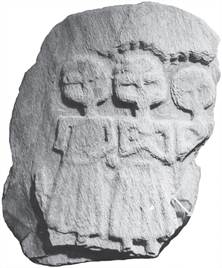
Schist plaque depicting triple goddesses, from the sanctuary of Sulis Minerva at Bath. Ht 24 cm (9½ in.).
Two of the Corinium mother-goddess carvings show the women seated stiffly in a row, staring out at their spectators.38 On each of the two stones, the women are given separate identities, with unique quirks in hairstyles and clothing. On one, the three hold trays of produce on their laps; two of them wear pleated robes but the one on the right (facing the viewer) wears a cloak pinned at the breast, more appropriate to a male deity, and close inspection even reveals possible traces of a beard. So the sculptor may have been ‘playing with’ or subverting gender, as if to shock, to jolt supplicants into challenging assumptions concerning the categorization of divinities as exclusively male or female. The second stone shows a different set of mother-goddesses, with long hair and robes to the feet; the two outer figures each have dishes of food on their knees, while the central woman holds a tightly swaddled baby. The final carving is very different: it displays three women looking relaxed, as if gossiping together in a playgroup, their toddlers frolicking around them with a small dog.39
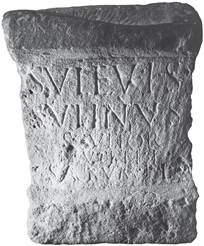
Stone statue-base dedicated to the Suleviae by a stonemason called Sulinus, from Bath. Ht 58.5 cm (23 in.).
There is one very simple, ‘matchstick’ carving from the Cotswold Roman villa-site of Chedworth40 that seems to resonate with several features of the earth-goddesses from the region already considered here. It depicts a robed figure with spiky hair, standing in a niche, its right hand poised over a cylindrical bucket, like Rosmerta’s. But in its left hand it holds a spear. The image itself appears ‘gender-neutral’, but a very faint inscription scratched on the base reads ‘Dea Riigina’, ‘the goddess queen’. It is always possible that the name could have been added to the stone some time after the figure was carved but, if not, the title is suggestive of the ‘sacred marriage’ alluded to in the context of divine partners. And the presence of the spear is interesting, too, because it is unusual to find a weapon in a woman’s hand and the image itself bears no resemblance to the Roman armed goddess Minerva. The spear’s position in the left hand may also be revealing,41 since then, as now, only a small proportion of the population was left-handed – so the spear may have been consciously placed in that hand to convey a non-aggressive attitude more appropriate of a guardian, communicating latent, but reserved, power. But, as perhaps with one of the Cirencester Matres carvings, was gender, again, perceived as a contested, questioned and perhaps fluid issue?
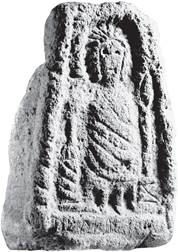
Stone relief-carving of a goddess with a spear; on the base is a scratched dedication to ‘Dea Riigina’ (the goddess queen). Found near Chedworth, Gloucestershire, and almost certainly from the precincts of the Roman villa. Ht 26 cm (10¼ in.). The water-spirits
‘And the lakes in particular provided inviolability for their treasures, into which they let down heavy masses of silver and gold. The Romans indeed, when they conquered the area, sold the lakes by public auction, and many of the purchasers found there hammered mill-stones of silver. In Toulouse, moreover, the temple was a revered one, greatly esteemed by the local inhabitants and for this reason the treasure there was unusually large since many made dedications and none would dare to profane them.’ STRABO42
The Greek geographer Strabo lived from c. 63 BC to AD 21. His Geography draws heavily upon the lost works of the earlier author Posidonius, who travelled in Gaul in the early 1st century BC. Here, Strabo was describing the rituals of the Tectosages, a tribe who lived in southwest Gaul, their capital being Toulouse. The passage is important for its emphasis on the sanctity accorded the deposition of precious objects in watery places, a practice we have already encountered. Strabo was writing about a specific region in southern France but Iron Age sites such as Fiskerton, Llyn Cerrig Bach (see pp. 19–21) and rivers, such as the Thames and Witham, indicate the importance of aquatic sanctuaries in Britain. Given this background, it is entirely understandable that water-cults played a prominent role in Romano-British religion.
The sacred river
According to early Irish mythology, the most sacred river was the Boyne, which winds through the present-day counties Meath, Kildare and Louth. One medieval mythic document, the History of Places, describes the way in which the goddess Boann was transformed into the great river as a punishment. She was married to a water-god named Nechtan, but when she disobeyed his command never to visit his holy well, he cast a spell so that the spring-water boiled over the well-head and surrounded her, sweeping her up in its torrent and turning her into a water-spirit.43 Many Irish legends focus on the magical properties of Boann’s great river, most famously in the story of the young hero Finn and Finnegas the Bard.44 When he was still just a child, Finn came upon Finnegas, near his house on the banks of the Boyne, where he was fishing for the legendary Salmon of Wisdom, which dwelt in a river pool. Just as Finn approached, the bard caught the fish and instructed Finn to cook it. As the boy did so, he inadvertently touched the scorching flesh with his thumb and instinctively sucked the sore place. And so it was that, by accident, the salmon’s vast knowledge was passed to Finn and he became a fount of all wisdom. The river Boyne was clearly a ‘thin’ place, a portal to the Otherworld, whence the spirits strayed into the domain of people and changed their lives forever.
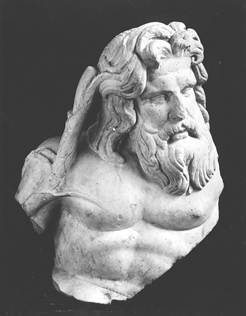
Stone image of a river-god, from the Walbrook Valley, London (very possibly from the Mithraeum). Ht 34 cm (13 in.).
But what of rivers in Roman Britain? Were they, too, invested with sacred power? Some of the divine personifications, like the bearded reclining river-gods from the Walbrook Valley in London45 and at Cirencester,46 were depicted in the manner of the Roman water-god Neptune. But the names of several indicate that they were perceived as female: Verbeia was the goddess of the river Wharfe in Ilkley,47 and Sabrina was the personified spirit of the Severn.48 But it is, perhaps, Tamesa, the goddess of the Thames,49 for whom there is the most evidence for persistent veneration. It was into this great river that Iron Age communities living in the vicinity of what would become the bustling Roman port city of Londinium cast exquisitely decorated metalwork, particularly military parade-gear, such as the Battersea Shield and the Waterloo Helmet,50 presumably as offerings to the spirit of the tidal waters. What is more, a series of disembodied human skulls have been found in both the Thames and its tributary the Walbrook: they belonged to young men and some have been dated to the early Roman period.51 Were these also offerings to the river-gods, perhaps made at a time of deep crisis in the province? Could it be that these young adults were sacrificed at the time that Boudica’s army was marching on Roman London, and buried within the waters? Or perhaps the heads were deliberately removed from corpses and deposited in a sacred river as some act of reverence to the spirit within. Might they, like the objects from the Thames, have been offerings to the river-goddess Tamesa?
Fire, sun and steaming water: the healing sanctuary to Sulis at Bath
‘In Britain there are hot springs furnished luxuriously for human use. Over these springs Minerva presides and in her temple the perpetual fire never whitens to ash, but as the flame fades, turns into rocky lumps.’ SOLINUS52
In the early 3rd century AD, Solinus wrote thus of the hot and sacred springs at Bath, part of a series of strange phenomena from all over the Roman Empire that he gathered from other people’s anecdotes. Ancient chroniclers53 called Bath Aquae Calidae (‘hot waters’), but the town is better known as Aquae Sulis, after the local name of the presiding goddess. The thermal springs here gush out of the ground beside the river Avon at a rate of over a million litres (a quarter of a million gallons) a day at a temperature of 46° C (114.8° F).
Solinus’s comment about fire has gone generally unnoticed, but it is potentially important, for the worship of the goddess Sulis (whose name is related to the Celtic ‘Sul’ meaning ‘sun’) was all about heat. The first image seen by pilgrims visiting the town’s sanctuary would have been the intimidating, moustachioed head of the ‘male Medusa’ that glared out at the world from the temple-pediment (see p. x, top).54 The eels and serpents in his hair suggest that gorgon-, solar- and water-symbolism all influenced the sculptor’s representation. But it is tempting to see the swirling tendrils surrounding this head as flames.55
The Romans made much of the hot springs at Bath. Indeed, the highly visible and odour-laden billows of steam emanating from the hot water would have struck any visitor with wonder. Only a few decades after the Claudian invasion, engineers (probably from the military) were deployed to build a great stone temple and precinct around the bubbling waters, and not only were the military involved in building the sanctuary to Sulis; the sacred complex may have been originally established by and for Roman soldiers. There is paltry evidence for exploitation of the site in the Iron Age56 and, if the springs held significant pre-Roman sanctity, any ritual activity during this period has left virtually no footprint. But the sacred springs of Aquae Sulis were a magnet for Romans and Roman Britons. During a massive and integrated construction programme, the reservoir containing the principal spring, the temple and the bathing complex were built in homage to the goddess and to accommodate large numbers of pilgrims.
The local spring-deity was Sulis and her responsibilities were clearly perceived as akin to those of the Roman State soldier-goddess Minerva, perhaps in her role as guardian, a protector against disease and misfortune. Were only the imagery of Sulis Minerva to have survived, she would be interpreted as a wholly imported Classical divinity, for the life-sized gilded bronze head, severed from the body in antiquity and originally bearing a helmet, appears to depict the young Minerva in typically Roman style (see p. xi.57 But the epigraphic evidence tells us her true identity: the dedications made to the goddess address her as Sulis Minerva, or simply as Sulis.58 A lead defixio, or curse tablet, from the spring-reservoir mentions Fons Sulis (the Spring of Sulis), clearly in reference to the divine personification of the miraculous steaming waters constantly bubbling up from underground.59 And close scrutiny of some of the iconography appears to acknowledge local traditions alongside those of Rome. One image of Minerva,60 standing in a gabled niche, depicts a rather ungainly woman with a heavy woollen robe (suitable for Britannia’s fickle climate) and with the typical Minervan gorgoneion61 (head of Medusa) on her breast but otherwise distinctly British in style, with flame-like hair and a very Celtic face that has a marked resemblance to the head on the temple-pediment. It is true that Sulis’s sanctuary attracted many cults besides her own, so we should make only a tentative interpretation of this triple-image as Sulis rather than any other local female divinities, but it is nevertheless possible that the charming trio of schematized ‘mother-goddesses’ on the little schist plaque from the town (see p. 106)62 represented Sulis in local triplistic tradition.63
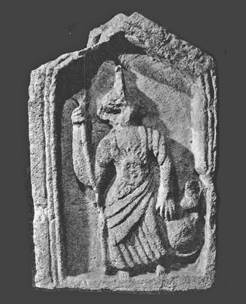
Stone relief of Minerva, from the sanctuary of Sulis Minerva at Bath. Ht 69 cm (27 in.).
The hot water of the springs (though foul to taste and at times toxic to drink) was recognized by Romans and Britons to possess curative properties, particularly for inflammatory disorders such as gout and rheumatism. Pilgrims travelled here from far-flung places in the western Roman Empire: Peregrinus from Trier was just one of many who undertook a gruelling journey to a sanctuary whose presiding spirit clearly had a profound and widespread reputation beyond Britannia. Sulis’s popularity came from her thermal springs. Bath was one of a host of healing sanctuaries in Britain and the western provinces that grew up around springs and sacred pools. In Gaul, these curative shrines are characterized by the presence of model body-parts presented by sick pilgrims in the hope that the healer-deity would accept these offerings in exchange for healthy organs.64
British pilgrims left fewer of these anatomical votive gifts at the curative shrines they visited but, as noted at Lydney (see pp. 94–96), they are occasionally found here. Two offerings in the form of miniature pairs of breasts are recorded from the main spring at Bath; perhaps the women who left them for Sulis did so in hope of, or gratitude for, successful lactation.65 Female pilgrims cast other personal possessions into the sacred spring, intimate items worn on the body, as if to establish direct connection between supplicant and goddess. As was so often the case in antiquity, spiritual healing went hand in hand with empirical medicine. An eye-doctor called Janianus perhaps held a regular surgery here, leaving stamps for eye-ointment inscribed with his name at Sulis’s sanctuary.66 Ironically, the spring-water in the baths at Bath may itself have been a source of eye infections, providing eye-physicians like Janianus with an ever-burgeoning and lucrative trade.
Whatever the nature of ritual that went on at this great spring-shrine, the principal focus was the enclosed reservoir that Roman engineers built to control and enclose the sacred spring and its magical hot waters. Countless objects were deliberately cast into the pool: from pewter vessels, used to douse pilgrims or for drinking-cups, to a washer from a catapult, an offering from a soldier.67 But the most striking group of objects cast into the reservoir is the defixiones, the curse tablets, with vengeful inscriptions scratched onto the soft lead or pewter, demanding justice and retribution for wrongs done to pilgrims, usually involving theft. We will return to these fascinating objects in the next chapter.
What exactly was the status of Aquae Sulis? Was it a Roman town that happened to have a spa and temple, or was it principally a sanctuary to a powerful goddess, with thriving pilgrim visitor numbers, around which the settlement grew and from which it drew its economic prosperity, rather like Lourdes? And what of the relationship between Bath and other Roman sites in the region? We know of connections between the temple-spa and Corinium, where the same sculptor, Sulinus, plied his trade. And some deities, like the Suleviae, were also shared by Bath and Corinium. Bath also possessed links with the temple of Mercury at Uley, Gloucestershire, where the same scribes were employed at both sites to write out curse tablets on lead or pewter sheets (see p. 192). So several sites in the vicinity of Bath and the Cotswolds appear to have enjoyed close-knit connections with each other.
In the archaeologist Barry Cunliffe’s words, ‘Bath is a peculiar settlement, in size much smaller than typical Roman market towns, in elaboration much greater’.68 It is impossible to resolve Bath’s role, if any, in the politics of the province, whether it ‘served as a centre for regional government’69 or not. Bath was perhaps essentially a cathedral city, like Salisbury or Wells: small but rich and powerful beyond its size, and a centre for cult and pilgrimage. We may imagine regular pilgrimages that could take in a number of the neighbouring holy places during spiritual journeys. However, during the 4th century AD, rising sea levels affected the water-table and the baths suffered disastrous flooding. They eventually closed, and the demise of the spa and temple’s prosperity marched alongside the end of romanitas experienced by Britain as a whole, exacerbated by tensions within the religious community, as we shall see in Chapter 11.
Coventina’s Well: a ‘northern power-house’
‘To the goddess Coventina for the First Cohort of Cubernians Aurelius Campester joyously set up his votive offering.’
‘To the goddess-nymph Coventina Maduhus, a German, set this up for himself and his family, willingly and deservedly fulfilling his vow.’70
If Sulis’s sanctuary is the most significant reflection of sacred water-power in southwest Britain, Coventina perhaps fulfilled a similar role in the north. When the Roman army settled at Carrawburgh, a fort on Hadrian’s Wall, they built a sanctuary in the nearby valley, which contained several streams forming a marshy area with a number of springs at the bottom. The water was famous in the 19th century for its purity, and it was this freshness that attracted the attention of the military units stationed at the fort, causing them to build a shrine to Coventina, the deity of the springs.71
The square structure was built of local stone and left open to the air, so it was not a true temple, but consisted of a concentric square building, the inner square enclosing the spring-well and the outer forming the boundary of the temenos (the sacred area surrounding the shrine). The spring-fed well was personified as a goddess, Coventina. Epigraphy shows that many of her devotees came from the Rhineland, including the ‘Cubernians’. She was not twinned with a Roman goddess and probably belonged to this single location. Many individuals or units set up altars thanking the goddess for her help, and the presence of incense-burners (not dissimilar to the ‘Druidic’ ones from Chartres), one of them inscribed,72 indicates that religious ceremonies took place here. The inscribed altar stones were placed in groups around the well, and some were ritually buried so that they could never be desecrated or reused. Central to the devotional acts by supplicants here was the casting of personal possessions and money into the holy water. They included bronze figurines of human faces and animals, jewelry, leather shoes and glass and pottery vessels.
It is likely that, like Sulis at Bath, Coventina’s popularity lay in her perceived ability to heal. But in addition to a wealth of inscriptions providing her name, stone relief-carvings reveal her physical form too. Two sculptures depict Coventina as a water-spirit: one, inscribed with a dedication to her, shows the goddess lounging at ease on a waterlily-leaf, holding a frond languidly aloft; the other represents a triple goddess (or three separate deities) each reclining, as if on a bed, and holding a beaker of spring-water in one hand while pouring it out from a pitcher with the other. The ‘Celtic’ style in which their faces are treated betray her origins – or those of her sculptor.73
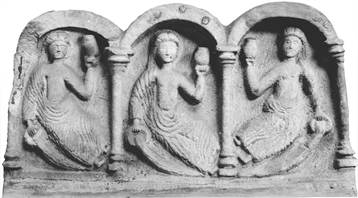
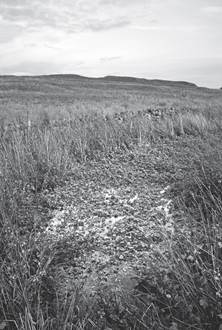
Stone relief-carving of triple Coventina (ht 52.2 cm/20½ in.) from Coventina’s Well at Carrawburgh (bottom right).
Coventina’s cult resonates with all those discussed in this chapter. The gods of the cosmos – of sky, earth and water – all demonstrate in their different ways how communities and individuals perceived the spirits to whom they prayed and offered gifts. Whether a soldier stationed in the cold north on Hadrian’s Wall or a wealthy pilgrim bringing riches to the steaming atmosphere of Aquae Sulis, worshippers accepted romanitas but constantly sought to adapt as well as adopt, and to use the new ways of expressing their devotion to make visible their own local deities whose pre-Roman form had previously been hidden.