CHAPTER SIX Gut-Gazers and God-Users Divination, curing and cursing
‘Now he was teaching in one of the synagogues on the Sabbath. And just then there appeared a woman with a spirit that had crippled her for eighteen years. She was bent over and was quite unable to stand up straight.’ LUKE1
The perception that illness – whether of mind or body – was caused by the invasion of evil spirits lurked at the heart of many societies in antiquity (and still lingers in certain traditional communities to this day).
Luke, Christ’s chronicler, describes just such a diagnosis for the unfortunate woman in the passage quoted. The connection between disease and the spirit world was, and is, one of the fundamental tenets of shamanic belief-systems, and a principal role of the shaman is to take ‘soul-flight’ between the material and spirit worlds in order to vanquish the maleficent ghosts and accomplish feats of healing by their banishment from the afflicted.2 In traditional medicine, whether in Classical antiquity, medieval Britain and Europe or in modern-day non-Western communities, the work of empirical physicians marches alongside that of the spiritual healer: indeed, the two professions are frequently combined in one person. The fictional Brother Cadfael, a medieval monk of Shrewsbury Abbey in Ellis Peters’s crime novels and the consonant television series, is a physician whose skill lies both in his knowledge of herbal remedies and his faith in God.3 The combined practice of fact-based medicine and spirit-healing may have been true of a Briton who died at Camulodunum and was given a ceremonial burial during the earliest years after the Claudian invasion, for his tomb produced grave-goods that indicated his professional status in both realms of the curative art. The shaman-doctor of CamulodunumAccording to Roman law, the dead could not be buried within the precincts of towns because of the fear of pollution that might infect the living (see Chapter 10).
In about AD 50, a Briton of high rank died and his cremated remains were interred in a richly furnished tomb that has been called ‘The Doctor’s Grave’. His was one of several wealthy tombs within enclosures located at Stanway, just outside the Roman city of Colchester (formerly the Trinovantian tribal capital of Camulodunum), dating to the post-conquest period. These interments were discovered in the late 1980s and mid-1990s as the result of rescue excavations undertaken by the Colchester Archaeological Trust in advance of quarrying activities that threatened to encroach upon and destroy evidence for late Iron Age and Roman occupation here.4 The Doctor’s Grave is particularly special because of its singular grave-goods. The most striking of these consist of a gaming board, its glass counters positioned as if in mid-game between two players; a spouted bronze vessel; a set of iron and copper-alloy rods; and a surgeon’s tool-kit,5 hence the grave’s name. The medical equipment (including a surgical saw, scalpels, forceps, a retractor, needles and scoops)6 betrays a mixture of Roman and Gallo-British traditions, appropriate to the date of the grave, only a few years after the Roman invasion of AD 43. While twenty-five comparable medical implements were recorded as having been found in Cirencester in the 19th and 20th centuries, none has a precise provenance and there is no reason to assume they were originally a group, as those in the Doctor’s Grave evidently are. But the Cirencester finds also include oculists’ stamps, one of which, sadly lost, was apparently adorned with the Christian chi-rho monogram (see Chapter 9).7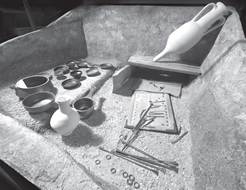
The board-game, rods, spouted vessel and medical tool-kit found in the Stanway Doctor’s Grave.
Alone, each object placed in the Doctor’s Grave is highly significant: combined, they allow glimpses into the complex persona of the dead person.
A physician’s medical kit was an intensely valuable and personal possession. Certain pieces among this set demonstrate their probable local manufacture, and it is almost certain that some were individually made to the doctor’s specifications. The saw was designed for bone surgery, while the retractor, forceps, hooks and needles would have been essential tools for probing, internal investigations and suturing wounds.The bronze strainer bowl and the sets of metallic rods from the tomb may be considered together, for both suggest a sacred and arcane dimension to the physician’s craft. What makes the vessel so special is the presence of an organic deposit lodged in the spout: a plug of various plant-materials, with a high concentration of artemisia vulgaris (mugwort) and artemisia absinthium (wormwood).8 Both forms of this herb have proven therapeutic powers, employed by early doctors and by practitioners of herbal medicine even today to treat internal complaints such as worm-infestations and other gut disorders.9 Taken as an ingested infusion, it would have been extremely bitter to taste, but the presence of pollen in the vessel’s spout suggests that honey might have been mixed with the drink to make it palatable. But it is also possible that the herbal brew in the Stanway vessel was inhaled rather than drunk and that it was used as a narcotic in spiritual healing. Studies of psychoactive substances used for current transcendent rituals in Africa and the New World consider a whole range of alkaloid hallucinogens, presenting evidence for the use of artemisia as a ‘marijuana substitute’ in Central American spiritual ceremonies.10 So could it be that the physician who died at Camulodunum was combining empirical and sacred crafts in order to heal the bodies and minds of his patients? The strainer bowl from his grave might have acted in much the same way as the incense-burners found in the secret underground ‘Druidic’ shrine at Chartres (see pp.
29–32). Ceramic thuribula were also present at Romano-British shrines such as Coventina’s Well at Carrawburgh (see pp. 116–17), which contained two clay incense-burners, of which one bears an inscribed dedication to Coventina Augusta.11 As we saw earlier, archaeological evidence that psychotropic substances were ingested as part of ritual experience is not uncommon in prehistoric Europe, from the later Neolithic to the Iron Age and beyond.12By itself, the evidence from the strainer bowl might not be sufficiently convincing to interpret the Stanway ‘doctor’ as having dabbled in ritual behaviour. However, the set of iron and bronze rods, together with the board-game, may add colour to the picture of someone who attempted to cure ailing minds and bodies, using a variety of empirical and spiritual means by which to do so. The eight rods break down into four groups, consisting of four longer ones, two of bronze and two of iron, and four shorter ones, again comprising two of each metal. Seven of the rods were clustered in a heap near the gaming board, rather as in the pointed sticks used in the game of spillikins (pick-up sticks),13 but a single iron rod lay diagonally across the board, between the opposing rows of counters.14 What was the purpose of these rods? Their form resembles that of Roman pens (styli), with one flattened end used to erase words written in wax and the other with a blunt rounded terminal that (if these rods were pens) would originally have been fitted with a sharp point.15 But the number and varying sizes and metals of the Stanway rods suggests a different function from writing implements.
What if the Stanway rods were used for a ritual, even shamanic purpose? More than one ancient writer recorded the use of wooden rods for casting of lots, a practice employed in divination. Describing the Germanic tribes in the late 1st century AD, Tacitus reported that in consulting the gods these northern communities cut wood from fruit trees and whittled it into thin rods.16 Then runes were written on each rod and a bundle of them was cast onto a white cloth, to be ‘read’ by the priest who interpreted the will of the gods according to the positions in which the sticks had fallen and by the message inscribed on three rods he chose to examine.
There are certain similarities between Tacitus’s testimony and the rods from the Doctor’s Grave at Stanway although – alas – no runes appear to have been engraved on these. But Tacitus’s comment that wood from specific trees had to be selected puts in mind the special choice of different metals (and sizes) for the Stanway rods. There is one other possibly significant factor for the bundle of rods, for if they were thrown onto the gaming board from any height, they would clang together as they landed, adding an auditory dimension to the ritual experienced by the mourners at the grave.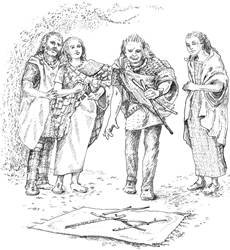
Reconstruction drawing of ritual lot-casting among ancient Germanic tribes, as described by Tacitus.
The board-game, too, hints at ritual connections within this burial. What part did it play in the funerary activities at Stanway? Its centrality to the event is suggested by the way the medical kit, the rods and the straining-bowl lay on top of it or close beside it.17 The gaming board is not unique to the Doctor’s Grave; another has been found in a nearby grave thought to accommodate a soldier, so, by itself, it does not necessarily point to ritual behaviour. But the soldier’s counters were placed in a neat pile beside the board, as if awaiting play,18 while in the doctor’s tomb the twenty-six glass counters, half blue, half white, were positioned as though a game between two people had begun, and one blue counter was inverted, probably deliberately. What is more, as well as the metal objects – the rods and the spouted bowl – placed on the board, a small heap of cremated human bone had been tipped out onto its surface.19 There is some evidence to suggest that gaming boards in antiquity were not only valued personal possessions but in some contexts, such as medieval Wales, also played a role in the ceremonies surrounding the installation of prominent people in public office.20 For instance, the game gwyddbwyll (Welsh for ‘wood-sense’) is recorded as being played by high-ranking individuals in medieval Welsh mythic literature, such as Arthur in the tale Peredur son of Efrog.21
To judge by the grave-goods that his community felt appropriate to inter with him, the Stanway doctor appears to have been a complex individual whose skills and responsibilities included surgery and religious duties including divination and the manipulation of minds by the use of psychotropic substances.
If so, it is tempting to think of him as a kind of shaman, a ‘two-spirit’ person who was able, through drug-induced trance, to move between the worlds of people and the gods and to fight disease by combating evil spirits and predicting the divine will, as well as healing through conventional medicine. His double persona (as doctor and shaman) may even have been displayed by the two players represented on the gaming board. A gut-gazer from Bath‘To the goddess Sulis, Lucius Marcius Memor, Haruspex, gave this gift’22
The priests who maintained the great healing shrine at Bath, presided over its rituals and attended to the spiritual needs of its supplicants have left their archaeological mark. They are represented by their ceremonial regalia, such as headdresses and a sinister-looking tin mask, used in processions and concealing the face of the wearer. These objects are anonymous, but inscriptions provide the names of two of the clergy. One, we can discern, was a seventy-five-year-old priest of Sulis called Gaius Calpurnius Receptus23 (see also Chapter 10). About the other we can glean considerably more. His name, Lucius Marcius Memor, proclaims his Roman citizenship, and his presence at Bath is recorded on a statue-base, presumably once bearing an image of Sulis. He held the very Roman title of Haruspex (‘gut-gazer’), signifying a specialist in reading portents from the entrails of sacrificed animals, but since the inscription that mentions him clearly shows that the statue (and its base) was a gift to the goddess, it appears that this man’s business at Bath was as a pilgrim-supplicant rather than as a religious practitioner. His name is significant, for his cognomen, Memor, perhaps referred to his expertise as a curator of sacred memory and oral tradition, and we know from Julius Caesar’s observations that the Druids were keepers of memory and holders of their communities’ past. Of course, Memor might have been both pilgrim and official gut-gazer at the site. Perhaps, because of his specialist skills, local priests had called upon him to help in their shamanic task of divining the future and Sulis’s will by reading the signs in the bloody innards of sacrificial victims.
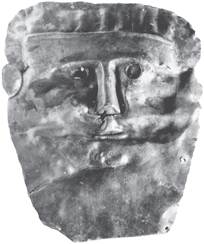
Life-sized tin mask from the sanctuary of Sulis Minerva at Bath.
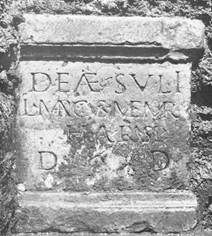
Dedication to Sulis (‘SVLI’) by the haruspex Lucius Marcius Memor, Bath. The Lydney ‘dream doctor’
The cella mosaic at the rural temple of Lydney incorporates an inscription mentioning an important man called Victorinus, an ‘interpreter of dreams’. It is likely that this individual was a professional religious practitioner, perhaps resident at Lydney, for dreams were an important part of the complex relationship between people and the gods. In the Roman world, the dreams of supplicants in sacred places were perceived as one of the pathways of spiritual communication; but to the recipient of a god-given dream, its meaning was opaque and required someone skilled in ‘translating’ its message, to make it accessible and to interpret the meaning behind it.24 Dreams were deemed so important in healing sanctuaries in the Classical world that many curative shrines had a special abaton (a dormitory) to house sick pilgrims, who hoped that they would receive a divine visitation while they slept on holy ground. It is tempting to think that when pilgrims awoke after their stay in the abaton or large guest-house at Lydney, they told their dreams to Victorinus, and he would act as the mouthpiece of the spirits, instructing supplicants what they should do for the gods in order to be healed. A suite of bath-buildings here demonstrate that – as at Bath – washing was a central part of the healing process.25
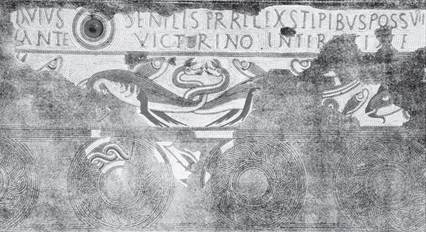
The inscribed cella mosaic at the temple of Nodens, Lydney, Gloucestershire, mentioning Victorinus, the ‘interpreter of dreams’ (‘Victorino Interp…’). Music: the ‘perfume breath of God’
‘There are also lyric poets whom they call Bards. They sing to the accompaniment of instruments resembling lyres…’ DIODORUS SICULUS26
In the summer of 2016, sixteen years after his release from his four-year incarceration as a hostage in Beirut, Brian Keenan broadcast a talk about his psychological experiences of being shut up on his own in a dark cell so small that he could touch all its walls without moving.27 He explained that one of the imaginary people who inhabited his suffering mind during that time was a 17th-century blind Irish harpist called Turlough Carolan, who used his music and his poetry to heal. After Keenan’s release, he was invited to speak about his experience of captivity at the University of Fairbanks in Alaska. He told of an email he received from an Inuit woman after his talk. She explained to him that Carolan was a ‘dream-walker’ who, after his death, became a wandering spirit-healer, or shaman, who came to the aid of damaged minds. The woman told Keenan that dream-walkers worked on the principle that those whom they helped to heal were obliged to pass on the curative gift to others. Keenan’s address in Alaska – and other talks – served to fulfil that obligation.
How does Brian Keenan’s story of Turlough Carolan inform healing-cults in Roman Britain? To my mind the connection is music; the use of harmonious sound to access the spiritual dimension. There is compelling evidence for the playing of musical instruments in ancient religious contexts. In the later Iron Age, ceremonial trumpets were ritually deposited in watery places, such as the little pool at Loughnashade in County Armagh, Ireland,28 and at Llyn Cerrig Bach on Anglesey.29 And in a sacred deposit of material deep underground by a subterranean stream at High Pasture Cave on the Isle of Skye,30 someone deliberately interred part of a lyre, as if to reflect the musical contribution to ritual and its resonant sound in that enclosed dark space. Like Keenan’s blind harpist, the musician here very likely accompanied his playing by song or sacred verse. The quote from Diodorus Siculus that opens this section describes this practice in ancient Gaul.

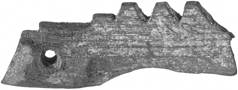
Part of a ceremonial trumpet from the late Iron Age ritual deposit in a pool at Llyn Cerrig Bach, Anglesey (above), and part of an antler bridge from a lyre, deposited in about 180 BC at High Pasture Cave, Skye (left).
There is plenty of iconographic evidence for music in the Gallo-Roman provinces.31 In Britain, the record is more mute, but the little bronze figurine of a girl flautist from Silchester may well have come from a sanctuary; likewise the stone image of a ‘mother-goddess’ from Cirencester who holds what looks like a drum on her lap.32 In traditional societies, shamans use drums to communicate with the spirits, and among the Sami communities of northern Europe and Siberia these instruments act as ‘cognitive maps’ that help the shaman to navigate, and gain insights into, the spirit world33 – the drums are covered with images and symbols that represent the triple-layered cosmos at the heart of Sami shamanism, and these markings are read and interpreted by the shaman according to the seasons or other time-centred events.34 While it may be a leap to imagine that the Cirencester carving represents a shaman, her ‘drum’ may indicate that percussive sounds were employed by priests in order to attain altered states and, like shamans, to enter the spiritual realm and thus to combat the evil spirits that caused harm.35
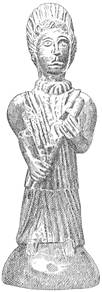
Drawing of the bronze figurine of a flute-girl from Silchester, Hampshire. Healing and harming on holy ground
‘to the goddess Sulis…whether slave or free, whoever he shall be, you are not to permit him eyes or health unless blindness and childlessness […] so long as he shall live, unless he returns these to the temple.’36
The curious thing about certain healing sanctuaries in Roman Britain is their presentation of a dichotomous association between help and harm. The lead curse tablet on which the above message was written comes from the thermal shrine to Sulis Minerva at Bath. It was one of a host of small lead plaques which, once inscribed with the wished-for act of vengeance, were tightly rolled for secrecy and thrown into the sacred spring-reservoir. This short but venomous letter to the goddess expresses much, not least about the relationship between the person doing the cursing and the deity to whom the request was addressed. The tone is far from that of a humble suppliant; it is a curt and urgent demand that the goddess grant revenge. The fragmentary inscription does not tell us what the cursed miscreant had done, this section sadly being lost, but, on analogy of numerous others from the site, it almost certainly involved theft: of clothing, jewelry or money. As in many defixiones, the retribution sought for the misdemeanour seems excessively harsh. But this may be to do with the fact that the crime took place on sacred ground, the supplicant apparently requesting that the items be returned to the place from which they went missing – the temple. It is telling, too, that the penalties demanded of the healer-goddess Sulis were the blight of ill-health and the terrible afflictions of blindness and infertility.
Eyes, light and water
Sulis at Bath and Nodens at Lydney both appear to have been associated with an ability to cure eye afflictions. That eye-doctors practised at these shrines is confirmed by the medicine-stamps on sticks of eye ointment that have been discovered at them.37 Tiberius Janianus lost his stamp at Bath, and Iulius Iucundus mislaid his in the Lydney temple.38 Excavations of the rich deposits from the healing sanctuary at Fontes Sequanae near Dijon, France, have revealed a great deal of evidence for eye-disease and the rituals used to combat it.39 Pilgrims journeyed to this remote spot to implore the presiding goddess for eye-cures, and left votive offerings in the form of images of themselves in wood and stone, their eyes deliberately emphasized to hammer home their message. Small bronze plaques simply depicting pairs of eyes were a similarly popular gift.
Water played a key role in the sanctuaries of both Sulis and Sequana. Like Sulis, Sequana was a water-goddess, and it seems as though pilgrims suffering a variety of ailments were drawn to watery shrines in the belief that the healing touch of the deity was transmitted through sacred water. Fontes Sequanae was built where the infant river Seine bubbles out of the ground in a series of springs and pools, its water pure and fresh but with no particular curative properties. Sulis’s springs, conversely, contain many minerals, including sulphur, and the stream running through Lydney is rich in iron. Some of the ‘selfies’ from Sequana’s shrine display tell-tale lumps in the neck that suggest some pilgrims suffered from goitre, a condition caused by iodine deficiency that can result in not only thyroid-swelling but also exophthalmic (prominent) eyes.
In addition to its real or imagined healing properties, water is associated with light, with its reflection and translucency endowed by light on clear springs and pools. Even the cloudy, spring-turbulent bath-waters of Aquae Sulis shine with a lambent green glow, as though lit from beneath. There is an obvious connection between eyes and light. Sulis was a goddess of both light and water, and it is surely no accident that the fierce bearded face that greeted pilgrims at the entrance to her temple was carved with piercing eyes that seem to look right through to the soul. One inscribed dedication from Bath, on a stone broken off a building block, is particularly striking in this context: ‘…son of Novantius, set this up for himself and his family as the result of a vision’.40 So the inward eye, too, is represented at Bath. The dedication brings to mind Victorinus, the ‘interpreter of dreams’ whose name and profession was written in tesserae on the mosaic floor within the inner sanctum of Nodens’s temple at Lydney, who would have interpreted such visions and instructed pilgrims to pursue such paths. Bargaining with the gods
‘I have given to the goddess Sulis the six silver coins which I have lost. It is for the goddess to exact them from the names written below: Senicianus and Saturninus and Anniola. The written page has been copied out.
Anniola
Senicianus
Saturninus’41
This is the inscription written on one of the curse tablets found in the spring-reservoir at Bath. Like others from the site, the person with the grievance adopts a curt and peremptory tone with the goddess; basically, the message is, ‘you get them, you keep them’. But there is more: it seems to have been important for the efficacy of the curse for the accused to be named not once, but twice. Identity is wrapped up in names, and presumably by naming the thieves, the curse was perceived to carry more potency, for the goddess’s avenging arm could be directed straight at them. It is interesting, too, that the victim was less concerned to get his property back than to ‘finger’ those responsible. One of the accused in this curse bore the name Senicianus. It would be rather wonderful were he to have been that same villain who stole Silvianus’s ring from the Lydney temple.
The ‘coin curse’ exemplifies an aspect of the relationship between deity and person in the context of healing rituals. In Chapter 3 the idea of asking and thanking prayers (the nuncupatio and the solutio) was introduced. In rogation invocations, the supplicant would often make a vow offering a gift to the divinity if the request was granted and, if the god gave a positive response, the result might be an altar mentioning that the devotee was fulfilling the pledge as promised. Underpinning all this was the rather pragmatic principle of reciprocity: a boon for a boon. The supplicant entered into a contractual relationship with whichever deity was seen to be the most likely to grant a particular request.
Offerings to the gods, in both asking and thanking rituals, could take many forms: altars, brooches, bronze statues, finger-rings. A particular form of votive took the form of miniature tools, weapons or other implements.42 A good example of a Romano-British shrine containing many of these is Woodeaton in Oxfordshire, a sanctuary that bordered the powerful tribes of the Dobunni and the Catuvellauni. The most common type of model here (and, indeed, generally within the province) was the model axe, but six tiny copper-alloy spears were also deposited at the shrine, of which three had been bent double. This practice was by no means confined to Woodeaton. Pilgrims visiting the great shrine to Mercury at Uley in the Gloucestershire Cotswolds also brought offerings of miniature spears. Most are of iron, but a much costlier and more ornate example was made of silver. The blade had been pierced, as if for suspension, and it was twisted back on itself before being placed in the temple. Why offer models to the gods? A cynic might be inclined to suspect that offering a small substitute of a grander item was a cost-cutting tactic. But could miniaturization itself have been symbolic, a way of rendering an object unusable, like the damaging of full-size weapons in the Iron Age or of the miniature spears at Woodeaton? This seems a more plausible interpretation. Deliberate breaking and shrinking both render objects unusable and therefore serve to remove them from the world of the mundane, thus symbolically ‘killing’ them (much as happens with an animal or human sacrifice). The objects are thus transformed in order to enable their reception by the gods.
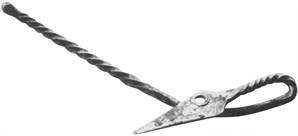
Silver model spear, deliberately bent out of shape, from the temple to Mercury at Uley, Gloucestershire. It closely resembles the six bronze miniature spears from Woodeaton. L. 5.2 cm (2 in.).
The principle of reciprocity seems to have been central in healing cults, for at curative sanctuaries, offerings frequently fell into the category of ‘bodily exchange’: a sick pilgrim would visit a curative shrine and dedicate a model replica of the diseased organ or limb in the hope and expectation that, in return, the presiding spirit would grant the ailing supplicant a healed and whole body-part in exchange. The anatomical votive habit was common across ancient Greece, Italy and Gaul. The god Asklepios (Roman Aesculapius) appears to have had a particular reputation for curing deafness, for many of the offerings made at his shrine at Epidaurus were of model ears or ears carved on altars.43 But we need to be careful in making such a unilateral correlation. When Asklepios revealed himself to a supplicant named Aelius Aristides at Pergamum, the god gave him specific instructions to go barefoot.44 So it might be that at Epidaurus, the ears did not reflect diseased ears but the need to make sure the god’s commands were heard, heeded and acted upon.
At Ponte di Nona, near Rome, a Republican healing shrine was visited by hosts of sick pilgrims who brought large numbers of ‘health’ offerings in the form of clay models depicting bare feet, hands, female breasts, penises and what may be a uterus.45 The model sex organs might have reflected prayers associated with love and fertility, but perhaps also sometimes depicted diseased organs: Catherine Johns has suggested46 that the model phalluses were offered by men suffering from phimosis (tight foreskins), a condition that can cause both discomfort and, if left untreated, infertility. The potters who turned out these offerings perhaps made deliberately ambiguous models that could stand for a range of health issues: so a model breast might be purchased by women who wanted children, who struggled to breast-feed or who had breast-disease.
Models of body-parts in wood and stone from the sanctuary of Sequana at Fontes Sequanae were just as varied as those from Ponte di Nona, and included arms, hands, feet, eyes, heads, torsos, genitalia and even whole bodies of pilgrims. The site is of particular interest because of its geography and the divergence of offerings within the sacred space. The wooden images were grouped around the sacred pool and marshy ground at the foot of a low cliff, away from the temple-buildings, while the stone models and statues were placed inside the sacred precinct. It is possible that the materials chosen reflected the different states of being outside and inside the temple; impermanent wooden offerings might have represented the instability of the human condition, while the permanence of stone within the sanctuary perhaps acknowledged the transformation of pilgrim-supplicants after they had visited Sequana’s sacred pool. According to this theory, when they had bathed in or drunk from it, the sick supplicants crossed the threshold to the goddess’s ‘power-house’, having been possessed by the healer-spirit, and their new transcendent state might have been depicted by the use of stone.47
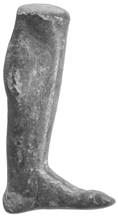
Miniature bronze leg from South Cerney, Gloucestershire. The polish and finish of the top surface indicates that it was cast as a votive leg, not broken from a statuette. Ht 3.7 cm (1½ in.).
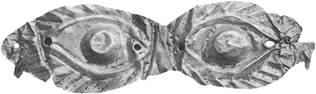
Pair of miniature gold eyes, probably offered to a healer-deity, from Wroxeter, Shropshire. Numerous other model eyes, fashioned from painted wall-plaster, have been found in the Roman town. W. 6.3 cm (2½ in.).
Roman Britain has produced no sanctuaries whose anatomical votive offerings compare – in either numbers or variety – to those from the great Gallic healing sanctuaries such as Fontes Sequanae and Chamalières. But reference has already been made to the little bronze arm with its diseased fingers from Lydney and the pairs of model breasts from Bath, one of which was made of ivory, and may have been worn as an amulet. The little pair of sheet-gold eyes from Wroxeter48 may have been the gift of a pilgrim to an unknown healer-deity: the use of gold suggests the thank-offering of a grateful supplicant.
This religious habit of placing anatomical votive offerings in curative sanctuaries has been an incredibly tenacious one, common throughout the Classical world but continuing to the present in Mediterranean Catholic churches and monasteries. In my own travels, I have happened upon two shrines dedicated to the Virgin Mary that function as curative centres and involve the donation of anatomical models. At Mellieha Bay on Malta an ancient rock-cut cavern whose rough walls are festooned with model body-parts is filled with motorcycle crash-helmets, crutches, discarded plaster-casts and baby clothes. They are offerings to the Virgin Mary who here, as in numerous other Roman Catholic countries, has an enduring reputation for her healing powers (Lourdes, of course, being a case-in-point). I visited Mellieha in the 1980s and learnt the legend of the place. For centuries, a statue of Mary stood outside the eight-hundred-year-old shrine. Two hundred years ago, the community built a new brick church on the hill above, and re-erected the statue outside the entrance. But every morning, the image was found back at its old site outside the cave. This mysterious overnight phenomenon repeated itself so many times that, in the end, the locals gave up and left Mary in her original position.49 Not only did the Maltese Virgin have the gift of healing, so did her original sanctuary.
The second curative sanctuary to Mary that I have encountered is at Fatima in Portugal. This is very different, founded only in 1917 after local shepherd children repeatedly saw visions of the Virgin, who first appeared to them on 13 May of that year. The apparitions from Heaven began to visit more and more of the townspeople, and now there is a huge and magnificent centre of pilgrimage at Fatima that attracts many thousands of pilgrims and where, on Mary’s festival day, the visitor can hardly move for the crowds that pour in from near and far. But the relevance of Fatima to ancient Gallo-British healing-cults is the custom there of purchasing model body-parts in a reciprocal therapeutic ritual. The Portuguese models are made of wax, and when modern pilgrims visit, they purchase a replica of the anatomical part they wish to be cured. They then progress, many on their knees, to a long trough of flames into which they cast the wax model; the belief is that as the wax melts, so the Virgin accepts the offering. The constant recycling of the wax, recovered in molten form from the fire and reused when solid, serves to intensify the efficacy of the offerings.50 Cursing rituals: walking on the dark side
‘Germanicus had a relapse – aggravated by his belief that Piso had poisoned him. Examination of the floor and walls of his bedroom revealed the remains of human bodies, spells, curses, lead tablets inscribed with the patient’s name, charred and bloody ashes, and other malignant objects which are supposed to consign souls to the powers of the tomb.’ TACITUS51
All over Roman Gaul and on fewer but significant sites in Britannia, people consulted the gods for positive as well as negative reasons. I want now to give this ‘dark side’ more detailed consideration, partly because of the British deities from whom vengeance and retribution were demanded. This practice is particularly noteworthy at Bath, where the presiding goddess Sulis Minerva’s primary function was supposedly that of a healer. Curse tablets, or defixiones, were employed all over the Classical world for the divine settling of grievances, and the cursing-habit was eagerly embraced in the western provinces too.52 In the quotation above, Tacitus tells of the dark magic used to get rid of Germanicus in AD 18, allegedly perpetrated by Piso on the orders of the emperor Tiberius, who was determined to stamp out any possible rival claims to the imperial title – including that of the unfortunate Germanicus..
In the Roman world, curses were traditionally written in cursive script on sheets of lead – a heavy, base metal that was believed to have a particularly strong connection to the underworld. In Latin such a tablet was a defixio, something literally ‘fixed’ so that the potentially unstable spell could only travel in one direction and not rebound on the curser. So each curse tablet would be transfixed with a nail into position on a door or wall of a shrine or other building. Such tablets frequently appear at Bath, where the curative goddess Sulis was called upon to reverse her powers for ill rather than good. The other major shrine to have produced multiple curse tablets is the temple to Mercury at Uley in the Gloucestershire Cotswolds (see pp. 192–93).53 And it is clear from examination of the two deposits that some of the scribes who worked at one temple were also employed at the other. Why should such curses appear at sanctuaries in Britain where the presiding deities were essentially beneficent healers, dispensers of good health or prosperity?
These two sanctuaries appear to have embraced contradictory powers (those of helping and harming) but, upon reflection, perhaps this is not so strange. Sulis was a goddess of both fire and water: both elements have the capacity to give and take life. Her solar energy is complemented by its dark side, the moon. Mercury’s character is equally complex: his main emblem, the caduceus, is made up of a serpent-entwined staff, a motif still used in the medical world today as a symbol of healing. Mercury’s caduceus acted as his herald’s wand, to beckon the gods and (like another of his images, the cockerel) to welcome the new day. But Mercury had a darker role, too, for he was a ‘psychopomp’, a leader of souls to the Otherworld, so perhaps the aggrieved saw him as a deity who would willingly wreak vengeance on transgressors. This may account for another group of cult-objects found at Uley: a collection of miniature spearheads, like those from Woodeaton but made from iron, except for one of silver,54 most of which had been deliberately bent or twisted, perhaps to symbolize the damage that could be done by defixiones.
Blood and blindness
‘Docimedis has lost two gloves. He asks that the person who has stolen them should lose his mind and his eyes in the temple where she appoints…’55
‘The person who has lifted my bronze vessel is utterly accursed. I give him to the temple of Sulis, whether woman or man, whether slave or free, whether boy or girl, and let him who has done this spill his own blood into the vessel itself…’56
It is notable that so many of the curse tablets from Bath contain messages to the healer-goddess Sulis asking that she deny health to malefactors, the very reverse of what we should expect of curative deities. In a sense, the aggrieved party was demanding that the thief be ‘excommunicated’, excluded from Sulis’s beneficence; perhaps the curse went far beyond the physical illness wished on the ‘defendant’ and struck at the very roots of his or her personhood and access to divine aid. By cursing an individual in this manner, the curser was sending the ill-doer beyond the pale of civilized society. It is striking that the curses request ill-health for the miscreant in the form of blindness and anything to do with bodily fluids – blood, semen or urine. Blindness and fluid-related curses may be linked with Sulis’s role as a goddess associated with heat and light, like the sun (the British word ‘Sul/is’, cognate with the Latin ‘Sol’, being associated with solar energy) and the flow of spring-water. So the curses might directly reflect the perceived powers and responsibilities of the goddess.
Most of the curse tablets from Bath were tightly rolled up, presumably to keep their contents secret, for the eyes of the goddess alone. Maybe their efficacy depended upon their exclusivity and a belief that exposing them to the light and to the gaze of others would dilute their potency and interrupt the connection between the aggrieved person and petitioned deity. There is a possible – and tragic – parallel in today’s Britain, a shocking incident surrounding a Middle Eastern ritual whose outward manifestation is curiously similar to the treatment of curse tablets by Roman Britons at Bath.57 In February 2016 a seventy-one-year-old imam named Jalal Uddin was beaten to death by two young fellow Muslims in Rochdale, ostensibly for engaging in ‘black magic’. Uddin had been practising an Islamic healing ritual called ruqya, which involves writing a series of ‘magical formulae’ on pieces of paper that are then rolled up and placed in a small container to be worn on the body by a sick person as an amulet, or taweez, in order to repel the evil spirit causing the sufferer’s ill-health. Because ruqya attracts criticism from some Islamic quarters, the taweez is often kept hidden by being sewn into clothing. The attack on Jalal Uddin was very particular: his face, and particularly his mouth, was the main target of his assailants, and this is likely to have been because of the ‘magical incantations’ used in the practice of ruqya. The ‘link’ between this Islamic ritual and the use of defixiones in Roman Britain is the outward signature of secrecy, the rolling up of the sacred messages. But what befell a quiet, peaceful healer in present-day England serves as a reminder of possible prejudices against magic in the far-removed context of ancient Britannia. Uddin’s magic was positive ‘white magic’. The defixiones were far from that, yet both rituals were associated with the healing art, the one for good, the other for its opposite: retribution.