CHAPTER SEVEN Subverting Symbols Heads, horns and seeing triple
‘And Philip arose and went: and behold, a man of Ethiopia, a eunuch of great authority under Candace, queen of the Ethiopians, who had the charge of all her treasure, and had come to Jerusalem to worship’1
Between 40 and 10 BC, Queen Amanirenas (the biblical Candace) ruled over the ancient African kingdom of Meroë, just to the south of the Roman Empire’s southernmost border.
Meroë occupied a part of what is now North Sudan, covering the region of the Nile Valley between Berber and Khartoum. The empire flourished between the 6th century BC and the 4th century AD. Queen Amanirenas regularly led raids from her Sudanese kingdom into southern Egypt, and on one of these sorties, in 25 BC, she captured the bronze statue of Augustus that stood in the town of Syene and beheaded it. Amanirenas carried the severed head of the imperial image back to Meroë in triumph and ceremonially buried it underneath the steps of her temple of Victory. This was a powerful act of subversion, for the head’s position meant that all the pilgrims who visited the sanctuary would trample the emperor’s face underfoot on their way to worship. The head is preserved in the Greco-Roman collection of the British Museum, and the tiny grains of sand forced into the bronze face by the feet of ancient Meroitic worshippers can still be discerned.2What Queen Amanirenas did was not so different from the treatment meted out to the statue of Claudius at Colchester by Boudica’s marauding army (see pp. 44–45). For the head of Augustus in the African desert, the ultimate humiliation was being trampled underfoot. But the fate of Claudius’s head in faraway Britain was somewhat different, for casting it into a nearby river was perhaps a multifaceted act: on the one hand it was drowned, but on the other it was appropriated and turned into a British sacred symbol, that of the severed head.
Talking heads‘They cut off the heads of enemies slain in battle and attach them to the necks of their horses. They nail up these “first fruits” upon their houses…They embalm in cedar-oil the heads of the most distinguished enemies and preserve them carefully in a chest, and display them with pride to strangers, saying that for this head…the man refused the offer of a large sum of money from the enemy’s family. Some of them boast that they refused the weight of the head in gold.’ DIODORUS SICULUS3
In this passage, Diodorus Siculus describes a Gallic custom central to which was the perception that human heads were special, full of meaning and power. Other authors speak of the display of heads in Gallic temples. Archaeological corroboration of this habit is particularly evident in the Lower Rhône Valley, at Iron Age Saluvian4 shrines such as Roquepertuse and Entremont.5 All over Gaul and Britannia, real heads and images appear to have possessed a particularly compelling meaning.6 Human skulls from the disused grain silos at Iron Age Danebury and similar sites, and the careful defleshing of the adolescent boy’s skull and its ritual disposal in a shaft outside a Romano-British temple at Verulamium (see pp. 17–18, 81), exemplify similar special treatment of disembodied heads. In late Iron Age and Roman-period iconography, once again, the significance of heads is demonstrated both by the depiction of heads without bodies and the modification of human-body presentation to exaggerate them. Two sculptures from Roman Caerwent clearly display the importance of head-symbolism for the local tribe of the Silures.7 Both were carved out of local sandstone and, although each was found in a different chronological context from the other, certain similarities in style and craftsmanship raise the possibility that they were made at the same time by the same stonemason and that the ‘earlier’ one was curated for a time before its final deposition.
The treatment of the facial features in both sculptures has much in common: the circular eyes, in which the right is more deeply carved than the left (suggesting that the left eye was closed), the wedge-shaped nose and, most tellingly of all, the deeply-drilled open mouth.8 The first Caerwent sculpture was deliberately carved as a disembodied head, rather than being part of a broken statue, for the neck is cleanly finished off, as if the object were designed to sit on a plinth. The second image is that of a female figure seated in a high-backed chair. She sits staring straight ahead at the viewer; her hooded head is huge in relation to her body with its diminutive limbs, and she holds what might be interpreted as a frond of yew and an ‘aril’ (a yew berry), perhaps symbols of longevity or the afterlife.9 Both carvings were found in sacred contexts: the disembodied head found standing on a platform within a fanum (a private shrine) in the backyard of a substantial late Roman house; the ‘goddess’ at the bottom of a deep pit near the Romano-Celtic temple adjacent to the forum-basilica (the market and civic hall) in the centre of the town. The head comes from a 4th-century context but the yew-bearer was associated with material dating at least a century earlier.10 If they were the work of a single sculptor, the only way this can be explained is if the severed head was kept somewhere, perhaps on display in another sacred place, before being hidden in the garden of a wealthy person whose house contained a mosaic hinting at his or her Christian affiliation.11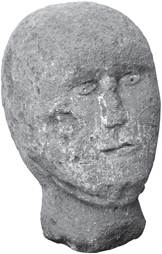
Stone head found reused in a wall at Bryn y Môr Farm, Anglesey. Ht c. 40 cm (16 in.).
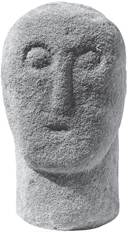
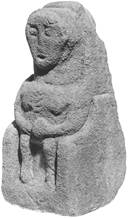
Stone disembodied head (ht c.
22 cm/8 in.) and statuette of seated female (ht c. 27 cm/10 in.) from Caerwent.So, if the chronological divergence can be explained, is it too far-fetched to suggest that the images of the head and the female statuette represent the same religious entity? I wonder whether both might have been ‘oracle stones’, somewhat like the palantiri of Tolkien’s The Lord of the Rings, spiritually charged prophetic stones that glowed and became translucent when touched, allowing the viewer to gaze into them and see the future. Were the Caerwent stones used like the palantiri or the Sibyls of Classical antiquity, as mouthpieces for the words of the gods, and could they have been manipulated by priests who spoke ‘through’ them in divinatory rituals? Their open mouths would seem to suggest as much. If the two stones are synchronous, might they have represented the same entity, whether a priest, sacred oracle or deity? And what was the significance of their eventual resting places? The statuette was placed deep underground, while the head was hidden away in a secluded place, both implying a certain sense of secrecy. The Cumaean Sibyl, who features in the Augustan poet Virgil’s Aeneid as Apollo’s Oracle, lived deep in a dark cavern12 and caves are ‘thin’ places, regarded by many traditional societies as gateways to the world of the spirits. Horn-bearers and shape-shifters: masks and masquerades
‘And then Math took up his magic wand and struck Gilfaethwy, so that he became a good-sized hind, and he seized Gwydion quickly and struck him with the same magic wand, so that he became a stag…’ FROM THE MABINOGION13
The medieval Welsh myths contain numerous references to ‘skin-turning’, the ability to morph between human and animal form. In this mythology, as demonstrated in this passage, transformation of people into animals was often a punishment for transgressing human rules of conduct. In this legend, the two brothers Gwydion and Gilfaethwy had raped a virgin called Goewin, who belonged to Math, the lord of Gwynedd in North Wales.
Goewin had occupied the bizarre position of ‘footholder’ to the king14 but once raped, she could no longer maintain this role. In his fury at his nephews’ perfidy, let alone for their outrageous violation of Goewin, Math changed them into mating pairs of wild creatures for three consecutive years. In Irish mythology, conversely, shape-changing was more often the voluntary action of divine beings. For instance, in the Ulster prose tale the Tain Bo Cuailnge (The Cattle Raid of Cooley), the fearsome battle-fury known as the Badbh or the Morrigan spent a lot of her time morphing at will from young girl to old crone to crow.15Stag-people: wearing the wild
Religious beliefs in Roman Britain and Gaul included the notion that gods were not perceived just in human form but could present themselves with animal characteristics, particularly horns. In Chapter 3, reference was made to the little sandstone relief of a horned warrior-god from the Roman fort of Maryport in Cumbria, perhaps the fusion of a local deity with the Roman Mars; he is one of several horned images from northern Britain.16 One sculpture of an antlered deity from Cirencester is of particular note because of the intensity and multiple nature of the shape-shifting: both the deity and his animal-companions are hybrid creations. This crouching naked figure with vestigial antlers on its head grasps in each hand a large serpent with a ram’s head, and by each snake/ram’s open mouth is an open bag of coins, fruit or grain.17 The most obvious explanation of this double divergence from ‘real’ beings is that the meaning of the sculpture was more important than sticking to the ‘norms’ of nature.
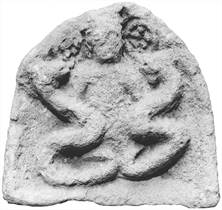
Stone relief-carving of an antlered deity clutching ram-headed serpents from Cirencester. Ht c. 23 cm (9 in.).
This image’s significance lies not only in its intrinsic symbolism, but also in its affiliation to a widely distributed group of cognate images not just in neighbouring Gaul but in faraway Denmark, notably the human head sprouting antlers, the cross-legged seating position, the torcs and the ram-horned/headed snakes; such iconography had its roots in the Iron Age.
Depictions of an antlered ‘human’ on rock-carvings dating as far back as the 4th century BC are known from Val Camonica in northern Italy.18 To find a name for this being we need to go to Paris, to a complex stone monument dedicated by a guild of boatmen plying their trade on the river Seine at Paris in AD 26. One of the several divine images on this great stone pillar is the head and shoulders of a bearded god wearing antlers, suspended from which are two torcs. Inscribed above his head is the Gaulish word ‘[C]ernunno’, ‘to Cernunnos’ – or ‘the horned one’.19 It is not certain whether this was a name meant to represent a single spirit-entity, or whether it was a generic term used to address a variety of divine beings.The appearance in Roman Cirencester of an antlered god in company with the even more idiosyncratic mixed-up snakes evidently derives from a widely shared sacred story or myth, for the same combination occurs on one of the inner plates on the great silver cauldron found in a marsh at Gundestrup in Jutland, Denmark, probably made in the 1st century BC.20 The peculiar ram-headed snakes appear on a number of Gallo-Roman images, including a bronze figurine of a seated man with removable antlers from Savigny in Burgundy.21 His detachable antlers may have been intended to represent the stag’s annual cycle of antler-growth and -shedding, perhaps to tie into different seasonal festivals. In about AD 10, just before the Roman conquest of Britain, a silver coin was minted and lost at Petersfield in Hampshire. On one side is the depiction of a human head with antlers sprouting from it.22
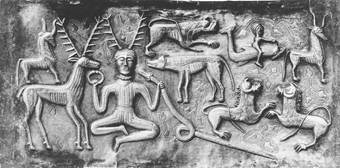
Inner plate depicting antlered human figure clasping a ram-headed serpent, and accompanied by a stag, from the gilded silver cauldron found at Gundestrup, Denmark. W. c. 40 cm (16 in.).
Cat-faces at Caerleon: god, myth or shaman?
‘Thus was Cairbre the cruel
who seized Ireland south and north
two cats’ ears on his fair head
a cat’s fur through his ears’23
Before delving a little deeper into the thinking behind hybrid iconography, I want to consider another human-animal image, this time from a military context: the Roman legionary fortress of Caerleon. For while the tribal capital of the Dobunni at Cirencester was clearly ‘owned’ by Britons, albeit exposed to strong Roman influences, Caerleon was inhabited largely by Roman citizen-soldiers. Having said this, it is only right to point out that by the time the fortress was established, in the later 1st century AD, the Roman army was itself a hybrid creature, with recruits from all corners of the Empire, including Britain’s nearest neighbour, Gaul (see Chapter 3). Caerleon has produced a number of triangular clay roofing-tiles (antefixa) that display human heads, a few possessing feline elements: cat-ears with fur between them.24 The passage quoted above is from a medieval Irish poem, and the person mentioned was Cairbre of the Cat Head. Was it this man’s reputation for cruelty or hunting prowess that gave him such a title? Or could it be a veiled reference to something to do with ritual? It is well established that Irish (and Welsh) myths had deep pagan roots, despite their codification by medieval Christian clerics.25 Cairbre’s cat persona perhaps contained a ‘back-story’ of pre-Christian ‘shamanic’ ceremonial activity that involved dressing up in animal-costume in order to enter the world of the spirits.26 Could it be that the images of the cat-eared heads on the Caerleon antefixa represented the kind of shape-shifting that later blossomed into early medieval mythic storytelling?
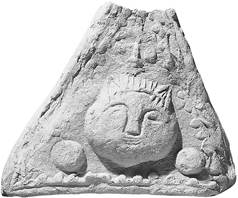
Clay roofing-tile (antefix) displaying a human head with cats’ ears, from Caerleon. W. of base c. 20 cm (8 in.).
Fedelma’s speckled cloak
‘They saw a young grown girl in front of them. She had yellow hair. She wore a speckled cloak fastened around her with a gold pin, a red-embroidered hooded tunic and sandals with gold clasps. Her brow was broad, her jaw narrow, her two eyebrows pitch black, with delicate dark lashes…She had hair in three tresses…Her eyes had triple irises. She held a light gold weaving-rod in her hand, with gold inlay. Two black horses drew her chariot, and she was armed’ TAIN BO CUAILNGE27
This passage from the early medieval Irish epic prose tale of the legendary war between the kingdoms of Ulster and Connaught introduces a young prophetess called Fedelma. The storyteller employed powerful word-painting, full of deliberate shocks and contrasts. She had fair hair but dark brows; she wore a bi-coloured cloak; her clothes were decorated in red (symbolic of the underworld); she gazed at the world through strange threefold eyes; and she carried the peaceful, domestic symbol of the spindle alongside the aggressive motifs of war-chariot and arms. She prophesied to Queen Medbh of Connaught that the young Ulster champion Cu Chulainn – a half-human, half-divine hero – would bring about her downfall.
The oppositional imagery employed by the Irish storyteller in his presentation of Fedelma appears to reflect her identity as a ‘two-spirit’ person – a shaman – who moved freely between the layers of the cosmos, acting as a mouthpiece for the spirits and as a conduit between earth-bound humans and the gods. Speckling is a typical mark of a shaman, and Fedelma’s bi-coloured garment thus signifies the shaman’s soul-journeys through the worlds of the humans and the spirits. The triplism displayed in her hair and her eyes recalls a persistent magical symbol in Irish and Welsh mythology: the sacred nature of the number three. We will return to this theme in the context of Romano-British iconography. But the image of Fedelma may also serve as a lens through which to examine some of the hybrid imagery already met, the half-people, half-beasts who we may interpret as shamanistic beings, their unstable, shifting position in the double world of the material and the spirit reflected in their dual physicality. In many traditional societies, such as Amerindia and Siberia, where shamanism is still active, particular individuals within their communities are able to communicate with the world beyond in order to foretell the will of the divine and to heal (see Chapter 6). They do this by achieving out-of-body trance-states, sometimes attained through music, chanting, sensory deprivation, hyperventilation or the ingestion of narcotics, and also by donning animal-skins, painting their faces with whiskers or wearing horns or antlers on their heads.28
Many of the hybrid human-animal images that have been discovered from Iron Age and Roman Britain might in fact represent people dressed as animals, rather than ‘genuine’ hybrid beings; indeed, such ritual regalia has been discovered by archaeological excavations. Dressing up was clearly a tradition among officiants at certain religious ceremonies. In 1886, the Stone Age scholars John and Arthur Evans came across an assemblage of Iron Age material found in a gravel pit at Aylesford in Kent.29 They had been searching the pit for Palaeolithic artefacts, but they immediately recognized the importance of this later group of objects, which turned out to belong to a late Iron Age cemetery. One rich cremation grave of the late 1st century BC produced a wooden bucket clad in sheet-bronze, the uppermost band decorated in repousse,30 with ornamental La Tène designs, including swirls and whirligigs, but also a rather significant motif: a pair of mad-looking ‘pantomime’ horses whose human lips and back legs betray their identity as costumed people (see pp. xii–xiii).31 The sacral character of the decoration on this funerary vessel is enhanced by the two escutcheons on its rim, in the form of human heads wearing elaborate crowns. Buckets like these were made for holding large quantities of locally brewed liquor (ale, fermented berry-juice or mead); in the European and British Iron Age, drink was closely associated with affirmations of status, power, social relationships, politics and religious ceremony. It also arguably played a role in attaining altered states of consciousness during shamanic ritual.32 So the people dancing opposite each other in their horse-costumes on the Aylesford bucket may represent religious specialists taking part in the funerary rites of the deceased, helping his spirit, freed from the body, to cross into the world of the ancestors.
Close scrutiny of the antlered man depicted on the Gundestrup cauldron reveals that he may be wearing an animal headdress, rather than being a true hybrid creature, for antler-headdresses are known in Britain as early as the Mesolithic (around ten thousand years ago): red-deer antlers modified for human wear have been found at Star Carr in Yorkshire,33 where people were heavily exploiting the red-deer population not just for meat but also for antler as a material for making implements. But something similar was apparently going on eight thousand years later in Roman Britain, for a similarly modified pair of red-deer antlers comes from a pit at Hook’s Cross in Hertfordshire, found in association with pottery dating to the 2nd century AD.34 So there is a body of evidence, from iconography and liturgical regalia, that fits the shamanistic model and supports the theory that in late Iron Age and Roman Britain certain individuals assumed alternative personae in order to signify their unstable oscillations between the upper and lower layers of the cosmos, the realm of the spirits and the mundane material world.
Ravens and ‘bird-men’
‘Conare took his sling and stepped from his chariot and followed the great speckled birds until he reached the ocean. The birds went on the waves, but he overtook them. The birds left their feather hoods and turned on him with spears and swords; one bird protected him, however, saying, “I am Nemglan, king of your father’s bird troop. You are forbidden to cast at birds, for, by reason of your birth, every bird is natural to you.”’35
Nemglan appears in Irish mythology as a ‘bird-man’, probably a shaman who assumed an animal-persona, the better to communicate with the spirit world. The speckling of his and his fellow birds’ plumage is telling for, as we have seen in the description of the future-telling Fedelma, dappling was the signature of a ‘two-spirit’ being. Nemglan’s fellow bird-man was a blind Druid named Mog Ruith whose physical incapacity allowed his inner sight to flourish and to be used to see into the future.36 The ‘prohibition’ placed upon Conare by Nemglan resonates with the doctrine of bodily rebirth mentioned by Classical chroniclers as preached by Gallic Druids (see Chapter 10).
The Aylesford ‘horse-people’ wore elaborate headdresses that look as if they were made from feathers. There is some circumstantial evidence for the use of plumage for ceremonial headgear too, from Iron Age ritual deposits at hillforts in southern England. The practice of reusing decommissioned grain silos as foci for votive offerings has long been known at sites such as Danebury and Winklebury.37 Deposits often include the entire or partial bodies of humans and animals, and by far the most common of the latter belonged to domestic species: cattle, sheep and pigs, kept as livestock, plus significant numbers of horses and dogs, often found together. But the only wild creature to occur in any quantity is the raven, and this has been explained in terms of its underworld connotations, based on its blackness and its carrion-feeding habits.
Recent research on Iron Age and Romano-British bird-burials, including the Danebury burials and a group of corvids found in shafts in the centre of Roman Dorchester,38 has suggested another explanation for the presence of ravens in these pit-deposits, proposing that these creatures might have been exploited for their feathers, perhaps for use in religious ceremonies.39 The reason for proposing this stems partly from their singling out for special, arguably ritual, deposition in deep underground locations, but the most compelling argument for such a thesis is the revelation that some ravens had their wings and feathers removed after they had been killed, but were otherwise left intact. The selection of ravens for such treatment might be because of the large, glossy feathers that would make ideal and striking headdresses, but also because of the raven’s distinctive ‘voice’, one that can mimic and learn simple human speech, its longevity, its memory and its reputation for being able to foretell the future (this last perhaps because they were quick to spot bloodshed and fly to the scene to scavenge). Moreover, ravens are frequently considered to have an affinity with people, because of their particular intelligence – they have been witnessed counting, figuring out solutions to problems and using tools, and are known to be adept at deception.40
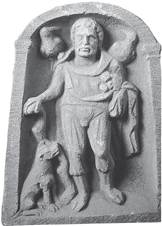
Gallo-Roman relief-carving of a raven-god from Moux in Burgundy. W. 27 cm (10½ in.).
Two images of ravens serve to symbolize this ‘special relationship’ between ravens and people: an Iron Age war- helmet and a Gallo-Roman relief-carving. The helmet comes from a warrior’s grave at Ciumes‚ti in Romania, and dates to the 3rd or 2nd century BC.41 It was fashioned with bronze ravens’ wings, one on each side, hinged so that they would flap up and down (and probably screech as they did so) when the wearer charged into battle. This was a piece of visual and auditory psychological warfare, designed to unnerve the enemy, and it is no surprise that the large, carrion-hungry raven was chosen for the purpose.
The Roman-period sculpture conveys a very different message, one of peaceful communication between a god (or a shaman) and two ravens. It comes from Moux in Burgundy and depicts a bearded man dressed in Gallic breeches and a cloak, a gnarled stave in his right hand, an open bag of fruit (or possibly oak-apples) in the crook of his left arm and a billhook in his left hand. By his side sits a large hound and on each of his shoulders sits a raven, its beak pointing towards him as if conversing with him.42 The raven-images on both the Romanian helmet and the Burgundian carving exhibit the close connections that people felt with these large carrion birds. One conveys war; the other intimate ‘conversation’. But in each case, the raven’s presence may signify the birds’ perceived role as advisor, helper or prophet to humans. The sacred power of three
‘As Conare was making along Slige Chualand, he perceived three horsemen up ahead making for the house. Red tunics and red mantles they wore, and red shields and spears were in their hands; they rode red horses, and their heads were red. They were entirely red, teeth and hair, horses and men.’43
This excerpt from a medieval Irish myth – the tale of a luckless king, Conare Mor, who disobeys a geis or sacred prohibition and is condemned by the gods – communicates vividly the Celtic preoccupation with the colour red. For the Celts, red was a colour belonging to the Otherworld, and the three red horsemen were thus harbingers of Conare’s impending doom. The horsemen’s special status is also conferred by their triplicate coming; three is a constantly recurring number in Irish and Welsh mythic literature, signifying magic and mysticism. The description of the Irish prophetess Fedelma contained reference to her triple tresses and the triple irises of her eyes, and the Welsh brothers Gwydion and Gilfaethwy were punished in a cycle of three forms. Its special significance can be traced back much earlier, first in Iron Age art and into Romano-British iconography. The ‘triskele’, or three-armed whirligig, design is a persistent motif particularly in Welsh Iron Age La Tène art, as illustrated by the decorative bronze plaques from Moel Hiraddug and Llyn Cerrig Bach in North Wales.44
But it is in Roman Britain (and Gaul)45 that triplistic imagery blossomed; it is such a feature of religious sculpture of this period that it must have possessed an especial spiritual resonance. Some Gallo-British deities, such as Epona, were rarely multiplied but others, such as the mother-goddesses and the little hooded gods known as Genii cucullati (see Chapter 4), were typically depicted as triads. Sculptures of disembodied heads, too, were often grouped in threes. Wroxeter (Viroconium Cornoviorum, the ‘settlement of Virico of the Cornovii tribe’46) appears to have been the centre of one such ‘head-cult’, for in the remains of one of its temples fragments of deliberately defleshed human skulls, and one of a horse or cow, were recovered during excavations. One of the human crania had been scalped, and coated or steeped in vegetable oil. Another had clearly reposed for a time on a bronze plate or sheet, for it was stained with the green colour that comes from copper. And a column from one of the buildings in the forum (the central market-place) was once decorated with a strange, native-looking threefold male head, each with luxuriant curly hair.47 A more complete triple disembodied head with curly hair, full moustache and beard comes from the Roman city of Lugdunum (Lyon) in Gaul, but the carving differs from the British stone in that it represents a single head with three distinct faces.48 And unlike the Wroxeter stone, where the three faces stare, more or less, straight ahead, the faces on the Gallic image gaze at the world at right-angles to one another. Although some elements of romanitas can be distinguished in the modelling of these triple heads, the three-faced Iron Age stone head from Corleck (County Cavan) in Ireland,49 beyond the western frontier of the Roman Empire, serves as a reminder that the roots of the motif lay in the indigenous traditions of the west. All these threefold heads have in common a slight but perceptible differentiation between each face and an air of power, and perhaps even of threat. In his description of the Corleck head, Barry Raftery aptly refers to ‘the stern and brooding presence of an Otherworld being’.50 The same may be said of the triple head from Wroxeter, whose half-shut eyes and grim expression give the faces an air of malevolence.
In Roman Britain, the power of three was represented not simply by disembodied heads but, more often, by triple beings whose entire bodies are replicated. Earlier chapters have already touched on the two most common forms of Gallo-British cult-images treated in this manner: the mother-goddesses and their frequent companions the Genii cucullati, small, non-gender-specific figures shrouded in the long hooded cloak known as the birrus Britannicus. Such garments were robust woollen coats designed to withstand the cold wet weather that is so much more prevalent in Britain and northern Gaul than in southern Europe. One aspect of the hoods worn by these triple ‘godlets’ is their capacity to shroud faces. Was the choice to depict them hooded designed to demonstrate hidden or obscured identity?
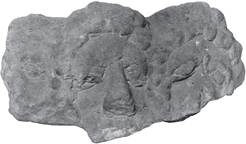
Monumental stone triple-faced male head from the Roman forum at Wroxeter, Shropshire.
The Cotswolds around Cirencester seem to have been a particular focus for triplistic imagery and, while threeness occurs in varying forms and combinations, it was a persistent and clearly significant symbol for the Dobunni. Even ‘unlikely’ Cotswold deities were triplicated, like the ‘Mars’ or native warrior-god found in a well at Lower Slaughter.51 What is particularly striking is the way in which sculptors played with the triplism associated with the mother-goddesses. In Chapter 4, the carvings of three goddesses were introduced. But even when the goddesses were presented alone, triplism was referenced in associated imagery. So, for example, a solo mother-goddess from Ashcroft (a site identified as a likely temple for mother-goddess worship) sits in a chair with three apples in her lap;52 and a once-lost but rediscovered relief found at Stratton, near the Dobunnic capital, depicts another single seated woman, with a large round object in her lap, facing a processional trio of cucullati who approach her, each carrying a goblet of liquor.53 These two carvings illustrate the primary importance of threeness, over and above other features within these carvings. But the Stratton carving has additional interest in that, sometime in antiquity, the three genii and the goddess were deliberately ‘beheaded’, thus emphasizing the triplism even more, without the viewers’ gaze being distracted by the individuality conferred by heads and faces.54 This was not iconoclasm but a careful modification that took place some years later than the date the stone was carved, a statement of purposeful and religious intent. There is no sign of what happened to the severed heads: perhaps they were considered no longer necessary to the carving’s meaning, or maybe they were reused in other ‘head-centred’ ritual events, or received a dignified and respectful burial somewhere nearby.
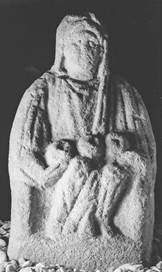
Stone figure of a goddess with three apples in her lap, from Ashcroft, Cirencester. Ht c. 42 cm (16 in.).
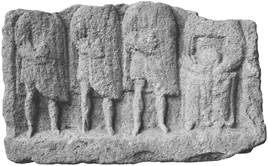
Small stone relief of three cloaked standing figures (Genii cucullati) and a seated woman, all deliberately decapitated, from Stratton, Gloucestershire.
So why was triplism so significant and so persistent in Romano-British cult-imagery? What did ‘threeness’ mean to the Britons? We need to be very careful in ascribing meaning without much tangible evidence. In Llandaff Cathedral there is a 19th-century stone corbel depicting a three-faced head representing the Holy Trinity whose iconography is remarkably similar, in visual terms, to the Lugdunum triple-head mentioned earlier.55 It serves as a warning that meaning is entirely context-dependent, and no written sources reveal any clues as to what triadism represented in the western Roman Empire. But there is no harm in indulging in some mild speculation. A clue may present itself in a particular form of triple image from Roman Gaul, a group of sculptures from Nuits-Saint-Georges in Burgundy depicting goddesses of varying ages: youth, middle age and old age.56 Here, at least, triplistic imagery is associated with the ‘three stages’ of humankind – birth and childhood, adolescence, and old age and death. Perhaps such images were meant to warn human worshippers of the brevity of life, a reminder of the inexorability of time and that the vital thread might be cut whenever the gods willed it. Other alternatives suggest themselves for the meaning behind such a persistent and widely distributed tradition: past, present and future, perhaps. Triadism might have been connected to spatial perceptions of a triple-fold cosmic structure, in which the uppermost level was deemed to be inhabited by the spirits, ‘middle-earth’ by people and other living beings, and the underworld, the land of the dead. The triple-layered cosmos has wide currency in traditional societies where shamanism plays a prominent role.57 These layers are permeable for the shaman, whose soul has the power to move between worlds to liaise with the spirits and the dead, to negotiate with them on behalf of the living communities dwelling on the central, material level. Some of these individuals might also be able to cause time to become fluid, to segue between temporal layers and manipulate the past and the future by tapping into the will of the gods. Whatever perceptions lay behind the ‘triple habit’ in Roman Britain and its Gallic neighbour, what is clear is that, like horns, disembodied or exaggerated heads and other reality-bending iconography, triplism fed into a broad tradition of ‘otherness’, of presenting divine forms outside the ‘normal’ template of the human or animal image. Being different: the surreality of spirits
In this chapter we have seen how the world of the spirit was expressed in iconographic traditions that thought outside the parameter of the natural. In the Classical world, the gods were perceived as beings who were essentially superhuman versions of people, despite their exalted status as immortal deities. Certainly, the world of Classical mythology allowed for monsters, like the Gorgon or the Hydra, but Zeus, Mars, Venus and Mercury were recognizably human. In Gallo-British communities, the gods were not always imagined like this. For religious officials, artists and worshippers, the spirit world was demonstrably different from that experienced by humans, and sometimes this difference was represented by crossing the boundaries between realism and surrealism. This predilection for twisting real life to create other canons of being can be traced back to the Iron Age artistic tradition known as La Tène,58 which produced a rich array of fantastical creatures, from human-headed horses to nightmare human faces with bulging eyes and animal-ears or enormous leaf-shaped headdresses, as well as stylized leaf-designs whose tendrils end in birds’ heads, hybrid bull-horned horses and cats’ faces that morph into owls as you look at them. This is two-thousand-year-old surrealism, what Ernst Gombrich called ‘the ambiguity of shapes, the game of “rabbit or duck?”’,59 the desire to escape earthbound reality and get beyond it to truer truths.
It is possible to use early 20th-century surrealism as a lens through which to consider some of the images that are the subject of this chapter. There is one other iconographic custom in Roman Britain with which to conclude, namely the ‘schematic habit’. Alongside the three-dimensional moulding of the human form in religious imagery, there marched a tradition that stripped back form to its very essence, deliberately eschewing detail to create mere outlines. This is not, as some purist Roman scholars would suggest, simply ‘bad art’, the failure of British sculptors to master the art of realistic sculpture, but an attempt to express alternative ways of seeing, a ‘schematic shorthand’60 where all that mattered was the message. For it is almost certain that the school of figure-carving that was so active in the Dobunnic Cotswolds, with its centre almost certainly in Cirencester, produced sculptors capable of creating both realistic and shorthand images, probably depending upon the choice of their clientele. One carving is sufficient to demonstrate minimalism at its most evocative: the little plaque from Cirencester depicting the three Genii cucullati, or hooded spirits,61 whose slanting legs depict them scurrying off to the viewer’s right, one behind the other. The body of each figure is represented by a simple triangle, the only detail of the heads being the side-projection of the hood. But all the essentials are present: threeness, hoodedness and movement. The power of the image is in its spare economy of line, where the interplay of shape, contour and light can be appreciated without the clutter of unnecessary detail.
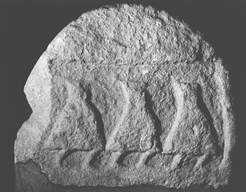
Highly schematized relief-carving of three scurrying Genii cucullati from Cirencester. Ht c. 23 cm (9 in.).
At the very end of his life, when he was in his nineties, Michelangelo sculpted the last of his three images of the Pietà,62 the Virgin Mary cradling the dead Christ in her arms, in an attitude of deep mourning. The fine detail of the first two exhibit the artist’s breathtaking mastery over his medium of marble; his final piece represents an entirely new artistic direction. Here, the minutiae of detail are subordinated to shape, form and the all-consuming image of grief. The two figures, mother and son, seemingly merge into a single ululation of sorrow. The sculpture is all the more potent because Michelangelo died before finishing it; its incompleteness allows for the viewer’s own interpretation to contribute to its message. Confrontation with a minimalist image allows for active and personal engagement on the part of those who gaze at it. It is immersive, wrapping the spectator in a private and organic dialogue that permits fluidity and interactivity, so that each individual can connect to a sculpted figure in a meaningful, highly personal way. The schematic cucullati from Corinium present just such a ‘blank canvas’, upon which every worshipper had the capacity for their own endowment of meaning. Despite the presentation of movement in these three little figures, there is about them – and many of their fellow carvings – a kind of ‘robust tranquillity’,63 a muscular stillness that greatly enhances their power to draw the gaze and to invite people to ponder on the nature of the divine.