CHAPTER EIGHT Candles in the Dark and Spice from the Orient: Mystery cults
‘But what a small part of our dregs
Is Greek! Long ago the wide
Orontes of Syria poured into the Tiber
And brought
With its lingo and morals its flutes
And harps…’ JUVENAL1
Rome did not sit entirely happily with the East.
In the 1st century AD, the memories of the notorious Egyptian queen Cleopatra, whose seduction of both Julius Caesar and Mark Antony had such a devastating effect upon Roman politics late in the previous century, were still fresh and raw. There was prejudice against the perceived effeteness and decadence of the painted and perfumed ‘Oriental’. In his Satires, Juvenal poked fun at Eastern customs and religion.2 In the particularly scornful verse quoted at the beginning of this chapter he probably echoed the prejudices of many of his contemporaries. But the traditions of the East did undoubtedly penetrate the Roman Empire, even as far to the north as Britain. These exotic religions arrived here with army units recruited in the eastern provinces, like Anatolia and Syria, and with merchants, oriental entrepreneurs who sought new markets for their wares. So it is unsurprising that archaeological evidence for these cults is clustered in large entrepôts like London and, above all, on military sites, particularly on Hadrian’s Wall.New research taking place in London is shedding light on the multicultural nature of the city’s population, demonstrating the presence of people from all over the Empire relatively early after its establishment as a major Roman port. To appreciate how important Roman London was as a hub of commerce, we need look no further than the recent finds of wooden tablets preserved in the waters of the river Walbrook. The most ancient of these tablets dated to the first decade of Roman rule, between AD 43 and 55. It ‘reveals that the city was a snake pit for financiers twenty centuries before the stock market crash caused by the collapse of subprime mortgages’,3 and that the city recovered incredibly quickly from the ravages of the Boudican revolt in AD 60 to flourish as the financial capital of Britannia for the next three hundred years.
The analysis of Roman skeletons recently undertaken by Rebecca Redfern at the Museum of London has demonstrated the cosmopolitan nature of the city. Study of the DNA from the bones and teeth of people buried in its cemeteries enabled Dr Redfern to trace their ethnic origins, and her results prove that some ancient Londoners came from northern and eastern Europe and North Africa. Most astoundingly of all, two individuals, buried in a cemetery in Southwark, were of Chinese origin.4 They are quite likely to have been traders in silk, for the penchant for this exotic fabric is well documented in Roman literary sources from the 1st century AD onwards.5 Given Roman London’s multiculturalism, the importance of international trade and the ethnic mixture of the Roman army, the presence of eastern cults in Britain is easy to comprehend. Only good men allowed: Mithras the Persian God
‘Mithras, God of the Midnight, here where the great bull dies,
Look on thy children in darkness. Oh take our sacrifice!
Many roads Thou hast fashioned, all of them lead to the Light,
Mithras, also a soldier, teach us to die aright.’ KIPLING6
Rudyard Kipling’s poem is about the most prominent of the new oriental religious movements to be established in Britain, the cult of the Persian god Mithras, an exclusively male cult. Not only that, his followers had to be of good character. Mithraism was an exacting religion that accepted only those capable of the kind of physical stamina and endurance that Mithras himself demonstrated in his wrestle with a great bull. Mithras was sent to earth as the emissary of the great Iranian creator-god, Ahura Mazda, to hunt and slay the divine bull so that its life-blood would revitalize the earth and humankind; he was a guider of souls, teaching people the right path, that of goodness.7 So, unlike most other religions in the Roman Empire, it was a cult whose adherents were required to live a life of merit, and furthermore to undergo a complicated series of seven initiation rites.
The Christian leader and writer Saint Jerome wrote in the early 4th century AD of ‘the monstrous images there by which worshippers were initiated as Raven, Bridegroom, Soldier, Lion, Perseus, Sun Runner and Father’.8 Jerome was born in c. AD 348 in Dalmatia,9 but taken to Rome early in his life, to be taught by the greatest theologians of the time. As an ardent and outspoken Christian leader, he was both appalled by and scornful of Mithraism, which seemed to him to represent a twisted and wicked travesty of monotheism that set itself up to rival Christianity.The fundamental basis of the Mithraic cult was dualism, the ceaseless struggle between right and wrong, light and darkness; but the dark forces were perceived as necessary for the existence of good, to enable it to triumph and flourish. Central to the ‘dark side’ was Ahriman, lord of chaos and the clouds of disorder, and even Mithras himself contains contradictory aspects. He represented the great Persian god of light and the cosmos, but was born deep in a lightless cave, as if sprung from the forces of primeval chaos. Mithraea (sanctuaries to Mithras) were generally sunk into the ground, in acknowledgment of Mithras’s subterranean birth, and worship took place in the dark, the shrines lit only by oil-lamps, torches and candles flickering in the blackness. The most visible focus in Mithraic temples was the tauroctony, the bull-slaying scene that formed the reredos, or high altar, of the sanctuary, which would have been specially lit for dramatic and theatrical effect. Wealth may have been a factor in the acceptance of novices for training and initiation, for it was a cult whose devotees came mostly from the officer ranks of the army and prosperous merchants, and they gave generously to the upkeep of their temples and to the honour of the god.
North and south: the Mithraea in London, Carrawburgh and Inveresk
‘To the Unconquered Mithras, Lucius Antonius Proculus, Prefect of the First Cohort of Batavians, willingly and deservedly fulfilled his vow.’10
This inscription comes from an altar, one of three, set up in the early 3rd century AD in front of the apse behind which the bull-slaying scene would have been mounted in the Carrawburgh Mithraeum.
Several temples to Mithras existed in the cities and military installations of Roman Britain; it was essential to the rituals that the sites chosen had access to a stream or spring, which as we have seen was also a consideration in the location of military bases, as, for example, Coventina’s Well at Carrawburgh and the temple to Sulis at Bath (see Chapter 5).11 Lustration (purification by water) was a key element in oriental cults, such as Mithraism and the worship of Cybele (see p. 166). The Mithraea in London and on the Hadrian’s Wall fort of Carrawburgh are among the best preserved, allowing some appreciation of what it must have been like to worship there. The temples’ construction followed a set architectural formula. The sanctuary buildings consisted of a small entrance-hall or narthex, through which the devotee progressed down a flight of steps to the nave, flanked by two side-aisles, in which altars and images were displayed (see p. xiv, bottom). At the end of the nave nearest the narthex stood two images of Cautes and Cautopates, keepers of the sacred flame. Cautes was depicted holding an upright torch, while Cautopates’s torch was inverted, between them representing the dualism of light and dark in Mithraic doctrine. At the far end an apse framed the sculpture of the bull-slaying scene, subtly but dramatically lit so as to reveal Mithras astride his victim, wearing his soft, ‘Phrygian’ cap (a form of soft, conical hat that originated in ancient Phrygia, now Turkey), his knife plunged into the bull’s neck, the figures picked out in bold colours.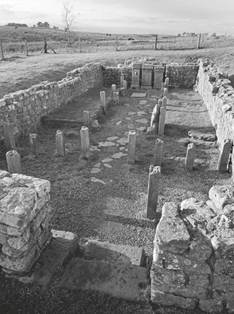
The stone foundations of the Carrawburgh Mithraeum. The shrine is semi-subterranean, divided into a central nave with side-aisles. Three altars can be seen at the far end.
The diverse sculptures from the London Mithraeum reveal that devotees of other cults were welcomed to the shrine: the Egyptian god Serapis was represented here, as were the Roman Bacchus and Minerva.
Some were depicted in exquisite marble carvings, others less well executed in oolitic limestone, probably from the Cotswolds.12 Coin evidence suggests that the sanctuary was erected in the 2nd century AD and went through a number of phases before falling out of use sometime in the 4th century. During its lifetime, there were at least two events that involved the deliberate burial of some of the sculptures, perhaps in attempts to prevent their desecration by early Christian persecutors.13 Little can be discerned about the ritual practices that went on in the London Mithraeum, but some of the finds provide tantalizing clues: broken cups for libations or votive offerings, and the food-remains of sacred feasts; lustral basins that would once have held water for purifying supplicants; and candlesticks that would have glowed in the gloom of the sanctuary and dramatically illuminated the sculptures. The most exceptional small find was a gilded silver canister decorated with scenes of hunting and combat, inside which was a strainer. This was almost certainly used for the preparation and keeping of the secret fluids that had a part in Mithraic ceremonies.14 The vessel’s iconography has a strongly oriental flavour: people wearing Phrygian caps, exotic-looking trees and animals such as lions, hippopotamuses and elephants. It was probably made at a workshop somewhere in the eastern Mediterranean in the late 3rd or early 4th century AD, towards the end of the temple’s life.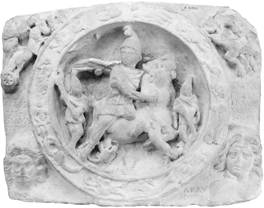
Marble relief of Mithras astride and slaying the sacred bull, from the Walbrook Mithraeum, London. The torchbearers, Cautes and Cautopates, flank the bull. Ht c. 43 cm (17 in.).
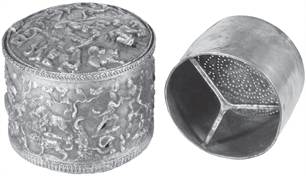
Gilded silver canister and strainer from the Walbrook Mithraeum, London. Ht 6.35 cm (2½ in.).
The Mithraeum belonging to the fort at Carrawburgh on Hadrian’s Wall was a smaller, more modest affair than the great, lavishly furnished Walbrook shrine in London, but it was of similar basilical design, and contained a feature whose presence hints at the enactment of initiation rituals there: a trench sunk into the floor with a flagstone lid.
Guy de la Bedoyère is almost certainly correct in interpreting this structure as ‘some kind of endurance pit for an initiation exercise’,15 designed to test the physical and psychological stamina of would-be Mithraists before their admittance into the mysteries of the cult. Here, perhaps, the confined initiate struggled with the pain of hunger and thirst and with solitude and darkness before being released and judged by those already accepted into the inner circle of cult-adherents. The epigraphic evidence from the Carrawburgh Mithraeum indicates that, here at least, Mithras, god of light, was equated with Sol Invictus, the Unconquered Sun, whose cult, which was of Syrian origin, became popular during the reign of the emperor Aurelian in the 3rd century AD.16 One of the three altars ranged in front of the reredos at the far end of the Mithraeum depicts Sol-Mithras clad in a cloak, carrying a whip, the solar rays sprouting from his head pierced so as to allow back-lighting to illuminate it, in a wonderfully theatrical statement of the god’s celestial power.17 This altar was deliberately damaged in antiquity, perhaps by devotees of a rival cult.The dramatic visual effects of Mithraic rites at Carrawburgh were replicated further north, at the Roman fort of Inveresk in East Lothian, Scotland, where in 2010 excavators uncovered part of a Mithraeum just east of the fort itself. The discovery is particularly exciting because it is the first to have been found in Scotland and because of its secure date in the mid-2nd century AD, when the Antonine Wall was built and garrisoned.18 The shrine was of typical form, rectangular and sunk into the ground. At one end, two altars had been deliberately buried face-down, one dedicated to Mithras, the other to Sol, the sun-god, both bearing rich cult-iconography. As at Carrawburgh, the image of Sol was lit from behind to illuminate his facial features, but at Inveresk, Sol’s nose had also had an iron rod at the back, perhaps in order to manipulate the god’s face and introduce sound effects, like breathing or speech. So we can imagine the rituals here, on the very northern edge of the known Roman world, of a cult far from home but displaying all the flamboyance, theatre and spectacle of a sophisticated sanctuary in London, Rome or an eastern city.
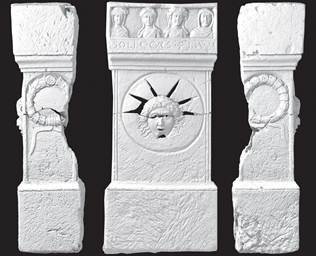
Stone altar to Sol-Mithras from the Inveresk Mithraeum on the Antonine Wall, Scotland. Ht. c. 125 cm (49 in.).
New light on Mithraic Wales
Mithras was venerated by army units stationed at forts and fortresses in both North and South Wales. The Mithraeum excavated at Segontium (Caernarfon) was founded in the mid-2nd century AD and probably went out of use by about AD 350, with some evidence for deliberate destruction. It conformed to type, with a narthex, nave, aisles and an apsidal recess for the bull-slaying reredos, and its temple furniture included small altars, lamps and – unusually – a free-standing portable candelabrum,19 perhaps designed to be moved from altar to altar during ceremonies, or to illuminate the faces of would-be initiates as, one by one, they presented themselves to the presiding officers in the temple. No Mithraeum has been discovered in Wales’s principal legionary fortress at Caerleon, but an inscribed dedication to ‘the Invincible Mithras’ erected in the fortress by a devotee called Justus from the 2nd Augustan Legion formed part of a circular base, perhaps for a statue of the god.20
In 2007, the local Monmouth Archaeology unit discovered some exciting new evidence for the cult of Mithras at Caerleon while undertaking an archaeological evaluation of some land on the Bulmore Road, just over the river Usk from the legionary fortress and near to the vicus (the extramural settlement) and to major Roman cemeteries for soldiers, veterans and the civilians living in the vicus. The finds were part of the liturgical furniture, almost certainly for the Caerleon Mithraeum, and take the form of fragmentary ceramic altars and sacrificial tables (mensae), some pieces pierced with holes for the insertion of candles or torches and showing signs of burning. These objects were made of local clay, probably by army potters. During two episodes in the life of the temple (one in the later 2nd century AD, the second in the later 3rd or 4th century), some of these portable clay tables and altars were deliberately smashed by being hit hard by a heavy object at their centres, and then recycled to form part of a drainage channel for a nearby Roman building. The debris of ritual feasting, including the burnt and butchered bones of sheep or goats, was placed inside this channel and covered with a capstone.
On some of the surfaces of this sacrificial material are fragmentary inscriptions that do not, by themselves, convey any useful information revealing the rites performed. However, one of the pieces, part of a ‘box’ altar, bears decoration that ties it directly to sacrificial rites: palm-branch garlands for decorating the animal before its slaughter, and the main instruments for despatching animal-offerings: a pole-axe for stunning the beast, and a knife for cutting its throat. What is more, a hole was deliberately bored into the clay in the space between the garlands and the axe, possibly as a receptacle for real palm-fronds.21
So far, their intrinsic form and decoration serve to link these ceramic finds firmly into the context of sacred rites. But what is the rationale behind their possible connection with Mithras? Although ceramic altars are rare, they do occur in Romano-British temples whose cults were nothing to do with the Persian cult, an example being the fragments of a ‘box’ altar from the temple to Mercury at Uley.22 But research by Mark Lewis of the Roman Legionary Museum at Caerleon23 has put together a persuasive assemblage of evidence that points strongly to a Mithraic role for the Caerleon ceramic temple furniture, particularly the sacrificial mensae. There is a close parallel between the examples from South Wales and similar fragments from the Tummel Platz Mithraeum at Linz on the Danube frontier in Austria, the coin-evidence indicating that the sanctuary was built in about AD 275. The mensa from this Danubian Mithraeum bore an inscription that confirms the shrine’s dedication to Mithras. Lewis also draws attention to a series of monumental stone altars dedicated to the Persian god at Tummel Platz. These, like the clay ones from Caerleon, were pierced with candle-holes. Comparable Mithraic temple-furniture has also been found in the Roman military establishment at Dura Europos, on the eastern bank of the river Euphrates in Syria.
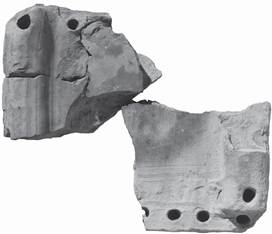
Fragments of clay ‘table’ altars, with holes for candles, probably from a Mithraeum, found at Caerleon, South Wales.
The inscribed stone dedicated to Mithras at Caerleon indicates his worship at the legionary fortress. Although the evidence of the clay altars from the Bulmore site is largely circumstantial, based on parallels with other Mithraic liturgical equipment from elsewhere in the Empire, it is reasonable to make the connection between these ceramic altars and the Persian deity, and to suggest the presence of a small Mithraeum placed deliberately near the Bulmore cemetery in the 2nd century AD. These altars show signs of (possibly iconoclastic) destruction, as did the Segontium Mithraeum. What is particularly special about these recent discoveries in Caerleon is the emphasis on light in the darkness: the candles. These finds help us to visualize the physical experience of entering a dim, shadowy sanctuary whose gloom was dramatically pierced with subtle, carefully controlled illumination that shone on sculptures, inscriptions, priests and supplicants as desired by the bearers of the flame, while keeping the mysteries secret in the artificial, cave-like night of the shrine. Fertility and castration: Cybele and Atys
‘Of Cybele it is a shame to speak: unable to satisfy the affections of her luckless lover – for mothering of many gods had made her plain and old – she could not allure him to lust and castrated him, so as to make a god, no less, a eunuch, and in deference to this fable her galli priests worship her by inflicting the same mutilation on their own bodies. Such practices are not sacred rites but tortures.’ MINUCIUS FELIX24
Sometime during the earlier 3rd century AD, the North African Christian writer Minucius Felix constructed a fictitious dialogue between a Christian whom he called Octavius and a man called Caecilius Natalis from Cirta (in what is now Libya) in the province of Numidia. This ‘dialogue’ presented arguments that held up pagan rites to ridicule, while at the same time defending Christians from allegations that their Eucharistic rituals involved cannibalism.25 In this passage, Felix is poking fun at the cult of the Magna Mater, the Great Mother goddess of Phrygia in Anatolia (today part of Turkey). She was, in origin, a nature-goddess, sometimes known as ‘Our Lady of the Animals’, and in many of her images, she is depicted flanked by lions or panthers.26 Hers was one of the earliest and most enduring of the oriental cults to be absorbed into mainstream Roman religion. It was imported to Rome around 205 BC, in response to a prophecy that the Carthaginian armies under Hannibal would be defeated only if Cybele’s sacred stone from Ida in Anatolia was brought into the city. The worship of Cybele lasted until finally ousted by Christianity in the late 4th century AD under the emperor Theodosius.27
Our Lady of the Animals
‘Eunuchs will march and thump their hollow drums, and cymbals clashed on cymbals will give out their tinkling notes; seated on the unmanly necks of her attendants, the goddess herself will be borne with howls through the streets in the city’s midst.’28
‘The Virgin in her heavenly place rides upon the Lion; bearer of corn, inventor of law, founder of cities, by whose gifts it is mans’ good lot to know the gods…’29
The first passage quoted comes from the Augustan poet Ovid’s poetical calendar of the Roman religious year, the Fasti (or ‘correct days’). Like his compatriot Juvenal, Ovid shows scant respect for this exotic, and somewhat unrestrained and over-emotional cult, whose flamboyant processions probably rather shocked the senate fathers, particularly at a time when Augustus was trying so hard to impose an austerity regime on Rome.30 The second quote is part of a stone panel dedicated to Cybele in the late 2nd or early 3rd century AD by the military tribune Marcus Caecilius Donatianus at Carvoran on Hadrian’s Wall. It is the opening of a poem or hymn in honour of the goddess, and the paean goes on to link her with the cult of Julia Domna, the Syrian wife of the African emperor Septimius Severus (r. AD 193–211), who was often referred to with the honorific title ‘The Virgin’.
The myth underpinning the cult of Cybele was based upon jealousy and infidelity. Cybele was in love with a young shepherd called Atys and, catching him in flagrante delicto, she drove him insane, bending his mind so that he castrated himself beneath a pine tree and bled to death. Built upon this myth was a cult founded upon the rhythm of the year: the winter of mourning for Cybele’s dead lover (the ceremony of the tristitia) was followed by the joy of the spring of his rebirth and the renewal of the earth’s fecundity (the hilaria). In the annual re-enactment of Atys’s funeral ceremony, cult officials known as dendrophori (‘tree-bearers’) paraded through the towns and cities carrying pine trees, in deference to the tree under which the young god died. Felix was correct in his description of the Great Mother’s religious attendants, for initiates to the priesthood had, like Atys, to undergo castration, and ceremonies involved the ingestion of mind-altering substances, trance-dancing in ecstasy, self-flagellation and the enactment of the taurobolium, the bull-sacrifice, in which the blood of the animal poured through a grille set into the ground into an excavated space where initiates were bathed in the gore, as part of their trial-rites.31 Because of its reputation for orgiastic rites and general wildness, the cult was strictly controlled in the Roman Republic, when no Roman citizen was allowed near it, but the emperor Claudius relaxed the rule and the cult of Cybele and Atys became ‘respectable’ and even a Roman State Religion,32 with the eunuch celebrants (galli) and their high priest (the archigallus) fully absorbed as Romans, with Latin names.33
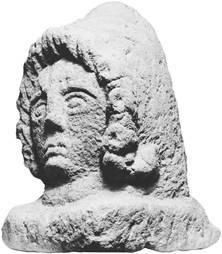
Stone head of Atys from a Roman cemetery at Caerleon. Ht c. 48 cm (19 in.).
Cybele and her unfortunate consort, Atys, were – like Mithras – worshipped in cities, where foreign merchants plied their wares, and on army bases, such as Carvoran and Corbridge on or near Hadrian’s Wall, where regiments from the eastern provinces were stationed. The specialist auxiliary cohort of Syrian archers, Cohors I Hamiorum, was deployed from Carvoran, and here the Anatolian Cybele seems to have been merged with the Syrian goddess Caelestis or Dea Syria.34 There must have been a temple (called a Metroon) to Cybele at Corbridge, just south of the Wall, for here, in the 3rd century AD, army personnel set up an altar to the Anatolian goddess under the name Dea Panthea; on each lateral surface of the stone a figure of Atys in mourning is depicted, wearing a Phrygian cap and cloak.35 A disembodied head of Atys from here36 may have belonged to the same temple.
London was clearly an important centre for the cult of Cybele, for several small figurines of Atys have been found in the city, as well as two more significant objects: an altar (alas now lost) and a curious piece of liturgical equipment. The altar was rich in iconographical detail: on one surface was carved the figure of Cybele holding pomegranates and a small wine-flask, flanked by two of her galli (priests); another face depicts the funeral of Atys, with his bier carried in procession by clergy (with a basket and pine branches said to represent the dedication of the unfortunate youth’s genitals to the jealous goddess).37 The ceremonial bronze object mentioned earlier has gained much notoriety for its identification as a ‘castration clamp’ for gelding the would-be priests of Cybele. It comes from the river Thames near London Bridge and comprises a hinged pair of ‘forceps’, serrated on the inside and decorated on the outer surfaces with busts of Cybele, Atys and other deities, with the terminals ending in the heads of lions.38 The object may have been thrown into the water as a sacrificial act or, perhaps just as likely, to avoid its despoliation by a rival cult, maybe that of Christ. It wasn’t intentionally broken, for the hinges seem to have decayed naturally, and the two arms, though separate, were found close together. It may have been a purely ceremonial object, symbolizing Atys’s own castration, but it is not impossible that such an instrument was actually used in the initiation rituals for Cybele’s eunuch priests, a rather gruesome thought.
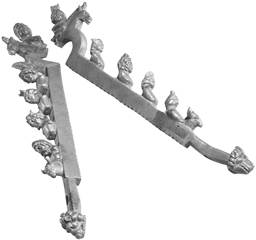
Bronze ‘castration clamp’, used in the rites of Cybele, from the river Thames, London. Ht c. 29 cm (11 in.). Mountains, smiths and double-axes: Jupiter of Doliche
‘By order of Jupiter Optimus Maximus Dolichenus Eternal, for the preserver of the firmament and for the pre-eminent divinity, invincible provider, Lucius Tertius Hermes, Roman knight, candidate and patron of this place, for the welfare of himself, his wife Aurelia Restituta, his daughter Tertia Pannuchia and his family, and his dearest brother Aurelius Lampadus, and for the welfare of the priests and candidates and worshippers of this place: he presented a marble plaque…. Jupiter Optimus Maximus Dolichenus chose the following to serve him: Marcus Aurelius Oenopio Onesimus as recorder…’39
The above is part of a long inscription from the Dolichenum on the Aventine Hill in Rome. The plaque was dedicated by a high-ranking Roman citizen in the mid-3rd century AD, and the passage quoted goes on to list the religious officials according to their status within the religious community. Oenopio’s name is Greek, and his role as ‘recorder’ may relate to his role in initiation of candidates to the Dolichene sect. Inscriptions like these demonstrate the high degree of the cult’s organization. The text goes on to list the names of those aspiring to acceptance to the ritual hierarchy: the ‘father’ of the candidates, their ‘patrons’ and ‘brothers’, the ‘leaders’ of the sanctuary, the ‘guardian’ of the temple, priests and the god’s litter-bearers (presumably these carried the images of Dolichenus in processions). Doliche was in the north of the Roman province of Syria and from this small town emanated an eastern cult that enjoyed high prominence and popularity within the Roman State religious system. Dolichenus achieved his elevated profile by being linked with Jupiter Best and Greatest, the head of the Roman pantheon, father of the gods and lord of the heavens. Sanctuaries were built for his worship all over the Roman world, from Dura Europos on the Euphrates to Corbridge in northern Britain.
So who exactly was Dolichenus, and what was his role as a Syrian deity in the Roman world? He was essentially a mountain-god, the personification of Mount Commagene, and presided over the sky and storms, but he was also a god of iron, responsible for mining, smelting and smithing. Frequently, he is depicted wearing the conical hat typical of a smith-god, and wielding a double-axe, probably a thunderbolt-symbol. He was worshipped in Britain, particularly in military regions and, while his cult may have been imported through Syrian-raised army units, the evidence from the great Dolichene sanctuary on the Aventine Hill in Rome demonstrates what a mainstream ‘Roman’ deity he had become by the early 3rd century AD. He enjoyed a particular spike in popularity during the reign of Septimius Severus.40
A number of Dolichena (temples to Dolichenus) may have been built for the worship of the Romano-Syrian hill-deity41 in Britain, and his worshippers seem to have come almost exclusively from the frontier regions. One shrine is known for certain, though no surviving structure has been identified: a dedication-slab from Bewcastle, an outpost-fort 6 miles (10 km) north of Hadrian’s Wall, records the building of a temple ‘to Jupiter Best and Greatest Dolichenus, this temple from its foundations…’.42 A stone frieze, richly ornamented with sacred images, and a temple-pediment may well come from a Dolichenum at Corbridge, where a centurion of the 6th Legion dedicated an altar to Jupiter Dolichenus and his Syrian consort Caelestis.43 Here, her Syrian name was twinned with that most British of goddesses, Brigantia, the guardian-goddess of the great north British hegemony of the Brigantes. The stone bull from Corbridge,44 sawn in half in antiquity and the surviving portion reused as a threshold stone, may well have come from a temple, for Dolichenus’s animal was the bull. He is often depicted standing on a bull’s back, perhaps because its bellowing roar evoked the god’s power as a thunder-god.45
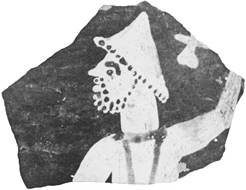
Potsherd from a slip-decorated ceramic vessel depicting the Syrian god Jupiter Dolichenus, with his distinctive conical smith’s hat and double-axe, from Sawtry, Cambridgeshire.
The popularity of Dolichenus is shown by the widespread distribution of his cult: he was venerated as far apart as the legionary fortress at Caerleon in South Wales46 and the auxiliary fort at Birrens in Dumfriesshire.47 But perhaps the most poignant symbol of his cult is a small, personal object far away from the military frontier: a fragment of painted ceramic Castorware from Sawtry, in the vicinity of the potteries, depicting the head and shoulders of Dolichenus, bearded, with his tell-tale conical hat, brandishing his double-axe.48 Because this Eastern god was mainly worshipped among the military and in cities, to find his image on a Romano-British pot in the Cambridgeshire countryside is true testament to his dedicated following. Cleopatra’s gods
‘Lo I Isis am at hand, moved by your prayers, Lucius, I the parent of the nature of things, mistress of all the elements, initial begetter of the ages, supreme of divine powers, queen of the shades of the dead, first of heavenly beings, the uniform countenance of gods and goddesses. I who control at my will the luminous points of the sky, the salubrious breezes of the sea and the lamented silences of the underworld…’ APULEIUS49
Lucius Apuleius was born in about AD 123 into a wealthy family at Madaurus in North Africa. His education took him to Carthage, then to Athens and Rome. His quasi-autobiographical novel, The Golden Ass, is about a fictional character, Lucius, who meddles in black magic and is turned into an ass, meets a range of deities (including the Gallic horse-goddess Epona) and people and has all sorts of adventures until the Egyptian goddess Isis rescues him and returns him to human form.50
The mystery cult of Isis in the Roman Empire was a legacy from Pharaonic Egypt. Despite the opprobrium that Egypt attracted in the late 1st century BC for the behaviour of Cleopatra, first luring Julius Caesar, then Mark Antony, into her bed and her politics, Isis was popular in the west, particularly in Rome itself. The emperor Domitian, who ruled from AD 86 to 91, was an adherent of the goddess: the writer of court gossip Suetonius gives an enthusiastic description of how he escaped from the warfare between Vespasian and Vitellius in AD 69 by taking refuge with the priests of Isis, even donning their garb as a disguise.51 So when he became emperor, he fostered the cult, and became its powerful patron. From Apuleius and from wall-paintings surviving in Pompeii,52 it is possible to get a smattering of information about the rituals and beliefs associated with the cult, although some of it was quite secret. Behind all this was the essential triadic myth of Isis the mother-goddess, her husband Serapis, and their son Harpocrates (originally Osiris and Horus respectively). Serapis was destroyed by Seth, god of evil, avenged by his son and then brought back to life by Isis.53 So she had power over creation, nurture and the ability to resurrect the dead. The rites of Isis were built upon this myth.
Apuleius speaks of his initiation: it involved lustration (purification by washing), fasting, the reception of secret instructions concerning the liturgy for several days before the initiate was brought into the temple, and the ‘meeting of the goddess’ in the inner sanctum of Isis’s temple. Once received by the divine one, the new adherent would be dressed in special garments and his or her transformed self would be presented to devotees, who welcomed and feasted the newly initiated, as someone reborn,54 like the god Serapis himself. Because of the secret rituals associated with the cult of Isis and her divine family, the cult had a sub-religious aspect: that of magic. Charms were worn by people who sought to invoke Isis as a guardian against evil forces. Martin Henig55 cites an amulet made of red haematite from the vicinity of the Roman villa at Welwyn in Hertfordshire that he thinks must have been the property of someone from the east, perhaps a slave-girl. The message on the charm beseeches the goddess to protect her from the dangers of childbirth, a hazardous business in the ancient world. The blood-red colour of the stone surely added to the potency of the magic. The owner of the amulet may well have kept it hidden on her person, beneath her clothing, so that only she knew of it resting against her skin, wrapping her in a symbolic cloak of protection. The theme of quiet secrecy occurs on other Isiac objects too, for images of her son Harpocrates typically show him as a small child with his finger to his lips.56 A silver-washed bronze figurine of the divine child from London depicts him in company with a watchful dog and a silent snake.57
Isis had her adherents in Roman London, where there is evidence for at least two temples built for her worship, as well as the possession by devotees of small portable objects, such as figurines. In the 3rd century AD, a Roman governor called Marcus Martiannius Pulcher set up an altar recording the restoration of a temple to the goddess.58 There may be a back-story here: did the original temple fall into disrepair, or was it targeted by zealots from a rival cult? Martiannius’s Iseum may have been the home of another major find: a pottery flagon, dated by its fabric and form to the 2nd century AD, that bears a graffito scratched on with a sharp pointed instrument, like a stylus: ‘in London, by the temple of Isis’. The vessel comes from Southwark and may originally have been used to hold water in the goddess’s lustration rites. But its undamaged condition may reflect either that it was reused as part of funerary furnishings or, perhaps more likely, that it was placed in a ritual pit59 outside the Iseum. If the latter was the case, the inference is that for some reason it was deemed no longer fit for use, maybe because it had somehow been defiled.
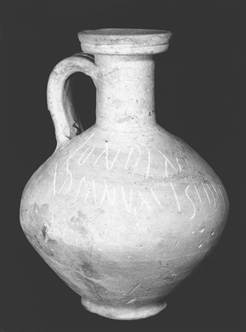
Ceramic flagon with scratched inscription referring to a temple of Isis in London, from Southwark, London. Ht 25.4 cm (10 in.).
In the 2nd century AD, there were no fewer than forty-two temples to Isis’s consort Serapis in his Egyptian homeland. He was particularly popular because he was perceived as a gentle and forgiving god, a less dominating deity than Isis, and his worship continued until the very end of the 4th century AD, despite the growing influence of Christianity.60 Temples were also built for Serapis in Roman Britain. One of the most outstanding marble sculptures from London’s Walbrook Mithraeum was a magnificent head of the god, wearing a modius or corn measure, which has a hole at the top to hold real ears of corn.61 Like other carvings from this temple, it had been deliberately buried sometime during the life of the sanctuary. A Serapeum at York is recorded on an inscription by an officer of Legion VI Victrix, in the late 2nd or early 3rd century AD.62 As a born-again god, rescued from the dead, Serapis must have held particular appeal for soldiers, who hoped that if they perished in battle, they would, like the deity they worshipped, live again in the afterlife.
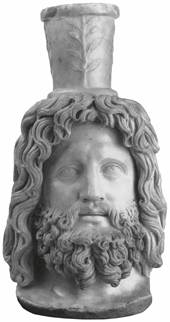
Head of Serapis, Egyptian god of death and rebirth, from the Walbrook Mithraeum, London. Ht c. 43 cm (17 in.). The appeal of the oriental cults
The oriental religions offered something that those of ‘undiluted’ romanitas did not. Their exoticness, their secrecy and their fraternities brought with them a flavour of the mysterious East, demanding passion, emotion, stamina and loyalty (to each other as well as to the divine). These cults involved the initiation of the chosen, based on physical and psychological tests of endurance, on fasting and feasting and on secret formulae of prayer and ritual. Mithraism offered worshippers a discipline, a rule of conduct that, if followed faithfully, promised rewards based on merit. The myths and rituals that underpinned these foreign religions offered the excitement of theatre: dramatic lighting in dark sacred spaces, the offering of their manhood by priests of Cybele, the ordeals of sensory deprivation, the initiation ceremonies and pledges of faith, all of which meant that worshippers felt truly and actively involved in their chosen cult. Isis beckoned with the hope of rebirth. For the most part, the cults that came out of Asia were ‘thinking’ religions that attracted the educated classes and satisfied their intellectual curiosity. But in saying that, we should remember the girl from Welwyn, perhaps an immigrant eastern slave, homesick for her sunny homeland, whose most precious possession might have been the little amulet that she wore so that Isis would protect her from harm.