CHAPTER NINE The Coming of Christ From many gods to one
‘Whether pagan or Christian, whosoever, whether man or woman, whether boy or girl, whether slave or free, has stolen from me, Annianus son of Matutina, six silver coins from my purse, you, lady Goddess, are to exact them from him…but reckon as the blood of him who has invoked this upon me…’ DEFIXIO FROM BATH1
Of more than a hundred lead curse tablets found in the sacred spring at Sulis’s temple in Bath, this is the only one to mention Christians.
The piece has been dated to the later 4th century AD, by which time silver coinage was circulating reasonably regularly in Britannia. Although the text is written in Roman (rather than British) script, the entire text is written backwards. While such a technique is not unique to curse tablets, it is comparatively rare, and leads to speculation as to the need for secrecy surrounding these supplications and, perhaps, to the particular desire to hide the allusion to Christianity.This chapter examines the way in which Christianity was introduced into Britain, at first secretly, and then practised more openly from the time the emperor Constantine himself embraced the new faith and elevated it to the State Religion of the Empire in AD 314. We will not journey much further forward in time from this cataclysmic religious event, because our main interest is the relationship between paganism and Christianity and, in particular, the manner in which certain cult-objects from the early 4th century clearly indicate an attempt to woo pagans to Christian monotheism using material culture that resonated with the old belief-systems. Early Christianity in Britain, as elsewhere in the Empire, was by no means a fully formed and coherent belief-system, and it is likely that many converts, including Constantine himself, did not entirely shed the pagan mantle when adopting the cloak of Christ.
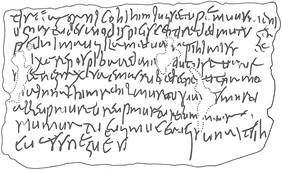
Reproduction of Christian curse tablet from the sacred reservoir at Bath.
Ht 6 cm (2¼ in.).Christianity probably began to trickle into Britain during the late 2nd or early 3rd century AD. At the beginning of the 3rd century, the North African Christian convert Tertullian wrote, in a text attacking the Jews, that even people living in remote places such as Britannia were beginning to learn about Christ.2 Because it was a monotheistic cult, unlike the pagan mystery religions, Christianity faced huge opposition from the Roman imperial establishment, not so much because its followers denied the Roman gods but – far more importantly – because Christians turned their back on the Imperial Cult itself, and so struck at the very roots of fealty to the Empire and its ruler. Any group of people who challenged the worship of the emperor was immediately suspect, potentially seditious and dangerous. There is a telling moment in the epic film Barabbas, where the eponymous ‘hero’ (the man whom the Jews chose to be pardoned in place of Christ), a convicted slave condemned to the deadly sulphur mines of Sicily, is persuaded by his companion-worker to convert to the Christian faith. Barabbas allows his friend to scratch the sign of the cross on his identity disc but, when challenged by the Roman overseer, Barabbas hastily denies he is a Christian and the official dramatically erases the hated symbol with his dagger.
From the time of Christ’s life and death in the early 1st century AD, Roman emperors strove to eradicate the disturbing new religion. Strong waves of imperial persecution affected Britannia, particularly in the mid-to late 3rd century AD. Diocletian, who ruled from 284 to 305, is often ‘credited’ with the martyrdom of Britons, because of comments to this effect by the fiery and irascible 6th-century Welsh monk Gildas in his excoriating book De Excidio Britanniae (The Ruin of Britain).3 But it is perhaps more likely that these people died by the hands of earlier emperors, such as Decius or Valerian in the 250s.4 Among several martyrs who died in Britain during reigns of terror, the names of three are recorded: one from Verulamium (St Albans) and two from Caerleon, the ‘City of the Legions’.
A trio of martyrs‘Saint Alban suffered on the twenty-second day of June near the city of Verulamium…When the peace of Christian times was restored, a beautiful church worthy of his martyrdom was built, where sick folk are healed and frequent miracles take place to this day. In the same persecution suffered Aaron and Julius, citizens of the City of the Legions, and many others of both sexes throughout the land…’ BEDE5
Significantly, perhaps, all three of the men to whom the Venerable Bede refers were murdered in the amphitheatres attached to major cities and legionary fortresses, huge arenas whose public displays attracted enormous gatherings. The slaughter of these three martyrs in the mid-3rd century AD sent a clear message: ‘don’t mess with the Imperial Cult; venerate it or be damned!’
It is Saint Alban of Verulamium (the city later renamed after him) about whom we know most, because of Bede’s full account, some of which was derived from that of Gildas. Alban was a pagan, but offered shelter to a Christian priest fleeing persecution. Observing the fugitive’s manner and devotion, Alban became a convert, turning his back on ‘the darkness of idolatry’.6 When the priest’s pursuers tracked him down, Alban put on the man’s clothes and pretended that he was the refugee they sought. The judge to whom Alban was presented recognized him and tried to force him back to pagan worship, which he refused to do. He was then flogged and tortured in the vain hope that he would renounce his new faith; he would not yield, so he was brought to the arena beyond the town’s walls and the order was given that he should be decapitated. But the soldier chosen as his executioner could not bring himself to wield the axe, and begged to be allowed to die in his place, as a Christian martyr. Alban climbed a hill, asked God for water and a spring immediately flowed at his feet. He was then executed, but his murderer was cursed by God; as Bede put it, ‘he was not permitted to boast of his deed, for as the martyr’s head fell, his eyes dropped out onto the ground’.7
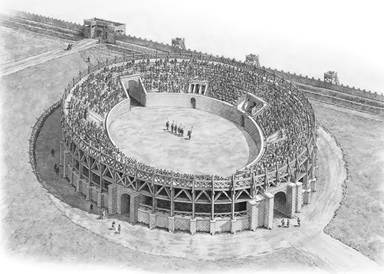
Artist’s reconstruction of the amphitheatre at Caerleon, where early Christian martyrs were executed.
Little is known of Alban’s fellow martyrs Julius and Aaron, said to have died at Caerleon at roughly the same time. But their names are intriguing: while Julius is a common Roman name, well attested in Roman Britain, Aaron is Jewish,8 so he may have originated in Judaea or have adopted a Judeo-Christian name at the time of his conversion. The record of their martyrdom seems to suggest that they were comrades, perhaps fellow-converts who worshipped together and died together. Constantine and his conversion
‘We forbid soothsayers and priests and persons accustomed to serve that rite to approach a private home or under pretext of friendship to cross the threshold of another; and punishment will threaten them if they disregard that statute. You, however, who thinks this profits you, go to the public altars and shrines and celebrate the ceremonies of your custom; for we do not forbid the services of a bygone usage to be conducted in public view.’9
The passage quoted contains the emperor Constantine’s ‘take’ on the continuing practice of pagan rites after Christianity was officially adopted as the Roman State Religion. Constantine was hailed as the new emperor in AD 306, but his succession was by no means straightforward, and it was not until 324, after he had beaten off a number of rivals and engaged in several civil wars, that he finally emerged as undisputed ruler. He enjoyed a ‘special relationship’ with Britain, having visited the province more than once before his elevation, and it was the Roman army stationed at York who first proclaimed Constantine as their Augustus.10 But in AD 312, Constantine underwent a dramatic conversion to Christianity, when he, with his army behind him, confronted Maxentius, a rival contender for the purple, at the Milvian Bridge outside Rome. Different chroniclers of this event have presented varied accounts of Constantine’s experience, but in all versions he saw a vision, in the form of a shining cross and the words ‘in hoc signo vince’ (‘in this Sign, conquer’).11 He commanded his soldiers to put the sign on their shields, and his consequent victory over his rival convinced Constantine that Christ had intervened.12 Two years later, in AD 314, Christianity became the official State Religion of the western Empire.
The emblem Constantine adopted, based on his visionary experience at the Milvian Bridge, was the ‘chi-rho’ monogram, a diagonal cross (the Greek letter ‘chi’: χ) together with a vertical ascender with a closed loop at the top (the Greek letter ‘rho’: ρ): these are the first two letters of Christ’s name in Greek. His army wore this sign as its insignia, and the chi-rho monogram became widely used in shrines, houses, pottery and church plate as a Christian symbol.13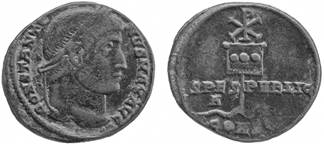
Coin of the emperor Constantine: his head is on the obverse (front), and an image of his army’s standard, showing the chi-rho Christian monogram, is on the reverse.
It is by no means the case that even the emperor himself thereafter eschewed all other cults – far from it; but Christianity became firmly established from this period onwards, despite attempts by later rulers, such as Julian the Apostate in the mid-4th century, to resurrect paganism in its place. The passage quoted at the beginning of this section clearly states Constantine’s ambivalence towards paganism, though interestingly what made him uneasy was the private pursuance of pagan rites and practices, not its public presence, which he condoned. This may be because in the early 4th century many Romano-British Christians appear to have conducted their liturgies in ‘house-churches’, shrines set up within their own homes. But Constantine himself continued to have a foot in both camps until his ‘deathbed baptism’.14 Before the Milvian Bridge episode, Constantine commissioned a great coin series depicting the ‘Sol Invictus’, the Unconquered Sun, a cult closely associated with Mithraism, and these coins continued to be minted and circulated long after AD 312. Gradually, Christ himself came to be worshipped as the great solar creator-god; John Ferguson15 draws attention to the proclamation, made in AD 321, of ‘Sunday as a day of rest…precisely because it was a Sun-day’.
Archaeological traces of Christianity in Roman Britain‘When this storm of persecution came to an end, faithful Christians [in Britain], who during times of danger had taken refuge in woods, deserted places, and caves, came into the open, and rebuilt the ruined churches. Everywhere the Faith advanced victoriously; the shrines of the martyrs were built and endowed, the festivals of the Church were observed, and its rites performed reverently and sincerely.’ BEDE16
The evidence for Christianity in early 4th-century Britannia consists of small private sanctuaries, mainly within Roman villas, and portable objects marked with Christian symbols. What is clear from the material culture is that the new religion was taken up by wealthy and high-ranking Romano-Britons, who may have been more receptive to the monotheistic idea than ‘ordinary’ people. This seems to mirror the demographic of other oriental ‘saviour’ cults, like Mithraism. But the evidence may, of course, be skewed in favour of the rich finds, such as mosaics, wall-paintings and liturgical equipment. Poorer British Christians may have marked their adherence to their faith in less visible ways that have not survived: on wooden objects, domestic pots or other ephemera that have left no record of their presence. Church plate
‘Those who devote their service to this holy worship – those who are customarily named clerics – shall once and for all be kept completely exempt from all compulsory public services. They shall not be dragged away from the worship due the Divinity through any mistake or irreverent error, nor shall they be disturbed in any way from devoting themselves completely to serving their own law.’ EUSEBIUS17
The Palestinian-born Eusebius became Bishop of Caesarea in AD 314, two years after Constantine’s conversion to Christianity. This passage comes from a letter probably written in 313 to Anulinus, proconsul of the Roman province of Africa, and is relevant to the story of early Christianity in Roman Britain because it underlines both the presence and the importance of organized clergy even before the faith achieved official paramount status within the Roman State.
Whether they conducted worship in established churches or in private houses, early Christian clergy mentioned by Eusebius in the quotation would have used special plates, bowls, chalices and utensils for the celebration of the sacrament from at least the early 4th century AD.18 This liturgical equipment might comprise splendid gilded silverware, but sometimes people made use of much humbler, more sentimental objects, like a small pewter bowl from Caerwent. This seems to have begun life as a utilitarian vessel, but during the period of its use, someone took a sharp-pointed tool and scratched a chi-rho monogram on the inside of its base.19 This is interesting enough but what happened at the end of its life was also significant, for it was carefully hidden, sealed in a large jar within a house, presumably because the owners feared persecution or some other threat to them or the precious bowl itself. There were probably other early Romano-British Christians living here; the person in whose garden reposed a little shrine containing a disembodied pagan stone head may well have been a Christian, if the mosaics that decorated his house are anything to go by.20 And we must not forget the two martyrs – Julius and Aaron – who had met their deaths at nearby Caerleon. While there is no evidence for a purpose-built early Christian church at Roman Caerwent, a suite of rooms in one of the houses seems to have been adapted for use as a house-church.21
At the other end of the scale from the modest little pewter bowl modified by a roughly scratched Christian symbol is the magnificent set of silver church plate from Water Newton in Cambridgeshire, close to the Roman town of Durobrivae, almost certainly representing ‘the communal property of an ecclesia or Christian community’,22 so markedly different from the individually owned pewter bowl from Caerwent. Many of the twenty-eight precious-metal objects (twenty-seven of silver and a small plaque made of gold) from Water Newton were marked with the chi-rho symbol, and significantly the form of the monogram belonging to the reign of Constantine.23 The assemblage thus represents the earliest known collection of Christian liturgical plate from the Roman Empire.24 Bowls, chalices and an ornate jug formed the ‘sacramental’ part of the assemblage and one piece, a hanging-bowl,25 bears an inscription that reads ‘O Lord, I Publianus, relying on you, honour your holy sanctuary’.26 The hoard, perhaps deliberately concealed to avoid looting at a time of instability, was found accidentally during ploughing in February 1975. Sadly, less is known about its context than should have been the case, owing to metal-detectorists’ actions at the site.
Notwithstanding the splendour of the silver vessels, the most exciting of the finds are the nearly twenty feather-shaped plaques from the Water Newton hoard, all marked with the Christian chi-rho, of which some also bear the further Christian symbols, the Greek alpha (α) and omega (Ω).27 What makes them so significant is that these distinctive objects represent a kind of ‘halfway-house’ between paganism and Christianity. Their triangular, feathered (or leaf-shaped) form and their manufacture from sheet-metal speak to their origin as objects associated with pagan worship. They are found in votive contexts all over the Roman Empire, sometimes blank but often bearing images of deities and/or inscribed dedications, and they were brought to shrines by devout pilgrims, and laid on the altar in homage to their chosen god or goddess.
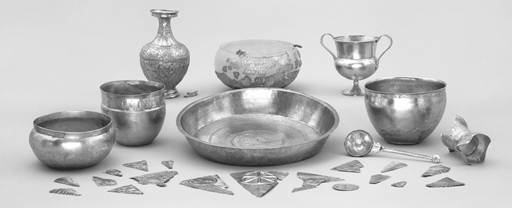
The hoard of early Christian silver church plate, including a chalice, flagon, bowls, a platter (used in sacramental liturgy) and ‘feather’ plaques, found at Water Newton, Cambridgeshire.
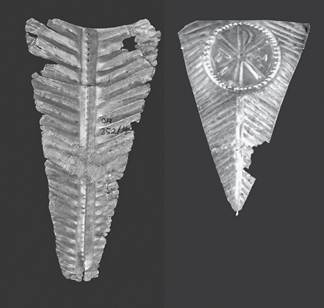
Silver ‘feather’ plaques from Water Newton: a plain one (left) and another marked with the Christian chi-rho symbol.
Many pagan feathered plaques have been found in Roman Britain, including a rectangular silver example with feathering round the edges from London, bearing an image of the triple mother-goddesses.28 The hoard of votive material found in 1789, concealed in a large pot at Stony Stratford, Buckinghamshire, provides a rich religious context for such plaques; alongside several inscribed silver and bronze sheets was a priest’s headdress. Two of the pieces were dedicated to Mars, and the most complete one to Jupiter and Vulcan, to whom the dedicant, one Vassinus, pledged six denarii if they saw him safely home from a journey.29 Like curse tablets (see Chapter 6), these objects were used as a means of invoking the gods, but in a more positive, rogatory way than the vengeful messages written on the lead defixiones. But how interesting it is that such ritual material should have been the agents for displaying and disseminating Christian worship at Water Newton in the early 4th century. The presence of these overtly Christian feather-plaques, boldly marked with the chi-rho and other symbols of the faith, seems to indicate a strong desire to beckon pagans towards Christ using comfortably familiar liturgical pieces in an inclusive rather than a threatening or combative, manner.30 House-churches
In the 4th century AD, people began to worship Christ in their own homes, and this is particularly evident in a few large and prosperous villas in the countryside. Two great mosaic floors, at Frampton and at Hinton St Mary in Dorset, clearly demonstrate the Christian affiliation of the villa-owner. One of the rooms at Hinton St Mary contains a mosaic that actually depicts the head and upper body of Christ himself, as a young, beardless, robed man with fair hair and large dark eyes, standing in front of a large chi-rho monogram (see p. xv, bottom).31 This portrait represents one of the very earliest depictions of Christ, certainly in the west of the Empire, but, as Charles Thomas has pointed out,32 the iconography presents a conundrum in so far as its position, on a floor, suggests that it was meant to be stepped on, surely a rather sacrilegious thing to do. So, perhaps the roundel that surrounded the image was marked off in some way, signifying holy ground so that the villa’s inhabitants and their visitors could walk round it and look down upon it.
The mosaic in the villa at Frampton bears no portrait of Christ, but it is decorated with a large chi-rho monogram, clearly demonstrating that its owner belonged to the Christian faith. This motif is associated with that of a chalice, which surely references the Eucharist. The same mosaic is rich with the symbolism of Neptune, the Roman god of the sea, whose head appears in conjunction with an inscription that reads: ‘The head of Neptune to whose lot fell the kingdom of the sea scoured by the winds is figured here, his deep-blue brow girt by a pair of dolphins’.33 According to the great Roman art-historian Jocelyn Toynbee, the juxtaposition of overtly Christian and pagan imagery does not present an irreconcilable clash of ideologies. She argues that the villa-owner probably used the Neptune symbolism as an allegory of death, rebirth and heaven, sentiments that would sit equally well within a pagan or Christian context.34 So the person who commissioned the pavement showed an erudition in his knowledge of Greek and Roman mythology that in no way detracted from his adherence to the Christian faith. Indeed, such imagery enhanced the mosaic’s message by adding the familiar to the new and strange and thus, perhaps, giving its owner’s guests a gentle introduction to his chosen cult. A person who owned such an establishment would have been educated and sophisticated, and one could imagine how, at dinner parties, the mosaic would have been a talking point, the centre of intellectual, philosophical and theological discussions about the place of humans in the material and spiritual worlds.
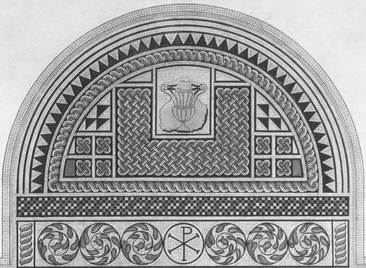
Reconstruction of the mosaic floor from the house-church at Frampton Roman villa, Dorset. The apsidal extension contains a depiction of a sacramental chalice and a large chi-rho monogram.
Christianity in Roman Britain possessed an idiosyncrasy all its own, not least in its inclusion of the images of Christ. Early Christian writers, such as Tertullian, strongly disapproved of such depictions as blasphemous idolatry, so the owner of the Hinton St Mary villa, with the likeness of Christ on its floor, would have been condemned to eternal damnation if Tertullian were to have his way. The person who inhabited a villa at Lullingstone, Kent, in the 4th century might have been equally frowned upon by the early Christian fathers of the Roman Empire. Lullingstone35 had a long life, beginning with a house built close to the arterial road of Watling Street in the later 1st century AD, with easy access to major towns and cities, including London and the other southern ports. The establishment underwent a huge programme of expansion and refurbishment around AD 150, and there is speculation that it may even have been the equivalent of ‘Chequers’ (the official country retreat of British prime ministers), for use by the Roman governor of Britannia. Further phases of building took place in the 3rd and 4th centuries, but finally – whether by accident or arson – the house was burnt to the ground early in the 5th century.
At some point in the life of Lullingstone, its owner built a pagan shrine to water-deities in one room and, in the 3rd century, the focus of devotion was altered, perhaps to become a sanctuary for the worship of the villa-owner’s ancestors and household gods, a theory founded on the discovery of two marble busts of middle-aged men, of the kind often made as portraits of the dead. In the 4th century, the room above this domestic temple was made into a Christian house-church, with elaborate frescoes unique to Britain and virtually so for the entire Empire (see pp. xiv–xv, top).36 It is likely that, for some time, the pagan and Christian shrines co-existed, one above the other, either for the same person, who – reluctant to abandon his old ancestor-gods – sought to embrace both traditions or, perhaps, for members of his family or his staff.37
The wall-paintings recovered from the house-church at Lullingstone are remarkable both in terms of their content and their quality. On one wall of an anteroom was an ornate chi-rho monogram, encircled by a wreath, the intersection of the diagonal chi flanked by an alpha (α) and omega (Ω); other chi-rho decoration was also present. But even more significant is the depiction of a row of robed figures in the attitude of orantes, people in the act of prayer, their hands uplifted in supplication.38 At least one of these worshippers was a woman, and another of the figures especially stands out: a young man with flaming red hair, his lustrous eyes bring to mind the Christ-figure on the Hinton mosaic. Unlike the others, whose hands are extended in prayer, his fingers bend inwards. It has been suggested that this figure represents one of the family ancestors.39 But might it not have been intended to represent Christ himself? Holy water
‘All who are convinced and believe that what is taught and said by us is true, and promise that they are able to live accordingly, are taught to pray and with fasting to ask forgiveness of God for their former sins; and we pray and fast with them. Then they are brought by us to where there is water, and they are reborn in the same manner as we ourselves were reborn. For in the name of God, the Father and Lord of the universe, and of our Saviour Jesus Christ, and of the Holy Ghost, they then are washed in the water…’ JUSTIN MARTYR40
Justin Martyr was born in AD 100 and died for his faith in Rome sixty-three years later. His two Apologiae were written in defence of Christianity; in this section he describes the rite of baptism and the centrality of blessed water to the sacrament. As we have seen, water also played a key role in many pagan rites and practices in Roman Britain and beyond. It was the focus of active worship at healing sanctuaries such as Bath and Coventina’s Well, and equally prominent in the lustration-rituals of the Eastern mystery cults, such as those of Mithras and Cybele. From its beginnings in the earlier 1st century AD, a central focus for Christians was the cleansing of their sins by baptism, which wiped their souls clean of both inherited (‘original’) sins and those that they had acquired in life. So it is not surprising that in late Roman Britain, there is material evidence for the practice of baptism and its association with water. A large lead tank found at Icklingham in Suffolk41 was marked with a chi-rho, flanked by capital alpha and omega symbols, dating to the 4th century AD (and probably the reign of Constantine). In all likelihood this vessel acted as an early baptismal font, and it is worth noting that a later Christian church was built here, on pagan temple-land, one of several such foundations.42
A different kind of font may have existed in the 4th century at the great Roman villa-estate at Chedworth in the Gloucestershire Cotswolds. The house possessed an extensive suite of bathrooms and so required a good water supply. This came from a spring, whose water was conducted to a reservoir contained in an octagonal stone basin. The building was almost certainly a Nymphaeum (a shrine to the spring-spirits) but sometime, probably in the early 4th century, three of the stone slabs around the basin were inscribed with small chi-rho monograms.43 So at a point late in the great villa’s history, its owners appear to have been Christian, and converted the spring’s sanctity from that of a pagan water-spirit to a Christian font. It is a rather nice thought that those same spring-waters originally personified as a Nymph came to be used to cleanse a Christian’s sins. Of course, it is necessary to be careful in the interpretation of these markings. The most sceptical view is that the symbols scratched onto the stones were merely doodles, engraved in an idle moment by someone who had seen them elsewhere without fully grasping their meaning, but it seems certainly plausible that the owners of Chedworth deliberately built a baptismal font around their spring and that the house itself became a place of Christian worship, like Hinton St Mary, Frampton and Lullingstone.
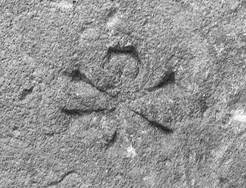
Small chi-rho symbol scratched on one of the slabs around the Nymphaeum basin at Chedworth Roman villa. Pagan shrines and Christian churches
The religious events that took place in Britannia during the later 4th and 5th centuries AD are beyond the remit of this volume, but it is worth considering the way that early Christians ‘accommodated’ paganism, not only in terms of objects and the juxtaposition of pagan and Christian imagery but also in sacred architecture. We have seen how the hoard of early church plate from Water Newton contained objects that were deliberately chosen for their resonance as pagan ritual objects, but boldly marked with Christian symbols. Did something similar happen in sacred architecture? It is certainly the case that early churches were sometimes founded on the site of pagan temples. This appropriation can be regarded in one of two ways: it was either a confrontational act of defiance to replace a polytheistic sanctuary with a Christian structure, or it represented a less oppositional attitude, one of wishing to entice pagans to the new religion by means of the familiar.
The site at West Hill, Uley, in Gloucestershire, presents a complex relationship between paganism and Christianity. There was an Iron Age hillfort here and, as often occurred, a Roman temple was built inside it, perhaps both to reference the past and to utilize a dominant position in the landscape.44 Uley is special because it was a cult site that maintained its sacred nature, in one form or another, for more than six centuries. Indeed, there is even evidence to suggest that many thousands of years earlier a Neolithic community chose this place to erect a monumental ceremonial enclosure. Certainly in the late Iron Age, in the early 1st century BC, local people marked out a special space, with palisades round it, to create a temenos, or sacred boundary, inside which two wooden shrines were built. Ritual activity at this period included the sinking of deep pits to receive votive deposits, along with pottery and weapons that were ‘sacrificed’ to an unknown deity, probably a war-god. In the 2nd century AD, a temple of Romano-Celtic form (see Chapter 4) was constructed in stone. It was a popular sanctuary, judging by the finds, and seems to have been an important focus of pilgrimage. Iconography and epigraphy reveal that the temple was dedicated to Mercury, and offerings included the animals particularly sacred to him: goats or sheep, and cockerels.45 Supplicants not only brought gifts to the god but also, using lead curse tablets similar to those from Bath, implored him to wreak vengeance on those who had wronged them.
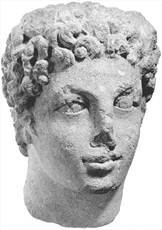
Stone head of Mercury from the cult-statue at the temple at Uley, Gloucestershire, possibly ‘recycled’ as an image of the young Christ when the early church was built here. Ht c. 35 cm (14 in.).
The Romano-British shrine at Uley went through a number of modifications during its life, but early in the 5th century the temple was deliberately deconstructed, the building levelled, its cult-statue broken up and its furnishings and sacred objects removed and sometimes buried. A new sacred building was erected in its place, a basilican timber church, later replaced by one of stone. But the spirituality lingering from the previous pagan shrine appears to have been acknowledged by the Roman colonizers, for some of the ancient iconography and altars were repurposed in these new buildings and, what is more, the life-sized stone head of Mercury, from the great cult-statue that had stood in the centre of his temple, seems to have been carefully reburied, upright. Perhaps the young, curly-haired deity was ‘reborn’ as an image of Christ.46 Earliest Christian burial rites
According to pagan funerary practice, a reasonably well-to-do Romano-Briton would expect the observance of particular obsequies when he or she died. Depending on fashion and century, the deceased might be laid in a tomb with grave-goods, including personal possessions, or be cremated and the burnt remains collected and buried in an urn within a cemetery (see Chapter 10). The grave would be marked with an inscribed tombstone, giving at least the person’s name and age (to the day), and often including tribal affiliation, occupation and rank (if an official or a soldier). Early Christian burials were different: the precise age at death was not mentioned because it was considered unimportant; there were few, if any, grave-goods, because the soul would not need them in the afterlife; and the deceased were usually oriented east–west, because of the belief that Christ would welcome them from the east. The funerary site at Poundbury outside the Roman city of Dorchester, Dorset, contained both pagan and Christian tombs. It is our best-recorded early Christian cemetery, and some of the dead interred here were placed in simple stone or wooden coffins, some packed with gypsum, perhaps in an attempt to preserve the bodies inside. Given the belief that the mortal body would not be necessary in heaven, this is both interesting and puzzling. More telling still is that rank still counted for something, for a few of the dead had little mausolea erected over their graves, some decorated with painted wall-plaster.47 Evidently the new Christian beliefs did not entirely eradicate the old religion; it is not impossible to imagine that some newly converted Christians were cautious about letting go entirely of the beliefs that their ancestors had held for half a millennium or more. Britannia Christiana
‘We are but of yesterday, and we have filled everything of yours – cities, islands, forts, towns, public meeting places, even the camps, tribes, courts, palace, senate, forum. We have left you only the temples…’ TERTULLIAN48
So wrote the Christian writer from Carthage in the late 2nd or early 3rd century AD.
Literary sources record that in AD 314, just after Constantine’s conversion, three British bishops from the dioceses of London, York and Lincoln attended the Ecclesiastical Council at Arles in Provence.49 If the texts are to be believed, the mention of these three prelates means that as soon as Christianity became the Roman State Religion, bishoprics were already in place, and so hierarchical Church structures must have been in existence for some time prior to the date of the Council, at a period between the martyrdoms of Alban, Aaron and Julius in the mid-3rd century (or even before) and the second decade of the 4th.
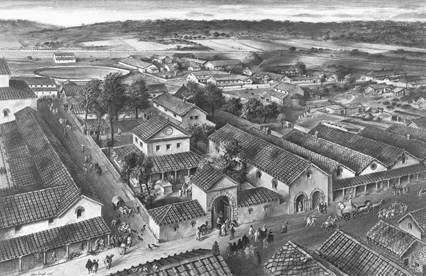
Reconstruction painting by Alan Sorrell of the late Romano-Celtic temple complex, near the forum and basilica (market and town hall) at Caerwent, South Wales.
But it should not be assumed that the adoption of the new monotheistic faith in Britain was a one-way street; far from it. Paganism persisted alongside the worship of Christ and, in the reign of one mid-4th-century emperor, Julian the Apostate, many of the Empire’s provinces witnessed a resurgence of paganism. Britannia was no exception; there was a wave of pagan temple refurbishment, particularly in the southwest, and some new sanctuaries sprang up, too. A Romano-Celtic temple was constructed at the Roman town of Caerwent, tribal capital of the Silures, in about AD 330. It is not known to whom the shrine was dedicated, but it might have been a local god, Mars Ocelus Lenus Vellaunus, whose name is recorded on inscriptions from the town, or – perhaps – the mother-goddess whose statuette was found buried deep in a pit near the temple.50 And across the river Severn, sanctuaries such as the great Classically styled temple to the British healer-hunter-god Nodens (see Chapter 4) flourished at this time, long after Constantine’s edict concerning the status of Christianity in the Empire. Paganism died hard, and was periodically resurrected in Britain for many centuries to come.