CHAPTER TEN Journey into Avernus Death, burial and perceptions of afterlife
‘A deep, deep cave there was, its mouth enormously gaping,
Shingly, protected by the dark lake and the forest gloom:
Above it, no winged creatures could ever wing their way
With impunity, so lethal was the miasma which
Went fuming up from its black throat to the vault of heaven:
Wherefore the Greeks called it Avernus, the Birdless Place.’ VIRGIL1
The 6th Book of Virgil’s epic poem, written to glorify the emperor Augustus, is wholly concerned with the journey made by the eponymous hero Aeneas to find his dead father Anchises in the underworld.
Not only does Virgil paint a vivid picture of Classical attitudes to death and the afterlife, he also describes funerary ceremonies in great detail: the building of the pyre to consume the body after its cleansing and anointing, the prayers said for the dead and the need for the mourners to undertake the correct ritual in order to enable the dead to progress to the happy Otherworld of Elysium. Although a work of poetry, and therefore loaded with dramatic and imaginative writing, this text demonstrates the importance of mortuary rituals and the belief among Romans and Greeks that death did not mean oblivion. February 2017 saw the publication of George Saunders’s novel Lincoln in the Bardo.2 Its theme is an exploration of limbo, the term for the liminal space occupied by the newly dead who wait in purgatory for the expiation of their sins before admittance to heaven. The book tells the story of Abraham Lincoln’s visit to see the body of his dead son Willie, who succumbed to typhoid in 1862 when he was eleven years old. Willie’s corpse lay in the crypt of the Georgetown Cemetery in Washington DC and, while Lincoln kept vigil with the body, a myriad of spirits thronged limbo, perhaps waiting to welcome the newly dead. The interesting thing about these dead souls is their perception of what has happened to them. They do not fully accept their deceased status; to them, the living world is an exclusive club from which they have been expelled and to which they aspire to return. There are aspects of Saunders’s treatment of death and the afterlife that resonate with Virgil and with the documentary and archaeological testimony concerning ancient perceptions of death, including ideas about reincarnation. Roman attitudes to the dead appear to have been somewhat ambivalent. Alongside the elaborate rituals attending some funerals and the expensive tombstones erected by families or colleagues in commemoration of the deceased, corpses were sometimes treated not with respect but with dismissive contempt. While the honourable dead received a commensurately careful burial, the fate of the poor was less certain. Despite the long-standing rule that the dead could only be interred outside the city walls,3 body-dumping was a persistent problem in the city of Rome, and legislation had to be brought in to prevent the ‘fly-tipping’ of corpses. In his Life of Nero, the author Suetonius recounts how, when the disgraced emperor was fleeing from Rome, his horse stopped dead, terrified by the sight of a dead body that had been left in the street to rot.4The ambiguity with which the Romans regarded the human dead is reflected not just in the treatment of bodies but also of the people whose job it was to manage them, the undertakers. Both corpses and those who handled the dead and dealt with the physical aspect of their disposal were imbued with the miasma of pollution that hung about them like a toxic cloud. The death-industry involved the morticians, the cremation-teams, the grave-diggers and – for certain high-ranking dead – the embalmers. These people were regarded as deeply polluted, and undertakers were required to be tattooed in a way that marked out their profession and allowed people to avoid having physical contact with them.5 Virgil makes it clear that the unclean properties of the dead themselves could have a disastrous effect upon the living.
When advising Aeneas as to what he must do in order to see his father, the Sibyl (the Oracle of Cumae) reminded him that no progress could be made until his dead friend Misenus had been cremated, because an unburied corpse polluted the hero and all his companions.6 I wonder, then, whether even those whose task it was to produce tombstones and the scriptores who inscribed them might also have been subject to prohibitions simply because of their association with the dead.Contemporary texts tell us about attitudes to the dead in Rome and Italy, but virtually no documentation reveals to what extent such views were adopted in far-flung provinces such as Britannia and Gaul. But, for the latter at least, we do possess some informative documents about how the afterlife was perceived. Most importantly, several authors refer to the belief in rebirth. For some writers, rebirth appears to have meant bodily resurrection itself, involving actual reincarnation (or the renewal of the physical person); for others, it was the spirit (or the soul) that was reborn. Recycling the dead: reincarnation and rebirth
‘The Druids hold that the soul of a dead man does not descend to the silent, sunless world of Hades, but becomes reincarnate elsewhere; if they are right, death is merely a point of change in perpetual existence. These Northerners are most fortunate to believe in a doctrine which frees them from that besetting terror of mankind: fear of extinction.’ LUCAN7
‘The belief of Pythagoras is strong in the Gauls, that the souls of men are immortal, and that after a definite number of years they live a second life when the soul passes into another body. This is the reason why some people at the burial of the dead cast upon the pyre letters written to their dead relatives, thinking that the dead will be able to read them.’ DIODORUS SICULUS8
Both Lucan and Diodorus were commenting on customs they had heard about as practised in Gaul, not Britannia.
However, as the Druids (active in both regions) were heavily involved in religious doctrinal matters, it is likely that Britons and Gauls shared many of their attitudes to the dead. The Greek geographer Strabo reinforced the observations of both Lucan and Diodorus in his remarks that Druidic doctrine included the belief that the souls of people never perished.9 For the Romans, the afterlife was a mixture of heaven and hell and where the dead ended up – according to Virgil at any rate – depended at least in part upon how they had conducted themselves in life, how they died and whether they had been given proper burial rites. The situation with regard to Britain and Gaul pre-conquest is, of course, less clear because of the pre-literate nature of society in these lands. And once they became part of the Roman Empire, the scanty textual references to such matters are bound to be tinged with notions that belonged to mainstream Roman views of death. Burying the deadOne archaeological clue to how pre-Roman Iron Age Britons regarded death and the afterlife lies in the ways in which the dead were treated. In the hundred or so years leading up to the Claudian invasion, people practised several methods of body-disposal. Both cremation and inhumation were employed, but the scarcity of formal interments in urns or coffins suggests that other, less visible means of dealing with the dead were also used, including the scattering of cremated bone and ash in rivers or on land and excarnation, the exposure of bodies in the open air for wild animals and birds to feed on, followed by the disposal (or dispersal) of the bones. It is possible that some of the enigmatic four-post structures excavated at the Iron Age fortified settlement of Danebury are the remains of excarnation platforms. It could even be that the complete skeletons and body-parts interred in the disused grain silos here represent the final act of disposal for selected individuals.10 The archaeological ‘evidence’ for the practice of excarnation in Iron Age Britain is circumstantial, but two Classical writers make specific reference to this funerary ritual in Celtiberia: Aelian and Silius Italicus, both of whom describe the selective rite of body-exposure.
According to their testimony, only the valiant dead – those who had perished in battle – were granted this honour; the religious thinking behind the excarnated corpses involved the belief that their consumption by vultures allowed the souls of the honourable dead to ascend straight to heaven. For Celtiberians, vultures were sacred to the celestial gods, so they were considered a fail-safe way of fast-tracking the chosen ones to the happy afterworld.11 It is difficult to interpret beliefs surrounding death and the survival (or otherwise) of corporeal and spiritual existence from archaeological evidence alone. But the placing of grave-goods with the bodies of certain individuals, as if to accompany them to the next world, hints at the prevailing understanding of death and the afterlife. This funerary ritual was practised in Britannia both before and after the Roman conquest of AD 43. In the British Iron Age, the corpses of some people were treated with elaborate ceremony and their tombs might be richly furnished with precious objects: jewelry, weapons, food and liquor. A special grave of a woman aged about thirty-five, who died in the late 4th or early 3rd century BC, was found at Wetwang in East Yorkshire (see p. xvi). It provides a wealth of information about her life through the funerary rituals accorded her. She was given a chariot-burial, an honour more often accorded to British Iron Age men, the mode of interment so named because of the placement of an entire or disassembled two-wheeled vehicle in the tomb.12 The mourners and religious practitioners who attended her funeral had laid her body on the floor of the tomb, carefully placed joints of pork and her mirror on it, and then covered her with part of the chariot. She was a distinguished person, both physically and in terms of rank, and the two may have been linked. Forensic examination of the woman’s skull revealed that she had a large, bright-red growth by the side of her nose that would have pushed her features out of shape. Far from being a source of shame and ridicule, it appears that her community revered her disfigurement, for many of her grave-goods were liberally decorated with red coral, as if to celebrate her difference. And the chariot, mirror and meat all suggest that she was a person of no mean consequence.13 The Wetwang ‘coral’ woman’s high rank – and perhaps her physical distinctiveness – was reflected in her funeral rites and tomb-furniture.Very different but equally special was the burial of an infant who probably died in the 2nd century AD and was interred in a lead coffin at Arrington in Cambridgeshire.14 Although babies seem often not to have been accorded formal burial rites in Roman Britain, there were exceptions, of which the Arrington child is one. He was about nine months old when he died; his vastly enlarged cranium indicates that he suffered from hydrocephalus. His coffin was evidently not custom-built for him, being adult-sized, but he was interred with care, wrapped in expensively dyed red and blue cloth. Around his head were traces of aromatic resin, perhaps a gesture to ensure the healing of his condition when he reached the afterlife, and white pipe-clay figurines were placed in a box near his body to join him on his journey to the next world. These statuettes comprised images of people and animals: rams and a bullock. Two human images took the form of a baby and an older child, and they may represent the hoped-for life-journey of the dead child.
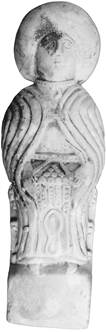
Pipe-clay figurine of a Rhenish mother-goddess, made in the earlier 2nd century AD, found in a baby’s lead-lined oak coffin at Arrington, Cambridgeshire. She wears a lunate amulet at her throat, perhaps a symbol of her role as a bearer of light in the darkness of death. Ht c. 15 cm (6 in.).
The most striking object in the Arrington child’s grave was a small clay figure of what appears to be a mother-goddess, seated in a high-backed chair and wearing a cloak clasped with a brooch. On her lap is a basket or plate of fruit, and she wears a massive circular ‘beehive’ headdress. This last identifies her not as a British Mater but as one of the Germanic Matronae Aufaniae whose worship was centred in the Rhineland. It is very likely, therefore, that the infant’s parents came from this region, as foreign migrants or visitors, bringing their own gods with them. We can imagine that they would have chosen a nurturing goddess from their homeland as a fitting guide or divine ‘chaperone’ for their dead son’s spirit on its perilous journey to the unknown. Indeed, it may well be that the child was singled out for special burial precisely because of a perceived need to compensate him for his dramatically short time on earth and a hope that his sojourn in the Otherworld would be blessed by the companions he took with him; the images of domestic animals might have been present as surrogate sacrificial beasts, to ease his passage and provide payment for his conferral to Elysium. Of course, it is possible these little figures were simply his toys, but it is tempting to think that the grieving mother saw the goddess as a surrogate for her own loving care for her child. The Arrington child is by no means the only infant to have been provided with a spiritual guide on his travels to the underworld; in 2011, excavations in a Roman cemetery at Bridges Garage in Corinium revealed the remains of a child buried with an enamel-decorated copper-alloy figurine of a cockerel.15 This bird was sacred to Mercury, one of whose roles was that of a ‘psychopomp’, a leader of souls to the afterlife.
The dead and the living
The many Roman-period cemeteries that have been discovered across Britain provide clues not just about the dead and the mortuary rituals associated with their passing, but also about the living.16 Two examples are particularly noteworthy: Dunstable in Bedfordshire, and Lankhills, Winchester in Hampshire. The Dunstable cemetery exhibits idiosyncrasies associated both with groups of burials and with individuals.17 In the 4th century AD, one sector of the burial ground seems to have been set aside for a specific and favoured community, as the mean age at death of these individuals far exceeds the average in the other areas. It has been suggested that the longevity of this particular group might have been due to their special status in life – they may have had access to better, and more abundant, food, and have enjoyed a less rigorous lifestyle than the general population. Could these people have belonged to a protected sub-set of society, maybe even a religious community, perhaps thereby avoiding the hazards of warfare or hard manual labour and, for women, the dangers of childbirth? The second unusual feature of the Dunstable cemetery is the treatment of certain individuals: several corpses were decapitated, a practice not uncommon in late Roman inhumation, while others had dismembered limbs, and at least one woman’s face was deliberately obliterated before her head was removed and placed next to her body.18
The late Roman cemetery at Lankhills, Winchester, displays similar (mis)treatment of the dead to the patterns of mortuary behaviour at Dunstable. In the 4th century, certain elderly women’s bodies were beheaded, and their severed heads carefully placed by their knees. Equally bizarrely, one of the decapitated corpses buried here was accompanied by two dogs, itself quite unusual, but even more so because one of them had been subjected to extreme post-mortem (it is to be hoped) violence: its limbs were severed and both ends of its backbone bent together and tied in that position.19 These peculiar burial practices at Dunstable and Lankhills were not unique, but did not represent ‘normative’ rites. The treatment of elderly females at Lankhills bears marked resemblances to some odd interments at Kimmeridge in Dorset where, in the 3rd century AD, a group of mature women were interred with their heads taken off and placed by their feet, with a spindle whorl by each body.20 Such objects might have signified their work as weavers, but a more sinister interpretation may be equally feasible. Like the Roman Fates, who spun the thread of people’s lives and cut it off at will, might these women have been thought to have power over the destinies of those within their communities?
The disfigurement and mutilation carried out on certain bodies at Dunstable and Lankhills is likely to have had something to do with who these people were in life. Were the beheaded women ‘scolds’, or witches, whose powers of incantation had to be firmly and ritually curtailed? What about the woman whose face was removed? And why chop the limbs off cadavers? Was it necessary for the defaced person to have her very identity stripped away, because of some shameful episode in her past? Was the dismemberment meted out to the bodies of particularly disruptive individuals done in order to stop them walking back to their community? And was the mutilated dog treated in this manner because of its own persona, or that of its human companion? We can but speculate on these possibilities, because the context has been lost. But it is legitimate to speculate in a general way; clearly unusual death-rites had some motivation, a purpose designed to reach beyond the end of human life into the world beyond, and the probability is that communities felt the need – sometimes – to take steps to protect themselves from the unquiet dead.
Interrupting death: freeze-framed bodies
In about 441 BC, the ancient Greek dramatist Sophocles published his play Antigone, an overtly political drama whose central theme is tyranny. Antigone, daughter of Oedipus and Jocasta, falls foul of her uncle Creon, dictator of Athens, by flouting his will concerning the denial by him of proper burial rites to his enemy, and her brother, Polynices. While Creon is adamant that the body should lie unshriven and unburied, Antigone is equally determined that her brother should be accorded the funeral rites that would allow his spirit access to the afterworld. So she secretly visits the body and sprinkles earth upon it, thereby releasing Polynices’s shade to cross over between worlds.21
The funerary rituals considered in this chapter are not only expressions of grief, but also acknowledgment of some kind of existence after death. But there were special and unusual circumstances in Britannia and elsewhere in northwest Europe where there appears to have been a deliberate intention to deny the natural processes of dissolution and soul-release. The phenomenon of the bog-bodies has been touched upon already, in Chapter 1, where Lindow Man was considered in the context of human sacrifice. The two people whose preserved bodies were found in the Cheshire marshlands in the 1980s also represent the Iron Age practice whereby certain individuals were selected for violent killing and disposal specifically in an environment that prevented bodily decay. The active preservative agent in raised bogs is sphagnum moss. Bogs containing this marsh plant act like fridges, eternally keeping organic material (including human corpses) fresh and whole until, when disinterred, the natural process of dissolution is triggered. It is debatable whether those responsible for the despatch of these bodies were deliberately trying to keep them intact but I think this is entirely feasible, at least in part because there is evidence that Iron Age people purposely placed foodstuffs, such as butter and meat, in bogs in order to keep them fresh, so were well aware of their preservative properties. The Lindow bodies belong to a large group of Iron Age and Roman-period bog-people, whose remains have been found for the most part in Ireland, Denmark, North Germany and the Drenthe region of the northern Netherlands.22 It seems possible, even likely, that the persons chosen for this kind of death and watery interment were considered special within their communities and that, for whatever reason, it was deemed essential that they met particular deaths and that their bodies were prevented from disintegrating in decay. The victims not only met untimely and highly ritualized – sometimes extremely violent – deaths, but they were also denied ‘proper’ burial and, by inference, entry to the next world or to the realm of the ancestors. We can only ponder why both the deaths and the special disposal happened. Surely the mode of death and the post-mortem treatment were linked. Were both to do with ultimate humiliation, a shame that reached beyond the grave? Or were the spirits of these ritually murdered people considered too dangerous to be allowed to haunt the living?23 One further possibility is that the bogs themselves were considered liminal spaces, not quite land nor water, and so were perceived as gateways between the world of mortals and the underworld spirits. If so, then might the bog-people have been ‘gatekeepers’,24 whose role after death was to help patrol these dangerous boundaries and keep the dark powers from interfering with the living? Dark forces: the gods of the underworld
‘In this, this enchantment of women, the enchantment of the seeress of this binding curse. O Adsagsona, look twice upon Severa Tertionicna, their diviner, their restrainer, so that she shall commit the enchantment when they are bound by malediction.’25
This somewhat abstruse passage comes from a long inscription on a lead sheet, written in Gaulish, as a defixio (curse) or duscelinata (evil death-song), the recipients being pairs of women, foster-mothers and foster-daughters. Everything about the ‘song’ concerns women: Adsagsona appears to be a goddess of death and vengeance; the diviner is a seeress. The curse tablet was found in 1983 during archaeological excavation of a Gallo-Roman cemetery at Larzac in southern France. The lead sheet had been deliberately snapped in two and placed as a lid over the mouth of a funerary urn whose surface was inscribed with the name Gemma, the woman whose burnt remains were contained within the urn.26 The whole thing hints at a dark story, and it was no accident that the broken tablet was positioned so as to engage directly with the dead. It is as if it was thought that the curse would find a quick way to the underworld if it ‘hitched a ride’ on Gemma’s grave.
Larzac is a fair way from Britannia, which has produced nothing as dramatically evocative as the Severa Tertionicna’s duscelinata. But a similarly dark message to the underworld spirits may be discerned in human remains found in an Iron Age settlement at Great Houghton in Northamptonshire. In the 4th century BC, a woman’s body was interred in a pit here.27 Her arms and legs had been bound, probably before she died, but the most striking thing about her was that she wore a lead torc that had been carefully placed around her neck back to front. The metal used for this necklet is highly unusual: torcs are usually of gold, silver or bronze, occasionally of iron. Its positioning, too, with the terminals at the back of the neck, is contrary to the way that torcs were donned and worn in life, with the opening under the chin. The burial in a pit (like rubbish), the restraints, the use of lead for the torc and its back-to-front position all point to a complex raft of symbols apparently designed to convey an intense message of shameful death and the desire to consign this woman to outer darkness.
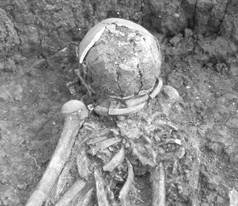
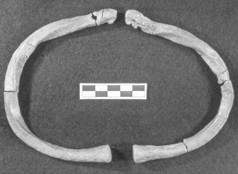
The Iron Age woman from Great Houghton, Northamptonshire, her lead torc in position round her neck; and the broken lead torc.
So do we know anything about the deities who might have been the intended recipients of duscelinatae or tenebrous burials? The evidence from both Larzac and Great Houghton seems to acknowledge not the happy Otherworld of Elysium but hell. However, there is literary evidence to suggest that Gauls and Britons did not always perceive darkness as cognate with evil and death. In speaking of Gallic beliefs, Julius Caesar commented on the Druidic doctrine that the Gauls were descended from Dis Pater (the Roman god of the dead); he goes on to remark that this lineage caused them to calculate elapses of time by nights rather than days.28 And there is an enigmatic inscribed bronze calendar from Coligny, near Bourg in Central Gaul, which lists the months and seasons using the Gaulish language, though the calendar dates to the early Roman period.29 Its purpose was to mark the correct timing for religious events, and it is clear that the reckoning was done by nights. Indeed, each month was divided into fortnights according to the waxing and waning of the moon, by the Gaulish word ‘atenoux’ (‘returning night’).
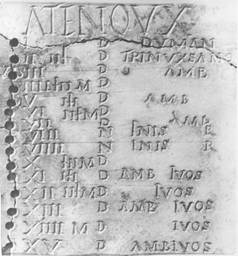
Part of the Gallo-Roman ritual calendar, written in Gaulish, from Coligny, near Bourg, France, showing the word ‘Atenoux’ (‘returning night’) to mark the start of the moon’s waning fortnight.
One find, from a Romano-British context at Upper Deal in Kent, might depict an underworld divinity. It is a simple human image made of chalk, with schematic facial features and a rectangular block for a torso; no limbs are depicted. By itself, the figurine tells us little, but its context is intriguing, for it was found in a small chamber at the bottom of a shaft dug 2.5 m (8 ft) into the chalk, within a native Romano-British settlement.30 The image had clearly been dislodged from a niche carved into the wall of the chamber. But what was it doing deep in a dark pit where nobody would see it? Did it represent a god of the underworld, or was the white chalk figure instead meant as a gleaming light shining in the darkness, designed to combat the forces of darkness rather than to honour them?
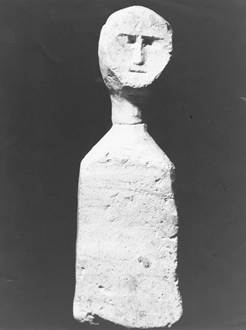
Chalk figurine from a Romano-British underground ‘shrine’ at Upper Deal, Kent. Ht c. 18 cm (7 in.). Remembering the dead: tombstones along the way
‘To the spirits of the departed; Mercatilla, freedwoman and foster-daughter of Magnius, lived 1 year, 6 months, 12 days’31
This inscription is typical of the epitaphs on tombstones from Roman Bath, which provided important details about the dead and those who mourned them. There is tenderness in the precise record of Mercatilla’s age, even to the very day of her passing, poignant testimony to the sadness of a life cut off almost before it had begun, The inclusion of the age at death is common on Roman tombstones because details about the deceased were deemed important for the dead soul’s sojourn in the afterworld.32 What happened to Mercatilla in her short life? Despite her extreme youth, her status as a ‘freedwoman’ (an ex-slave) is described, as well as her relationship with her foster-father. Her mother is not mentioned. It is likely that she was (or had been) the freedwoman and, probably, the wife of Magnius, who adopted her daughter when they married. Mercatilla would have had the same status as her mother. Fosterage was common in the Roman world; even adults could be fostered or adopted.33 The pairs of foster-mothers and foster-daughters who were the targets of the Larzac curse, too, serve as a reminder that fosterage was probably a regular part of Gallo-British society. Marriage between free citizens and their ex-slaves was by no means rare in the Roman world. Calpurnius Receptus, a priest of Sulis, married his freedwoman, Calpurnia Trifosa. Another such marriage was that of a Syrian called Barathes, who came from Palmyra. He set up a tombstone to his British freedwoman-wife, Regina, a Catuvellaunian woman from southeast England.34
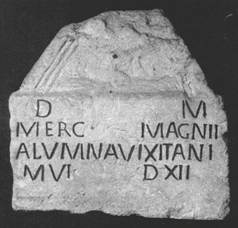
Tombstone of an eighteen-month-old girl Mercatilla, from Bath. Ht 61 cm (24 in.).
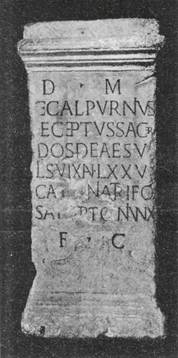
Tombstone of Calpurnius Receptus, priest of Sulis, from Bath. Ht 134.5 cm (53 in.).
Other tombstones from Bath are interesting, too, for the personal details they reveal. Gaius Calpurnius Receptus lived, worked and died close to the great sanctuary of Sulis, where he was a cult-official. His trianomina suggest that he was a Roman citizen, probably a Briton, and he clearly enjoyed high status as the priest of one of the most prestigious cult-centres in Britain. The tombstone of Aventina, a tribeswoman of the Mediomatrici, aged fifty-eight, indicates that she hailed from eastern Gaul, and she may well have died while on pilgrimage to Bath, appealing to Sulis to cure her of disease. If this were so, her plea was not heeded and she may well have died without her family around her. Her principal mourner, Sestius, was named as her heir, though not her son. These epitaphs are brief, but hint at life stories, grief, loss and the need to remember, as well as the committal of the dead to the ‘spirits of the departed’.
Disposal of the dead, in Britain as elsewhere in the Empire, was either by inhumation – the interment of the entire corpse – or by cremation. Graves were often placed within designated cemeteries, outside towns or other settlements, but tombstones were frequently not with the grave itself but ranged along the roadsides. Such positioning seems to have represented a perceived need for the dead person to be remembered by people as they went about their everyday lives. However, there was also the factor of show: the better and more expensive your loved one’s memorial stone, the better you, as the bereaved, displayed your wealth and status within your community. Fashions changed over time, both in burial practices and in the design of tombstones. In general, cremation was the more favoured means of body-disposal in the earlier centuries of Roman provincial rule, with an increasing trend towards inhumation later on, though that was by no means a hard-and-fast rule. But the selection of burial practice may well have been influenced by religious beliefs: cremated bone and ash rise up towards the sky, while an inhumed body decomposes and its remains sink into the earth. So the choice of cremation or burial may have been governed by differing beliefs concerning death, life after death and the gods responsible for the dead.
The need to provide corpses with nourishment after death seems to have been a serious concern to those left behind. Sometimes the bereaved actually fed the deceased: after one death at the legionary fortress of Caerleon, mourners placed the cremated remains of their dead in a lead canister, which they connected to a leaden pipe up to ground-level. In a similar burial, found in the 18th century, the pipe gave onto an elaborately sculpted stone funerary table, presumably piled with food and drink to be shared between the living and the dead. Martin Henig graphically describes how wine would have been poured down the pipe for consumption by the dead person.35 The theme of feasting is also represented in a popular form of tombstone, which depicts a funerary banquet: a good example is an elaborate pedimented stone from Chester, which depicts the dead person reclining as if at dinner; and several tomb-reliefs from York portray families sharing a meal.36 Other grave-sculptures consist of portraits of the dead, as they wished to be remembered when alive, like the tombstone of Facilis at Colchester, who stands staring out at the viewer, dressed in full legionary uniform,37 and those of the Corinium calvarymen Dannicus and Genialis (see p. 41).38 More sombre are the tomb-images that depict death as a ravening wild beast like the lions from Cowbridge,39 in the Vale of Glamorgan, and the better-known one from Corbridge, near Hadrian’s Wall and the sphinx from Colchester.40 These dark images served to remind the living of the grimness of death, a very different message from the cheerful feasting scenes chosen by other mourners.
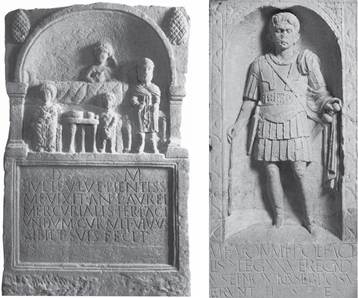
Tombstone of Julia Velva, a fifty-year-old woman from York (left, ht 160 cm/63 in.), who is depicted reclining on a couch, cup in hand, at the centre of a banqueting scene, surrounded by her family; and the tombstone of Marcus Favonius Facilis (right, ht 183 cm/72 in.), a centurion of the 20th Legion at the time of the Boudican rebellion. His cremated remains were found in a lead container nearby.
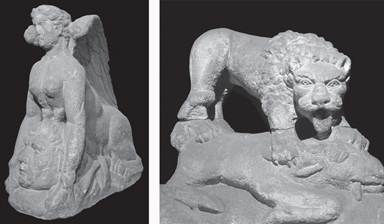
The Colchester sphinx (left, ht 84 cm/33 in.) and the Corbridge lion (right, ht 86 cm/34 in.), both monumental funerary images depicting the ravages of death. Living, dying and afterwards
Elizabeth Jennings’s ‘A poem for Lazarus Saturday’41 takes as its theme the New Testament episode in which Jesus raised his friend Lazarus from the dead,42 and explores, with great insight, the problem of earthly resurrection: the recomposition of the stinking, decaying body of Lazarus; the way that, even brought back to life, the smell of death still clung to him, his refusal to speak to his sisters and onlookers when brought out of the tomb at Christ’s summons, and his clear reluctance to be torn from heaven and forced to re-enter the material world. But the poem begins with something wonderful: the dazzling whiteness of Lazarus’s shroud, as if lit from within, testament to the fact that his soul had been touched by God. The process of bringing Lazarus back to life was a painful one, not just for the dead man but for everyone, because it reversed time, interrupting the ‘norm’. There is always something disturbing about death but the resurrection of Lazarus brought an earthquake-like shock to those who witnessed it.
Exploration of Romano-British burial practices provides some clues as to how communities regarded death and what came afterwards. The rituals involved clearly indicate a threefold dimension to personhood: one’s past, the present moment and the future. It is this last, the future, wherein lies the key to why people treated the dead as they did. For Romano-Britons, as for so many people, past and present, who possess religious beliefs, the future of an individual does not end when they die but reaches out into a perceived afterworld, however that may be imagined. Burial practices in Roman Britannia, and in its immediate Iron Age prequel, embrace endearing traits, as in the placing of sentimental, comforting things in a baby’s grave, or the tender message on a tombstone. But they also show elements of violence that remain foreign to our scrutiny. All these ritual practices appear to convey something in common: an expectation that the dead were capable of having a post-death existence, whether in body or body and spirit, and a consonant need for the living to undertake what was necessary for that afterlife to be manifest or – in rare instances – curtailed. The Lazarus story, and Elizabeth Jennings’s poetic presentation of the event, provides an evocative exploration of the threefold nature of being, and particularly the complicated and disturbing nature of the transitions between life, death and its aftermath.