CHAPTER ELEVEN Worshipping Together Acceptance, integration and antagonism
‘All the faiths clung on to the old religion during the Communist years, and they sprang straight back to life afterwards’1
‘This holy spot, wrecked by insolent hands and cleansed afresh, Gaius Severius Emeritus, centurion in charge of the region, has restored to the Virtue and Deity of the Emperor’2
Val McDermid’s The Skeleton Road, a tense psychological crime novel focused on Croatia and other former Soviet-bloc satellite countries, makes the very valid point that religion is a conservative business; while old indigenous beliefs may have perforce to take a back seat during colonial oppression, they are often not dead but hibernating, biding their time on the sidelines until the tyrannous regime is ended.
Is such a model relevant to a Roman province like Britannia, given the Roman Empire’s apparently lenient attitude to provincial religions? To what extent did such indigenous systems adapt and assert themselves under Roman rule?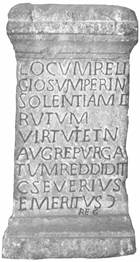
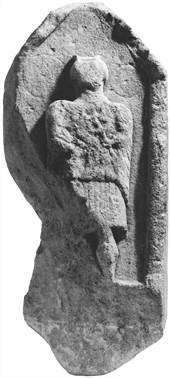
Altar set up by the centurion Gaius Severius Emeritus to mark the restoration of a desecrated holy place, Bath. Ht 89 cm (35 in.).
The second quotation comes from an altar found in 1753 at Roman Bath. Its date is uncertain, but it may have been carved during the 3rd century AD. The stark message of the inscription both gives and withholds a good deal of information. The ‘insolent hands’ are likely to have been those of an impious individual (or group) whose hostility to a particular faith or deity caused them to destroy a shrine, a sacred image or an altar. This particular stone was found very close to two others, one of which was dedicated to the Treveran divine couple Loucetius Mars and Nemetona,3 and the other, a statue-base, to the Suleviae,4 a trio of goddesses whose name links them closely to Sulis, goddess of the town’s hot springs.
Could that lost statue have been the victim of counter-religious bigotry, smashed by adherents of a rival cult? There is further suggestion of intolerance at Bath, in the evidence for an assault on the gilded bronze cult-statue of Sulis Minerva herself. At some point in antiquity, her life-sized, Classically styled head was hacked from its body and the face sustained knife-cuts, as if an attempt was made to desecrate and disfigure it.5 The myth of tolerance: tension, opposition and entrenchment‘Moreover, the temple erected to the divine Claudius was a blatant stronghold of alien rule, and its observances were a pretext to make the natives appointed as its priests drain the whole country dry….When all else had been ravaged or burnt, the [Roman] garrison concentrated itself in the temple. After two days’ siege, it fell by storm.’ TACITUS6
In this passage, Tacitus describes the build-up to the rebellion of Boudica in AD 60, a cataclysmic event for Rome that almost cost it the province of Britannia. Soon after the initial Claudian invasion of AD 43, the Trinovantes’ tribal capital of Camulodunum was turned into the veteran legionary garrison town of Colchester (see p. 43–44). Retired soldiers were given parcels of land seized from the local inhabitants and right in the middle of the new city a gleaming new Roman stone temple was built, a stark reminder and affront to the people of Camulodunum that a foreign power was in charge. To add insult to injury, the temple and its upkeep was to be paid for by the Trinovantes themselves, out of the pockets of its Roman-appointed priests, the seviri Augustales.7 What happened at Camulodunum was an unhappy mix of politics, religion, ideology and muscle-flexing on the part of the conquering colonists. No wonder that the Trinovantian uprising was centred on the blight on its landscape that was the temple to the cult of Claudius the invader.
In a recent lecture at the University of Edinburgh, Jane Webster addressed the issue of religion along Hadrian’s Wall.
She referred to the Wall’s situation ‘at the crossroads of multiple diasporas’, a colonial landscape in which the whole of the Roman Empire was represented in microcosm.8 Like so many parts of the world today, the Wall was home to a multitude of migrants, who were, in Webster’s words, ‘natally alienated’ persons. Alongside these military incomers were the native populations, socially displaced people whose world had been turned upside down by the Roman occupation of their lands. The upheaval caused to the Wall region can be mapped not only in terms of people but also their gods. The deities soldiers brought with them on their garrison duty formed an integral part of the diaspora scene, and the divine immigrants had to find a modus vivendi with the deities and rituals that were already in residence. If this diaspora model is true for Hadrian’s Wall, then it may also be applied to the rest of Roman Britain.It is often iterated and reiterated that Roman society was tolerant of other faiths and cults. There is a somewhat cosy assumption that because Roman religion embraced polytheism, there was therefore no problem with the continual absorption of foreign beliefs and divinities. But the reality has to have been far more complex and problematic than this picture of easy acceptance. In addition to the well-documented hostility of the Roman state to the intransigently monotheistic Christian religion, there is abundant literary testimony to Roman antipathy towards the Druids of Gaul and Britain, not least because of their nationalistic, seditious influence on the newly annexed provinces. We have seen, too, that there existed lively prejudices against pagan oriental cults, particularly their percolation to Rome.
But there is a more fundamental issue at work within any colonial system, of which the Roman Empire is no exception: the beliefs and cults of the conquering power will always take precedence over those of subjugated peoples. In the particular case of romanitas, such apparent asymmetry is reinforced by the nature of the surviving evidence for provincial religion.
The Romans not only brought to Britain a fully formalized, hierarchical religious system, based largely on that of the Greeks, they also introduced what Webster has termed ‘new technologies of worship’: image-making on an industrial scale, and epigraphy.9If we are to try to understand the multiple religious systems coexisting within Roman Britannia, it is worth viewing such ‘pluralism’ through a modern lens. Over the past few decades, Britain and Europe have seen the growth of Islam in ways that have encompassed both peaceful and aggressive relationships between it, Christianity and the cultures within which they are, broadly speaking, respectively followed. In February 2008, the then Archbishop of Canterbury, Rowan Williams, caused a storm of controversy when he made a public statement advocating the formal adoption of some aspects of Sharia Law within the British legal system,10 arguing its necessity within modern Britain in order to safeguard social harmony.11 Dr Williams’s comment is important, for it presents the case for religious, or moral, relativism. According to such a principle, all religions have equal virtue, value and validity within any given cultural context, whether such faiths are ‘home-grown’, like Christianity in modern Britain, or not. The argument for such relativism has to be seen in the context of the need to break down barriers between modern British communities, rather than to build or reinforce them. With respect to Christianity and Islam, it is crucial to remember that the same God is worshipped by the followers of both. It is the manner of human conduct within each faith where the gulf between the two may yawn wide.
If we apply such a model to the Roman past, ‘religious relativism’ would mean that the Roman pantheon, as introduced to Britannia by the occupying colonial forces, was accorded no more or less weight than the cults of the indigenous Britons or foreign religions that came in with soldiers recruited from the provinces.
But this, evidently, was not the case within Roman society, because of the inextricable link between the highest Roman cults – those of Jupiter Optimus Maximus (Best and Greatest) and of the emperor – and fealty to Rome. However inclusive romanitas was in its attitude to foreign religious systems, there was little doubt that, within the Empire, the gods and goddesses of Rome took precedence, at least officially.The complexity of the relationship between romanitas and ‘Britishness’ in terms of religion and its expression is demonstrable in a range of cult-objects from Britannia. Along and in the vicinity of Hadrian’s Wall, a plethora of apparently local and non-Roman gods sprouted under the stimulus of the Roman military presence. A fine example is the martial deity Cocidius, ‘the red god’.12 Cocidius appears to have been worshipped particularly in the Irthing Valley, centred on Bewcastle, a northern military outpost of Hadrian’s Wall. Two rare embossed silver plaques from Bewcastle bear both images of and inscribed dedications to the god; each depicts Cocidius fully armed, and rendered in highly schematized ‘shorthand’ manner.13 This form of schematic depiction reflects British divergence from the true-to-life representation so central to Greco-Roman figurative art. The images of Cocidius (like his distinctively British name) suggest that the god represented was of native (or at any rate Gallo-British) rather than Roman origin. Who was worshipping Cocidius? One plaque identifies the devotee as a man called Aventinus, which is not much help, but stone altars from the site provide interesting information. Far from being a god whose worshippers were humble Britons or low-ranking soldiers, the epigraphic testimony indicates that Cocidius’s cult attracted high-status military officers. One, Aurunceius Felicessimus, was a tribune, who had been promoted after having been an evocatus (a veteran soldier who had volunteered for re-enlistment). Another cult-follower of Cocidius was of even higher rank: Quintus Peltrasius Maximus was a member of the Praetorian Guard, an elite corps of imperial bodyguards, and so his loyalty to the emperor was beyond question (you don’t get much more ‘Roman’ than the Guard).14 So were gods like Cocidius, and so many other ‘Wall-deities’, such as Belatucadrus, Coventina and Antenociticus, British or not?
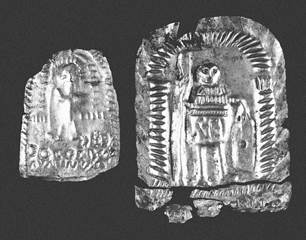
Two silver embossed plaques dedicated to Cocidius, from Bewcastle, Cumbria.
Ht of larger plaque c. 8 cm (3 in.).Perhaps soldiers stationed in the military frontier-zone simply invented gods at need. If so, then was it important to them that such divinities be endowed with a British identity? Did this somehow improve their spiritual efficacy, through stronger ties with – and therefore influence over – the lands that the Romans were seizing? It is possible that such ‘new gods’ had less of a genuinely indigenous voice than is suggested by their local names. Britishness may have been manipulated (perhaps even with a degree of cynicism) by the Roman military. But an equally valid alternative is that Roman soldiers serving along Hadrian’s Wall felt a religious need to identify with, and give a voice to, the spirits already residing here. The case for iconoclasm: religious hatred in action?
‘It was certainly a deliberate and calculated act by which the work of art, once dedicated by a shoemaker and a stonemason, perished, and it was not the only such act to affect the cult inventory of the temple. The sculpture of Mithras born out of the rock was beheaded, and so was the image of Mithras as a bowman…’15
This account relates the vicious treatment of the superb collection of religious iconography that once adorned the Mithraeum at Dieburg in southern Germany, until it was targeted by a group of people hostile to the cult, possibly foreign Germanic tribesmen or Christian communities.
While much of the evidence for Persian Mithraism gives the impression of a somewhat exclusive cult, the preserve of high-status military men and entrepreneurs, the Mithraeum at Dieburg in the Roman province of Upper Germany had more humble origins.16 Sometime during the later 2nd or early 3rd century AD, a family of artisans set up an elaborate stone carving in honour of Mithras here. The relief was double-sided and could be rotated by a device so that, during the dark, mysterious lamp-lit ceremonies, devotees could view both the ‘front’ and ‘reverse’ surfaces, both richly decorated with images and epigraphy. The dedicants were a stonemason called Silvestrius Silvinus, his brother, a cobbler, Silvestrius Perpetus, and the shoemaker’s grandson, Aurelius. Despite their modest professions, the iconography shows a high level of knowledge about Mithraism and its mythology, as well as of the broader corpus of Classical cult systems and stories. The Mithraeum attracted other cults and icons to the site, the largest of the latter being that of Mercury.
In AD 233, the Alemanni, a powerful Germanic tribe, invaded the region and thereafter its inhabitants struggled to maintain its romanitas. Sometime during the 3rd century, a hostile group targeted the Dieburg Mithraeum for wanton and systematic destruction that seems to have been fuelled by a desire not just to smash, but to signify utter rejection of the religious beliefs and practices associated with the Mithraic sanctuary. The central Mithraic relief dedicated by the Silvestrius brothers was damaged by savage blows from a broad-bladed chisel-like tool; blows not seeking random destruction, but deliberately ‘killing’ the hunting Mithras by targeting the figure’s head. Likewise, other images from the shrine were decapitated, as if in acts of capital punishment, and the great statue of Mercury was smashed to smithereens.17 The destruction meted out to these sacred stones indicates more than mere vandalism; it represents a fanatical religious hatred. So who was responsible? Was it the Alemanni, or perhaps a group of zealous Christians? One possible clue is that a lot of the violence of the Dieburg iconoclasts appears to have focused on the naked or near-naked male images within the shrine, particularly their genitals; this may be why Mercury attracted special attention.18 The culprits might, therefore, have been Christians, repelled by what they might see as the indecent nudity displayed on the carvings. Fellow pagans did not generally harbour such hang-ups about naked depictions. But if such pagans were foreigners – like the Alemanni – the destruction of the Dieburg iconography was probably carried out for reasons of enmity rather than religious scruple. But we will never know for certain who perpetrated such vandalism upon the Mithraeum’s sacred stones.
Dieburg is a long way from Britannia, but the religious hatred directed at its Mithraeum evidences the turbulence and hostilities that could exist in the Roman provinces. There are tantalizing glimpses of tensions at Bath, as we have seen. And what about the row of deliberately broken stones re-erected outside a late Roman shop in Cirencester (see pp. 82–83) that may have been rescued, along with the cults they reflected, and brought back to life after a period of iconoclasm? Conversely, other sacred stone sculptures from the town were deliberately and sometimes carefully beheaded, as if to rob them of their sanctity, or at least to change their identity.19 One such figure, depicting Fortuna, the Roman goddess of Chance, was carefully stowed away in a flue inside the stoking room of a bath-building, but not before her head had been removed.20 We saw in Chapter 8 that sometime during the life of the London Mithraeum, sacred images were deliberately buried, as if to prevent their desecration and destruction, perhaps by Christians, by adherents to a rival cult, or simply by vandals.
The violence meted out to the sacred sculptures at Dieburg appears to represent extreme reactions of an aggressive counter-religious movement not, alas, dissimilar to what is happening to ancient religious images and temples, like that at Palmyra in Syria, at the hands of Islamic State today.21 But iconoclasm can be a complicated issue, particularly when applied to the remote past,22 without adequate written records to confirm the intent of apparent destruction. Of course, the destruction of a sacred monument does not necessarily destroy the relationship it has with its believers. T.S. Eliot speaks of ‘prayers to broken stone’ in his poem ‘The Hollow Men’;23 even fragmentary images should be treated as potentially significant elements in sacred practice.
The evidence from one temple in Roman Britain exemplifies the dilemma of how to interpret ‘broken stone’: the sanctuary to Mercury at Uley in the Gloucestershire Cotswolds, discussed in Chapter 9. That the shrine was an important centre for the worship of Mercury in the region is obvious from the many votive objects dedicated to him placed there by pilgrims, but more so on account of the great stone cult-statue erected to the god.24 Mercury was an influential god in the western provinces, including Britannia. He was not only a god of commercial prosperity (hence his emblem of a purse), but also led souls to the Otherworld, so he looked after people in life and in death. By no means all of the sculpture at Uley survives, as it was systematically broken up some while after its production in the mid-2nd century AD, and all that the excavators found were parts of limbs, the god’s accompanying animals (a ram and a cockerel) and an exceptionally finely carved head of the young god that had been deliberately severed from the body in antiquity. This head is virtually undamaged, apart from the tip of the nose, and it is clear that trouble was taken to keep it intact; it was evidently curated and then given a careful burial in the post-Roman period.25 If, as I suggested in Chapter 9, Mercury was morphed into Christ, we are witnessing the very antithesis of iconoclasm. Twinning and connecting: the two-way street of interpretatio romana
‘The god the Gauls worship most is Mercury, and they have very many images of him. They regard him as the inventor of all the arts, the guide of all their roads and journeys, and the god who has greatest power for trading and moneymaking. After Mercury they worship Apollo, Mars, Jupiter, and Minerva, having almost the same ideas about these gods as other peoples do: Apollo averts diseases, Minerva teaches the first principles of industry and crafts. Jupiter has supremacy among the gods, and Mars controls warfare.’ CAESAR26
Just what was Caesar saying here? Given that he was writing in the 50s BC while on campaign in Gaul and before that region had become absorbed into the Roman Empire, it is somewhat curious that he presented the Roman pantheon as a fully established part of the Gaulish religious system. There is no way that this could have been the reality. It is true that the Roman deities were present in Gaul, brought there by Caesar’s army, and that the long-standing trading links between Gaul and the Classical world might have led to a basic familiarity with Roman cult-systems among the native tribes. But for Caesar to speak so emphatically about the Gaulish adoption of Roman gods was surely a literary device rather than accurate reporting. Given that his comments were situated in a campaign report (or war diary) designed to be read to the Senate in Rome, one explanation of his ‘Gaulish pantheon’ is simply that he was trying to make his report comprehensible to people who were unfamiliar with Gaul, by describing in Roman terms foreign deities whose function accorded with his own gods. But another possibility is that he was kept in the dark about Gaulish divinities, only being told what the Druids or other local religious officials considered fitting for him – as a foreign conqueror – to know.
In equating the principal Roman gods with what he may have seen as Gaulish equivalents, Caesar was invoking the principle of interpretatio romana, a phrase first used by Tacitus in his description of the religious beliefs held by an obscure German tribe called the Naharvali, who lived far beyond the frontiers of the Roman Empire.27 Like Caesar, Tacitus sought to equate a pair of German gods, the Alci, with the only divine Classical twins with whom he was familiar: Castor and Pollux. While Caesar did not attempt to give the Gaulish-equivalent names, Tacitus did so and, what is more, he actually used the term interpretatio romana to describe what he was doing. Both chroniclers, Caesar in the mid-1st century BC and Tacitus more than a hundred years later, were recording religious beliefs outside Britannia. Archaeological evidence, particularly from epigraphy, demonstrates that pairing between deities with Roman and Gallo-British names did indeed occur in Roman Britain; but the more nuanced testimony of material culture shows that interpretatio was not a one-way street. The equivalence between divinities of two cultures can be seen to have involved both the interpretation of indigenous god-names through a Roman lens and the reverse: the perception among indigenous people that ‘Roman’ deities had original British identities.
We can observe the mutual exchange of interpretatio in action. It encompasses multiple variations but the two main categories consist of a single spirit being endowed with a double-name, one British (or Gallic or German) and the other Roman, and the phenomenon of divine couples of whom one (generally the female) may have a local (or at any rate non-Classical) name and whose partner usually carried a Roman name or a double Roman/British one. Rarely – as occurred with the Gaulish couple Sucellus and Nantosuelta – both male and female deities bore only indigenous names. We have already met some of these in earlier chapters. A good example of the former group is Sulis Minerva, the personified spirit of the hot springs at Bath. The surviving bronze head of her cult-statue closely resembles Minerva, even down to the helmet she once wore. Yet, the vast majority of inscribed dedications to her – whether in stone or on the prolific lead curse tablets invoking her as a goddess of retribution – name her Sulis Minerva (the British element almost always coming first) or simply as Sulis. What are we to make of that? Who was driving the notion of pairedness? Did Sulis exist as a British water-goddess before the Romans arrived or was she – according to Jane Webster’s model of god-invention at need28 – newly created by the Roman army in order to ground their worship within the local community? We need to be careful not to allow the new technologies of devotion (iconography and epigraphy), introduced under the Roman occupation of Britannia, to cloud our judgment. Just because Iron Age Britons rarely depicted their gods with visibly set identities that does not mean that these deities were not firm entities within Britannia’s pre-Roman consciousness. It is just that their voices were silent and their footprints barely discernible. In the case of Sulis at Bath, we should remember the scattering of Iron Age silver coins from the sacred spring,29 which might indicate her veneration before the monumentalization of her sanctuary, although it is always possible that they were deposited early in the Roman period.
To explore the phenomenon of gendered divine couples, in terms of the degrees of romanitas (or its absence) shown by their epigraphy and iconography, I want to look at three that occur in Roman Britain: Mercury and Rosmerta, Loucetius Mars and Nemetona and Sucellus and Nantosuelta, for each represents a particular and graded manner of cultural presentation. The first reflects a pattern of overt romanitas in the case of the male deity and Gallo-Britishness for the female; in the second, the female once again has a totally un-Roman name while her male companion possesses a double-name, one Roman, one not; and the third represents total epigraphic avoidance of adherence to the Roman pantheon.
I will begin in reverse order, with an image unique to Britain but a frequent occurrence in Burgundy and southern Gaul: that of Sucellus and Nantosuelta.30 On a rare relief-carving from Sarrebourg, near Metz, the tribal capital of the eastern Gaulish tribe the Mediomatrici, the pair is depicted with an accompanying dedication that names them.31 Usually, though, the images and inscriptions do not appear together. The key identifying elements of their imagery are the long-shafted hammer and small pot or goblet held by Sucellus, and varying symbols associated with hearth, home and well-being carried by his companion. In Britannia, Sucellus’s name appears on a few objects but the only image of the couple so far to be identified comes from East Stoke in Nottinghamshire, in the tribal territory of the Corieltauvi.32 The names have been interpreted as Gallo-British titles: ‘the good striker’ (Sucellus) and ‘winding brook’ (Nantosuelta). Neither the epithets nor the images conform to romanitas except in the fact of their physical naming on inscriptions and their presentation as ‘human’ images. Indeed, there seems to have been a conscious desire to emphasize the independent, non-Romanness of these deities.
A settler or a wandering pilgrim from the land of the Treveri in the Moselle Valley set up an altar to another divine couple, Loucetius Mars and Nemetona, at Bath.33 The dedicant’s name was Peregrinus34 and his instructions to the scriptor35 were clear: in the double-name given to the male deity, the non-Roman name was to be mentioned first. We saw this with Sulis Minerva at the same sanctuary. And Loucetius Mars’s consort had a significant name, the Gallo-British epithet ‘Nemetona’, which derives from the word nemeton, meaning ‘sacred place’ or ‘sacred grove’.36 Both deities had their roots in the Rhine region and travelled to Bath in Britannia with their devotee. Peregrinus is a prime example of someone who chose his gods to reflect his origins and brought them with him from his homeland, as well as signing up as a follower of the British goddess Sulis. But he did not entirely turn from romanitas, for Loucetius was given ‘Mars’ as a ‘surname’. And maybe this Mars, worshipped at a British healing spa shrine, was nothing to do with war but was the Treveran version, like Mars Lenus, who presided over important sanctuaries at Trier and its environs37 as a healer-deity, a fighter not against people but against disease.
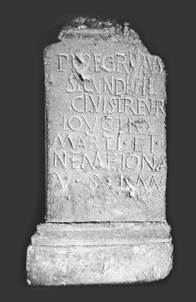
Altar to Loucetius Mars and Nemetona, dedicated by Peregrinus at Bath. Ht 76 cm (30 in.).
And so comes the final example of ‘twinning’ or conflation in action: that of Mercury and Rosmerta, the male having an entirely Roman name, his partner an unequivocally Gallo-British or ‘Celtic’ one. An important dedication to the pair comes from a temple at Niederemmel near Neumagen, in the same tribal territory from which Peregrinus’s family originated. The significance of this Treveran inscription lies in the identity of the dedicants: two brothers – Doccius Aprossus and Doccius Acceptus – who jointly held the post of seviri Augustales.38 This was a college of priests associated with the Imperial Cult, and, as its second name implies, it was founded in the reign of the first emperor, Augustus. What is particularly special about this priesthood is that it was open not only to high-ranking free citizens (those of the equestrian middle class) but also to freedmen.39 This priesthood appears to have originated in the south of France, at Narbonne in Gallia Narbonensis. In AD 11/12, an inscribed altar was set up by the town’s citizens dedicated to the divine spirit of the emperor Augustus, to celebrate his birthday. The inscription carries a lot of detail, not least concerning the establishment of the seviri Augustales, decreeing that there should be six of them, three recruited from the equites, and three from the ranks of freedmen. These priests had the ‘privilege’ of paying for the festival on the emperor’s birthday and on other sacred occasions, each providing a sacrificial animal and footing the bill for the incense and wine.40
Narbo was a very Roman town, capital of Gallia Narbonensis, dubbed ‘The Province’ because of its early foundation and its ‘special relationship’ with Rome. One would expect its seviri Augustales to be steeped in Roman ways, especially in religious matters, so the Treveran Doccius brothers’ dedication to Mercury and Rosmerta is of especial interest. Mercury is straightforward enough, but Rosmerta seems to have been a Gallic invention of an indigenous consort, perhaps to leaven romanitas, to impose an interpretatio gallica on this most popular of gods. Rosmerta’s name is a Gaulish word meaning ‘the good provider’. On certain continental altars, Mercury and Rosmerta are represented both by images and epigraphic dedications, thus allowing confidence in identification in instances where only sculptures of the pair are present.41
This is the case in Britannia, which had its share of worshippers but where devotion was expressed through iconography rather than epigraphy. At least one major focus of their cult here was the Roman colonial city of Glevum (Gloucester), where several stone images were set up, perhaps by the same person, group or guild.42 I will concentrate on just one: the relief-carving from Shakespeare Inn.43 Here is a richly interwoven tapestry of romanitas and Gallo-Britishness. Not surprisingly, Mercury has the most overt Classical symbolism: he carries his purse, symbol of commercial success, and he rests his right hand on a cockerel and caduceus (herald’s staff) positioned by his right leg. He is presented in his usual semi-nude state, his chlamys (short cloak) over his left shoulder. But what interests me is his head for on it, thrusting through his curls, is a pair of pointed objects where his petasos (winged hat) should be but which look much more like horns. The Classical Mercury possessed a range of emblems associated with his mythology and function that help identify his images: the cockerel, caduceus and wings44 are all tied in to his primary role, that of the herald of the gods. But in some British portrayals,45 including this one from Gloucester, the British predilection for horned deities46 (see pp. 142–44) has crept into the Mercury-repertoire, as if appropriating the Roman deity for British taste. The god’s female companion is almost certainly Rosmerta: she is clad in an ankle-length robe and carries in her left hand a curious long-shafted object ending in a pelta-shaped terminal, probably a sceptre of authority. In her right hand is a ladle, and by her right ankle a stave-bound wooden bucket. This last is significant, for it characterizes several Rosmerta images from the region, including one from Bath, and the vessel is distinctively British, harking back – perhaps – to the ale-buckets buried with high-status Britons from southeast England in the century before the Roman conquest.47 The images of Mercury and Rosmerta exemplified by the Shakespeare Inn sculpture indicate a subtle blend of romanitas and britannitas. Whoever was responsible for commissioning the piece (and its execution) wanted to establish himself or herself as someone who wished to present an intercultural balance.
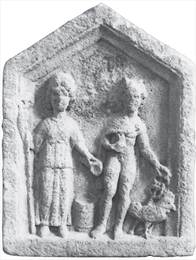
Mercury and Rosmerta, from Shakespeare Inn, Gloucester. Ht 57 cm (22½ in.). Observing syncretism: Roman Britain in context
‘“Syncretism” is a contentious term, often taken to imply “inauthenticity” or “contamination”, the infiltration of a supposedly “pure” tradition by symbols and meanings seen as belonging to other, incompatible traditions.’48
Is it appropriate to apply the term ‘syncretism’ to the way in which different religious beliefs and ritual practices manifested themselves in Roman Britain? I would say not, at least not in the somewhat negative sense of the quoted passage. In my opinion, what happened in Britain under Roman occupation was a complicated but dynamic set of negotiations, manipulations, understandings, misunderstandings, hostility and tolerances, the whole package laced with invention and reinvention of deities and faiths. Many scholars of modern comparative religions49 regard syncretism as superficially equal in the coming together of multiple religious systems, but in fact always skewed towards the dominant partner, for example the colonial occupier of other peoples’ lands. To determine to what extent this was true of Roman Britain (setting aside, if that is possible, the issue of ‘new technologies of worship’50 discussed earlier in this chapter), I turn to a ‘modern’ colonial model of syncretism from the New World, in the Bahia region of eastern coastal Brazil, which demonstrates just how complex and multidirectional colonial interrelationships can be, including those associated with religious beliefs. In the early 16th century, Portuguese colonists, hungry for mineral wealth, landed at Bahia, bringing their Roman Catholicism with them. But a strong indigenous Amerindian religious tradition already existed, and proved resistant to submersion by foreign Christianity. But a third strand of religion is present in the Bahian mix: the Yoruba cults that came with West African slaves to the Portuguese at the time of European colonization of Brazil. Each of the three belief-systems has been so modified by the other two that, even today, it is hard to identify which – if any – has dominance. The healing rituals contributed by the indigenous Amerindians have melded seamlessly into the curative properties perceived as a fundamental element in the powers wielded by the Virgin Mary and the other saints within the Roman Catholic Church. Many of these saints have, in turn, become fused with the spirits (called orixas) of the Yoruba people.51
Schematized sculpture of Mercury, with horns instead of his winged hat, from a Roman well at Emberton, Buckinghamshire. Ht 33 cm (13 in.).
So to what extent did people living and working in Roman Britain worship together? We have seen that hostility and intolerance existed; some believers felt it incumbent upon themselves to wreak destruction on the outward manifestations of faith that they found inimical. But this trend appears to have been far outweighed by its opposite. Temples housed the images and dedications of many gods and presumably welcomed their diverse adherents to pay homage there. Individuals and groups – whether military or civilian – showed their devotion to more than one deity on a single inscribed altar. The gods themselves went into partnership with those of different cultural backgrounds; one and the same deity might have both a Roman and a Gallic or British name; and some were presented in imagery that spoke of both Romanness and Britishness. Soldiers stationed on Hadrian’s Wall or other military installations may have invented new gods, with British names, whom they thought it important to propitiate while on foreign ground. And we must never forget that so many army recruits were not ethnic Romans but came from Gaul, the Rhineland and beyond and, like the Spaniard Maximus in the film Gladiator, set up shrines to their local divine protectors wherever they went. The Bahian model is, I think, not that far away from what existed in Roman Britain. With certain notable exceptions – Druids and sometimes the Imperial Cult, for instance – the archaeological evidence at least appears to present a rich tapestry of religious cults and worship whose interaction, negotiation and mutual appropriation resulted in a series of new religious movements on the western edge of the Roman Empire.