CHAPTER THREE Marching as to War Religion and the Roman army
‘For the welfare of our lords, the most invincible emperors,
to the Spirit of the Place Flavius Longus, military tribune
of the Twentieth Legion Valeria Victrix, and Longinus,
his son, from Samosata, fulfilled their vow’1
This dedication was inscribed on the front of a large stone altar found in the Roman legionary fortress at Chester in 1693.
Inscriptions like these, from military installations across Britannia provide a mass of information not just about religion but also about the soldiers enlisted into the Roman army and sent to the distant provinces to keep the pax romana (peace across the Empire). We cannot be sure precisely when this altar was erected, but the mention of two emperors narrows the field to the end of the early 3rd century AD at the earliest.2 The altar was dedicated to the Genius loci, the ‘Spirit of the Place’ (presumably Chester), and reflects a common habit among army personnel: when soldiers were first drafted to a particular provincial location, they made it their business to ascertain who the local gods were and to worship them alongside their own deities. So this Genius loci might have been an indigenous British divinity or the spirit of the Roman fortress, or both. But Longinus certainly came from a very distant place: Samosata was a town on the Upper Euphrates in Mesopotamia.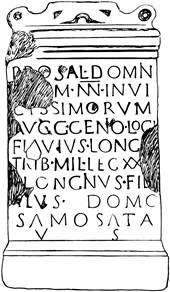
Altar to the Genius loci (‘GENIO LOCI’), dedicated by a legionary officer from Samosata, found at Chester. Ht c. 81 cm (32 in.).
The wording on the altar erected by Longus and Longinus ends with V S, (v)otum (s)oluerunt, a common formula explaining that father and son were making a votive offering together. The Romans had a somewhat curious attitude to the gods (to a modern, Western viewpoint at least), believing that they were engaged in a kind of contractual relationship whereby if a person asked for a divine favour and it was granted, it must be ‘paid for’ by a votive gift.
So prayers had two distinct parts: the first, called the nuncupatio, or ‘asking-ritual’, included both the request and the vow of a particular present to the spirit if the prayer was answered; the second, the solutio, was the tangible gift itself, in this case the stone altar, the fulfilment of the original vow. We cannot know what Longus and his son asked of the gods, but the inclusion of his son’s name in the dedication was perhaps because the boy had been ill. After all, the tribune was a serving officer and may well have been the father of a young child or, perhaps, of a young man about to enter military service himself, with all the risks that entailed. This altar from Chester is one of numerous examples of epigraphic communication with the gods by soldiers from all over the Empire. Perhaps for those stationed a world away from home, such vows had – and have – particular poignancy.Ridley Scott’s iconic film Gladiator (2000) portrayed Roman soldiers’ attitudes to the gods remarkably accurately. Central to the beleaguered and betrayed Roman general Maximus’s character was his veneration of his personal household gods. Everywhere he travelled he carried with him three small figurines, the Lares et Penates, his personal spirits who watched over him and kept him grounded in his Spanish farm and homeland. Each day, he would unwrap the sacred images from the cloth in which he concealed them, recite prayers to them and pour them a small libation (gift) of wine or oil; then he would bury them for safe-keeping until the following day. In a sense, the fictitious Maximus was engaging in a private ceremony essentially analogous to the public displays of devotion demonstrated by Longus and Longinus at Chester. All places, whether military fortresses or private dwellings, possessed their own spirits, who had to be propitiated so that they would continue to look after those who lived and worked there. One possible manifestation of the Genius loci worshipped both by the army and by the civilian population comprised images of a triad of distinctive little godlets, known as Genii cucullati, ‘hooded spirits’, because they are shrouded in the peculiarly Gallo-British hooded cloak called variously a sagum or a birrus britannicus.
One image from Housesteads, Northumbria, shows three ostensibly gender-neutral figures, swathed in heavy woollen hooded capes, staring out at their worshippers.3 If these figures did represent the spirit of the place, then they are a powerful reflection of synthesis between Roman and native religious tradition: a combination of the Roman Genius loci and the British reverence for the sacred number three (see Chapter 7).4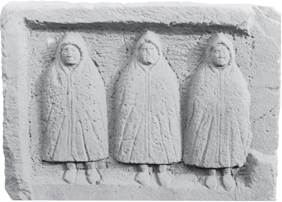
Relief-carving of the Genii cucullati from the fort of Housesteads on Hadrian’s Wall. Ht 41.5 cm (16¼ in.). The impact of the army on religion and its expression
The Roman army in Britain was a highly significant force in matters over and above the strictly martial sphere. It is striking that those regions in which we observe a strong and enduring military presence are also those in which religion left its heaviest footprint. Guy de la Bedoyère5 comments quite rightly that the distribution of surviving cult-material, particularly of inscriptions, correlates closely with the regions where the army was at its strongest. Conversely he cites the South West Peninsula, land of the tribe of the Dumnonii, where the military appears to have been virtually absent west of Exeter and where there is thus an almost complete absence of Roman culture, whether religious or secular.6 It is clear from the pattern of finds that the army played a crucial role in the spread of the ‘Roman brand’ (romanitas). So we might be forgiven for assuming that cultural and religious interaction was largely a one-way street, and that the adoption of Roman religious ideas and beliefs was a unilinear affair in which natives in colonized areas were afforded little choice in the matter and did not make an impact upon their invaders’ culture. But this was demonstrably not the case, for the epigraphy and iconography in militarized areas indicate a strong presence of British religion, albeit presented in a Roman manner.
And, of course, into this mix was added the polyglot nature of the Roman army, which brought with it a kaleidoscope of cults and rituals from all over the Empire.John Creighton’s Britannia: The Creation of a Roman Province draws attention to ‘the creation of the familiar’:7 the manner in which Roman colonists, whether military or civilian, sought to construct environments, both physical and emotional, in which they felt at home. An obvious example of this is the recurrent formula of building – forts, temples and houses erected according to uniform architectural plans – imposed upon annexed regions. In terms of the spiritual, one method of bringing the familiar to religion was to discern which deities belonging to conquered territories best fitted with Roman perceptions of their own pantheon, and to ‘join up’ certain Roman and native deities. Such an exercise may be termed conflation, fusion, equation or synthesis, but the result is consistently expressed epigraphically by linking two names – one Roman, one indigenous – or by merging elements of the imagery associated with each original god. So while much of the evidence for religion in Roman Britain may represent ethnic singularity (whether that be Classical, Oriental or Gallo-British), there is a significant amount of evidence for the construction of strong connections between gods of widely divergent origins. This concept of bridging religious divides, often termed syncretism by anthropologists,8 is addressed in detail in Chapter 11.
The other way in which the army ‘created the familiar’ was by the constant repledging of fealty to the spirit(s) of Empire/the emperor(s) and to the head of the Roman pantheon, Jupiter [Iuppiter] Optimus Maximus (I.O.M) through observance of the Imperial Cult (see pp. 42–43). The excavation of multiple altars to Jupiter found at such northern forts as Maryport, Birdoswald and Castlesteads is indicative of an annual military ritual in which, every 3 January (Jupiter’s birthday), a new altar to this most powerful of gods was dedicated and erected and the previous year’s commemoration ceremonially buried.
In a sense, this practice was much more about reaffirmation of connection to the motherland of Rome than about spiritual belief but, nonetheless, Jupiter was a multi-functional god; not just lord of all gods, ruler of the skies and bringer of thunder, but also a solar rider and a fighter against evil (see Chapter 5), and it behoved an army far from home to pay him homage. Being a soldier: cults of war, triumph and fateHosts of Mars
‘To the god Mars and the Spirits of the Emperors the Colasuni [brothers], Bruccius and Caratius, presented this [figurine] at their own expense at a cost of 100 sesterces; Celatus the bronzesmith fashioned it and gave a pound of bronze made at the cost of 3 denarii’9
This inscription is cut into the base-plinth of a bronze image of Mars, naked but for a flamboyantly crested helmet; his hands once held weapons, perhaps a spear and a shield. The statuette was found in 1774 on the course of the Foss Dyke canal in Lincolnshire. It is interesting to attempt a rough calculation to find out the kind of outlay involved for the Colasuni brothers (it is not an easy sum to do, because the value of different coin denominations fluctuated significantly depending, as in all monetary systems, upon changes in the economic situation). The annual pay for a Roman legionary (the elite of the army) at the time of the Claudian conquest was c. 225 silver denarii, so a citizen soldier’s weekly pay-packet was roughly 4.5 denarii. A denarius was worth between 4 and 6 sesterces. The brothers therefore may have paid 28 denarii for the statuette, the equivalent of seven weeks’ wages for a regular Roman soldier.10 We do not know the occupations of Bruccius and Caratius, but their names are British, and by the mid-2nd century AD, when the figurine was probably commissioned, monetary values were probably quite different from Claudian times, but at least we can say with confidence that the brothers contributed a substantial portion of their income in this dedication.
Although the dedication on the Foss Dyke Mars makes no mention of their status as soldiers, for these British brothers the Roman war-god was worthy of veneration. However, as we shall see, funny things could happen to the worship of Mars in the hands of British (and Gallic) devotees, including a radical change to his perception as a bloody god of the battlefield.The figurine of Mars from Foss Dyke appears to conform to the Classical idea of a god of war (except, perhaps, for his nakedness). But at Maryport, a Roman fort on the Cumbrian coast south of the western edge of Hadrian’s Wall, soldiers worshipped a war-god whose image could not provide a greater contrast to the Lincolnshire Mars. This little figure, roughly carved on a piece of sandstone, depicts a warrior-god, also with a spear and shield, but it is aggressively British in its style, with a huge head surmounted by bulbous horns. It, too, is naked, but is additionally ithyphallic, and the point of its clumsy-looking spear also resembles an erect phallus.11 So what does the Maryport image represent? Is it meant to be Mars or is it, instead, a kind of subversion of the Roman war-god, a British ‘counter-Mars’? The influence of indigenous tradition is very marked, particularly in the giant head and the horns, both entirely foreign to the iconography of the Roman Mars. Who commissioned this image: a soldier, of British or Gallic origin, or a local civilian? Roman soldiers stationed at Maryport set up a number of altars specifically dedicated to ‘Military Mars’,12 stressing their veneration of him as a warrior-deity. The inscriptions on these stones proudly state that the members of this army-unit, the 1st Cohort of Baetasians, were Roman citizens, a comparatively rare status for auxiliary troops on active service. Baetasians were a German tribe whose homeland was in the Roman province of Lower Germany,13 near the mouth of the Rhine. The cohort was raised there in the mid to late 1st century AD,14 but the altars to Mars probably date to the later 2nd century. I would be wary of assuming that these soldiers were responsible for the somewhat risque image of the horned god found at the fort. Another inscription from Maryport might provide the solution: an optio (a deputy centurion)15 called Julius Civilis commissioned the erection of an altar dedicated to Belatucadrus, ‘the Fair Killer’, a local northern British war-god worshipped widely in the region of Hadrian’s Wall and sometimes given the forename Mars.16 Could the little naked, horned image from the same fort have been he?
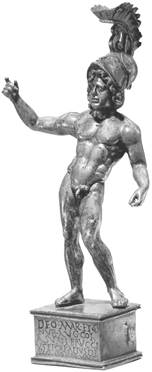
Inscribed bronze figurine of Mars, from Foss Dyke, Lincolnshire. Ht c. 27 cm (10½ in.).
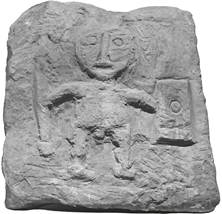
Relief-carving of a horned warrior-god from the Roman fort of Maryport, Cumbria. Ht 34 cm (13½ in.).
Belatucadrus is one of many northern British war-gods with local names whom native worshippers linked with the Roman war-god. A fellow indigenous warrior-deity was Cocidius, his name translated by Anne Ross as the ‘red god’, perhaps a reference to blood-letting in battle. While the great majority of inscriptions from the region of Hadrian’s Wall were carved on stone, the headquarters building in the fort of Bewcastle, Cumbria, produced a rare find of two small silver plaques, both inscribed ‘to the god Cocidius’ and each bearing an image of an armed man (see p. 219).17 The warrior on the smaller plaque has a spear and shield and appears to be wearing a rudimentary mail-coat; on the larger one, Cocidius only has a spear, but the fuller inscription provides information that the dedicant was a military tribune with the splendid name Aurunceius Felicessimus. The silversmith who made these plaques stamped through the imagery from the back; the figures are simply and schematically rendered, as are many Romano-British stone images, but all the essentials for the presentation of the god have been observed: he is fully armed and named.18 Cocidius was a popular deity in the military north: in the western region of Hadrian’s Wall he was very much a warrior-lord, but to the east he was linked with the Roman god Silvanus, perhaps in the latter’s capacity as a hunter (another blood sport!). The Bewcastle finds suggest the presence of a shrine here or nearby, for decorated plaques like these are usually designed to be displayed on the walls of religious buildings in order to show the devotion of the dedicant to the god and to display the fulfilment of his or her vow. There is some corroborative evidence for a fanum (small shrine) to Cocidius in the region of Bewcastle, for a fanum Cocidii is mentioned in a strange document known as the Ravenna Cosmography, compiled by an anonymous cleric in Ravenna, Italy, in about AD 700. Although according to David Mattingly ‘the Cosmography is an error-strewn and disorganized listing of place-names from all over the empire’,19 and so we might dismiss the location of the Italian monk’s fanum Cocidii as at best vague and at worst virtually random, the silver plaques from Bewcastle mean he might just have been right.
Roman soldiers worshipped a plethora of Mars or Mars-related gods in Britannia. Belatucadrus and Cocidius may have been well established in northern Britain before the army arrived, and the connection with the Roman war-god made by Roman military men who perceived equations or at least similarities between their own Mars and the British warrior-deities. Sometimes, army-recruits brought their own local gods to Britain with them, already linked up with Mars. One such was Mars Thincsus, worshipped by a German military unit at the wall-fort of Housesteads in Northumbria. Thincsus was a Germanic deity who migrated to Britain with the German cohort where he was coupled with the Roman god of war (as happened with the British spirits Belatucadrus, Cocidius and their brothers). His devotees set up a sanctuary to him here; of a once imposing temple-building, an inscribed altar and an associated fragmentary carved stone arch from a gateway survive.20 The inscription reads: ‘To the god Mars Thincsus and the two Alaisiagae, Beda and Fimmilena, and to the Deity of the Emperor, the Germans, being tribesmen of Twenthe, willingly and deservedly fulfilled their vow’. Twenthe is in what is now the Netherlands. Another altar from Housesteads gives further information: it is dedicated to Mars and the Two Alaisiagae, also by people from Twenthe, who identify themselves as ‘of the formation of Frisians of Vercovicium [Housesteads]…styled Severus Alexander’s’.21 This probably refers to the existence of a personal imperial military unit raised around the mouth of the Rhine in the early 3rd century AD, when Severus actively campaigned against the powerful German tribe of the Alemanni.22 Eric Birley has suggested that the term ‘Alaisiagae’ might mean ‘all-honoured ones’. Beda and Fimmilena may be titles respectively meaning ‘prayerful one’ and ‘skilful one’.23 All their names are female, and they were probably helpers to Mars Thincsus: the arch depicts the war-god holding his sword, shield and spear, and accompanied by a goose, a symbol of alertness and aggression; he is flanked by two naked goddesses, members of the Alaisiagae, each bearing a sword and a victory-wreath. While Thincsus was assimilated with Mars, the Alaisiagae remained determinedly foreign, German goddesses who escaped overt linkage with romanitas.
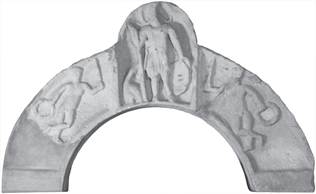
Arch from the temple of the Germanic god Mars Thincsus from Housesteads. Ht 106.5 cm (42 in.).
Geese seem to have been popular birds with Romano-Germanic gods of war: far away in Caerwent, South Wales, the Silures worshipped a Treveran god named ‘Mars Lenus or Ocelus Vellaunus’. This god’s name was inscribed on the base of a statue that has virtually disappeared, except for a pair of human feet standing next to those of a goose.24 A second altar from Caerwent was dedicated to the same god, though simply called ‘Mars Ocelus’.25 The association of Mars with these Gallo-British deities raises questions concerning the wholly military nature of their responsibilities. Lenus Mars presided over a great healing sanctuary at Trier (Augusta Treverorum) in the Moselle Valley, where his Treveran name always comes first on inscriptions, indicating that the local god was pre-eminent in the partnership.26 The peaceful function of Lenus is endorsed by an inscription on a small altar from the great Roman villa at Chedworth, in rural Gloucestershire, where the god’s name was scratched on a stone beneath a roughly incised human figure holding a spear and an axe that seem to have represented protection against disease.27 The role of ‘Mars’ as a healer seems rather odd, but it is widely accepted, at least among French and German scholars, that one quirk of Gallo-British religious manipulation of the Roman pantheon is reflected in the reinterpretation of Mars’s warlike qualities as a force for protection against disease. We will return to this subject in Chapter 6.
Regiments of divine military women
‘To the goddess Fortuna, Julius Bassus, camp-prefect, set this up.’28
‘Lady Nemesis, I give thee a cloak and a pair of boots; let him who wore them not redeem them except with the life of his Blood-red charger.’29
Roman soldiers worshipped a plethora of goddesses, each of whom appears to have tapped into a military need. The Roman goddesses Fortuna and Nemesis were deities of Chance and Fate: important to keep them in one’s corner when facing the enemy! Victory needs no explanation; as a matter of course, soldiers would pray to her before battle. Unlike this trio, the mother-goddesses, themselves often presented in groups of three, were born and bred in Gaul and the Rhineland, but they were eagerly adopted by the Roman military because they represented succour, protection and sustenance on the battlefield. Divine personifications of such abstract concepts were often perceived as female. The dedication to Fortuna by Julius Bassus was found on the site of the great baths at the legionary fortress of Caerleon in South Wales. Bassus held the post of praefectus castrorum, which meant that he was third-in-command of Legio II Augusta. Fortuna (Chance) was not a military goddess per se, but Roman soldiers were careful to propitiate her so that she would protect them on the battlefield. Fortuna is often found in military bathhouses, because the bathers believed they were at particular risk from evil forces when stripped naked. Several gemstones, once mounted in rings and lost when the steam from the baths loosened the glue holding them in place, bear the image of Fortuna, for a soldier’s personal protection. At the northwestern legionary fortress at Chester, the goddess was invoked, rather wistfully, as ‘Fortuna Redux’ – Fortuna the Home-bringer – and the altar was also dedicated to the healing-deities Aesculapius and Salus (‘Health’) by the freedmen and slaves in the household of a senior army officer.30
The personification of Victory was another important military cult strongly tied up with fealty to the emperor and winning wars for the expansion and consolidation of imperial provinces. So it is no surprise that the apparently spontaneous collapse of the great statue of the goddess Victoria at Camulodunum (Colchester), its back turned as though running away from danger, just before Boudica’s army attacked it was seen as an evil portent of terror to come.31 Both legionaries and auxiliary soldiers frequently dedicated altars to Victory. A rarer find is a beautifully evocative little bronze plaque from Caerleon that depicts winged Victoria bearing a trophy of war: a breastplate and helmet flanked by two shields, which she brandishes in triumph on a long stave (see p. viii). The plaque is thought to have come from a piece of parade armour,32 proudly worn by an army officer on ceremonial occasions.
A close relative of Fortuna was Nemesis, or Fate. She was invoked on a lead defixio, or curse tablet, placed in the amphitheatre at the fortress in Caerleon by someone with a personal grievance who wanted revenge. The writing on the curse tablet does not tell us what the unknown recipient of the spell had done to invoke such invective. He was probably a fellow gladiator who had brought his cloak and boots into the cloakroom of the amphitheatre. Maybe he played dirty in the arena, and his injured opponent called upon Nemesis for justice. Far away at Chester, another legionary soldier set up an altar to Nemesis, once again in the amphitheatre.33 Why was Fate invoked at these places? Military amphitheatres were mainly used for parades, ceremonies and military drilling, but they also sometimes hosted games, including gladiatorial combat. Was Nemesis called upon to give favours in betting, or was she propitiated for a more sinister purpose, to bring curses down upon individuals at these dangerous events? The defixio from Caerleon specifically calls for the slaughter of a war-horse.
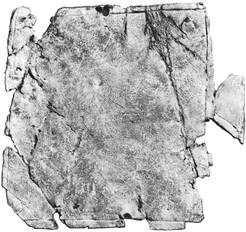
Lead curse tablet invoking Nemesis from the amphitheatre of the fortress at Caerleon. Ht c. 7.5 cm (3 in.).
The cult of the mother-goddesses was not of Roman origin, seeming rather to have had its origins in Gaul, but its outward manifestations only occur as a result of the epigraphic and iconographic habits introduced by the Roman army and administration.34 The Matres (called Matronae in the Rhineland) were very frequently perceived in triplicate, whether as three distinct entities or as three aspects of the same goddess. These triple goddesses are explored in more detail in Chapter 7, but it is important to mention them here because, despite their overt symbolism of fecundity and motherhood, these divinities enjoyed considerable popularity among the Roman military in the frontier regions of both Britain and the Rhineland. A cohort raised among the Tungrians of Belgium, stationed at Housesteads, venerated the Mothers,35 as did troops also raised in Gaul based at Vindolanda, Chesterholm, just south of the Wall.36 It is very likely that these units imported the mother-goddess cult from Gaul to Hadrian’s Wall. It is perhaps significant that the worship of the Matres in military Britain was expressed mainly in epigraphic dedications, with the notable exception of multiple images from Housesteads, where there must have been a major sanctuary for them,37 while the other main cluster of devotees in the Cotswolds (see Chapter 5) displayed their veneration for these goddesses almost solely through iconography. By contrast, the cult of the Matronae followed by army officers on and around the Rhine frontier was expressed in monumental stone altars that combined a unique form of imagery with well-cut and detailed inscriptions, often indicative of the senior rank of the dedicants.38 Whatever the precise role the mother-goddess cult played in military Britain, it is likely that these triple goddesses were worshipped as protectors and nourishers of soldiers’ lives and welfare.
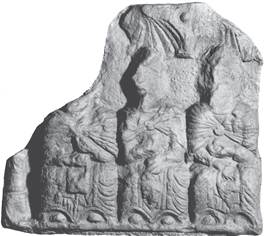
Three mother-goddesses from Cramond on the Antonine Wall, Scotland. Riding into battle
I am no rider. Until a few days before writing this section, the only encounters I had enjoyed with horses comprised slow, sedate ambles on the little white horses of Provence through the rice-fields of the Camargue. So it was not until I met Jazek, a Polish-Arab horse, that I realized what a strong bond there is between riders and their animals. Jazek is twenty-two years old and suffers from arthritis, so he can no longer be ridden for more than short canters. His owner, a former research student of mine, stables him a few miles from where she lives and visits him at least twice a day. When I was taken to meet Jazek, I was amazed at his greeting of her: nudging her shoulder with his head in a long, loving massage. We took him for a walk through the woods near Newport in South Wales and, by the end of the hour, I was treated to the same gesture of affection, and felt oddly at one with this powerful but gentle creature. His owner explained that when she rides Jazek, there is a real sense that he is careful to protect and look after her, instinctively seeking to avoid tricky situations, such as low boughs or treacherous ground. All the sentimentality expressed here does have a purpose: to emphasize how close the bond must have been between cavalrymen and their war-horses in the Roman army. Little surprise, then, that deities associated with horsemanship were popular with mounted soldiers. After all, riders and their horses were dependent upon each other for their survival, and mutual empathy was crucial to their successful partnership.
Epona, goddess of cavalrymen
‘To the spirits of the departed (and) to Aventinus, curator of the Second Cavalry Regiment of Asturians, of 15 years service; his heir Aelius Gemellus, decurion, set this up.’39
The tombstone bearing this inscription comes from the fort of Chesters on Hadrian’s Wall. Military curatores and decuriones were army men with administrative roles within their units. Another tombstone from Chesters has a barely legible inscription, but above it is the image of a horseman brandishing a sword,40 and it is possible that a similar image once adorned Aventinus’s memorial tablet too. We met two early cavalrymen – Dannicus and Genialis from Cirencester – in Chapter 2, both of whom are depicted on their tombstones trampling prostrate enemy Britons.
Roman cavalry were specialized auxiliary troops from areas within the Empire with strong riding traditions; Aventinus’s regiment was raised in Asturia, northern Spain. Cavalry units were crack fighting corps, their speed and manoeuvrability vital in outflanking enemy armies in pitched battle. Unsurprisingly, many of these horsemen worshipped deities associated with horses.41 The Cumbrian coastal fort of Maryport was home to several cavalry units over time; one was the 1st Cohort of Spaniards, a part-mounted regiment.42 Two carved stones at this site may be connected: one is a tombstone depicting a cavalry-officer; the other is an image of the Gallic horse-goddess Epona,43 a rare depiction within Britain. These two carvings, both on red sandstone slabs, are very similar to one another: indeed it is tempting to see the same sculptural hand at work. But unlike the cavalryman, who sits astride his mount, Epona adopts her typical side-saddle position.44 Another dedication to Epona was written on an altar set up in the 2nd century AD at Auchendavy on the Antonine Wall in Scotland by a legionary centurion called Cocceius. The Auchendavy altar comes from the outer northern limits of Empire and its dedication is telling for it places a Gallic goddess alongside high-ranking Roman martial deities.45
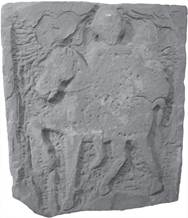
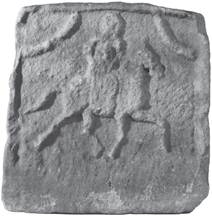
Carvings of the Gallic horse-goddess Epona (above, ht 65 cm/25½ in.) and on a tombstone of a cavalryman (right, ht 134 cm 53 in.) from Maryport, Cumbria.
From her distribution in her Gallic homeland, Epona seems to have appealed to Roman soldiers and Gallo-Roman civilians alike. She was extremely popular on the Rhine frontier, with a particular concentration of dedications from legionary fortresses east of the Rhine and in the Danube Valley.46 Her symbolism suggests that she was associated primarily with fertility. Epona is often depicted with a suckling foal, particularly in Burgundy, and corn-sheaves adorn a little bronze image of the goddess with two ponies from southern England.47 The common imagery of the goddess bearing a key also suggests her role both as guardian of stables and – more significantly – of the gateway to the afterlife. So why was such a ‘homespun’ deity as Epona worshipped by army officers? She never appears as an overtly military figure, unlike Victory. But her role as a horse-guardian (maybe even as a horse-whisperer) probably appealed to her military devotees, particularly cavalrymen, because they saw her as a protector of their mounts, and by extension themselves. And it is easy to see why people engaged in the risky business of fighting called upon a deity who could lead them safely to the Otherworld should they die in battle.
Divine horsemen
Sometime in the Roman period, a dead man was buried in a grave with an exquisite little bronze figurine of a mounted warrior at Westwood Bridge, Peterborough.48 He wears a flamboyantly crested helmet, a cuirass and a cloak; in his left hand he carries a diamond-shaped shield, and in his right he once held a spear. He sits astride a chunkily built pony with a stylized mane and tail. He looks like a Roman cavalryman, but the rider and his mount betray local craftsmanship: the man’s head is too big for his body, his shield too small to be functional, and the horse’s incised eyes and mane suggest indigenous schematic tradition.49 The same is true for a small stone carving of a mounted warrior from the Roman town of Margidunum in Nottinghamshire, depicted in an even simpler fashion. The horseman’s head is just a sphere above a rectangular slab of torso and diminutive legs, an immense spear in his hand, riding a horse smaller than a Shetland pony. The artist’s intention was clearly not to reflect realism but to present the essentials: armed warriors on horseback.50 But who were these deities? Despite the apparent romanitas of the Westwood Bridge figurine, I suspect that both these images depict local (though to us) nameless warrior-gods. Perhaps, like Epona, they represented the crucial role played by Roman cavalry on the battlefield; they may have been perceived as local deities, but were accorded the physical form of a Roman mounted soldier. But at Margidunum, at least, the craftsperson who fashioned the image played only lip-service to Classical iconographic traditions (see also Chapter 7).
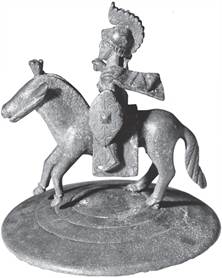
Bronze figurine of an armed cavalryman, found at Westwood Bridge, Peterborough. Ht 9 cm (3½ in.). Antenociticus: a British deity on Hadrian’s Wall
‘Two vast and trunkless legs of stone stand in the desert…Near them, on the sand,
Half sunk a shattered visage lies…’51
PERCY BYSSHE SHELLEY, OZYMANDIAS
Were it not for the accompanying inscriptions from his shrine, the fractured remains of the god in a fort at Benwell would be just as enigmatic as Ozymandias’s shattered statue in the Egyptian desert. Once a life-size statue, only the head and a few fragments of Antenociticus’s image survive. Both images are full of pathos, ruined but retaining hints of former splendour. Just outside the fort, towards the eastern end of Hadrian’s Wall, the soldiers stationed here built a rectangular stone sanctuary to a local British god called Antenociticus.52 It is a happy, though fairly unusual, happenstance that the site yielded epigraphic and iconographic evidence for his worship as well as for the building in which he was venerated. Three inscriptions tell us his name, which was entirely British, with no Roman name added, but the status of the dedicants indicates that his was a ‘high-end’ cult whose devotees included a legionary centurion and a prefect of cavalry. The name Antenociticus itself provides no key to the god’s identity but the fragmentary statue, including the head, depicts him as a youthful deity. His face was carved in the British tradition, with lentoid eyes, a wedge-shaped nose and thick, coarse hair, and he gazes serenely out over his sanctuary and those gathered to do him homage. One feature of the carved head has caused controversy: two locks of hair fan out from the middle of his head to just above each eye. Although dismissed by one scholar as a simple vagary of the hairstyle,53 others are of the view that these strands represent not hair but a pair of horns.54 The latter reading is supported by the remains of a torc (a Gallo-British necklet) on Antenociticus’s neck, broken from the body. These torcs were not only symbolic of high status but were also frequently associated with horned deities, such as Cernunnos (see Chapter 7).
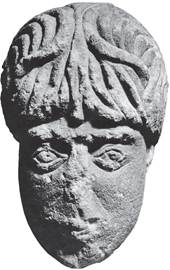
Stone head of the British god Antenociticus, part of his cult-statue from his temple at Benwell on Hadrian’s Wall. The curly horns in his hair are clearly demarcated. Ht of head c. 30 cm (1 ft).
So what was Antenociticus doing at Benwell? Was he brought to Britain by soldiers from elsewhere in the Empire? One of the altars dedicated to him was set up by a cohort originally recruited among the Vangiones, a tribe whose lands lay in northeast Gaul near the west bank of the Rhine. Was he an entirely British god, known only in this one remote spot and, perhaps, silently existing before the army arrived? Or was he, as Jane Webster has suggested for a number of the British-named deities that sprang up all over Hadrian’s Wall, an ‘invention of a god at need’?55 I suspect that, in any case, the adoption of Antenociticus’s cult by the army at Benwell was relatively short-lived, at its peak in the mid-2nd century AD, when all the surviving altars were erected, but perhaps not lasting long beyond that time. The altars were deliberately buried – significantly – face-down in a corner of the shrine, and the statue broken up: only the head was preserved: was that because it was felt to be too impious an act to smash it, when the human head was such an important cult-signature in Roman Britain? Rule Brigantia
‘Sacred to Brigantia; Amandus the engineer, by command fulfilled the order.’56
Antenociticus is just one example of an apparently British deity worshipped by Roman soldiers in the frontier zone of the province. While he appears to have been confined to Benwell, the goddess Brigantia had devotees in several places in the territory of the eponymous northern tribal hegemony of the Brigantes, a huge region stretching from Yorkshire to Dumfries and Galloway. Brigantia was the personification of the tribe and she was perceived as an armed woman, not unlike Britannia, with her shield and trident, as represented on pre-decimal British coins and other imagery. Several altars to Brigantia record her worship, by people of Gallic or British origin and by senior Roman military personnel alike.
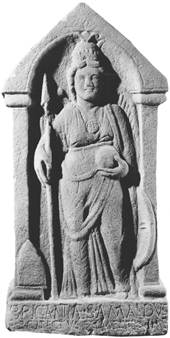
Monumental relief-carving of Brigantia from the Roman fort at Birrens, Scotland. Ht 93 cm (37 in.).
By far the most interesting dedication to Brigantia is from the Roman fort at Birrens in southwest Scotland, where a relief-carving of the goddess is accompanied by the inscription quoted above.57 She stands more than 45 cm (18 in.) high, facing the spectator, wearing an elaborate helmet surrounded by a crown representing a turreted wall, holding a spear and a globe, with a shield resting on the ground beside her. The head of Medusa is carved between her breasts and she is winged. So, in iconographic terms, she resembles a blend of the Roman goddesses Minerva and Victory: her imagery could not be more Roman, yet her crown and her name proclaim her as a guardian-spirit of British Brigantian territory. A rather eclectic dedication to Brigantia comes from Corbridge,58 an army depot just south of Hadrian’s Wall. Here a Roman centurion of the 6th Legion called Gaius Julius Apolinaris commissioned the erection of an altar to a range of gods including Jupiter Dolichenus and Caelestis Brigantia. Dolichenus and Caelestis were Syrian divinities (see Chapter 8), and it is likely that Apolinaris himself came from the east, bringing his gods with him and relating them to both the Roman and British panthea.59 The army and its gods
This chapter has had the space only to focus on a handful of the more prominent cults practised by the army in its forts and fortresses. As might be expected, the bulk of appeals to the gods made by soldiers were dedications to those appropriate to the welfare of fighting men: Mars, Victory and Fortuna. Other prominent deities of Roman origin popular with army personnel have not yet been discussed because their cults belong principally to later chapters; this is especially true of Jupiter Optimus Maximus, the focus of the Imperial Cult, Mithras, a god of Persian origin (to whom we shall return in Chapter 8), Mercury and Minerva. But it is striking how many Gallic and British divinities were worshipped by soldiers: Epona, for instance, and, curiously, the mother-goddesses. But it is time to leave the army and military cults for the present and to explore, in the next chapter, the shrines and temples built in the towns and the countryside of Roman Britain.