CHAPTER TWO Foreign Conquest and Shifting Identities New cults and old traditions
‘I will buy with you, sell with you, talk with you,
walk with you, and so following, but I will not eat with you,
drink with you, or pray with you…’
WILLIAM SHAKESPEARE, THE MERCHANT OF VENICE1
Religion has so many, sometimes contrary, facets.
It can be a powerful and positive agent for bonding people, but it can also be deeply divisive and disturbingly destructive. It can define who we are and who we are not. It can be used as a tool for ‘othering’ those who follow creeds and conventions different from what is considered ‘standard’ (whatever that may mean). In today’s multicultural world, dress and hair codes, physical appearance, gender roles, food habits and ritual practices may all serve to mark religious affiliations, making adherents highly visible, sometimes seemingly intrusive and even aggressive to those outside their particular faiths. Shylock, Shakespeare’s Venetian merchant, speaks simply and eloquently about what it meant to be a Jew in the early modern period. This seems a world away from Britain in the mid-1st century AD, when Rome sought to add the island to her Empire. Yet Shylock’s words provide a timely reminder that religion is complex and that today’s scholars need to scrutinize and interrogate the evidence from ancient literature, images and inscriptions carefully in order not to fall into the traps of over-simplification. Moreover, it is impossible to disentangle religion from ‘secular’ society. Even in the present Western world, where – in many places – formal religion is in decline, sacred architecture is everywhere: the spires of churches, mosques and temples punctuate city skylines, and a church or chapel sits at the core of nearly every British rural community. Conquest and colonialism‘The Senate and Roman people [dedicated this arch] to Tiberius Claudius Caesar Augustus Germanicus…because he received into surrender eleven kings of the Britons conquered without loss and he first brought the barbarian peoples across the Ocean under the authority of the Roman people.’ INSCRIPTION FROM THE ARCH OF CLAUDIUS, ROME2
The conquest of one people by another, more powerful one is never bloodless or peaceful.
By its very nature, conquest carries the inevitable baggage of carnage, the appropriation of land and assets and the imposition of the ‘superior’ culture upon its subjects. In spring 2016 the author travelled to Jamaica, in part to try to find out more about its original Amerindian inhabitants, the Taino (formerly known as the Arawak). When Christopher Columbus arrived in 1494, the Taino greeted him and his men in friendship, but the Spaniards’ greed for the gold they believed to be there soon turned the encounter between the two worlds into a pitifully asymmetrical conflict that caused the virtual annihilation of the peaceful Caribbean inhabitants of the island. The Taino possessed a rich spiritual tradition, with a plethora of spirits they called zemis, but in Columbus’s Christian colonization of Jamaica, their religious beliefs, too, were all but obliterated.3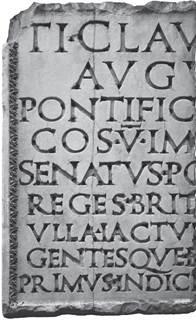
The inscription on the Arch of Claudius in Rome, referring to the emperor’s conquest of Britannia.
The inscription on the Arch of Claudius quoted above is full of the brio, bravado and swagger of the conquistador. Claudius was flexing his muscles, asserting that – despite his physical infirmities (probably cerebral palsy) – he was a supreme ruler, capable of conquering not only the fabled island of Britannia but also Ocean itself, the boundary of the world. More evocative still (and much more disturbing) is the image of Claudius and the personified Britannia carved on a stone from the shrine to Aphrodite and the Julio-Claudian emperors at Aphrodisias in Turkey (see p. iv).4 It depicts a brutal scene in which the emperor, naked but for a short cloak and helmet, kneels astride a bare-breasted woman, pinning her down in order to rape (even to sodomize) her. He is the all-powerful, muscular young hero (quite different from the middle-aged, physically impaired reality) in the ultimate act of subjugating the helpless female that is Britannia, in what Iain Ferris has aptly termed ‘the pornography of conquest’.5 The figure of Claudius is animated and full of vigour; his conquest, by contrast, is a disempowered female, her cowed demeanour vividly communicating her stress.
This image and the inscription on the lost arch, together with Claudian triumphal victory coinage, leaves us in no doubt that the Claudian conquest of Britain was far from a bloodless fusion of different cultures. Before Ground ZeroIn order to understand the religious impact of the Roman conquest on Britain, it is necessary to take a backward glance at the Iron Age rituals already in place. Scholars struggle with Iron Age religions because – certainly compared with that of Rome – they appear muted, at least in terms of their archaeological voice. Of course, Classical literary sources are of limited use, containing little that is pertinent to Iron Age Britain, except for passing references to the Druids, and the pre-Roman Britons had no tradition of written chronicles. Chapter 1 dealt with the Druids, arguably the overarching authorities on later Iron Age cult practices. But what of local cults, those followed in the numerous settlements and farmsteads scattered about Britannia? Archaeology has detected no more than a handful of firmly recognizable shrines, the best example being the circular sanctuary at Hayling Island, Hampshire.6 Its form echoes the typical Iron Age roundhouse, and it is significant that many rituals actually did take place in domestic contexts. A good example of this is the Iron Age roundhouse at Thornwell Farm near Chepstow, where the inhabitants appear to have placed special deposits of pottery and animal body parts around the southeast-facing entrance,7 as if to mark its symbolic significance (perhaps because it represented the most vulnerable part of the house).
More widespread was the practice of so-called ‘structured deposition’, where assemblages of objects were deliberately buried in pits and ditches or put into aquatic places, as if to placate the underworld or water spirits. Llyn Cerrig Bach (pp. 19–21) is a prime instance of the latter.8 Iron Age objects whose primary use was undeniably sacred are rare, though the newly discovered bronze figurine from Culver Hole Cave on Gower (see p.
ix) and some wooden images, notably the early Iron Age group from the Humber Estuary at Roos Carr,9 buck the trend of iconographic silence. Set against this tradition of sporadic, non-formalized and largely personal expressions of worship, the religious changes in Britannia following the Roman conquest, epitomized by the triumphal trumpet-blast that was the new temple to Claudius at Colchester, represented an upheaval of truly epic proportions. Gods for all seasons‘Each god used to dine at home; there was not such a mongrel galaxy of the divine powers as we have today. The stars were content with a few divinities; thus with a lighter burden they didn’t overdo the load on poor Atlas.’ JUVENAL, SATIRES10
The Roman annexation of new provinces was far from simple, in both cultural and religious terms. It is necessary to appreciate that, by the mid-1st century AD, the Roman army consisted not only of Romans from Rome or even Italy, but contained recruits from many previously subjugated peoples, including Gauls whose culture and belief systems were quite closely connected to those of Britannia. Accompanying the warrior elite, the legions, were large auxiliary forces, non-citizen military units recruited wholesale from different parts of the Empire for their particular fighting expertise, for example as archers or cavalry. The funerary inscriptions on early Roman military tombstones from Corinium (Roman Cirencester) clearly display this diversity; among those commemorated were one Dannicus, a Raurican who enlisted in the Rhenish Ala Indiana, a cavalry regiment raised by a Treveran from the Moselle Valley; and one Julius Indus Genialis, a Frisian from the Netherlands, who belonged to a mounted unit raised in Thrace.11 Both men died in about AD 60. The cultural mix in the invading force was reinforced by groups of merchants, speculators and entrepreneurs, all hoping to milk the fledgling province of its resources and take advantage of new trading opportunities, as well as to make money by providing the army with food, wine, clothes and equipment.
These diverse troops brought with them their own gods and goddesses, whom they worshipped alongside the State gods of Rome.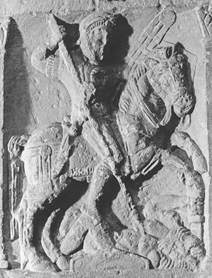
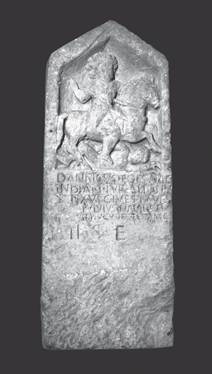
Tombstones of Genialis (ht 210 cm/ 82½ in.) and Dannicus (ht 108 cm/ 42½ in.) from Corinium. Genialis wears a Roman army helmet, in contrast to bare-headed Dannicus, who has long curly hair.
The Romans’ attitude to religion was complex. At its heart was polytheism, the acknowledgment and veneration of a plethora of deities. Some were ‘high’ gods, divinities of the State, worshipped throughout the Empire. At the opposite end of the scale were the local spirits of groves and springs, and the augenblickgotter (literally, ‘gods who supervise the blinking of the eye’), who watched over all human activity. It was this multiplicity of gods and godlings that was being mocked by the Roman satirist Juvenal, writing in the earlier 2nd century AD.
At the apex of the hierarchical pyramid of the Roman pantheon was the Capitoline Triad: Jupiter, king of the gods, his consort Juno and their daughter Minerva. Like most of the Roman ‘high’ gods, these three were the direct counterparts of Greek deities, in this case the ruling trio Zeus, Hera and Athene. Worship – particularly of Jupiter – was to a degree more about pledges of loyalty to the emperor and the Empire than religious devotion. This was especially pertinent to the Roman army: military units erected new altars to ‘Iuppiter Optimus Maximus’ (Jupiter Best and Greatest) every year on the god’s official birthday, early in January.12 When a new shrine was set up, the previous year’s dedication was ceremoniously buried. Excavations of auxiliary forts on Hadrian’s Wall, such as at Castlesteads, Birdoswald and Maryport, have revealed several such altars. Intriguingly, some of these characteristically Roman altars betray more local concerns than statements of loyalty to the emperor and the motherland: small, unobtrusive symbols of a solar wheel, the emblem of the Gallo-British equivalent to the Roman sky-god, often feature in the archaeological assemblage.
We will explore such issues of cultural fusion in Chapter 3. Worshipping the emperorFor the newly acquired Roman province of Britannia, perhaps the most crucial part of the State Religion was the Imperial Cult: the divine sanction of Roman authority. This was a strange phenomenon that took different forms depending upon where in the Empire its worship took place. According to a long-standing Roman tradition in which both kings and the deification of living people were anathema to government and people alike, reigning emperors could not be gods, but were elevated to divine status only after their deaths. But the Imperial Cult within the eastern Empire was readily absorbed into a tradition wherein living potentates, such as the Egyptian pharaohs, were already accepted as divine, and here there was no stumbling-block to the veneration of a living emperor-god. In the west, the cult of the emperor was more subtle: during an emperor’s lifetime, the cult consisted of the worship of the ‘spirit’ of empire, represented by the current ruler, and of Rome. Like the veneration of Jupiter in the provinces, the Imperial Cult was actually more a recognition of fealty to the sovereign power of Rome than a function of deep religious conviction. (Indeed, when Christianity first came to the attention of the Roman government as a significant new religious movement, the monotheistic denial of the emperor as a god was the chief source of friction and persecution, largely because Christians’ refusal to worship the emperor was perceived as sedition.)
Despite the Roman central government’s rule that living emperors could not be gods, in the provinces, the subtle distinction between a dead emperor-god and a living one was probably often missed.13 This became especially apparent – and problematic – in early Roman Britain in the furore caused by the insensitive (to say the least) erection of a large stone temple to the Imperial Cult at Roman Camulodunum (Colchester) in AD 49. Camulodunum had been the tribal capital of the Trinovantes, whose heartland was Essex; the town’s name itself is telling, for it enshrines the veneration of the tribal god Camulos, an image of whom might have survived. For an immediately pre-conquest potsherd from Kelvedon, Essex, not far from Colchester, depicts a bearded Trinovantian horseman, with stiff, lime-washed hair.14 In his left hand he carries a trapezoidal shield and in his right is a curious crook-headed staff, perhaps a ceremonial sceptre but just possibly a lituus, an object used in Roman divination rituals, but familiar to southern British tribal leaders.15 Whether the Kelvedon image represents a god or a warrior, it serves to make visible the indigenous Trinovantian presence; and if it is an image of Camulos, it is an indicator of the tension between local religious tradition and the brash new cult of the Roman emperor. For just a few years after the Claudian invasion, Camulodunum, with its modest wooden shops and houses, was transformed both by the construction of a huge Classical temple of gleaming white stone – set high on a podium, a triumphant trumpet-blast of foreign victory – and by the settling of veteran Roman legionaries there in what became the model Roman town of Colchester, a colonia, built not simply to house ex-soldiers but as a statement to the Britons of Classical civilized living. And the twist of the knife was that the locals, particularly the Roman-appointed Trinovantian priests (called severi Augustales) had to foot the bill, both for the erection of the sanctuary itself and for its maintenance. This burden was in addition to other crippling taxes levied on the population, and the confiscation of parcels of land as allotments for the retired soldiers. It was little wonder that when the Iceni rose up in rebellion in AD 60, led by Boudica, the Trinovantes gladly joined forces with their northern neighbour to throw off the Roman yoke.
Just outside the temple-steps there stood a life-sized bronze equestrian statue of the emperor Claudius, just to remind the locals whose temple it was. In his Annals, Tacitus describes the construction of the temple as ‘erected to the divine Claudius…during his lifetime’, and the author goes on to comment, with penetrating insight, that the building was ‘a blatant stronghold of alien rule, and its observances were a pretext to make the natives appointed as its priests drain the whole country dry’.16 Very little trace of the image survives but his head, brutally hacked off the body in antiquity, was found nearby, tossed into the river Alde in Suffolk; and some enraged British warrior struck off a hoof from Claudius’s bronze mount and carried it all the way from Colchester to Ashill in Norfolk, where it was deliberately deposited as a votive act, perhaps in thanks to the British gods who gave strength to the freedom-fighters. But was something else going on here? Is it possible that the treatment of Claudius’s bronze head was not simply a matter of contemptuous discard? For the Britons (and the Gauls), the human head was deemed especially iconic, the power-source of the body. Enemies were beheaded and their heads collected for display in shrines or on gate-posts of important buildings. Stone images of the severed heads of gods or humans with overlarge heads indicate the significance and reverence accorded this motif.17 In Iron Age religious traditions, both within Britain and elsewhere in western Europe, the human head was treated as an object of veneration,18 and the skulls of the dead were sometimes ritually deposited in watery places. Perhaps, in a deliberately ironic twist, the head from the hated image of imperialist domination was not thrown away, but subverted to become an icon of nationalist religious fervour. Religion and rebellion
‘The gods gave the Romans advance warning of the disaster: during the night a clamour of foreign voices mingled with laughter had been heard in the council chamber, and in the theatre uproar and lamentation, but it was no mortal who uttered those words and groans; houses were seen underwater in the river Thames, and the Ocean between the island of Britain and Gaul on one occasion turned blood-red at high tide.’19
So wrote Dio Cassius of the sinister omens surrounding the Boudican army’s sack of Londinium, a Roman port and entrepôt whose location on the great tidal river Thames caused its early florescence during the period of conquest and beyond.20 The Romans were extremely superstitious. Their world view admitted that the gods constantly intervened to control humans and bend them to the divine will through the medium of portents. The more significant the subject of the omens, the more extraordinary the spirit-manifestation might be. The incomprehensible and sinister mutterings heard in the Roman basilica (city hall) and the moaning and groaning issuing from the theatre fanned the flames of dread in a colonial community already on high alert in the face of the imminent danger from the savagery of the rebel forces bearing down upon their city, which had no walls and was virtually devoid of defence.
Similar doom-laden stories circulated around the Britons’ attack on Colchester. Tacitus goes into graphic detail about the strange prophetic happenings there, most disturbing of which was the collapse of a huge statue of the Roman goddess of Victory, which fell down ‘with its back turned as though it were fleeing the enemy’.21 Not only that, but the Roman author describes how Maenad-like women (Maenads were the frenzied followers of the Greco-Roman god Dionysus/Bacchus), in trance-state, howled gibberish in the local Roman senate-house, and tells of the phantom appearance of London in ruins. Tacitus’s account tallies in many respects with that of the later writer Dio, and it may be that the latter used Tacitus’s testimony and embroidered it. In both accounts, we may be seeing hindsight in action, but it is clear that the Roman settlers in the new province were seriously spooked – and rightly so – by prophecies of disaster (quite possibly initiated by the Druids). Britannia erupts
One well-known Roman exploiter of Britain in the early post-conquest days was the unscrupulous Stoic philosopher Lucius Annaeus Seneca, born in Cordoba in southern Spain in about 4 BC, who became chief advisor to the emperor Nero. He was a master of the double-standard: Stoicism involved personal integrity and austerity, yet Seneca was an immensely wealthy imperial official, who perceived that rich pickings were to be had from the new province.22 He lent tribal leaders in southeast Britain vast amounts of money, in the expectation of gaining lucrative returns on the loans. When the Boudican rebellion erupted, however, Seneca realized that his investments could be at risk, so he immediately foreclosed on the deals and called in the loans for repayment. Seneca was probably only one of many foreign speculators and usurers who sought to suck the life-blood from the new province by ruthless exploitation and the promise of ‘cheap’ loans to help fund the building of new roads and public buildings (like the temple of Claudius) and the extraction of new Roman taxes.23
So in the early post-conquest years, the Trinovantes were simmering, full of smouldering resentment for the Romans, and especially because of the seizure of lands that had belonged to them and their ancestors (including their god Camulos) since time immemorial. Enter Boudica, the catalyst for full-blown revolt. Her tribe, the Iceni, who shared a border with the Trinovantes, were nursing their own grievances. Prasutagus, their king, had been a client-ruler, a Roman ally who, in exchange for his loyalty to the emperor and his promise to keep the peace in his realm, had received assurances that he would keep his kingdom and be protected against hostile neighbours. But in AD 60, Prasutagus died while the Roman governor Suetonius Paulinus was far away with much of his army, smashing the Druidic stronghold on Anglesey, at the opposite end of the country. Tacitus takes up the story:
‘While Suetonius was thus occupied, he learnt of a sudden rebellion in the province. Prasutagus, king of the Iceni, after a life of long and renowned prosperity, had made the emperor co-heir with his own two daughters. Prasutagus hoped by this submissiveness to preserve his kingdom and household from attack. But it turned out otherwise. Kingdom and household alike were plundered like prizes of war, the one by Roman officers, the other by Roman slaves. As a beginning, his widow Boudica was flogged and their daughters raped. The Icenian chiefs were deprived of their hereditary estates as if the Romans had been given the whole country. The king’s own relatives were treated like slaves.’24
This episode has been touched upon in Chapter 1, in the context of native British pro- and anti-Roman factions just before and during the conquest-period of the mid-1st century AD. The client-king Prasutagus seems to have disinherited his wife in favour of his daughters as well as the emperor Nero, and it is possibly because Boudica was as anti-Roman as her husband was friendly to the new regime. This split between the Icenian king and his consort might also explain Boudica’s savage and – given her probable status as a Roman citizen – likely illegal punishment for resisting the rapacious demands of the finance minister, the procurator Decianus Catus.25
Just as Roman religion – in the shape of the intrusive Imperial Cult – played a crucial role in the British rebellion of AD 60, so too did British divine matters. We saw in Chapter 1 that the Druids represented a very real threat to Roman domination and that their resistant influence had to be erased. Dio Cassius’s account of the Boudican revolt26 reveals that Boudica herself exercised divinatory powers; he describes her use of a hare, released from her tunic to see which way it ran, in order to predict victory for the Britons before the final pitched battle with Paulinus’s forces. This ritual act took place in a sacred grove presided over by Andraste, a British goddess of victory; the wider ceremonies included well-born Roman women being impaled on sharpened stakes, and their breasts being cut off and sewn into their mouths so that it looked as though they were devouring them. Boudica’s status as a religious as well as political leader may even mean that she herself was a Druid, though there is no documentary evidence for British Druidesses, and the literary references to Gaulish female Druids all date much later than Boudica.27 Beyond Boudica: reconciliation and rebuilding
‘Still, the savage British tribesmen were disinclined for peace, especially as the newly arrived imperial agent Gaius Julius Alpinus Classicianus was on bad terms with Suetonius, and allowed his personal animosities to damage the national interests. For he passed round advice to wait for a new governor who would be kind to those who surrendered, without an enemy’s bitterness or a conqueror’s arrogance.’28
So, what was going on in the aftermath of the Boudican revolt? The rebellion itself shook the Roman Empire to its foundations, and the fledgling province of Britannia was almost lost. Under the leadership of one woman, Boudica, three major Roman towns – Colchester, London and Verulamium – had been sacked, and the 9th Legion savaged. In the wake of the final pitched battle between Paulinus and Boudica, when the British forces were defeated, the Roman governor appears to have behaved with excessive brutality towards the survivors, so the province was in meltdown. Nero made the only possible decision if Britannia was not to be lost: to replace his senior ministers in the region. The emperor’s first act was to embark on a major cabinet reshuffle in Britain, and to sack Decianus Catus, whose disastrous appointment as chief finance officer had lit the flames of rebellion. We don’t know much about Decianus Catus’s background, but he was already hated because of the high taxes he was levying on the Britons, and may also have had a hand in the dispossession of the Trinovantes from their lands to make way for the settlement of retired Roman legionary veterans. It was his high-handed behaviour in seizing Icenian assets and brutalizing its royal family after the death of king Prasutagus that had sparked the terrible events that followed, and it was clearly felt that he had to go immediately, and that the restoration of financial security in Britannia was even more crucial than Suetonius’s removal. Significantly, his replacement as procurator, Classicianus, was not a Roman but a provincial from northeastern Gaul. Appointing him to Britain was a shrewd move on Nero’s part, for although technically subordinate to the provincial governor, procuratores augusti were independent of his authority and reported directly to the emperor. As a Gaul, Classicianus was likely to have empathy (if not sympathy) for the Britons, and he was clearly effective, for he warned Nero of Suetonius’s excesses and ensured that the next governor, Turpilianus, was not a career soldier like his predecessors but a man skilled in administration and arbitration, who would consolidate the parts of Britain already annexed rather than attempt to beat the fringes of the province into submission.
If Classicianus was a key player in the future of Britannia as a Roman province, his death also provides significant information concerning religious ritual. His Gallic origins were no bar to his achievement of high office in Roman provincial administration. Despite his conciliatory attitude to the Britons, he was, by allegiance, a Roman first and foremost, and his status is reflected in the rites surrounding his death and burial. In 1852, a fragmentary inscription was found on a stone reused in the Roman wall that was raised to defend Londinium after the rebellion.29 It was part of an elaborate Cotswold limestone tombstone, with an ornamental ‘bolster’ design on the top that was erected over the procurator’s cremated remains in about AD 65. His tombstone is a very direct statement of romanitas, being utterly Roman in every way, not least in its adherence to the Roman custom of committing the dead man’s soul to the Roman spirits of the Otherworld. The inscription tells us a great deal about this man, including that he died when still in office and that his widow, Julia Indiana Pacata, daughter of Indus, had the gravestone built in his memory. Classicianus’s names indicate both that he came from northern Gaul and that he was a Roman citizen (at this period, only this chosen few possessed three names). His widow’s father, Indus, belonged to the tribe of the Treveri, in the Moselle Valley, though Tacitus comments that Julius Indus had been a Roman collaborator during the great rebellion of the Rhenish tribes led by Florus and Sacrovir in AD 21.30 So Classicianus came from a northeastern Gaulish family who had prospered by becoming Roman, but who were particularly useful to Rome because of their provincial origins.
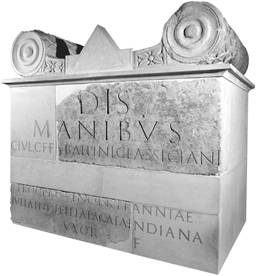
The tombstone of Gaius Julius Alpinus Classicianus, found in London. 162.5 ? 155 cm (64 ? 61 in.). Bodicacia’s tomb
There is no direct archaeological evidence for Boudica’s existence. It is even possible that she was entirely a figment of the Roman imagination, a trope of barbarism, with her long red hair, masculine appearance and harsh voice – even her name straightforwardly means ‘victory’. However, in February 2015, excavations on the Bridges Garage site outside the Roman west gate of Corinium (Cirencester) yielded a startling find: an early 2nd-century AD Roman tombstone set up in memory of a twenty-seven-year-old British woman called Bodicacia, a name closely connected etymologically to Boudica (see p. vii). Could it be that Bodicacia was a relative of Boudica, or simply that she, too, bore a name meaning ‘victory’? The gravestone was not found in situ but had been moved from its original position and placed face-down on a much later Roman inhumation grave.31 The significance of the Bodicacia tombstone does not end with the inscription itself; its form, its iconography and its later reuse also reveal early Romano-British religious beliefs and practice.
Bodicacia’s tombstone came from a cemetery used throughout the Roman period, whose early phase saw the construction of a square stone edifice, possibly a mausoleum. The tombstone itself is topped with a decorative triangular pediment, as if to mimic a Roman temple. Within the triangle was carved the face of Oceanus, the sea-god who, according to Classical tradition, was thought to gird the known world, with the wild land of Britannia lying beyond its boundaries. The depiction of Oceanus on a tombstone is extremely rare, but other, similar imagery from a stone sculpture32 and a mosaic33 from Corinium suggests that he, or a local river-deity, may have been accorded special significance here. On Bodicacia’s tombstone, Oceanus’s long, flowing hair and beard and his crown of crabs’ claws survive, but sometime in antiquity his image was literally defaced, the facial features deliberately obliterated. While the other Corinium sculpture is worn and battered, there is no firm evidence that it was similarly defaced. Was somebody trying to erase it because of a change in ideology or religious thinking later in the stone’s history, perhaps when it was reused as a grave-cover? There is another dimension to the Oceanus head. Although the protruberances sprouting from his hair are undoubtedly the claws of a crustacean, as befits a sea-deity, they look remarkably like the antlers surmounting the head of another stone image from Cirencester showing a seated male figure clasping a pair of ram-horned serpents, often interpreted as the Gaulish stag-god Cernunnos, whose worship is known elsewhere in Britain (see pp. 142–43).34
Bodicacia’s tombstone is otherwise in near-perfect condition, its surface unweathered, the inscription as sharp as the day the scriptor cut it. This is because more than a century after it was raised in the young woman’s memory, the stone was removed from her grave and repositioned, face-down, to form the lid of a later inhumation burial. Why was the stone inverted? Was it to appease the spirit of its original owner or, more likely – in my opinion at least – a deliberate act of engagement between past and present souls? By placing the inscription facing down into the new grave, perhaps the newly and older dead were able to communicate, and the ancestor able to provide comfort for the fresh corpse.
The turbulence of the eastern tribes, which culminated in the cataclysmic Boudican rebellion, should not lead us to imagine that the whole of southern England was in turmoil in the years after the Claudian invasion. The very Roman tombstone commemorating a woman with the very British name of Bodicacia reminds us that early Roman Britain was complicated. The Corinian woman was a member of the Dobunnic tribe, whose incorporation into the Roman province is mentioned only briefly by ancient commentators. Dio Cassius remarked that the first governor, Aulus Plautius, ‘secured the surrender on terms of part of the Bodunni [Dobunni] tribe who were subject to the Catuvellauni’, and left a garrison there.35 This laconic statement by a late Greco-Roman historian contains the important point that at least part of the Dobunnic people and their territory had been in vassalage to its more powerful eastern neighbour. So it may well be that the intervention of Plautius was welcomed by the Dobunni as being more palatable than their previous domination by the Catuvellauni. We know from coins that a local Dobunnic king, Bodvoc, ruled the tribe in the earlier 1st century AD.36 It is possible that he, or a successor, became a client-king of Rome, like Togidubnus in West Sussex (see pp. 12–13) and Prasutagus. The discovery of Bodicacia’s tombstone may be taken as an example of early interconnectivity between Britons and Romans in the first days of the province, as exhibited in the mixture of funerary and religious symbolism and in the adoption by British mourners of Roman ways of remembering their dead. New gods and old beliefs
‘Though he slays, in Numa’s fashion,
lambs and russet steers,
He swears before Jove’s high altar
By none but his revered
Goddess of horses, and images daubed
On the stinking stalls…’
JUVENAL, SATIRES37
In this early 2nd-century AD poem, Juvenal jeers at a Consul called Lateranus, who was probably of Gaulish origin. The reference to the ‘goddess of horses’ is to the Gallic horse-deity Epona. Juvenal does not approve, sneering at Lateranus for paying lip-service to the Roman State gods, Numa and Jove, aping the most respected of the early Roman kings, while implicitly venerating his favourite local animal-divinity. Juvenal disapproved of a lot in Roman society; he did not like foreigners and he particularly objected to those jumped-up provincials who assumed high office and threw their weight about while pretending to possess a Roman pedigree. I am sure that Juvenal was far from being alone in his ‘us’ and ‘them’ attitude to people and cults he considered strange, vulgar and inherently un-Roman.
On 25 May 2016, The Times published an article by Alice Thomson about the rise in the number of faith schools in Britain, and the increase of religious prejudice in some of them, thereby exposing students to a culture of intolerance and perhaps even extremism.38 This piece prompted a riposte in a letter from the Rev. Nigel Genders the following day: ‘But for children, learning about faith is about discovering themselves, their identity and how they relate to their friends.’39 These two notions of faith-teaching encapsulate just how emotive issues of belief and religion can be. The underlying message of Thomson’s original article can be perceived as one of imbalance between two ideologies, where one displays far more zealousness in its presentation than the other; in Genders’ response, the emphasis is on the fundamental importance of religious faith, not just for its own sake but also as a platform for informed and curious enquiry about differing secular views of the world. Divergent though they seem, both viewpoints can contribute to the question of religious interaction between Roman incomers and the indigenous British population during the years immediately following the establishment of Britannia as Rome’s newest imperial acquisition.
In trying to understand religious beliefs and rituals in early Roman Britain, a different kind of asymmetry from that examined in Thomson’s article is manifest. Roman religious systems appear to have had far more formalized structures than those of native Britons and, just as importantly, the physical expression of such systems was much more tangible and visible than was the case for local British cults (at least in the archaeological record). Two traditions were vital for the intense physicality of Roman religious expression: the epigraphic habit and the iconographic habit, added to which was the choice of permanent material – stone or metal – for building temples and making divine images. For pre-Roman Iron Age Britain, as for its Gallic neighbour, religion was a more ‘silent’ affair, with virtually no inscriptions, few formally structured sanctuaries – certainly nothing comparable to the architectural templates adhered to by the Romans – and scarce images, most of which were probably made of wood and thus perishable.
There is little literary or archaeological evidence for religious persecution in Britain during or after the conquest, the exception – of course – being the attempted annihilation of the Druids, though this was largely motivated by the recognition that they were powerful political agents for resistance and rebellion. Indeed, the Romans have a reputation for being ‘tolerant’ towards the cult-systems of their provinces and for being receptive to the adoption and absorption of foreign deities into their own pantheon. This is at least partly due to the multi-god cosmologies that existed in much of the ancient world; tension did, of course, arise when Roman polytheism clashed head-on with monotheistic Judaism and then with Christianity. However, while monotheism was not present in early Roman Britain, it would be rash to assume a complete absence of religious tension following annexation. Juvenal’s attitude makes Roman prejudice seem very real, even if he was only speaking for one who lived in the city of Rome itself. So the study of religious epigraphy and imagery in Roman Britain can be meaningful only if approached not through a lens of neutral ideology or benign syncretism, but against a model of competitive power-hierarchies.40 The interaction between official Roman religion and the belief systems of the peoples colonized under imperial expansion was by no means an anodyne ‘marriage’. Feelings of colonial superiority, tensions and subversions must have marched alongside the religious connections between Rome and Britain. The hated temple to Claudius, brashly erected at Colchester only a few short years after the invasion of AD 43, would not have been easily forgotten or forgiven by those who had to see it daily where their old shrine had stood, and not least to pay for it. Yet at about the same time as this temple was built and destroyed, another was constructed at Chichester by a British king, Togidubnus, who adopted the name of his emperor, Tiberius Claudius, and who dedicated his sanctuary to ‘Neptune and Minerva, for the welfare of the Divine House [of the emperor]…’.41 But even Togidubnus, Rome’s friend, ally and client-king, stressed in his temple dedication that he was a great British king. Early tensions within the new province are exemplified by Suetonius Paulinus’s destruction of the Druids’ holy of holies on Anglesey. British subversion to Rome and a counter-religious movement may be expressed by the human sacrifice of Lindow Man (see p. 17), if he was ritually murdered as part of a last-ditch attempt to avert the Roman army’s push towards the island.42
As we explore the cults that proliferated in Britannia in the post-conquest period, it will become increasingly clear that post-colonial perspectives on Romano-British religion can only take us so far. Yes, the introduction of Roman methods of cult-expression, like epigraphy and image-making, appears to skew the balance between Roman and native, so that romanitas is the more visible. But cultural interaction, even in a colonial situation, was a two-way street (a principle explored in Chapter 11). Given that there was undoubtedly a degree of coercion and ‘conqueror-muscle’ in the early days, religion in Britain became more Romano-British than either Roman or native. But the persistence not only of local beliefs but also of the long-standing spiritual ties with neighbouring Gaul is abundantly expressed in the developing arenas of epigraphic and iconographic cult-expression. These multi-cultural religious issues are explored in the pages that follow.