CHAPTER ONE The Druids Priesthood, power and politics
‘But, we all owe a debt beyond measure to the Romans because they destroyed these horrible activities in which human sacrifice was thought to please the gods, and eating the victim thought to be good for one’s health.’
PLINY THE ELDER1
Pliny compiled his monumental Naturalis Historia in the 1st century AD.
He collected information from all over the then known world, mining the writings of hundreds of previous authors, some of his resultant work factually accurate, but much of it warped by an overactive imagination and a certain credulousness. In this quotation, the author was referring to the Druids, the high priests in charge of religion in Gaul and Britain in the last few centuries BC and still highly influential at the time of the Claudian invasion of Britannia in AD 43. Pliny was by no means alone in his literary condemnation of the Druids as savage, barbarous and wildly uncivilized, but his testimony takes intolerance to a whole new level: Pliny was unable to resist the temptation to add a further layer of shock and disgust to his comment about human sacrificial practices, laying the charge of cannibalism at the Druids’ door. This has interesting parallels with similar charges levelled at early Christians, whose Eucharistic rituals were interpreted by some of their pagan contemporaries as involving the literal consumption of a person’s flesh and blood.2The Druids’ arena was Iron Age Britain and Gaul, particularly during the 1st centuries BC and AD (though there is literary testimony for their presence in Gaul as late as the 4th century AD), and they are crucially important to the story of early Roman Britain because they represented an organized, well-educated religious opposition to the imposition of Roman rule on the island, one capable of causing very real problems to the invading army, and the new administration and governance introduced by Rome.
The Druids thus played a significant role in the shaping of the new province of Britannia during its first decades. The seismic shift in British society caused by the new order threatened to take away the Druids’ power base and, indeed, their raison d’être. So, in opposing romanitas, they were fighting for their very survival. Human sacrifice‘The Gauls believe the power of the immortal gods can be appeased only if one human life is exchanged for another, and they have sacrifices of this kind regularly established by the community. Some of them have enormous images made of wickerwork, the limbs of which they fill with living men; these are set on fire and the men perish, enveloped in the flames. They believe that the gods prefer it if the people executed have been caught in the act of theft or armed robbery or some other crime, but when the supply of such victims runs out, they even go to the extent of sacrificing innocent men.’ CAESAR3
The Romans took the moral high ground when it came to ritual murder, even though such practices only became illegal in Rome as late as 97 BC. Accusations of such barbarous rites as endemic within the Druid-ridden societies of Britain and Gaul could therefore be used as a convenient smoke-screen in order to justify the annihilation of a dangerously nationalistic priesthood. The reality of human sacrifice in late pre-Roman Britain is difficult to evaluate. Some of the human bodies buried in disused grain silos at Danebury, Hampshire, may well have been sacrificial victims. Heads, complete bodies and separated body parts were carefully interred here, and at least some of the skeletons show evidence of having been bound.4 At Alveston, near Bristol, human remains bearing evidence of violence and dating to the late 1st century BC were found in a sinkhole, and may have been victims of ritual murder.5 But the bias of foreign texts, coupled with the ambiguity of archaeological testimony, presents a stiff challenge to objective considerations.
Of the various possible candidates for such ritual killings, two Roman-period deaths are especially persuasive: those of the bog-man from Lindow Moss in Cheshire, who died in the mid-1st century AD,6 and a young boy whose defleshed skull shows signs of wear on the base, indication that it was mounted on a pole and displayed in front of a shrine at Folly Lane in 2nd-century AD Verulamium. ‘Lindow Man’ underwent a complicated and prolonged death that involved at least three fatal injuries – blows to the head, strangulation and throat-slitting – before he was pushed head-first, naked, into a remote marsh pool. It is hard to interpret such a calculated series of acts as having any other than a ritual purpose. The adolescent boy from the Roman city of Verulamium – killed by a massive head-injury – may also have been a ritual victim and, if so, proves that such practices were not entirely stamped out by the Roman presence. The child’s head was carefully stripped of its flesh, using a thin, sharp-bladed knife, placed on display outside a temple and then interred in a deep pit together with the body of a puppy and a whetstone, used for sharpening tools.7 This burial is itself interesting in as much as the items accompanying it appear to reinforce both the boy’s youth and the manner of his head’s defleshing, with a sharpened knife. Bearing in mind the Classical literary testimony linking the Druids with human sacrifice, it is possible – maybe even likely – that they were involved in these British ritual killings, even though their spheres of influence would have declined sharply following the Roman occupation.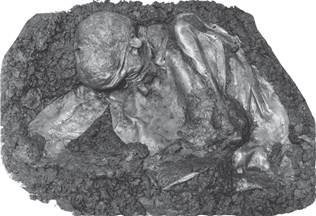
The body of Lindow Man, a young adult male ritually killed and placed in a peat-bog at Lindow Moss, Cheshire, in the mid-1st century AD. Druids’ footprints: material remnants of an ancient priesthood
‘Hailing the moon in a native word that means “healing all things”, the Druids prepare a ritual sacrifice and banquet beneath a tree and bring up two white bulls, whose horns are bound for the first time on this occasion.
A priest arrayed in white vestments climbs the tree and with a golden sickle cuts down the mistletoe, which is caught in a white cloak.’ PLINY THE ELDER8If we believe the testimony of ancient authors such as Caesar and Pliny, the Druids were a hugely dominant force within Britain and Gaul before and during the process of bringing these western regions into the fold of the Roman Empire. If so, such a group might be expected to have left tangible traces of their ritual activities within later Iron Age material culture, even if they were to all intents and purposes emasculated under imperial rule. The reality is that, despite a wealth of archaeological material relating to cult matters, there is virtually nothing that can be linked unequivocally to the Druids. However, there is some persuasive circumstantial evidence both for Druidic presence in Britain and, even more so, in Gaul. Anglesey: the sacred isle of Mona
‘The groves devoted to Mona’s barbarous superstitions he demolished. For it was the Druids’ religion to drench their altars in the blood of prisoners and consult their gods by means of human entrails.’ TACITUS9
The ‘he’ mentioned here is Suetonius Paulinus, Roman governor of Britain in AD 60, and the occasion to which Tacitus refers is Paulinus’s strategic attack on Anglesey, a remote island off the northwest coast of Wales reputed to be the Druids’ holy of holies. No archaeological evidence for such a sanctuary survives, which is not altogether surprising, given that Paulinus’s army burned it to ashes. However, there is a site on Anglesey that was clearly of major religious importance during the later Iron Age: Llyn Cerrig Bach.
In 1942, the military airbase at RAF Valley in northwest Anglesey underwent construction work. As part of the operation, a peat-bog was excavated and a large amount of Iron Age metalwork came to light.10 The material was deliberately deposited by the ancient island inhabitants on a dry islet within the swamp, and included high-status martial equipment, such as swords, spears and parts of shields, and horse-gear and chariot-fittings, including iron nave-hoops for the wheels.
Some of the copper-alloy objects were decorated with La Tène designs.11 These abstract and animal- and plant-based motifs, named after the site on the shore of Lake Neuchâtel in Switzerland where they were first recognized on hundreds of Iron Age metal objects in the late 19th century, are found across Britain and non-Mediterranean Europe dating between c. 500 BC and the early years of the Roman period. Recent research at Anglesey has identified a number of phases of deposition, between the 4th century BC and the early 2nd century AD, suggesting that people visited the site over a long period, perhaps as pilgrims.The practice of deliberately placing valuable objects in watery places has long been recognized as a sacrificial rite widespread in Bronze Age and Iron Age Britain and Europe.12 Bogs, pools, lakes and rivers were persistently chosen as foci for sacred activities, offerings often being made to the gods perceived as dwelling therein. Water seems to have been regarded as special, and charged with supernatural energy. The ancient Greek geographer Strabo, writing in the late 1st century BC and early 1st century AD, describes the practice of sinking great masses of gold and silver treasure into sacred lakes. He explains that nobody dared to profane these watery offering-places by trying to steal their contents.13 At Llyn Cerrig Bach, the first phase of religious expression appears to be represented by animal sacrifice; unfortunately, during excavation only a very few animal bones were collected, and the majority of those thrown away without proper assessment or recording, but a pony, sheep, cattle and dogs were among the beasts whose remains were found at the site – though sadly no evidence survives as to how they met their deaths.14 In any case, this practice was later replaced with the destruction and offering of prestigious metal goods.
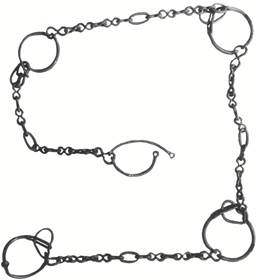
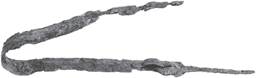
Late Iron Age iron slave-gang chain (top) and bent iron sword from a sacred lake at Llyn Cerrig Bach, Anglesey.
The site of Llyn Cerrig Bach may have been purposely chosen because of its extreme remoteness from the rest of Britannia: Anglesey is off the northwest coast of Wales, and the sanctuary itself lies on the far northwest of the island. While there can be no direct connection between this rich deposition site and the Druids, it is nonetheless tempting to imagine a link with Tacitus’s sacred Druidic grove. Islands may be considered special, ‘thin’15 places, where the divide between the realms of the sacred and the mundane can seem particularly narrow. Such ‘thin’ places were, and are, repeatedly sought out as loci of spiritual refuge. In about AD 600, the remote island of Skellig Michael 8 miles (13 km) out in the Atlantic on the southwest coast of Ireland, was home to a tiny early Christian monastic community, its drystone circular houses and oratory perched precariously on the precipitous barren rock.16 I have been fortunate enough to visit Skellig Michael myself, and it is the epitome of both wild isolation and tranquillity. The sea is treacherous and landfall almost impossible unless the ocean is dead calm. Similarly ‘thin’ places exist today, for example in northern Greece, in the Meteora and Mount Athos, where Greek Orthodox monasteries are suspended in the air on near-vertical cliff faces and rock pinnacles.17
Many medieval Celtic myths refer to the Otherworld dwelling places of the spirits as being on islands, like the ‘Isle of Apple Trees’ described in the early Irish text The Voyage of Bran, synonymous with King Arthur’s Avalon (‘Apple Isle’).18 One of the things about Britain that fascinated the Romans was its separation by the sea, or the great river Ocean, from the ‘known’ world, a feature that led some even to doubt its very existence. In an emotive text, an unknown author of a festival oration created for a late Roman emperor described Julius Caesar’s attitude to Britain when he first visited it in 55 BC: the Roman commander was amazed by its sea-girt remoteness and felt that he had ‘found another world’.19 If Britain itself was regarded an enigma, then Anglesey (and its Druids) must surely have seemed sufficiently off the scale of oddness to be surrounded by mystery and spirituality, a place to draw Roman pilgrims20 and, at the same time, to be worth Suetonius Paulinus’s while to desecrate and destroy. ‘Druidic’ regalia in Iron Age Britain
The single quotation marks bracketing ‘Druidic’ are well placed because there is no solid archaeological evidence for the presence of the Druids in Iron Age Britain. Although the material from Llyn Cerrig Bach is persuasive because of the Tacitean link between Anglesey and the Druids, even that association is by no means certain. However, Iron Age British sites have produced some spectacular artefacts associated with cult practices.21 Among these, headdresses and ‘divination’ spoons are especially compelling. A headdress, superbly reconstructed by National Museum Wales, comes from a grave at Cerrig-y-Drudion, Denbighshire, in North Wales, dating to the 4th century BC (see pp. ii–iii).22 Three centuries later at the opposite end of Britannia, a young man died and was given a ceremonial burial with a spectacular array of military equipment in the cemetery at Mill Hill, Deal, in Kent.23 Two things mark him out as having a possibly sacred role in his community: on his head he wore a decorated bronze diadem, of a kind so far unique to Iron Age Britain and Europe but comparable to ritual crowns discovered at Romano-British temple sites,24 rather than the helmet we might expect of a military man; and his body was interred not in the main part of the burial-ground but positioned on its outer edge, as if – perhaps – he was considered too charged with spiritual force to be with the other bodies, maybe even a shaman.25 His burial, close to a Bronze Age barrow, may be significant: in putting his body there, were his mourners deliberately referencing the earlier burial, as if it were perceived important to connect him with the past, with a site of earlier reverence and perhaps even seen as close to his ancestors? If the man from Deal was a religious practitioner, his interment with a sword and shield might feasibly be interpreted as a mark of especial respect, somewhat akin to the ‘full military honours’ accorded some prominent people, not just soldiers, in today’s world.
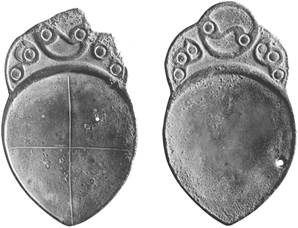
Pair of bronze ‘divination spoons’ from Castell Nadolig, Cardiganshire, 1st century AD. L. c. 11 cm (4¼ in.).
If the Deal man was a shaman working in Britain in the early 1st century BC, one of his principal tasks would have been to divine the will of the gods and the future of his community (see Chapter 6). To help him accomplish this role, the tools of his trade might have included the curious pairs of ‘divination spoons’ frequently found as grave-goods or ritually deposited in marshes within late Iron Age Britain. The precise function of these objects cannot be known for certain but, interestingly, just such a pair was found in another grave at Deal.26 In most instances, the inner surface of one spoon was divided into four quadrants by intersecting incised lines, while that of the other spoon had a hole drilled through it. One theory is that the two spoons were placed together so that their flat surfaces were touching, then a liquid or powder blown through the hole. ‘Reading’ the resultant scatter of deposit on the quadrant-marked spoon could have been used to determine whether the omens were good or bad.27 Pride and prejudice: the chroniclers of British Druidism
‘The system of divination is not even neglected among barbaric peoples, since in fact there are Druids in Gaul; I myself knew one of them, Divitiacus of the Aedui, your guest and eulogist, who declared that he was acquainted with the system of nature which the Greeks call natural philosophy and which he used to predict the future by both augury and inference.’ CICERO28
In order to put the flesh on the bones of ancient Druids, we must turn to the (biased) reporting of their Roman contemporaries. There could hardly have been a more dyed-in-the-wool Roman than the urbane, sophisticated and well-connected Marcus Tullius Cicero, a prolific author, philosopher, politician, lawyer and orator. The above quote comes from a letter he wrote to his brother Quintus, a soldier, while hosting the Gallic Druid Divitiacus. The meeting with the Gallic Druid to which he refers took place in 60 BC, when Divitiacus visited Rome in order to petition the Senate for military aid in the repulsion of the German leader Ariovistus, who was threatening to invade Aeduan territory in Burgundy.29 Cicero’s description of this Druid is both admiring and patronizing: it betrays surprise and grudging respect for a ‘barbarian’. Contrary to Cicero’s expectations, the foreign religious leader had shown talent in a field deeply significant to Roman religious custom, namely the ability to predict the future by contact with the spirit world, which was possible only if the correct ritual practices were observed; maybe Divitiacus used equipment like the divination spoons found at Deal.
Julius Caesar was a contemporary of Cicero’s, but far more familiar with contemporary Gaul, having served nearly ten years there as conqueror and governor. Quintus Cicero served under him and had probably written about him to his brother. Caesar himself appears to have had few prejudices against the Druids, despite their potential for undermining his authority and fomenting rebellion. Indeed, he wrote of them at some length in Book Six of the eight-volume Commentarii de Bello Gallico, describing their far-reaching influence in the fields of religion, politics, teaching and judicial matters.30 Caesar and Divitiacus were allies, and even friends; Divitiacus was loyal to the Roman general, supporting his campaigns and keeping his army supplied with grain. However, the Aedui were split into pro- and anti-Roman factions, the former led by Divitiacus and the latter by his fervently nationalistic brother Dumnorix. The brothers shared political leadership of their divided tribe, and they seem also to have shared religious duties, for although Dumnorix’s role as a priest (or Druid) is never explicitly stated by Caesar, it is implied by the freedom-fighter’s reluctance to accompany Caesar to Britain for the general’s second expedition to Britain in 54 BC. Dumnorix is quoted by Caesar as having produced two excuses for not wishing to travel away from Gaul: that he was frightened of sailing the ocean and that ‘religious considerations prevented him’.31 What Dumnorix failed to mention was his anti-Roman fervour, which made him too dangerous for Caesar to leave behind in Gaul while absent in Britain. Island of magic: changing Roman attitudes
‘Even today Britain is still spell-bound by magic, and performs its rites with so much ritual that she might almost seem to be the source of Persian ritual.’ PLINY THE ELDER32
If high-profile Romans like Caesar and Cicero had respect for the Druids in the mid-1st century BC, opinion shifted sharply in the next century, when Pliny the Elder specifically records the desires of early Roman emperors to eradicate them. Caesar made a direct association between the Druids and Britannia, commenting that ‘it is thought that the doctrine of the Druids was invented in Britain’.33 A hundred years later, Pliny the Elder said precisely the opposite, claiming that Druidism spread from Gaul to Britain. In language charged with high drama, he wrote, ‘why should I call to mind these matters of a profession which has now crossed the ocean and betaken itself to the void [Britannia] beyond our world?’34 This comment is significant, for what Pliny was doing, in a sense, was equating the Druids and the Britons as (literally) beyond the pale of civilization. He compounds his diatribe against the Druids with his assertions that they practised human sacrifice and cannibalism.35
Attitudes demonstrated by other authors broadly contemporary with Pliny, such as Lucan and Tacitus, betray similar prejudices levelled at a priesthood and an island each inspiring Roman fear and hostility in equal measure. Lucan’s tone is very similar to Pliny’s, commenting darkly on the Druids’ return to their ‘barbarous rites’ and ‘wicked religion’ when the opportunity arose, as the Roman focus was distracted by the civil war between Caesar and Pompey.36 Although Lucan does not dwell specifically on the association between the Druids and human sacrifice in this particular passage, earlier in the same piece he does speak generically about ritual murder as practised by ‘those Gauls who propitiate with human sacrifice the merciless gods Teutas, Esus and Taranis…’.37 And it is difficult not to believe that by his phrase ‘their wicked religion’, he was referring to the sacrifice of human victims, for it is hard to imagine what else would have caused him such shock and revulsion. Family factions in the face of Rome
Political splits, such as that between the two brothers of the Aeduans’ ruling family, were by no means confined to Gallic political systems during the 1st centuries BC/AD. At least two British tribes are recorded by Roman authors as suffering similar divisions in broadly contemporary circumstances: the Iceni of East Anglia and the northern Brigantes. Both involved not siblings, but spouses. The more well documented of the two, recorded by Tacitus, occurred in the north, where queen Cartimandua was the reigning monarch. She was a Roman ally, a client-queen, while her husband and consort Venutius was fervently anti-Roman. History has frowned upon Cartimandua for her betrayal to Rome of the British freedom-fighter, Caratacus, after he had fled from his homeland in eastern England to her realm for refuge in AD 51.38 As for Venutius, he had personal reasons to dislike his wife, beyond their political differences; he was understandably bitter as she had indulged in an adulterous liaison with his armour-bearer, Vellocatus,39 thereby not only cuckolding him but dishonouring his family.
Although the documentary evidence concerning the Iceni is less clear, reading between the lines it is possible to infer that similar splits occurred along the marital fault-lines between the rulers Prasutagus and Boudica. Prasutagus was, like queen Cartimandua, a client-monarch and when he died he left his fortune and his lands jointly to his daughters and to the emperor Nero. One of the issues that incited his widow Boudica to lead the Britons into a calamitous rebellion against Rome was the brutal seizure of Prasutagus’s assets by Decianus Catus, the Roman procurator (finance minister) assigned to Britain, which – according to Tacitus40 – included the raping of the Icenian princesses by Roman soldiers and the public flogging of Boudica herself. But why did Boudica’s protest against Catus’s action provoke such a ferocious response? It seems as if there must have been ‘history’ to Boudica’s relationship with Rome and that, despite Prasutagus’s pro-Roman ally status, she had a reputation for being a British agitator.
So how did these inter-family factions come about? This issue is a key factor in our understanding of British attitudes to the Roman presence. The answer, in part at least, lies in the relationship between Britain and Rome in the century prior to the Claudian invasion of AD 43. This was a time when the noble families, particularly in southeast England, were coming more and more into contact with the Roman world, particularly with respect to trade. But more significantly, certain British ruling families took the decision that romanitas was the future, so they sent their sons (and maybe daughters too) to Rome to be educated (see pp. 11–13). One of these, almost certainly, was the client-monarch Togidubnus, upon whom the Roman government bestowed large tracts of land in southeast England, in gratitude for his pro-Roman stance in the early years around the time of the Claudian invasion.41
When lordlings, such as Cartimandua and Togidubnus, returned to Britain after their sojourn in Rome, some of them might well have thrown their weight about, lording it over their fellows and scorning their parochial ways, breathing seditious allegiances to their foreign hosts and attempting to overthrow local traditions. No wonder, then, that factions thrived among these divided families. It is almost irresistible to make comparisons between this situation in ancient Britain, on the cusp of its engulfment into the huge maw of the Roman Empire, and the current divisions in Britain between the advocates of Brexit, fearful of the cosmopolitan influence of the European continent over ‘traditional’ British culture, and pro-European unionists following the historic national referendum that took Great Britain out of the European Union. In Britannia in the 1st centuries BC and AD, such schisms would have wrought profound changes to local attitudes towards politics, nationalism and, of course, religion. Druids in the Roman Empire: disintegration or survival?
‘There came a time when the emperor Aurelian, anxious to ascertain whether his lineage would continue to wear the purple after his death, sought to consult the female Druids residing in Gaul. They responded by saying that it would be Augustus’s line, not Aurelian’s that would be the most renowned in the Empire.’ SCRIPTORES HISTORIAE AUGUSTAE42
Aurelian, commander of the elite Dacian cavalry, assumed the purple (that is, became emperor) in AD 270. He was a Dacian, from Transylvania, and he was put on the imperial throne by the army after the military deposition of his predecessor Gallienus. What are we to make of this writer’s account of Druidic predictions of the new emperor’s accession? The dubious nature of these late Roman texts, also known as the Augustan Histories, has long been appreciated by Classical scholars, one of whom scathingly referred to them as ‘generally damned and generally used’.43 Despite major problems and controversy surrounding their authorship, these documents cannot be completely discounted as literary evidence for the late Empire. A striking feature of the passage quoted here is that it is one of several prophecies within the Histories involving emperors-in-waiting and female Gallic Druids.44 Behind the stories, we can glean that for each of these would-be-rulers the certainty of succession was bolstered by the prognostications of even the most obscure provincial religious leaders who upheld their Druidic traditions. If these tales tell us nothing more, at least they suggest that, far from being forgotten, the Druids remained within the Roman consciousness at the highest levels. The Histories are the only known ancient texts unequivocally to mention female Druids. The nearest equivalence comes from Tacitus two centuries earlier, in whose narrative of Paulinus’s destruction of the Druidic stronghold on Anglesey mention is made of ‘black-robed women with dishevelled hair like Furies, brandishing torches’,45 who stood alongside the Druids themselves on the shore to confront the Roman army. The Chartres ‘magician’: shaman or charlatan?
The (albeit unreliable) testimony of the Augustan Histories challenges the claims of authors such as Pliny46 and Suetonius, the gossipy biographer of ‘the twelve Caesars’, that the emperor Claudius wiped out the Druids completely.47 But there is some eccentric and tenuous – but nonetheless plausible – archaeological evidence for Druidic survival (or even reinvention) in Roman Gaul, at Chartres, Roman Autricum, originally the capital of the Iron Age Carnutes tribe in northern France. On 20 July 2005, construction workers excavating the site for a car park in the centre of Chartres stumbled upon a small underground shrine beneath the burned-out ruins of a Roman house. The little sanctuary had been protected and preserved for two thousand years by the collapsed dwelling and, when the house was occupied, worshippers would have gained access to the basement-shrine by means of a wooden ladder, placed atop a short flight of stone steps. Safely concealed under the stairs was a cache of sacred material, including pottery vessels, oil-lamps and a broad-bladed knife, of the kind used in killing sacrificial animals.48
Why is the discovery of the Chartres shrine relevant to Druidic survival into Roman imperial times? The answer lies in the deposition there of at least three large inscribed pottery incense-burners (thuribula). Only one of the vessels survived intact but it was covered with four panels of cursive writing, scratched onto the outer surface of the censer with a pointed instrument, probably a stylus, when the clay was hard but before firing. Each block of script begins with the name of one of the cardinal points: oriens (East), meridie (South), occidens (West) and septentrio (North). Beneath each of these directional headings is a prayer to the ‘all-powerful spirits’, from one Caius Verius Sedatus, who states that he was their guardian, followed by a long list naming these spirits. It is these lists that point to a direct link between this shrine and the Druids, for one of the names appears to be ‘Dru’. We should be cautious in assuming that this name explicitly designates a Druid, or even refers to Druidism at all, because ‘dru’ is a Gallic root-word meaning ‘wise’ and therefore with much broader potential applications; but these are the only surviving inscriptions that actually mention a word etymologically linked to the Druids. In support of a Druidic presence here in Roman Chartres, we should recall Julius Caesar’s comment concerning an annual pan-Druidic assembly in a ‘consecrated place’ in the land of the Carnutes.49
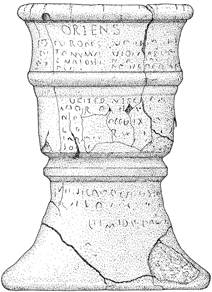
Clay thuribulum bearing magical invocations, from an underground shrine in Chartres, France. 2nd century AD. Ht c. 28 cm (11 in.).
Several issues arise from the messages on the Chartres incense-burners. Not least is the change of status for the Druids implied by the inscriptions, for here, the Druids are included as named spirits, while in the ancient literature they are unequivocally presented as religious leaders, not gods. Another challenge is to explain the calling up of Druidic spirits by a Gallo-Roman gentleman living in a Roman city in the 2nd century AD. Caius Verius Sedatus’s three names (a praenomen, nomen and cognomen – together the trianomina) mark him out as a Roman citizen, so he may well have been a town councillor, eminently respectable and expected to toe the Roman party line rather than spend his time conjuring up obscure old Gallic deities. But herein may lie the secrecy, and fear of discovery, implied by the hidden sanctuary. Could it be that Sedatus (incidentally a name of Gallic origin) was a Roman official during the day but moonlighted in his leisure hours by donning the identity of a magician in his basement? If the word ‘dru’ in the inscriptions genuinely refers to Druids, Sedatus may not have been preserving an ancient tradition, but constructing it anew.
It is crucial to view the sacred inscriptions within both a micro and macro context. For the first, it is important to consider the thuribula not simply as vehicles to convey written messages to the gods but also as vessels for burning ‘incense’, whatever that comprised. Andrew Sherratt has made a convincing argument for ‘narcotic archaeology’, based on his observations of ceramic vessels probably made as ‘aromatic burners’ and of the presence of mind-bending substances such as Cannabis sativa and opium poppy seeds in prehistoric European contexts.50 Cannabis was identified in the grave-goods accompanying the Hallstatt chieftain buried in his splendid, gold-rich tomb at Hochdorf in Germany in the late 6th century BC;51 excavations at an early Romano-British site at Frensham in southeast England produced a series of deliberately deposited miniature votive pots, some containing cannabis residues;52 and buried in the broadly coeval ‘Doctor’s Grave’ at Stanway, Colchester (see pp. 119–23) was a copper-alloy vessel in whose spout remains of the hallucinogen Artemisia survived.53 Mind-altering drugs were evidently far from unknown at the time that Sedatus was performing secret rituals in his dark cellar at Chartres. It is tempting to imagine the fragrant, psychotropic smoke emanating from the censers as thought by the celebrants here to represent the spirits arising in response to Sedatus’s summons, particularly if they were high on the fumes. But what is more, some of the material in the cellar chimes with Greco-Egyptian cult ritual practices, including the use of cryptic magical spells, and, if that is correct, it may help to explain Sedatus’s reference to ‘Dru’ as one of the omnipotentia numina rather than as earthly religious leaders. As a Roman citizen living in central Gaul in the 2nd century AD, two hundred years after the Caesarean conquest, he may well have been ignorant of the Druids’ original role within Gallic society, and have cobbled together a mish-mash of esoteric-sounding rituals from different parts of the Empire in order to impress his followers, without much clue as to what he was doing. But why was Sedatus engaged in such clandestine religious activities? In presenting an alternative and arcane cosmology deep in the Roman city of Autricum, what was he trying to achieve? Was it simply a power trip or commercial venture, designed to impress gullible seekers after something spiritually new and engaging? Or was Sedatus a self-styled ‘shaman’, one of a number who, like 20th-century Russian and Siberian shamans living under Soviet rule, were potent foci of old traditions and religious freedom? Caius Verius Sedatus may have been a Roman citizen, but he was also a Gaul: so much is indicated by his Gallic cognomen.
The real significance of the Chartres inscriptions is the inclusion of the term ‘dru’ in the inscribed list of spirits’ names on the three incense-burners in the basement sanctuary. If the term does refers to the Druids, their mention here indicates the retention of the ‘idea’ of this Gallo-British priestly class in the Gallo-Roman consciousness at least as late as the 2nd century AD. But the land of the Carnutes has produced yet more evidence for the survival of specifically native, non-Roman spiritual leaders and, what is more, this material has important links with the Chartres shrine. Book Eight of de Bello Gallico was written by Aulus Hirtius, an officer in Caesar’s army and later governor of Transalpine Gaul, after Caesar’s assassination in 44 BC. Describing the final episode in the conquest of Gaul by Caesar in 51 BC, when small, isolated pockets of resistance to Roman rule threatened the stability of the new province, Hirtius makes reference to a freedom-fighter called Gutuatrus.54 The name means ‘master of voice’ or ‘father of inspiration’; interesting epithets in themselves, but more significant is the archaeological evidence for Gallo-Roman inscriptions using Gutuater as a title, rather than a proper name. Might Hirtius have confused ‘Gutuatrus’ as a name with a descriptive or honorific title referring to the man’s skill at oratory or divination? The link with Sedatus’s shrine at Chartres is this: the list of obscure names, of which ‘dru’ is one, is full of ‘plosive’ sounds whose power would come from their being recited out loud, perhaps by a ‘master of voice’. The association of gutuatri with religion is secured by two altars from Aeduan territory in Burgundy inscribed with the word gutuater. One from Maçon is alas lost, but it recorded the presence of a gutuater of Mars and a priest of a native Gallic deity called Moltinus, putting this ‘father of inspiration’ clearly in a religious role. The other altar, from the Roman city of Autun (Augustodunum), dedicated to another local god, Anvallus, coupled with the Emperor, bears the word GVTVATE[R] on its base.55 The territories of the Carnutes and the Aedui are relatively near one another geographically and, according to ancient literature, both have firm associations with the Druids: Caesar spoke of the annual Druidic assembly among the Carnutes, and, as we have seen, at least one Druid, Divitiacus, ruled over the Aedui (see pp. 23–24). The testimony of Ausonius
The poet and rhetorician Ausonius was a Gaul, born at Bordeaux in Aquitaine early in the 4th century AD. He was of high rank within the western Roman Empire, being appointed by the emperor Valentinian I as tutor to his son Gratian. But Ausonius spent most of his working life in his native city. He is a person of interest here because of his authorship of a history of education called the Commemoratio Professorum Burdigalensium (A Commemoration of Bordeaux University Teachers), a work in which he makes specific mention of a Druidic family dynasty. One of these Druids was named Delphidius, a contemporary of Ausonius and a colleague at the University. He was the grandson of another Druid, Phoebicius, who Ausonius states was a priest at the shrine of the important Gallic deity Belenus, a god of light and healing equated with Apollo, who had similar roles in the Classical pantheon. Chadwick56 connects the Greek names of these late Gallo-Roman Druids – both inextricably linked with Apollo – to Caesar’s comment in the mid-1st century BC that these religious leaders used the Greek alphabet for ‘public and private accounts’.57 But what truth was there in this? Did Druids adopt Greek names, while upholding their old traditions and identities?
Caesar’s commentary on the Gallic wars was designed to reach the ears of the Roman senate, and he may have mentioned the Druidic use of Greek characters only to enhance their status as an educated, ‘civilized’ group. After all, the Roman author’s whole tone towards the Druids is generally respectful; he clearly admired them, and Divitiacus was his personal friend as well as his ally. Ausonius’s emphasis on his dynastic Druids’ Greek names appears to have a different purpose. We must remember that he was a poetic writer and rhetorician, who loved words for their own sake; he was not attempting to write objective history. The key lies in the association of these late Druids with the cult of Apollo, the Roman sun-god, and his holy of holies at Delphi, overlooking the Gulf of Corinth in southern Greece. The Delphic Oracle58 was perhaps the most renowned prophet in the Classical world and, of course, one of the Druids’ most important roles in the 1st century BC was as diviners of the future and the will of the spirits. So could it be that Ausonius’s account of his 4th-century Gallic Druid family is largely fictitious, or at least heavily embroidered in order to enhance the romance and allure of his poem? In a sense, this does not matter too much for us, because whatever the truth (or otherwise) of the rhetorician’s account, his testimony definitively shows that, even at this late period in the Roman Empire, the Druidic tradition maintained an active presence in the consciousness of Ausonius’s contemporaries.
The degree to which the Druids maintained their authority in the Roman Empire after their last-ditch attempt to repel the invaders in AD 60, when they tried in vain to protect their sacred island of Anglesey from the Roman army, however, is open to debate. The evidence that some of the old ways survived – even human sacrifice59 – and the multitude of British or Gallo-British divinities who strode through the centuries of Roman Britain alongside the new deities of the Empire would seem to suggest that they did. The long memories associated with sacred places argue strongly for the maintenance and fostering of ancient traditions.
We have only to look at sites like Fison Way, Thetford, in Norfolk, to acknowledge the importance of sacred memory. Here, around AD 60, the East Anglian tribe of the Iceni refurbished a massive timber assembly hall, a place to meet for political and ceremonial events. After Boudica’s defeat, the Roman army carefully dismantled it, post by post, in order thoroughly to obliterate any trace of Icenian power and discourage the glorification of the site by any Britons still harbouring a rebellious spirit. But 300 years later, someone buried a votive deposit of precious jewelry and other treasures very close to the spot where the great wooden hall had been built. This hoard included more than thirty silver spoons, many inscribed with the names of local deities, some of them twinned with Faunus, an obscure Italian woodland god.60 Shifting sands: Druids and Christianity
‘This is the penitence of a Druid or a cruel man vowed to evil, or a satirist or a cohabiter or a heretic or an adulterer, namely seven years on bread and water.’61 AUTHOR UNKNOWN
After the fall of the Roman Empire, the Druidic ‘signature’ in mainland Europe dried up; the same is, to a high degree, true of Britannia, the exception being some passing allusions to Druids (derwyddon) in the medieval Welsh myths. They are mentioned in the 14th-century Book of Taliesin, a compilation of poetry that takes its name from the great Welsh poet and satirist of the 6th century AD, and in other 14th-century sources.62 Indeed Taliesin, with his shamanic, shape-changing abilities, was very possibly a Druid himself.
By contrast, the Irish medieval mythic tradition is full of Druids. Medieval Irish prose literature relating to the Druids is sharply divided into pagan myth and overtly Christian texts. In the former, they remain heavily associated with prophecy and the ability to divine the will of the gods. The most notorious pagan Irish Druid was Cathbadh, one of the major players in one of the earliest texts, the Tain Bo Cuailnge (The Cattle Raid of Cooley). It was he who correctly predicted the short but glorious life of the Ulster hero Cu Chulainn.63 The frequent references to Druids in the Irish medieval prose tradition pose the question of whether they were as prevalent and influential in Iron Age Ireland as in Gaul and Britain. Of course, we have no way of ascertaining their presence in Ireland at that earlier period because it never became part of the Roman Empire and Classical authors, for the most part, ignored it. The Irish Druids are a complex mystery to unravel, given that the individuals who wrote down the pagan myths were early medieval Christian monks in the monasteries that were the main foci of education in Ireland. These clerics were well versed in the Classical literary tradition, and so they may well have injected doses of Druidism into their stories, at least some of which were designed to ridicule and belittle paganism. So the presence of Druids in pre-Christian Ireland has to remain an unresolved enigma.
A unique phenomenon in the medieval Irish literary tradition is the connection between Christianity and the Druids. The Lives of two saints, Patrick and Brigit, date to the 7th century AD. The Druids play a prominent role in both, but for opposite reasons. The Life of St Patrick contains numerous references to the saint’s battle with paganism, epitomized by his efforts to quash the Druids. The Life of St Brigit is quite different: her foster-father was a Druid, though he converted to Christianity when she was a child.64 But of course Brigit herself was a transitional figure in Ireland; for pagans, she was a goddess of the dairy and of ale-brewing, and her festival was Imbolc, the beginning of spring and lambing. Even as a Christian saint, she retained many of her old divine responsibilities, particularly with respect to milk and ale.
But it is time to leave Iron Age traditions and their ancestral influence on and beyond the western fringes of the Roman Empire in Wales and Ireland, and turn attention to the seismic change brought about by the absorption of Britannia into the Roman world, with the dramatic effect its entry onto a global stage had on the religion and beliefs of this sacred island.