PROLOGUE Introducing a Sacred Isle
‘Most of Britain is marshland…The barbarians usually swim in these swamps or run along in them, submerged up to the waist. Of course, they are practically naked and do not mind the mud because they are unfamiliar with the use of clothing, and they adorn their waists and necks with iron…They also tattoo their bodies with various patterns and pictures of all sorts of animals.
Hence the reason why they do not wear clothing, so as not to cover the pictures on their bodies.’HERODIAN1
Herodian, a Roman civil servant of Greek origin, wrote his History nearly two hundred years after Britain became part of the Roman Empire, and so his observations of its inhabitants are unexpected. He presents Britain as home to people so bizarre and uncouth as to be barely human, in spite of the civilizing influence of Rome. We can detect in his writing the kind of deliberate stereotyping of ‘the other’ that seeps into the discourse of far-right nationalists who seek to demonize the foreign, the different and the peripheral today. What truth was there in Herodian’s account of the Britons? He was far from alone in painting Britannia as alien and beyond. The Augustan poet Horace made several references to ‘untouched Britons’ and ‘Britons at the end of the world’,2 although his comments are the more understandable in so far as he was writing before Britain became a Roman province. Part of Rome’s suspicion of Britain derived from its separation from the European land-mass by Ocean, the great river perceived by Greeks and Romans as encircling the world, so putting the island of Britain literally outside human habitation. When first Caesar and later Claudius made the decision to conquer Britannia, their prestige was greatly enhanced by their courage in taking their armies to overcome Ocean and all its sea-monsters in order to bring the Never-Never land of Britain under Roman rule.
Sacred Britannia explores the religious character of the isle in the period between Caesar’s expeditions in 55/54 BC and the traditional ‘end’ of Roman Britain in the early 5th century AD, when the emperor Honorius allegedly sent instructions to the cities of Britain to organize their own defence against barbarian incursions from Germanic tribes, the Roman Empire itself being in crisis owing to persistent threats from the Goths.3 We shall see how the incoming religious traditions of the invaders collided with local forms of worship, and explore the great diversity of ancient British religious beliefs that flourished against the kaleidoscopic background of mixed cultures and peoples that populated the Roman Empire, including its army and its governance, with all the tensions, anxieties, misrepresentations, hostilities, tolerances and acceptances that drove religion into so many different avenues and directions at the edge of the known world. But in order to be able to open doors into that far-off world of two thousand years ago, it is important sometimes to use modern keys. A persistent thread running through the book is the relevance of attitudes obtaining at that time to modern perceptions of ‘us’ and ‘them’, the familiar and the ‘other’. In both the ancient and modern worlds, there is a wired-in tendency to distrust and, whether deliberately or not, to misunderstand other cultures, beliefs and ideologies. How different was Herodian from the successful Republican candidate for the 2016 US Presidency, Donald Trump, with his stated intention to build a wall between the US and Mexico? How easy it is to construct a scaffolding of scaremongering stories about those different from ourselves, in order to bolster our sense of identity and indulge our fears of change. Study of the past is fascinating in itself but it can be more than that if we can relate it to the world we currently inhabit; the resonances between past and present can be very loud. Prongs of evidenceTwo pathways, neither of them straight but both narrow, lead modern pilgrims back into the past: those of ancient literature and of archaeology.
Both serve to enlighten the traveller, but also to trap the unwary. Iron Age Britons were non-literate, and so left no first-hand testimony about themselves, their sense of identity or how they thought about the material and spirit worlds. So we are forced to rely on the reports of authors from the Greco-Roman world, who wrote about the ‘barbarians’ to their north with varying degrees of ignorance and spin. Historians, both past and present, can never be wholly objective; they are inevitably products of their own culture and cannot entirely shed that baggage. And, particularly in the 1st centuries BC/AD, when Romans and Britons came head to head in conflict, the texts of those chronicling such events were bound to reflect their Roman bias. However, we must not underestimate the value of ancient literature, despite its flaws, for it populates the past with individuals and reveals far more than it obscures. In terms of religious beliefs, the texts introduce us to the Druids (see Chapter 1) and, occasionally, to named British deities, like the fearsome Andraste, goddess of war and victory, in whose sacred grove in London Boudica made blood sacrifices in AD 60, including the mutilation and skewering of well-born Roman women.4Archaeological evidence, conversely, possesses an objectivity of a kind – material culture itself cannot lie – but it comes with its own set of challenges: principally those of incomplete survival and of interpretation. The discovery of pits full of gold and silver jewelry, like those found at Snettisham, Norfolk, buried in the 70s BC, might be variously explained as hoards interred for safe-keeping at a turbulent time, as the equivalent of the contents of a modern Hatton Garden vault, or as votive offerings to the gods. At the hillfort of Danebury, Hampshire, excavators uncovered several Iron Age roundhouses of ‘normal’ British Iron Age (the period between c. 750 BC and the Claudian invasion of AD 43) form inside a typical enclosure boundary, but in the centre of the site were unusual square structures.
Were they granaries, assembly halls or, perhaps, shrines? How are we to detect religious intent behind such ambiguous remains? Once we enter the world of Roman Britain, things become somewhat clearer. For one thing, the Romans brought epigraphy: writing in stone that helps to reveal the function of structures, including those of a religious nature. Architecture, too, is easier to interpret, because building plans became more clearly specific to function: there is less confusion about whether or not a building was religious in purpose, for there was unequivocal temple-architecture. There is also a great proliferation of material culture in general and, for sacred activity, a new form of common religious expression – that of iconography, which was relatively sparse in the Iron Age. Does this vast change in sacred material culture, triggered by the Roman occupation, represent a chasmic shift in cosmologies and belief-systems, or simply a new way of expressing religious beliefs? In other words, was a new sacral system born in Britain under Rome or were the old, previously ‘silent’, local cults given a new voice? The Roman occupation of Britannia unquestionably brought with it ‘new technologies of worship’5 in epigraphy and iconography, but how deeply did these new modes of expression affect people’s perceptions of the divine? Julius Caesar’s legacyThe hundred years between Caesar’s expeditions, the first ‘official’ Roman activity in the island, and the invasion of the emperor Claudius that resulted in Britain’s annexation to the Roman Empire in AD 43 represent a crucial period in Britannia’s history, although often overlooked, being considered a time of minimal interaction between Britain and Rome. Despite their brevity, Caesar’s two sojourns in the island in 55 and 54 BC had a profound influence over the way the future province reacted to romanitas – the set of political and cultural principles that the Romans adhered to; allegiance to an imperial state with a standing army, codified laws and formal political ways of expressing religious devotion, including the worship of lifelike representations of the gods and the construction of temples with a highly formalized architecture – in the time of Claudius and beyond.
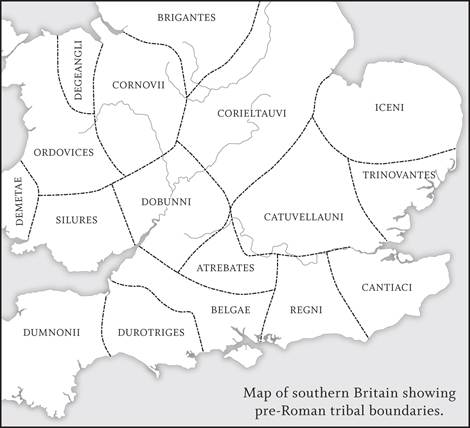
When Claudius sent his legions to Britain under his general Aulus Plautius, the British tribes of southeast England were already familiar with Rome, partly on account of trade but also because some tribal leaders were turning covetous eyes towards the Empire as a means of enhancing their status at home. (The prevailing ‘north–south’ divide in modern Britain was as relevant on the cusp of the 1st millennium BC as it is today.) Indeed, Caesar himself may have laid the foundations for these ambitions. He is sometimes credited as a ‘king-maker’, involved in creating or at least encouraging late Iron Age political hierarchies that resolved themselves, in the decades between his first contact and Claudius’s conquest, into polities with firm leadership among such tribes as the Catuvellauni and the Atrebates, whose lands lay respectively north and south of the Thames. One product of these fiefdoms was the desire of some overlords to send their sons to the imperial court at Rome to be educated as Roman gentlemen. John Creighton6 has argued convincingly for the hostage-practice, well known in other Roman provinces, such as Judaea, as pertinent to late Iron Age Britain. These youths, called obsides (‘friendly hostages’), returned to Britain having adopted Roman dress and speaking and writing Latin and Greek, with a smattering of knowledge of Roman law and their heads full of the glamour and prosperity of the Roman world. During their stay in the capital, they would have rubbed shoulders not only with native Romans but with other obsides from the other side of the empire, places like Egypt, Judaea and the Near East, and inevitably absorbed some of their mores. Archaeology may provide some evidence for the existence of obsides in late Iron Age Britain and thus, indirectly, for Caesar’s legacy. Sometime in the early/mid-1st century BC, a wealthy family belonging to the tribe of the Atrebates in southeast England acquired some special gold jewelry, perhaps made for a husband and wife, for the ornaments were paired: two necklets of different sizes, two pairs of brooches and two unfinished bracelets (see p. ii). These were not locally made, but the work of Greek goldsmiths. Signs of wear on the jewelry indicate that it was worn for a time before being ritually deposited on a hilltop, chosen for its commanding views and isolated situation, near Winchester in Hampshire. Fanciful, possibly, but could these precious and foreign gold objects have been brought back from abroad by someone who had been at the Roman imperial court and had perhaps commissioned special ornaments from a Greek workshop in Rome?7 The apparently ritual nature of the jewelry’s deposition chimes with synchronous activity in the Atrebatian kingdom, namely the building of a shrine on Hayling Island off the southwest coast of England in the later 1st century BC.8 The shrine began its life as a rectangular timber hall, later replaced by a substantial circular stone building, within an enclosure. This structure was the focus for votive depositions of personal objects such as brooches and coins, some ritually broken, as if to sever their connection to the world of the living and enable them to be accepted by the spirits. The interpretation of this late Iron Age building as a sanctuary is buttressed by the temple of early Roman date that replaced it, for there is abundant evidence that special places, once sanctified, remained so even where political and religious situations changed. The Roman-period temples to Nodens at Lydney (see pp. 94–96) and to Mercury at Uley (see pp. 192–93), both in Gloucestershire, are cases in point. Lydney had been an Iron Age hillfort, and there is evidence for ritual practices at Uley stretching even as far back as the Bronze Age. It has been suggested that the Hayling Island religious complex was erected to honour a cult of the Atrebatian royal dynasty founded by Caesar’s onetime friend Commius, who may well have been one of the kings created by Julius Caesar, the ‘king-maker’.9 Significantly, the architecture of the Roman shrine adhered to the circularity of the earlier building, despite the fact that Roman temples usually followed the Classical rectangular form. Around the time that the Roman temple was built at Hayling Island, in about AD 40, another royal Briton, Togidubnus, was active in religious affairs at Chichester in West Sussex. The origins of Togidubnus’s entry onto the British political scene are uncertain. It is even possible that he came from Gaul.10 Publius Cornelius Tacitus, a Roman senator and historian, referred to Togidubnus as a client-king and lauded his ‘unswerving loyalty’ to Rome, while at the same time sneering at his subservience, in his account of Publius Ostorius Scapula’s governorship of the new province of Britannia. This was a turbulent period, characterized by British resentment of and rebellion against the new regime, and Togidubnus played a major role in keeping the peace. In recognition of his alliance, the emperor made over to him certain tracts of land in southeast England.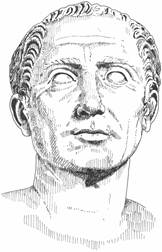
Portrait of Julius Caesar.
We have firm archaeological evidence for Togidubnus’s presence in the form of an inscription from Chichester that records this client-king’s dedication of a temple to the Roman deities Neptune and Minerva (with no mention of local gods). Intriguingly, the inscription reveals that Tiberius Claudius Togidubnus (note his adoption of Roman imperial names) styled himself ‘Great King of the Britons’, perhaps because of his non-British origins. This title was foreign to the western Roman Empire but was common in the east, in places like Egypt. Could Togidubnus have been one of the British obsides sent to Rome to learn how to be a Roman gentleman and, while there, might he have picked up this rather flamboyant and exotic title from his fellow guests? If so, the custom of sending royal children to the imperial court to be educated survived Caesar for a hundred years. The Chichester inscription is a testament to the power of romanitas even in the half-fledged province of the mid-1st century AD, and the personal histories of Britain’s obsides may have been crucial to the way that Britain reacted to the new order brought in under Claudius.
 The past is a (very) foreign country
The foregoing discussion indicates how tricky it is to try to interpret what went on in Britain’s remote past. All of the types of evidence at our disposal have strengths and weaknesses; all are capable of producing various interpretations. Colouring every attempt to understand past lives, especially those in a pre-literate context, is our own cultural background, which inevitably seasons how we view a two-thousand-year-old world. What I hope to present in the pages that follow is a story that engages modern readers in pursuit of an ancient world, while both acknowledging the problems associated with accessing ancient systems of thought and spiritual belief and facing honestly the tensions between past and present. Roman Britain was a cultural palimpsest in which, under the rule of Rome, what it meant to be British became just as complex and multi-layered as it is today. While the apparent ‘direction’ of ideological travel in the early post-conquest years was Romanocentric, there is plenty of evidence – much of it associated with belief systems – that displays the two-way traffic of cultural exchange between Britain and Rome.
A curious facet of this has only recently come to light, in excavations of Roman London. Wooden writing tablets discovered between 2010 and 2014 have revealed the conscious re-establishment of British identity by some inhabitants of this prosperous and very Roman port.11 Some of the inscriptions indicate that people with totally Roman names chose to give their children names of Gallo-British origin. What drove their decision? Could it be something akin to the trend among certain middle-class English and monoglot parents in parts of Wales in the present day who make the deliberate choice to send their offspring to schools that teach entirely in the Welsh language? Perhaps these early Londoners, whether their heritage lay in Britain or in other Roman provinces, chose British names for their children to communicate and consolidate their own connection with Roman Britannia. Similar issues relate to the interplay between imported and indigenous cults; in religious terms, the period immediately before and after the Claudian invasion of AD 43 could be seen through the metaphor of a crucible in which different metals undergo change to form new alloys. To what extent did religion affect, or was affected by, the perceived identity of individuals? Sacred Britannia will endeavour to further our understanding of what it meant to be, and to feel, British in Roman Britain.
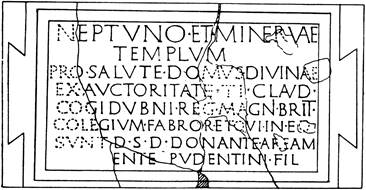
Reproduction of the Chichester inscription, recording Togidubnus’s dedication of a local temple to Neptune and Minerva. W. c. 125 cm (49¼ in.).