The Mantramarga
It is clear that the cosmos of the Mantramarga grew out of that of the Atimarga by the same process of competitive extension which set the Lakulas above the Vaimalas, and the Vaimalas above the Mausulas and the Karukas.
And there are other continuities between the two Paths in the fields of ritual, iconography, mantras and observances (yrata). However, in spite of these continuities, there is a fundamental difference of character between the two main branches of the Saiva tradition. While the Atimarga is exclusively liberationist, the Mantramarga, though it accommodates the quest for liberation, is essentially concerned with the quest for supernatural experience (bhoga).This difference might be thought to correspond to that between the aspirations of the original ascetics and the newly admitted married householders. On the contrary, it corresponds to that between two varieties of ascetic. For in the Mantramarga it is the ascetics who are principally concerned with the attainment of powers, the path of liberation being largely the domain of the men in the world; and it is the methods by which power may be attained that are the main subject matter of the Mantra- marga’s scriptures. The gnostic home-dwellers, who would come in time to dominate the Mantramarga, are here the unmarked category of aspirant. They are defined by the fact that they do not involve themselves with the concerns which generated not only the greater part of their texts but also the system’s internal diversity. For it was for the sake of the power-seeker that there developed the extraordinary variety of rites, deities and mantras which sets the Mantramarga apart from the purely gnostic Atimarga.
The history of the expanding hierarchy of the Rudra-worlds shows that the Mantramarga is later than the Atimarga. None the less, the dichotomy between the liberation-seeking and the powerseeking forms of Saiva asceticism is more ancient than the present corpus of Mantramargic texts.
The latter contain more archaic strata at which the superior deities of the developed Mantramarga give way to the earlier Rudra. If we compare these text-elements with the Rudra cult of the Atimarga, we see that the dichotomy which underlies the later form of the division is between a solitary and celibate Rudra in the Atimarga and a Rudra associated with bands of protean and predominantly female spirits in the background of the Mantramarga. In the fully developed and diversified Mantramarga this association is but one aspect of that with feminine power (sakti) conceived more universally. It is this association which most obviously marks off the Mantramarga from the sakti-\ess Atimarga. We shall see that within the Mantramarga the major divisions correspond to different representations of this association.The Tantras of the Saiva Siddhdnta
While our evidence for the Atimarga is very sparse, the Mantramarga can be studied in an enormous body of Sanskrit texts. The scriptures of the Mantramarga fall into two groups. On the one hand is the well-defined and relatively homogeneous canon of texts (the ten Siva-Agamas, the eighteen Rudra-Agamas and attached scriptures) that constitute the authority of the tradition known to itself and others both in the scriptures and later as the Saiva Siddhdnta. On the other hand is a much more diverse, numerous and variously listed body of revelations known as the scriptures of Bhairava (Bhairava-Agamas) or collectively as the Teaching of Bhairava (Bhairavasdstra).
The Siva forms of both are visualised as skullbearing denizens of the cremation grounds. In the fsaiva Siddhanta, however, the god lacks the aura of terrifying and ecstatic power which is emphasised in his manifestations in the tradition of Bhairava (‘the Fearsome’). Similarly, while the concept of feminine power (sakti) is found throughout the Mantramarga, it tends in the Saiva Siddhanta to move away from personification as the Goddess or goddesses towards metaphysical abstraction.
It is seen here principally as the creative power of the male Deity, manifest in the cosmic and soteriological process and embodied in his mantra-forms. In the daily ritual of the initiate the deity is worshipped, like the Rudra of the Atimarga, without a female consort. Linked to this is the purity of the mode of his worship. There is none of the offering of alcoholic drinks, blood and meat that typifies the rituals of the rest of the Mantramarga, with its greater emphasis on feminine and transgressive power.The Tantras of Bhairava: Kdpdlika Saivism
The Tantras of Bhairava, so called because they take the form of his answers to the questions of the Goddess (Devi, Bhairavi), have been variously listed and classified in different parts of the corpus. The classification given here corresponds, I believe, to the main structure of the Saiva tradition outside the fsaiva Siddhanta at the time when the Kashmiri began their work of postscriptural systematisation in the ninth and tenth centuries.
Within these Tantras there is a primary division between those of the Seat of Mantras (Mantrapitha) and those of the Seat of Vidyas (Vidyapitha). The latter are either Union Tantras (Ydmala-tantras) or Power Tantras (Sakti-tantras). Within the latter one may distinguish between the Tantras of the Trika (or rather of what was later called the Trika) and material dealing with cults of the goddess Kali. Tantras which teach the cult of Tumburu-bhairava and his four sisters (Jaya, Vijaya, Jayanti and Apara- jita) are fitted into this scheme as a third division of the Vidyapitha. But this is artificial. It accommodates a tradition whose importance had been superseded by that of the Mantrapitha (the cult of Svacchanda-bhairava) to the extent that it was no longer part of the main structure. No more will be said of this minor tradition here.
Figure 36.1: The Structure of the Mantramdrga
Tantras of Kali
Trika-tantras
Sakti-tantras
Yamala-tantras
Vidyäpitha
Mantrapitha
Bhairava-tantras
Saiva Siddhänta
MANTRAMARGA
This arrangement is hierarchical.
Whatever is above and to the left sees whatever is below it and to the right as lower revelation. It sees itself as offering a more powerful, more esoteric system of ritual (tantra) through further initiation (diksd). As we ascend through these levels, from the Mantrapitha to the Yamala-tantras and thence to the Trika and the Kali cult, we find that the feminine rises stage by stage from subordination to complete autonomy.The Mantrapitha and the Cult of Svacchandabhairava
At the beginning of this ascent is the Seat of Mantras (Mantrapitha). This term expresses the fact that this group of Tantras emphasises the masculine, while in the Seat of Vidyas (Vidyapitha) it is the feminine that predominates (the nouns mantra and vidyd, which both signify the sacred sound-formulas, being masculine and feminine respectively).
The basic cult of the Mantrapitha is that of Svacchandabhairava (‘Autonomous Bhairava’) also known euphemistically as Aghora (‘the Un-terrible’). White, five-faced (the embodiment of the five hrahma-mantras) and eighteen-armed, he is worshipped with his identical consort Aghores'vari, surrounded by eight lesser Bhairavas within a circular enclosure of cremation grounds. He stands upon the prostrate corpse of Sadas'iva, the now transcended Siva-form worshipped in the Saiva Sid— dhanta.
The traditions of the Bhairava Tantras are Kapalika, the basic form of their ascetic observance being that of the skull (kapalavratal mahavrata). The difference between this and the Lakula form of this observance is largely a matter of the basic difference of the Mantramarga stated above. The term Kapalika is reserved here for this Mantramargic segment of the Saiva culture of the cremation grounds.
This Kapalika background is evident from the iconography of the divine couple. Worshipped within an enclosure of cremation grounds they themselves wear the bone ornaments and brandish the skull— staff (khatvdhga) of the Kapalika tradition. None the less these features are not emphasised here to the extent that they are in the Vidyapitha.
Though the Svacchandatantra, which is the authority for this cult, teaches the worship of certain secondary forms of Svacchandabhairava such as Kotaraksa (‘the Hollow-Eyed’) and Vyadhibhaksa (‘the Devourer of Diseases’), which, being visualised as terrifying, gross-bodied and black, are closer to the standard Bhairavas of the Kapalika tradition, Svacchandabhairava himself, the deity of daily worship, has milder elements that make him transitional in type between the calm Sadasiva of the Saiva Siddhanta and the gods of the Kapalika mainstream.In the Saiva Siddhanta, Siva (Sadasiva) was worshipped alone. In the Mantrapitha he is joined in worship by his consort as the personification of sakti. Iconically she is his equal. But the larger ritual context shows that she is still subordinate. Her feminine presence is not reinforced by secondary goddesses in the circuit (a v ar ana) that surrounds the couple. Furthermore Svacchandabhairava is worshipped alone after he has been worshipped with his consort. His appearance with Aghoresvari is his lower form.
The Vidyapitha
With the ascent to the Vidyapitha the Saiva entered a world of ritual in which these last restraints on s'akti dissolved. He was consecrated in the cults of deities who presided in their mandalas over predominantly female pantheons, and who passed as he ascended to the left from Bhairavas with consorts, to Goddesses above Bhairavas, to the terrible Solitary Heroines (ekavlrd) of the cults of Kali.
If in the cult of Svacchandabhairava the Kapalika culture of the cremation grounds was somewhat in the background, here it is pervasive. The initiate gained access to the powers of these deities by adopting the observance of the Kapalikas. With his hair matted and bound up with a pin of human bone, wearing earrings, armlets, anklets and a girdle, all of the same substance, with a sacred thread (upavlta) made of twisted corpse-hair, smeared with ashes from the cremation-pyres, carrying the skull-bowl, the skull-staff and the rattle-drum (darnaru), intoxicated with alcohol, he alternated periods of night-wandering (nisafana) with worship (puja) in which he invoked and gratified the deities of the mandala into which he had been initiated.
This gratification required the participation of a dutt, a consecrated consort, with whom he was to copulate in order to produce the mingled sexual fluids which, with blood and other impurities of the body, provided the offering irresistible to this class of deities.The Cult of Yoginis. Accessible from the main cults of the Vidyapitha, and underlying them in a more or less constant form, is the more ancient cult of Rudra/Bhairava in association with female spirits (Yoginis). In the Atimarga and thence in the Mantramarga the series of cosmic levels (bhuvanadhvan) is governed by Rudras. When the initiate passed into this subjacent tradition he found that this masculine hierarchy was replaced by ranks of wild, blood-drinking, skull-decked Yoginis. Radiating out from the heart of the Deity as an all-pervasive network of power (yogint- jdla), they re-populated this vertical order of the Saiva cosmos, appropriated the cycle of time (ruling as incarnations in each of the four world-ages and irradiated sacred space by sending forth emanations enshrined and worshipped in power-seats (pifha) connected with cremation grounds throughout the sub-continent.
The goal of the initiate was to force or entice these Yoginis to gather before him and receive him into their band (yoginigana), sharing with him their miraculous powers and esoteric knowledge. The time favoured for such invocations was the fourteenth night of the dark fortnight, the night of the day of spirits (bhutadina); and the most efficacious site was the cremation ground, the foremost of their meeting-places. The Siva worshipped in these rites is Manthana-Rudra (or Manthana-Bhairava), a fourfaced and therefore secondary or archaic form. Not ‘married’ to the Goddess as in the cults of entry, he is rather the wild ascetic who leads the Yogini hordes (yoginiganandyaka).
The cult of Yoginis is not concerned with these protean powers only as the inhabitants of a theoretical and liturgical universe, and as goddesses enshrined in the cremation ground power-seats. For they were believed also to possess women and thereby to enter into the most intimate contact with their devotees. Of these incarnate Yoginis some, having been conceived in the intercourse of the consecrated, are considered divine from birth. Others appear in girls of eight, twelve or sixteen who live in the vicinity of the power-seats, these being of three degrees of potency. Others are identified in untouchable women from the age of twenty-seven as Dakinis and other forms of assaulting spirit.
All Yoginis belong to the family (kula) or lineage (gotra) of one or other of a number of higher ‘maternal’ powers, and in any instance this parentage is ascribed on the evidence of certain physical and behavioural characteristics. An adept in the cult of Yoginis can identify members of as many as sixty-three of these occult sisterhoods, but is most vitally concerned with the eight major families of the Mothers (mdtr) Brahmi, Mahesvari, Kaumari, Vaisnavi, Indram, Varahi, Camunda and Mahalaksmi. For at the time of consecration he entered a trance in which the possessing power of the deity caused his hand to cast a flower into a mandala enthroning these Mothers. The segment into which the flower fell revealed that Mother with whom he had an innate affinity. This established a link between him and the incarnate Yoginis, for these families of the eight Mothers were also theirs. On days of the lunar fortnight sacred to his Mother the initiate was to seek out a Yogini of his family. By worshipping her he aspired to attain supernatural powers and occult knowledge.
The Union Tantras (Yamala-tantras): the Cult of Kapdl’tsabhairava and Canda Kapalini. Above this Yogini cult, in the front line of the Vidyapitha. the first level of the ascent of Sakti towards autonomy is seen in the Union Tantras. The principal cult here is that of Bhairava Lord of the Skull (Kapal’isa-, Kapalesa-, Kapala-bhairava) and his consort ‘the Furious’ (Canda) Goddess of the Skull (Kapalini). This is taught in the twelve thousand stanzas of the strongly Kapalika Picumata-Brahmayamalatantra (MSS). In the cult of Svacchandabhairava, in the Mantrapitha, the secondary deities surrounding the couple in the mandala were male and solitary. Here they are female, with subordinate male consorts in the densely populated mandala installed for exceptional worship, and alone in the much simpler pantheon of the private daily cult (nityakarma). Bhairava rules these secondary deities as the unifying holder of power (saktimat, sakticakres'vara), in accordance with the general f>aiva conception of the divine nature. But this supremacy on the iconic plane is transcended by sakti on that of the deityembodying mantras. For the essential components of the mantras of the nine deities who form the core of the greater mandala and are the pantheon of daily worship are the syllables of the mantra of Canda Kapalini: (OM) HUM CANDE KAPALINI SV AHA (‘... O Canda Kapalini Thus Kapalisabhairava (HUM), his four goddesses (Rakta (CAM), Karala (DE), Candaksi (KA) and Mahocchusma (PA)) and their four attendant powers or Dutis (Karali (LI), Dantura (N1), Bhimavaktra (SVA) and Mahabala (HA)), are aspects of a feminine power which transcends the male-female dichotomy which patterns the lower revelations.
The Power Tantras (Sakti-tantras): the Cult of the Triad (Trika). Above the Yamala-tantras are the Sakti-tantras. These contain the scriptural authority for the system that in its later Tantras is called the Trika, and also that of the esoteric Kali cults.
In the Tantras of the Trika (Siddhayogesvarimata (MSS), Tantrasadbhdva (MSS), Mdlinivijayottaratantra) the cult of Yoginis permeates all levels; for the cult of entry is itself a development of that tradition. The focus of the Trika is directly on the network of Yoginis (yoginijdla) as the hierarchy of cosmic manifestation, from the innermost resonance of the deity’s power to its gross transformations as the sense-data that populate individualised consciousness.
The Trika’s system of ritual and yoga leads to liberation and power by treading the steps of this emanation in reverse. The worshipper ascends to the core within the circuits of lesser Yoginis. This core is the triad of goddesses, Para (see Figure 36.2), Parapara and Apara, worshipped alone or with subordinate Bhairavas and visualised as enthroned on three white lotuses that rest on the tips of a trident (trisula) (see Figure 36.3). This trident is superimposed in imagination along the central vertical axis of the worshipper’s body so that the trifurcation rises through a space of twelve finger breadths above his head, the whole from its base at the level of his navel to this summit being identified with the series of cosmic levels from gross matter to the Absolute. The central goddess, Para, is white, beautiful and benevolent. Single-faced and two-armed she holds a sacred text and exhibits the gesture of self-realisation (cinmudrd). Parapara and Apara, to her right and
Figure 36.2: Para
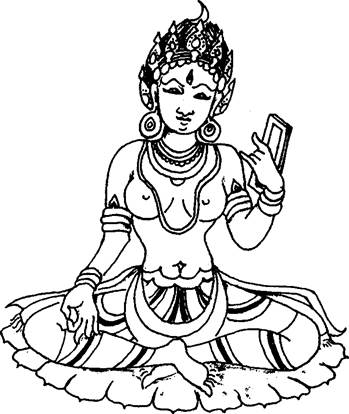
left, are red and black respectively. Raging Kapalika deities, they brandish the skull-staff (khatvdnga). Externally the three are worshipped with offerings that must begin with alcoholic liquor and red meat, and on such ‘thrones’ as a mandala, a square of ground prepared for this purpose (sthandila) or an image painted on cloth (pata) or incised on a human cranium (tura).
Figure 36.3: The outline of the Mandala of the Trident and Lotuses (trisulabjamandala) as prescribed in the Trika’s Devyayamalatantra
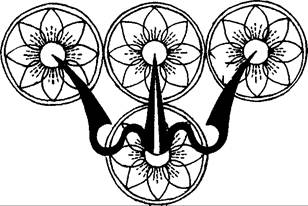

Para has two aspects, for she is worshipped both as one of the three and as their sum and source. In this higher aspect she is called Matrsadbhava (Essence of the Mothers), the summit of the hierarchy of the female powers which populate the cult of Yoginis. Later all this would be interpreted along more metaphysical and mystical lines. Matrsadbhava was read as Essence of (All) Conscious Beings (lpra-]mdtr-) and the three goddesses were contemplated as the three fundamental constituent powers of a universe which was consciousness only. Para was the power of the subjectelement (pramdtr), Apara that of the object-element (prameya) and Parapara that of the cognitive field or medium (pramdna) by virtue of which they are related, while their convergence in Matrsadbhava came to express the ultimate unity of these three within an Absolute of pure consciousness contemplated as the Eberated essence of the worshipper.
TheJayadrathaydmala and the Cult of Kalt. Beyond the cult of the three goddesses, at the extreme left of the Mantramarga, is the Jayadrathaydmalatantra (MSS). Also known as the King of Tantras {Tantrard- jabhattdraka) it expounds in 24,000 stanzas the Kapalika cults of over a hundred manifestations of the terrible goddess Kali as the Destroyer of Time (Kalasamkarsini).
There are two main levels in the Tantra. The first, which is taught in the first quarter of the work (probably composed eariier than the rest), is that of the cult of a golden-Embed, twenty-armed Kalasam- karsini with five faces of different colours, that which faces the worshipper being black. Conventionally beautiful but holding such Kapalika emblems as the skull-staff (khatvdriga) and the severed head (munda), wearing a tiger skin dripping with blood, trampling the body of Kala (Time) beneath her feet, she holds a trance-possessed Bhairava in a two-armed embrace in the centre of a vast, many-circuited mandala of goddesses enclosed by cordons of male servant-guards and an outer ring of cremation grounds. In the elaborate form of worship both the goddesses and the guards embrace consorts. Here then is a Yamala (Union) cult very similar to that of Kapalisabhairava and Canda Kapalini taught in the Picumata-Brahmayamala but centred in Kali rather than Bhairava.
In the remaining three quarters of the text Bhairava is excluded from worship altogether. He is now just the highest of the male deities whose power Kali transcends, the seventh at the summit of the hierarchy of the dethroned, coming above Indra, Brahma, Visnu, Rudra, Isvara and Sadasiva. Lying beneath her feet or dismembered to adorn her body, Bhairava suffers in his turn the humiliation which he inflicted on Sadasiva in the Mantrapifha. With his fall the pantheons of worship are entirely feminised. But the femininity which remains is not that of the Yamala systems. There sakti is worshipped in the form of beautiful and passionate consorts. Here the triumphant Goddess reveals herself to her devotees as a hideous, emaciated destroyer who embodies the Absolute (anuttaram) as the ultimate Self which the ‘I’ cannot enter and survive, an insatiable void in the heart of consciousness.
Typical of the conception of the Goddess in this second and more esoteric part of the Tantra is VTrya-Kali (Kali of the [Fivefold] Power) (see Figure 36.4). Visualised in the centre of an aura of blinding light and contemplated as the innermost vibrancy (spanda) of consciousness she is black and emaciated. She has six faces and her hair is wreathed with flames. She is adorned with the severed heads and dismembered limbs of the lower deities. She rides on the shoulders of Kalagnirudra (the Rudra of the Final Conflagration). In her twelve hands she carries a noose, a goad, a severed head, a sword, a shield, a trident-khafvdhga, a thunderbolt (vajra), a ringing bell, a damaru-drum, a skull-cup, a knife, a bleeding heart and an elephant-hide. The Rudra who is her vehicle (vdhana) is black on one side of his body and red on the other, symbolising the two breaths, the ingoing (apana) and the outgoing (prana), whose fusion and dissolution into the central axis of power reveals the state of thoughtless (nirvikalpa) awareness that holds the Goddess in its heart. The fivefold power (virya) that she embodies as ‘the essence of the entire Vidyapitha’ is that by virtue of which the ‘waveless’ (nistarariga), self-luminous ground of reality projects itself as content in consciousness, and then re-absorbs this content, returning to its initial tranquility: this cyclical movement being the pulsation of consciousness from moment to moment as well as the pulsation of consciousness in cosmic creation and destruction. She passes from pure Light (bhdsd (1)) within the Siva-void (s'ivavyoma), through incarnation (avatdra (2))
Figure 36.4: Virya-Kali
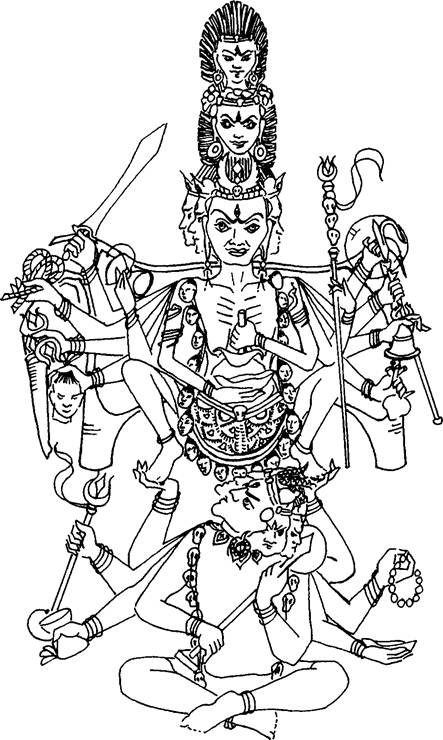
as the impulse towards extroversion, to actual emission (srsti (3)) of content, which appears as though outside consciousness, to her KaE phase (kdlikrama (4)), in which she re-absorbs this content, and finally to the Great Withdrawal (mahdsamhdra (5)), in which she shines once again in her initial state as the pure Light. By contemplating this sequence (krama) in worship the devotee of KaE is beEeved to reaEse the macrocosmic process within his own consciousness and thereby to attain omniscience and omnipotence.
In the fourth quarter of theJayadrathaydmalatantra we are introduced to what the text claims to be the ultimate form of the KaE cult. Here MahakaE (Great KaE) is worshipped in a black circle with a vermilion border surrounded by a ring of twelve such circles containing KaEs who differ from her in their names but are identical in appearance. The relation of dependence between the Goddess and Siva-Bhairava has already been transcended in the pure sakti cult of the higher level of this Tantra. Now even the hierarchy of source and emanations which remained within sakti herself is ritually dissolved, in a mandala which expresses the perfect identity in essence (sdmarasya) of the Absolute and its manifestations, of the state of liberated transcendental (sarvottirna) consciousness (nirvana) and its finite projections, as the state of transmigratory existence (bhava, satnsdra). Worshipped externally in orgiastic rites, the thirteen Kalis (12+1) are to be realised internally in mystical self-experience, flashing forth as the ego-less (niraharikara) void through the voids of the senses during sexual union with the dutl. This system known here as the Kalikrama or KaEkula, links this Tantra with the Krama to be described below (see pp. 683—4 and 696-9).
Figure 36.5: The Trika’s Mandala of the Three Tridents and (Seven) Lotuses (tritrisulabjamandala) with the twelve Kalis in its centre, as prescribed by the Trikasadbhavatantra
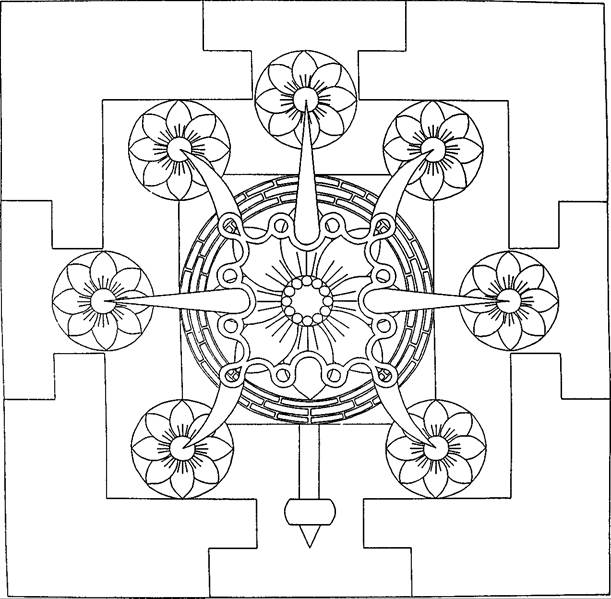
The Kali-based Trika. The cult of the three goddesses and that of Kali were not sealed off from each other in the manner of rival sects. The Jayadrathydmala shows that the devotees of Kali had developed their own versions of the cult of the three goddesses. The Trika in its turn assimilated these and other new and more esoteric treatments from the left. Consequently we find a later Trika stratum in which Kalasamkarsim has been introduced to be worshipped above the three goddesses of the trident (Devyayamalatantra). Finally there is a radical reorientation in which a system of sets of deities, worshipped in certain forms of the Kali cult as the embodiment of the phases of cognition, is superimposed on to an elaborated version of the ancient triad as the inner structure of the point in which the three goddesses converge into the mystical fourth power, which is their interpenetration (3x3) in unity. In the centre of this convergence are the twelve Kalis of the Kalikrama (or Kalikula) in their twelve circles (see Figure 36.5).
The Vidyapitha and Esoteric Buddhism. By the eighth century ce the Buddhists had accumulated a hierarchy of Tantric revelations roughly parallel in its organisation and character to that of the Mantramarga. Their literature was divided in order of ascending esotericism into the Tantras of Action (kriyd-tantras), of Observance (carya-tantras), of Yoga (yoga-trantras), of Higher Yoga (yogottara-tantras) and Supreme Yoga (yoganuttara-tantras).
Leaving aside the lowest and miscellaneous category we can compare the relatively orthodox cult of the mild Vairocana Buddha in the Tantras of Observance (Mahdvairocanasutra etc.) and Yoga (Tattvasam- graha, Paramadya, etc.) with the Saiva Siddhanta’s cult of Sadasiva, and the more esoteric and heteropractic traditions of the Higher Yoga (Guhyasamdja etc.) and Supreme Yoga (Abhidhdnottarottara, Hevajra, Dakinivajrapanjara etc.) with the Mantrapitha and Vidyapitha of the Tantras of Bhairava. Just as the Svacchandabhairava cult of the Mantrapitha is transitional between the more exoteric Saiva Siddhanta and the Kapalika Vidyapitha, so that of Aksobhya in the Higher Yoga stands bridging the gap between the Vairocana cult and the feminised and Kapalika-like cults of Heruka, Vajravarahi and the other khatvdnga-bearing deities of the Supreme Yoga.
At the lower levels of the Buddhist Tantric canon there is certainly the influence of the general character and liturgical methods of the Saiva and the Pancaratra-Vaisnava Tantric traditions. But at the final (and latest) level the dependence is much more profound and detailed. As in the Vidyapitha cults these Buddhist deities are Kapalika in iconic form. They wear the five bone-ornaments and are smeared with ashes (the six seals (mudrds) of the Kapalikas). They drink blood from skull-bowls (kapala), have the Saiva third eye, stand on the prostrate bodies of lesser deities, wear Siva’s sickle moon upon their massed and matted hair (jatd). And, just as in the Vidyapitha, their cults are set in that of the Yoginis. Those who are initiated by introduction to the mandalas of these Yogini-en circled Buddhist deities are adorned with bone-ornaments and given the Kapalika’s khatvdriga and skullbowl to hold. Those who wish to do so may take on the long-term practice of the Kapalika observance itself (Vajra-Kapalikavrata), living in the cremation grounds, consuming meat and alcohol and offering erotic worship.
The Buddhist-Kapalika Yogini cult which gives these Tantras of Supreme Yoga their distinctive character and the greater part of their subject matter—indeed, they refer to themselves as Yogini-tantras on the whole—borrows much of its detail and textual material directly from parallel Saiva sources. Thus most of the material in the Abhiahdnottarot- taratantra and Samputodbhavatantra listing the characteristics by which Yoginis of different sorts may be recognised, and the sign language and syllabic codes with which they must be addressed (chomma), has been lifted with some Buddhist overwriting from such Vidyapitha texts as the Yoginisamcdra of the Jayadrathaydmalatantra, the Picumata-Brahmaydmalatantra and the Tantrasadbhdva.
The Kaula Reformation of the Yogini Cult
The Yogini cult, like the main cults of entry into the Vidyapitha, was the speciality of skull-bearing ascetics removed from conventional society. It might reasonably have been expected to remain so but for Kaulism. This movement within esoteric Saivism decontaminated the mysticism of the Kapalikas so that it flowed into the wider community of married householders. In that of Kashmir it found learned exponents who used it to formulate a respectable metaphysics and soteriology with which to stand against the Saiva Siddhanta.
The rites of the Yogini cults and the fruits they bestowed were called kaulika or kaula in the texts which prescribed them, these terms being adjectives derived from the noun kula in its reference to the families or lineages of the Yoginis and Mothers. Thus a Kaulika rite was one connected with the worship of these kulas, and a kaulika power (kauliki siddhih) was one that was attained through that worship, above all assimilation into these families (kulasdmdnyatd).
Kaulism developed from within these Yogini cults. It preserved the original meaning of the term kula and its derivatives but it introduced a new level of esotericism based on a homonym. For kula was also taken to mean the body and, by further extension, the totality (of phenomena), the ‘body’ of power (s'akti). This last meaning neatly encompassed the original, for this cosmic ‘body’ was said to consist of the powers of the eight families of the Mothers. One was believed to enter the totality (kula) through that segment of its power with which one had a special affinity, determined as before by the casting of a flower during possession (dvesa).
Furthermore, these eight Mothers of the families were made internally accessible by being identified with the eight constituents of the individual worshipper’s ‘subtle body’ (puryastaka), these being sound, sensation, visual form, taste, smell, volition, judgement and ego. The worshipper was therefore the temple ofhis deities; the central deity, out of whom these Mother-powers are projected, in whom they are grounded and into whom they are re-absorbed, was to be evoked within this temple as the Lord and/or Lady of the Kula (Kulesvara, Kulesvari), as the blissful inner consciousness which is the worshipper’s ultimate and transindividual identity.
In the cults of the Vidyapitha the propitiation of the deities involved sexual intercourse with a dutt. This practice is continued in Kaulism. Indeed it moves to the very centre of the cult. However while its principal purpose in the Vidyapitha was to produce the power-substances needed to gratify the deities, here the ritual of copulation is aestheticised. The magical properties of the mingled sexual fluids are not forgotten: those seeking powers (siddhis) consumed it and even those who worshipped for salvation alone offered the products of orgasm to the deities. However the emphasis has now moved to orgasm itself. It is no longer principally a means of production. It is a privileged means of access to a blissful expansion of consciousness in which the deities of the Kula permeate and obliterate the ego of the worshipper. The consumption of meat and alcohol is interpreted along the same lines. Their purpose, like that of everything in the liturgy, is to intensify experience, to gratify the goddesses of the senses.
The Kapalika of the Vidyapitha sought the convergence of the Yoginis and his fusion with them (yoginlmelaka, -meldpa) through a process of visionary invocation in which he would attract them out of the sky, gratify them with an offering of blood drawn from his own body, and ascend with them into the sky as the leader of their band. The Kaulas translated this visionary fantasy into the aesthetic terms of mystical experience. The Yoginis became the deities ofhis senses (karanesvaris), revelling in his sensations. In intense pleasure this revelling completely clouds his internal awareness: he becomes their plaything or victim (pas'u). However, when in the same pleasure the desiring ego is suspended, then the outer sources of sensation lose their gross otherness. They shine within cognition as its aesthetic form. The Yoginis of the senses relish this offering of‘nectar’ and gratified thereby they converge and fuse with thefeauM’s inner transcendental identity as the Kulesvara, the Bhairava in the radiant ‘sky’ of enlightened consciousness (cidvyomabhairava).
Kaulism developed into four main systems. These were known as the Four Transmissions (dmndya) or as the Transmissions of the Four Lodges (gharamndya) (eastern, western, northern and southern). Each has its own distinctive set of deities, mantras, mandalas, mythical saints, myths of origin and the like.
The Kaula Trika: the Eastern Transmission (Purvdm- ndya). The first context in which we find this Kaula esotericism is the Trika. The Kaula form of the cult of the three goddesses of the trident was well established among the Kashmiri by the beginning of the ninth century; and our first detailed exegesis of the Kashmiri Trika, at the end of the tenth century, shows that there had long existed a hierarchical distinction between the lower, Tantric form of the cult (tantra-prakriyd) and the new Kaula tradition. Kaula sources outside the Trika, such as the Cincinimatasdrasamuc- caya (MSS), indicate that the Kaulism of this branch of the Vidyapijha is the closest to the origin of the tradition.
The basic Kaula pantheon consists of the Lord and/or Goddess of the Kula (Kulesvara, Kulesvari) surrounded by the eight Mothers (Brahmi etc.) with or without Bhairava consorts. Outside this core one worships the four mythical gurus or Perfected Ones (Siddhas) of the tradition (the four Lords of the Ages of the World (Yuganatha)), their consorts (dutis), the offspring of these couples and their dutis. The couple of the present, degenerate age (kaliyuga) are Macchanda (the Fisherman), venerated as the revealer (avatdraka) of Kaulism, and his consort Konkana. Of their sons, the twelve ‘princes’ (rdjaputra), six are non-celibate (adhoretas) and therefore specially revered as qualified (sddhikdra) to transmit the Kaula cult. They are worshipped as the founders of the six initiatory lineages (pvalli). At the time of consecration one entered one of these lineages and received a name whose second part indicated this affiliation. Hand-signs (chommd, choma, chumma) enabled members of the ovallis to reveal themselves to each other (a remnant of the more elaborate code-languages [also called chomma] of the Kapalika Yogini cults and their Buddhist imitators); and each ovalli had lodges (matha) for its members in various parts of India. In this last respect they maintained the earlier tradition of Saiva asceticism.
The Trika’s Kaula cult added little to this matrix. It simply worshipped its three goddesses Para, Parapara and Apara at the comers of a triangle drawn or visualised enclosing the Kulesvara and Kulesvari of the centre. The worship could be carried out externally, on a red cloth upon the ground, in a circle filled with vermilion powder and enclosed with a black border, on a coconut substituted for a human skull, a vessel filled with wine or other alcohol, or on a mandala. It may also be offered on the exposed genitals of the duti, on one’s own body, or in the act of sexual intercourse with the duti. Later tradition emphasises the possibility of worshipping the deities within the vital energy (prana)—one visualises their gratification by the ‘nectar’ of one’s ingoing breath. We are also told that the seeker of liberation may carry out his worship in thought alone (samvidipuja). However even one who does this must offer erotic worship with hisduft on certain special days of the year (parvas).
The Kaula tradition of the Trika saw itself as essentialising Tantric practice. In this spirit it offered a much condensed form of the liturgy followed in the Tantra-system, emphasising spontaneity and intensity of immersion (tanmay Ibhdv a, samdvesa) over elaborate ritual. Thus the usual preliminary purifications (sndna), the internal worship (antarydga) which always precedes the external in Tantric rites and the offerings in the sacrificial fire (homa), which follow and repeat the worship of the deities, may all be discarded as superfluous. Moreover, the worshipper may advance from an initial stage in which he worships the full Kaula pantheon until eventually he worships only the central Kulesvara.
The same condensation and intensification determines the form of consecration (kaula-dlksa). The guru opens the initiate’s path to salvation and power by ritually annulling in advance whatever future experiences other than his present goal might await him at the various levels of the cosmos. He unites him with the deity at the summit of the subtle levels of the universe and then equips him with a ‘pure’ or divine body so that after this elevation to the immaterial plane of the deity he can re-enter the world as an initiate. In the Tantra-system of the Trika, as in all Tantra-systems, this destruction of karmic bonds involves an elaborate sequence of offerings in the sacred fire (hautrl dlksa). The initiate may be entirely passive during this process. In the Kaula system all this is achieved with minimal ritual, while the initiate is required to manifest signs of possession (dvesa) and is said to have direct experience during his trance of his ascent from level to level of the cosmos.
The Tantra-system with which this Kaulism is contrasted is not exactly the Trika-Tantrism of the ascetics. It is rather that tradition’s domesticated form as it was practiced by the married householders from whom the Kaula Trika received its initiates. One might conclude, then, that this Kaulism, with its emphasis on possession and mystical experience, offered the married Tantric enthusiast an acceptable substitute for the intensity of the Kapalika Tantric tradition to which he was directly linked through his deities and mantras, but from which he was necessarily excluded by his status as a married home-dweller.
The Kaula Kall Cult: the Mata, the Krama and the Northern Transmission (Uttaramnaya). After its appearance in the Trika, Kaulism next emerges in the Kali cult. We must distinguish here three major traditions, (i) the Doctrine (Mata), (ii) the Sequence(-system) (Krama), also called the Great Truth (Mahartha), the Great Way (Mahanaya)., or the Way of the Goddess (Devinaya), and (iii) the cult of Guhyakali.
(i) The Mata. The Kaula Mata is rooted in the tradition of the Jayadratha- ydmalatantra. Its essence or culmination is the worship of the twelve Kalis, the kallkrama which, as we have seen above, was believed to irradiate or possess the consciousness of the adept and his dutl during sexual intercourse, obliterating the binding structures of differentiated awareness (vikalpa).
This Kaulism, like that of the Trika, rests upon a broader base of Tantric practice, but unlike that of the Trika this base is unrestrainedly Kapalika. The most striking feature of this Tantric Mata is the prevalence of deities who have the faces of animals, or who have numerous such faces in addition to a principal anthropomorphic face. In the centre of its pantheon are three terrific goddesses of this second type, Trailokyadamara (Terroriser of the Universe), Matacakresvari (Goddess of the Circle of the Mata), and Ghoraghoratara (She who is More Terrible than the Terrible).
Our only detailed account of the Kaula form of the Mata is the Cincinimatasdrasamuccaya (MSS). Given there as the Kaulism of the Northern Transmission (Uttaramnaya) it is expounded through two mystical texts of twelve and fifty verses respectively associated with the probably mythical gurus Vidyanandanatha and Niskriyanandanatha. In style and content these are closely related to the Kalikrama section in the Jayadrathaydmalatantra.
(ii) The Krama. A much more elaborate or rather better documented Kaula system of Kali worship is found in the literature of the Krama. The outstanding characteristic of this tradition is that it worships a sequential rather than a simply concentric pantheon. A series of sets of deities (cakras) is worshipped in a fixed sequence as the phases (krama) of the cyclical pulse of cognition (samvit). These phases are Emission (srstikrama), Maintenance of the emitted (sthitikrama) (also called Incarnation (avatarakrama)), Retraction of the emitted (samharakrama) and the Nameless fourth (andkhyakrama) (also called the Phase of the Kalis (kalikrama)), in which all trace of the preceding process is dissolved into liberated and all-pervading consciousness. This sequence differs somewhat from that seen below in the cult of ViryakaE, and considerably as far as the actual deities who are worshipped in these phases are concerned. The final phase, that of the Nameless, is identical to that of the thirteen (12+1) Kalis seen in the Mata. Indeed this set of deities is the feature which is most constant through the different forms of the Kali cult.
The main scriptural authority for this form of the Krama is the Devipancas'ataka (MSS). However there was a variant Krama tradition based on the Kramasadbhdva (MS). This adds a fifth sequence, that of pure Light (bhasdkrama (see p. 676)), to the four above. It also worships a system of sixty-four Yoginis (also called Sakinis) in five phases as the prelude to the cult of the KaEs of the N ameless. In the period of the Kashmiri exegetes elements from each of these two traditions were brought together (see pp. 697-8 for the interpretation of this cycle of sixty-four Yoginis). None the less there remained a permanent division in the tradition between tetradic and pentadic krama-worship, deriving from the Devipancas'ataka and the Kramasadbhdva respectively.
The scriptures of this tradition considered themselves to be above the Vidyapitha, and it is true that, though there are continuities with theJayadrathaydmalatantra, they are more sophisticated in a number of respects. Thus the cult has mantras but lacks the grosser level at which the deities take on iconic form. External worship is greatly simplified and looked upon as inferior to worship in the mind, it being understood that the order of worship (pujdkrama) is no more than a reflection of the everpresent order of cognition itself (samvitkrama).
This claim to superiority is also expressed by the fact that the two scriptures mentioned reject the universal convention of the Bhairava Tantras which has Bhairava teach the Goddess. Here the roles are reversed. The Goddess teaches Bhairava. For she embodies what he cannot know, the cycle of cognitive power which constitutes his own selfawareness.
While on the whole it is not possible to say at present where the majority of the Tantras originated, the scriptural tradition and the later commentators are unanimous in attributing the Krama revelations to Oddiyana, the Northern Seat of Power (uttara-pitha). This was in the Swat valley in what is now Pakistan, some 300 kilometres north-west of the valley of Kashmir. The same place figures prominently in the hagiographical histories of Buddhism as the major centre from which the traditions of the Yogini-tantras ( = Yogdnuttaratantras) were propagated. With the advent of Islam and the subsequent collapse of urban and monastic culture in that region, all traces of its Tantric traditions have disappeared.
(Hi) The Cult of Guhyakdli. It is a common phenomenon in the history of the Tantric traditions that such refinements as those of the Krama are quickly written into the lower, more concretely elaborated rituals which they sought to transcend. So there has flourished, from at least the tenth century to the present, a cult in which the mystical deity-schemata of the Krama are fleshed out with iconic form as the retinue of the Goddess Guhyakali. The source of this concretisation is the Tantric tradition of the Mata. In her three-faced and eight-armed form, Guhyakalf’s faces are worshipped as the three Mata goddesses Trailokyadamara, Matacakresvari and Matalaksmi (=Ghoraghorat- ara). Thus she is seen as the transcendent unity of that tradition. Further, in her principal form she is virtually identical with the third of these goddesses. Eight- and finally fifty-four-armed, black and ten-faced, she dances on the body of Bhairava in the centre of a cremation ground (see Figure 36.6).
The earliest datable evidence of this cult is also our earliest datable example of a Tantric ritual handbook providing detailed instructions on worship with all the mantras to be recited. This is the Kdlikulakramdrcana of Vimalaprabodha, an author first mentioned in a Nepalese manuscript dated 1002 ce. This and many other practical texts of her cult have circulated and circulate still in the Nepal Valley, where she is the esoteric identity of Guhyesvari, the major local Goddess from our earliest records (c. 800 ce) to the present. The Newars, who maintain the
Figure 36.6: Guhyakalt
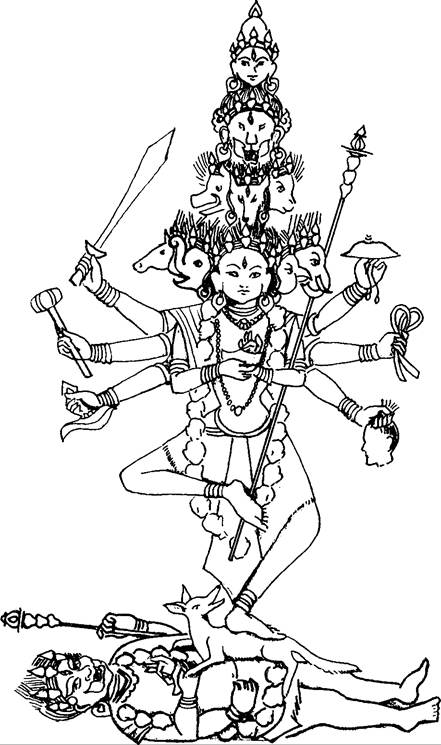
early traditions of the region, preserve her link with the Northern Transmission. For them Guhyakali is the embodiment of that branch of Kaulism. Linked with her in this role is the white Goddess Siddhalaksmi (always written Siddhilaksmi in Nepal), one of the apotropaic deities (Pratyangira) of the Jayadrathaydmalatantra and the patron goddess of the Malla Kings (1200—1768 ce) and their descendants.
A version of the cult of Guhyakali seems also to have flourished in Mithila (in northern Bihar) on the authority of the Mahakdlasamhitd. The connection with the Krama sequence-worship is very attenuated here. Though her icon is as elsewhere, she is unusual in being worshipped with a consort and one who is not a form of Siva, as one might have expected, but the Man-Lion (Narasimha) incarnation of the rival God Visnu. But that too has its precedent in theJayadrathaydmalatantra. For in its fourth quarter that Tantra teaches the cult of a Kali Madhavesvari to be worshipped as the consort of this same Visnu-form. Indeed this seems to have been a major tradition in Kashmir, for Abhinavagupta, the great Kashmiri Tantric scholar, gives this cult in his Tantrdloka as one of two forms of Kaulism connected with the Trika.
The Kaula Cult of Kubjikd: the Western Transmission (Pascimdmndya). Intimately connected with the Trika is the third form of Kaulism, the cult of the Goddess Kubjika. It is distinct from the Trika in that it adds the cult of a new set of deities, so that the Trika recedes from the front line of devotion into the ritual, yogic and theoretical body of the system. Its dependence on the Trika is revealed by the fact that much of its principal and earliest scripture, the Kubjikamata, consists of chapters and other passages taken with minor overwriting from the scriptural corpus of that tradition.
Figure 36.7: Kubjika with Navatma on Agni, according to the visualisation text of the Nityahnikatilaka
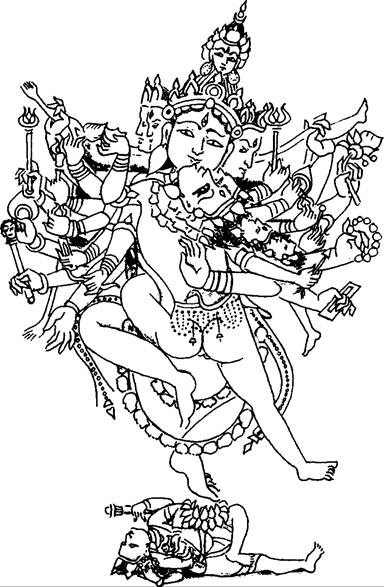
The high deity of the new pantheon is the goddess Kubjika (‘the Humpbacked’ or ‘Stooped’). Black, fat-bellied, six-faced and twelve-armed, adorned with snakes, jewels, human bones and a garland of severed heads, she embraces her consort Navatma (‘the Nine-fold’ [embodying the nine-part mantra H-S-KS-M-L-V-Y-R-UM]). He is five-faced and ten-armed. Also black, but youthful and handsome, he dances with her on a lotus which grows from the navel of Agni, the god of Fire, who lies in the centre of a lotus visualised by the worshipper in his cranial aperture (brahmarandhra) at the summit of an axis of brilliant light rising from the power-centre (cakra) in his genital region (svadhisthana) (see Figure 36.7).
The tradition of the Kubjikdmata is sakta, which is to say that it is a Saiva cult which emphasises the Goddess (sakti) rather than Siva/Bhairava. In this sense all the Transmissions are sakta. However in the Western Tradition (Pascimamnaya) there is a parallel system known as the Sambhava. It is Sambhava as opposed to sakta because it stresses Sarnbhu (equivalent to Siva, i.e. Navatma) rather than sakti (=Kubjika). Similarly masculinised variants existed in the Trika and the Krama. In the first there is the Kaula cult, in which Para, Parapara and Apara are worshipped as the powers of Trisirobhairava (Bhairava the Three-headed); and in the second Manthana-bhairava may take the place of the thirteenth Kali in the Kali- krama. This Sambhava system, however, was much more widely propagated. It is found in the Sambhunirnayatantra (MS) and in much south Indian postscriptural literature (e.g. Sivanandamuni’s Sambhunirnayadtpikd (MS), Tejanandanatha’s Anandakalpalata (MSS), and Umakanta’s Sadanvayasam- bhavakrama). It was even taken into the mainstream of the purified Kaulism propagated by the south Indian Sankaracaryas of Srrigeri and Kandpuram, being the esoteric content of the ever popular Anandalahari attributed to Sankara.
In this system Navatma also called Navesvara or Navaka is worshipped as Solitary Hero (ekavira). Alternatively the divine couple (Navatma and Kubjika) assumes six variant forms to preside over the Six Orders (sadanvaya-) located in the six centres (cakras) along the central power-axis of the body and equated with the five elements (earth, water, fire, wind and ether) and mind (manas). These six levels are further populated by six series of divine couples (ydmala), 180 in all (the 360 ‘rays’), drawn from the pantheon of Kubjika in the earlier cult of the Western Transmission.
The system of the six power-centres (cakras) (adhdra, also called miilddhdra, in the anus, svadhisthana in the genital region, manipura in the navel, andhata in the heart, visuddhi in the throat and djhd between the eyebrows) is also characteristic of the yogic rituals of the Kubjikdmata. Later it became so universal, being disseminated as part of the system of kundaliniyoga beyond the boundaries of the Tantric cults, that it has been forgotten in India (and not noticed outside it) that it is quite absent in all the Tantric traditions except this and the cult of the goddess Tripurasundari. The yoga of these two traditions sets them apart from the earlier Kaula traditions of the Trika and the Kali cult. It is noteworthy in this respect that these two newer forms of Kaulism also mark themselves off from the earlier by worshipping as their founding Siddhas Mitranatha, Od4anatha, Sasthanatha and Caryanatha, while the Trika and the Kali cults share the series Khagendranatha, Kurmanatha, Mesanatha and Macchandanatha also called Matsy endranatha.
The Southern Transmission (Daksindmnaya) and the Cult of Tripurasundart. Under the heading of the Southern Transmission the Cincinimatasdrasamuccaya describes the cult of Kamesvari (the Goddess of Erotic Pleasure), a slim, two-armed and single-faced maiden (kumdrt) surrounded by a retinue of twelve. Eleven of these are goddesses with such appropriate names as Ksobhini (the Exciter) and Dravini (the Melter). The twelfth is male, Kamadeva, the Indian Eros.
This cult of erotic magic is the prototype or part of the prototype of the Kaula cult of Tripurasundari (the Beautiful Goddess of the Three Worlds), also called Kamesvari, the Goddess who is worshipped in and as the nine-triangled s'ricakra, red, red-garmented, garlanded with red flowers, single-faced and four-armed, carrying a noose (pds'a), an elephantgoad (arikusa), a bow and five arrows (the five arrows of the Love God), and
Figure 36.8: Tripurasundart on Sadasiva
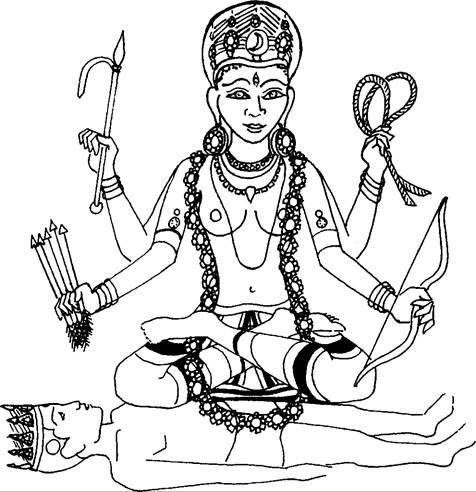
seated above the lower gods Brahma, Visnu, Rudra and Isvara, on the prostrate body of a white Sadas'iva (see Figure 36.8).
The classical form of this cult remembered that it had a special link with the older Southern Transmission; but it had come to see itself as transcending this quadripartition of the Kaula traditions. It called itself the Upper or Supreme Transmission and considered the four divisions to be subsumed within it. In a later elaboration of the cult known as the Kali-Doctrine (Kalimata) worship of Tripurasundari incorporated more or less artificial and inaccurate versions of the pantheons of these other systems. To these new liturgies corresponded the almost universal ascendancy of this form of Kaulism throughout the middle ages down to the present.
The cult of Tripurasundari is certainly the latest of the traditions of the Mantramarga covered here. Its basic scripture, the Nitydsodasikarnava, clings to the edge of the Saiva canon, being known in this canon only to itself. The southerners, who took this cult very seriously—it became so powerful that it was adopted, in a purified form, by the orthodox authority of the Sankaracaryas of Srhgeri and Kandpuram—considered it to be Kashmiri in origin. However, this is quite possibly because they failed to distinguish the scriptural tradition itself from the Kashmiri theological and exegetical system within which they received it from the north and within which they continued to work. From Kashmir itself the evidence is inadequate. The Kashmiri Jayaratha (fl. c. 1225-75 ce), who wrote a learned commentary on the Nitydsodasikarnava (his Vdmakes'varimatavivarana), refers to a long tradition of local exegesis, but we cannot conclude from his evidence more than that the cult was introduced into Kashmir at some time between 900 and 1100 ce.
Figure 36.9: Sricakra
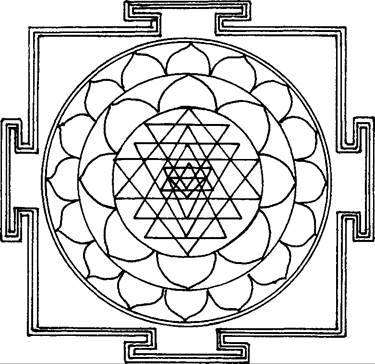
The Nityasodas'ikdrnava is an unsophisticated text which concentrates on external ritual and on the various supernatural effects which such ritual can bestow on the worshipper, particularly in the quest for control over women. For a deeper meaning the tradition had to turn to the Yoginlhrdaya. Here one could find the internal correspondences of the external elements, the metaphysical meaning of the sequence of creation and re-absorption which the deity-sets of the densely populated s'ricakra were believed to embody (see Figure 36.9). Thus the text of the ritual, though apparently concerned with erotic magic—the names of many of the constituent goddesses make this clear enough—could become the vehicle of ritualised, gnostic contemplation. However, although the Yoginlhrdaya is scriptural in form (a dialogue in which Bhairava teaches the Goddess), there is no evidence of its existence before the thirteenth century in south India, shortly before Amrtanandanatha (fl. c. 1325-75) wrote the first known commentary. Certainly it was composed when the non-dualistic Saiva system of the Kashmiri exegesis of the Trika and the Krama had become the norm in the reading of the Kaula cults in south India, that is after c. 1050 ce. This is clear from the fact that it frequently echoes such popular texts of the Kashmiri tradition as the Pratyabhijndhrdaya of Ksemaraja (fl. c. 1000-50).