The Post-scriptural Saiva Traditions of Kashmir from the Ninth Century
The Common Base
From the middle of the ninth century these Tantric Saiva traditions of the Mantramarga emerged from their scriptural anonymity into an extensive body of Kashmiri exegesis.
In this literature we encounter two schools. On the left were the theoreticians of the Trika and the Krama. On the right was the staider and more Veda-congruent Saiva Siddhanta. The doctrines of the former reached their definitive formulation in the works of Abhinavagupta (fl. c. 975-1025 ce) and his pupil Ksemaraja. Those of the latter school culminated in the works of their contemporary, Ramakantha.The tradition of Abhinavagupta was recent. It looked back to Vasugupta (fl. c. 875-925 ce) and Somananda (fl. c. 900-50 ce) as the founders of a new and anti-Saivasiddhantin movement among the learned. The Saiva Siddhanta itself has preserved no records of its presence in Kashmir beyond Ramakantha the Elder, a contemporary of Somananda. We know that there was an already well established tradition in Kashmir at that time, but we do not know how long it had been there. It based itself above all on the works of Sadyojyoti (Nares'varapartksd, Moksakdrikd, Paramoksa- nirasakdrikd, etc.); and it has been assumed that he too was Kashmiri, and that he lived shortly before Somananda. But there is no evidence that Kashmir was his home, and some that he may be considerably older.
Both schools addressed themselves principally not to the specialist seekers of powers so prominent in the scriptures themselves but to the seekers of liberation (mumuksu), to those with no specific goal, who seek self-perfection through conforming to the physical and mental rituals of the Saiva tradition. This, the unmarked category, was the sect’s broad base in society, the community of married Saiva householders. It is in accordance with this breadth that Saivism appears in both schools not merely as a system of doctrines but first and foremost as a set of social facts independent of or presupposed by doctrine.
Thus beneath the fundamental differences in theology which separate the schools there is complete solidarity in a basic faith that it is enough to be a Saiva in a purely ritual sense, that the least gnostic (privy to special knowledge) of their common audience will attain liberation simply by being processed by the rituals of the community.The Kashmiri Saiva Siddhdnta
The Kashmiri Saiva Siddhanta enclosed and reinforced this exoteric base. It propagated an anti-gnostic ritualism which immunised the consciousness of the Tantric performer of ritual against the mystical and non-dualistic tendencies of the Kapalika and Kaula left, and encouraged him to internalise without inhibition the outlook and values of non-Tantric orthodoxy.
According to Ramakantha the scriptures of the Saiva Siddhanta teach that salvation can only be attained by ritual. To be bound to the cycle of death and rebirth (samsdra) is to be ignorant of one’s true nature, but knowledge of that nature cannot bring that bondage to an end. This is because the absence of liberated self-awareness is caused by impurity (mala). This cannot be removed by knowledge, because it is a substance (dravya). Being a substance it can be destroyed only by action and the only action capable of destroying it is the system of ritual prescribed in the Saiva scriptures.
The rite of consecration (diksd), through which one enters upon one’s ritual obligations, destroys all the impurity (mala) which would otherwise be the cause of further incarnations. The daily (nitya) and occasional (naimittika) rituals which one is bound to perform after consecration cause, said Ramakantha, the daily decrease of the impurity which the rite of consecration has left intact, the impurity which is the support of one’s current physical and mental existence. But since the passage of time itself accomplishes this end, bringing one daily closer to the liberation at death which is the promised effect of consecration, it is hard to believe that this theory that ritual after consecration has a positive effect can have been in the forefront of the awareness of the Tantrics of the Saiva Siddhanta.
More compelling must have been the negative argument offered by Ramakantha, as by the Bhatta Mimamsakas, that one performs one’s ritual duties in order to avoid the evil consequences of not performing them. For if one omits them, or breaks any other of the rules (samaya) which bind the initiate, one must perform a penance (prdyas'citta); and one is told that if this penance is neglected one’s liberation guaranteed by the rite of consecration may be postponed by another incarnation, even by a period in hell.The Kashmiri Trika
The Kashmiri authorities of the Trika attacked this ritualism of their Saiva Siddhantin contemporaries. They claimed that they had exaggerated certain tendencies in the scriptures of the Saiva Siddhanta by means of sophistic exegesis. Thus, said the Trika, these scriptures place a greater emphasis on ritual than those of the left, but they do not go to the extent of claiming that salvation can be gained by no other means.
According to the left, the Saiva Siddhanta contains the truth as modified by Siva for the benefit of those not mature enough to enter the less conditioned and more demanding paths of his esoteric revelations. The extreme positions of the current Saiva-Siddhantin exegesis were believed to have arisen from failure to see this essential continuity of the Saiva revelation. Thus the left attacked certain interpretations of these scriptures—and it must be said that in the main its criticisms are justified— but it never denied the efficacy of the religious practices of those who followed the prescriptions of these scriptures, even if they accepted the right’s biased exegesis. The left was content to believe that the most hardened Saiva-Siddhantin ritualist would attain perfect liberation at death by the power of Siva manifest in the mechanism of ritual. It drew’ its strength not from exclusion but from the propagation of a universally applicable theory of ritual. This theory promised liberation to all Saivas while motivating ascent into the esoteric left through further consecrations in which the meaning of ritual proposed by the theory could be realised with ever greater immediacy and intensity.
The culmination of this intensification is liberation, not at death but in life itself.The left maintained that there are those who have attained this mystical transformation spontaneously or by means of gradual, ritual-less insight. Thus while the Saiva Siddhantins held that liberation could not be attained except through ritual, the authorities of the Trika maintained that liberation, while attainable by ritual alone (Saiva-Siddhantin or esoteric), could also, though more rarely, be attained by mystical experience and gnosis. Further, their theory divided the performance of ritual itself into two levels. Ritual without internal awareness would lead to liberation at death, as we have seen; but ritual could also be a means of liberation in life. Gnostic meaning encoded into the manipulations and formulas of the ritual could be so internalised through daily repetition that it would no longer require this external medium of expression in action. It could become purely mental, a ritual of self-definition in thought. The Tantric was exhorted by the left to see the sequence of ritual (pujdkrama) as a mirror in which he could perceive and contemplate his ultimate nature. Thereby he could attain liberation, for to be fully aware of this ultimate nature is to be liberated as this nature. By means of daily repetition he was to achieve a state of mind in which he believed that he was and always had been that which his ritual defines.
The ritualist of the Saiva Siddhanta maintained that the scriptures taught no self beyond that of a purified and blissless individuality. For him salvation was not a merging into a transcendental godhead. It was simply that state of the eternally individual self in which its equality with Siva previously concealed by the substance of impurity had become fully manifest. He did not become Siva; he became a Siva, omniscient and omnipotent but numerically distinct. Thus the Kashmiri Saiva Siddhantins stressed the difference between the Siva who had never been bound, the ‘original Siva’ (anddisiva), and those who were ^ivas through liberation from bondage, ‘released Sivas’ (muktasivas).
The latter were held to be capable of performing the five cosmic functions (pahcakrtya-: creation, maintenance of the created, retraction of the created, and the binding and liberating of other selves), but to refrain from so doing because of the non-competitive spirit inherent in liberation.Equally absolute in the Kashmiri Saiva Siddhanta was the doctrine that matter and consciousness are entirely separate. According to Ramakantha, following Sadyojyoti’s interpretation of the scriptures, selves know and act upon a world whose existence is entirely independent of them, though it is arranged to fulfil their karmic needs. Siva causes the entities of our universe to emerge by stimulating an independently eternal, all-pervasive, and unconscious ‘world-stuff’ (rndyd). Thus are created the various spheres, bodies and faculties by means of which eternal selves can experience the effects of their past actions (karma) and eventually attain release from their beginningless state of bondage through Saiva consecration (diksa).
In the Kashmiri Trika the seeker of liberation (mumuksu) is to realise through his ritual a self which breaks through these exoteric barriers of pluralism, realism and reified impurity. For the self of his worship and meditation is an absolute and omnipotent consciousness which, by manifesting contraction of its infinite powers, appears as separate individuals, their streams of experience, and the ‘outer’ objects or ‘causes’ of those experiences. He thinks of the three goddesses convergent in the fourth as this infinite and all-containing self, seeing their structure as that of his own consciousness. As this awareness deepens through immersion in the ritual, his individual consciousness, which is these powers contracted without change of structure, dissolves into its uncontracted prototype (cf. p. 673).
The Doctrines of Vibration (Spanda) and Recognition (Pratyabhijnd)
According to the Kashmiri Trika these doctrines of the ultimate nonplurality of centres of consciousness, of the non-existence of any reality except as projection within this all-containing consciousness, and conse quently of the immateriality of impurity (mala), have been revealed by Siva in all the Tantras of Bhairava.
This is to say that they were read into this corpus or presupposed in any reading, for the surviving texts themselves hardly support this sweeping claim.None the less, these doctrines are not entirely postscriptural. For the view that the Deity is non-dual, dynamic consciousness (samvidadvayavdda, s'dktddvayavdda) was already present at the far left of this corpus, in the literature of the Kapalika and Kaula cults of Kali (in the Mata and the Krama). From the middle of the ninth century the Trika, which was then permeated by the Kali cult (see p. 678), produced theological metaphysicians who elevated these doctrines towards respectability within the Saiva mainstream by abstracting them from their heterodox ritual context, by formulating them in a less sectarian terminology and by defending them philosophically against the doctrines of the Buddhists. This new direction began precisely during the period at which royal patronage in Kashmir started to shift from Pancaratra Vaisnavism to Saivism.
The first stage of this development is seen in two works of the ninth century: the Aphorisms of Siva (Sivasutra) and the Concise Verses on Vibration (Spandakdrika). The first was ‘discovered’ by Vasugupta. The second was composed by Vasagupta according to some, or by his pupil Kallata according to others.
The Sivasutra is too brief and allusive a work for us to be able to form a precise picture of its doctrine apart from its inevitably biased interpretation in the commentaries of Bhaskara (fl. c. 925r-75) and Ksemaraja (fl. c. 1000-50). We can see only that it sought to outline the non-ritual soteriology of an esoteric Saiva tradition closely related to what we find in the Jayadrathaydmalatantra and the Kali-based Trika.
The Spandakdrika, being more discursive, can be much more clearly understood independently of the commentaries. The work’s fifty-two verses, offered as the key to the theology of the Sivasutra, proposed that &va is all-inclusive reality, a single, unified consciousness, which manifests itself as all subjects, acts and objects of experience by virtue of an inherent and infinite dynamism. This dynamism, the essential nature of the Deity, was termed the Vibration-Reality (spanda-tattva). Liberation was to be attained by realising this vibration (spanda) in the source, course and end of all states and movements of consciousness.
Ksemaraja, the author of an important commentary on this work, was probably right when he claimed that the scriptural background of this text is the Krama and the Mata with some elements of the Trika. For the concept of‘vibration’, or rather the use of this term to denote the inherent dynamism of a non-dual consciousness, which is the signature of this doctrine, is well-established in theJayadrathaydmala and other texts of the Kali cults.
The second stage of this scholarly underpinning began in the early tenth century with the Perception of Siva (Sivadrsti) by Somananda (fl. c. 900-50). While the Spandakdrikd preserved some of the heterodox flavour of the goddess-orientated traditions of the far left, Somananda, though he was certainly an initiate in those traditions, formulated a Saiva non-dualism along more orthodox and rigorously philosophical lines. His pupil Utpaladeva, also a guru of the Trika and the Krama, gave this non-dualism its classical form in his Concise Verses on the Recognition of the Deity (Is'varapratyabhijhdkdrika). Claiming to follow his master he offered a ‘new and easy path to salvation’ through the recognition (pratyabhijnd) that it is one’s own identity (dtman) which is Siva, the Great Deity (Mahesvara). This transpersonal Self (atmesvara) is to be seen as that which contains all subjective and objective phenomena, holding this totality in a blissful synthesis of non-dual awareness. Through this recognition, which is forcefully defended against the Buddhist doctrine of impersonal flux, one is released from the cycle of death and rebirth (samsdra). For one’s true identity is an already-liberated and never-bound T-consciousness outside time, form and location (the three bases of (the appearance of) bondage in the continuum of transmigratory existence). This state of limitation is to be contemplated as the spontaneous play of this T-consciousness. The pure autonomy (svdtantrya) of the self expresses itself by manifesting its own ‘contraction’ in the form of limited centres of consciousness perceiving and acting within time, form and location, in accordance with the causal power of their acts (karma). Thus there arises the ‘binding’ appearance of essential differences between a world ‘out there’, a self ‘in here’ and other selves. Liberation is the realisation that all this is internal to the awareness which represents it as external. Consciousness thereby throws off its state of‘extrin- sicist contraction’, and knows itself only as the pre-relational, pre-discursive unity of manifestation (prakas'a) and self-cognition (vimars'a).
The philosophical position of Utpaladeva’s Doctrine of Recognition was analysed and supported in great detail by Abhinavagupta (fl. c. 975-1025), a pupil ofhis pupil Laksmanagupta, in a commentary of the Concise Verses (Isvarapratyabhijhdvimarsini) and in a much longer commentary on Utpaladeva’s own exegesis ofhis verses (Isvarapratyabhijhdvivrtivimarsini).
The Doctrine of Recognition and the Trika
The Kashmiri Trika is known to us principally through the works of this same Abhinavagupta, particularly through his Tantrdloka, Tantrasdra, Mdlinivijayavdrtika and Pardtrimsikdvivarana. In the first three of these he expounds the doctrine and ritual of the Trika on the basis of the Mdlinivijayot- taratantra. In the fourth he develops a more concentrated form of Trika worship, which focuses only on Para, the highest of the three goddesses. Because the goddess is worshipped here as Solitary Heroine (ekavird), that is without the customary offerings to aspects and emanations, this tradition is sometimes distinguished from the Trika proper as the Ekavira. For the same reason it is known as the Anuttara, ‘that above which there is nothing’.
His exegesis of both of these forms of the Trika is based on the Doctrine of Recognition. Utpaladeva’s concepts and terminology provide his metaphysical groundwork and are fed into Trika ritual. Thus, to give but one example, the phases of the worshipper’s divinisation of his person with mantras (nyasa) is required to be understood within the framework of Utpaladeva’s four levels of contraction in which the self manifests itself in progressively grosser forms as the sensation-less void (sunya), internal sensation (prana), the mind (buddhi) and the body (deha). r,,
Thus we may speak of at least three major phases in the evolution of the Trika. At the beginning are the Siddhayogesvarlmata and related texts (see pp. 672—4) which teach the cult of the three goddesses alone. Then this triad is transcended and subsumed within Kali (see p. 678). Finally we have the Pratyabhijna-based Trika of the Abhinavagupta with its two aspects, the first being the Kali-based cult of the Tantraloka, and the second the condensed cult of Para as Solitary Heroine.
The Kashmiri Krama
The Krama passed from its scriptural phase into chartable history with Jnananetra alias Sivananda in the first half of the ninth century. Said to have been instructed supernaturally by the Goddess herself in Oddiyana, he was the source of well-attested^wni lineages in Kashmir and beyond. His tradition is remarkable for the theoretical structure of its ritual. It synthesised and adjusted the scriptural prototypes (principally those of the Devipancasataka and the Kramasadbhdva (see pp. 683-4)) to produce a liturgy which could be thought of as the unfolding of the imperceptible sequence of cognition (samvit-krama) in the perceptible sequence of worship (pujd-krama).
After contemplating various pentads as the structure of his bodily and mental existence and seeing them as emanations of a set of five goddesses representing the cycle of cognition—thus he consecrates his person as the true site of worship and seat of power (pitha)—the worshipper proceeds to a five-phased worship which enacts the progress of cognition from initial to terminal voidness. Each phase is equated with one of these same five goddesses.
In the first, that of the goddess Vyomavamesvari (She who Emits the [Five] Voids), he worships the whole pentadic cycle (the Five Voids) as condensed within the initial and eternal vibration of thoughtless consciousness.
In the second, the phase of the goddess Khecari (She who Pervades the Void [of Cognition]), he worships the twelve Lords of the Wheel of Light (prakdsa-cakra). These are identified with the twelve faculties of cognition (the introvertive mental organ [buddhi ] and the five senses) and action (the extrovertive mental organ [manas], speech, manipulation, locomotion, excretion and sexual pleasure). He mediates on these as illuminated by cognitive power as it moves from its initial vibration (spanda) in the five voids towards the extroverted representation of objects facing a subject.
In the third stage, that of the goddess Bhucari (She who Pervades the [Outer] Field), the constituents of the preceding phase have moved outwards and incorporated into consciousness the representation of the five external sense-data (sound, tactile sensation, visible form, taste and odour). This extroversion entails the suppression of the introvertive mental organ. Thus there are now sixteen constituents: the preceding twelve reduced to eleven and increased by five. These he worships as the sixteen Yoginis of the Wheel of Sensual Bliss (ananda-cakra).
The fourth stage is pervaded by the goddess Samharabhaksini (She who Devours in Retraction). It represents the first stage in the reversion of cognitive power to its prediscursive source, the internalisation of the object of sensation that occurs in the awareness that one has perceived it. The extrovertive mental organ (manas) which was distinct in the preceding phase is now submerged and the introvertive mental organ (buddhi) re-emerges. These sixteen are increased to seventeen by the addition of ego-awareness (ahahkdra). They are worshipped as the Lords of the Wheel of Fusion (murti-cakra).
The fifth and final stage is that of the goddess Raud- resvari (The Terrible). Here he worships the sixty-four Yoginis of the Wheel of the Multitude (vrnda-cakra). The ego-awareness which emerged in the preceding phase is represented as suddenly expanding to obliterate all that conceals the radiant voidness of the transpersonal Absolute within consciousness. This obliteration is worshipped in five stages as sixteen, twenty- four, twelve, eight and four Yoginis.
The first sixteen of these Yogini emanations dissolve the latent traces (vdsand, samskdra) of the field of objective sensation worshipped as the Wheel of Sensual BEss (ananda-cakra). In the second stage the traces of the twelve constituents of the cognitive Wheel of Light (prakdsa- cakra) are obliterated. Twenty-four Yoginis are worshipped here, because each of the twelve has two aspects, a latent and an active. In the third phase twelve Yoginis penetrate this cognitive field with pure, non-discursive awareness. Now there remain the latent traces of the subtle body (puryastaka) consisting of the five sense-data (sound, etc.) and the three internal faculties (the extrovertive and introvertive mental organs together with egoawareness). By worshipping eight Yoginis here he enacts the elimination of these elements. The four Yoginis worshipped in the fifth and last phase of the Wheel of the Multitude (yrnda-cakra) represent the obliteration of a subtle residue which the preceding eight left untouched: the deep latent impression of the threefold inner mind and of objectivity reduced to a single, undifferentiated sensation of contact (sparsa).
He now worships Raudresvari herself as the sixtyfifth power, the non-relational ground of these sixty-four Yoginis, consciousness in its pristine purity. He identifies her with Mangala alias Virasimha, the goddess incarnate of Oddiyana. He thereby equates the Krama’s Absolute with the lineage of teachers, male and female, who have embodied this Absolute and transmitted it to him. For after Mangala he worships Jnananetra and then the gurus who descend from Jnananetra to himself.
Finally he worships the four Sequences (krama), those of Emission (srsti-), Maintenance (sthiti-), Retraction (satnhdra-), and the Nameless (andkhya-) which pervades the three as their ground. The twelve Kalis of this fourth sequence are to be worshipped during sexual intercourse with the duti. They are understood as the gradual withdrawal of cognitive power into Kalasamkarsini (Kali the Destroyer of Time), the waveless void of the absolute Self. Here the worshipper realises the absolute autonomy (svdtantrya) of the Goddess (Consciousness) through which she assumes the form of the universe without contamination or diminution of her nature.
Three major works of this Kashmiri Krama survive, all entitled Mahanayaprakdsa (Illumination of the Great Way), that of Sitikantha (in Old Kashmiri with a Sanskrit auto-commentary), that of Arnasimha (MS) and the third anonymous. The last is the source of our exposition of the phases of pentadic worship leading up to that of the four Sequences.
The function of the ritual sequence of this tradition is said to be that it prepares the initiate for the non-sequential (akrama) intuition that will enable him to transcend it. It is designed to condition awareness with the image of its true nature, so that eventually it will provoke a spontaneous and instantaneous ‘swallowing of dichotomising cognition’ (vikalpagrdsa), the annihilation (alamgrdsa) of the mechanisms of individuation and projection through which the innate (sahaja) purity of awareness appears as though it were sullied in the natural processes of ideation and perception. The worshipper is to pass through the ritual to reach the liberating conviction that absolute reality is this pure awareness, and that the phases and levels of cognition are co-extensive with it as its innate vitality. Liberation (moksa) here is the resolution of the distinction in self-perception between a transcendental or internal state of nirvana and an imminent or external state of finite, transmigratory existence (bhava, samsdra).
This system of contemplative worship was not the Krama’s only means of enlightenment. It believed that there were those who were capable of reaching the goal without it. For these two higher paths are described. In the first, that of Oral Instruction (kathana), the guru was to provoke the disciple’s intuition through certain mystical aphorisms (kathd, chummd). The emphasis here is on sudden enlightenment (sdhasa). In the second path the goal was believed to be attained without any instruction, either spontaneously or through some non-verbal stimulus such as the guru’s glance.
Both this intuitionism and this view of ritual as a mode of liberating insight are thoroughly in harmony with the position which Abhinavagupta expounds for the Trika. Indeed in this respect the Trika was greatly indebted to the Krama. It had already accommodated important elements of this system in the second phase of its development (see p. 678). In the third phase, during which this enriched Trika was grounded in the Doctrine of Recognition, we find Abhinavagupta drawing directly on the postscriptural Krama of the lineage ofjnananetra, adapting it as the basis of the Trika’s claim to be the ultimate in Saiva revelation. Ksemaraja, his pupil, who offered no detailed exegesis in the Trika itself, unambiguously asserts that it is the Krama that embodies this final truth. Clearly the prestige of the Krama-based Kali cult was widely felt in esoteric Saiva circles. The Manthdnabhairavatantra places it above the Trika at the summit of the hierarchy of the Saiva traditions, allowing it to be transcended only by the Western Transmission (Pascimamnaya), the tradition of the text itself. Another work of that Transmission, the Cincinimatasdrasamuccaya, goes further. It gives the realisation of the Krama’s Kalis in the Sequence of the Nameless as the highest, internal worship within the cult of Kubjika itself.
The Kashmiri Cult of Svacchandabhairava
We have seen that Saivism in Kashmir was split between two centres of authority. On the right was the ritualistic Saiva Siddhanta with its anti- mystical pluralism and extrinsicism. On the left was the gnostic non-dualism of the Trika and the Krama. The right saw the left as heretical while the left saw the right as the exoteric base of the Saiva hierarchy, leading to liberation but only at death.
It might be imagined therefore that it was the tradition of the Saiva Siddhanta which was the source of the practice of the greater part of the Saiva community, and that the Trika and the Krama were the preserves of enthusiasts dependent on this exoteric or common Saivism both for the candidates for these ‘higher’ initiations and as the form of their own more public identity in the wider society. This then would be the sense of the frequently quoted maxim of the left which requires one to be privately Kaula, publicly Saiva and Vedic in one’s social intercourse.
However, the interrelation of the traditions was more complex in Kashmir. For the Saiva cult of the majority was not that of Sadasiva taught by the Siddhanta, but that of Svacchandabhairava. Since the latter derived its authority from the Svacchandatantra of the Mantrapitha section of the Tantras of Bhairava (see p. 670), it was, strictly speaking, a tradition of the Kapalika-based left. None the less, the Kashmiri practised a thoroughly domesticated form of the cult, and in the tenth century the Saiva Siddhanta, though not its source, had taken advantage of this to bring it under the sway of its doctrines. The Saiva Siddhanta was, therefore, the principal doctrinal authority among the Saivas of Kashmir, at least during the tenth century.
It is hardly surprising, then, that the non-dualistic tradition of the left should have tried to oust the Saiva Siddhanta from this position of power once it had itself attained a degree of respectability during the course of the tenth century. This vital task of establishing the authority of the new exegesis beyond the confined territory of the Trika and the Krama was accomplished by the works of Ksemaraja. While his teacher Abhinavagupta limited himself to the exposition of the esoteric traditions in harmony with the Doctrine of Recognition, Ksemaraja (fl. c. 1000-50) popularised the essential doctrine and applied it through commentaries to the cult of Svacchandabhairava and its annexes. In the first case we have such works as his Essence of Recognition (Pratyabhijndhrdaya) and his commentaries on two popular collections of hymns, the Stavacintdmani of Bhatta-Narayana and the Stotrdvali of Utpaladeva. In the second case we have his elaborate analytical commentaries on the Svacchandatantra and the Netratantra.
In both of these commentaries Ksemaraja states that his motive is to free the understanding of these texts from the dualistic exegesis that was traditional in his day. The importance of the Svacchandatantra has already been stated. The Netratantra was the authority for the cult of Amrtesvarabhairava and his consort Amrtalaksmi. The worship of this pair was closely finked with that of Svacchandabhairava and Aghoresvari in the Kashmiri tradition, as can be seen from the surviving ritual handbooks (paddhatis) in use until recently among the Tantric family priests.
In purely doctrinal terms Ksemaraja’s commentaries do violence to both of these texts, at least as much as that of which the dualistic commentaries must have been guilty. Neither Tantra fits either exegetical straitjacket. In the area of ritual, however, Ksemaraja had a clear advantage. When, for example, he attacked the then current practice of substituting water for alcoholic liquor in Svacchandabhairava’s guestoffering, he was simply reinstating the text within the tradition of the Bhairava Tantras to which it properly belonged. This recontextualisation would have seemed all the more plausible in the light of the fact that when the deity-system of the Svacchanda cult of common Saiva worship in Kashmir extends beyond its immediate boundaries, it does so not to the right and the Saiva Siddhanta but to the left and the goddess cults. Thus we find the Picumata-Brahmayamala’s Candà Kàpàlini with her eight saktis (see p. 672), Kulesvari and the eight Mothers with the Bhairavas (see p. 681), the Kaula alcohol deity Anandesvarabhairava, the Trika’s Para and Màlini (as Goddess of the Eastern Transmission), Kubjikà (as Godess of the Western Transmission), several aspects of Tripurasundari and a number of goddesses from the Jay adrathay amala.
The literature of this common Saiva worship current in Kashmir shows that this attempt to throw off the influence of the Saiva Siddhanta was entirely successful. How quickly this was achieved cannot be seen from the evidence so far uncovered. We can say only that the corpus of the anonymous texts of Saiva ritual in Kashmir is completely non-dualistic in the manner defined by Abhinavagupta and Ksemaràja, that this corpus records a tradition which must go back at least five hundred years, and that there is no trace of any Kashmiri literature in the doctrinal or liturgical aspects of the Saiva Siddhanta after the eleventh century. But the most striking indication of its ascendency is its influence outside the sphere of the properly Tantric.
Saiva Non-Dualism and the Non- Tantric Tradition in Kashmir
When the Pratyabhijna-based Trika was emerging in Kashmir both the Vedic and the Tantric traditions were fully deployed. The first was active in both its srauta and its smòrta forms (see pp. 660-2), while the second could be seen not only in the various forms of Saivism outlined above but also in the Vaisnavism of the Pancaratra.
At some point, probably during the Muslim period from the fourteenth century, the Kashmiri s'rauta tradition of the Kàthaka- Yajurvedins disappeared entirely. All that remained of the Vedic tradition were the domestic rites (following the ordinances of Laugàksi) together with a repertoire of non-Tantric deity-worship (devapuja). In Kashmir, as elsewhere, this smòrta tradition of worship mirrors the Tantric at a safe distance. This is to say that it has borrowed Tantric deities and liturgical forms, but uses Vedic rather than Tantric mantras within this framework.
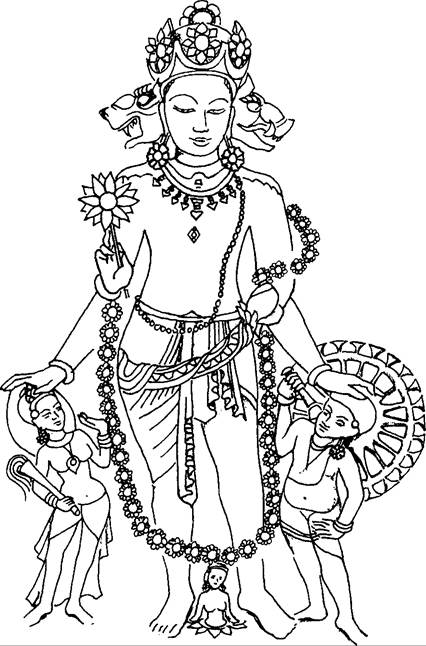
The Tantric Vaisnavism of the Pancaratra also disappeared, but not without leaving behind clear evidence that it was once a powerful influence in Kashmiri refigion. For the Tantric tradition mirrored in the smòrta worship of the region is not the Saiva as one might have expected but precisely the principal cult of the earliest scriptural Pancaratra, that of Vàsudeva in his form as Vaikuntha (see Figure 36.10), in which a mild human face is flanked by those of his incarnations as the Man-Lion (Narasimha) and the Boar (Varàha), with that of the wrathful sage Kapila behind.
Thus there remained only the simple dichotomy between a smòrta tradition influenced by the Pancaratra and the Tantric Saiva
Figure 36.10: Vaikuntha
tradition which, as we have seen, was itself simplified by the decline of the Saiva Siddhanta.
It should not be imagined, however, that the non- Tantric excluded and condemned the Tantric in Kashmir. While this may have been the more usual position in the rest of India, as earlier in Kashmir itself, the evidence of recent centuries shows a more or less unified community. The Vedic tradition came to be outside the Saiva only in the sense that the former comprised the rituals of those who had undergone the common investiture (upanayana) of the Brahmanical tradition but had not yet undergone or never underwent special consecration in the form of the Tantric Saiva dtksd. Thus they were not bound by the additional and more exacting duties of Tantric worship. However, outside the special domain of ritual these brahmins were as Saiva as the rest. Texts dealing with their duties teach side by side with non-Tantric ritual a thoroughly Tantric form of yoga. This is designed to cause sakti as macrocosmic power within the microcosm of the body (kundalini) to rise from her state of latency in the region of the anus (muladhdra-cakra), to ascend through the central channel (susumnd) imagined along the internal vertical axis of the body, to transcend the body through the cranial ‘aperture of Brahma’ (brahmarandhra), and finally to come to rest in union with Siva at a point twelve finger-breadths above the head (dvadasdnta). This form of kundalini-yoga is derived, as we have seen (see pp. 687-8), from the later Kaula tradition of the cults of Kubjika and Tripurasundari. As for duty in the form of the cultivation of liberating knowledge (jndna), this is the study of the mystical soteriology of the Trika expounded by Abhinavagupta, which is to say the practice of all but the ritual of that system.
Thus the whole society of Kashmiri brahmins had become Saiva. It was no longer necessary, as the earlier tradition had insisted, to take Tantric consecration, thereby binding oneself to perform Tantric worship, if one wished to have access to Tantric yoga and mystical doctrine.
This separation, which enabled Tantric Saivism to pervade the community so completely, is not a recent phenomenon. Its roots can be seen at the turn of the millennium in the works of Abhinavagupta and Ksemaraja themselves. For it is in the essence of their opposition to the Saiva Siddhanta that they saw ritual as a lower and transcendable mode of selfknowledge (see pp. 700-1). The rule that only those who had been consecrated and bound to Tantric ritual could attain liberation was preserved only in the letter. For the definition of consecration was stretched into the metaphorical so that it could bypass ritual in the special case of‘consecration by the deities of one’s own consciousness’. This sort of thinking was justified by appealing to the authority of the most heterodox area of the Saiva Mantramarga; but it served in the end to make a private Tantric identity accessible to all Kashmiri, while the Saiva Siddhantins, for all their ostentatious orthopraxy, declined and disappeared from the scene. For though the Siddhanta argued that it was pure in the sense accepted by the non-Tantric, it did not do so out of any desire to extend its domain across boundaries of ritual qualification (adhikdra) into the wider community. Its concern was rather to claim high social status for its adherents as a distinct and exclusive group within that community. The Saiva Siddhanta has survived to this day in south India among an endogamous community of Saiva temple-priests, the Adisaivas, as the basis of their profession and the guarantee of their exclusive hereditary right to practise that profession. It seems very probable that the Kashmiri Saiva Siddhantins were protecting similar rights. If they died out it may have been because centuries of Islamidsation had deprived them of their institutional base. Certainly nothing survives in Kashmir that is remotely comparable to the richly endowed Saiva temples which continue to provide the livelihood of the Adisaivas in the Tamil south.
Finally, just as the esoteric Saiva traditions in Kashmir flowed into the non-specialised brahmin majority, so when these same traditions went south they took root among the Saiva brahmin community that surrounds the Adisaiva enclaves in that region. The cult of Tripurasun- dari (see pp. 688-9) became particularly well established. In purely Tantric circles it was propagated within the theological system of the Pratyabhijna- based Trika; but, much as in Kashmir, it came to pervade the wider community of Saiva brahmins known as the Smartas. Purged of its Kaula heteropraxy, it became there the special cult of the renunciate (samnydsin) Sankaracaryas, who are the ultimate spiritual authorities of this community. Its emblem, the srtcakra (see pp. 689-90), was installed in the major Saiva temples to assert their claim to pre-eminence even within the domain of the Adisaivas.
Further Reading
On Pas'upata doctrines:
Hara, Minoru ‘NakuEsa-Pasupata-Darsanam’, in Indo-Iranian Journal, vol. II (1958), pp. 8-32
On the Pasupatas, Kalamukhas and Kapalikas:
Lorenzen, David N. The Kapalikas and Kalamukhas: Two Lost Saivite Sects (Thomson Press (India), New Delhi, 1972)
On the doctrines of the Saiva Siddhanta:
Brunner, Helene, ‘Un chapitre du Sarvadarsanasamgraha: Le Saivadarsana’, in Melanges Chinois et Bouddhiques, vol. XX (Tantric and Taoist Studies in Honour of R.A. Stein) (Institut Beige des Hautes Etudes Chinoises, Brussels, 1981), pp. 96-140
On the mysticism and ritual of the Saiva Siddhanta:
Brunner, Helene, ‘Le mysticisme dans les agama sivaites’, in Studia Missionalia, vol. 26 (1977) (Gregorian University, Rome), pp. 287-314
----- Somas'ambhupaddhati, vols. 1-3 (1963-77) (Institut Franfais d’Indologie, Pondicherry). See the introductions to these volumes for an excellent account of Saiva ritual. The other traditions of Tantric worship (the Pancaratra, the Trika, the cult of Svacchandabhairava, etc.) differ from this only in their deities, mantras, mandalas, mudrds and such constituents. The ritual framework is largely constant.
On the Trika and related systems:
Gnoli, Raniero (trans.), Luce delle Sacre Scritture (Tantrdloka) di Abhinavagupta, (Unione Tipografico-Editrice Torinese, Turin, 1972)
Padoux, Andre Recherches sur la Symbolique et I’Energie de la Parole dans certains Textes Tantriques (Institut de Civilisation Indienne, Paris, 1963)
Sanderson, Alexis ‘Purity and Power among the Brahmans of Kashmir’ in Michael Carrithers, Steven Collins and Steven Lukes (eds.), The Category of the Person (Cambridge University Press, Cambridge, 1985), pp. 191-216