An Eternal Succession of Tirthankaras
Jainism, like Hinduism and Buddhism, is categorized by scholars as an “eternal” religion in the sense that it subscribes to an ongoing succession of world cycles, without beginning or end.
Jains believe that twenty-four tirthankaras, or jinas, have appeared in this current world cycle. Mahavira is the latest in an infinite line of previous tirthankaras, but he is not expected to be the last.All twenty-four tirthankaras of this world cycle are known by name and by their specific symbols: Mahavira by the lion, for example, and Parshva—of whom there are more sculptures in India than of any other tirthankara—by the serpent. Along with Parshva and Mahavira, however, the only additional jinas who play a prominent role in the scriptures and in the tradition generally are the first, Rishabha (symbolized by the bull), and the twenty-second, Nemi (symbolized by the conch shell). Rishabha, who is clearly legendary and not historical, is believed to have been the father of Bharata, whom Jains regard as the first world emperor of this world cycle. Nemi, in addition to being the predecessor to Parshva, is traditionally thought to be a relative of Krishna, whom many Hindus revere as an avatar (human incarnation) of the god Vishnu (Chapter 4). The nineteenth tirthankara, Malli (symbolized by the jar), is also especially notable, for according to the Shvetambara sect, Malli was a woman. The Digambaras, who in general are more conservative, deny this assertion, regarding this tirthankara as a man by the name of Mallinatha.
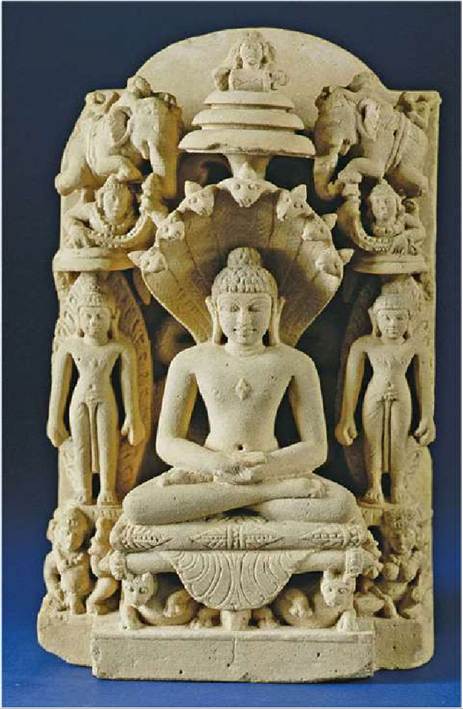
Sandstone sculpture of Parshva, the tirthankara most commonly depicted in Jain art.