Mahavira, the Twenty-Fourth and Last Tirthankara of This World Cycle
Nataputta Vardhamana, popularly known as Mahavira (“great hero”), was probably bom near Vaishali (located in the northern Indian state of Bihar). He lived, according to the Shvetambara sect, from 599 to 527 bce, although the Digambaras date his death at 510 bce (and scholars tend to date it later still, to sometime in the second half of the fifth century bce).
The earliest biography of Mahavira is from the ninth century ce (the Sanskrit work Vardhamanacharita, by the poet Asaga), and so it is not possible to determine with historical certainty the details of his life. All, however, agree on one detail: Mahavira was a contemporary or near-contemporary of Gautama the Buddha, who lived in the same area of northern India and preached his last sermon at Vaishali. There is no record of the two having met, but their legendary biographies are strikingly similar.Vardhamana is said to have been born into the ruling class (the kshatriyas), the second son of a rajah or local ruler who was also a pious Jain. Vardhamana grew up amid the luxuries of the palace, eventually marrying a princess named Yashoda (although the Digambara sect denies that he married), with whom he had a daughter. Eventually, however, he yearned for more than his princely life could offer, and so at age thirty he asked for permission to leave and become a monk. He joined a group of Jain ascetics who were followers of Parshva, the last tirthankara to have lived prior to Mahavira.
Vardhamana soon set off from the other ascetics and wandered about for over twelve years, naked and exposed. Fasting, going for long periods without sleep, withstanding the verbal and physical abuse of human opponents, and enduring the bites of insects rather than doing them harm, Vardhamana exemplified the ideals of nonviolence and asceticism, thereby earning his epithet “great hero,” Mahavira.
In the thirteenth year of his ascetic wanderings, Mahavira is believed by Jains to have attained the state of kevala, or omniscience, the complete and perfect knowledge that leads at the time of death to liberation from the realm of samsara.
The tradition recounts that Mahavira attained this enlightenment after spending two and a half days fasting in the heat of the sun, squatting near a tree but out of its shade. With these acts of extreme asceticism, his steadfastly nonviolent approach to life, and his supreme spiritual achievement of attaining kevala, Mahavira exemplifies Jainism’s central ideals.Now perfectly enlightened, Mahavira set about preaching the tenets of Jainism. His followers included eleven ganadharas, or disciples, who had been Hindu brahmins before hearing Mahavira’s message. All of them eventually attained kevala, ending with Jambu, who is regarded as the last human being ever to attain kevala in this world cycle.
Mahavira preached for some thirty years until, at the age of seventy-two, he died in the town of Pava (like Vaishali, located in the northern Indian state of Bihar). Now liberated from his body, Mahavira’s perfected soul is said to have ascended to the top of the universe in a state of eternal bliss.
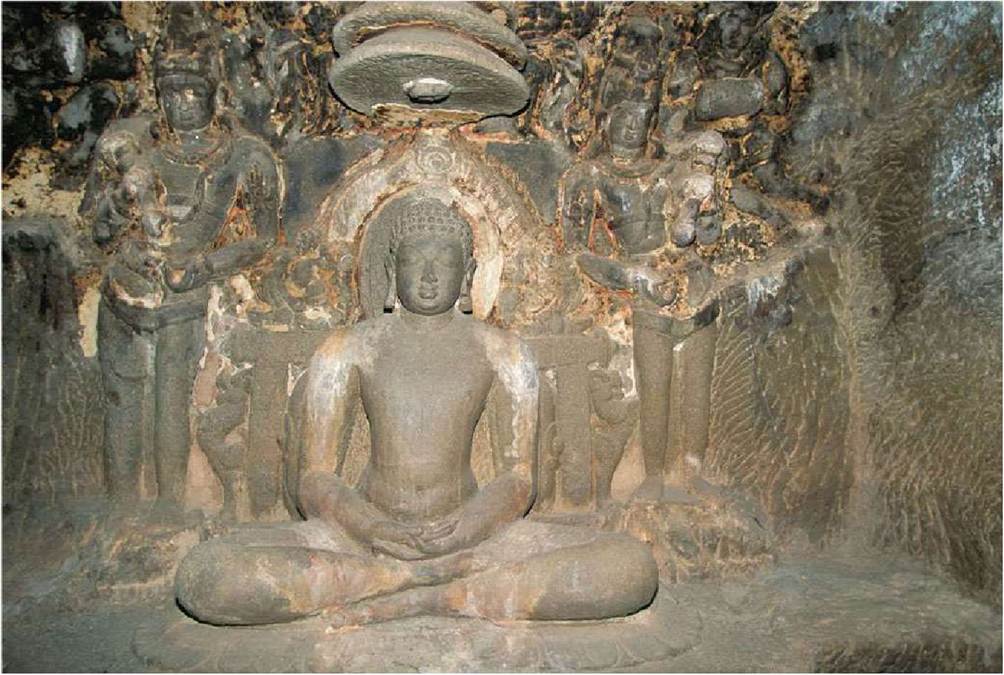
Sculpture of Mahavira in the cave temples of Ellora, India.
It is helpful at this point to recall the similarities between the Buddhist accounts of Gautama’s path to enlightenment (Chapter 5) and Mahavira’s path to kevala. Both men practiced severe austerities. But whereas Mahavira continued on the path of strict asceticism to the very end of his life, Gautama, at the time of his enlightenment, rejected strict asceticism and instead embraced the Middle Way, which calls for moderation in the treatment of one’s body. The distinction is highlighted during the climactic moments of each story, for while Gautama is said to have sat underneath the Bodhi tree when he experienced enlightenment, Mahavira is said to have squatted in the scorching heat of the sun, near a tree but apparently intentionally avoiding its shade.
Whatever the historical accuracy of these accounts, clearly the two traditions diverged over the question of the degree of ascetic rigor. Indeed, Buddhists typically held Jains in contempt for their extraordinary rigor, which for Jains has always been the hallmark of their religion and a mark of honor. And so, even though Buddhism and Jainism have a considerable amount in common doctrinally and in terms of practice and of artistic representations of their founding figures, who are typically shown in meditative trance, the two traditions seem not to have engaged much with each other. Apparently, it was this way from the beginning, for while Mahavira and Gautama the Buddha seem to have been at least near-contemporaries, none of the texts claim that they ever met.