Hindu Sacred Texts
The great diversity within Hinduism is reflected in its astonishing array of texts, composed in many different languages over the course of centuries. Down to present times, Hindu texts have facilitated the asserting of new ideas, the overturning of old ones, and the reasserting of the dominance of fading traditions.
In this next section, we undertake a brief survey of Hinduism’s main texts and their continued relevance.The Vedas
The term Veda (“knowledge”) is used in two ways when categorizing Hindu texts. In the broader sense, the Vedas refers to all of Vedic literature. These texts are regarded by most Hindus as revealed. That is, they are believed not to have been composed by man but rather “heard” by the rishis, the poet-sages of ancient times who were divinely inspired. Vedic literature thus belongs to the category of Hindu texts known as shruti (“that which is heard”), as opposed to the other category, smriti (“tradition”).
In the more narrow sense of the term, Vedas refers to four collections (Sanskrit, “samhitas”) of texts. Composed in Sanskrit between 1200 and 900 все and drawing on centuries of oral tradition, these are the earliest Hindu texts and are generally considered to be the world’s oldest scriptures. The four Vedas are the Rig Veda, a collection of hymns to the gods; the Sama Veda, melodic renditions of hymns from the Rig Veda; the Yajur Veda, ritual formulas; and the Atharva Veda, hymns, spells, and incantations.
Following upon the four samhitas, the Brahmanas set forth instructions for brahmin priests. The next collection of texts, the Aranyakas (or “forest treatises,” so-named because they record esoteric teachings conveyed to students in secret), form a bridge from the samhitas to the Upanishads by exploring the hidden meanings of rituals. The Upanishads are speculations with regard to the deeper truths of the samhitas, especially the Rig Veda.
The 1,028 hymns of the Rig Veda, the oldest and by far the most important of the samhitas, praise the gods and ask for their blessings. The gods include Indra, god of lightning, thunder, and rain and king of the gods; Agni, god of fire and messenger of the gods; and Varuna, god of law and order (who later becomes god of the sea). New deities emerged in the later portions of the Rig Veda. One deity that has enduring influence is the Purusha, who is praised and described in the famous Vedic hymn known as the Purusha Sukta, which was discussed earlier in connection with the caste system. This later Vedic hymn is also significant for the ways in which it asserts the centrality of sacrifice, and it continues to be recited in Hindu rituals even today. The Purusha Sukta describes the sacrifice of a primordial, cosmic man out of whose body the universe is created. As a creation myth, it has parallels in numerous Indo- European traditions. As we have seen, the Purusha Sukta not only details the first sacrifice but also delineates the structuring of society.
The Upanishads (900-200 все) The Upanishads, also known as Vedanta (“end of the Vedas”), are so distinctive from the earlier Vedic texts and so important as to deserve their own treatment here. The term Upanishad means “sitting down near [a teacher].” The term Vedanta, while identifying these texts as the concluding portion of Vedic literature, implies for some Hindus—for example, followers of the Vedanta philosophical school—that the Upanishads contain the culmination of the wisdom of the Vedas.
HINDU SACRED TEXTS
Shruti (“That Which Is Heard”)
Samhitas (“Collections”)
Rig Veda
Yajur Veda
Sama Veda
Atharva Veda
Brahmanas
Aranyakas
Upanishads
Smriti (“Tradition”)
Dharma Shastras (including Laws ofManu)
Epics and Puranas
Ramayana
Mahabharata (includes the Bhagavad Gita)
Bhagavata Purana
Markandeya Purana
Darshanas (treatises of the philosophical schools)
Tantras (scriptures of the various sects)
Writings of Hindu gurus
Departing from the Vedic focus on ritual, and especially sacrifice, the Upanishads feature philosophical speculation on the nature of the divine, the self, the world, and the relationships between them.
These texts signal a significant shift away from emphasis on the external performance of sacrifice characteristic of the Vedic era. The Upanishads also mark a new stage in the development of religious texts, having been composed in part by people of nonbrahmin backgrounds. The newfound emphasis on philosophical speculation, no longer the sole domain of the brahmin class, had an enormous impact on the development of Hinduism. It propelled the development of the contemplative disciplines of yoga and meditation and influenced the philosophical concepts found later in the Bhagavad Gita.The Upanishads are also significant for describing for the first time the concepts of karma, samsara, reincarnation of the soul, and the soul’s immortality, which were initially closely guarded secrets. We had occasion earlier in the chapter, when discussing Brahman and the monistic concept that atman is Brahman, to draw from the Brhadaranyaka and Chandogya Upanishads. They are two among the thirteen so-called principal Upanishads (some scholars set this number at ten). Traditionally, there are 108 Upanishads, although the term has been applied to some 200 texts, some of which were written in recent times.
What advantages and disadvantages can you think of when comparing the flexibility of Hindu beliefs with that of other religions?
Ramayana
For most Hindus, belief and practice are informed by and disseminated through storytelling traditions and narrative texts. Two of the most significant of these texts are the Sanskrit epics the Ramayana and the Mahabharata, both of which are categorized as smriti rather than shruti—although this in no way diminishes their relevance as Hindu sacred texts. Both epics are among the most important sources of Hindu notions of duty, or dharma.
The Ramayana (“The Journey of Rama”), composed between 200 bce and 200 ce, is a compelling tale of political intrigue, romance, and philosophical speculation. It tells the story of a ten-headed demon king named Ravana, who was rewarded for his austerities with the granting of a wish by Brahma.
Ravana asks for protection from gods, celestial beings, and other members of his own demon race. Protected in this way, he and his demon hordes dominate the earth and eventually enslave the gods of heaven. But in his arrogance, Ravana neglects to ask for protection from humans and animals.In the meantime, King Dasharatha of Ayodhya and his three queens, desiring an heir, perform a sacrifice in hopes that the gods will grant their wish. The king is blessed with four sons— Rama, Lakshmana, Bharata, and Shatrughna. Rama, as we have noted earlier, is an avatar of Vishnu. Rama eventually marries a princess, Sita. As Rama is beloved for his righteousness and virtue, King Dasharatha, wishing to step down from the throne, announces that Rama’s coronation will soon be held. Then Kaikeyi, Dasharatha’s favorite wife, suddenly calls in two wishes that the king had once granted her. She demands that Rama be banished to the forest for fourteen years and that her own son, Bharata, ascend to the throne of Ayodhya instead. Distraught, King Dasharatha grants Kaikeyi’s wish but dies of a broken heart.
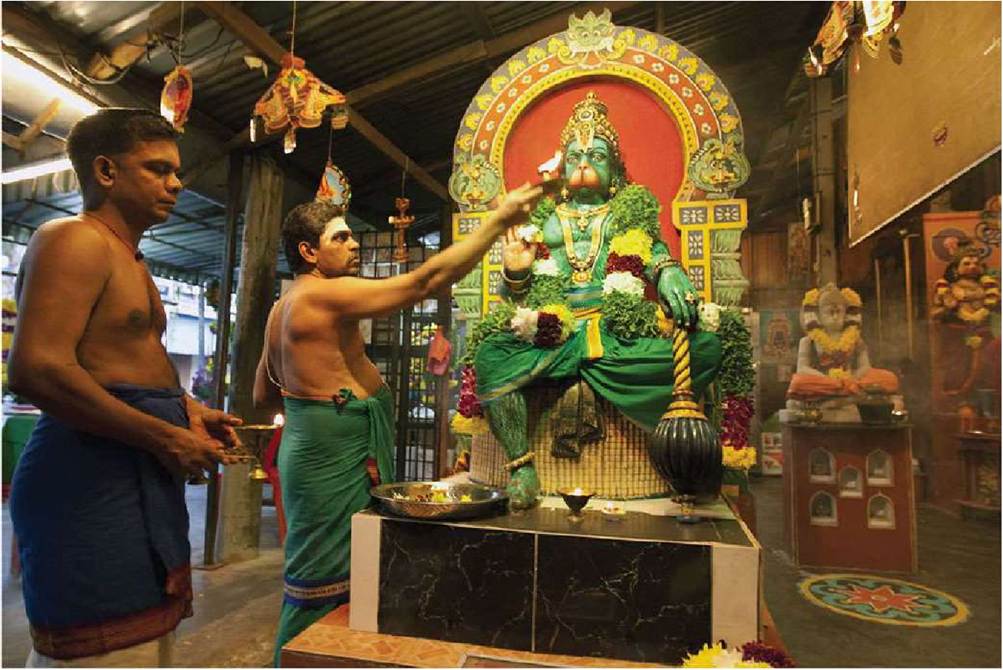
Hindu priests perform arati, waving a lamp of burning camphor before an image of Hanuman (the monkey god of the Ramayana) at a temple in Kuala Lumpur, Malaysia, during the festival of Diwali.
Rama accepts his exile without protest and is accompanied by his wife Sita and his brother Lakshmana into the forest, where they spend many years, until one day Ravana kidnaps Sita and carries her off to the island of Lanka.
A despairing Rama and Lakshmana wander in search of Sita. They eventually meet Hanuman, a messenger from a kingdom of monkeys. Hanuman helps to search for Sita. At the citadel of Ravana on Lanka, Hanuman finds Sita held prisoner in a garden. He tells her not to lose hope, promising that Rama will soon come to free her.
Upon hearing Hanuman’s news, Rama and his army march to Lanka.
During the battle that ensues, Rama kills Ravana and is reunited with Sita. However, after spending a year in another man’s house, Sita must publicly prove her chastity through a trial by fire. With the fire-god Agni as her witness, she passes through the flames and into Rama’s embrace. Their exile concluded, Rama, Sita, and Lakshmana return to Ayodhya, where Rama is reinstated as the rightful king. All are happy for a time, but later, because of rumors circulating about Sita’s chastity, Rama is compelled to abandon Sita in the forest. He doesn’t know she is pregnant with their two sons, who are raised by the hermit Valmiki. Valmiki, who, while meditating, has seen all that has come to pass, composes the Ramayana and teaches it to the two boys, who eventually sing it before their father. Rama dies shortly thereafter, sadly pining for Sita.For many Hindus, the characters in the Ramayana serve as exemplary social role models. Sita is the faithful wife, Rama is the ideal man and perfect king, Lakshmana is the loyal brother, and Hanuman is the selfless devotee. The text grapples with issues involving dharma, both in the public, political realm and in the private, familial realm. The characters of the Ramayana, however, are also understood to be divine. Thus, the Ramayana is as much a text that imparts religious and ethical knowledge as a text that reinforces Hindu beliefs about the accessibility and immanence of God.
Mahabharata
The other great Hindu epic, the Mahabharata, is composed of over 100,000 verses and is the world’s longest epic poem. Like the Ramayana, this work is deeply concerned with issues of dharma. The epic also introduces Krishna, the beloved avatar of Vishnu.
The main storyline of the Mahabharata concerns a dynastic conflict between two groups of royal cousins. These are the Pandavas (the five sons of King Pandu), the heroes of the epic who are all descendants of the gods, and their antagonists, the Kauravas (the hundred sons of the blind king, Dhritarashtra).
Their dispute ultimately results in a terrible war that marks the end of an epoch for humanity.On the eve of the battle, the great Pandava warrior Arjuna experiences crippling doubt. When Arjuna asks his charioteer, Krishna (an avatar of Vishnu), to pull the chariot into the middle of the battlefield, he sees his friends and relatives on both sides clamoring for war. Not wanting to commit the sin of killing his kinsmen and overcome with sorrow, he refuses to fight. It is at this key point in the story that the profound philosophical discourse known as the Bhagavad Gita begins. Many Hindus regard this conversation between Krishna and Arjuna as the most significant philosophical work in Hinduism.
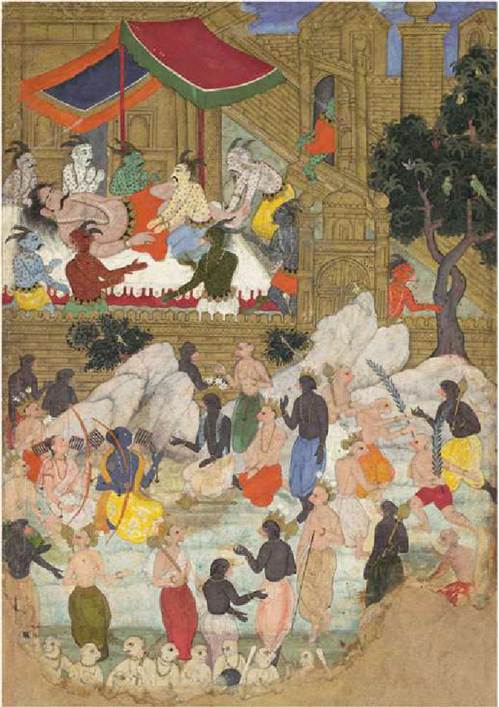
Rama and Lakshmana, with their army of monkeys and bears, are camped outside the palace of the demon-king Ravana on the isle of Lanka, while the demons try to rouse Kumbhakarna, the giant brother of Ravana. India, Mughal period, c. 1595-1605.
The Bhagavad Gita (The Song of the Lord)
The Bhagavad Gita, the conversation between Krishna and Arjuna, was probably composed around the first century ce. The text, which seeks to reconcile the tension between renunciation and worldly life, also presents radical new ideas about the pursuit of moksha, including the three margas or paths to liberation that we explored in an earlier section.
The Gita begins with Arjuna refusing to act on his dharma, as is demanded of a member of the kshatriya, or warrior class, out of fear of the consequences of killing his kinsmen. Krishna responds to his dilemma by revealing that one does not need to give up action to achieve moksha. Rather, as we noted before, one gives up the fruit of action. That is, one cultivates “desireless action,” or acting without attachment to the fruit or benefit of the action.
Arjuna must honor his dharma as a warrior and fight his own kinsmen. But he transcends the karmic repercussions of this act by relinquishing personal attachment and realizing that Krishna is the primary cause leading all the individual actors toward this inevitable outcome.
As you have seen in the earlier section on bhakti marga, the Gita emphasizes the path of devotion, which later comes to dominate Hindu practice and belief. The Gita also teaches that it is possible to achieve moksha by being active in the world, provided that, through selfless devotion, one surrenders attachment to the expectation of any particular result. This contrasts with earlier teachings that advocated complete detachment through renunciation as the primary means of escaping samsara.
Puranas
In addition to the rich storehouse of narrative material in the epics, there are equally important collections of mythic stories known as Puranas (Sanskrit purana, “ancient”). Like the epics, the Puranas existed in oral form before being committed to writing—in this case, between the fourth and sixteenth centuries. The Puranas contain useful historical data, such as the genealogies of regional kings, but they also reflect the rise of dualistic or devotional Hinduism. This is evident primarily in their narrations of the deeds of the great deities such as Shiva, Vishnu, and Devi. They also consider the genealogies of gods, rules governing the proper worship of the gods, the construction of temples, the observance of festivals, the undertaking of pilgrimages, and similar topics.
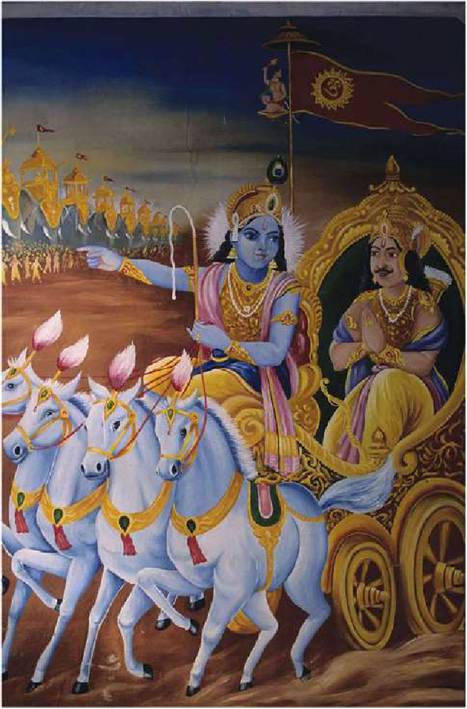
Krishna, in the guise of Arjuna’s charioteer, counsels the warrior on the verge of battle against his kinsmen. The battle scene in the Mahabharata is the setting of the Bhagavad Gita.
There are eighteen major Puranas, two of the most influential of which are the Bhagavata Purana and the Markandeya Purana. The Bhagavata Parana focuses on Vishnu and his incarnations, most especially Krishna. It is one of the most widely recited, performed, and studied texts in contemporary Hinduism. The tenth book, which serves as the primary source for Krishna’s life story, is particularly important. The Markandeya Purana includes the Devi Mahatmya, which is an important text of Shaktism, one among various Hindu sects that we explore in the next section.