The Long Nineteenth Century
From the beginning of British rule in India, a turning point in history that is usually dated to the English East India Company victory at the Battle of Plassey over the Nawab of Bengal in 1757, Great Britain sought—and fought—to secure the maritime routes of the Indian Ocean in order to protect its commerce and, in time, its expanding empire.
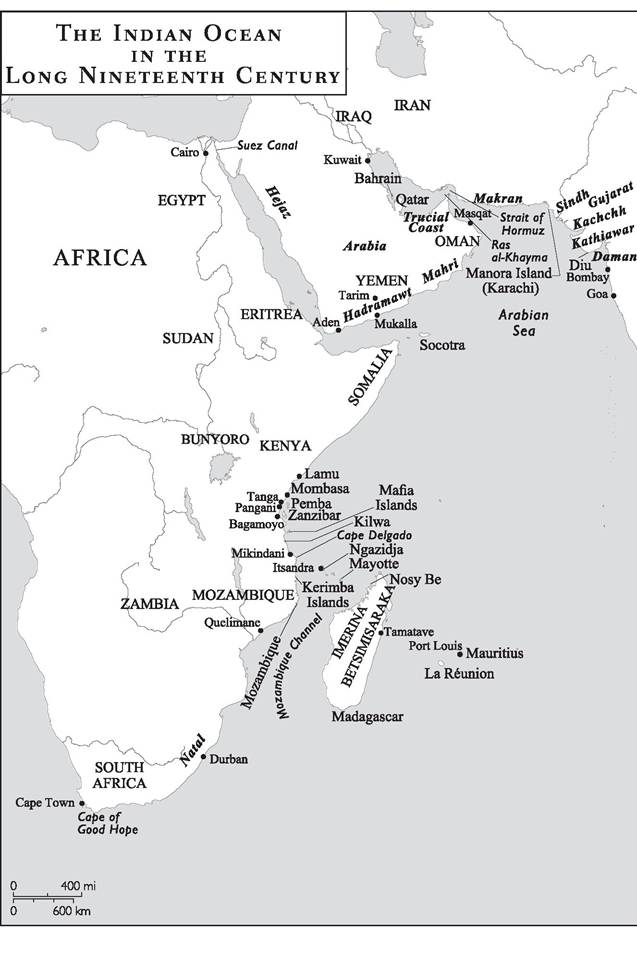
In 1892, still several years before he was appointed Viceroy of India, Lord George Curzon blustered, “Without India the British Empire could not exist. The possession of India is the inalienable badge of sovereignty in the eastern hemisphere.”1 Achieving this prize was not a straightforward process. Challenges to British sea power came initially from the French, while slave raiding and piracy were a constant threat to Great Britain’s ability to ensure peaceful commercial sea lanes. To achieve its goals, in addition to flexing its naval and military muscle, Britain adopted a strategy that also involved making judicious alliances, surveying the complex coastline of the entire region, and developing key strategic ports through modern civil engineering projects. In the last half of the nineteenth century the industrial capitalism that transformed Great Britain gave rise to both the construction of the Suez Canal and the triumph of steamships over sailing vessels in the open sea.Finally, the expanding tentacles of empire steadily transformed the Indian Ocean world from its historic foundation in maritime commercial exchange, where production was overwhelmingly still in the hands of indigenous peoples and polities, and focused on its ports of trade, to a new system of land-based colonial occupation and European-controlled plantation production for export. If India was “the brightest jewel in the crown” of the British Empire, then this complex set of factors emanating from British India transformed the Indian Ocean from an “Islamic Sea” into what came to be known popularly as a “British lake.”
British naval superiority in the Indian Ocean, arguably dates to Great Britain’s defeat of France during the Seven Years War (1756-63), but it was not cemented until their decisive victory over Napoleon.
At the end of the eighteenth century, with the defeat of the Netherlands by France in 1795, Great Britain seized upon this enforced alliance between its main European and Indian Ocean rivals to take Cape Town, Ceylon (today Sri Lanka), and Java and Melaka from the Dutch, and the Mas- carene Islands of Bourbon (now La Reunion) and Ile de France (now Mauritius) from the French. Twenty years later, by 1815, the British controlled the Cape, Ceylon, Melaka, and Mauritius, while Bourbon was returned to France by the Treaty of Paris. Just a few years later, the unauthorized occupation of Singapore by Stamford Raffles in 1819 and its formal possession by the British in 1823 almost immediately reduced the economic significance of both Melaka and Dutch Jakarta.According to British navigator George Windsor Earl, in 1832 Jakarta “was formerly visited by numbers of large junks from China and Siam, and by prahus from all parts of the Archipelago; but from the establishment of the British settlement at Singapore, the perfect freedom of commerce enjoyed at that place has attracted the greater part of the native trade, while that formerly carried on by junks between Jakarta and China has totally ceased.”2 Thus, two decades into the nineteenth century the basic framework of British domination in the eastern Indian Ocean was established, with the Dutch limited to Indonesia and the French an afterthought.
After dealing with its imperial rivals in the eastern Indian Ocean, the challenge for the British was to suppress both the slave trade, which Great Britain had abolished in 1807, and piracy. The South China Sea had a long history of piracy in which the major political power, the Chinese Empire, initially controlled the definition of who was a pirate. Later, the Portuguese, Dutch, and Spanish were in their turn considered pirates by regional maritime powers. By the time the notorious opium trade from British India to China through the European enclave of Canton at Guangzhou was approaching its height in the early nineteenth century, Qing authorities in South China were equally concerned about Chinese piracy.
A report entitled “A Discussion of the Seaport Situation,” written by the knowledgeable governor of Fujian Province, Wang Chih-i, in 1799 included the enlightened observation that piracy was caused by lack of economic opportunity, so that prohibiting sea trade was not a solution to piracy. The most feared Chinese pirate at this time was Cheng Yao-I who was the leader of a major pirate confederacy numbering tens of thousands of members around Canton in the first decade of the nineteenth century. His ships disrupted imperial Chinese control of trade,
captured European vessels, and held their passengers and crews for ransom. His activities and those of his widow and successor, Shih Hsiang- ku, eventually forced the Qing dynasty to conclude a truce in 1810 and to grant her immunity from prosecution.
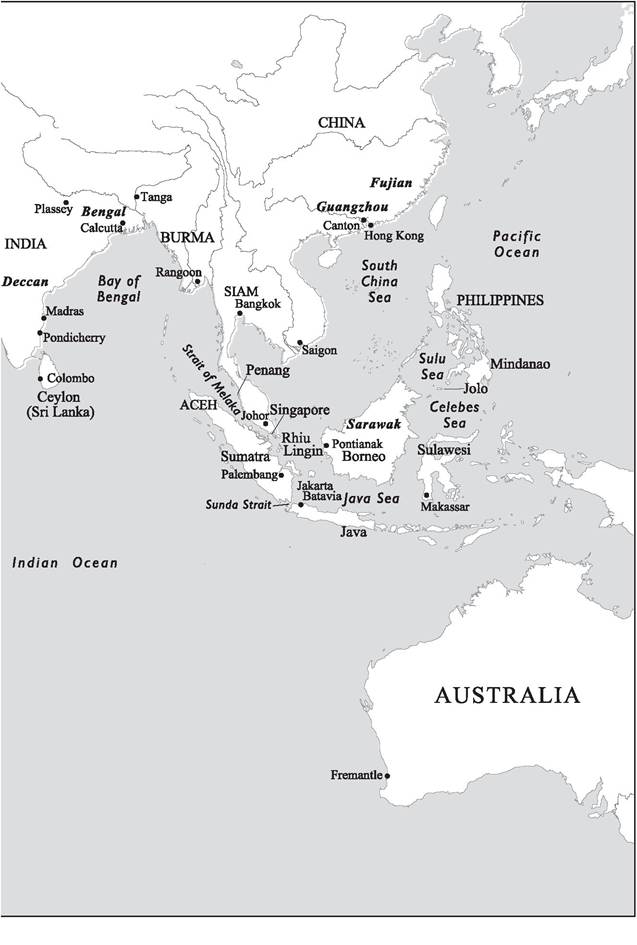
Piracy also reached unprecedented heights in Southeast Asia, where attacks on European and Chinese shipping became indiscriminate. Pirates in the Melaka and Singapore Straits and Java Sea were drawn from several different ethnic groups, particularly the Iranun and Bal- angingi, and were connected to specific local polities. The center of this system has been called the Sulu Zone, where a maritime state based at Jolo straddled the Sulu and Celebes seas between southwest Mindanao and northeast Borneo. Tracing its roots to 1768, the Sulu Sultanate pursued an aggressive policy of seasonal slave raiding stretching from the Philippines right across the Malay world to provide a labor force for its own production and exchange. Slaves were employed in pearl and tripang, or sea cucumber fisheries, in agriculture, and as retainers of every sort, including soldiers, galley slaves, artisans, concubines, and domestic servants. In the eyes of outsiders, Sulu’s activities constituted piracy.
An 1812 report by J. Hunt, who lived at Jolo for half a year, called the subordinate settlement of Tontoli on the northern shore of Sulawesi, “a great piratical establishment;... the town is fortified with 300 guns and 3,000 Illana (Iranun)... and 50 or 60 prows.”3 A British observer recorded in 1820, “There are annually fleets of pirate prahus, which come up from Rhio and Lingin, and lie in wait for the defenseless prahus, plundering them of all they possess and murdering or carrying away as slaves all on board.”4 Indeed, as the volume and value of trade moving through the Straits increased dramatically in the nineteenth century, piracy increased accordingly. Moreover, European intervention created a sense of grievance and legitimated piracy among Malay elites.The British-Dutch Treaty of 1824, which settled the imperial division of maritime space and colonial territory in maritime Southeast Asia, included this critical statement of intent: “Their Britannic and Netherlands Majesties... engage to concur effectually in repressing piracy in those seas: they will not grant either asylum or protection to vessels engaged in piracy, and they will in no case permit the ships or merchandise captured by such vessels to be introduced, deposited, or sold in any of their possessions.”5 In particular, the two European powers agreed to eliminate slavery and destroy the markets where pirates sold their captives. Nevertheless, the following decade was the peak period for piracy.
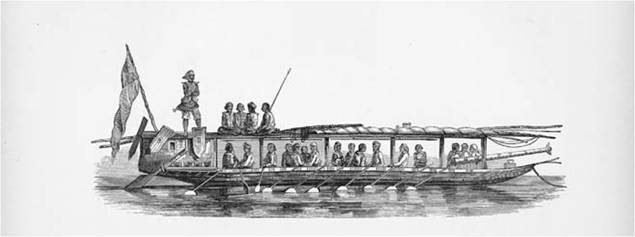
Even with its sail furled, an Illanoan pirate galley was a formidable seaborne vessel, with its armed crew and a cannon mounted at its bow. This particular galley also features a side-mounted steering oar. Charles E. Young Research Library, University of California, Los Angeles
In 1836 a junior British naval officer, Montagu Burrows, bemoaned that the route to China “was more unsafe than ever and piracy more and more organized.” Of the pirates themselves he was informed at Penang “about these people, their numerous little squadrons, their wellarmed and manned boats (called prahus, pronounced prows) with several guns and well-protected bows, their desperate character, neither giving nor taking quarter, and utter contempt of death.”6 Writing about the British survey voyage of the Indonesian archipelago undertaken by HMS Fly in 1842-46, naturalist J.
Beete Jukes commented: “Their seas, for the most part so tranquil and easy of navigation, have been left unsurveyed and permitted to swarm with the piratical craft of their own uninstructed chieftains, or those of foreign adventurers who have acquired influence among them.”7British interviews with captured Balangingi pirates in 1838 provide some more nuanced insight “about these people.” According to a pirate named Silammkoom, who was also an occasional small trader, “Our fleet consisting of six prahus came from Ballongningkin and left that place about 3 months since.” The fleet was commanded by a relative of the chief at Ballongningkin who “informed us that the Sultan had desired him to plunder and capture all nations save Europeans. I have never seen the Sultan of Sulu, this is my first voyage to the east coast of the Malayan peninsula, but for many years I have cruised in the vicinity of Manillas, Macassar and other places on which occasion Orang Kaja Kullul [his commander] took any boats he happened to meet.”
A second testimony comes from Mah roon, who had himself been captured two years previously and taken to Ballongningkin, “where I was treated as a slave and compelled to perform all kinds of work.... I did not voluntarily join the pirates.” Echoing the sensitive analysis of Wang Chih-I, a third captive named Daniel testified that “the fact is save ‘Mangoorays’ (pirating) we have scarcely any other means of getting a livelihood.”8
Other testimonies reveal in more grisly detail than that of Mah roon the harsh realities of enslavement. A man named Si-Ayer was captured by an Iranun prahu in 1847, where “the prisoners were all kept tied, until they showed no symptoms of attempting to escape;... water and rice [were] given to us very sparingly. Some died from hunger, some from being handcuffed, some from grief; they untied me after about a month. If prisoners were sick so they could not pull an oar they were thrown overboard.”9 A decade later Dutch traveler C.
Z. Pieters published his experiences as a captive of Balangingi marauders. Upon gaining consciousness, “I found that I was stripped naked and bound in a prahu.... The rope at which captives are tied by the neck is taken off in the day-time. At six o’clock in the evening, whether they are inclined to sleep or not, they must lie down and are bound by the feet, hands and neck to the deck of the prahu, and the rope by which their necks are confined remains within reach of the pirates who are keeping watch.”10A Spanish captive named Luis Ibanez y Garcia, who was seized at about the same time, remembered with horror that similarly bound captives sat “on the deck of the boat under the scorching heat of the sun, in the rain, and in the winds eye. Some simply collapsed over their oar, dying. Others were untied just on the verge of passing out, in order to regain consciousness, only to be tied up once again on the oar.”11 Enslavement designed to produce still more captives was surely an especially cruel fate to suffer.
As late as 1852, when coal-fueled steamships had just begun to enter Indian Ocean waters, James Brookes, the British governor at Sarawak, on northeastern Borneo, submitted an official memorandum that argued, “It is certain that the extension of commerce depends upon the suppression of Piracy; and it is equally certain that the suppression of Piracy—the extension of Commerce—the success of our settlement of Labuan—the possession of a supply of coal in those distant seas and our national position in the Eastern Archipelago, are but the links of one chain of Policy.”12 No clearer statement of British imperial ambitions could be made. Eventually, with the expanded use and modernization of steamships, piracy was steadily restricted. However, although it only experienced a dramatic decline in the early twentieth century, it was never completely eradicated.
Forging the links of that chain assumed a rather different character in the western Indian Ocean, although the marriage of antislavery and antipiracy prevailed there, as well. The principal challenge to British control of the Arabian Sea came from the Qawasim, an important Arab tribe inhabiting what the British called the “Pirate Coast” who had their main port at Ras al-Khayma, a headland of the Arabian Peninsula that frames one side of the entrance to the Gulf at the Strait of Hormuz. The Qawasim ships ranged from the Gulf to the Makran coast, raiding East India Company vessels and disrupting British designs to expand their control from Bombay into the Gulf. The Qawasim were both opponents of the Omanis for control of the Gulf and allies of the Wahhabis of central Arabia who were challenging Omani control of its inland frontiers.
By the beginning of the century, however, Great Britain had already established itself as a dominating foreign power in Oman by virtue of a 1798 treaty that granted the British the right to build a fortified factory at the Omani capital of Masqat and forbade similar footholds by their French and Dutch rivals. Omani reasons for consenting to this treaty lie primarily in the ruling Busaidi dynasty’s interest in protecting their commercial linkages with numerous ports under British domination around the western Indian Ocean. Ratified in 1800, this treaty effectively made Oman the proxy for British imperial designs in the western Indian Ocean.
In this context, British attempts to control Qasimi maritime violence can also be understood as a playing out of the Arab political rivalries in the Gulf. In December 1819 the British seized the Qasimi headquarters at Ras al-Khayma, and in 1820 they imposed a General Treaty of Peace, Article 9 of which joined suppression of piracy with abolition of the slave trade, the major humanitarian and international political campaign of the expanding British Empire, in the following terms: “The carrying off of slaves (men, women, and children) from the coast of Africa or elsewhere, and the transporting them in vessels, is plunder and piracy; and the friendly Arabs shall do nothing of this nature.”13 At the time Great Britain had no interest in obtaining command over the Arabian Peninsula, its chief concern being, as noted by Lord Curzon at the end of the century, “to secure the maritime peace of the Gulf.”14
By 1853 the British imposed a Perpetual Maritime Truce from which the Trucial Coast, now the United Arab Emirates, took its name. Thus, whether one considers the Qawasim to have been pirates or not, they were certainly political rivals of the Omanis and their British allies.
Again, in 1903 Curzon provided a crystal clear statement that illuminates imperial policy toward this corner of the “British lake” when he explained to a gathering of the sheikhs of Trucial Oman that “the peace of these waters must still be maintained; your independence will continue to be upheld; and the influence of the British government must remain supreme.”15
The key link between Oman and British India was Bombay, a link forged by Indian merchant capital and the circulation of Indian traders between these two ports. Most of these traders were from different ports in Gujarat and Kachchh; in nineteenth-century parlance they were generally called “Banians,” although used in this way the term could sometimes include Muslims, as well as Hindu and Jain baniyas. In the 1760s Danish traveler Carsten Niebuhr reported a population of about 1,200 Banians at Masqat. According to Vincenzo Maurizi, the personal physician of the young Busaidi ruler, Seyyid Said b. Sultan (r. 1804-56), in the first decade of the nineteenth century the population of Masqat had grown to as many as 4,000 Banians among its total population of 60,000. While these figures may be exaggerated, they provide an index to the central financial role played by Gujarati merchants at Masqat throughout the nineteenth century. Arriving at Masqat from Bombay on November 12, 1816, Lieutenant William Heude “saw twenty-five grabs, or small craft, sailing out for Bombay under convoy of the Caroline, an Arab frigate of forty guns. Two other large English-built vessels were in the cove; whilst thirty or forty small craft were loading or unloading their cargoes of dates, salt, rice, and other goods of various kinds.”16
Gujarati merchants enjoyed a special place in the political economy of an emerging Omani Empire in the western Indian Ocean, while as British-protected subjects they became the advance guard of British imperial presence in both the Gulf and eastern Africa north of the Portuguese possessions. Already by this time Omani customs collection, which was farmed out on five-year contracts to the highest bidder, was in the hands of a Kachchhi Hindu trader named Mowjee Bhimani whose family maintained control of the customs farm at Masqat into the 1840s. No less important was the Shia Muslim Khoja family of Shivji Topan, which was originally based at the port of Mandvi in Kachchh. Omani ruler Seyyid Said was intimately connected to the Shivjis through bonds of friendship and indebtedness, and in 1818 he granted control of the customs farm at Zanzibar to Ebji Shivji. The Zanzibar customs remained almost exclusively in the hands of the Shivji family into the late 1880s.
By the time Seyyid Said followed the logic and encouragement of his Indian trading partners and first visited East Africa in 1826, he had already been obliged by the British to sign an initial antislave trade treaty in 1822. This treaty prohibited trading in slaves to Europeans, empowered British seizures of transgressors, and limited the range of Omani slave trading to a line that ran from Cape Delgado, which marked the nominal boundary between Omani and Portuguese jurisdiction along the East African coast, and extended up to Diu Head on the Kathiawar Peninsula in Gujarat. Following Seyyid Said’s defeat of Mazrui Mombasa in 1837, he moved permanently to Zanzibar and made it the Busaidi capital in 1840.
A sign of the further cracking of one of the premodern spice monopolies of the Indian Ocean was the introduction of clove trees to Zanzibar in about 1819. The subsequent development of clove plantations based on slave labor at Zanzibar and Pemba transformed Busaidi Zanzibar from one trading port among many in the Indian Ocean to a major colonial primary crop producer. As a result, antislavery enforcement was difficult and slave trading thrived as the demand for bonded labor spiked at Zanzibar and elsewhere in its coastal East African empire: in the Arabian Gulf where pearl diving and date plantations required a regular supply of unfree labor; and elsewhere in Arabia. Faced with the cozy relationship between Great Britain and the Busaidi dynasty, Captain G. L. Sulivan, commanding HMS Pantaloon at Zanzibar in 1866, during the reign of Seyyid Majid b. Said, expressed his frustration in these terms: “In the China seas, should a Chinese junk attack and rob another, we call the crew pirates, attack them, and hand them over to the authorities for execution; yet this infinitely worse piracy is covered by a treaty on the part of a despicable petty Arab chief.”17 In 1873 the British imposed a final antislave trade treaty on Majid’s brother and successor, Barghash b. Said. So long as there was demand, of course, slaving continued throughout the nineteenth century, ending only in 1902; while smuggling of individual captives endured so long as slavery enjoyed legal status in Arabia, where slavery was not banned until the second half of the twentieth century.
The experiences of the African victims of the Indian Ocean slave trade merit some reflection here. Thanks to interviews conducted by members of the Royal Navy Antislavery Patrol like Sulivan and the testimonies of Christianized liberated captives there are dozens of such accounts. Most of these come from individuals who were captured as children or young people. Many women were included among the captives. Taken together they reveal the trauma of violent capture in outright raids or kidnapping,
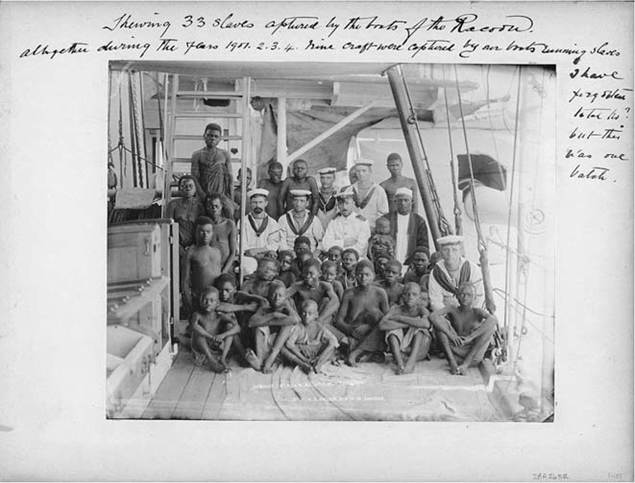
Like the image of a modern soccer team, the crew, interpreter, and thirty-three enslaved Africans sit seriously aboard HMS Racoon for the formal recording of their “liberation.” Despite the claims of British abolitionists that the 1873 treaty with the Sultan of Zanzibar effectively ended the slave trade from East Africa, the date of this photograph demonstrates that slave trading died a much slower death. © National Maritime Museum, Greenwich, UK
the deceit involved in the sale of unsuspecting children by older relatives, and the role of debt in pushing people into slavery. Although the oceanic passage from continental Africa or Madagascar to Zanzibar, Arabia, or even the Mascarenes was not as lengthy as the Atlantic Middle Passage— except for the tens of thousands who were shipped on Portuguese and Brazilian ships from coastal Mozambique to Brazil in the first three decades of the nineteenth century—the conditions were just as awful and the effects equally terrifying. Apart from the psychological trauma of being wrenched from one’s family and home, as well as the physical conditions of the oceanic passage crammed onboard a dhow, the Arab, Swahili, and Comorian slave traders who dominated the trade further terrified the vulnerable captives by telling them that they would be eaten by white men if they were captured by the British. To take only one example of this cruelty, a Makua boy from northern Mozambique who had been sent in slavery to the Comoros and liberated by a British naval patrol was then shipped on a British steamship to Zanzibar, where he was assigned to the Anglican mission at Kiungani. “In this ship,” he wrote, “by which we came we were not at all happy, because some people said to us, ‘You are all going to be eaten.’ This is why we were unhappy; we did not know they were deceiving us.”18
With respect to the dhow passage itself, a young Yao girl named Swema who had been marched from northwestern Mozambique to Kilwa in 1865 and whose mother had been killed by her captors on route to the coast, recounted: “Although I was generally indifferent to everything that happened around me, I did not long remain in this state in the dhow, where my suffering redoubled. We were so closely packed that not only could I not turn, but even breathe. The heat and thirst became insufferable, and a great seasickness made my suffering even worse.”19 In the words of another young mission boy from Bunyoro, in western Uganda, whose overland passage to the coast covered more than one thousand miles, until he finally sailed from Tanga, on the northern Mrima coast, with fifty-one other captives:
We embarked in a dhow with five Arabs and sailed. The first day we had bananas to eat, the second day unripe mangoes, and the third day the same as the second, both the third and the fourth. Those three days there was rain with bursts of sunshine on the sea, but water to drink there was not a drop. On the fourth of these days the sea was very rough, but we went on till four o’clock, and then we came to Pemba.20
Petro Kilekwa, a young Bisa from modern Zambia, who following his liberation by the British in the Gulf first became a sailor and finally an Anglican priest, echoes this account of inadequate food supplies that he and his companions endured as they sailed across the Arabian Sea. Leaving an unnamed port on the Kilwa coast, they were loaded on the lower deck of a large dhow. “We traveled all night and in the morning we found that we were in the midst of the sea and out of sight of land. We went on thus for many days over the sea. At first we had food twice a day, in the morning and in the evening.” Their meals often included fish that the Arabs sailing the dhow had caught. “But because the journey was so long the food began to run short and so we were hungry, and also water was short and they began to mix it with salt water.”21 These children and young people grew up into men and women in their many thousands to become the enforced founders of enslaved African- descended communities around the Indian Ocean and into the South Atlantic. Most ended up in Zanzibar, others in Pemba, Kenya, and Somalia, while still others were sent farther overseas to Saudi Arabia, Yemen, the Arabian Gulf states, Pakistan, India, the Comoros, Madagascar, the Mascarenes, South Africa, and Brazil.
Considering the British obsession with fighting both slaving and piracy, it may seem surprising that the three decades of Betsimisaraka maritime slave raids from eastern Madagascar to the Comoro Islands and coastal East Africa did not provoke a robust British response, although during the era of the raids the British were preoccupied with the oceanic dimensions of the Napoleonic Wars. Reminiscent of the massive raids from Madagascar described 900 years earlier by Buzurg b. Shahriyar, starting in 1785 and not ending until 1816-17 the Betsi- misaraka launched a generation of piratical slave raids that terrorized local African populations and the Portuguese colonial authorities at Mozambique Island and the scattered Portuguese northern coastal outposts of the Kerimba Islands.
Raiding parties gathered at the northeast of Madagascar before setting off as a fleet of large outrigger canoes called laka for the Comoros. The Betsimisaraka developed special large canoes measuring as much as forty-five feet in length and ten to twelve feet in width for these raids, which were intended to return with captives to be sold off to French traders for the Mascarene sugar plantations. According to contemporary accounts, the largest fleets numbered up to 400-500 canoes with as many as 15,000 to 18,000 men. They utilized prevailing currents and winds, following typical Indian Ocean monsoonal patterns for the raids, which generally occurred on a five-year cycle. The first series of raids were limited to the closer-at-hand Comoro Islands, but eventually the Betsimisaraka were joined by Sakalava canoes from western Madagascar for the raids on coastal East Africa, where they wreaked havoc from the Kerimba Islands as far north as Mikindani, Kilwa, and the Mafia islands. On several occasions these fleets seized and destroyed both French and Portuguese ships in the Mozambique Channel.
Only in 1809 did the British station a ship off the Mozambique coast to provide protection against these Malagasy raiders, although it never engaged them. Eventually, in 1817 the authorities in British India did recommend that the governor of Mauritius take appropriate action, but only after a disastrous final raid put an end to the threat. During this last raid the Malagasy fleet suffered severe losses as a result of storms in the Mozambique Channel, while those who returned carried a virulent strain of smallpox with them. In addition, after they reached the Mafia Islands, the farthest northern penetration of the Malagasy maritime raids, they were pursued and defeated at sea by a fleet of warships dispatched by Seyyid Said, who claimed sovereignty over the southern Swahili coast. Finally, the defeated fleet and the weakened state of the Betsimisaraka were further complicated by the French occupation of Tamatave in 1810. It seems likely that the origins and the legacy of maritime violence that marked Betsimisaraka history in the eighteenth and early nineteenth centuries owed much to the tradition of piracy that was established by their interloping ancestors, for whom this way of life—like that of their Sulu Zone counterparts on the other side of the ocean—provided a means of accumulating wealth to which they would not otherwise have had access.
For a while the British occupation of Mauritius recommended an important relationship with Madagascar, which was a source of both labor and provisions, mainly rice, to the island. But the combination of a difficult relationship with the dominant highland Malagasy kingdom of Imerina and a growing commitment to South Africa, especially following the British occupation of Natal in 1843, meant that Great Britain was happy to leave the southwest Indian Ocean to Portugal and France. Portugal had historic claims to coastal Mozambique, while France still occupied Bourbon and added the small islands of Nosy Be and Mayotte, off the west coast of Madagascar, in the 1840s. Ultimately, France conquered Madagascar in 1895.
The imposition of modern colonial regimes upon the countries of the Indian Ocean rim had a dramatic impact on indigenous societies. Colonialism both expanded the access of Western capital to these areas while restricting it to national businesses. Production and transportation were reorganized for the extraction of colonial primary products, such as sugar, cotton, coffee, tea, and rubber. Christian missionary activity was facilitated and with some exceptions Western education was significantly left to the missionaries.
The European powers imposed new territorial borders that artificially cut through historic or fluid frontiers and frequently divided ethnically discrete societies. A circuit of Indian Ocean shores at the conclusion of World War I reveals that the British Indian Ocean empire— consisting of Crown colonies, protectorates, and League of Nations Mandate territories—included Tanganyika, Zanzibar, Kenya, Somaliland, Sudan, Egypt, Oman, the Trucial States, the sheikdoms of Bahrain, Qatar, and Kuwait, Iraq, Mauritius, India, the Malay States, Singapore, and Hong Kong; France controlled the Comoro Islands, Madagascar, La Reunion, the tiny enclave of Pondicherry on the Coromandel coast of India, and Indochina; Portugal retained Mozambique, Diu, Daman, and Goa in Portuguese India, and East Timor at the far eastern reaches of the Indonesian archipelago; the Netherlands claimed the vast island universe of the Dutch East Indies; latecomer Italy had Somalia and Eritrea. Settler South Africa had gained its independence from Great Britain in 1910, but in every other sense remained a colonial territory. Saudi Arabia, Iran, and Siam were the only significant independent states among those whose coastlines were washed by the Indian Ocean.
By mid-nineteenth century, Great Britain possessed a necklace of critical ports around the greater Indian Ocean littoral from South Africa to southern China. The oldest of these were located in India—most notably Calcutta, Bombay, and Madras; others were added following the British victory during the Napoleonic Wars—Cape Town, mid-ocean Port Louis, Mauritius, and Colombo; while the last lot were acquired to fill in the interstices of the “British lake”—Durban, Aden, Karachi, Singapore, Hong Kong, and Fremantle, in southwestern Australia. Although the ports of the Trucial states, Masqat, and Zanzibar were technically independent, British political domination of all was undoubted, while the final partition of East Africa formally added Zanzibar Town and, more significantly, Mombasa. A few of these ports had natural harbors that could accommodate the rapidly expanding generation of steamships that now plied the waters of the Indian Ocean, but many did not. Modern engineering transformed all of these into modern deep water ports.
Karachi, for example, which the British seized in 1839 and annexed to India in 1843 to become the capital of Sindh Province, appears to have been particularly unsuited for modern shipping, as it was located at the silt-filled delta of the Indus River. In 1841 or 1842 the young Sir Lewis Pelly—newly in the service of British India and serving in Sindh— sailed from Karachi to Bombay in a traditional Sindhi vessel. His boat was anchored at the bar of Manora Island, located to the south of the modern Karachi port and today connected to the mainland by a twelvekilometer causeway, from which “we proceeded to the muddy shore beyond the city; we were then carried on the backs of some Seedees some two miles to a further boat, which, in turn sailed us to our Din- gee.”22 Modern port construction, a railway to the port, and an export- driven agricultural policy transformed what had historically been a minor port into one of British India’s main colonial ports. Civil engineering projects at, around, and linking these ports to ever-deepening hinterlands likewise enhanced most of these ports.
Unquestionably, the most significant civil engineering project of the nineteenth century for the entire Indian Ocean was the construction of the Suez Canal. Financed by both British and French capital, dredging of the Suez Isthmus commenced in 1854 and the canal was completed in
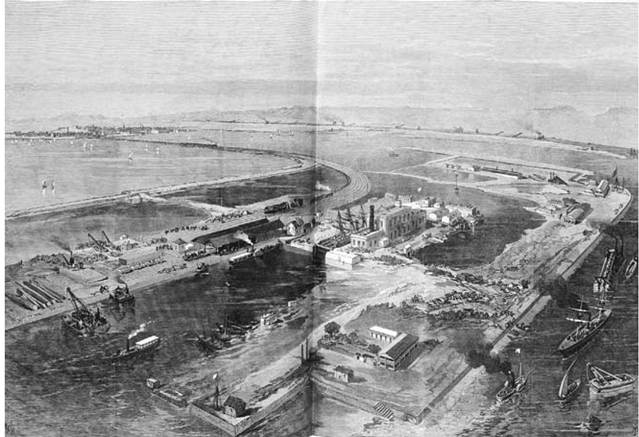
More than simply opening up a faster means of travel from Europe to the Indian Ocean, the engineering and dredging of the Suez Canal represented a major achievement of European capitalism and technology. Such imperial exploits were followed avidly in the popular press, as in this illustration from the Illustrated London News, April 17, 1869. Courtesy Bodleian Library, University of Oxford
1869. The canal route significantly reduced travel time between Europe and the Indian Ocean world; at the same time the number of ships and volume of shipping expanded exponentially.
Without the invention of steamships, however, this transportation revolution would have been incomplete. Steamships not only enabled Indian Ocean travel to overcome the tyranny that the monsoons imposed on sailing vessels, they also facilitated the expansion of commerce and transformed port hierarchies. The first steamers reached Indian Ocean ports in the 1820s. In 1842 the P&O Company inaugurated steamer service from the Red Sea port of Suez to Aden and the major ports of British India. A decade later the P&O extended its service to Australia. Early coal-powered steamships were neither efficient nor a great improvement on the fastest sailing vessels; later engines generated greater power and were more fuel efficient. But because they did not depend on wind power, steamships provided more predictable service. By midcentury, travel by steamer from England to the Indian Ocean was both faster and less expensive than ever before.
By the end of the nineteenth century, travel time from London to Great Britain’s major Indian Ocean ports was cut by more than 40 percent to Kuwait and Bombay, by more than 32 percent to Calcutta, by almost 28 percent to Singapore, and even by some 14 percent to Fremantle. In particular, Aden—blessed with its natural deep water port—and Singapore— with its critical location astride multiple sea lanes—benefited from the increased traffic and the refueling requirements of coal-driven steamships. Initially restricted to carrying passengers and mail, in the long run steamships also became the principal transporters of trade goods. For most of the century, however, both luxury and bulk commodities, as well as people, continued to be carried in sailing ships, both indigenous and EuroAmerican.
In addition to the goods that had been exchanged for centuries across the Indian Ocean and beyond, the Industrial Revolution created new tastes and a class of the newly rich in Europe and North America who now sought exotic materials from which luxury goods could be manufactured. East African ivory, which because of its whiteness and malleability had been traded to India and China for millennia, now supplied a new market for piano keys, billiard balls, buttons, and combs in the West. The result was the aggressive hunting out of elephants across much of eastern Africa. Rising wealth in the West also created a new demand for pearls, which had for centuries been sourced from beds in the Gulf and off northern Sri Lanka. The consequent need for pearl divers in the Gulf stimulated the slave trade from eastern Africa. In the wake of the coffee craze of the seventeenth century, the habit and fashion of drinking tea created a boom in that trade from China and later from India and Sri Lanka. At the same time, the importation of Western manufactured goods expanded across the Indian Ocean. To take only a single example, until the cotton famine caused by the American civil war, the preferred everyday cloth in eastern Africa became American white sheeting, in Swahili called merikani, a name that persisted after the end of that great conflict.
Steam travel made it possible for many more Europeans to travel to and settle around the periphery of the Indian Ocean, although their numbers were minuscule compared to those individuals who were enslaved and transported far beyond their homelands, whether they were African, Malagasy, Indian, Indonesian, Filipino, or Chinese. Furthermore, there were a great many free or uncoerced travelers in the nineteenth-century Indian Ocean. Some were merchants, who like other Indian Ocean peoples before them, established circulating commercial networks that now developed in association with the changing economy of colonial production from West to East. Others were indentured laborers who, though driven by poverty and debt, and sometimes the victims of disguised enslavement, became the main suppliers of plantation labor after the abolition of slavery in the British, Dutch, and French colonial empires. Still others recreated older Islamic networks of scholars and Sufis that stretched right across the Indian Ocean basin. Most of these Indian Ocean nineteenth-century travelers still journeyed on traditional sailing vessels, not steamships, until the 1880s.
Three broad groups of Indian Ocean people were prominent migrants during the nineteenth century: Indians, Chinese, and Hadra- mis. Of Indians, in general, in the early 1870s Sir Bartle Frere commented, “Along nearly 6,000 miles of sea coast, in Africa and its islands, and nearly the same extent in Asia, the Indian trader is, if not the monopolist, the most influential, permanent, and all-pervading element of the commercial community.”23 In the western Indian Ocean Gujarat was clearly the most important center for the weaving of commercial networks, as it was for textile production. Leading and following the growing colonial presence of Oman in East Africa, Gujarati merchants established themselves in numbers at Mozambique, Zanzibar, northwest Madagascar, and in smaller numbers at the main feeder ports along the Swahili and Somali coast. In the late eighteenth and early decades of the nineteenth century Gujaratis constituted a small, but commercially powerful community at Mozambique of perhaps three hundred men, where they dominated the ivory and textile trades. Ibadi Zanzibar was home to a diverse Indian merchant community of Sunni and Shia Muslims, as well as a small number of Hindus.
From just over 200 individuals in 1819, the Muslim Gujarati community at Zanzibar grew more than tenfold to almost 2,600 in 1874, 86 percent of whom were Shias. Initially an all male population, in the same year 28.6 percent were women and 33.7 percent children. Sent from India to investigate the slave trade in 1873, Sir Bartle Frere was impressed by the industry of Indian men who came to Zanzibar. “Arriving at his future scene of business with little beyond credentials of his fellow caste men, after perhaps a brief apprenticeship in some older firms, he starts a shop of his own with goods advanced on credit by some large house, and after a few years, when he has made a little money, generally returns home to marry, to make fresh business connections, and then comes back to Africa to repeat, on a large scale, the same process.”24
The most prominent figures belonged to the great trading houses— like that of the Shivji Topan family—with correspondents in Masqat and Gujarat; but by the end of the century the Indian population doubled to more than five thousand and included various artisans, shopkeepers, and clerks. In M. G. Vassanji’s historically informed novel The Gunny Sack, the story begins by following the route of a character the author calls Dhanji Govindji to Zanzibar in 1885, where he was employed as a clerk before getting established on the mainland at Kilwa. “There were scores of apprentices like himself, from all the villages in Gujharat, Kathiawad, and Cutch it seemed, all lured to the island by dreams of becoming like Amarsi Makan or Jairam Shivji or Ladha Damji—owners of chain stores, underwriters to Arab, Indian and Swahili entrepreneurs, to whom stranded explorers came for credit.”25
However, not all Indian travelers across the Indian Ocean were traders or aspiring colonists. Abolition of slavery in the British Empire in 1834-35 created a huge demand for labor for the booming plantation production of colonial agricultural products like sugar, cotton, coffee, tea, and rubber. In control of both the supply and demand for labor in their growing Indian Ocean empire, the British developed a carefully monitored system of indentured labor. An interesting precedent to the development of this system was the shipment between 1815 and 1837 of about 1,500 Indian convicts to Mauritius, which became the testing ground for the new system. In India most indentured laborers came from Bengal and Madras Presidencies; in the Indian Ocean world the main receiving territories were Mauritius, Natal, Ceylon, Burma, and Malaya. Following the French abolition of slavery in 1848, the British also permitted some movement of Indian indentured labor to French Reunion, while a smaller number were recruited to East Africa to build the Uganda Railway in the early twentieth century.
Recruitment focused initially on men, but soon women were understood to facilitate a more stable labor force. Contracts generally were for three to five years, but the presence of women gave rise to a permanently settled population. Despite certain similarities to slavery, plus the continued existence of slavery in British India and the fact that a small number of captive Indians had indeed been enslaved in Mauritius, indenture was not slavery. Of the more than 450,000 Indians who arrived as indentured laborers on Mauritius between 1834 and 1910, about one-third returned to India. Nevertheless, the immigration of so many Indians completely transformed the population of Mauritius from being about 80 percent African and Malagasy in the early 1830s to one that was two-thirds Indian by the late 1870s. Of the Indian population, most were Hindu, the remainder being Muslim.
Poverty and lack of economic opportunity drove most men and women to indenture. At first recruitment was individual, recruits coming from among those who had already sought greater opportunity by moving from rural India to cities like Calcutta and Madras. As the system matured, family or clan groups were recruited directly from villages by experienced Indian contract laborers called sirdars, who then made the voyage with them to Mauritius and became their representative to their employers and the colonial government. After working in the sugar cane fields of Mauritius for three years, Ramdeen testified to the Calcutta Commission of Enquiry in 1838 that he “was promoted by my master to a sirdarship My master sent me here with Captain
Real to get more Coolies.... There are three relatives of mine now with me; if I go I will take them.... There are nine of my relatives there now, and therefore I wish to go back.”26 Although conditions could vary during the middle passage from India to Mauritius, the experience was generally better than that for captives in the slave trade, and it improved as the system developed. According to Boodoo Khan, “When I arrived in Calcutta I learnt that I should have to go on board a big ship, and that I was to engage for five years. I did not know how far the island was, or what time would be expended in the passage.” His passage to Mauritius involved traveling on two ships on which he perhaps generously averred “we got good food and water, and were well treated” during the two-month voyage.27
Women were sometimes subject to abuse by both officers and crew, but for the most part their experience of the middle passage was similar to those of most men. A woman named Bibi Juhooram, who had been unhappy with the way she was treated once she arrived in Mauritius, declared of her six-week voyage from India, “there was plenty of room on board for the Coolies; we had plenty to eat and drink... the allowance on board ship was ample.”28 Because these testimonies were given before British authorities in India, they may be unusually positive. Many people did suffer on their passage from India to Mauritius, but overall the oceanic system of transportation was neither as violent nor as deadly as that of the slave trade. Mortality rates to Mauritius from India were less than half those for the nineteenth-century Atlantic slave trade.
Indenture of Indian workers endured as a system to 1938. Several millions of peasants left India as seasonal laborers to work in the coffee
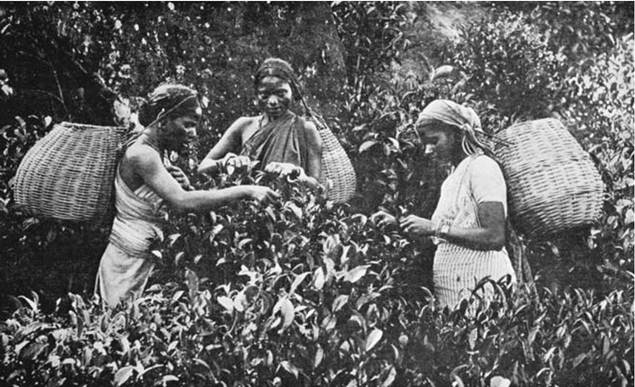
Three indentured south Indian women pick tea on a plantation in Ceylon at the beginning of the twentieth century. Tea picking relied on both female and child labor to select the tender young leaves of the bush. Henry W. Cave, Golden Tips, A Description of Ceylon and Its Great Tea Industry (London: Sampson Low, Marston & Co., 1900), courtesy Butler Library, Columbia University in the City of New York
and then tea plantations of Ceylon and the harvesting of rice in Burma (modern Myanmar), while perhaps a quarter million migrated to British Malaya as laborers. South Africa received more than 150,000 Indians, most as indentured workers on the sugar cane plantations of Natal, while a better educated class of so-called passenger Indians because they purchased their own passage also journeyed to Durban from the 1870s. Among this latter group was a young Gujarati lawyer named Mohandas Gandhi, who landed at Durban in 1893, where he developed the practice of Satyagraha, or nonviolent resistance, in 1906 before leaving for England in 1921 and, ultimately, greater fame in India. In each instance these labor-driven imperial connections fostered the evolution of settled Indian communities in these far-flung countries.
The other great movement of indentured laborers was from southern China to Southeast Asia. Bonded labor caused by debt and mostly involving women was historically a major institution in Southeast Asia. In urban areas in Southeast Asia Chinese merchants, like Dutch colonialists, were large slave holders. Abolition notwithstanding, slavery persisted deep into the nineteenth century. The growth of Chinese trade and agricultural production of opium and rice in Southeast Asia during this period created new demands for labor.
In the mid-eighteenth century the junk trade from South China to the countries bordering the southern seas reached its apogee, with more than one hundred junks annually making this voyage. This traffic gradually declined in the following decades as Western shipping sought to gain control of this trade. Yet as late as 1833 a Chinese mandarin named Phan Huy Chu could write as he embarked from Vietnam to Batavia on a Chinese junk, “Every year ships sail to faraway barbarian lands, stable and safe on the waves, as if they were coming and going over flat land.”29 Many of these ships were actually built in Southeast Asia by locally based Chinese shipwrights.
Although this Chinese maritime commercial frontier was already thriving by the end of the eighteenth century, involving Chinese tin miners in Malaya and agricultural workers on Chinese plantations in Singapore and Johor, on the Malay Peninsula, to produce pepper and gambier, the leaves of which were used medicinally in China, it was the rapidly expanding opium trade that propelled it to new prominence. By the 1760s the English East India Company controlled production of opium in India, and British merchants dominated its trade to Southeast Asia and China. From midcentury, Chinese merchants also developed opium farming in Java, eventually expanding right across the entire region. The consequent demand for labor on opium farms, in addition to the other Chinese commercial operations in Southeast Asia, could not be satisfied by local sources and eventually, building on decades of sojourning Chinese labor, gave rise to the introduction of contracted Chinese “coolie” labor. By the late eighteenth century there were numerous settlements of Chinese workers around the Southeast Asian littoral. Opium fueled this entire commercial system, both by driving production and by keeping the immigrant labor force docile.
The negative effects of opium addiction on its people caused the Qing dynasty to attempt to eradicate the opium trade and strictly control European and American merchants at Canton. The First Opium War of 1839-42 between Great Britain and Qing China broke imperial Chinese opposition to the opium trade, led to the British establishment of Hong Kong in 1843, and opened up China to free trade. Henceforth opium came to dominate the revenues of the colonial economies of Southeast Asia. Because of its central location, British Singapore stood at the center of both the opium trade and the immigration of Chinese laborers, while Hong Kong became its counterpart in China. As in India, population growth, poverty, and lack of economic opportunity were the push factors for these migrant workers. In the words of Thomas Church, the Superintendent of Police at Singapore in 1830, “It is, in truth, want and destitution... which drive these thousands annually out of China.”30 Nearly all of the Chinese migrants were men until, after 1900, Chinese women began to be able to join men to form families. Even well into the twentieth century, however, the ratio of Chinese men to women in Southeast Asia was significantly skewed. Until the 1870s these men traveled on Chinese junks, but by the next decade they were mainly transported on steamers. Upon leaving China, most contracted debt that continued to bond them to their employers or labor agents in Southeast Asia. Their situation was at best only a step removed from traditional forms of debt slavery in Southeast Asia. By the end of the century, however, about 90 percent paid their own passage.
Singapore was the central clearinghouse for through migration of Chinese, who were contracted out across the entire subregion and across the Indian Ocean to Mauritius, Reunion, and South Africa. Between 1880 and 1910 the annual number of Chinese coolies arriving at Singapore ranged from a low of 50,000 to a high of 200,000.
Already by the 1870s Singapore’s population of more than 96,000 included some 54,000 Chinese, of whom fewer than 7,500 were women. It was a diverse Chinese population that included five different ethno- linguistic groups. In addition, Singapore was also home to the so-called Baba or Straits-born Chinese migrants, who had their origins in Melaka and Batavia. The Baba constituted a distinct commercially powerful and wealthy class that actually controlled the coolie trade. The Baba network extended to the most important ports across the entire region, from China to Malaya, even to Rangoon (today Yangon) and Calcutta. According to an anonymous Baba recitation of travel within this commercial network in 1890, the writer first embarked on a small ship from Batavia to Singapore, where he stopped briefly. In his journal he wrote, “I had already come to Singapore sixteen years ago. The city was not as prosperous as it is now. Revisiting the place today things have really changed a lot.” Leaving Singapore he then sailed to Saigon (today Ho Chi Minh City) on a larger and faster French steamer, where he stayed with a colleague on “the street of the Babas.”31 In this way were the foundations built for the extraordinary Chinese presence in Southeast Asia today.
The third example of population movement focuses on Islamic networks. Examples of these networks had existed for centuries, but the expansion of the British Empire around the Indian Ocean and the introduction of steamships greatly facilitated movement. Emanating from the Hadramawt and from greater Bombay these new networks carried Sufism and renewed Muslim scholarship across the breadth of the Islamic Indian Ocean. Sufism as a way of worship was organized into specific “Ways” that traced their practices to original founding figures who possessed exceptional spiritual power or baraka that was handed down over generations to their most blessed disciples. Each Sufi Way, or tariqa, assumed its specific organizational form; these organizations are sometimes known as “brotherhoods.” Unlike monastic orders, these organizations were not exclusive, that is, an individual could belong to more than one tariqa, although in practice they could assume fierce rivalries. Among Hadramis the dominant Sufi Way was the Alawi- yya, which had reached the Hadramawt from the Maghrib by way of Mecca by the middle of the thirteenth century.
The Hadrami Indian Ocean network dates back to the sixteenth century and reached from the Comoro Islands to western India and the
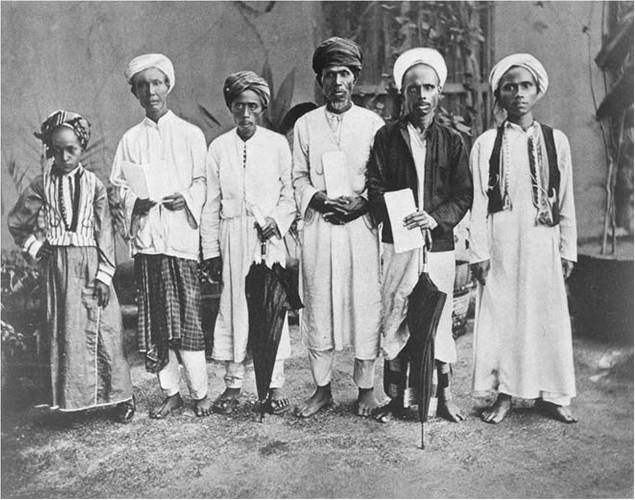
A group of Hadrami pilgrims from Indonesia photographed at Mecca in the late nineteenth century. Their clothing reflects a combination of Indonesian and Arab styles of dress, but the two umbrellas are clearly of Western manufacture. Tropenmuseum, Amsterdam. Coll. no. 10001261
Deccan, to insular Southeast Asia. Travel and trading were well established among Hadramis, while among Hadrami elites Islamic learning and missionary activity were important activities. The most prominent members of this elite group were identified as sayyids, direct descendants of the Prophet Muhammad’s son-in-law Ali. Others were regarded as shaykhs, religious scholars who did not claim this genealogy. Hadramis came to serve as religious leaders wherever they settled and encouraged the spread of Shafii Islam, reflecting the dominant Islamic school of law in Arabia, around the Indian Ocean. The religious center of the Hadramawt was the city of Tarim, which became a place of return and pilgrimage for Hadramis dispersed in India and Southeast Asia. In a parallel development, as the religious prominence of locally settled Hadrami Sufis grew, their graves also became sites of pilgrimage.
Movement along these elite networks depended on family contacts. An early twentieth-century document written by a member of the prominent al-Kaf family included instructions on how a young man should proceed. Beginning at Tarim it advises the traveler to stay at Mukalla, on the coast of Hadramawt, with a family member “whom we have notified” and who would provide money for further travel. It reminds the inexperienced man to “send presents and letters to your family and children and to us—write from everywhere so that we can rejoice at your well-being.” The instructions further recommend, “If there is honey available in al-Mukalla, get some as presents for the relatives in Singapore.” Moving next to Aden, where he would similarly be welcomed by family, he should book appropriate passage on a steamer. “Once you arrive in Singapore, follow the advice of your uncle.”32
The first wave of Hadrami migrants to Southeast Asia dates to the late eighteenth century, individuals moving from Aceh to Palembang and then Pontianak, on the west coast of Borneo. By the 1820s there were important Hadrami trading colonies on the north coast of Java. The 1859 census for Dutch Indonesia counted more than 7,700 Hadramis; by the 1885 census the number had grown to 22,500. By the 1930s perhaps as many as 140,000 people living outside of the Hadramawt could claim Hadrami origins around the Indian Ocean world. Nearly all of the Hadramis who settled in Indonesia were men who married locally; their children were called muwallads, a process of family formation that recalls both the formation of Swahili and Mappila societies in an earlier age. Although many Hadramis and Muwallads were simple traders, the high status of some and their first language command of Arabic, the language of the Prophet, gave them prominence in local Muslim society. Some gained positions within the Dutch colonial enterprise, while others established small, independent sultanates. In 1824, Hadrami sultans were involved in the separation of British Malaya from Dutch Indonesia. From 1873 until 1903 the Hadrami ruler of Aceh, Abd al-Rahman b. Muhammad al-Zahir, led a spirited resistance against the imposition of Dutch colonial rule. By the late nineteenth century a new Hadrami elite based on wealth and education, not ascribed status, emerged. Stimulated by the first stirrings of Indonesian national consciousness and Indonesian Chinese ethnic awareness, they developed a greater sense of Arab ethnic identity. By the 1930s, however, most Muwallads rejected a separate Hadrami identity and sought integration as Indonesians.
On the other side of the Indian Ocean Zanzibar and the Comoros were important nodes of the Hadrami commercial network and Alawi presence. The most important Alawi Sayyid family in East Africa was that of the al-Bin Sumayt, which also had members in Southeast Asia. Among the many distinguished members of this family in the western Indian Ocean, the most prominent was unquestionably Ahmad b. Abi Bakr b. Sumayt, who was born in 1861 on Ngazidja (also known as Grande Comore) at Itsandraa, where his tomb is an important pilgrimage shrine. Ibn Sumayt, as he is known, was a trader, Islamic reformer, and judge, or qadi, who gained prominence in British-controlled Busaidi Zanzibar after 1890. In his youth he was also a skilled navigator and astronomer. According to a modern Swahili hagiography, Ibn Sumayt was “a complete dhowmaster.”33 Like other Muwallad—his mother was a member of a prominent non-Sayyid Comorian family—after travel and study in the Hejaz, Ibn Sumayt revisited the Hadramawt, about which he wrote, “Trade is not very developed (in Hadramawt) but its people trade in foreign parts of the world, and for that reason, many people come and go, and eventually they return to their old home- lands.”34 Following his first visit to Hadramawt in 1880-81, Ibn Sumayt set out for Zanzibar to serve as a qadi but soon left this position and spent the next several years traveling to and studying in Istanbul, Cairo, Mecca, and Java before returning to Zanzibar in 1888, where he served until his death in 1925.
The Alawiyya was not the only Sufi Way to flourish during this period. By the end of the nineteenth century, eastern Africa was also home to a growing community of followers of the competing Qadiriyya and Shadhiliyya Ways. The Qadiriyya spread from Zanzibar to the coast through Bagamoyo and from there inland along continental caravan routes, while the Shadhiliyya was carried from Ngazidja to Mozambique Island and then to the interior. Adherents also introduced both independently to Somalia from Arabia.
Beyond the greatly enhanced Sufi networks achieved throughout the Indian Ocean world in the nineteenth century, Sufi saints were considered to be particular protectors of Muslim sea travelers. Coastal shrines dotted the Indian Ocean, while seafarers regularly called upon specific Sufi saints to protect them from the many hazards of sea travel, even after the introduction of steamships. During the stormy passage of Indian pilgrims from Bombay to Mecca in 1903 a female Sufi saint named Baba Jan “saved the steamer from being dashed to pieces after all the passengers, including the European ones, had promised to garland the grave of the Holy Prophet.”35 During the second half of the nineteenth century Bombay, which had become the hub of colonial industrialization and India’s major port, had also become a major nodal point for Muslim migration from both its hinterland and foreland, as well as for missionary activities to Iran and South Africa. So while indentured workers and passenger Indians like Gandhi were traveling to Durban, Muslim missionaries carrying Urdu religious tracts published in Bombay followed in their wake.
In addition to the expansion of Sufi Ways, new varieties of popular Islam penetrated the social and cultural practices of most Indian Ocean Muslims. To take only one example, according to an 1869 Alsatian Roman Catholic missionary account a women’s healing spirit possession cult at Zanzibar was known by the name kitimiri. Identified as an Arab sea spirit, the name of this cult refers to the dog Kitmir who guards the Seven Sleepers of the cave in the eighteenth Surah of the Quran, which is known as the Surat al-kahf or “surah of the cave.” Part of the elaborate ceremonies surrounding the kitimiri cult involved naming the possessing spirit, who in this case came from Mahri, the country lying between Oman and the Hadramawt, by way of Pemba. In addition, the protective qualities of both the Seven Sleepers and Kitmir were recognized and put into practice as far away as Indonesia. Thus, in their own way the women possessed by kitimiri in nineteenth-century Zanzibar had integrated features deriving from both Omani colonial rule and the Hadrami network.
Another large group of travelers were the sailors who manned the indigenous Indian Ocean sailing vessels, many of whom made the transition to steamships in the lower rungs of the hierarchical order that prevails on board any ocean-going vessel. Most prominent in this motley crew were “lascars,” mainly but by no means exclusively Indian seamen who worked on British steamships. An estimate of
their numbers in 1855 was about 10,000 to 12,000; by 1881 British merchant ships employed more than 16,600 lascars, a figure that rose to more than 51,600 in 1914. Their work conditions were regulated by a set of Asiatic Articles that amounted to a form of indentured labor distinct from how European sailors were contracted. Another important category of maritime industrial workers were “seedies,” African laborers who were often of slave origin or freedmen and who worked mainly as firemen in the suffocating bowels of the ships. So long as the Chinese junk trade continued, of course, their crews were Chinese.
Finally, just as Columbian expansion across the Atlantic introduced deadly new diseases to the Americas with disastrous results, the increased maritime mobility of the nineteenth century was accompanied by the spread of cholera around the Indian Ocean world. Cholera was endemic to Bengal and spread out from there in several devastating epidemic waves in the nineteenth century. The first dated to 1817-22. It ravaged about one-fifth of Bangkok’s population in 1820, spreading to Java in 1821, where mortality sometimes reached 60 percent and killed about 125,000. It may also have reached the Gulf and East Africa, as did another outbreak in 1835-37. In 1858 cholera spread from Mecca, where tens of thousands of pilgrims had gathered for the annual hajj, down the towns of the Swahili coast, reaching Zanzibar from Lamu in November.
According to the diary of the British consul at Zanzibar, C. P. Rigby, by February 1, 1859, “the deaths by cholera are reported to be 250 daily. The dead are buried amongst the living, by the roadside in long lines of shallow graves, the earth scarcely covering the toes.” Later, in his 1860 report on Zanzibar he summarized the devastation by noting that “in the spring of 1859 it carried off about twenty thousand persons in the Island of Zanzibar, and almost depopulated several towns on the opposite coast,” whence it continued south to Kilwa and Mozambique.36 Experienced explorer Richard Burton was at Kilwa, “where people died like flies,” during this horrific epidemic and left this disturbing account of its devastation: “There were hideous sights about Kilwa at that time. Corpses lay in the ravines................. The poorer victims
were dragged by the leg along the sand, to be thrown into the ebbing waters of the bay; those better off were sewn up in matting, and were carried down like hammocks to the same general depot. The smooth oily water was dotted with remnants and fragments of humanity........................................
Limbs were scattered in all directions, and heads lay like pebbles upon the beach.”37
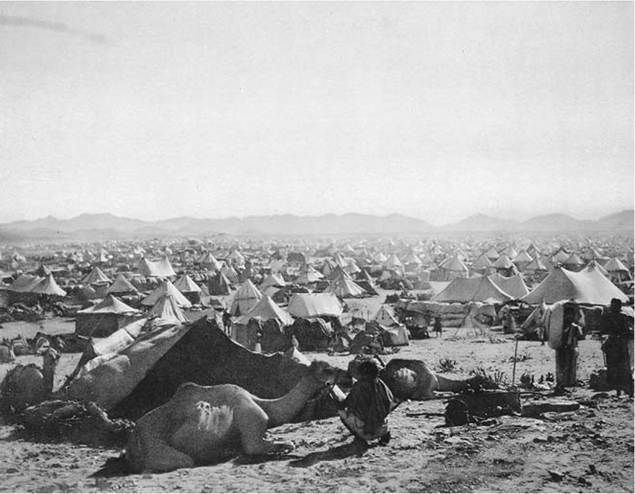
Tents cover the plains outside Mecca where permanent housing for the annual influx of Muslim pilgrims now has been built. This photograph gives some idea of the vast numbers of pilgrims who traveled to Mecca in the late nineteenth century. Courtesy of Rijksmuseum, Amsterdam.
In 1865 another wave of cholera reached Mecca from Singapore and Java, where the epidemic began. That year 15,000 out of 90,000 Muslim pilgrims died at Mecca and from there cholera again spread to eastern Africa, moving first across the Red Sea to Sudan and then up the Nile where it moved along mainland caravan routes right down to the coast at Pangani in October 1869. Eventually the disease killed as many as 30,000 on Zanzibar island. Kilwa Kivinje, the principal mainland port for the slave trade, experienced a daily death rate of 400. In the end cholera extended up the coast to Socotra, down to Quelimane, across to the Comoros and northwest Madagascar.
By the end of the long nineteenth century, Great Britain’s colonial enterprise in the Indian Ocean had wrought a whole range of serious consequences that affected millions of inhabitants of the entire region. Some of these were a direct result of the transformations effected by industrialization in the West and the development of colonial plantation production. Others were unintended by-products of the facilitation of population movement. Taken together they accelerated a historical process begun many centuries before that demonstrates how the Indian Ocean world was—more than ever before—both an internally connected world region and one that was globally linked to the rest of the world.
More on the topic The Long Nineteenth Century:
- The Long Nineteenth Century
- 31 Western Ukraine during World War I
- 29 Ukrainian Lands under Habsburg Rule, 1772-1914
- Nineteenth-Century Japanese New Religions
- The modern “family”
- National Survival: Constitution-Making in a Failed State
- THE LONG-RUN EVOLUTION OF WEALTH-INCOME RATIOS
- THE LONG-RUN EVOLUTION OF WEALTH CONCENTRATION
- 28 The Peoples of Dnieper Ukraine in the Nineteenth Century
- THE LONG GERMINATION OF THE IDEA OF A WORLD FREE OF POVERTY