Intrusions and Transitions in the Early Modern Period
On May 20, 1498, Vasco da Gama reached Calicut after a smooth passage from the East African coastal town of Malindi, where he had been advised about how to follow the monsoon by a Gujarati pilot.
According to some sources, his first encounter in India was with two North African merchants from Tunis who reportedly spoke both Spanish and Italian. “The first greeting that he received was in these words: ‘May the Devil take thee! What brought you hither?’ They asked what he sought so far away from home, and he told them that we came in search of Christians and spices.”1True or not, Portuguese fleets had been seeking to outflank the control exercised over the spice trade by Venice and their Muslim counterparts who dominated the eastern Mediterranean for almost a century. Beginning with the conquest of the North African stronghold of Ceuta in 1415, Portuguese vessels had steadily made their way around the coast of western Africa until, in 1487-88, Bartolomeu Dias rounded the Cape of Good Hope. Emissaries to the Holy Land and Rome in the late medieval period from Christian Abyssinia, whose king was considered to be the mythical Prester John, had caused Western Christendom to hope to join forces with a Christian ally, now surrounded by Islam. So when Gama’s small fleet of three ships anchored outside Calicut his allegedly declared goals are not surprising.
When they entered the Indian Ocean world, the Portuguese carried with them a deep antipathy to Islam and Muslims born of a crusading mentality. Yet Muslims were a familiar enemy. Hindus were unknown, which explains how it was that Gama thought “the city of Calicut is inhabited by Christians” and that “the king,” meaning the Samudri- Raja/Zamorin, “was a Christian like himself.”2 Mistaking Hindu temples for Christian churches, Gama clearly misread the cultural differences the Portuguese encountered at Calicut.
Eventually the Portuguese came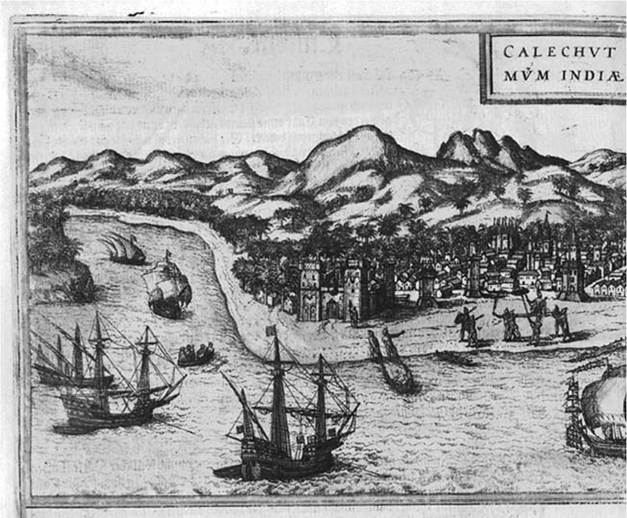
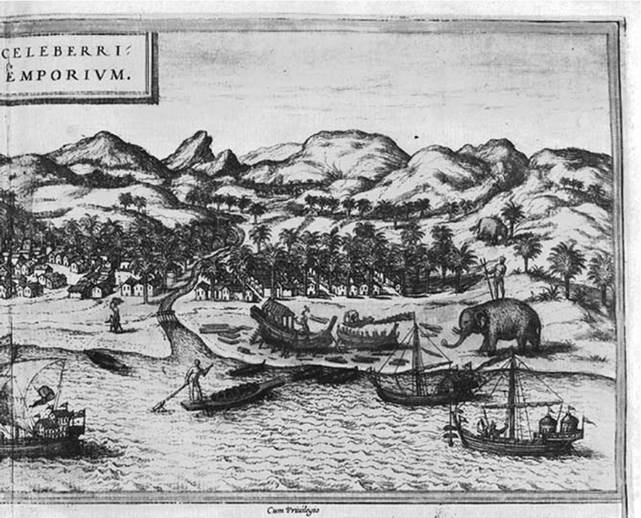
A 1572 image of Calicut reveals an extensive coastal settlement; most of the ships are Portuguese, but there is a regional vessel with lateen sails at the left in the river and also a man poling a dugout canoe. The elephant with a mahout standing on its back was probably used to haul timbers for the repair of ships, like those hauled up on shore. National Library of Israel, Shapell Family Digitization Project and Hebrew University of Jerusalem, Department of Geography, Historic Cities Research Project
to distinguish between “Arabs,” “Moors,” meaning non-Arab Muslims, “Gentiles,” meaning Hindus and Buddhists, and “Kaffirs,” a term ironically adapted from the Arabic word for nonbelievers, to designate nonMuslim Africans. The basic prejudices they exhibited, however, marked attitudes that they shared with the European powers that followed them into the Indian Ocean world.
Gama’s first experience at Calicut failed not because of racial prejudice, but because the Portuguese did not understand that the Samudri- Raja ruled over one of the most sophisticated commercial centers of the Indian Ocean. On May 29 Gama assembled a present for the king that consisted of “twelve pieces of lambel, four scarlet hoods, six hats, four strings of coral, a case containing six wash-hand basins, a case of sugar,
two casks of oil, and two of honey,” essentially an assortment of minor trade goods. When the Samudri-Raja’s trading representatives “saw the present they laughed at it, saying that it was not a thing to offer to a king, that the poorest merchant from Mecca, or any other part of India, gave more, and that if he wanted to make a present it should be in gold, as the king would not accept such things.”3 After Gama’s misstep matters went from bad to worse, and the Portuguese left Calicut with a modest cargo of trade goods, although these brought the Portuguese Crown a great profit in Lisbon.
Although the Portuguese had forged an alliance with the king of Malindi, elsewhere on the Swahili coast the impetuous Gama had resorted to violence whenever he encountered reluctance to comply with his wishes. His experiences and the way in which he reported them resulted in the Portuguese embracing a bellicose approach to their attempt to seize control of the maritime trade of the Indian Ocean. When the much larger fleet of Pedro Alvares Cabral bombarded Calicut for two days in 1500 because the Samudri-Raja refused to expel all Muslims, it signaled the beginning of a long period of transition in Indian Ocean history. Nevertheless, as a single event Cabral’s action was scarcely different from Zheng
He’s attack on Palembang less than a century previously. Unlike the Chinese, however, who seemed content after Palembang to exercise their influence nonviolently, equipped with the ability to fire cannon from on board their ships the Portuguese continued to employ violence in seeking to establish their mastery of Indian Ocean commerce.
Two Arab accounts reveal how the Portuguese actions were regarded by the Muslims. A sixteenth-century Hadrami chronicle refers to seaborne attacks launched by the Portuguese in 1502-3 in these terms: “In this year (Radjab) the vessels of the Frank appeared at sea en route for India, Hormuz, and those parts. They took about seven vessels, killing those on board and making some prisoner. This was their first action, may god curse them.”4 According to Ibn Majid’s last major work, a poem entitled “al-Sofaliya” written in 1535, by which time the Portuguese had seized Hormuz and Jidda,
[The Franks] arrived at Calicut...
There they sold and bought, and displayed their power, bought off the Zamorin, and oppressed the people.
Hatred of Islam came with them! And the people were afraid and anguished.
And the land of the Zamorin was snatched away from that of Mecca, and Guardafui was closed to travelers.5
In a very real sense, although Muslim antipathy to Portuguese intrusion was expressed in reciprocal religio-cultural terms, Portuguese actions in disturbing peaceful trade in the Indian Ocean were little different from the actions of generations of regional pirates.
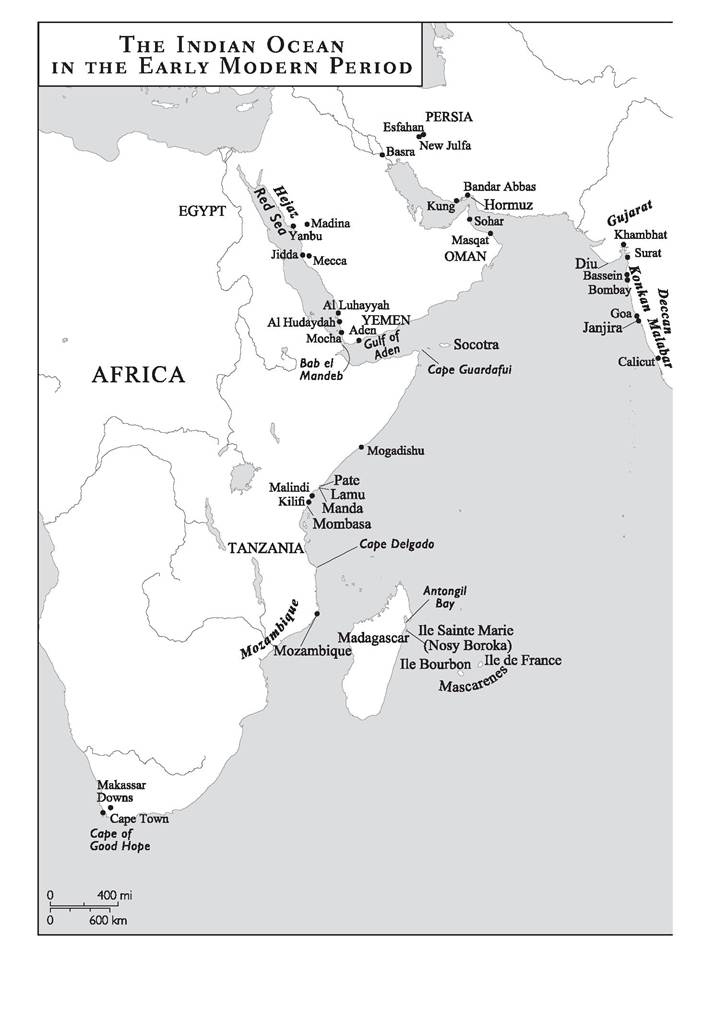
As it happens, the Portuguese were not the only external power seeking to exercise dominance over Indian Ocean trade in the early sixteenth century. Within two decades of Gama’s pioneering voyage, the Ottoman Empire sought to stake out a position as Muslim sovereign over the Islamic Indian Ocean. Prodded by the Portuguese conquests of strategic Indian Ocean choke points such as Hormuz in 1507, Melaka in 1511, and Columbo in 1518, as well as by the establishment of the grandiosely named Viceroyalty of the Estado da India at Goa, which the Portuguese also seized from a Muslim ruler, the Ottomans saw themselves as delivering this Islamic sea from the infidel Franks. Particularly galling was the humiliating Mamluk naval defeat at Diu early in February 1509 that was characterized by excessive Portuguese brutality.
Following their conquest of Mamluk Egypt in 1517, the Ottomans developed a comprehensive strategy to gather intelligence and develop their navy so as to be able to recapture control of the Indian Ocean seaways for Islam and, more to the point, for the Ottoman Empire. Over the course of the sixteenth century these two great powers—one land-based but aspiring to maritime superiority, the other a small European kingdom with a maritime empire that spanned two oceans—struggled to defeat each other and gain command over the wealth of the Indian Ocean trade.
The Luso-Ottoman rivalry extended from the Red Sea as far east as northern Sumatra. Although the Portuguese failed in their attempts to take Aden, and in 1511 abandoned a foothold on Socotra after only five years, they continued to threaten Muslim control of the Red Sea for the first half of the sixteenth century by regularly dispatching naval patrols to the Gulf of Aden and deep into the Red Sea itself.
To meet this challenge the Ottomans seized control of Suakin in 1524, Mocha in 1535, Aden, first in 1538 and finally in 1549, as well as fortifying the critical Hejaz port of Jidda in 1525. This short period of struggle to control the Red Sea undoubtedly affected negatively the flow of commerce through this critical arm of the Indian Ocean, but by about 1540 trade appears to have regained its normal rhythm.According to a report by Portuguese chronicler Diogo de Couto, a Portuguese patrol waiting outside the Bab el Mandeb in 1562 was decidedly unsuccessful, noting that “they saw more than sixty different [Muslim] vessels without ever being able to reach even one of them. This was because [the Portuguese vessels] were near the shore, and [the merchant ships] came in from the sea with the wind fully at their backs. It was therefore impossible either to catch them or to follow them inside [the mouth of the Red Sea], for [the Portuguese] dared not enter the straits for fear of risking the loss of their own ships.”6 Thus, although the Portuguese patrols amounted to a form of state piracy, this particular one was rendered ineffective as much by the monsoon as by the failure of its commander.
The Ottomans generally did not seek to challenge the Portuguese in the open seas. Their fleet consisted primarily of galleys or galliots, which combined oars with sails, that were most effective near the coast and where their pace and maneuverability could overcome the size and firepower of the Portuguese sailing vessels. In addition to the Red Sea standoff, once the Ottomans took control of Basra in 1546 a diplomatic modus vivendi evolved with the Portuguese at Hormuz. Nevertheless, direct conflicts did occur as both the Ottomans and the Portuguese sought to draw upon local allies to give them an advantage in the longer- term competition for control of the Indian Ocean.
In 1538 the Ottomans sent a massive fleet of seventy vessels into the Indian Ocean to challenge the Portuguese in western India and Southeast Asia.
It did not succeed. The Mappila corsairs who were supposed to challenge the Portuguese along the Malabar and Konkan coast were defeated before the Ottoman fleet set sail, while an attack on Melaka by Muslim allies in northern Sumatra likewise failed. The main battle was played out before Diu, which the Portuguese had wrested from the Sultan of Gujarat during the latter’s short-lived repulse of the expanding Mughal Empire only three years previously. The Ottoman fleet laid siege to the island-fortress of Diu for six weeks and almost brought the Portuguese to their knees, but failures of leadership and of coordination with local allies caused the Ottomans to withdraw without success.In the early 1550s the Ottomans again mounted a major offensive against the Portuguese, this time focusing their efforts on the massive fortress at Hormuz, at the entrance to the Gulf. Once again the expedition met with disastrous failure. The Ottoman fleet withdrew to Basra before attempting to return to its home port at Suez. In the largest open sea battle between these imperial rivals, the Ottoman galleys commanded by Murad Beg almost destroyed the Portuguese fleet. Aided by a sudden drop in the wind that left the Portuguese sailing vessels helpless, the Ottomans devastated the Portuguese until a just-as-sudden resumption of the wind enabled the Portuguese to regroup and counterattack their Ottoman enemies, who withdrew again to Basra. Under a new commander, Seydi Ali Reis, in 1554 the Ottoman fleet set out once more to return to Suez. Thinking they had slipped the Portuguese fleet at Hormuz, the Ottomans rowed across the Hormuz Strait to Masqat where the faster Portuguese sailing vessels had preceded them and organized a murderous ambush. The Portuguese destroyed six Ottoman galleys in the battle and two of the remaining nine were wrecked in their escape into the stormy open sea. In his memoir Seydi Ali wrote, “As compared to these awful tempests, the foul weather in the Western seas is mere child’s play, and their towering billows are as drops of water compared to those of the Indian sea.”7 The Ottoman commander finally led the remnant of his fleet into a friendly port on the western Indian coast, where they were abandoned and scrapped, while he made his way overland to Istanbul. Nothing was left of the Ottoman fleet.
The crushing defeat did not end this great rivalry. Based on their control of the Islamic Holy Lands, the Ottomans fashioned themselves as protectors of the faith in the Indian Ocean world. Like the Portuguese, they also desired to control the rich spice trade of the Malukus. Accordingly, the Ottomans sought to challenge the Portuguese position in Southeast Asia, in particular their control of Melaka. They did this by wooing the Muslim Sultanate of Aceh in northern Sumatra, which plied
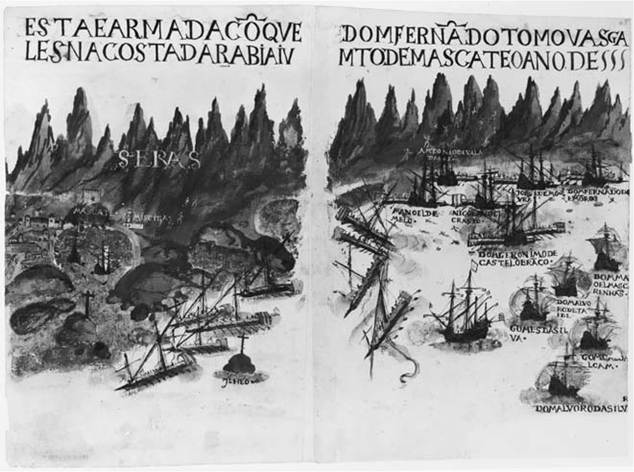
This Portuguese rendering of the great sea battle in the harbor of Masqat in 1554 depicts both the Portuguese caravels, with the names of their commanders by each ship, and the smaller, oared Ottoman galleys. The setting of Masqat, surrounded by high mountains, is an accurate, if stylized, representation. The Pierpont Morgan Library, New York. MS M.525, fols. 16v-17
a handsome direct annual trade with the Ottoman-controlled Red Sea and Gujarat. Aceh had already failed once to seize Melaka, but by midcentury much of its trade involved the importation of armaments. Although it was nominally a vassal to the Portuguese, Aceh sent an emissary to Istanbul in 1562 and two years later an Ottoman representative named Lutfi reached Aceh, where he apparently became a focus for pan-Islamic and anti-Portuguese sentiment. Lutfi returned to Istanbul in 1566 carrying a letter from the Sultan of Aceh that Lutfi probably drafted and that declared Aceh to be “one of Your Majesty’s own villages, and I too am one of your servants.”8
At the same time diplomatic exchanges between the Ottoman Empire and Portugal appeared to be heating up, as Sultan Suleiman the Magnificent wrote to King Sebastiao:
It has been reported that the Muslim pilgrims and merchants coming from India by sea have been molested and abused in direct violation of the desired peace agreement between us If it is truly your desire to
bring peace and security to those lands, then as soon as this Imperial
Ferman arrives you must cease all of your attacks at sea against merchants and pilgrims.... If you are still set on pursuing the path of rebellion, then with the help of God Almighty we will do everything necessary to restore order to those lands.9
Although nothing came of either the Ottoman or the Acehnese threat to Portugal’s Estado da India at this time, the language of Suleiman’s letter to the Portuguese monarch serves as a reminder, yet again, that the Portuguese were essentially cast as piratical interlopers in the largely Muslim Indian Ocean world of the sixteenth century.
The final episode in this historical drama played itself out not in Southeast Asia nor in Gujarat, where the Mughal conquest of the independent sultanate in 1573, including Surat, which had particularly close connections to Ottoman merchants, created a different set of challenges for the Ottoman Empire. Instead, the denouement occurred where the Portuguese intrusion into the Indian Ocean had begun, on the Swahili coast. The key Ottoman figure was a dashing sea captain named Mir Ali Beg, who was based at Mocha on the southwest coast of Yemen. In 1581 he made a daring raid on Masqat with only three ships, sacking the city and capturing three vessels and a large amount of booty. According to a seventeenth-century Portuguese chronicler, “in the opening and closing of an eye he entered the town a pauper and came out again a rich man.”10
Over the next few years rising Muslim agitation against the Portuguese, including another Ottoman-assisted attack on Melaka, prompted new Ottoman imperial ambitions of liberating the Islamic Indian Ocean lands from the Christian infidels and against their Mughal Muslim rivals. The ambitious governor of Yemen sought to take advantage of the rising Islamic tide by liberating the East African coast, which had close trade relations with the Ottoman Red Sea, from its nominal Portuguese suzerainty. He ordered Mir Ali Beg to reconnoiter East African waters.
Although the Ottoman commander arrived in January 1586 with only a single galliot and some eighty men, his mission met with enthusiastic reception at towns from Mogadishu to Pate, each of which promised men, money, and local shipping to support Ottoman intervention. Because the Portuguese commander at Malindi decided not to challenge him, Mir Ali Beg managed to seize several Portuguese vessels, eventually amassing a fleet of two dozen vessels from almost nothing. He received fealty from every Swahili town except Malindi and returned to Mocha on the Southwest Monsoon with a large amount of booty, including gold, ambassadors from Mombasa, Kilifi, and Pate, and sixty Portuguese captives. The king of Malindi, whose town had hitched its star to the Portuguese from their first appearance in the Indian Ocean, warned the Portuguese at Goa that if Mir Ali Beg returned with a larger fleet, as he had promised to do, and the king of Mombasa fulfilled his promise to build a fort at Mombasa, the entire coast could be lost to the Ottomans. Were this to happen, the annual passage of the carreira da India—the royal fleet linking Portuguese Asia to Lisbon—would be seriously jeopardized.
In December 1588 Mir Ali Beg’s second and larger fleet embarked from Mocha for the Swahili coast, where his reception was as enthusiastic as three years before. Alerted to his expedition by its spies in Yemen, the Portuguese organized a large fleet that included three times as many soldiers as Mir Ali Beg commanded to sail from Goa to East Africa. The battle was joined in March 1589 at the island-city state of Mombasa, Malindi’s chief rival on the coast. The smaller Ottoman force was caught between the powerful Portuguese fleet and a fearsome African mainland army of so-called Zimba who temporarily allied themselves with the Portuguese. Together they devastated the Ottomans and their Mombasa allies. The Portuguese sacked Manda for supporting the Ottomans and publicly executed the king of Lamu and several leading citizens of Pate and Kilifi. The faithful ruler of Malindi received Mombasa as a reward for his support. Mir Ali Beg and some of his men were captured, the latter serving the rest of their days as slaves in Portuguese India. Mir Ali Beg was sent from Goa to Lisbon and converted to Christianity. The withdrawal of the Ottoman governor of Basra in 1596, followed by the loss of Mocha in 1636 and Aden in 1645, marked the complete end to Ottoman pretensions to Indian Ocean empire.
Unwilling to chance defending further challenges to their precarious hold on the Swahili coast without a solid base, the Portuguese determined to build a fortress stronghold at their new headquarters at Mombasa that was equal to the monumental Fort Sao Sebastiao at Mozambique Island, which they began in 1558 and finally completed in 1583. They wasted no time and initiated the building of Fort Jesus in 1593, rapidly completing construction in 1596. Cape Delgado became the boundary between the Portuguese Captaincies of Mombasa and Mozambique, both of which still were subordinate to a Portuguese Viceroy at Goa. It remains today the coastal boundary between modern mainland Tanzania and Mozambique.
As newcomers to the trading systems of the Indian Ocean, the Portuguese soon realized that they could not compete directly with well- established indigenous merchant networks. Instead, operating from fortified points around the Indian Ocean littoral, they sought to rake off profits by imposing port taxes, requiring Crown licenses or passports known as cartazes on non-Portuguese merchant vessels, and forcibly inhibiting dangerous rivals that they defined either as “infidels” or “pirates.” In addition, unofficial Portuguese settlers married locally and became go-betweens with indigenous traders, as well as coastal traders themselves, not unlike their Arab and Indian predecessors in the Indian Ocean world. In Portuguese centers of power like Mozambique Island, Diu, and Melaka, where they had aggressively attacked Gujarati and Arab Muslim traders and pushed them out of the local market, different Hindu associations of traders took advantage of the situation that weakened their Muslim rivals to work with the Portuguese. Gujarati baniyas, Hindu and Jain members of this trading caste, from Diu became dominant traders at Mozambique, while Tamil Keling merchants from the Coromandel coast, as well as non-Muslim Chinese, became increasingly influential communities in Melaka during the sixteenth century. Elsewhere, however, Indian Ocean trading continued much as it had before the Portuguese intrusion.
In the course of a century the Portuguese had without question effected change in the Indian Ocean world. They had introduced a novel form of state violence to seaborne trade, new ship designs that some Indian Ocean boat builders sought to adapt to their own needs, and a form of Portuguese Creole that had evolved first in the Atlantic world and became a lingua franca for many Indian Ocean traders and in many Indian Ocean communities, even beyond formal Portuguese rule. But despite linking the Indian Ocean directly to the Atlantic, the Portuguese had not substantially altered historical patterns of trade or the lives of its indigenous inhabitants. Christianity had few converts outside of Portuguese Goa, and the Holy Roman Church had failed miserably in trying to impose its form of Christianity on Orthodox Ethiopia in the sixteenth century. At the end of that century, then, the Portuguese Crown seemed secure in its ability to control the open seas of the Indian Ocean from its fortified coastal bastions. Most of these were on islands or peninsulas, with very little in the way of continental domination, except for mainland conquests to the immediate north and south of Goa. Portugal’s was in every sense a seaborne empire or thalassocracy. It was also about to be challenged by a series of European rivals.
The familiar story of seventeenth-century European rivalries in the Indian Ocean focuses on the roles played by their different trading companies and their private employees, followed by the transition to genuine colonial domination from about the middle of the eighteenth century. Many different European private merchants, corsairs, and freebooters sought to break into the Indian Ocean commercial arena opened up by the Portuguese, especially after the Spanish incorporation of the Portuguese Crown made Portugal the enemy of both England and the Netherlands. But the main challenges came when these nations organized their merchants into chartered companies to rival the royal monopoly that dominated the Portuguese venture. First off the mark in 1600 was the English joint-stock East India Company (EIC). It was followed two years later by the Dutch East India Company, the Verenigde Oostindische Compagnie (VOC). Drawing upon the burgeoning capitalist economy of the Netherlands, the VOC was organized to trade and earn profit. It was also much more aggressive than the EIC and took the initiative in challenging the Portuguese in the Indian Ocean.
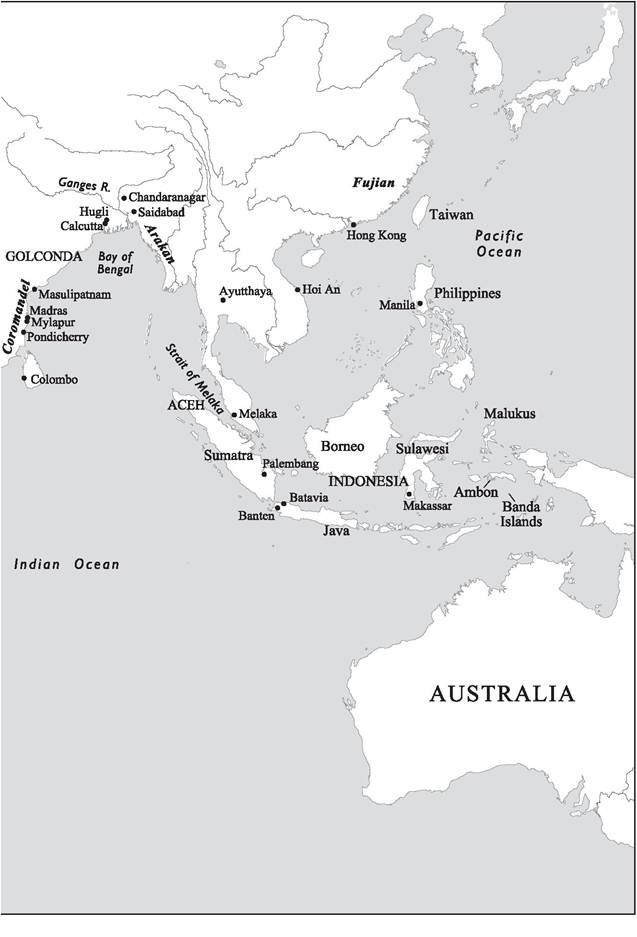
The Dutch and English shared many of the same prejudices of their Portuguese rivals regarding Muslims and other non-Christian peoples of the Indian Ocean world. In the words of a metropolitan VOC administrator writing in 1669, “We have had ample occasion to learn that people in the East Indies are in general of an evil and treacherous nature. They do not have the slightest scruple to break any commitment and are imbued with a deep hatred for Christians.”11 In the end, however, the main concern of both companies was to drive trade. The Dutch conquered Melaka in 1641, Colombo in 1658, and all the Malabar ports in the 1660s. In addition, they took command of a small Javanese port named Jakarta in 1619 and renamed it Batavia, which became the center of VOC activities in the Indian Ocean. Dutch success was built on their engagement with the so-called country trade or inter-Asian trade that drove the internal markets of the Indian Ocean, drawing upon the shifting hinterlands where goods were produced and exchanging them overseas or overland for other goods. The direct trade to Europe was laid over this more deeply rooted trade. Finally, to secure their shipping from the Atlantic into the Indian Ocean in 1652 they also established a station and colony at Cape Town. Although Portugal had toyed with the establishment of a foothold on the African coast to the south of Sofala in the previous century, this decision by the Dutch marked the real integration of South Africa into the Indian Ocean world.
The goal of the VOC was to establish a monopoly of the spice trade— cloves, nutmeg, and mace—and while the Dutch definitely had success in this sector, their control was initially never absolute. When they failed to achieve their ends regarding nutmeg and mace in the Banda Islands, they decimated the indigenous population and in 1621 replaced them with slaves, loyal Dutch, and willing Indonesians. From the mid-seventeenth century they again employed raw violence to eradicate clove production from the Malukus, where indigenous merchants often evaded Dutch
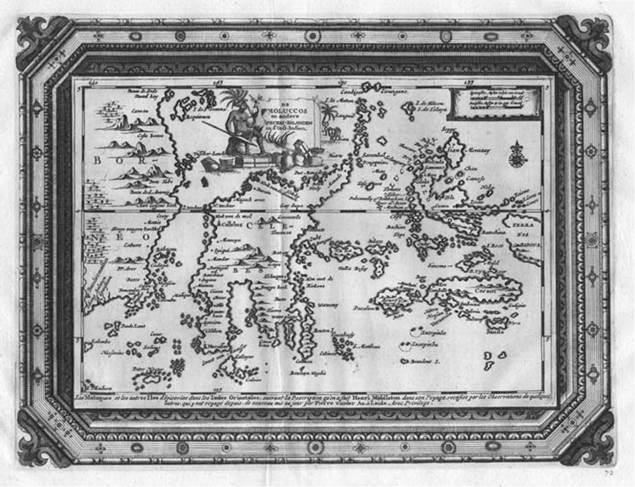
As the Dutch sought to control the spice trade, the development of more detailed local maps, like this eighteenth-century one of the Malukus, was important to the Dutch imperial project. The image of a seated man, perhaps a local chief, with a spear in his hand and boxes of goods at his feet may suggest the nature of exchange in the Malukus. Map Collection, Rare Books and Special Collections, Northern Illinois University Libraries
control, and reestablish production on Ambon, which was under firm VOC control. Because its cultivation was widespread in both Malabar and Indonesia, the VOC was unable to control production of pepper. Instead, they labored to dominate the coastal markets for the pepper trade, which they were also able largely to achieve by the late seventeenth century.
In addition to monopolizing the spice trade, the VOC responded to the growing Euro-American appetite for coffee. Originally cultivated in highland Ethiopia and Yemen, the international market for coffee was first driven by Ottoman and Persian demand. In the seventeenth and eighteenth centuries, the Yemeni ports of Mocha, Al Hudaydah, and Al Luhayyah were the main outlets for coffee traders, the most well known being Mocha. In the mid-eighteenth century German traveler Carsten Niebuhr recorded the following legend about the city’s origins, which focus on a venerable Sufi saint, Shaykh Ali b. Umar al- Qirshi al-Shadhili:

This nineteenth-century German drawing of the flower and fruit of the clove plant is emblematic of how European expansion inspired new generations of naturalists seeking to control knowledge of indigenous plants. From Kohler’s medizinal-Pflanzen in naturgetreuen Abbildungen mit kurz erläuterndem Texte: Atlas zur Pharmacopoea germanica, austriaca, belgica, danica, helvetica, hungarica, rossica, suecica, neerlandica, British pharmacopoeia, zum Codex medicamentarius, sowie zur Pharmacopoeia of the United States of America by Hermann Kohler, courtesy of Biodiversity Heritage Library, http://www.biodiversitylibrary.org, and the Missouri Botanical Garden, Peter H. Raven Library
A ship bound from India to Jidda cast anchor, one day, about four hundred years since, in these latitudes. The crew, observing a hut in the desert, had the curiosity to go and see it. The Scheh [shaykh] gave those strangers a kind of reception, and regaled them with coffee, of which he was very fond himself, and to which he ascribed great virtues. The Indians who were unacquainted with the use of coffee, thought that this hot liquid might cure the master of their ship, who was ill. Schaedeli assured them, that, not only should he be cured by the efficacy of his prayers, and of the coffee, but that if they would land their cargo there, they might dispose of it to considerable advantage.12
As for the Dutch, in 1696 they introduced coffee plants to Indonesia and in 1725 initiated a system of forced cultivation with annual quotas in the highlands of West Java, eventually to be followed by areas under their control in Sumatra. Dutch success on the world market may be measured by the adoption of “java” as a popular name for coffee, just as “mocha” suggested a superior variety of this stimulating beverage.
Although slavery was an ancient institution everywhere and smallscale slave trading was endemic in the Indian Ocean world, after the failed ninth-century Iraqi experiment with slavery it was the Dutch who first employed slaves in agricultural slavery. A census taken in 1688 counted the total enslaved population of the Dutch Indian Ocean possessions of the Cape, Ceylon, and Indonesia at about 70,000 individuals, which was supplied by an annual slave trade of between 3,730 and 6,430. Captives were drawn from East Africa and Madagascar, from India, and from Southeast Asia. In the middle decades of the seventeenth century the largest numbers came from the Arakan/Bengal and Coromandel coastal regions of India. In addition to the Dutch slave trade between Coromandel and Indonesia, independent Aceh imported many slaves from Coromandel to work on rice production during this period. Although not all bonded laborers worked in agriculture, their employment there was a harbinger of things to come in the Indian Ocean colonial world.
As the Dutch worked steadily to monopolize the spice trade that had drawn them to this part of the world, for most of the seventeenth century the British remained a much less active participant in the main currents of Indian Ocean trade. Instead, they focused their attention on gaining a foothold on the Indian subcontinent, allying themselves with local mercantile and political partners to acquire a piece of the region’s rich trade. They built a fort at Madras (now Chennai), in 1639, and acquired Bombay (now Mumbai), from Portugal in 1667; in 1690 they received a license to establish a parallel trading center on the Hugli River at Calcutta (now Kolkata). They also developed a chain of trading factories in other ports around peninsular India, including one at Surat in 1612. With a firm array of bases in coastal India, from about 1680 to 1740 the British became a much more important factor in Indian Ocean trade, exploiting the textile trade from India as well as developing new trade in tea and opium to Indonesia and, eventually, China.
The withdrawal of Ming China from the Indian Ocean after the death of Admiral Zheng He in the second quarter of the fifteenth century ensured that a potentially major Asian navy was not a factor in the early modern period. Nevertheless, except for the chaotic period that precipitated and followed the collapse of the Ming dynasty in 1744 and its replacement by the Manchu Qing dynasty, China remained an integral part of the easternmost branch of Indian Ocean commerce, despite an imperial ban on private trading from Fujian ports. In fact, from about 1570 to 1630, a period when the Ming reversed the ban on private Chinese trade to the south, the number of licensed Chinese junks increased significantly to more than one hundred at the end of the sixteenth century. Because Europeans were denied access to China until 1684, and even then their ships were subject to very high tariffs, the China trade continued to be dominated by Chinese and Chinese-crewed Southeast Asian junks. After the slump associated with the dynastic change in China, from about 1680 forward Chinese trade with Southeast Asia expanded significantly.
Because many overseas Chinese merchants had fought against the new Manchu rulers under the leadership of Ming loyalist Zheng Cheng- gong, who had seized Taiwan from the Dutch and made it his base in 1662, in the first half of the eighteenth century the Chinese state remained ambivalent about how to regulate its overseas trade. For example, it attempted to control overseas Chinese traders by a 1727 regulation that required Chinese traders to return to China after three years abroad, which many merchants avoided. Recognizing that trade to insular Southeast Asia was important to China, the Manchu governor of Fujian Province recommended in the early 1750s that transgressors should be allowed to return home “provided that their real reason for not returning within the time allowed was their inability to close their accounts.”13
Chinese merchants were ubiquitous throughout both mainland and insular Southeast Asia in the early modern period. From their coastal ports Chinese merchants penetrated hinterland supply lines that fed the overseas markets. By about 1630 the Dutch depended upon Chinese merchants to supply them with the goods they sought in exchange for cloth in Southeast Asia, while Chinese junks dominated about half of local shipping networks. Large Chinese merchant communities flourished at Ayutthaya in Siam, Banten in Java, and Hoi An in Vietnam. In Spanish Manila, their numbers had reached 23,000 before a terrible massacre in 1603, only the first of many against the Chinese in the Spanish Philippines, decimated their population. During the earlier decades of the seventeenth century Chinese merchants tended to marry local women and to integrate themselves with local society, but toward the end of the century, perhaps as a combined consequence of the official requirement that overseas merchants regularly return to China and the Dutch preference for separateness in Indonesia, this process soon declined. Still, many Chinese in the trading centers of indigenous Southeast Asian states continued to localize themselves, while those in Dutch urban areas like Batavia retained their “foreign” character.
In both settings it is remarkable that Chinese merchants became tax farmers for state revenue collection. By securing a reliable annual source of revenue for the state, whatever its provenance, Chinese business became ever more closely associated with the political elites of both regional and colonial administrations. Nevertheless, resentment against Chinese economic domination in Batavia, where they were almost 40 percent of the population at the end of the seventeenth century, resulted in a pogrom against them in 1740. In the aftermath the Dutch relocated the remaining Chinese to a Chinatown outside the main city walls.
An ironic consequence of European competition in the Indian Ocean during the early modern period is that every player regarded itself as the rightful claimant to domination and its rivals as pirates. To take only one example, according to the Portuguese viceroy, writing in January 1698, “The sea is full of pirates, which will result in the ruin of commerce and—if robbery continues like this—its total destruction and it is rumored with good grounds that all pirates are Englishmen and they go to Bombay to sell the treasures they have robbed. And if our frigates try to seize them they show us letter-patents of the East India Company, so that we cannot do them any harm.”14 Apparently, for the viceroy a Portuguese cartaz signaled a legitimate merchant ship, while its British equivalent amounted to a legal dodge to enable piracy. By contrast, to indigenous merchants and sailors it was the Portuguese who were the pirates.
By the 1680s eastern Madagascar, which lay beyond the reach of any European claimant to Indian Ocean sea power, had become the principal world base for a collection of pirates who had been driven out of the Caribbean. Although most captains were British, their crews included French, Dutch, and Danish sailors. Most were pirates by trade; others were honest seamen who had been pressed into piracy after their ships had been captured. Secure in their coastal strongholds, these maritime raiders sallied out to attack shipping across the northwestern Indian Ocean and into the Red Sea. They indiscriminately preyed upon both Muslim and European shipping, depending on the circumstances, the potential spoils, and the particular connections of individual pirate captains. For them piracy was their business; their notoriety was widespread.
To take only one example, the rich coffee trade of Mocha attracted shipping from all over the Indian Ocean and piracy in the Red Sea was both rife and multinational. In 1661-62 a Dutch vessel seized an Indian merchantman bound for Mocha, only releasing it after payment of a steep ransom. According to “An Account of the Attack by the Band of Hollanders and English of the Christian Nations, on the Port of Mocha,” written by the governor of that port, al-Hasan b. al-Mutahharal al-Djarmuzi, when the Yemeni authorities tried to negotiate, the Dutch seized their envoys. “Turning to such Muslim shipping as was found off the coast, they sank and burned it, looting all they were able.” Then, when the Muslims attempted to counterattack, the Dutch interlopers overwhelmed their ship and took or burned their goods. “As for the large vessel,” al-Djarmuzi writes, “a galliot, and two vessels belonging to the Indians, these they burned along with four sambooks; then they put back to sea.”15
European piracy in the Red Sea had serious implications for any European traveler. In August 1700 an English traveler named William Daniel, who was carrying official letters for the EIC from London to Surat, found himself at Yanbu, the Arabian port for Medina. When he was brought before the local Ottoman governor, he records, “he was inform’d I was a pyrat and a spy, going to joyn and give information to those of Madagascar, who had lately taken a ship near Mocha in which he and his relations were concern’d, and now he thought he could not do himself greater justice than to have satisfaction of me.”16
Like the pirates of the Caribbean, the exploits of the Madagascar pirates in the late seventeenth century make for exciting popular history and fiction. What is most interesting from the perspective of the Indian Ocean world, however, is the social transformation that accompanied the settlement of European pirates along the coast of eastern Madagascar. In a process that recalls the integration of Arabs and Persians into what became Swahili and Mappila societies, or smaller scattered communities in the eastern Indian Ocean, individual pirates gradually settled in local coastal villages from Tamatave (today Toamasina) south to Antongil Bay, where the small Ile Sainte Marie (today Nosy Boraha) became the center for the stockpiling and marketing of goods seized by pirates of this community. Most pirate settlers married local women and established commercial and political relations with the different local polities. In several cases the immigrant men became local rulers by exploiting the distribution of the wealth they had accumulated and by making astute marriages. The children of these unions between pirates and Malagasy women became known as Malata, mulattos, or ZanaMalata, children of mulattos. Not surprisingly, there was initially no political unity along the pirate coast, while their cumulative wealth increased on profits from trading slaves to the Mascarene Islands, which under French rule had begun to develop plantation economies with a resulting demand for labor from the second quarter of the eighteenth century.
Despite their diverse origins, in the 1710s the Zana-Malata provided a generation of political leadership that precipitated the emergence of what is today the second largest Malagasy ethnic group, the Betsimisaraka. The process began with the political struggle for control of the coast between a coalition of indigenous northerners or Antavara- tra and a parallel grouping of southerners or Antatsimo. In this contest the Zana-Malata joined forces with the Antavaratra. In about 1712, a Zana-Malata leader named Ratsimilaho, the son of an English pirate named Tom and a Malagasy royal daughter, emerged as leader of the northern alliance and led them to a defeat of the southerners. The victorious alliance then assumed the name of Betsimisaraka or “the many inseparable” and Ratsimilaho was elected their king with the throne name of Ramaromanampo, “he who rules over many.” European traders knew him as Tom Similaho, a name that acknowledges his dual parentage. The Betsimisaraka kingdom was more a confederacy than a unified state, and it was weakened by competition along the coast for control of the slave trade to the Mascarenes. Political unity was ephemeral and the kingdom fell apart after the death of Ramaromanampo in 1750. Yet by then the ethnic identity associated with the name of Betsimisaraka had become well established and the group retained a reputation as fierce warriors, no doubt a heritage of their pirate ancestors.
Notwithstanding the imperial competition as well as the great violence that characterized the methods of each of these intruders, the essential patterns of Indian Ocean commerce remained in the hands of indigenous networks. Foremost among these were Gujaratis, whose capital and shipping dominated the trade in spices from Southeast Asia, textiles and indigo from northwestern India, as well as the return carriage of bullion and specie from the Red Sea. The draining of precious metals from the Atlantic economies, which were now exploiting the silver mines of South America, to the East as payment for spices and the textiles of China and India was a persistent feature of international trade in the early modern period. Gujarati shipping also commanded the annual traffic generated by the hajj, the annual pilgrimage by Muslims to the Holy Lands of the Hejaz. With Khambhat as their principal port until the Mughal conquest of Gujarat determined Surat as the official Mughal maritime outlet for Gujarat, the network of Gujarati bani- yas stretched from Mocha in Yemen to Aceh in Sumatra.
As members of a group of Hindu and Jain merchant families, bani- yas provided nearly all of the financing of the Gujarati commercial networks. Like other communally defined trading groups, such as the Jewish traders who participated in the India trade in the thirteenth century, ban- iyas depended on a network of family and cultural intimates—whether locational, religious, or linguistic—to further their commercial interests. Credit was another institution on which Indian Ocean commerce depended. Although banks did not exist, bills of exchange, or hundis, served the same function for baniyas and other indigenous Indian Ocean traders. To an outsider, theirs was a closed enterprise. Writing in 1611, a frustrated VOC employee commented, “The banias keep their accounts on long scrolls of paper in secret signs and they are so secretive about their content that they will never show them to anybody. So they will have two books: one to show to outsiders and one showing the actual trade.”17
Of course, not all Gujarati merchants were baniyas. In the early sixteenth century the wealthiest merchant and governor at Surat was a certain Malik Gopi, also known as Gopinath, who as a Hindu Brahmin belonged to a higher caste than the baniyas. Two distinct Ismaili Shia Muslim groups, the Khojas and Bohras, were also deeply involved in commerce, as were a smaller group of Sunni Bohras, including Mulla Abdul Ghafur, a fabulously wealthy merchant-shipper at Surat in the early seventeenth century. Ghafur was unusual not only for his exceptional wealth, but because he combined being a merchant with being the largest shipowner at Surat. Indeed, whereas most merchants were Hindu and Jain baniyas, most shipowners were Muslims. Late in the following century still another indigenous group, the Parsis, became notable merchants at Surat and subsequently at Bombay, where they forged a profitable alliance with the British East India Company.
Following the Portuguese seizure of Melaka and the ouster of Muslims from that city, Gujarati Muslims shifted their activities to the rival Muslim Sultanate of Aceh. Despite Ottoman pretensions to leading the Indian Ocean Muslim community by wooing Aceh, it was Gujarati Muslims based there who made it possible to bypass the Portuguese control of the spice trade between Southeast Asia and the Red Sea. In addition, among the great proponents of orthodox Islam in Sumatra in the seventeenth century was Nuruddin ar-Raniri, a Gujarati Sufi from a Hadhrami family who wrote a seven-volume history of the world and guide to Islamic monarchy, the Bustan al-Salatin, or Garden of Kings, in Malay. Before arriving in Aceh, Nuruddin had studied in Mecca; eventually he returned to Gujarat. His story reveals parallel Gujarati commercial and religious networks that operated in the Indian Ocean world during this era.
Another example of how commercial and sacred geographies coincided comes from a less prominent and relatively short-lived contemporaneous network. Lying midway between the important ports of the Coromandel and the mouths of the Ganges River in eastern India, Masulipatnam became the outlet port for the Sultanate of Golconda in the last quarter of the sixteenth century and part of a network of Bay of Bengal ports that collaborated to avoid Portuguese attempts to control trade from Melaka. One of the major Golconda court factions was Persian and its members soon came to dominate maritime trade from Masulipatnam. In the first half of the seventeenth century Persians occupied all the official posts at Masulipatnam and were its principal shipowners. While most of its trade was in the Bay of Bengal, an annual ship was sent under the flag of the Golconda sultan to the Red Sea.
By the 1630s, the sultan’s ship from Masulipatnam typically had Dutch pilots and gunners, as well as occasional men provided by the English and even the Danes. When in 1622 the Portuguese lost Hormuz to a combined Safavid Persian and English attack, it was replaced as the major Gulf port by Bandar Abbas, on the Persian mainland. This turn of events encouraged Masulipatnam’s Persian merchants to establish a new trading link between these two ports with permission granted in 1632 to the Sultan of Golconda by the Shah of Persia. Although the initial voyages met with limited commercial success, the route was apparently still worth pursuing for Persian merchant Mir Kamal-al-din. What is especially interesting is that when he sought the sultan’s approval for a return voyage in 1635, the English at Surat reported “that hee may visit the toombe of a certaine Prophet unto which he is much devoted,” presumably the shrine of a prominent Sufi saint.18 Here again is evidence for the overlap between a commercial and a sacred geography.
The Masulipatnam-Bandar Abbas link was most successful in the 1640s and 1650s under the dominant figure of Mir Muhammad Sayyid Ardestani, who originally came to Golconda as a horse trader from Esfahan, capital of Safavid Persia. He soon became a successful diamond merchant and governor of Masulipatnam in 1636, eventually amassing a fleet of ten ships. His voyages enjoyed protection from the Dutch, English, and Danes, but they were always in danger of assault by the Portuguese. On May 11, 1652, the French traveler Jean-Baptiste Tavernier sailed from Bandar Abbas to Masulipatnam on a large ship owned by Mir Muhammad that carried more than one hundred Persian and Armenian merchants, a Dutch pilot with his assistant and three gunners, and fifty-five Persian horses. In his Travels in India Tavernier noted that the Sultan of Golconda’s ship “every year goes to Persia laden with muslins and chites or coloured calicoes, the flowered decoration of which is all done by hand,—which makes them more beautiful and more expensive than when it is printed.”19
Eventually the Masulipatnam trading link to the western Indian Ocean was ended by a combination of political and economic changes that culminated in the Mughal conquest of Golconda in 1687 and the steady encroachment of private European rivals along the eastern coast of India. Furthermore, Golconda shipping had increasingly become victimized by European piracy. In 1665, for example, the sultan’s vessel had been seized by the Portuguese on route to Persia, while another Masulipatnam ship was attacked in the Red Sea by a Swedish ship with a Dutch captain. Seen from the perspective of indigenous trading networks, then, the European rivalry for control of Indian Ocean trade that erupted in the seventeenth century was notable mainly for a dramatic increase of maritime violence. A Bengali ballad recalls how “the dreaded Portuguese pirates, the Harmads,” a word adapted by Bengali speakers from “armada,” terrorized coastal shipping, and “plundered the boats and assassinated their crew, and the boatmen and captains of the seaside trembled in fear of the Harmads.”20
Networks linking Gujarati and Persian merchants were not the only ones operating in the Indian Ocean world during this period. The seventeenth century witnessed the rise of an entirely new network of Asian traders—New Julfan Armenians—that owed its existence to the war of 1603-5 between the Sunni Ottoman and Shia Safavid empires. Individual Armenian merchants had traded in the Indian Ocean as early as the twelfth century as far as India and Southeast Asia. In the sixteenth century small Armenian communities existed at Hormuz, Surat, and around Mylapur on the Coromandel coast. In 1605 Safavid Emperor of Persia Shah Abbas forcibly caused the relocation of the large Armenian community of Julfa, which was located in southern Armenia at the contended border between the two competing Muslim empires, to a suburb of the Safavid capital at Esfahan, in central Persia. The Jul- fan Armenians were deeply involved in the lucrative overland silk trade. After the new community was founded in 1605, it became the hub of a powerful commercial network that stretched out from New Julfa as far east as Manila and as far west to London and Amsterdam.
The Safavid defeat of Portuguese Hormuz and establishment of a Persian port at Bandar Abbas in 1622 opened up the Indian Ocean to the New Julfan Armenians. By the end of the century a network of New Julfan merchant communities was established at all the major Indian ports and several major interior cities. These included Portuguese Goa, French Pondicherry and Chandernagore, near Madras and Calcutta, plus Mughal Saidabad in Bengal. The most important of their settlements was near Hugli, where they were well placed to exploit Bengali sources of raw silk production and the silk trade. In 1688 they signed a treaty with the EIC the purpose of which was to divert the silk trade from its overland route through Ottoman lands to an overseas route to London. To secure Armenian cooperation, the EIC promised the Armenians access to company ships at favorable terms, low custom fees, and “liberty to live in any of the Company’s Cities, Garrisons, or Towns in India, and to buy, sell, and purchase Land or Houses, and be capable of all Civil Offices and preferments in the same manner as if they were Englishmen born, and shall always have the free and undisturbed liberty of the exercise of their Religion.”21 This generous concession facilitated the establishment of New Julfan communities and Armenian churches throughout EIC India. An Armenian merchant further cemented these links by negotiating the EIC lease that created the new company headquarters at Calcutta.
In the 1690s EIC interest in attracting Armenian merchants to Madras went so far as to propose designating that a quarter of the proposed expansion of the city “be set apart for the Armenian Christians to build their new church... and convenient dwelling houses for their merchants... that quarter so set apart you may call Julpha, that being the town from whence Shah ‘Abbas the Great brought them when he conquered Armenia.”22 From Madras Armenians developed their trade in Coromandel cottons and diamonds from Golconda. Madras also afforded them easier access to the ports of the eastern Indian Ocean. In Southeast Asia they established communities in both independent ports of trade and those controlled by the VOC. At the very edge of the Indian Ocean world Armenians pioneered trade to Manila, which was under Spanish rule from 1571.
The success of the New Julfan network depended on several institutions. Literacy facilitated business correspondence and commercial intelligence, which was communicated confidentially through a sophisticated courier system that always brought information back to New Julfa. In this their commercial network mirrored that of other important Indian Ocean merchants. Unique to the New Julfan network in the Indian Ocean context was their adoption of the commenda system as part of the Armenian family firms around which trade was organized. The commenda was a legal contract between a merchant with capital or goods and an agent who was willing to work for him on trust. In addition, the system of trust that this system regulated was enforced by a set of community institutions intended to prevent its breakdown. Because everything within the Armenian commercial network ultimately came back to New Julfa, the commenda system provided a built-in check on overly ambitious or simply unscrupulous agents acting against the interests of their sponsors, since the agent’s family was an integral member of the very same community. However, this system proved to be limiting because trust was restricted to members of the New Julfan community.
In the end, this remarkable Armenian commercial network collapsed in the mid-eighteenth century under violent circumstances reminiscent of those that gave rise to it almost 150 years previously. First, the 1722 Afghan conquest of Safavid Persia, including the capital Esfahan,
signaled an important rupture at the heart of the Armenian network, as did the political chaos of the years immediately following. More significant, extraordinarily heavy taxation imposed in the late 1740s on New Julfa merchants by the founder of the Afsharad dynasty, Nadir Shah, indiscriminate looting by his troops, and arbitrarily administered violence brought the community to its knees and effectively disrupted its network. Even before the worst excesses of 1746-47, a member of the prominent merchant Minasian family wrote to a brother in India, “there is no traffic in trade in our country and day by day [the economy is in ruins].”23 Combined with the increasingly dominant position of the EIC in India, there was no future left for the once-thriving New Julfan Armenian merchant network in the Indian Ocean.
Each European pretender to Indian Ocean power also created its own network, none more effective than that established by the VOC linking its capital at Batavia with Colombo and Cape Town. Colombo, on the southwest coast of Sri Lanka, represented the midway node between the two extremes of Indonesia and the Cape, while Cape Town acquired the moniker “tavern of the seas” for its role in provisioning VOC ships that made port there, restoring its crews, and being the Dutch link between the Indian and Atlantic Oceans. One aspect of the VOC network that bears witness to the way in which their Indian Ocean posture was developing into a genuinely colonial presence is the way in which the Dutch used the Cape as a place of exile for dissident Indonesians.
The most prominent of hundreds of political exiles from Batavia to the Cape was Shaykh Muhammad Yusuf al-Maqassari, a charismatic Muslim leader from the important city of Makassar, capital of the small state of Gowa on South Sulawesi Island in the eastern reaches of the Indonesian archipelago. Gowa had emerged as an important state only in the early sixteenth century and grew to become the dominant trading port of eastern Indonesia in the seventeenth century by virtue of its rulers establishing a policy of free trade. This policy directly countered VOC ambitions to monopolize the spice trade. When in 1615 the Dutch tried to enforce a monopoly on the spice trade in Maluku and prevent merchants from Makassar trading there, its Sultan Alauddin replied, “God made the land and the sea; the land he divided among men and the sea he gave in common. It has never been heard that anyone should be forbidden to sail the seas.”24 Finally, in 1669 the Dutch settled the matter by smashing the great fortifications at Makassar, which they renamed Fort Rotterdam.
Shaykh Yusuf was born in 1627 during a period when Gowa was experiencing conversion to Islam. He was a member of the royal family of Gowa and raised at court, where he was educated by Arab, Acehnese, and local Muslim teachers. After marriage to the sultan’s daughter at age eighteen he studied with an important Sufi leader in Aceh before departing for Mecca and Medina via Gujarat in 1649. In Arabia he studied the teachings of several different Sufi Ways or turuq (which developed organizations built around ascetic retreat, participation in ecstatic religious exercises, and veneration of Sufi “saints”), gaining personal prominence and now attracting his own students. Although he was an exceptional individual, the path he followed was along the well-established Islamic network. By the late 1660s his reputation had already reached back to Indonesia and he appears to have been invited to return to the Islamic state of Banten, near Batavia, on Java, around the time that the VOC defeated Gowa and seized Makassar. In the 1670s Banten became a center for political refugees from Makassar, which greatly worried the VOC.
Over the next decade Banten politics deteriorated into a civil war in 1682, with Shaykh Yusuf supporting the old Sultan Ageng against his son, Sultan Haji, whom the Shaykh had taught before the young man had left on pilgrimage. Sultan Ageng surrendered to the Dutch, while Shaykh Yusuf escaped with several thousand followers, apparently hoping to reach Makassar, before he too was captured by the Dutch. Because many regarded Shaykh Yusuf as a saint, the Dutch exiled him to Colombo in 1684; but Ceylon was on the pilgrimage route to the Muslim holy lands and Shaykh Yusuf was unrestricted in his movements and meetings. His notoriety was such that even the Mughal emperor Aurangzeb knew of his exile in Ceylon and asked the Dutch to treat him well. In 1689 the VOC commander at Fort Rotterdam forwarded a request for the return of Shaykh Yusuf to Makassar, declaring in a letter to the Dutch governor-general that “the request had come from the common man, and the masses in Makassar hold this same Syaikh [szc] in such great love and awe as though he was a second Muhammad.”25
Unable to quell the demands for Shaykh Yusuf’s return to Batavia nor to curb his influence from exile in Colombo, in 1694 the VOC removed him to the Cape of Good Hope, accompanied by forty-nine family members, slaves, and followers. Because he was from Banten, an independent Muslim sultanate, and not a Dutch subject, at the Cape Shaykh Yusuf continued to enjoy the freedom of movement and association due to a prisoner of state. He died five years later outside Cape Town at the farm on which he was settled, a place that became known as Makassar Downs.
The saga of Shaykh Yusuf demonstrates the imbrication of two quite distinct Indian Ocean networks, the first Islamic and following historic commercial networks linking maritime Southeast Asia to Gujarat and Arabia, the second linking the nodal points of the VOC. However, there is still another layer to his story, one that recalls the pilgrimage of Mir Kamal-al-din from Masulipatnam to Persia to visit the tomb of a Sufi saint. Following Shaykh Yusuf’s death, his family finally won the right to return to Makassar in 1705. Shaykh Yusuf was neither the first nor the last political exile from Indonesia by the VOC. Moreover, like the members of his family entourage, some even managed to return to Indonesia, so that the circuit of exile became a twoway network. One consequence of this systematic movement was the implantation of Islam at the Cape, certainly something the VOC had not planned as part of its Indian Ocean policy. In addition, the prominence of visiting kramats, or holy tombs, as part of Islamic tradition at the Cape echoes travel around similar Sufi sacred geographies along Indian Ocean shores.
European maritime superiority did not go unchallenged in the early modern period. Along the coast of western India two rival indigenous navies clashed with each other and with the EIC to control coastal shipping. The most successful were the Sidis of Janjira Island, about forty miles south of Mumbai, who had ruled this fortified island since 1618. Descendants of enslaved Africans known as habshis, a broad name denoting origins in northeast Africa, the Janjira Sidis traced their Indian roots to military service in the Deccan of southern India.
The most well known of these influential Habshi figures in the political history of the Deccan was Malik Ambar, who was wazir and virtual ruler of Ahmadnagar from 1600 to 1626. Probably born in southern Ethiopia and bearing the name Chapu, he was enslaved, driven to the coast, and transported to Mocha. From there he was sold in Baghdad to an insightful merchant who recognized Chapu’s intelligence, had him educated, converted to Islam, and renamed him Ambar, the Arabic word for ambergris and a characteristic slave name. His value undoubtedly enhanced, in the early 1570s his owner sold him to Chengiz Khan, himself a Habshi and former slave who was by then peshwa of the Sultanate of Ahmadnagar, one of the Bahmani successor-states. Over the next quarter century Malik Ambar rose to prominence as a military leader and savvy political operator, working tirelessly to beat back the encroachment of the Mughal Empire under his contemporary Akbar the Great (r. 1556-1605) into the territory of the Nizam Shahi rulers of Ahmadnagar. Having arranged a marriage between his own daughter and his favored youthful claimant to the Nizam Shahi throne, Malik Ambar’s army defeated an invading Mughal force in 1601 and secured the throne for the chosen heir, Murtaza Nizam Shah II. As regent and prime minister, Malik Ambar rearranged the kingdom’s revenue system, organized the army to defend against the Mughals, founded a new capital city at Khirki (later Aurangabad) in 1610, and ordered the construction of a sophisticated water supply system to the town. It was he who assigned Janjira Island to the Sidis.
From the great fortress they constructed at Janjira, the Sidis became an important factor in coastal shipping north of Goa up to Bombay, whether serving the Mughals or their own interests. Sidi naval power was challenged by the powerful and ambitious Maratha ruler Shivaji Bhosale, whose army was seizing large chunks of western India from the Mughals. Shivaji commanded a series of small forts along the Konkan coast, as well as a fleet of perhaps several hundred ships. Although Shiv- aji is remembered as a militant Hindu ruler, in the typical Indian Ocean division of labor his ships were captained by Muslims. His several attempts to assert a naval presence on the coast proved to be disruptive to both the English and Portuguese, who were simultaneously contending with Maratha continental expansion. In the process of beating back the Maratha challenge, the Sidis momentarily shifted their alliance from the Mughals to the EIC, but they remained an independent if steadily less powerful coastal naval force deep into the nineteenth century.
This same period witnessed the rise of a much more successful Indian Ocean rival to European-attempted domination of the open seas and trade networks in the shape of the Yaarubi dynasty of Oman. By the election of a dynamic member of their tribe, Nasir b. Murshid, as Imam, the Yaarubi came to power in the mountainous Omani interior in 1624. Nasir united all of Oman with the shared goal of driving out the Portuguese from their coastal fortresses at Sohar and Masqat. The Omani Arabs seized the former in 1643 and the latter in 1650, a year after Nasir’s death. For the next eight decades the Yaarubi waged war against two enemies, Portugal and Persia. Their navy possibly strengthened by Portuguese ships captured at Masqat, they attacked Portuguese strongholds at Bombay in 1661 and 1662, Diu in 1668 and 1674, and Bassein in 1674, as well as the Persian port at Kung in 1670. Responding particularly to requests from various Swahili communities along the East African coast, where they chafed under Portuguese domination, Omani fleets sacked Mombasa in 1661, raided Mozambique Island in 1670, and destroyed the Portuguese outpost at Pate in 1689 before their successful siege of Fort Jesus, Mombasa, that lasted from March 1696 to December 1698.
Although the Portuguese briefly reoccupied Mombasa in 1728-29, the loss of Fort Jesus in 1698 effectively marked the end of their presence on the Swahili coast north of Cape Delgado. The steady loss of other Portuguese outposts on the Indian Ocean littoral had already undermined the reach of the once-powerful Estado da India. When the captaincy of Mozambique was separated from Goa in 1750 and a governor-general appointed to Mozambique in 1752, it marked both the reduction of the Estado to a few places in what was now Portuguese India and shifted the focus of Portuguese imperial interests to East Africa.
The Yaarubi rulers of Oman drew most of their revenue from customs duties levied at their ports, but they also began to expand the date plantations along the Batinah coast of northeastern Oman. The demand for labor created by this agricultural plantation expansion, as well as the maintenance of a standing army by the Imam, were harbingers of increased slave trading to the Gulf from East Africa. Maritime raiding was apparently another source of revenue for Oman, such that Masqat gained a reputation as a pirate’s den. In 1705 an Omani attack on an EIC vessel caused one official to write that “Muskat... is become a Terror to all the trading people of India,” while a company pilot’s guide published in 1728 cautioned that “the danger of this port is as much from the Treachery of the Arabs as from the Storms and Rocks of the Coasts; for they are not only Pirates and Thieves, but Cheats in every thing wherein you can deal with them.”26
By this time, however, internal dissension over election to the Imamate gave rise to civil strife in Oman. In 1749 a new dynasty, the Busaidi, came to power. Under the vigorous leadership of Ahmad b. Said, Oman’s place as a mercantile maritime power in the western Indian Ocean steadily grew. One immediate consequence of this political transition was that the Omani Mazrui governor of Mombasa rejected the new Busaidi claimant to authority. According to the anonymous nineteenth-century Swahili History of Mombasa, which only exists in Arabic renditions, “When the governor learnt that the Imam Ahmad bin Said had come to power, and that he was not of the family of the Imams, he declared himself ruler of Mombasa and refused to recognize the country as a possession of the Imam, and said: Formerly this Imam was my equal: he has now seized Oman, so I have seized Mombasa.”27 Mombasa’s independence would eventually be ended by Oman’s imperial expansion into East Africa in the long nineteenth century. From the middle of the eighteenth century, however, it was Great Britain that came to dominate the maritime space of the Indian Ocean as it built an empire based around India that eventually extended from South Africa, through the Gulf, across the Bay of Bengal and Malaya all the way to Hong Kong.