Becoming an Islamic Sea
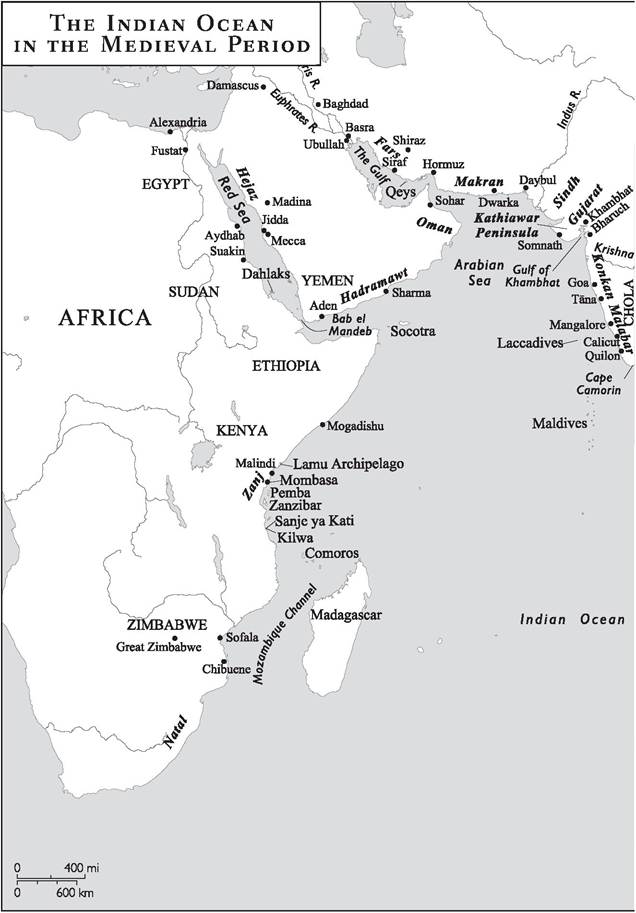
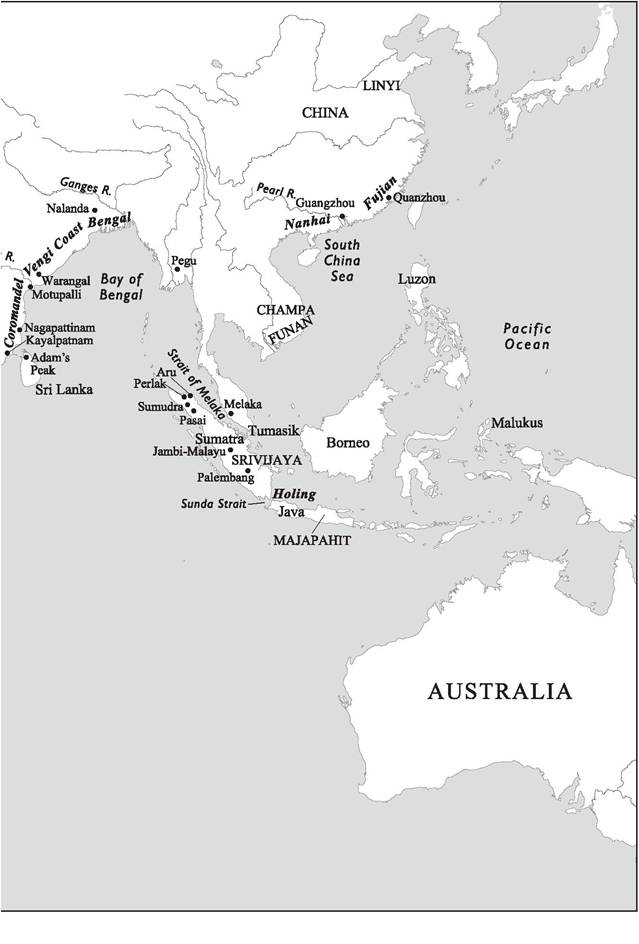
In 878, rebel forces opposed to the imperial Chinese regime massacred the Arab and Persian merchants who had come by then to dominate China’s overseas trade at the inland Pearl River port of Guangzhou.
According to the account written in 920 by Abu Zaid Hasan, from the Persian port of Siraf:They [the rebels] raised their hands to oppress the foreign merchants who had come to their country; and to these events was joined the rise of oppression and transgression in the treatment of the Arab shipmasters and captains. They imposed illegal burdens on the merchants and appropriated their wealth, and made lawful for themselves what had not been practiced formerly in any of their dealings. Wherefore God Almighty removed every blessing from them and the sea became inaccessible to them, and by the power of the blessed Creator who governs the world disaster reached [even] the captains and pilots in Siraf and ‘Uman.1
While Abu Zaid’s account records the closure to a major period of extensive direct seaborne trade from the Gulf to China, this singular moment of violence captures the extraordinary growth of Indian Ocean commerce over a few short centuries following the parallel rise of Islam in Arabia from 622 and the emergence of the Tang dynasty in China in 618.
From its beginnings as a land-based religious and social revolution in the Hejaz region of Arabia, the rapid expansion of Islam very quickly registered a major transformation across the western Indian Ocean world. Following the submission of the Arabian Peninsula during the lifetime of the Prophet Muhammad, the conquest of Egypt to the west and of Persia to the east within three decades of his death in 632 suddenly established Islam as the dominant faith of the Red Sea, the Gulf, and the Arabian Sea coasts. Under the Umayyad Caliphate by the middle of the eighth century Islam had spread east to beyond the Indus River delta, while merchants from the Islamic world of the Gulf had begun to explore Indian Ocean markets down the coasts of eastern Africa and western India.
Under the Abbasid dynasty, which ruled from Baghdad from 750 to 1258, a new era of political stability—an essential factor for commercial prosperity—dominated the western Indian Ocean world, although it was challenged on its western frontier by the Shia Fatimid Caliphate, which ruled Egypt from 909 to 1171 from Fustat or Old Cairo and pacified the Red Sea route linking the Mediterranean world to that of the Indian Ocean. At the same time the demand grew for luxury goods at the center of the caliphate, driving Muslim merchants farther out into the Indian Ocean world to secure these items through trade. Over time Arabic, the language of Islam, became the lingua franca of western Indian Ocean trade, while Islamic law provided a legal framework for regulating trade.
To the east, the rise of the Tang dynasty, whose emperors ruled China from 618 to 907, effected a similar period of political stability and economic prosperity that marked a high point for the Nanhai or South China trade. Following a period of civil war in the first half of the tenth century, imperial consolidation under the Northern Sung (960-1126) and Southern Sung (1127-1279) dynasties led to increased consumer demands for luxury goods and enlarged the zone of Chinese cultural influence in a way that paralleled the rise of Islam. Together with the expansion of Islam and the energetic, outward-looking commercial activity of both Arab and Persian merchants, the political economy of imperial China contributed to the development of a single Indian Ocean trading circuit that endured to about 1000 ce.
The early decades of the Tang dynasty featured the establishment of direct trade by Persian merchants with China. Although numbers are inexact, there was a large community of Muslim merchants at Guangzhou that may have numbered in the thousands. Like many stranger communities around the world before the modern era, they were essentially internally self-governing. They built their own mosques, had their own qadi, or Islamic jurist, and governed themselves through Islamic institutions.
Building of the Huaisheng Mosque, also known as the Lighthouse Mosque because it was used as a beacon by ships entering the port of Guangzhou, was attributed to an uncle of the Prophet Muhammad in the middle of the seventh century ce. Even if this story is more myth than history, there is no doubt that there was a flourishing Muslim community at Guangzhou and in other major South China commercial centers at a very early moment in the history of the faith.Official missions from both mainland and island Southeast Asia, as well as from India, flocked to a peaceful and prosperous South China in the middle decades of the seventh century. How did the Chinese seek to
deal with this important influx of, first, Kunlun Malay merchants and, later, Persian and Arab merchants? Sometime before 714 the central imperial government created the post of Superintendent of the Shipping Trade, which in other Chinese records of the period is referred to as Superintendent of Barbarian Shipping, a title that reveals more about imperial Chinese attitudes than it does about Southeast Asian societies. The reason to create this new imperial post was to regulate the trade with the southern oceans, known in China as the Nanhai trade. According to an official source from the beginning of the ninth century,
When [the laden Nanhai ships] arrive, a report is sent to the Court and announcements are made to the cities. The captains who commanded them [or chief merchants] are made to register with the Superintendant of the Shipping Trade their names and their cargo [or submit their manifests]. [The Superintendant] collects the duties on the goods and sees that there are no [prohibited] precious and rare goods [of which the government had a monopoly]. There were some foreign merchants who were imprisoned for trying to deceive [him].2
Occasionally, the local governor interfered with the role of the superintendent, as is recorded in this report dating to the period 817-20:
When the foreign ships arrive and are docking, they are charged a lowering-anchor-tax [tonnage dues].
[When the cargo is landed], there is an examination of the merchandise. Rhinoceros [horns] and pearls were so numerous that bribes were offered to the servants and retainers: the Governor stopped this [practice].Far across the seas in the South, there were those [merchants] who died in the countries there. The officials [the Superintendant and his subordinates?] held their goods. And if their wives or their sons did not come within three months to claim them, these would be confiscated. The governor [stopping this practice] said, “The sea journey back and forth is calculated in years; why fix the time in months. If anyone has proof [of his relationship with a dead man], no matter whether he comes early or late, let him have all [the goods].”3
These practices and thoughtful actions bear witness to the care with which the Chinese court wished to regulate and manage the vital overseas commerce that it sought to contain in its major ports.
Trade in China was not, however, without its problems. Official corruption sometimes interfered with the smooth operation of foreign merchants’ commercial transactions. In 684 the greedy governor of Guangzhou “tried to cheat them of their goods, [so] the K’un-lun [came] with daggers hidden by their bodies and killed him.”4 Following another period of good administration and prosperity, a decline in trade that caused Chinese officials to squeeze foreign merchants for excessive fees precipitated the sack of Guangzhou in 758 by both Muslim and non-Muslim merchants, who “pillaged the godowns, burnt the buildings and then escaped by sea.”5 After several decades when Persian and Arab merchants abandoned Guangzhou for other East Asian ports of trade, Guangzhou re-established itself as the center of the Nanhai trade, the beginning of the end of which dates to the cataclysmic events of 878 described above.
China was certainly the farthest destination to the east of traders from the western Indian Ocean, but the Nanhai trade itself had a long history that connected it to Southeast and South Asia.
During the first century of the Tang dynasty the most important state trading partner with China was known as Linyi, an area inhabited by the Cham people of coastal Vietnam who spoke an Austronesian language and had adopted Hinduism. In the fifth century, when Funan was the dominant trading state of peninsular Southeast Asia, the coastal sojourners of this region had been regarded by the Chinese as notorious pirates. Linyi was a source for a variety of indigenous primary products like ivory, rhinoceros horn, fragrant gaharuwood, tortoise-shell, and amber, as well as articles worked in gold and silver. After the middle of the eighth century, however, this trade appears to have diminished, probably because Persian and Arab merchants preferred to sail directly to ports like Guangzhou rather than lay over in the competing ports of trade of Champa, as Linyi was now called. Elsewhere in the region China traded with ports located on the Malay Peninsula, Sumatra, Bali, and Java. Following the sack of Guangzhou in 758 it appears that many Persian and Arab merchants found a welcome at the important Javanese maritime state of Holing. By the mid-ninth century, however, although Holing maintained commercial ties to South China, its less favorable position on the open sea route to China and, therefore, in the wider Indian Ocean trade contributed to its being superseded by the Sumatran state of Srivijaya.Founded by local Malay chiefs in 670, Srivijaya came to dominate the Strait of Melaka shores to create an unrivaled regional maritime empire that endured for three and a half centuries until its defeat by a fleet dispatched by the southeast Indian Tamil state of Chola in 1025. Srivijaya’s main city of Palembang was located some 80 km upstream on a navigable river that featured a fine harbor. It also benefited from a rich agricultural hinterland. Its location in southeast Sumatra placed it midway between the Strait of Melaka and the Sunda Strait, the only two passageways between the South China Sea and the main body of the Indian Ocean.
Its domination of the river-mouth ports of Sumatra and the Melaka Strait was, not surprisingly, more a matter of force than of geography. By bringing the sea-sojourners of this critical Indian Ocean choke point under their control the rulers of Srivijaya built a maritime empire more powerful than any that had preceded it.As was customary in state-trading relations, Srivijaya’s rulers sent several missions to China immediately after coming to power in the seventh century. Its dominance in the Nanhai trade into the early eighth century was such that, according to the chronicle of the Tang dynasty, its rulers “sent several missions to the [Chinese] court to submit complaints about border officials seizing [their goods], and an edict was issued ordering [the officials at] Guangzhou to appease them [by making inquiries].”6 No doubt this kind of extortion by imperial Chinese officials is what fueled subsequent attacks by Kunlun merchants on Chinese port officials. As direct trade between merchants from the western Indian Ocean and China developed during this period, Palembang became the most important regional entrepot in that route and was thereby able to maintain strong commercial ties to China without dispatching further state missions.
Although Funan had pioneered the Southeast Asian integration of Indian religions and statecraft, Srivijaya was most closely associated with the regional expansion of Buddhism. Yet even it was influenced by Hinduism. This process of Indianization and, especially, the regional development of Buddhism created a system of belief and an ethical framework for the exchange of goods from the Coromandel coast of southeast India across the Bay of Bengal and up to China that paralleled the impact of the expansion of Islam in the western Indian Ocean. According to the Chinese Buddhist pilgrim I Ching writing in the last quarter of the seventh century, there were one thousand priests living around Palembang. Indeed, it became a feature of the sacred geography of Buddhism during this period that pilgrims from China would spend a year or two at Palembang to prepare themselves theologically for the final voyage on to the centers of Buddhism in India. So powerful was this international connection that the Srivijayan king named Balaputradeva sent a mission to the Pala King Devpala around 860 to request permission to endow the major Buddhist monastery at Nalanda in northeast India.
Although Srivijaya remained the dominant Southeast Asian force in Indian Ocean trade during these centuries at the end of the first millennium of the Current Era, during the tenth century traders from Java had begun to carve out an independent role in the spice trade from eastern Indonesia. At the same time the new Song rulers of China sought to promote a direct connection to Java in addition to the long-standing position of Srivijaya in the Nanhai trade. As competition in insular Southeast Asia picked up, Srivijaya attacked Java unsuccessfully in 925, while in 992 the Javanese launched an attack on Srivijaya. In 1016 Srivijaya appeared to cement its domination over Java with a devastating raid that was immediately followed up by a new mission to China in 1017. The ruler of Srivijaya now called himself “king of the ocean lands.”7 But less than a decade later a Tamil inscription records that the Chola king Rajendra, “having dispatched many ships in the midst of the rolling sea,” successfully carried out punitive attacks against fourteen Srivijayan ports, including Palembang.8 So although Srivijaya remained an important factor in Indian Ocean trade for the next two centuries, its center now shifted from Palembang to the rival Sumatran port city of Jambi-Malayu. By the late twelfth century Chinese sources ranked Srivijaya third after “the realm of Ta-shih (the Arabs)” and Java in their oceanic trade relations.9
The path followed by traders from “the realm of Ta-shih” to Song China reflected only one aspect of the Indian Ocean expansion of Muslim traders and Islam. Once the military expansion, state building, and religious consolidation that marked the century or so following the death of the Prophet was achieved, maritime trade, Arab and Persian settlement, and the gradual growth of Islam around the coast of the western Indian Ocean followed. There was also scriptural justification for such a development. According to verse 31 of the 31st or Surah Luqman of the Holy Quran, “See you not that the ships sail through the sea by Allah’s Grace? That He may show you of His Signs? Verily, in this are signs for every patient, grateful (person).”10 Although divisions within Islam had appeared by the end of the seventh century ce and despite the political rivalries that emanated from divisions between Sunni and Shia Muslims, by and large these theological differences did not play themselves out as dramatically in the world of Indian Ocean trade as they did in the geopolitical struggles of land-based Islamic states. Rather, the growing concept of the ‘umma—the community of believers—contributed to group cohesiveness at the local, regional, and transregional levels, especially where Muslims were a minority population, and in most cases did not inhibit commercial relations between members of different Muslim communities of belief. Similarly, Islamic law provided a legal framework for the business of trade within the different Muslim communities.
The seventh-century Arab invasion of Persia and political consolidation of the early caliphates not only initiated a process of conversion to Islam and Arabization, but also pushed Persian Zoroastrians, Nestorian Christians, and eventually dissident Muslims out from the Gulf into the Indian Ocean trade. Many of these adventurers established themselves in the trading emporia of western India and eastern Africa. If Indian Ocean trade was ignored in the first century of the Islamic era, the relocation of the imperial capital from Damascus to Baghdad under the Abbasids encouraged official interest in this lucrative luxury trade. Located between the Tigris and Euphrates rivers, Baghdad had easy access to the Indian Ocean through the port of Ubullah, near Basra. Under the Abbasids the major Persian ports were, from north to south, Siraf, Qeys, and Hormuz. In addition, in the Arabian ports of Aden and Jidda many inhabitants were Arabic-speaking Persians, while Persian influence was important at the Omani port of Sohar. It should be no surprise, therefore, that their religious compatriots turned up among the foreign traders in China at this time.
Situated on a narrow coastal shelf with high mountains behind it in the district named for the Sassanian king Ardasir, Siraf was unquestionably the most important of the Persian ports of trade. With deep water access, a good anchorage, and protected from the prevailing storms of the Gulf, Siraf was well located to take advantage of the ninth-century boom in Indian Ocean trade. Although its food had to be imported from the sea, its location on the direct route between the Gulf and China, plus its access by overland caravan to Shiraz, the capital of the Shia Buyid dynasty that dominated the waning Abbasid Caliphate, made it a classic nexus for the meeting of land and sea trade routes. It was also a major center for the construction of dhows, the wood for which came from eastern Africa, as did that for its houses. Indeed, an interesting aspect of western Indian Ocean material culture from this time is that the average length—no more than four meters—of East African mangrove pole rafters, called boriti in Swahili, used in house construction at Siraf and widely throughout the region, imposed common limitations on the dimensions of domestic architecture from the Swahili coast to the Gulf.
The tenth-century Arab traveler and geographer Ibn Hawqal keenly observed of Siraf that “the inhabitants devote their whole time to commerce and merchandise.”11 Siraf dispatched ships and merchants to the Red Sea, the East African coast and its offshore islands, western India, Sri Lanka, and on to China. Another indicator of its central place in Indian Ocean trade is the distribution of unglazed earthenwares manufactured at Siraf and glazed Sassanian-Islamic ceramics in archaeological sites to ports around the western Indian Ocean. Its exceptional wealth, which the great eleventh-century Arab geographer al-Maqdisi described as surpassing that of Basra, derived entirely from the Indian Ocean trade. He noted the beauty of its houses and gardens, as well as its place at the center of the Persia-China trade. “In the whole lands of Islam there were no more remarkable mansions than those of Siraf.”12
A devastating earthquake in 977 marked the end of Siraf’s heyday in dominating Indian Ocean trade. In the first centuries of the second millennium ce it was surpassed by Gulf rivals, Qeys, an island off the southwest coast of Iran; Hormuz, on the south coast of Iran; and Sohar, in Oman. Another major Indian Ocean transit entrepot that was probably founded at this time by both Arab and Persian Gulf merchants was Sharma, on the coast of Hadramawt. Linking the ports of the Arabian Sea to those of the Red Sea, especially Aden, Sharma flourished from about 980 to 1140, when it was attacked from the Red Sea. It was a strongly fortified town with some eighty large buildings that were probably commercial warehouses. The abundant ceramic finds at Sharma include imports from all over the Indian Ocean world, from as far as China and Sri Lanka, to the east, and Africa, to the west. Africa also supplied Sharma with large quantities of copal resins, which were valued for use as incense. Sharma is a prime example of how a port emerged at a particular moment in Indian Ocean history in response to changes in the commercial networks linking changes in the Gulf, Red Sea, and Swahili coast. Despite the relative decline of Siraf and Shiraz, the cultural influence of the Gulf became a permanent feature of Islamic identity on the Swahili coast and its offshore islands, where claims of Shirazi forebears as a prestigious marker of social status and political leadership have endured to the present.
The earliest evidence for the expansion of Islam to coastal East Africa dates to the eighth century, when adventurous merchants from the Gulf made their way down the coast from ports like Mogadishu to Zanzibar in search of trading partners. These intrepid adventurers carried with them both luxury trade goods from the entire Indian Ocean region and the new ideas about religion and political leadership emanating from the Gulf. Physical evidence of their presence comes from shards of Chinese and Indian pottery, and large quantities of both unglazed Siraf pottery and Sassanian-Islamic ceramic wares. These were especially prominent at Manda, in the Lamu archipelago, but were also significant at Zanzibar and Kilwa. A few fragments of Sassanian-Islamic ware have also been found as far south as coastal Madagascar and Natal.
The earliest signs of Islam on the Swahili coast appear as mosques and date to the second half of the eighth century. Early tombs were small, as befit initial immigrant communities, and some were constructed of local timber, but as these pioneering communities attracted African converts and grew, so did mosques, which were now constructed in local coral rag. Shanga, in the Lamu archipelago; Ras Mkumbuu, on Pemba island; and Unguja Ukuu, on Zanzibar, feature such early mosques dating to the mid-eighth to the early eleventh centuries. Muslim burials from the same period are found at Mtambwe Mkuu, on Pemba, and at Chibuene, on the coast of southern Mozambique. Finally, the earliest Arabic inscription on the coast can be seen in the mihrab of the mosque at Kizimkazi at the south end of Zanzibar, which records the building of the mosque in 1107 ce. Carved in an elaborate Kufic script, the inscription suggests a possible connection to Siraf, either by importation or inspiration.
The Shirazi tradition reflects more than a specific connection to either Siraf or Shiraz, but more generally points to the greater Gulf region that dominated this foundational period of Islam on the Swahili coast. Early Islamic communities were established by mainly dissident Muslims—Shias, Ibadis, Kharajites—seeking refuge in the frontier region of the African coast. The rise of Siraf and its links to the capital of the Buyid dynasty that commanded the caliphate between 945 and 1055 established Shiism as the dominant sect linking the Gulf to the Swahili coast.
The integration of foreign Muslims into coastal East African society resulted from the intermarriage of men from the Gulf with local women, preferably from locally prominent families who could facilitate trade. As Muslims, their children would have claimed the Gulf origins of their fathers; indeed, such sons may well have traveled to the Gulf with their male relatives. Yet they would also have drawn upon the familial connections of their African mothers. Neither identity was necessarily exclusive of the other; indeed, depending on the situation, it made good sense for such individuals to be able to claim both. Over time, as some of the descendants of these Indian Ocean unions gained commercial prominence or staked claim to local political leadership, their forefathers’ “Shirazi” origins became fixed into local traditions. Thus, in some places “Shirazi” nisbas or patronymics feature in genealogies from this early period, while ruling dynasties claiming Shirazi origins became prominent from the coast of southern Kenya right down to the Comoros. Such claims cannot be taken at face value, but they do reflect significant Gulf influence on the Indian Ocean side of Muslim town formation along the Swahili coast and its offshore islands. How different was this historical process from the experience of Arabo-Persian Muslim merchants in China at the same time!
The most important early towns of the Swahili coast were located to the north, as these provided the nearest landfall to ships sailing from the Gulf. There is archaeological evidence to suggest that some of these settlements, particularly Mtambwe Mkuu, may have been favored by Ibadi Muslims who had been pushed out of Oman by the Umayyads. As Shia Muslims from the Gulf became dominant in the northern towns, some Ibadis migrated south to the island of Sanje ya Kati, in the same protected bay as Kilwa Kisiwani, “Kilwa on the Island,” on the coast of southern mainland Tanzania. Not surprisingly, the two walled towns became rivals, a struggle that probably focused on control of the seaborne gold trade with Sofala, located on the southern coast of Mozambique. By the twelfth century, however, headed by a dynasty claiming Shirazi origins, Kilwa Kisiwani had emerged as the dominant city-state on the entire coast because of its control of the gold trade.
What is remarkable about this commerce is that the gold that fueled Kilwa’s economic and political dominance of the coast came from deep in the interior of south-central Africa, not from its own continental hinterland. It was mined in auriferous or gold-bearing seams on the high plateau of modern Zimbabwe and transported overland down to the central Mozambican port of Sofala. Sofala was already known as a major coastal port to Arab and Persian travelers in the early tenth century. Sometime during that century its rulers converted to Islam and probably claimed ties to the Gulf. By the mid-eleventh century control of gold production was a factor in the rise of the state whose rulers caused the construction of Great Zimbabwe. They probably also extended their domination to Sofala until the rulers of Kilwa seized control of the port in the twelfth century. Thus, the golden hinterland of Kilwa was hundreds of miles south by sea and accessible only through the port of Sofala.
When Ibn Battuta visited the Swahili coast in 1331 the ship that carried him dropped anchor at Mogadishu, Mombasa, and Kilwa. He describes Mogadishu as “an enormous town” populated by merchants who daily slaughtered hundreds of camels for food.
When a vessel reaches the port, it is met by sumbuqs, which are small boats, in each of which are a number of young men, each carrying a covered dish containing food. He presents this to one of the merchants on the ship saying “this is my guest,” and all the others do the same. Each merchant on disembarking goes only to the house of the young man who is his host, except those who have made frequent journeys to the town and know its people well; these live where they please. The host then sells his goods for him and buys for him, and if anyone buys anything from him at too low a price or sells to him in the absence of his host, the sale is regarded by them as invalid.13
Ibn Battuta’s account reflects the fact that Mogadishu was an open roadstead and that ocean-going ships had to be served by local lighters to offload and load their passengers and trade goods. The trading system he describes was a well-developed mechanism by which a strangermerchant was represented by a host, called in Somali abban. In most cases, one’s original abban would continue to serve as a merchant’s host on future trips, something that the Moroccan visitor seems not to have recognized. Such a system would also have served as a means to integrate outsiders into the local community of Mogadishu.
As he was a learned man and not a merchant, the town qadi served as host to Ibn Battuta, but not before visiting the local sultan, who spoke both “the Maqdishi language,” which by that time would have been Somali, and Arabic. At his reception Ibn Battuta was offered “a plate containing betel leaves and areca nuts,”14 the basic components of paan, a sign of South Asian hospitality that belies a clear Indian Ocean influence. Three days later he embarked for Kilwa after worshipping at the local mosque with the sultan.
Ibn Battuta spent only a single night at the island town of Mombasa, whose inhabitants he described as “pious, honourable, and upright.” At Kilwa he noted that “the majority of its inhabitants are Zanj, jet-black in colour, and with tattoo-marks on their faces.” He learned that Sofala was located a fortnight away to the south and that the source of gold was a month’s journey inland. The ruler of Kilwa during his visit, Hasan b. Sulaiman, “was noted for his gifts and generosity” in accordance with the prescriptions of the Quran.15 This ruler did not, however, claim Shirazi origins. Rather, he was the scion of a new dynasty with family origins in Yemen, the Mahdali, that had seized power at Kilwa in about 1280. As direct descendants from the Prophet Muhammad, the Mahdali enjoyed a form of religious charisma or blessedness called baraka that endowed them with a special place within Sunni Muslim society. For Ibn Battuta the Swahili coast towns he visited represented mainstream Sunni Islam. In a word, no later than the early fourteenth century the Ibadi and Shia Islam of the Gulf had been largely replaced by the Sunni Shafii rite that was espoused by the Arabian heartland and had become the majority tendency in world Islam.
If African gold and ivory, not to forget timber, were the principal attractions for Indian Ocean traders, bonded labor was another. Early in the history of the Abbasid Caliphate its rulers determined to drain the saline marshes of southern Iraq to be able to convert the land to agriculture. To do so was a prodigious task requiring large inputs of human labor. To meet these new labor requirements the Abbasid rulers caused a great increase in the slave trade from eastern Africa, including both northeast Africa and the Swahili coast. Enslaved Africans from the Sudan and Ethiopia were shipped from Red Sea ports directly to Basra or indirectly through Arabia, where they were transported overland to southern Iraq. Those from farther south were embarked from different towns on the Swahili or Zanj coast, as it was also known to the Arabs. By the middle decades of the ninth century conditions of work in the marshes were so intolerable that the enslaved workers rose up in revolt in what is known as the Zanj Revolt.
Enslaved Africans were already familiar in the Middle East and claimed an important role in the early history of Islam. One of the Prophet’s earliest companions and the first muezzin or caller to prayers of the new faith was the emancipated African Bilal b. Rabah al-Habashi, this last name indicating he was from Ethiopia. The scale of slavery was greatly increased, however, during the state-building of subsequent centuries. The Abbasid Caliphs employed thousands of domestic slaves and slave soldiers, among them so-called Zanj slaves to designate their origins from coastal eastern Africa. Before the Zanj Revolt proper, the project of resuscitating the agricultural lands of southern Iraq produced small slave uprisings in 689-90, 694, and 760. When the great revolt began a century later it created havoc for the Abbasid dynasty.
Despite its designation as the Zanj Revolt, this social movement against Abbasid exploitation involved free and enslaved Africans from both northeast and East Africa, while its leader was a free Arab whose grandmother was an Indian concubine. Embracing the radical egalitarianism of Kharijite Islam, the revolt lasted from 869 into 883, recruiting broad support from among all the lower classes in southern Iraq. Flush with a series of early successes, the movement’s leadership quickly formed an independent state that seized control of the southern reaches of the caliphate, including the key Indian Ocean port cities of Ubullah and Basra. A combination of armed force and the offer of amnesty eventually caused the collapse of the Zanj state, driving many of its fighters, both Arab and African, into exile. The Zanj Revolt convinced the Abbasid ruling classes that the concentration of bonded agricultural labor was not a good idea, so while slavery as an institution certainly continued to exist in the caliphate, the extreme demand for enslaved labor from Africa to supply it that characterized this era was not to be replicated until the late eighteenth and nineteenth centuries.
A century later, according to Buzurg b. Shahriyar, a Persian nakhuda or merchant shipowner who probably sailed out of Hormuz, the Swahili coast was attacked by a massive fleet from Madagascar. Buzurg recounted that “they came with a thousand small boats and violently attacked the town of Qanbalu,” most probably Ras Mkumbuu on Pemba, both to obtain trade goods “useful in their country and for China... and because they wanted to obtain Zanj, for they were strong and easily endured slavery.” The history of the Zanj Revolt suggests otherwise, but this account stands as evidence that the Malagasy may have continued to augment their diverse population by periodic slave raids on the coast. In the same passage, Buzurg adds, “They said their voyage lasted a year. They had pillaged some islands six days away, and then several villages and towns belonging to Sofala in the land of the Zanj.”16 Although Buzurg is not always the most reliable author, his testimony anticipates equally massive and devastating maritime slave raids launched by Malagasy in outrigger canoes on the Comoros and Swahili coast in the late eighteenth and early nineteenth centuries.
If the Gulf dominated the commercial history of the western Indian Ocean during these centuries, the Red Sea also experienced a revival of its fortunes after the rise of Islam. The critical factor in this process was the coming to power of the Fatimids, a Shia Ismaili dynasty based at Fustat, or Old Cairo, who ruled Egypt from 969 to 1171. Conflict with Christian powers in the Mediterranean turned the Fatimids toward the Indian Ocean and emphasized the importance of Aden as the critical entrepot between the Indian Ocean and the Red Sea. Protected from the Arabian hinterland by a precipitous caldera of volcanic mountains, Aden was an isolated peninsula close to the strategic choke point of the Bab el Mandeb that enjoyed an excellent anchorage. As many as fifteen ships could anchor in its harbor where lighters would ferry goods to and from the city’s customs house. Contemporary Jewish correspondence relating to the India trade retrieved from the medieval Cairo Geniza, a repository for any paper with the name of God on it, states that Aden played host to “ships from every sea,” including “ships from India and its environs, ships from the land of Zanj and environs, ships from Berbera and Habash and environs, ships from al-Ashar and al-Qamr and environs,”17 that is, the coasts of northeast Africa and southern Arabia where the port of Sharma was located. At Aden one could see different types of ships from the Indian Ocean world, as well as Arab, Persian, Jewish, Indian, and Ethiopian nakhudas. The town itself combined stone buildings for the elites, fortifications to protect it from seaside or mainland attack, and more humble and numerous palm-frond huts.
At Aden, business interests trumped any and all potential communal divisions. While ethnic and religious communities managed their own affairs internally, when matters crossed these boundaries the city authorities adjudicated a solution. Although there was undoubtedly competition for business, and while commercial affairs were largely constructed within bounded communities, some cross-cultural partnerships also formed. A notable case involved the Jewish nakhuda Mahruz and his Indian counterpart Tinbu. In a letter to his brother-in-law, whose ship was attacked by pirates along the Konkan coast of western India so that he was forced to take refuge in the Gujarati port of Bharuch, Mahruz urged his relative to contact Tinbu if he needed money for the trip back to Aden. “If my lord, you need any gold, please take it on my account from the n akhoda Tinb u, for he is staying in T ana [on the Konkan coast], and between him and me there are strong bonds of inseparable friendship and brotherhood.”18
Not surprisingly, Aden’s success attracted the cupidity of its Indian Ocean rivals. In 1134-35 a naval force from Qeys laid siege to Aden that took many months to break and disperse. Ships plying the Red Sea also had to deal with rivals based at the Dahlak Islands, off the coast of Eritrea. Whether they were subject to high—possibly extortionate— tariffs levied by the local rulers of the Dahlaks or whether they claimed to be threatened by pirates from the Dahlaks, it appears that the western side of the lower Red Sea was a difficult place for merchants traveling between Egypt and India. A different consequence of the increased significance of the Red Sea trade and the decline of the Gulf was that the seaborne route to India came to emphasize the ports of the Konkan and Malabar coastline of southwestern India to the disadvantage of those of Gujarat and Sindh.
In 1173 the Ayyubids seized Aden and were eager to maintain it as the emporium for collecting revenue from the India trade. Although Aden continued to flourish under the Ayyubids, within half a century they were replaced by the Rasulid dynasty of Yemen, which ruled over all of south Arabia from 1229 to 1454. By incorporating Aden into a unified southern Yemeni state the Rasulids actually enhanced the commercial position of Aden, which now also served as an outlet for the trade in Arabian horses, which were highly sought after by the rulers of the major states of southern India. Aden alone produced one-third of the state revenue for the Rasulids by enabling them to control the India-Egypt trade. The Rasulid navy escorted as many as one hundred ships plying the Red Sea route linking Cairo to Aden, while all vessels sailing from India to the Red Sea were required to pass through the customs house at Aden.
In 1420 or 1421, however, an especially greedy Rasulid sultan extorted all the silk and spices brought to Aden from India. Facing financial ruin, the nakhudas sought to break this monopoly. In the following two years a Muslim Indian merchant shipowner named Ibrahim from Calicut, the most important transit entrepot on the Malabar coast, tried unsuccessfully to circumvent Aden, once by sailing directly to Jidda, the main port of the Hejaz, then by heading to the Dahlak Islands. At last, in 1424 Ibrahim was able to bring three ships to Jidda, where a special envoy sent there by the Mamluk sultan of Egypt, Barsbay, enabled him to disembark and sell his goods in security. The next year fourteen Indian vessels followed suit and in 1426 the number rose to forty. In the blink of an eye the seasonal port of Jidda, which had previously only come to life during the annual pilgrimage to Mecca and Medina, had replaced Aden as the main port for the India trade. This radical shift reflected the combined power wielded by the merchant shipowners who financed this Indian Ocean trade.
If by the fourteenth century Islam had become the dominant faith around the western coast of the Indian Ocean, its proselytizing success was both slower and less complete in South and Southeast Asia. Although Islam had reached Sindh in the second decade of the eighth century ce, it remained an isolated outlier until the Turkic conquest of northern India began at the end of the tenth century. Under the Hindu dynasty of the Caulukyas (941-1297), Gujarat remained outside the Muslim sphere. Although their center of power was in northern Gujarat, the Caulukyas promoted Indian Ocean trade though ports it controlled on the Gulf of Khambhat. Chief among these was Khambhat itself, the successor to Barygaza/Bharuch on the same bay.
Khambhat faced the same geographical challenges as faced Barygaza, namely dangerous fast tides, inaccessibility by sea at low tides, sand bars, and silting up. Its great advantage commercially was its immediate access to the major centers of Indian textile manufacture for the Indian Ocean trade. Under the Caulukyas it became the principal intermediary port of trade for the Aden-Melaka exchange. Its imports included precious and base metals, silk, gems, ivory, spices, wine, frankincense, and horses; its exports included textiles, dyes such as indigo, spices, aromatics, precious and semi-precious stones, and slaves. Much of this commerce was transit trade, with the same goods entering and leaving port without being distributed inland. Over time, bulk goods became more important, as did money.
The most prominent merchants of Gujarat were Jains, members of a universal faith with syncretic elements incorporated from Hinduism and Buddhism. Jains also occupied key administrative positions within the Caulukya kingdom. Jains dominated banking, credit, and continental trade, but they limited their maritime energies to coasting trade, leaving the Indian Ocean-side trade to Muslims, for whom they served as major financiers.
Muslim Arab and Persian trading settlements dotted coastal western India as far back as the eighth century. The Caulukya king Siddharaja (1094-1143) favored the Muslim traders, who gradually converted some Indians and settled in hinterland towns, including the capital city. In frequent acts of economic self-interest, Caulukya rulers often endowed mosques, as did the prominent Jain merchant-administrator at Khambhat, Vastupal (1169-1240), who was also known for his success in curbing piracy and providing security to merchants who frequented the town. Whatever their internal doctrinal differences, these Muslim trading groups generally expressed group solidarity with respect to the nonMuslim societies in which they operated. Mosque inscriptions and Muslim graves from the thirteenth century indicate that most Muslim traders were also shipowners.
Gujarat was conquered by the Muslim Delhi sultanate in 1303 and became an independent sultanate after the sack of Delhi in 1398, thereby becoming a Sunni Muslim polity. Khambhat retained its centrality as the principal Indian Ocean port of northwest India for the next two centuries, as visitors from Marco Polo to Ibn Battuta to the fifteenthcentury Venetian merchant Nicolo de Conti testify. By this time, however, several ports of the Malabar coast, notably Mangalore, Calicut, Cranagore, Cochin or Kochi, and Quilon or Kollam had emerged as rivals to Khambhat as entrepots for the trade between eastern and western Indian Oceans.
The entire coast of western India had long experienced vibrant coasting trade, particularly linking the excellent small ports of the more northerly Konkan coast. According to court poetry and inscriptions from the tenth and eleventh centuries, there was also an important maritime pilgrim’s route linking various Konkan ports to Somnath, on the south Gujarat coast, where there is a temple dedicated to the God Siva. Somnath was also a renowned port. Writing in 1030, the distinguished Persian scholar al-Biruni explained, “The reason why in particular Somnath has become so famous is that it was a harbour of sea-faring people, and a station for those who went to and fro between Sufala in Zanz and China.”19 An exceptional bilingual inscription in Sanskrit and Arabic dated to 1287 records the construction of a mosque at Somnath by a nakhuda from Hormuz named Nuruddin Firuz, who is praised in the Arabic version as “the great and respected chief, prince among seamen, king of kings of merchants.”20 No less remarkable, to acquire the land on which to build the mosque Nuruddin relied upon the support of local prominent Hindu religious leaders. The entire process was then approved by the town council and ruling authorities up to the Hindu ruler of Gujarat. A different example of mosque construction in Hindu India comes from an inscription recounting the shipwreck near Goa of a Kadamba royal pilgrim who was rescued by a Muslim Arab merchant shipowner named Ali. In gratitude Ali’s grandson was appointed administrator of the Goa region by Kadamba king Jayakesi. The grandson built a mosque at Goa that was to be maintained by tolls levied at that Konkani port. Distress at sea clearly also featured in the account of the Jewish merchant Mahruz reaching out to the Hindu nakhuda Tinbu.
Isolated Persian and Arab traders had certainly visited the coast of southwestern India and Sri Lanka from the early decades of the rise of Islam. As the Gulf lost its dominance of Indian Ocean trade to the Red Sea, however, Arab merchants from Arabia obtained an increasing foothold in Malabari ports. In particular, immigration from Hadramawt beginning in the thirteenth century gave a particular character to this process of settlement. In addition to the Hadrami role as traders, these intrepid maritime merchants also carried their faith, the same Sunni Shafii Islam that increasingly provided a religious nexus and legal framework for trade around the entire western Indian Ocean coast. From their port bases in peninsular India they soon moved out to proselytize the two extensive archipelagos of small islands to the southwest of India, the Laccadives and the Maldives.
Muslim traders on the Malabar coast were distinguished as either “Pardeshis,” meaning “foreigners,” or “Mappilas,” the social product of Arabs who had married into and converted lower-caste Hindu Mala- baris, mainly from groups associated with the sea. The Mappilas wore local dress, spoke the local language of Malayalam, and sometimes adopted a dual descent system to reflect the patrilineality of their Arab forebears and the matrilineal system of their mothers’ kin. In many respects the integration of these Muslim Arab outsiders into South Asian society mirrors that of foreign Muslims in the towns of the Swahili coast, the main difference being that the Mappilas remained a religious minority community whereas Islam became the dominant faith and a defining part of being Swahili.
Like Muslim merchants in Hindu Gujarat, those of the Malabar coast experienced close economic and political relations with their Hindu hosts. At Calicut, Muslim merchants enjoyed the patronage of a king called the Zamorin by foreign writers, but whose indigenous title was Samudri Raja, or “Ocean King.” Muslims held office as harbor masters and, as elsewhere in the Indian Ocean world, managed their own community affairs internally through their own royally appointed “chiefs.” Yet, both because of their insistence on maintaining their distinctive foreign origins as a hallmark of their identity, even distinguishing themselves from other Indian Muslims, and as a consequence of the increasingly strict caste segregation of Brahmanic Hinduism, there was a very real level of tension and conflict between Muslims and Hindus in Calicut and the other ports of southern India. Similarly, a literary biography of the rich Gujarati Hindu merchant Jagadu memorializes his rivalry over possession of a precious stone with a Muslim merchant from Hormuz who is described as an impure outsider. So while the mutual interests of business ruled to mediate relations between Hindu rulers and Muslim merchants in both Gujarat and the coastal ports of western India, as well as between different communities of nakhudas, there were also unsurprising elements of communal competition in the medieval Indian Ocean world.
Of all the Malabar coast ports Calicut was by all measures dominant. In the thirteenth century it surpassed Khambhat as the most important port of trade linking Egypt to the East. Writing in the following century, Ibn Battuta commented that it possessed “one of the largest harbours in the world. It is visited by men from China, Sumatra, Ceylon, the Maldives, Yemen and Fars, and in it gather merchants from all quarters.”21 During his three-month visit to Calicut he counted thirteen Chinese vessels waiting for the Southwest Monsoon winds to carry them back to China. Upon their departure one of the Chinese ships was wrecked in a storm and driven ashore. This unfortunate event revealed to Ibn Battuta one reason why Calicut had become a favored port for Indian Ocean merchants. Shipwrecks everywhere attracted scavengers, but at Calicut he witnessed the Zamorin’s “police officers were beating the people to prevent them from plundering what the sea cast up.” Ibn Battuta goes on to explain: “In all the lands of Mulaybar, except in this one land alone, it is the custom that whenever a ship is wrecked all that is taken from it belongs to the treasury. At Calicut however it is retained by its owners and for that reason Calicut has become a flourishing city and attracts large numbers of merchants.”22
Enforcing this policy regarding scavenging was not, however, unique to Calicut. A century earlier on the eastern side of the Indian Peninsula the Kakatiya ruler of Warangal, Ganapati, proclaimed a charter of security for the port of Motupalli on the Vengi coast of Andhra Pradesh at the Krishna River delta.
By the glorious Maharaja Ganapatideva the following edict (assuring) safety has been granted to traders by sea, starting for and arriving from all continents, islands, foreign countries and cities.... Formerly kings used to take away by force the whole cargo, viz., gold, elephants, horses, gems, etc., carried by ships and vessels which after they had started from one country or other, were attacked by storms, wrecked and thrown on the shore.23
Like the protection afforded to foreign merchants in all the major trading ports of the Indian Ocean world, the prospect of security was essential to conducting business that would profit all participants.
As early as the eighth century Arab merchants also pushed beyond Cape Comorin to Sri Lanka and the Coromandel coast of southeastern India. Small port towns offered respite to merchant vessels from Southeast Asia and China on the route to Quilon and more northerly ports of Malabar. Sri Lanka was also an important pilgrimage site for Muslims because of Adam’s Peak, the spot where Adam is alleged to have remained for two centuries after his banishment from the Garden of Eden. Contemporary to the great period of Chola state expansion, Muslim presence on the Coromandel coast increased notably in the eleventh century. Chola kings encouraged Tamil merchant guilds like the Manigramam and Ayyavole to expand their business to the east and created conditions for a port like Nagapattinam to develop as a major player in the trade of the eastern Indian Ocean. Srivijayan, Muslim, Jewish, and Chinese maritime merchants all gained a footing at Nagapattinam. In this latter respect the Chola acted in much the same way as the Zamorin of Calicut and the Caulukya ruler of Gujarat.
As along the Malabar coast, on the Coromandel coast Arabs continued to emphasize their Arabness and followed the Shafii school of law. Although they came to speak Tamil, they were known locally as Ilappai or Labbai, itself perhaps a rendering of arabl, and maintained their distinction from those Hanafi Muslims who adhered to a different legal tradition and who were from northern India and settled in Tamil Nadu. Notably mobile, the Labbai became known as dealers in pearls, which were obtained off Sri Lanka, and expanded their activities to Southeast Asia. Consequently, Muslim traders from ports like Kayalpat- nam, on the far southeastern coast, preferred to marry women from similar communities in Sri Lanka and Indonesia, rather than from Tamil society. Their expansion was marked by the erection of mosques and
Islamic schools, as well as the development of a Tamil-Arabic dialect for worship and even scholarship, such that “Labbai” became a generic name for Muslim jewelers and merchants in the larger Malay world. Compared to Arab Muslims on India’s western coast, then, those who established communities east of the subcontinent’s tip chose to distinguish themselves as outsiders in Hindu lands.
The Indian Ocean world of Southeast Asia remained the religious domain of Hinduism and Buddhism until the arrival of Islam. While scattered pockets of Muslim merchants had previously operated in insular Southeast Asia, Islam began to take root only in the thirteenth century, by which time Srivijaya’s regional domination of international commerce was in decline. The first small states to convert to Islam were the ports of Perlak and Aru, on the northeast coast of Sumatra, but the dominant Islamic polity to emerge in this strategically placed region for Indian Ocean trade was nearby Pasai. Like Srivijaya before it, Pasai joined downriver and upriver communities, commanding both the Melaka Strait from the port of Pasai and the pepper production of the rich agricultural lands of the interior. According to its royal chronicle, the Hikayat Raja-Raja Pasai, the first ruler to convert to Islam received the faith directly from Mecca and, in a dream, from the Prophet.
Once upon a time, in the days when the Prophet Muhammad the Apostle... was still alive, he said to the elect of Mecca, “In time to come, when I have passed away, there will rise on the east a city called Semudera. When you hear tell of this city make ready a ship to take to it all the regalia and panoply of royalty. Guide its people into the religion of Islam. Let them recite the words of the profession of faith. For in that city shall God... raise up saints in great number.”24
Although this foundational legend cannot be taken literally, it does indicate that Islam was introduced from Arabia. In addition, among Arabian merchants plying the Indian Ocean trading networks, the adherence to Sufism, a practice that emphasizes the personal and mystical dimensions of belief, proved important in conversion to Islam in Indonesia, enabling the incorporation of previous religious traditions into popular Islamic practice. Above all, what Islam offered was a new source of ritual prestige by which the rulers of Pasai could distinguish their regime from that of their Indonesian rivals.
A vivid indicator of the regional and Indian Ocean linkages forged by Islamic Pasai is a story about the fourteenth-century son of Sultan Ahmed II. “If he dressed in a Javanese costume he looked like a man of Java. If he dressed in [Thai] costume he looked like a man of the [Thai] state. If he wore the costume of India he looked like a man of India. If he wore the costume of Arabia, like an Arab.”25
In many respects, Pasai regarded the Javanese Buddhist kingdom of Majapahit as a model. The rise of Majapahit in 1293 marked a decided shift eastward of Southeast Asian maritime trade. It was built on control and expansion of the spice trade of the Maluku Islands, which it managed to maintain to about 1500 despite internal rivalries and the gradual Islamization of Java’s northern coast in the fifteenth century.
The major regional development in the fifteenth century with respect to Indian Ocean commerce was the rise of Melaka, located on the western coast of the Malayan Peninsula. Melaka was founded by a dissident Malay prince named Paramesvara who was a vassal of Majapahit at Palem- bang and sought greater independence by moving with his followers to Tumasik (modern Singapore) in about 1390. Siamese pressure forced Paramesvara west to Melaka, where he organized the local Malays and forged an important alliance with imperial China. He sent envoys to China to seek its protection and visited China himself in 1411. The Chinese Muslim eunuch admiral Zheng He visited Melaka on several occasions between 1409 and the early 1430s; but when the Ming dynasty turned inward, the ruler of Melaka converted to Islam to encourage the Muslim merchants who controlled the western Indian Ocean trade to make Melaka their headquarters. Commercially motivated diplomacy was also reflected in marriages to a Tamil princess by the third ruler of Melaka and by the fifth ruler to the royal house of Majapahit. At the height of its power Melaka controlled the entire Malay Peninsula and the opposing coast of Sumatra.
Melaka became the dominant and wealthiest international entrepot for goods in and through Southeast Asia, establishing especially close ties with Gujarati and Tamil merchants. While the Gujaratis at Melaka actually included Muslim merchants from Sri Lanka and all of western India, the Tamils were dominated by Hindu Keling traders. Muslim traders from Java who controlled the spice trade of the Malukus were another prominent community of foreigners at Melaka. All foreign traders at Melaka occupied assigned neighborhoods and each such community had its own “chief of port.” The largest group of foreign merchants at Melaka were actually Chinese, a cluster that included traders from mainland Southeast Asia, among them many Muslims. Smaller foreign communities, many of whom provided artisanal and other services, included Bengalis, Peguans from Myanmar, and smaller groups of Armenians, Nestorian Christians, Jews, Yemenis, Persians, and even a mixed Muslim Filipino-Chinese community from Luzon that lived outside of Melaka. In short, Melaka was an unusually cosmopolitan international trading port, even by historic Indian Ocean standards.
Perhaps the most remarkable single phenomenon of the fifteenth century was the short period of Ming voyages into the Indian Ocean. Direct Chinese trade out into the Indian Ocean dated only to the tenth century when the Sung dynasty moved to rationalize trade by creating a partial monopoly, thereby limiting the role of foreign merchants and hoping to avoid the problems that afflicted Guangzhou in the previous century. As more ports emerged on the South China coast to take up the slack, Chinese knowledge of Indian Ocean trade increased significantly. The writings of Chou Ku-fei (1178) identify southern Arabia, the Gulf, and Southeast Asia as the main centers of desirable goods. Fifty years later, an unidentified author named Chau Ja-kua, who was called Superintendent of Maritime Trade in Fujian Province, composed the Chu-fan chi (1225), which is comparable to the Periplus as a guide to Indian Ocean trade. The Chu-fan chi provides a comprehensive account of peoples and goods traded, as well as the role of the monsoons in governing the rhythm of trade.
The rise of the Yuan (Mongol) dynasty (1271-1368) strengthened Chinese Indian Ocean trading connections. Marco Polo gives the following rich description of Quanzhou, in Fujian Province, which he calls “the splendid city of Zaiton, at which is the port for all the ships that arrive from India laden with costly wares and precious stones of great price and pearls of fine quality,” in the late thirteenth century:
It is also the port for the merchandise of Manzi, that is, of all the surrounding territory, so that the total amount of traffic in gems and other merchandise entering and leaving this port is a marvel to behold. From this city and its port goods are exported to the whole province of Manzi. And I assure you that for one spice ship that goes to Alexandria or elsewhere to pick up pepper for export to Christendom, Zaiton is visited by a hundred. For you must know that it is one of the two ports in the world with the biggest flow of merchandise.26
Polo’s impression is verified by Ibn Battuta more than a half-century later, although there are many scholars who doubt whether the intrepid North African traveler actually visited the Chinese port. Nevertheless, he writes that “the port of Zaytun is one of the largest in the world, or perhaps the very largest. I saw in it about a hundred large junks; as for small junks, they could not be counted for the multitude.”27
So when the Ming dynasty came to power in China in 1368, it is not surprising that they had imperial maritime ambitions. Official expeditions were led by Admiral Zheng He, who commanded seven voyages between 1405 and 1433. According to contemporary Chinese accounts, the purpose of these expeditions was both diplomatic and commercial. The fleets included the largest junks ever seen on the Indian Ocean, many of which had as many as nine masts and crews of five hundred men. These were referred to as bao chuan, or treasure ships, and are reported to have dwarfed all other vessels and some carried up to one thousand crew and passengers. These were genuine fleets, not simply convoys of merchant ships traveling together for safety, with hundreds of ships in three size categories and thousands of men. They were unprecedented in the history of the Indian Ocean.
The first three voyages visited ports in Southeast Asia and India, including Melaka and Calicut. The fourth voyage was the most ambitious, involving some 30,000 men, and sailing to Arabia via Hormuz. Nineteen different “countries” sent ambassadors back to China with gifts for the Ming emperor to promote trade. One of the most remarkable gifts was a giraffe that had been a gift from the ruler of Malindi, on the Kenya coast, to the king of Bengal and was carried to China for the emperor in 1414. In China the giraffe was regarded as an auspicious mythical beast known as a qilin.
A poem written to accompany a painting of the giraffe when it was presented at court on September 20 reads as follows:
In a corner of the western seas, in the stagnant waters of a great morass,
Truly was produced a qilin, whose shape was as high as fifteen feet,
With the body of a deer and the tail of an ox, and a fleshy, boneless horn,
With luminous spots like a red cloud or purple mist.
Its hoofs do not tread on [living] beings and in its wanderings it carefully selects its ground,
It walks in stately fashion and in its every motion it observes a rhythm,
Its harmonious voice sounds like a bell or a musical tube.
Gentle is this animal, that in all antiquity has been seen but once, The manifestation of its divine spirit rises up to heaven’s abode.28
In the voyages of 1417 and 1421 Ming voyages visited the East African cities of Mogadishu, Malindi, whose ruler offered another giraffe to China, Mombasa, and Zanzibar. Finally, embarking on what proved to be the last Ming voyage in 1431, Zheng He’s fleet revisited the major ports of Southeast Asia, Persia, the Red Sea, and Africa, but after departing Calicut Zheng He died on the return voyage. When the fleet reached
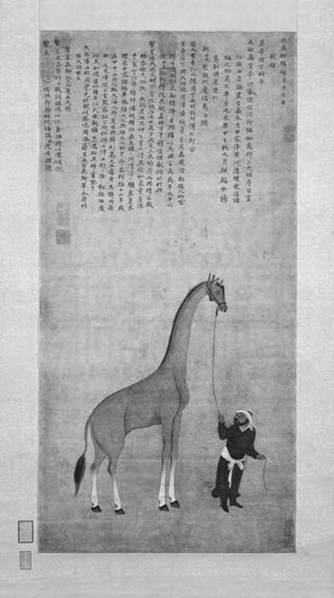
This giraffe, a present from the king of Malindi to the Chinese emperor in the fifteenth century, is led by a man in Arab-influenced clothing. Mistaken by the Chinese as a kind of mythical sacred animal called a qilin, i ts appearance at court inspired this painting and accompanying poem. National Palace Museum, Taiwan, Republic of China
China in 1433 it proved to be the last of its kind, as the Ming rulers turned increasingly inward and abandoned their outward-looking maritime diplomacy.
What did these extraordinary fleets represent? In the stone tablets that he had erected to commemorate his first six voyages, Zheng He declared that the treasure fleets had succeeded “in unifying seas and continents” and proclaimed that “the countries beyond the horizon from the ends of the earth have all become subjects... bearing precious objects and presents” to Ming China.29 Somewhat different was the trilingual stone tablet placed at Galle, Sri Lanka, in 1411. Inscribed in Chinese, Tamil, and Persian, it called for peaceful trade and praised the Buddha, the Tamil God Tenevarai Nyanaar, and Allah. Nevertheless, the political reality was that imperial China sought and effected a tributary sovereignty over Sri Lanka for several decades. While the Chinese treasure fleets cannot be seen as the equivalent of the violent Portuguese intrusion into the Indian Ocean world at the end of the fifteenth century, less than seven decades after the voyage of the last Ming fleet, they were clearly motivated by political and economic ends. Moreover, the size of the fleets implied a level of force that no other Indian Ocean presence possessed.
It remains to say something about the persistence of piracy during the period during which the Indian Ocean was becoming a Muslim sea. Moving across the entire region from west to east, the first Muslim Arab occupation of the Dahlak Islands in 702 was precipitated by pirates who were based there. During the heyday of the Fatimid Caliphate its rulers kept a fleet of several ships to protect merchant ships as they traveled to the major Fatimid ports of Aydhab and Suakin on the western side of the Red Sea from local pirates, especially those based around the Dahlak Islands. According to Arab geographers, the island of Socotra had been known to be “a pirates’ nest” as early as the tenth century, while the Central Asian traveler Ibn al-Mujawir, who visited the island in the course of his travels in Arabia, wrote that “the life-style of the people of these coastal areas is [tied up] with pirates, since the latter come and stay with them for six months [at a time], selling them their loot.”30 Half a century later, Marco Polo confirms that at Socotra, “many corsairs put in at this island at the end of a cruise and pitch camp here and sell their booty.”31
Along the Makran coast pirates known in Arabic sources as Bawarji were considered a menace to shipping in the Arabian Sea and the Gulf. In the tenth century, al-Masudi commented that the Bawarji threatened the India trade, while in the same century Buzurg describes a three-day sea battle against a massed fleet of these pirates. Centered on the ports of Daybul and Dwarka on the Kathiawar Peninsula of Gujarat, these pirates remained a thorn in the side of shipping right through the fifteenth century. Descriptions of these maritime raiders all come from writers located at the center of powerful regional Muslim states; whether those who carried out such acts regarded themselves as pirates remains an unanswered question.
One way to answer this question is to look at the question of piracy along the Malabar coast, an area identified by both Polo and Ibn Battuta as a favorite pirate haunt. On one occasion along this coast Ibn Battuta was traveling in an unprotected vessel that was attacked by pirates. No wonder, then, that he was convinced that the best guarantee of safety on the Indian Ocean was an armed escort, specifically a kind of broad galley that had “sixty oars and is covered with a roof during battle in order to protect the rowers from arrows and stones.” He visited this vessel and writes that it also “had a complement of fifty rowers and fifty Abyssinian men-at-arms. These latter are the guarantors of safety on the Indian Ocean; let there be but one of them on a ship and it will be avoided by the Indian pirates and idolaters.”32 According to the great pilot Ibn Majid, the actual pirates along this coast “are a people ruled by their own rulers and number about a [ sic] 1000 men and are a people of both land and sea with small boats (canoes).”33 Other sources suggest that these maritime raiders belonged to a Hindu caste of sea fishermen who conducted their piracy on a seasonal basis as an established aspect of their economy. Thus, within their own communities these men were an integral part of society. In view of the domination of Malabar trade by merchants associated with politically powerful ports of trade, their commitment to inserting themselves into this lucrative commerce by force—that is, by piracy—comes as no surprise.
When he described the South China Sea trade route in about 800, geographer Chia Tan reported an area that lay “three days sailing westwards out of the Straits [of Melaka] to Ko-Ko-seng-ti Kuo, many of whose people were devoted to robbery and plunder, and were much feared by those who travel in ships.”34 Not surprisingly, royal protection of the sea lanes was an important policy and practice for the rulers of Srivijaya and those of east Java in the eleventh and twelfth centuries. Nevertheless, when Ibn Battuta reached maritime Southeast Asia in the middle of the fourteenth century he reports of the port of Qaqula, which is possibly located on the western coast of the Malayan Peninsula, that “we found there a number of junks ready for making piratical raids, and also for dealing with any junks that might attempt to resist their exactions, for they impose a tribute on each junk [calling at that place].”35 A fourteenth-century Chinese source provides the following vivid description of the threat of endemic piracy near Singapore, at the other end of the Melaka Strait, where “the inhabitants are addicted to piracy... when junks sail to the Western [Indian] Ocean the local barbarians allow them to pass unmolested but when on their return the junks reach Chi-li-men the sailors prepare their armour and padded screens as a protection against arrows for, of a certainty, some two or three hundred pirate praus will put out to attack them for several days.”36 Indeed, by the fifteenth century Palembang, formerly the main port for Srivijaya, had become a major center for piracy.
On the return leg of his first voyage in 1407 Zheng He confronted the major pirate fleet of Chen Zuyi based at Palembang. According to contemporary Chinese sources, although Chen Zuyi sent tribute to the Chinese emperor, he continued his disruptive acts of piracy. The full description of this engagement is recorded in the Taizong Shilu in these terms:
Grand Director Zheng He, who had gone as envoy to the countries of the Western Ocean, returned holding in fetters the pirate Chen Zuyi and others. Originally Zheng He had arrived at the Old Harbor [of Palembang] and had encountered Chen Zuyi and the others, to whom he sent a messenger summoning them to submit. Chen Zuyi came down and pretended to submit, but kept his plans secret and actually intended to escape from the imperial fleet. Zheng He and his associates realized this and deployed their forces, preparing to stop him. Chen Zuyi, leading his forces, came out to plunder, and Zheng He sent forth his troops and did battle with him. Chen Zuyi was heavily defeated. Over five thousand of the pirate gang were killed, ten pirate ships were destroyed by burning and seven ships were captured, along with two forged seals made of copper. Chen Zuyi and two others were taken prisoner and delivered to the imperial capital, where all were ordered to be beheaded.37
Not only does this vivid account make clear the imperial motivations of the Ming treasure fleets, but it also bears witness to the military force assembled as part of state-directed Chinese maritime enterprise at this time. It equally stands as further evidence to the perils of Indian Ocean trade and the dynamic relationship between security and violence on both high seas and in ports. In a word, between piracy and shipwrecks, Indian Ocean maritime trade could be hazardous. Ibn al-Mujawir wrote poignantly in the thirteenth century about the sense of great relief that an Indian Ocean merchant must have felt upon entering the secure port of Aden. “A man’s return from the sea is like his rise from the grave, and the port is like the place of congregation on the Day of Judgment: there is questioning, and settlement of accounts, and weighing, and count- ing.”38 For many, the sense of calm captured by Ibn al-Mujawir was about to be shattered by the arrival of the Portuguese in the Indian Ocean world.