The Last Century
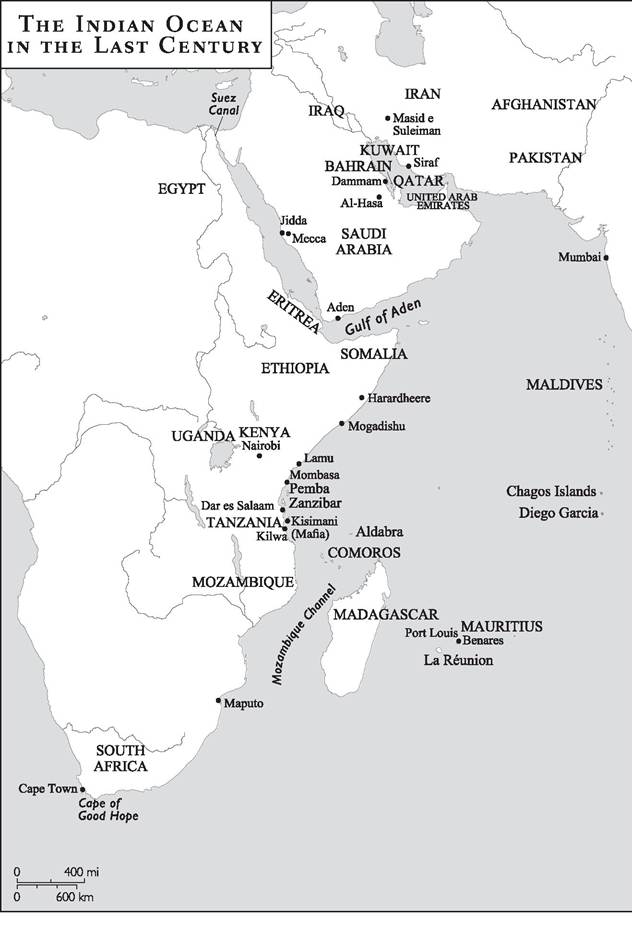
Oil was first discovered in commercial quantities at Well Number One at Masjid e Suleiman in Khuzistan, Persia, in 1908. It was then found at Kirkuk in northern Iraq in 1927, setting off a search for oil reserves elsewhere around the Gulf.
On the Arabian side of the Gulf the first oil began to flow at Jebel Dukham in Bahrain in 1932, followed by Dammam on the Gulf coast of Saudi Arabia and the Burgan field at Kuwait in 1938. Although there was no causal relationship between them, the discovery of oil in the Gulf was coterminous with the collapse there of the pearl fishing industry, which was caused by the commercial production of cultured pearls in Japan by Mikimoto Kokichi. Economic recovery would take years to effect, but oil eventually made it possible for the sheikhdoms to survive and today thrive economically. Oil also dramatically changed the distribution of wealth and affected patterns of labor migration after World War II.From the beginning, exploration and production of oil were dominated by British and American firms, the appearance of the latter signaling both the increased American presence in global politics after World War II and experience gained in the exploitation of oil in North America. Describing the arrival of the negotiating team for Standard Oil at Jidda in 1933, the distinguished American man of letters Wallace Stegner commented, “They were, without knowing it, [a] social and economic revolution arriving innocently and by invitation, but with implications more potent than if their suitcases had been loaded with bombs.”1 Later in his account of the discovery of oil in eastern Saudi Arabia he wrote of the pioneering days around al-Hasa of the mid- 1930s, “the coastal region was a frontier that changed with a magical swiftness once the Americans began to impose upon it the full range of their control over physical nature.”2 Indeed, the discovery of oil marks the most significant development of the twentieth century in the Indian Ocean world, and oil continues to dominate global concerns across the region to the present.
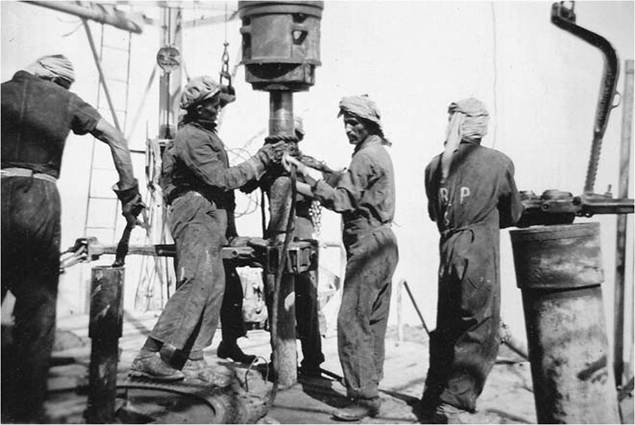
Arab workers operate a drill bit at a well site in Kuwait around 1950. The discovery and exploitation of Arabian oil reserves transformed labor and society in the Gulf and wider Indian Ocean world. Photo by Francis Hadden Andrus
Five other major themes dominate the century after the end of World War I in the Indian Ocean, yet all can be linked to oil in one way or another: the impact of travel by air; the continued expansion of Islam and changes within the faith; the increased threat to human society posed by natural disaster and environmental change; the resurgence of piracy in the late twentieth century; and the renewed geopolitical significance of the Indian Ocean. In some cases these themes reflect a major departure from the earlier themes that dominated Indian Ocean history; in others, they represent the persistence of issues that were sometimes less clearly glimpsed before the twentieth century. All five, plus oil, however, have salience for the contemporary Indian Ocean.
The new configuration of colonial territorial boundaries after World War I had the double effect of more closely linking the fates of those areas under a particular colonial regime, while again redefining the political boundaries of the Indian Ocean. One by-product of this process was the emergence of modern nationalism, the driving force that led to the gaining of independence for the colonial territories. The Japanese invasion and brief, but brutal, occupation of Southeast Asia reinforced these movements in those territories. The different struggles to gain independence among Indian Ocean territories were rooted in variously
expressed nationalist visions to overthrow the constraints of colonial rule.
In general, as well as in some quite specific instances, the independence of one influenced the continuing struggle of another. The reassertion of Egyptian independence in 1922 had repercussions among all the Muslim societies of the Indian Ocean, as did the post-World War II independence of India and Pakistan in 1947. The violence that accompanied the division of India from Pakistan in 1947 and then of Bangladesh from Pakistan in 1971; Indochina from France in 1954; Kenya from Great Britain in 1963; Mozambique from Portugal in 1975; and South Africa from apartheid in 1994 was driven by factors specific to the character of each colonial regime, while the aftermath of each continues to play out in the postcolonial Indian Ocean world.Nationalism emphasized the forging of national identity over ethnic particularisms and state citizenship in opposition to the foreignness of noncitizens. This tendency often clashed with the creation of different transnational identities, whether pan-Islamic, pan-Indian, pan-Arab, or pan-Chinese. For example, in the 1930s most Muwallads in Indonesia sought greater integration by accepting local over Hadrami identity. At independence most accepted Indonesian citizenship. Still, elsewhere in the postcolonial Indian Ocean world members of the far-flung Hadrami diaspora were not welcome. An example of how some historic Indian Ocean population movements reverberated violently in the twentieth century was the targeting of Arabs and Indians at the time of the Zanzibar Revolution in January 1964.
The continued migration of Indians and Chinese during the twentieth century, in particular, created problems. Indians came to occupy middle strata between British rulers and indigenous populations in East Africa, where they numbered perhaps half a million in the 1960s, and Burma, where after the mid-1880s they came to represent almost 7 percent—more than one million people—of the total population by 1930, that often caused them to be the most immediate target of dissatisfaction during the colonial era.
The Chinese population of Southeast Asia now numbers more than twenty million people. Among their ranks are numerous wealthy merchants, small shopkeepers, professionals, and civil servants, as well as many who are working class. Singapore stands apart for being majority Chinese, three-quarters of its population claiming Chinese origins.Elsewhere in Southeast Asia the Chinese constitute sizable minorities: 35 percent of Malaysians are of Chinese ancestry, several million Chinese live in Thailand and Indonesia, while many of the largest cities have major Chinese populations. These immigrant populations and the conspicuous roles they occupied in the colonial economy eventually led to scapegoating of these communities for not being indigenous or not having made a full commitment to the new postcolonial nations in which they resided. As early as the 1930s, spurred by Thai nationalism, anti-Chinese measures were adopted by Siam, while anti-Chinese violence erupted in Indonesia in both the 1970s and 1990s. In the 1930s anti-Indian riots, targeted mainly at Muslims, swept colonial Burma, while many Indians fled during the Japanese occupation during World War II. In the 1960s official discrimination caused some 300,000 Indians to leave Burma, while violence against Muslim Indians, who are known in Myanmar as Rohingyas, caused expulsions in 1978, 1991, and has raged as recently as 2012. Exploiting popular resentment against Indians in Uganda, in 1972 Idi Amin ordered the expulsion of all South Asians in ninety days.
The definition of modern state borders also had the effect of redefining the terms of travel in the Indian Ocean. For millennia travel by sea was generally unrestricted or only partially controlled, the attempts to control maritime travel by the early modern European colonial regimes notwithstanding. Colonialism now marked the native peoples of the Indian Ocean region as subjects—not citizens—of one colonial power or another; and while borders were definitely porous, seaborne travel was increasingly subject to the possession of a passport or its official equivalent even as movement at the local level still operated as a function of family, village, or communal affiliations.
Other continuities persisted, as well, such as the role of smaller indigenous sailing and then motorized craft to fill in the maritime interstices to which steamships were unable to gain access because of their deep draft and overall size and to carry materials that were not economical for steamships to transport, like mangrove poles by dhow from the Swahili coast to Arabia. Here is where the transportation revolution comes into play, as most travelers and sojourning workers today travel by air, rather than by ship. To be sure, the petrochemical industry soon made coal-powered ships obsolete and made possible more efficient engines. Improved engine design also boosted the power of steamships. Without a doubt, modern steamships enhanced oceanic travel by linking the ports and hinterlands of the Indian Ocean shores. For most Euro-American travelers steamers could provide a respite from daily cares. Steaming from Ceylon to Mauritius in April 1896, Mark Twain wrote,We are far abroad upon the smooth waters of the Indian Ocean, now; it is shady and pleasant and peaceful under the vast spread of the awnings, and life is perfect again—ideal.... There is no mail to read and answer; no newspapers to excite you; no telegrams to fret you or fright you—the world is far, far away; it has ceased to exist for you— seemed a fading dream, along in the first days; has dissolved to an unreality now; it is gone from your mind with all its businesses and ambitions, its prosperities and disasters, its exultations and despairs, its joys and griefs and cares and worries.... This sort of sea life is charged with an indestructible charm. There is no weariness, no fatigue, no worry, no responsibility, no work, no depression of spirits. There is nothing like this serenity, this comfort, this peace, this deep contentment, to be found anywhere on land. If I had my way I would sail on for ever and never go to live on the solid ground again.3
But in the last decades of the twentieth century air travel eclipsed sea travel as a means to move people around.
It also removed the experience of the ocean from traveling across the vast spaces of the Indian Ocean. Concomitant advances in naval design eventually produced the giant container carriers that today dominate global commercial shipping. Changes in technology have also significantly reduced crew size on these ever larger ships, while the crews themselves have become increasingly diverse and unconnected to both the flag registration and home ports of shipping.The oil industry initially depended exclusively on foreign capital, management, and labor. Educating local men to work as skilled labor in the industry and regional political leaders to support the development of modernized states was one aspect of how oil transformed the Gulf states, including Saudi Arabia. By the last decade of the twentieth century, the combined nationalization and globalization of oil production in Saudi Arabia yielded a labor force that was almost three-quarters Saudi and less than 6 percent American, with the remaining roughly 21 percent including employees from more than forty countries. A different demographic impact can be seen in Kuwait, Bahrain, Qatar, and the United Arab Emirates (UAE), where the wealth produced by oil has caused a massive immigration of foreign residents to support burgeoning urbanization.
While there are many well-heeled Westerners and Asian businessmen who now reside in these cities, the working class is mainly from other Arab countries, South Asia, and the Philippines. In 2010 the UAE population was composed of 11.5 percent Emirate citizens and 89.5 percent foreigners, with a more than 2:1 male to female ratio; for Qatar the data show that only 15 percent are citizens of the Sultanate, 13 percent other Arabs, and 72 percent non-Arab foreigners, while the male to female ratio is 3:1. Comparable data for Kuwait and Bahrain are less dramatic, but taken as a whole the skewed demography of the Gulf emirates reflects both the realities of the contemporary global labor market and the great disparities of wealth among nations. Such gender disparities recall certain characteristics of the earlier era of indentured labor, which can be regarded as a bridge between slavery and a “free” labor market in the Indian Ocean world.
Air travel has also had its effect on the movement of millions of Muslim pilgrims during the annual hajj season to Mecca. Jidda is still the port of entry for pilgrims, but it is now the Hajj Terminal at King Abdulaziz International Airport north of Jidda that serves as the principal terminus for pilgrims traveling to the Holy Lands of Islam. In addition to facilitating the annual mass of modern pilgrims, during the late colonial period, as part of their efforts to recruit Muslims to oppose insurgent nationalism, the Portuguese rulers of Mozambique courted favored Muslims by offering them free air passage from Lourenqo Marques (now Maputo) to Arabia so that they could complete the hajj. Air travel has similarly facilitated the movement of Muslim missionaries from the Middle East and South Asia to Africa and Southeast Asia, as it has also connected Hindu emissaries to Mauritius and South Africa. One important impact of such easy movement of individuals and ideas has been the broad dissemination of different reformist and revivalist movements across the Indian Ocean world. The influence of Salafism, the literalist and puritanical version of Sunni Islam that prevails in Saudi Arabia, was also facilitated by the enormous wealth created by oil in Saudi Arabia, which constructed Arabian-style Friday mosques in as many Indian Ocean Muslim communities as possible. Such Islamic ideologies have regularly opposed both the earlier Sufism that spread widely during the nineteenth century and the broad range of popular practices that had their origin in the adaptation and integration of Islam in places as distant from each other as the Comoros and Indonesia.
Radical notions of religious orthodoxy, including those implanted by Christian missionaries and their indigenous adherents, have affected both communal relations and global politics in many parts of the Indian Ocean world. Those that can be attributed to modern travel as well as modern communications—including newspapers, radio, television, and the Internet—include the spread of militant Hinduism from India to Mauritius and consequent tensions with the Mauritian Muslim community, who ironically share South Asian roots. Better known are the al-Qaeda attacks against American embassies in Nairobi and Dar es Salaam in 1998; the Lashkar-e-Taiba attack on Mumbai in 2008, carried out by militants arriving by inflatable speedboats from Pakistan; and the 2002 car bombing in Bali and the 2009 hotel bombings in Jakarta organized by al-Qaeda-linked Jemaah Islamiyya. A vivid illustration of the link between the securing of oil sources, maritime geopolitics, and radical Islam is the speedboat bombing carried out in 2000 by al-Qaeda against the USS destroyer Cole, which was harbored at Aden as part of the United States Seventh Fleet committed to the Gulf wars.
Environmental change, global warming, and natural disasters constitute a third major theme engaging the Indian Ocean world in the modern era. Natural disasters are, of course, not exclusive to the history of the last century, for example, the earthquake that leveled the Persian port of Siraf in 977. Because of the well-established connection between climatic fluctuations and major outbreaks of disease, disturbances in the Asian monsoon dated to 1816 are regarded as one of the causes of the first great Bengal cholera epidemic. On the other side of the Indian subcontinent, the dreadful famine of 1817 may have been a factor in pushing many Indian merchants farther afield in the western Indian Ocean. A freak hurricane that struck Zanzibar in 1872 destroyed property and wiped out the entire clove crop. Assaying the damage inflicted on the British Consulate, Sir John Kirk wrote, “As the sea rose, sheets of salt spray and rain drifted in at the broken windows and filled the rooms a foot with water.... The sea was driven with such force as to undermine and sweep away the whole embankment of stone and double row of wooden piles that protect the foundations of the English, German and American consulates.”4 Ironically, the aftermath of this particular natural disaster opened up Pemba Island, which was largely spared by the tempest, to greatly increased clove production.
Although cyclones are unusual as far north as Zanzibar, they are a regular feature of the southern Indian Ocean. Both Mauritius and Reunion have suffered more than once as a result of their enormous power, while on some occasions they have swept across Madagascar and the Mozambique Channel to cause extensive flooding along the Mozambique coast, where these storms are known as monomocaias and occur during the transition between monsoons. Such storms visited Mozambique Island in 1841-43, when “ships were unfastened from their moorings and grounded,” and relatively late in 1858, when a variety of local, Arab, and French vessels “were flung on the beach.”5 More recently, in 2000, Hurricane Hudah caused extensive damage across both Madagascar and Mozambique, displacing hundreds of thousand of people from their homes.
The worst hit area of the storm-driven disasters historically has been the low-lying flats of the northern Bay of Bengal, for which storm records date back to the late sixteenth century. In the last half-century, horrific human losses have resulted from the 1970 Bhola Cyclone that took more than half a million lives in Bangladesh; the 1991 cyclone in which some 143,000 lives were lost and ten million people made homeless in Chittagong; and the 2007 Cyclone Sidr, which left a million homeless and killed more than 3,000 people. The following year Cyclone Nargis killed another 140,000 people along the coastline of the eastern Bay of Bengal, hitting Myanmar, where it made landfall, especially hard.
The most widely known modern natural disasters of the Indian Ocean have been caused by volcanic activity along the Indonesian edge of the Pacific Ring of Fire. Lying in the Sunda Strait between Sumatra and Java, Krakatau exploded in 1883, killing nearly 36,500 people according to Dutch records and possibly uncounted thousands more. The town of Merak on Java was inundated by a 150-foot-high tsunami. The effects of what has been described as the loudest noise ever heard in world history were global. Because of the cloud cover created by volcanic ash, for a year after the eruption global temperatures lowered by up to 1.2°C, temperatures did not return to normal for five years, and weather patterns were disrupted. Lava rafts, some with human skeletons, drifted as far west as the coast of eastern Africa. More recently, the devastating tsunami that was caused by a volcanic explosion off the northwestern coast of Sumatra in December 2004 affected the coast from Sumatra to Thailand to Sri Lanka to Tanzania. As is well known, it caused huge population loss of more than 230,000 and displacement in fourteen countries, as well as deep emotional scarring. The televising of images from around the Indian Ocean made this natural disaster a truly global event. Undersea volcanic activity off the same coast continues to plague northern Sumatra with earthquakes always posing a threat of tsunamis.
Unrelated to volcanic activity but equally worrying is the rise of sea levels in the Indian Ocean as a consequence of global warming. Here the example of the ruins of the medieval town of Kisimani, located on a peninsula on the southeastern coast of Mafia Island to the north of Kilwa, on the Swahili coast, is fascinating. Kisimani had been attacked in 1816 by Sakalava raiders, but according to a version of the history of a neighboring village recited in 1955 by Shaykh Mwinchande b. Juma, “Kisimani was not destroyed by war but by the rising of the sea. Kisi- mani was a large town But because of the water there is no one now
who knows where it was.”6
Similar examples certainly exist for other Indian Ocean coastal locations, as long-term changes in the world’s climate have affected sea levels. More threatening today, however, is the compounding of natural
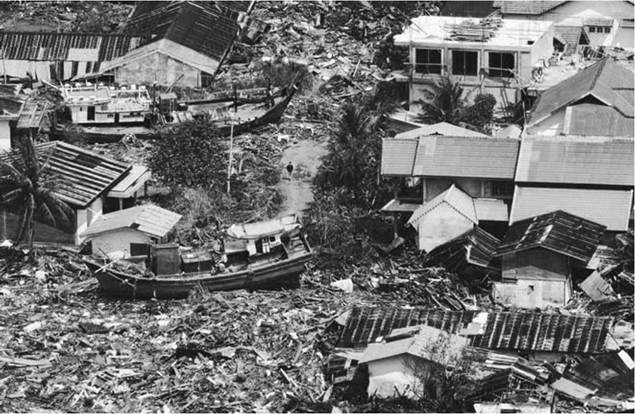
These fishing boats sit among the wreckage of an Indonesian community on Sumatra, near the epicenter of the 9.0 earthquake that triggered the tsunami. The terrible power of the 2004 Asian tsunami destroyed coastal settlements from Indonesia to East Africa. UNESCO Image
climatic fluctuations with global warming caused by the use of fossil fuels and other human impacts on the natural environment. The tiny, low-profile Andaman and Nicobar islands at the south end of the Bay of Bengal, which suffered great human losses in the 2004 tsunami, and the Maldive Islands in the Arabian Sea are now threatened with being slowly inundated, as are similarly vulnerable coastal zones.
Although piracy has never entirely disappeared in the past century, from the late twentieth century this form of maritime violence experienced a resurgence in the Straits of Melaka and Singapore. Much of this activity has been characterized by the opportunistic, hit-and-run actions of desperate fishermen whose livelihoods have been negatively affected by commercial overfishing. The amazing growth of the volume of container shipping passing through this critical sea lane has also attracted its share of organized criminal piracy. Today Singapore is the largest container port in the world. An unanticipated consequence of the development of container ships is that they are easier to attack because of their huge size, small crews, and perpendicular hulls, which make them easier to scale using grapples thrown over a ship’s gunwales from attacking speed boats.
Oil tankers are another potentially rich target of pirates. According to research conducted by Australian security scholar Carolin Liss, “These attacks are characterised by a high degree of organisation and require detailed planning and upfront capital. An example is the shipjacking of the tanker Selayang on 20 June 2001 in the Malacca Straits by 19 pirates. The vessel had a tracking device on board and the Indonesian authorities were able to arrest the hijacked ship and some of the pirates on the 27th of June near Balikpapan. According to the pirate’s statements, they had been hired to conduct the attack by a man called Mr. Ching, who had only limited contact with the perpetrators and remained anonymous.”7 Although piracy still persists in maritime Southeast Asia, since about 2000 the focus of Indian Ocean piracy has been Somalia.
The collapse of the Somali state in 1991 and the consequent inability to protect the coastal waters of northern Somalia from foreign commercial fishing vessels has resulted in severe overfishing of these waters. In addition, both European and Asian shipping have dumped toxic chemical waste in Somali coastal waters, which further devastates the fishing beds. Deprived of their livelihood, the Somali pirates were first drawn from the ranks of local Somali fishermen. According to maritime security analysts Michael Frodl and John Manoyan of the National Defense Industrial Association, this first generation of modern Somali pirates “consists of largely opportunistic pirating within 50 miles of Somali shores, especially in the Gulf of Aden, which has occurred for centuries.”8 One of the leaders of these pirates, named Sugule Ali, told a reporter for the Independent (London) in January 2009, “We don’t consider ourselves sea bandits. We consider sea bandits (to be) those who illegally fish and dump in our seas.”9
After a decade of activity in the Gulf of Aden, Somali piracy eventually forced its way into global consciousness in 2008 after the seizure of a French luxury yacht and the payment of a huge ransom to release its crew. Following several other dramatic attacks, in April 2009, four Somali pirates seized the United States flagged MV Maersk Alabama. When fears for the safety of its American captain grew, US Navy SEAL snipers killed three of the four pirates and the fourth surrendered. Spectacular cases like these drew wide international attention to Somali piracy. Emboldened by the success of some of these daring attacks, Somali piracy grew exponentially in the next several years, including the hijacking of the Saudi oil tanker Al Nisr Al Saudi in 2010. The small coastal town of Haradheere, located about 250 miles northeast from Mogadishu, has gained a reputation as a major center for piracy. This once obscure place was described by a Reuters journalist in December 2009 as “a bustling town where luxury 4x4 cars owned by the pirates and those who bankroll them create honking traffic jams along its
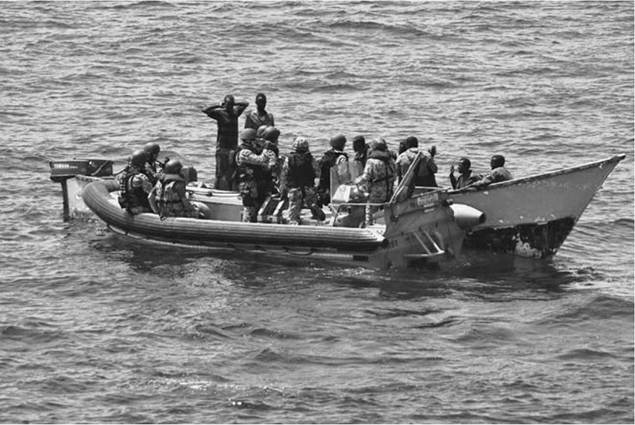
A crew from the European Union Naval Force Somalia (Operation Atalanata) captures a boatload of would-be Somali pirates on March 4, 2009. By 2012 political changes in Somalia and Somaliland plus the combined maritime efforts of many nations had severely reduced the chaos caused by Somali pirates. Photographic service of the Council of the EU, © European Union
pot-holed, dusty streets.” According to what he was told by Mohamed Adan, deputy security officer for the town, “Piracy-related business has become the main profitable economic activity in our area and as locals we depend on their output.”10
Especially worrying for every nation with economic and strategic interests in the western Indian Ocean, Somali piracy soon extended as far south as the northern end of the Mozambique Channel and as far east as a few hundred miles from Mumbai. Its activities precipitated increased maritime security practices, stepped up international naval operations and the arming of many merchant marine vessels, and encouraged local counterpiracy efforts in a combined effort to eliminate this threat to Indian Ocean shipping. Whatever the future of piracy in the Indian Ocean there can be no doubting that it has been a feature of its maritime history for at least two millennia.
Whether in the western Indian Ocean or in Southeast Asia the suppression of piracy is clearly a concern of regional nation-states, global powers with strategic interests in the region, and international business. Just as Great Britain regarded Mauritius to be strategically significant in the early decades of the nineteenth century, islands have occupied an important place in the recent geopolitics of the wider Indian Ocean. After World War II the United States moved to contain what it believed to be the Soviet threat in the Indian Ocean. This Great Power competition played itself out in many places, from Ethiopia and Somalia in the 1970s to Afghanistan in the 1980s.
However, the most striking example of how big power manipulations have affected the people inhabiting the smallest islands of the Indian Ocean is the case of Diego Garcia, a coral atoll with an entrance channel on its northern side. The United States initially explored the establishment of a secure base from which to operate in the 1960s. The first candidate was uninhabited Aldabra Island, a British possession located to the north of Madagascar, but the British refused because it was and remains a protected breeding ground for rare giant tortoises. Instead, secret negotiations were carried out between the two allies to give the United States rights over tiny Diego Garcia, the largest island of the Chagos archipelago just south of the Maldives and south of the Equator. In exchange for the United States underwriting research and development costs for the British acquisition of Polaris missiles, the United Kingdom leased Diego Garcia to the United States for ninety- nine years without reference either to Parliament or Congress.
In 1971 the United States began construction of a naval communication facility on Diego Garcia, upgrading it in 1977 to a complete military support facility. The Iranian Revolution in 1979 accelerated expansion of the base and, at a cost of half a billion dollars the full naval base was completed in 1986. It played a major air and naval support role during the first Gulf War, as well as during the second Gulf War. Whether the justification for these wars was to secure Middle Eastern oil or to fight against Islamic terrorism, the price paid by the people of the Chagos Islands was steep.
The islands had been a dependency of British Mauritius since 1814. Their tiny population was the descendants of enslaved Africans who had been landed there to work on coconut plantations. As a precondition to Mauritian independence in 1967 the Chagos were removed from Mauritian jurisdiction in 1965 and renamed the British Indian Ocean Territory. Between 1967 and 1973 all the Chagossians, perhaps as many as 2,000 individuals, were forcibly removed from the islands and relocated to Mauritius, about 1,200 miles away, where today they are an impoverished and somewhat despised urban enclave in Port Louis simply called “Ilois,” or islanders.
Finally, in 2000 the Chagossians won a British court decision that allowed them to return home, but it was blocked by the Labour Government of Prime Minister Tony Blair. Three years later a British court denied them monetary compensation. On May 12, 2006, as it ruled in their favor to return home, the British High Court delivered this scathing judgment: “The suggestion that a minister can, through the means of an order in council, exile a whole population from a British Overseas Territory and claim that he is doing so for the ‘peace, order and good government’ of the territory is to us repugnant.”11 Repugnant or not, the House of Lords rejected the claims of the Chagossians and they remain exiled today.
Although many of the original exiles have died, others and their children persist in the struggle to claim their ancestral rights. In the words of Chagossian community activist Louis Olivier Bancoult, “We are reclaiming our rights, our rights like every other human being who lives on the Earth has rights.... I was born on that land, my umbilical cord is buried on that land, I have a right to live on that land. It cannot be that a foreigner profits from all my wealth, profits from my sea, profits from my beaches, profits from my coconuts, profits from it all, while I’m left with nothing.” The Chagossians, he told his interviewer, are “asking for our islands, our fundamental rights, and our dignity.”12
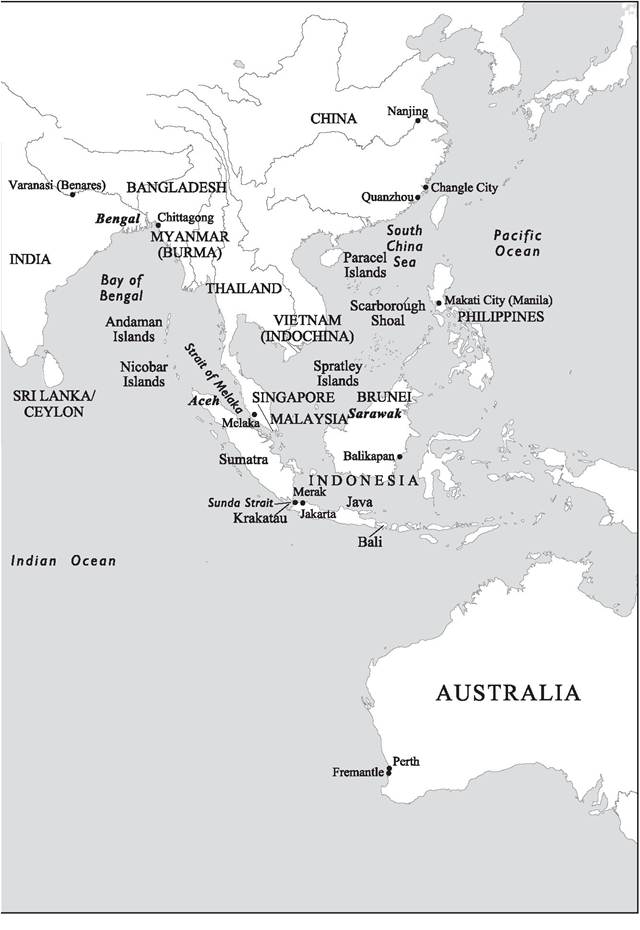
Far to the eastern reaches of the Indian Ocean, a more recent struggle has focused on the South China Sea, where China, Vietnam, the Philippines, Malaysia, and Brunei have forwarded overlapping claims to the Spratley and Paracel islands and the Scarborough Shoal. In differing combinations these sovereign nations seek to control potential undersea hydrocarbon reserves and fisheries beyond their internationally recognized coastal zones. Another aspect of Chinese claims concerns freedom of navigation through the South China Sea, through which fully one-third of global shipping passes. While China asserts it is part of their territorial waters by right of deep historical connections, the United States counters that it has been historically and must continue to be regarded as being in international waters. The naval presence of these global rivals is also complicated by the 1951 mutual defense treaty between the United States and the Philippines. In April 2012 China and the Philippines carefully stepped back from a potential armed confrontation over possession of the disputed Scarborough Shoal. Meanwhile, the potential for future conflict looms over this critical body of water, where “there are regular maritime clashes between fishermen, oil exploration ships and naval or coastguard vessels as the claimants refuse to concede ground.”13
More hopefully, the creation of an Indian Ocean Rim Association for Regional Cooperation (IOR-ARC) was suggested in 1995 by then-president Nelson Mandela of South Africa, during a visit to India, who declared that “the natural urge of the facts of history and geography... should broaden itself to include the concept of an Indian Ocean Rim for socio-economic co-operation and other peaceful endeavors. Recent changes in the international system demand that the countries of the Indian Ocean shall become a single platform.”14 Formally launched in 1997, at Mauritius, the IOR-ARC Charter begins by embracing the past: “Conscious of historical bonds created through millennia among peoples of the Indian Ocean and with a sense of recovery of history;...” and then proceeds to lay out a vision based on multilateral economic cooperation.15 From an initial membership of six nations in 1997 today it includes nineteen countries whose borders are washed by the waters of the Indian Ocean, but it does not include the Comoros, Somalia, Eritrea, Sudan, Egypt, Saudi Arabia, Qatar, Bahrain, Kuwait, Iraq, Pakistan, or Myanmar, quite apart from those that border the South China Sea. Whatever its limitations, the IOR-ARC provides a regional basis for beginning to build cooperative, multilateral regional strategies to address the most pressing problems facing the Indian Ocean world.
Considering the millennia of Indian Ocean history, how do its people and their governments remember their connected pasts? To take the last first, after decades of preoccupation with postcolonial nation-building, different governments have established museums and erected monuments to memorialize the past. Some of these have distinct nationalist claims, while others represent reconstructions of various ways in which a certain place is connected to the larger world of the Indian Ocean. The audiences for such official efforts are both domestic, intended to raise public consciousness, and global, intended to attract international tourists. There are too many of these to be listed, but among them is the Beit al-Ajaib or House of Wonders museum in Stone Town Zanzibar, where the interested visitor can examine a full-size mtepe that a master craftsman from Lamu built in 2003. Among the many cultural structures currently planned in the UAE is a museum dedicated to pearling and another to the dhow; a museum of slavery with an Indian Ocean focus is being developed in Qatar. The Western Australian Museum-Fre- mantle is an important center for research and exhibitions, while there is also a permanent Indian Ocean exhibition in the Western Australian Museum in Perth. An interesting new museum is the Aceh Tsunami Museum, opened in Banda Aceh in 2009.
The 600th anniversary of the first voyage of the Ming treasure fleets has generated more than a handful of Admiral Zheng He memory sites around the eastern reaches of the Indian Ocean world. Even though his body was buried at sea off the coast of western India, there are statues or museum exhibitions in Nanjing, Changle City, and Quanzhou in China; in Singapore, Melaka, Sarawak, and Java. These monuments signal recognition of the remarkable achievements of the fifteenth-century Chinese seaman by both China and the Chinese diaspora, but they also reflect the ambitions of a new outward-looking China.
Diasporas, the scattering of people from their homeland, have also generated important sites of public memory in Mauritius, where the Aaparavasi Ghat, commemorating the landing site for Indian indentured laborers in Port Louis, and Le Morne Brabant, a granite outcropping that was a refuge for runaway slaves on the southeast coast of the island, have both gained recognition as World Heritage sites from UNESCO. Many other national museums around the Indian Ocean have from time to time mounted exhibitions dedicated to various immigrant groups, such as that dedicated to Asian Africans at the National Museum of Kenya in Nairobi or one featuring art of the Chinese diaspora at the Ayala Museum in Makati City in the Philippines.
Diasporas have also generated various memories of homelands that have been expressed in both popular and literary culture. Here again there are many such examples, but a few from Mauritius will suffice. Not surprisingly, since there was no indigenous population at Mauritius, memory of where its people came from is a powerful element of their history, one that is intimately connected to Indian Ocean passages. The migration of Chinese workers to Mauritius is memorialized in Joseph Tsang Mang Kin’s The Hakka Epic, first published in French in 1992. In this epic poem the writer both glorifies Hakka origins and lays out the poverty that drove them overseas in search of a better life. He also recalls the perils of oceanic travel in the line “No one wanted to face the Southern Seas.” Later he writes,
Nobody thought of going overseas.
Nobody dreamt of trusting the wild seas.
Yet, he continues,
The seas saved us by hundreds of thousands.
The seas restored all our dreams and legends.16
A more immediate and painful recollection of an Indian Ocean passage is captured in a sega, the popular musical form developed by enslaved Afro-Malagasies and their descendants that has become a kind of Mauritian national music, sung by Chagossian Rita Bancoult.
My father, you’re yelling “Attention passengers! Embark passengers!”
This madame, her husband’s going but she’s staying.
Crying, madame, enough crying madame.
On the beach, you’re crying so much,
The tears from your eyes are drowning the passenger list.
Crying, madame, even if you cry on the beach, even if you cry Captain L’Anglois isn’t going to turn the boat around to come get you.17
Song and dance figure significantly as vehicles of historical memory among all overseas communities of the descendants of enslaved Africans in both the Atlantic and Indian Ocean worlds. Not all songs are, however, so immediately associated with the sea or with the overseas passage as is this sad recollection of Rita’s home on tiny Corner Island of the Peros Banhos archipelago that is part of the Chagos Islands, more than 1,000 miles from Mauritius.
A quite different example of how popular memory of origins is represented is the fascinating map of the Hadrami Indian Ocean network as seen from Indonesia. Published in about 2003 in the newsletter of the Hadrami genealogical organization Naqobatul Asyrof al-Kubro in Jakarta, the map has explanatory texts in both Arabic and Bahasa Indonesia that delineate Hadrami connections linking communities in Southeast Asia, India, Pakistan, Arabia, and Eritrea.
Memory of place is also embedded in modern literature. In the novel Benares by Mauritian author Barlen Pyamootoo, the narrator asks plaintively about the name of his village in the far south of Mauritius, “How would it make you feel to live somewhere and know there was somewhere with the same name in a different country?”18 Although the name of this small village that was established around a sugar mill in Mauritius named Benares clearly derives from the colonial name for the Hindu holy city (today Varanasi) on the banks of the Ganges River, how it came to receive this name remains uncertain in the novel. What it does suggest is that for the millions of Indian Ocean people who were moved by force or by poverty to the far corners of this watery world their individual and collective memories are still powerful witnesses to the past.
While each of these examples demonstrate different levels of attachment to original homelands, the Indian Ocean also remains a region of cultural exchange. An illustrative modern example of this kind of cultural openness and flexibility is the story of the late Mzee Mombasa Mwambao, a well-known musician and comedic actor who performed for many years on both Kenyan radio and television. Mzee Mombasa was born in 1922 and raised in the major Indian Ocean port of Mombasa, from which he took his stage name. As a young man he shipped out on a dhow that carried mangrove poles, which were used for construction throughout the region, to the Somali coast. From Africa the ship then sailed on to India, where Mzee Mombasa spent six months exchanging musical ideas and learning about Indian culture. “We met a lot of good people in India, we had quite a few parties, mixing with the Indian women, and the Indian men, just socializing.” He subsequently traveled in different merchant ships to South Africa, Somalia, the Comoros, and back to India, before returning to a similarly mobile life in East Africa. He recalls that “in all the places I visited we were treated very nicely because we were visitors and treated as guests.”
Indeed, the concept of hospitality was an essential component of Indian Ocean world cultures. When he was in port, he seems to have spent much of his time meeting people; eventually he turned to music more seriously for his livelihood, becoming expert in performing Indian music. At one point he returned to India to record a play that he tells us “was a mix of Swahili and Indian,” perhaps Hindi or Gujarati. Eventually, Mzee Mombasa settled down in Kenya, where he played the oud, a Middle Eastern stringed instrument that is similar to the Western guitar, in several different bands, including an Indian group in which he was the only African, before joining the Voice of Kenya in 1974 as part of their drama section. “So that’s my little bit of history,” he tells his interviewer, “I’m not sure if it is any good or not!”19 In fact, Mzee Mombasa’s story is a very good illustration of precisely the kind of mobile experience that lies at the center of Indian Ocean history.
The Indian Ocean world that has evolved over seven thousand years is very different today than it was in 5000 bce. The dramatic evolution of maritime technology, the emergence and expansion of several major world religions, numerous attempts to impose political domination, as well as the constant movement of people, goods, and ideas have incessantly worked to transform this vast world region. If the basic geography of the Indian Ocean has been relatively stable, the names associated with its places and peoples have regularly shifted. Yet there are many deep continuities in the Indian Ocean, most notably the monsoon winds that determine its seasons and the ocean currents that wash its shores. Nevertheless, the historic ways in which human societies have nurtured their specific cultures over time, what is often called “tradition,” remain significant in this ever-changing world. Never an isolated world region, the Indian Ocean is today more than ever a major world crossroads.