31 Western Ukraine during World War I
The “long” nineteenth century, characterized by its political stability and firm rule over Ukrainian territories by the Russian and Austro-Hungarian empires, came to an end in the summer of 1914.
Europe entered into what came to be known as the Great War—eventually the First World War—which was to last from August 1914 until November 1918. The major states opposed to one another were the Allies (Great Britain, France, Russia, and later the United States) versus the Central Powers (Germany, Austria-Hungary, and later the Ottoman Empire). Italy, which initially declared neutrality, joined the Allies in 1915. These Great Power alliances divided ethnic Ukrainians, so that those in western Ukraine fought in the armies of Austria-Hungary against their national brethren in Dnieper Ukraine who were in the ranks of the tsarist Russian army.From the very outset of the conflict and throughout much of the war western Ukrainian lands were part of the military zones along the eastern front, where the armies of Germany and Austria-Hungary were engaged against those of the Russian Empire. The Russians were initially successful, crossing the Zbruch River into Galicia as early as August 5, 1914. The Russian advance was rapid, so that by September 3 tsarist armies had captured Austria’s provincial capital of L’viv. By the end of that month tsarist forces had reached the Dunajec River and not long after that they were close to Cracow in far western Galicia. By the end of 1914 Russian forces held not only virtually all of Galicia but also several passes and the southern slopes of the Carpathian Mountains in Hungary, specifically the Rusyn-inhabited areas immediately adjacent to Galicia. The campaign in Bukovina took a little longer, but by November 1914 it, too, was in the hands of tsarist Russian troops.
The capture of Galicia and Bukovina was a major victory not only for Russia but also for a portion of western Ukraine’s East Slavic inhabitants.
During the second half of the nineteenth century, when the national movement in western Ukrainian lands was at its height, the local intelligentsia and eventually a large segment of the population were divided over the question of their precise national identity. In Galicia, there did exist a consensus on certain matters: the inhabitants were East Slavs who called themselves Rusyns (Rusyny) and they were Eastern-rite Greek Catholics—therefore, clearly not Roman Catholic Poles. There was decidedly less clarity when it came to the question of a larger national identity. Those who called themselves Old Ruthenians (Starorusyny) were Habsburg loyalists who had a vague sense of affinity with the entire Rus’ world in the east. Others who called themselves Ukrainians believed they were part of a distinct nationality, most of whose adherents lived in the Dnieper Ukraine. Still others rejected the notion of Old Ruthenian “distinctiveness” or of Ukrainian “separatism” and argued that they were Russians. Old Ruthenians, Russophiles, and Ukrainophiles were also present among the intelligentsia in neighboring Bukovina. In Transcarpathia, however, there were no Old Ruthenians or Ukrainophiles. There, most of the local East Slavic intelligentsia had already assimilated fully to Hungarian culture (become magyarized); as for those Transcarpathians who retained an East Slavic identity, most favored a pro-Russian (Russophile) national orientation, although there were also some who felt they comprised a fourth East Slavic nationality called Rusyn or Subcarpathian Rusyns.MAP 31 WESTERN UKRAINE DURING WORLD WAR I

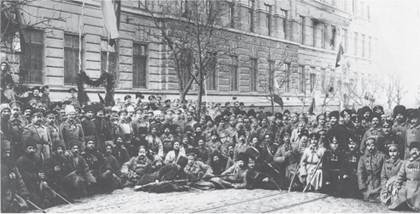
31.1 Victorious tsarist Russian troops on the streets of Austrian Galicia’s provincial capital, L’viv, September 1914.
Not surprisingly, the tsarist Russian government favored the Russophiles in Austria-Hungary’s western Ukrainian lands, and already before the war various segments of tsarist society provided assistance to a small but growing Orthodox movement among Greek Catholic villagers in Galicia and Transcarpathia.
At the time a “return to Orthodoxy” generally meant as well the acceptance of a Russian national identity and, for some, hope in “liberation” by the tsar. Austria-Hungary’s response was one of deep suspicion and the holding of periodic trials (in 1882, 1904-06, 1913, and 1914) against Galician and Transcarpathian Rusyn priests and secular activists in which “conversion” to Orthodoxy was equated with state treason.
31.2 Defendants at a trial in L’viv (March-June 1914) of Galician Russophiles accused of treason against Austria-Hungary. The group was acquitted, but the priest Maksym Sandovych (left) was shot by Habsburg authorities in September 1914; he was later canonized as a sainted Orthodox martyr.
On the larger geo-political plane, Russia’s capture of Galicia marked the fulfillment of an age-old dream. Since Muscovite times the tsars had claimed themselves to be descendants of the rulers of Kievan Rus’; therefore, they felt obliged “to re-unite” all “Russian” lands under their scepter. So significant was the acquisition of “Russian” Galicia that in early April 1915 Tsar Nicholas II undertook a triumphal visit to L’viv and Przemysl (which Russian forces had finally captured that March after a brutal four-month siege).

31.3 Austro-Hungarian troops return to L’viv, June 1915.
In its newly acquired territories of Galicia and Bukovina, the Russian government set up a civilian administration and engaged the services of local Russophiles, including those who returned from exile in Russia where they had sought refuge from Austrian persecution before the war. The Russian administration in Galicia also found some support among Polish leaders, but it was adamantly opposed to the Ukrainophiles. Tsarist officials closed Ukrainian cooperatives and cultural institutions, planned to dismantle the Greek Catholic Church, and deported to Russia its popular and politically influential primate, Metropolitan Andrei Sheptyts’kyi.
No sooner had Tsar Nicolas II completed his triumphal visit to L’viv than Russia’s military fortunes changed. German troops reinforced the Austro-Hungarian Army, and together they defeated the tsarist army at a major battle near Gorlice (May 2-13, 1915). After further victories near Sanok on the San River (May 10) and the retaking of Przemysl (June 3) and L’viv (June 22), the Russians were driven from most of Galicia and all of Bukovina by the end of June. Aside from the departing Russian civil administration, local Russophile leaders convinced more than 25,000 Galician “Russians” to flee eastward where they sought refuge near the mouth of the Don River. The returning Austrian authorities took revenge on both real and suspected Galician Russophiles (especially in the Lemko Region), arresting several thousand, who were held in internment camps in western Austria for the rest of the war.

31.4 Austro-Hungarian military personel oversee the execution of a Galician Ruthenian peasant and suspected Russian spy.
In the wake of its military reversals in 1915, Russian forces managed to hold on to only a small strip of territory in far eastern Galicia between the Seret and Zbruch rivers. In August 1916 tsarist Russia undertook yet another offensive (this time led by General Aleksei Brusilov), which extended the eastern front a bit further into Galicia. Bukovina was also retaken, where tsarist Russia once again set up a civil administration (under the direction of the historian from Dnieper Ukraine, Dmytro Doroshenko) that was to last until the end of 1917.
Soon after hostilities began in August 1914 Ukrainian political leaders in Galicia established a non-partisan Supreme Ukrainian Council. It immediately helped to organize a volunteer military formation, the Ukrainian Sich Riflemen (Ukraïns’ki Sichovi Stril’tsi), which fought on the Eastern front within the ranks of Austro-Hungarian Army.
As both Galicia and Bukovina were in the military zone for most of the war, western Ukrainian political activity was carried out in the imperial capital of Vienna. There, Ukrainian parliamentarians from both provinces formed a General Ukrainian Council (May 1915), which called for the creation of an independent Ukrainian state based on territories in the Russian Empire. The council also called for the division of Galicia into two provinces and for a future East Galicia and Bukovina to have greater autonomy. These seemingly minimal political demands were not only a reflection of political caution but of a true sense of loyalty that most Ukrainians maintained toward the Habsburg Empire, which they continued to consider the best guarantor of Ukrainian national life.
31.5 Troops of the Ukrainian Sich Riflemen Corps being inspected in July 1916 by the future Habsburg emperor, Karl I (r. 1916-1918).
MAP 32 UKRAINE, 1917-1918
