30 The Peoples in Ukrainian Lands under Habsburg Rule, 1772-1914
Austrian Galicia during the nineteenth century became the major center of both a Polish and a Ukrainian national movement. Poland as an independent country had ceased to exist after 1795.
Napoleonic France’s subsequent gesture to recreate a Polish state was short-lived (1807-1814), and Poles were roundly defeated in two revolts against Russia (1830-1831 and 1863), as well as in an abortive noble-led peasant uprising against Austria (1846). In such circumstances, some Polish leaders led by Austrian Galicia’s viceroy, Count Agenor Gołuchowski, came to believe that cooperation with the Habsburgs might be the best way to assure the future survival of the Polish people and the possibility of some kind of future statehood.
30.1 Count Agenor Gołuchowski (1812-1875), Polish patriot, loyal Austrian statesman, and governor/viceroy of Galicia between 1848 and 1859.
From the Polish perspective, all of Galicia—including predominantly Ukrainian-inhabited eastern Galicia—was considered part of a historic Polish patrimony. Although the Habsburgs did not grant wide-ranging political autonomy to “Polish” Galicia—a demand put forth in 1868—the Poles were subsequently accorded preferential treatment to administer the province within general Austrian guidelines. In practice, this meant domination by Poles of the provincial government (including the Galician diet) and its school administration. L’viv, in particular, became home to several important Polish institutions, including the university (which adopted Polish as its language of instruction), the Polish Historical Society, the Ossolineum library and research center, and a whole host of Polish newspapers, journals, publishing houses, theaters, and cultural and civic societies. In many ways, eastern as well as Polish-inhabited western Galicia were part of a largely Polish environment that served as a beacon for patriots who lived in less favorable circumstances in those parts of former Poland that were ruled by Russia and Prussia.
MAP 30 UKRAINIAN LANDS IN AUSTRIA-HUNGARY, circa 1875

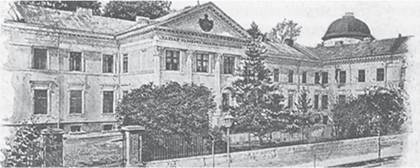
30.2 The Ossolineum Library and Polish National Foundation established in L’viv in 1817; today the main seat of the Stefanyk Research Library.
Galicia, in particular eastern Galicia, was also a center for the Ukrainian national awakening. During the first decades of Austrian rule in the 1770s and 1780s, the Habsburg government initiated several reforms that had an especially positive impact on the Ukrainians. Austrian officials sent to Galicia reported to the imperial government that the indigenous East Slavic population was neither Polish nor Russian; since the inhabitants called themselves Rusyns (rusyny), that ethnonym was rendered in German as Ruthenen (English: Ruthenians). The government also introduced a system of universal elementary education to be taught in the vernacular “Ruthenian” language (1777), and it recognized the equality of the Eastern-rite Uniate Catholic Church with the Roman-rite Catholic Church. This was of special importance to the East Slavic Ruthenians who were almost without exception Eastern-rite Catholics. In 1774 the adherents of this church received at their request a new name, Greek Catholic, and in 1808 the Metropolinate of Galicia was restored and headed by a metropolitan-archbishop with his seat in L’viv. It was also from among the ranks of the Greek Catholic Church that the beginning of a Ruthenian/Ukrainian national awakening took place. In the 1830s three seminarians who came to be known as the Ruthenian triad (Rus’ka Triitsia)—Markiian Shashkevych, Ivan Vahylevych, and Iakiv Holovats’kyi—published the first books in the Galician Ruthenian/Ukrainian vernacular.

30.3 Saint George’s Cathedral Church (Sobor sviatoho Iura, 1744-59), since 1817 seat of the Greek Catholic Metropolitanate of Galicia.
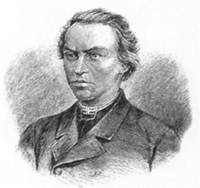
30.4 Markiian Shashkevych (1811-1843), priest, poet, and national awakener among Galician Ruthenians/Ukrainians.
Even more important for the Ruthenian/Ukrainian national awakening were events connected with the Revolution of 1848. The Habsburg authorities were suspicious of Galicia’s Poles (who had led an abortive revolt in 1846), and the Austrian government through the province’s governor Franz Stadion openly encouraged its Ruthenians/Ukrainians to enhance their political and cultural status. In 1848 alone Ruthenians/Ukrainians for the first time in history established in Galicia their own political organization (the Supreme Ruthenian Council), their own newspaper (Zoria halytska), and their own cultural organization (the Congress of Ruthenian Scholars); they elected their own deputies to an Austrian national parliament; and they were granted a Department of Ruthenian Language and Literature at the University of L’viv.

30.5 Ivan Vahylevych (1811-1866), Galician-Ruthenian ethnographer, priest, poet, and who eventually favored close cooperation with local Poles.

30.6 Iakiv Holovats’kyi (1814-1888), Galician-Ruthenian priest, historian, ethnographer, from 1848 to 1867 professor and first holder of the Chair of Ruthenian Language and Literature at the University of L’viv.
Despite the gradual change of Austrian policy following the Revolution of 1848 and the Habsburgs eventual accommodation with the Poles of Galicia, from the 1860s on, the Ukrainian national awakening continued to make remarkable progress. The Ruthenian/Ukrainian language was codified, approved by the Habsburg authorities, and used in all spheres of public life, including in local administrative offices and the courts.
By 1914 Ruthenian/Ukrainian was the language of instruction in 2,500 elementary schools, sixteen secondary schools (gymnasia), ten teachers’ colleges, and ten departments at the University of L’viv. There were as well a whole host of Ukrainian cooperatives, credit associations, cultural institutions, newspapers, publishing houses, and the equivalent of a Ukrainian academy of sciences (the Shevchenko Scientific Society). Among Galicia’s most important Ukrainian civic and cultural activists of the period were the prolific writer Ivan Franko, the historian Mykhailo Hrushevs’kyi, and the Greek Catholic prelate, Metropolitan Andrei Sheptyts’kyi. Ukrainians also established several political parties which chose deputies who defended Ukrainian interests in both the Galician provincial diet and the Austrian imperial parliament.
30.7 Count Franz Stadion (1806-1853), Habsburg governor of Galicia in 1846-1848, accused by Polish and other political enemies of having “created the Ruthenian nationality.”

30.8 First meeting of the Supreme Ruthenian Council (Holovna rus’ka rada) in L’viv, May 2, 1848.
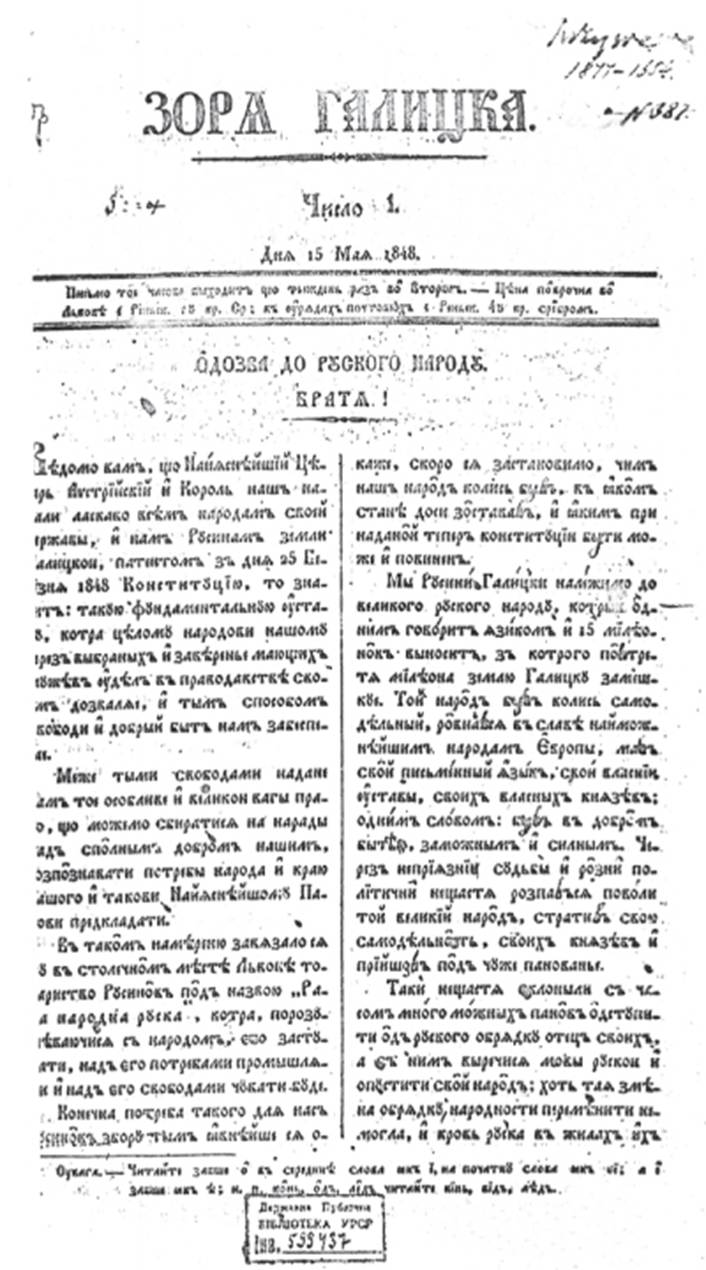
30.9. Title page of Zoria halytska (The Galician Dawn), May 15, 1848, the first newspaper ever published in Ukrainian.
Despite its various achievements, the national movement among the Ruthenians of Galicia during the last decades of the long nineteenth century continued to face both external and internal challenges. After 1868, the Habsburg government basically allowed Galicia’s Poles to run the administration of the province, with the result that virtually every political, civic, and educational goal set out by the Ruthenians was likely to be met with Polish opposition. Yet another problem was internal.
The Ruthenian intellectual elite remained divided throughout this period over the question of national identity, with some leaders arguing that Galicia’s East Slavs were part of either the Ukrainian or Russian nationalities, or that they were simply Old Ruthenians (Starorusyny) living within the borders of the Habsburg Empire. Each of these orientations had its own press and cultural and political organizations, which were frequently engaged in a mutual struggle as each tried to attract the Ruthenian peasant masses to accept and support its own particular national ideology (see Chapter 31).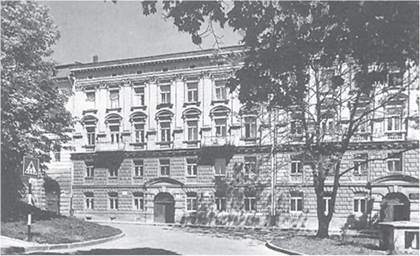
30.10 Seat of the Shevchenko Scientific Society, founded in 1892 in L’viv.

30.11 (Above) Ivan Franko (1856-1916), Galician-Ukrainian scholar, critic, political-civic activist, and prolific writer.

30.12 (On the right) Mykhailo Hrushevs’kyi (18661934), historian, professor, and head of the Shevchenko Scientific Society in the library of his L’viv residence, 1914.
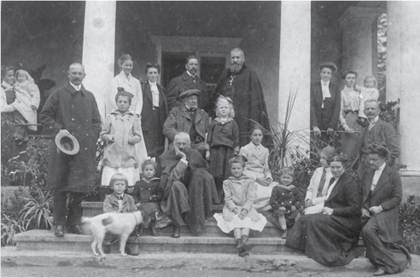
30.13 Count Andrei Sheptyts’kyi (1865-1944), convert to Greek Catholicism and to a Ukrainian national identity, archbishop-metropolitan of Galicia from 1900, photographed (standing on the right of the middle group) with his Polish aristocratic relatives at the family estate in Prybylchi, Galicia, 1911.
The neighboring province of Bukovina experienced much the same as did Galicia. One difference was the fact that the East Slavic Ruthenians of Bukovina never accepted the union with Rome and remained Orthodox. Bukovina’s Ruthenians were, therefore, similar to the region’s Orthodox Romanian inhabitants. Both groups remained separate, however, because of differences in language and political goals.
A national awakening began in Bukovina in the 1860s, although on a much smaller scale than in Galicia. Ukrainian as well as pro-Russian or Russophile civic, educational, and cultural activity was concentrated in the province’s administrative center, Chernivtsi. That small city was at the same time becoming a symbol of the best aspects of Habsburg rule in the decades before the outbreak of World War I in 1914. The myth of Chernivtsi (German: Czernowitz-Mythos), as it came to be known, reflected the reality of liberalism and tolerance that the Austrian Habsburgs promoted among all national groups in Bukovina and that was symbolized in the publication and community service of the German-language writer Karl Emil Franzos, the Ukrainian Osyp Iurii Fed’kovych, and the worldwide gathering of Jewish writers, who at the 1908 Czernowitz Congress codified Yiddish as a “national language,” thereby making it a suitable instrument to represent the culture of Ashkenazic Jews wherever they may live. Finally, Habsburg Chernivtsi became home to a wide range of Romanian cultural, educational, and political organizations, an increasing number of which were preparing the groundwork for that day in the future when Bukovina (Romanian: Bucovina) would be re-united in one state with other Romanian-inhabited lands.
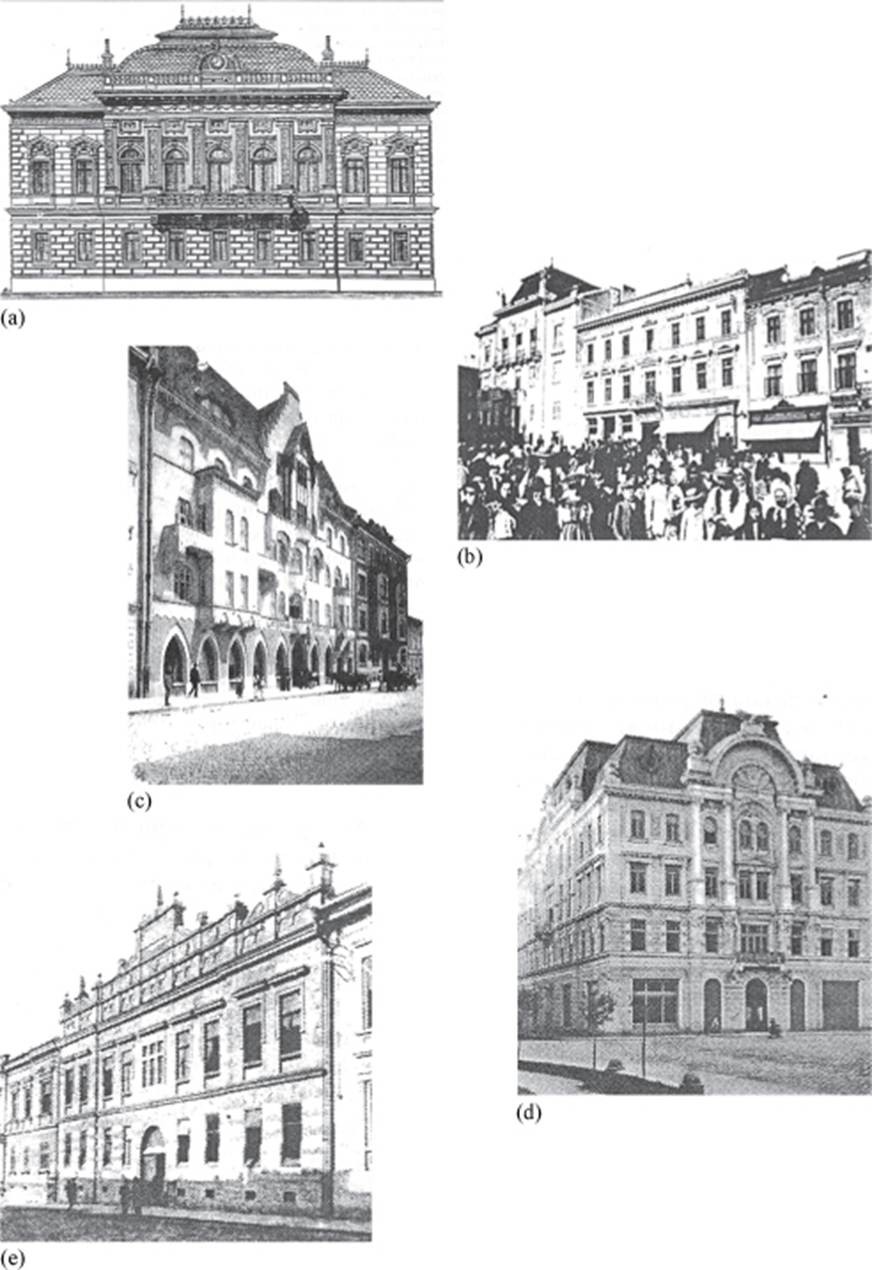
30.14 Multicultural life in late 19th-century Bukovina, epitomized by the Ukrainian (a), Romanian (b), German (c), Jewish (d), and Polish (e) national centers in Chernivtsi.
In Hungarian-ruled Transcarpathia, the situation was much more difficult for the indigenous East Slavs who designated themselves as Rusyns, or Uhro-Rusyns (Hungarian Rusyns). A national awakening among Hungary’s Rusyns did make some progress in the wake of the Revolution of 1848, and during the next two decades they were able to establish cultural organizations, publish books and newspapers in their language, have it taught in elementary and a few secondary schools (gymnasia), and even engage in political activity that called for cultural autonomy within the Hungarian Kingdom. But in 1868, with the creation of the Austro-Hungarian Dual Monarchy, Hungary gained full control of its own political destiny and soon instituted a policy of national assimilation (magyarization) that was particularly successful in denationaliziting the local Rusyn intelligentsia.

30.15 Iurii Fedkovych (1834-1888), writer, editor, and main promoter of the Ukrainian national awakening in Bukovina.

30.16 The monumental metropolitan-archepiscopal residence and seat (built 1864-82) of the jurisdictionally independent Orthodox Church of Bukovina, today the main seat of the University of Chernivtsi.
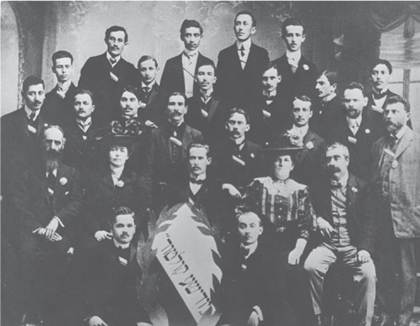
30.17 Delegates at the First Congress of the Yiddish Language held in Chernivtsi, 1908.
Despite the shortcomings of Habsburg rule, especially in the Hungarian “half,” of the empire, it is important not to lose sight of the larger context in which Ukrainians lived during the last decades of the long nineteenth century. At that time the vast majority of Ukrainians, known by the condescending term “Little Russians,” lived in the Russian-ruled Dnieper Ukraine. Under tsarist Russian rule, not only were they denied the use of their own national name, Ukrainian, the very idea that Ukrainians existed as a distinct nationality was dismissed as the misguided work if a handful of “separatists” aided by “subsersive” propaganda from neighboring Austrian Galicia. By contrast, in Austrianruled Bukovina and most particularly in eastern Galicia, a Ukrainian national movement was not only permitted but actively encouraged by the Habsburg government.

30.18. Aleksander Dukhnovych (1803-1865), Greek Catholic priest and writer, considered the “national awakener of the Carpatho-Rusyn people.”
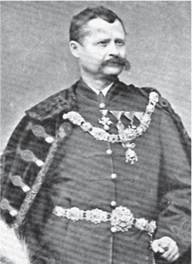
30.19 Adol’f Dobrians’kyi (1817-1901), Transcarpathian political and civic activist who defended Rusyn national interests in Hungary during and after the Revolution of 1848.
This was particularly the case during the reign of Habsburg Emperor Franz Joseph (r. 1848-1916), who became a kind of benevolent father figure and protector of Ukrainians. It is not surprising, then, that unlike many other nationalities in Austria-Hungary, Ukrainians were to remain loyal to Habsburg rule until the empire’s very end. In many ways it could be said that the Austrian Habsburg experience made possible the realization of the Ukrainian national idea and the future survival of Ukrainians as a distinct nationality.

30.20 Franz Joseph I (1830-1916), Habsburg emperor of Austria-Hungary, whose 68-year-long benevolent rule from 1848 to 1916 encompassed the entire period of the Ukrainian national awakening in Galicia and Bukovina.