Writing Constitutions Explained
Writing Constitutions uses colour coding throughout the book to allow readers to navigate through the chapters and to understand the underlying legal concept. Each chapter begins with figures containing the guiding questions for drafting a constitutional clause and are fully coloured.
Solutions to almost all guiding question are then summarised in tables which are then reviewed and discussed. The colour scheme is also reflected in the headings of the tables and follows the below classification: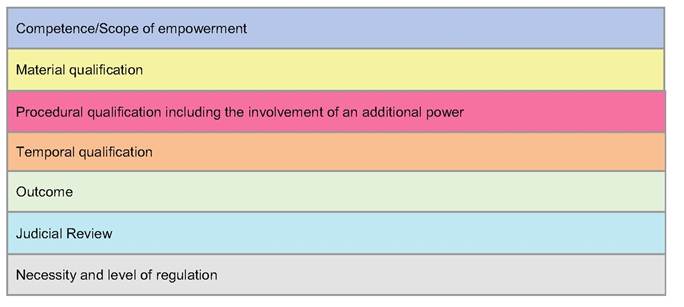
Writing Constitutions is presented in three volumes. Volume I is called Institutions, Volume II Fundamental Rights and Volume III covers Constitutional Principles.
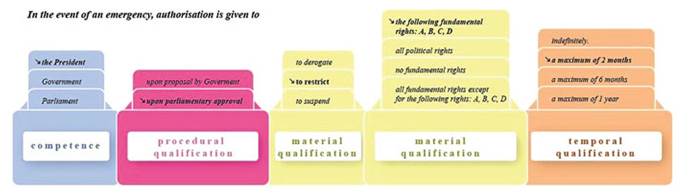
Volume I is based on a modular concept which dissects constitutional clauses in components. Many of these components have been presented as tables that outline the design options constitutional drafters have at hand. The tables form a card index cabinet and each tray in the cabinet contains an important component enabling lawmakers to assemble and compose the constitutional clause as shown in the image below.
Example
In the event of an emergency, authorisation is given to the President upon parliamentary approval to restrict the following fundamei rights:.4. B. C, Dfora maximum of 2 months.
However, alternatively, the wording could also be
In the event of an emergency, authorisation is given to Parliament upon proposal by Government to suspend el! fundamental rights except for the following rights:.4, B, C, D for a maximum of 6 months.
Writing Constitutions (as many works in comparative law will always be) is a work in progress. For once, constitutions are evolving and constitutional crises are unfolding around the globe year by year.
More importantly however, the constitutional practice around the world is too multi-faceted and voluminous to be captured in a single volume. Therefore, Writing Constitutions is a first attempt which will no doubt call for subsequent editions. Contributions from readers and practitioners around the world are welcomed—help us enhance Writing Constitutions by writing to: comments@writingconstitutions.com.This book would not have been possible without the loving support of Wolfgang’s family members Dorothee, Alea and Oscar as well as dedicated research and contributions by the following colleagues: Christina Albath (presidential qualification and oath), Kirsten Ammon (non-confidence), Tobias Beck (referendum), Julia Bofilet (budget), Lisa Brentrup (deputy), Kevin Bruhl (opposition), Dr Nicolai Culik (dismissal of government), Anna Gottesbuhren (investigative committees), Leonid Guggenberger (presidential election), Stefanie Hees (countersigning), Jasmin Hertel (veto and dissolution), Vera Hurter (vote of confidence), Christina Koch (appointment of government), Conrad Knochel (central bank), Sarah Kraft (immunity and indemnity and overall design), Annika Lindemann (presidential term), Stephan Labitzke (state of emergency), Leon Luserke (referendum), Jacqueline Metzing (election thresholds), Daniel Muth (non-confidence), Lilianna Ranody (political parties), Lena Reich (internal organisation of parliament), Isabell Schmitter (taxes and control chamber), Shaya Stender (legislative initiative), Toni Stotz (impeachment), Dr Gerhard Wiebe (amendment and overall design), Moritz Wiechert (interpellation) as well as editorial support by Jessica Swane and illustrations as always by Kathleen Chew. Thank you all for your amazing contributions! In addition, we are particularly grateful to Dr Brigitte Reschke of Springer Nature who from the very beginning endorsed our plans and progress on Writing Constitutions.
An introductory video can be found on www.writingconstitutions.com and on https://doi.org/10.1007/978-3-030-94602-9_1.
Sydney, Australia Osnabruck, Germany
Wolfgang Babeck
Albrecht Weber
September 2022