Analytic-synthetic and necessary-contingent
As we saw, Leibniz said that a sentence was necessarily true if it was true in every possible world. We can use this fact as a basis for a reductio of the idea that intensions are meanings.
According to the proposal that intensions are meanings, the meaning of a name is fixed once we know what it refers to in every possible world.Let's consider, then, what the intension of “the Morning Star” is. Well, it turns out that in every possible world “the Morning Star” refers to the Evening Star. If we consider a way the universe might have been in which the Morning Star is in various ways different, that is the same thing as considering a way the universe might have been in which the Evening Star is different.
You might think this was wrong. Surely it is possible, you might say, that the Morning Star should not have been the Evening Star.
But think about it for a moment. Since the Evening Star is the Morning Star, what is it that you are supposing might not have been the Evening Star? Of course, the Evening Star might not have been visible on the horizon at dawn. So there is a possible world in which the Evening Star doesn't appear on the horizon at dawn. But that is a possible world in which the Morning Star doesn't appear on the horizon at dawn, either. In that world, the Evening Star might never have come to be called “the Morning Star.” Because there is such a possible world, the sentence
The Morning Star might not have been called “the Morning Star”
is true. But in our language, in this world, the Morning Star is called “the Morning Star.” And the thing that our expression “the Morning Star” refers to is the same thing in every possible world as the thing that “the Evening Star” refers to.
It follows, of course, that the sentenceF: The Morning Star is the Evening Star
is true in every possible world, and thus necessary. The fact that true identity statements between names are all necessarily true is called the necessity of identity. It is the necessity of identity that leads to the conclusion that intensions are not meanings.
For, remember, the meaning of a sentence is what you have to know in order to understand it. If intensions were meanings, therefore, anyone who knew the meaning of the names in a language would be in a position to know the truth of every identity statement involving names. But, as Frege pointed out, F, which is an identity statement involving names, is not a piece of semantic knowledge, but a great astronomical discovery. This argument provides a reduc- tio of the claim that intensions are meanings.
There is another important reason why this theory is wrong. If intensions were meanings, then the meaning of a sentence would be determined by the class of possible worlds in which it was true. So any sentences that were true in just the same possible worlds would have the same meaning.
This would have very bizarre consequences. It would mean, for one thing, that every necessarily true sentence had the same meaning. So “2 and 2 is 4” would mean the same as “16 and 16 is 32.” More than this, any two contingent sentences that were true in just the same possible worlds would have the same meaning. Thus, not only would “The Evening Star is often visible on the horizon at dusk” mean the same as “Venus is often visible on the horizon at dusk,” but “John is a bachelor” would mean the same as “John is a bachelor and 2 and 2 is 4”!
These are the two main sorts of reasons why we have to distinguish between senses and intensions.
In 3.4 I said it was going to prove important that sense be defined as what you had to know to understand a sentence. Sense, Frege insisted, is a cognitive idea. (“Cognitive” just means “having to do with knowledge.”) If two names, “a” and “b,” have the same sense, then anyone who knows their senses—anyone who understands how those names function in the language—will know that “a is b” is true. But an intension is not a cognitive idea. From the fact that two names, “a” and “b,” have the same intension, it does not follow that people who understand the language will know that “a is b” is true.What is true in every possible world, then, is what is necessary. And we use the word “contingent” to refer to things that are true in only some possible worlds. Thus, it is a contingent fact that cucumbers are green, because they might not have been green. That is equivalent to saying that the universe could have been different in such a way that cucumbers were some other color; it is also equivalent to saying that there are possible worlds in which cucumbers aren't green.
It is crucially important to notice that whether a sentence is necessary is not the same question as whether anyone who knows the meaning must know (or be able to work out) that that sentence is true without relying on any nonsemantic information. For this reason we need another word to describe sentences whose truth does follow, in this way, from their meaning. We call such sentences “analytic,” using a word that the great German philosopher Immanuel Kant introduced with this meaning. A true sentence that is not analytic is called a “synthetic” truth.
We have already seen that there are necessary truths—“The Morning Star is the Evening Star,” for example—that are not analytic. But it is also true that there are contingent truths that are analytic.
Thus, everybody who knows English and understands what “centigrade” means, in particular, knows that “Water freezes at sea level at zero degrees centigrade” is true, because zero degrees on the centigrade scale is defined as the freezing point of water at sea level. But it isn't necessarily true that water freezes at zero degrees centigrade: there are possible worlds in which it freezes at a higher temperature.In the last chapter I said that rationalists thought that we could know necessary truths, because we could come to know them by reasoning, which is the only source of certainty. But, as we have now seen, this is not true. We can find out analytic truths by reasoning; but not all necessary truths are analytic, and not all analytic truths are necessary. We use the Latin expression “a priori” to refer to truths that can be known by reason alone. In a sense, they can be known prior to any particular experience. A posteriori truths are those that require more than reason to discover. In a sense, they can be known only after (that is, posterior to) experience. The rationalists assumed that all necessary truths were a priori and all a priori truths were necessary.
Because the meaning of a sentence is known to everybody who understands it, anybody who understands a sentence that is analytic can work out that it is true. So, provided you understand an analytic sentence, its truth, for you, is an a priori matter. Whether every a priori truth is analytic is a disputed question. But you might think that while mathematical theorems, which can be proved, are a priori, they are not true simply in virtue of the meanings of the terms they contain, because not everyone who understands the terms can work out the theorems. (I'll say more about this in 3.13.) Certainly, however, not every analytic truth is necessary, as we have just seen. Finally, there remains the possibility that some a posteriori truths are necessary, such as “The Morning Star is the Evening Star.”
It is essential, therefore, as I said a little earlier, to keep questions about whether truths are analytic or a priori, on one hand, distinct from questions about whether they are necessary, on the other.
That is one reason I have taken such trouble to use possible worlds to explain the relations between them. But there is another reason. Though we cannot use possible worlds in this way to explain the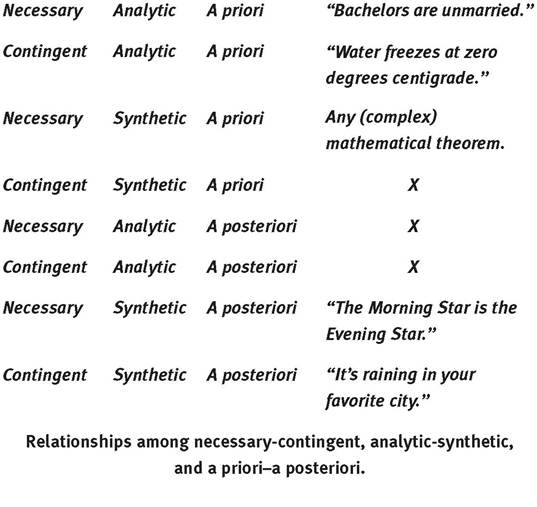
meanings of words, we can use them for another highly important philosophical task that has to do with language. And that task is understanding the nature of arguments.
3.9