Natural language and logical form
The study of arguments is logic, and beginning with the work of Frege, very great strides have been made in this subject. In the work of philosophers after Frege, the excitement that followed their logical discoveries led them to find—like Aristotle more than two millennia before—that the nature and status of logical truths is a topic of intrinsic interest.
Building on their theories, we can deepen our understanding of how arguments work.Here, then, are some of the basic ideas of logic. An argument is a sequence of declarative sentences that leads us to a final sentence, which is the conclusion. The other sentences, the premises, are supposed to support the conclusion. An argument is valid when any situation that makes the premises true makes the conclusion true also. If an argument is valid, we say that the conclusion follows from—or is a (deductive) consequence of—the premises. Logicians are especially interested in arguments that are formally valid. These are arguments where a sentence with the form of the conclusion must be true if the members of a class of sentences with the forms of the premises are true. Such arguments are also said to have a valid form. The idea of the form of a sentence is thus crucial to an understanding of logical theory. In order to explain what form is, I shall now make explicit an idea that we have been using implicitly throughout this chapter.
When I was discussing Frege's semantic theory, I talked about names and predicates and sentences, which are linguistic items, and discussed their connection with objects and properties and truths, which are things in the world. When we talk about the words and expressions that make up the sentence and the order in which they occur, we are talking about syntax.
So among the syntactic properties of the sentence “Snow is white” area) that its first word is “snow”
b) that the predicate is “is white”
c) that it is three words long.
The idea of form is essentially the idea of syntax.
In logic, then, what we seek to do is to identify those arguments that are reliable because of the syntax of the premises and the conclusion. So we want to identify patterns of argument that will work, whatever the particular content of the sentences. Just as we used variables earlier to stand in for names, so we can use sentential variables to stand in for sentences in order to make generalizations about arguments. Thus, using “S” and “T” to stand for sentences, we can say that an argument from a sentence of the form “S and T” to the conclusion “S” is reliable because it is not possible for “S and T” to be true when “S” is false. It is because we are interested in the form, the shape, of valid arguments, not in the particular contents of the sentences that make them up, that logic is sometimes called “formal logic.”
So far I have been talking about the natural languages that human cultures have developed for communication. But in order to study the issues about argument that are central to logic, philosophers and linguists have developed various artificial languages. When I wrote “S and T” just now, I was already moving away from natural languages toward the sorts of artificial languages that logicians have developed to study arguments. The use of symbols such as sentential variables has a number of advantages. One is that it allows us to see very clearly how the form of an argument affects its validity.
Another is that it allows us to escape some of the vagueness and imprecision of natural languages. But to use the artificial languages of formal logic we have to start by being clear about what we are developing them for. And if we are to be clear about this, it is very important to be clear about what is meant by the form of an argument in natural language.So let's consider an example. Take a sentence we've looked at before, and a conclusion we could draw from it.
Premise: S: John and Mary, who are friends of Peter's, sat in
the garden and ate strawberries.
Conclusion: T: Somebody ate strawberries.
Here there is one premise, and the conclusion certainly seems to follow. But it is also formally valid. According to the definition I just gave, this means that a sentence of the form of the conclusion must be true if a sentence of the form of the premise is. So what are the forms of these sentences?
One way to get a clearer picture of what is meant by the form of a sentence is to go back to considering Frege's open sentences. We get open sentences by removing the names from complete sentences. We can then say that the sentence is “composed from” the names and the open sentence. (As before, we label the blanks with variables, one for each name we remove.) S, the premise in this argument, is composed from the names “John,” “Mary,” and “Peter,” and the open sentence
O: X and Y, who are friends of Z's, sat in the garden and ate strawberries.
Using the variables as labels, we can say that “John” is in the X- position, “Mary” in the Y-position, and so on.
Now, there is nothing to stop us from removing words other than names.
Just as we can have variables for names, we could have variables for nouns and for any other words. Thus we could say that S is made up of the three names, the noun “friends,” and the expressionX and Y, who are F of Z's, sat in the garden and ate strawberries.
This time we can use the label “F” to say that, in S, “friends” is in the F-position of this formula. “F” is a noun variable, just as “X” is a variable for names. So we can generalize the idea of an open sentence to mean anything produced by replacing words with variables.
Notice that when we remove a word from a sentence to replace it with a variable, the open sentence we are left with can be used to make a different sentence. So we could make
S3: Peter and Mary, who are friends of John's, sat in the garden and ate strawberries
from O and the same names, if we just put the names in different variable positions. What S and S3 have in common is the fact that they are composed from the open sentence O. When we say that sentences share a certain form, we mean they can be composed from the same open sentence. In other words, we can use the idea of being composed from the same open sentence to describe aspects of the syntax that certain sentences share.
Among the less interesting facts about the form of S is the fact that it is a sentence. This simply means that we could remove all the words and replace them with the single variable that we earlier called a sentential variable. All sentences share this formal feature: they can all be composed by replacing a string of blanks with a string of words. We can make an open sentence by removing all the words from a sentence of English and then make another sentence by putting in another lot of words (though, of course, the rules of English syntax determine which strings of words make up meaningful sentences).
But sentences share more interesting aspects of form than the fact that they are sentences: for example, the formal property shared by all the sentences that can be made from O by replacing the variables with names.
We can now reexamine the argument from
S: John and Mary, who are friends of Peter's, sat in the garden and ate strawberries
to
T: Somebody ate strawberries
in the light of this discussion of form. What aspect of the form of the premise and the conclusion makes the argument valid? The sentence is composed of three names (let's call them “j,” “m,” and “p”), two one-place predicates (let's call them “G”, for “sat in the garden,” and “A”, for “ate strawberries), and a two-place predicate (“F” for “is a friend of”.) What it says is, in effect,

Since we can replace any sentence of the form “S & T” with a sentential variable (because every conjunction of sentences is itself a sentence), repeated applications of this rule will allow us to say that this sentence is of the form
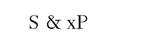
where “S” is a sentential variable, “P” is a predicate, and “x” is a name.
So one very general answer is that the inference we are analyzing is an example of an inference from a sentence of the form
to a sentence of the form
Conclusion: Somebody P.
Now, the reason why the argument is valid is that every argument of this form is valid. This allows us to record a very broad generalization about many possible arguments.
This is not the only way in which an argument of this form can be shown to be valid, however. Thus, any inference from a sentence of the form of
O: X and Y, who are friends of Z's, sat in the garden and ate strawberries
to
Conclusion: Somebody ate strawberries
is valid too. However we fill in the X, Y, and Z places, if the resulting sentence is true, the conclusion must be true also. So this is one way of making a narrower generalization about which arguments are valid. But logicians focus their interest on a special group of formal properties of sentences and study how the presence of those formal properties affects the validity of arguments.
One example of this sort of study is sentential logic (or propositional logic), which makes generalizations about how the presence of the words “and,” “not,” “or,” and “if” in sentences affects arguments. To do this, sentential logic uses sentential variables of the sort I introduced just now, but it also moves further in the direction of a purely artificial language by replacing the English words “and,” “or,” and “not” with the symbols “&”, “V”, and “~”, and the words “If...
then... “ with '*→". A typical (and not very exciting) claim of sentential logic is that every argument of the form
S
Conclusion: T is valid. This form of argument actually has a name. It's called “modus ponens.” Whatever sentences you put in place of “S” and “T,” provided you follow this rule, if the premises are true, the conclusion is also. (If you replace “S” in the first premise with a sentence, you must replace it with the same sentence in the second premise and the conclusion.) “And,” “or,” and “if” are called connectives, because they are used to connect sentences to each other. “S and T” is called the conjunction of “S” and “T”; “S or T” is called the disjunction of “S” and “T”; and “If S, then T” is called a conditional with “S” as antecedent and “T” as consequent.
“Not,” of course, isn't literally a connective: it applies to one sentence at a time, so there isn't a second sentence to connect. But it is a natural generalization of the idea of a connective that there are one-place (or unary) connectives, corresponding to the two-place (or binary) connectives like “and.” Among the other unary connectives will be “It's necessary that,” for example. We can also call unary connectives “sentence-forming operators on sentences”: if you put “not” into one sentence in the right place, thus operating on that sentence, you get another, different sentence. Thus, we can go from “It's snowing” to “It's not snowing.” “It's not snowing” is called the negation of “It's snowing.” Since, in English, you can get a sentence equivalent to the negation of any sentence, S, by writing “It is not true that—” in front of S, we often write “not-S” as shorthand for the form of the negation of S. But, of course, in the artificial language of propositional logic we can simply write “~S.”
Predicate logic builds on sentential logic. It studies the way in which the quantifiers “all” and “some” affect validity. Thus, the inference
Premise: X P
Conclusion: Somebody P,
is an instance of a simple result in predicate logic. Here we have variables for names and for predicates, not for sentences, and the quantifier “somebody.” First-order predicate logic involves quantifiers whose variables refer to individuals; in second-order logic we deal with quantifiers that refer to sets of individuals, or predicates, as well. We were using the ideas of second-order logic in Chapter 1, when we constructed the Ramsey-sentences using the existential quantifier “There exists an X such that X...,” because some of the variables here referred not to individuals but to properties such as “being-in-pain.” (This turns out to be important because second- order logic is rather less straightforward in many ways that first- order logic.)
Now, not every valid argument gives you a reason to believe the conclusion. Even if the argument is valid, it only gives you a reason to support the conclusion if the premises are true. A valid argument whose premises are true is called a sound argument. The task of logic, therefore, is to try to give a theory that will allow us to identify which arguments are valid. Once we know which arguments are valid, we can see then whether we should believe their conclusions by deciding if we have reason to believe the premises. If an argument is valid and sound, then it does offer good reason to believe its conclusion.
Notice that it follows that there is another way in which we can use valid forms of argument in arriving at new beliefs. In a valid argument, it can't happen that the premises are true and the conclusion false, so if the conclusion is false, the premises aren't all true. Sometimes, therefore, if we recognize that a form of argument is valid and know that the conclusion is false, we can infer that at least one of the premises is false. This is the logical truth we have relied on whenever we have used reductio arguments.
3.9