Factual Propositions and Supervaluationism
The idea that some propositions are factual (‘metaphysically first-rate, ‘grounded in reality/the world, etc.) while others are not is an old one.
In the context of vagueness, the view is most commonly attributed to some (but certainly not all) philosophers associated with the supervaluationist formalism.[175] According to that paradigm, vague propositions are not factual and when a proposition is borderline they say that there is no fact of the matter about whether it is true. (Indeed, some even see this to be the distinguishing feature of supervaluationism that prevents it from collapsing into a form of epistemicism.) The converse is not true, however: not all precise propositions are factual, because one can have precise propositions that are nonetheless higher- order vague.The distinction is supposed to be a metaphysical one. By contrast, one might try to elucidate a difference between factual and non-factual propositions by looking at their role in thought—how the different kinds of propositions behave as the objects of belief, desire, and knowledge (see chapters 6-10, Field [53], and Schiffer [126]). A theory that elucidates the difference purely in terms of how we think with vague propositions is, I think, at odds with the dominant understanding of the distinction. For example, Barnett [11] writes that ‘on the dominant view of vagueness [i.e. Fine- style supervaluationism], if it is vague whether Harry is bald, then it is unsettled, not merely epistemically, but metaphysically, whether Harry is bald'—it does not seem as though this metaphysical unsettledness could be explained purely in terms of how we think about things.
style='font-size:9.0pt;line-height:122%'>A natural place to start our investigation is to look at the way this notion gets formally cashed out in a supervaluationist framework.
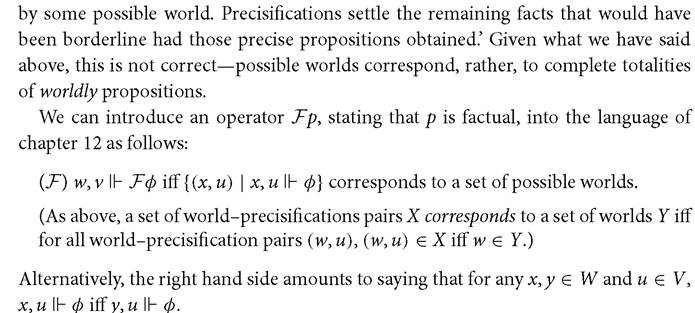
Recall that a vague proposition gets modelled within this formalism by a set of world-precisification pairs. Propositions are thus more fine-grained than sets of worlds. However, each set of possible worlds corresponds to a special kind of set of world-precisification pairs: the set of all possible world-precisification pairs whose world coordinate belongs to our original set of worlds. Intuitively these are propositions whose truth value can vary only through shifts in the world coordinate—no amount of shifting the precisification (i.e. shifting the boundaries of the vague predicates) will induce a change in truth value. Thus, in the supervaluationist setting a vague proposition is factual if and only if it corresponds to a set of possible worlds.It is clear that in this framework the distinction is intimately tied to the notion of a possible world. In order to find out whether a factual proposition is true or not,
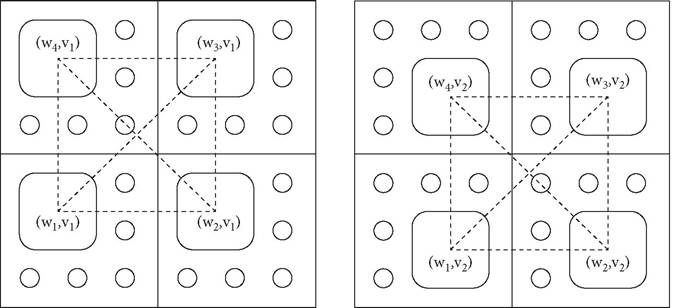
Figure 14.1. The space divided into four world propositions. The two diagrams represent two divisions into precise propositions depending on the precisifications v1 and v2.
one only needs to know which possible world is actualized—it doesn't matter which precisification accurately describes the distribution of cutoff points, since the truth of a worldly proposition won't depend on which precisification is accurate. The worldly facts are thus all and only those whose truth is determined by the world.
Recall also that due to higher-order vagueness, the factual/non-factual distinction is not the same as the distinction between precise and vague. This difference is made quite clear in the supervaluationist semantics: in Figure 14.1, the maximally strong consistent precise propositions are represented by the four rounded boxes and a collection of degenerate cells.
By contrast, the worldly/non-worldly distinction defined in the previous paragraph corresponds to the four quadrants of the diagram in which the maximally strong consistent precise propositions reside. Thus, typically, the maximally strong consistent precise propositions are stronger than the maximally strong consistent worldly propositions. Moreover, notice that while the divisions between the precise and vague propositions can themselves be vague and may vary from precisification to precisification, it is built into the formalism that the boundaries between the worldly and non-worldly propositions remain constant.It is only in very exceptional circumstances that the two distinctions align and, in the models in which they do align, there is no higher-order vagueness.[176] When explaining the role that possible worlds play in a supervaluationist semantics, it is tempting to fall back on something like the following characterization: ‘Each possible world represents a (metaphysically possible) complete totality of precise facts and each metaphysically possible complete totality of precise facts is represented
The Supervaluational way of modelling the difference between factual and non- factual propositions has the distinctive feature that propositions can be modelled as sets of ordered pairs, and the notion of factuality corresponds to being invariant along one of the coordinates in the way described above.