14.2 The Problem of Higher-Order Vagueness
The notion of factuality captured by the supervaluationist semantics described above is subject to a straightforward paradox of higher-order vagueness.
Consider the operator Sp that applies to p if it is entailed by some true factual proposition. We can introduce this operator by defining it from the notion of factuality and propositional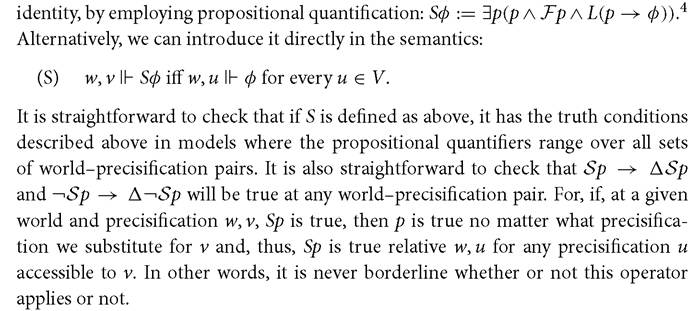
Consider now the following scenario. Suppose that the world is divided into a large but finite number of spatio-temporally disconnected epochs, which we shall number by the order in which they occur. Suppose, moreover, that the nth epoch contains exactly n electrons, but is otherwise completely empty. Now, presumably, if
4
face="Times New Roman">Recalling that Lp is defined as p = T.
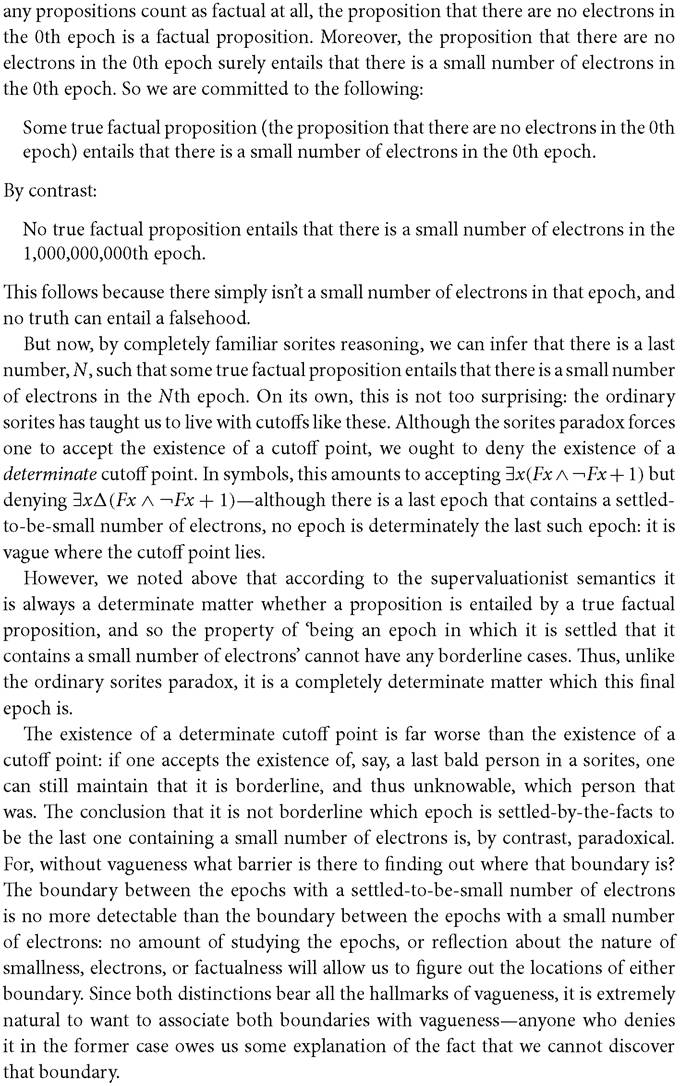
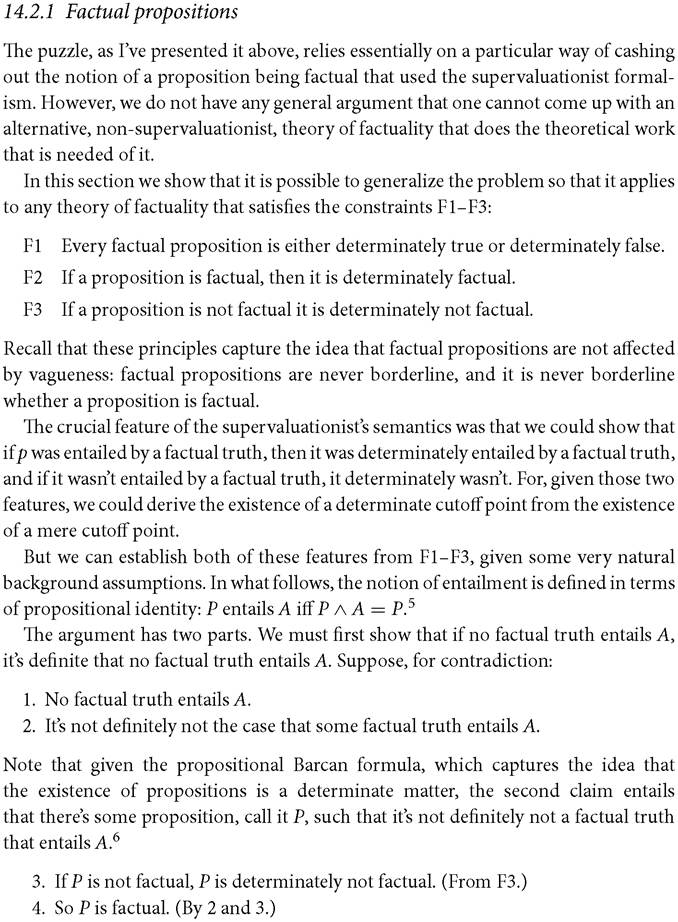

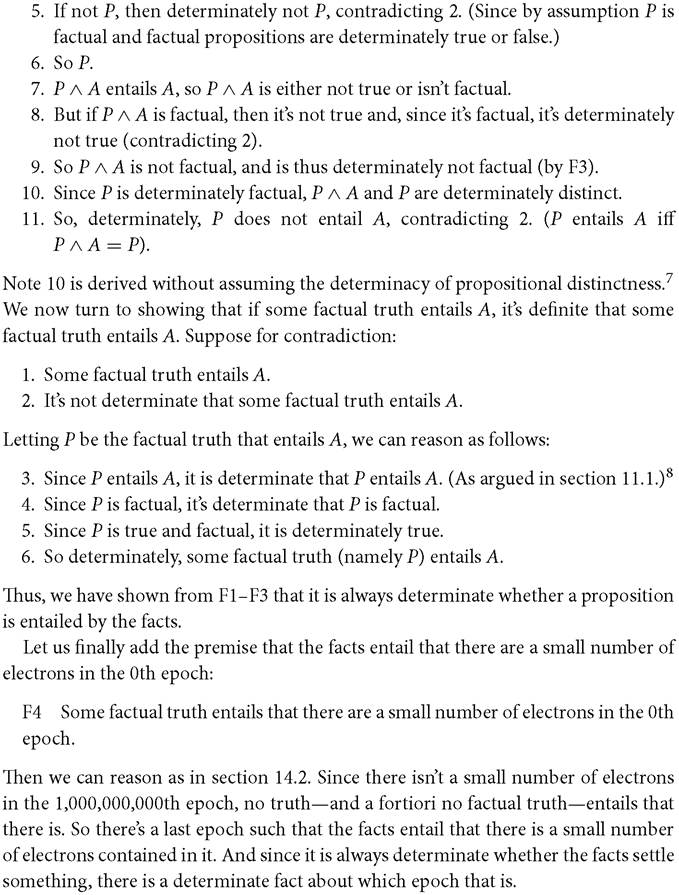

between the factual and non-factual.
This manoeuvre is not without its costs, however. For, given Booleanism and the plausible assumption that factual propositions are closed under Boolean operations, it follows that the disjunction of any factual proposition with an incompatible non-factual proposition will be non-factual.10 But, given classical logic, it follows that this non-factual disjunction is entailed by the factual disjunct. So, to maintain this radical form of the independence of the factual from the non-factual, one has to either give up Booleanism or deny that factual propositions are closed under Boolean operations.14.2.2 Fundamental propositions
Although I have targeted the ideology of a proposition being factual, or ‘grounded in reality’, the above argument generalizes to a great number of related distinctions. Many philosophers are quite happy to employ the closely related notion of a property or proposition being fundamental. This latter distinction is employed widely, even by those who eschew words like ‘facts', ‘grounded in reality’ and so on.11
The above argument can also be deployed to make trouble for the notion of a fundamental proposition, since fundamental propositions plausibly are governed by analogues of F1-F3. Itis clear that fundamental propositions are never vague, for they concern truths about the locations of electrons, the topology of space-time regions, and so on. On the usual understanding of the notion of a fundamental proposition, it is a completely precise matter which propositions are the fundamental propositions. Questions concerning whether a proposition describes the fundamental structure of the universe or not are not like questions that concern whether a person is bald: the former questions seem always to have determinate answers. Moreover, for the same reasons we gave in section 14.2.1, some fundamental proposition entails that there are a small number of electrons in the 0th epoch. Thus, we have secured F1-F4. We can reason that there is a last epoch which the fundamental truths settle to contain a small number of electrons, and that it is a completely determinate matter which this final epoch is.
Thus, I think, a similar conclusion can be drawn about the notion of‘fundamental- ity’ at least as it applies to propositions: it is not in good standing.
14.3