Vagueness All the Way Down
A couple of points are worth bearing in mind when evaluating these arguments. Firstly, although they purport to show that the notion of a fundamental proposition (and cognate notions) are not in good standing, there is a great number of useful 
related concepts that are not affected by the above considerations.
For example, the ideology of ‘fundamentality' is as often applied to language as it is to propositions (for example, when we talk about sentences formulated in the fundamental vocabulary of physics). Clearly, nothing I have said above suggests that there is anything problematic with the distinction between fundamental and non-fundamental language. Moreover, there is also a comparative notion of fundamentality that is not targeted by the above considerations. For all I've said, we can still talk about some propositions being more fundamental than others.But as for the notion of a fundamental proposition (or, indeed, a factual one), it needs to be revised in light of the present theory of vagueness. One option is to reject the notion altogether. I have effectively argued that the very idea of a basic layer of facts completely unaffected by vagueness is not sustainable; yet this seems to be exactly what the idea of a fundamental proposition presupposes. Alternatively, one could attempt to revise the notion of fundamentality in such a way that it violates one of our premises, F1-F4. I take it that allowing some fundamental propositions to be vague would do too much violence to the notion. But, perhaps, one could employ a revised notion with the feature that it is vague which propositions count as the fundamental ones.
I am not entirely sure which of these two lines to take—rejection or revision—but I think that whichever line we take, it is clear the resulting picture is quite at odds with the dominant way of thinking about fundamental structure.
The alternative might best be described as a view in which there is ‘vagueness all the way down': a view in which truths don't bottom out in some determinate, basic layer of precise facts. We have seen this sort of idea in action already. The idea that there is such a basic layer of truths might seem inevitable given the fact that we seem to be able to readily come up with specific examples of such truths: the proposition that there are electrons, that gravity attracts, or what have you. But as we noted in chapter 12, these propositions are plausibly vague. It is epistemically open whether claims about electrons and gravity really are rock bottom, or whether they are just as emergent and subject to vagueness as propositions about tables and chairs. Once this conclusion is properly taken to heart, I think much of the motivation for postulating the notion of a fundamental proposition is undermined.Let us now examine another notion that seems to be implicated in the paradoxes of higher-order vagueness: the notion of a possible world. We have already encountered several views that place special theoretical significance on the notion of a possible world. Both the supervaluationist described in section 12.1.2, and the expressivist we encountered in chapter 8 agree that, although in general propositions are more finegrained than sets of possible worlds, there are special sorts of propositions—ones that are somehow ‘metaphysically first-rate'—that correspond to a set of possible worlds. Similar ideas are frequently applied outside the literature on vagueness as well, for example in the context of moral expressivism (see e.g. Gibbard [64]), or epistemic modals (see e.g. Moss [109]). As we saw earlier, the idea that some propositions
correspond to sets of possible worlds can be seen as one way of formally modelling the distinction between factual and non-factual propositions.
However, insofar as the notion of a possible world allows us to introduce a notion of propositional factuality, governed by principles F1-F4, the notion of a possible world is notingood standing either.Suppose thatwe have aprimitive notion ofaproposition corresponding to a set of possible worlds, allowing that some vague propositions may not correspond to any set of worlds.
We can then say that a proposition is factual if it corresponds to some set of possible worlds. If it is always a precise matter whether a proposition corresponds to a set of worlds or not, and a precise matter which entities are the possible worlds, we can show F2 and F3 for our defined notion of factuality. If we also assume, quite plausibly, that only precise propositions can correspond to sets of worlds, we can also show F1 and F4 can be given a justification similar to the one we gave earlier.The rejection of possible worlds is not something that should be taken lightly. After all, the use of possible worlds is ubiquitous in philosophy: how are we to reconcile our picturewiththe largebodyofvaluablephilosophicalworkthat presupposesthe notion of a possible world? In addressing this issue we must be careful to distinguish the characteristics of possible worlds that are essential to the theoretical work that involves them, from some of the superfluous metaphysical theses that are often associated with them.
Part of the issue is that the word ‘world’, as it appears in the philosophical literature, is actually ambiguous between at least two different notions: what I'll call the logical notion of a world and the metaphysical notion of a world. The first is the logician’s concept of a world, which first made its appearance in an abstract kind of semantics for modelling a class of operators governed by principles of a normal modal logic— the Kripke semantics. The logical notion of a world does not carry commitment to anything like the notion of factuality discussed above. Indeed, for logical purposes, more neutral terminology is often employed in its stead such as indices, states, or points. In practice, the logical indices may not be metaphysically possible worlds, but world-time pairs, or world-precisification pairs, or perhaps things that can’t be analysed in terms of pairing an (ordinary) world with some other entity (as on the present view).
Note that if we are interested in languages containing operators representing metaphysical necessity, the logician’s indices will come equipped with an equivalence relation that tells us whether a proposition (a set of indices) is possible or impossible relative to a given index. Thus, we can classify our indices into possible and impossible, although, if the equivalence relation is not the universal relation, it will be a distinction that depends on the index of evaluation. It is the notion of a logical index that is relevant to most technical work in the philosophy of language and linguistics.According to the logical notion of a possible index, it is a vague matter which of the indices count as possible. For example, in a supervaluationist setting the indices are not possible worlds but world-precisification pairs. In that setting, a logical index (x, u) is possible relative to (w, v) only if the two indices are modally accessible, which happens iff u = v. It follows that if u and v are Δ-accessible then it is borderline, at (w, v) whether (x, u) is metaphysically possible: if v = u then (x, u) is not possible relative to (w, v) but is possible relative to (w, u) which is Δ-accessible to (w, v). If v = u then (x, u) is possible relative to (w, v) but is impossible relative to any Δ-accessible pair (w, v') with v' = v. (This result is not specific to the supervalu- ationist either. It is a necessary matter whether a number is small, but it can still be a borderline matter. If N is borderline small, then there must be indices that disagree about whether N is small, and given that it is necessary whether N is small, at least one of these indices must represent a metaphysically impossible state of affairs. Although, it will be borderline which one.)
It is straightforward to introduce the notion of a proposition which corresponds to a set of possible indices, but since it is vague which indices are possible indices, we have no guarantee that the notion of corresponding to a set of possible indices so-introduced satisfies F2 or F3.
Although the notion of a logical index doesn't get us in to trouble, more problematic is the other use of possible worlds talk: what one might call, by contrast, the metaphysical notion of a world.
Paradigm examples of the latter concept include Lewis' notion of a maximal spatio-temporally connected region of space-time or Plantinga's notion of a complete possible state of affairs. Such entities are typically not the same as the logician's indices. For those who theorize in these terms, it is quite common to model the logician's indices as ordered pairs of possible worlds and other things: times if we are doing tense logic, precisifications if we are modelling vagueness, and so on.The assumption that indices can be decomposed somehow into a possible world and something else is not always innocent. In chapter 15, we will explore in more detail a context in which the logical notion of an index cannot be reduced to the notion of a possible world plus something else, for logical reasons relating to the combined logic of necessity and vagueness. But in the present context we can see that the assumption is already controversial, for if our semantics of vagueness is one in which the indices can be decomposed into pairs of metaphysically possible worlds and something else (e.g. supervaluationist precisifications), then we effectively have a variant of the supervaluationist semantics outlined in section 12.1.2, and we seem to be subject to exactly the same problems we encountered there: we reinstate a metaphysically significant division of propositions into factual and non-factual which is plausibly governed by the problematic principles F1-F4.
To be clear, then, it is the substantive metaphysical, and not the logical, notion of a possible world I am rejecting when I maintain that the ideology of worlds is problematic. It is natural to ask, however, whether it is possible to revise the ordinary metaphysical notion of a world so that it can do some of the work that it is sometimes put to without involving us in the paradoxes of higher-order vagueness? After all, the use of possible worlds is ubiquitous if only due to their considerable heuristic value.
One might think, therefore, that it would be worth having some sort of story about what is going on when philosophers talk about possible worlds, even if it is not quite how these philosophers usually conceive of what they’re doing.I take it that it is part of the standard conception of a possible world, as they occur in the theories of Lewis, Plantinga, and so on, that it is a completely precise matter which things are the possible worlds:
For any object x, it is always determinate whether x is a possible world or not.
It is hard, for example, to imagine Lewis’ conception of a world being subject to vagueness, since it appears to be definable from completely precise vocabulary (i.e. a ‘maximal spatio-temporally connected concrete entity’). Possible states of affairs in Plantinga’s sense are presumably also supposed to be taken as metaphysically basic and, thus, not subject to vagueness.
There is, however, an alternative way of thinking about possible worlds. We could, following Arthur Prior and others, attempt to recover talk of possible worlds by reconstructing them in terms of quantification over certain kinds of propositions. Prior was attempting to reconstruct worlds and times in terms of propositions, and although there are lots of ways one could attempt to do this, a quite natural approach would be to identify a world proposition with a maximally strong consistent eternal proposition.[177] An alternative approach, if we are modelling propositions as sets of world-time pairs, is to note that each possible world, w, corresponds to a proposition consisting of all pairs that have w as its first coordinate. These two definitions match up exactly—a world proposition (a maximally strong consistent eternal proposition) is a proposition that corresponds to a possible world in the sense just defined.
This idea extends naturally enough to the supervaluationist setting: each world w corresponds with the propositions consisting of all pairs with w in their first coordinate. Now recall that, according to the supervaluationist, a proposition is factual if it corresponds to a set of worlds, and a maximally strong consistent factual proposition is one that corresponds to a singleton of a possible world. Thus, we can alternativelydefine aworld propositioninthe supervaluationistsetting asamaximally strong consistent factual proposition.
In the two cases above, we saw that we can either start off taking a metaphysically substantive notion of world as basic, treating propositions as certain sets of ordered pairs involving them, or we can treat worlds as certain kinds of propositions (encouraging a view in which the propositions are basic). Since we have expressed some scepticism about the metaphysical notion of a world, one might wonder whether we could introduce the notion of a world proposition in the latter way, without assuming a prior notion of possible world, or a conception of propositions as sets of pairs of worlds with something else. Of course, we cannot follow the supervaluationist in identifying them with maximally strong consistent factual propositions, because we have also expressed scepticism about the notion of a factual proposition. However, we could instead talk about maximally strong consistent precise propositions:
12
A proposition p is a world proposition iff p is consistent, precise, and entails every consistent precise proposition that entails it.
The resulting notion of a world proposition bears some resemblance to the classical metaphysical conception of a world, but also has some notable differences. Firstly, note what maximally strong consistent precise propositions are: they are complete descriptions of the way the world could be in all precise respects. They settle all precise questions but leave open questions that would have been borderline given the precise way they describe things to be. As outlined in chapter 12, we can picture logical space as being divided into cells where precise propositions correspond to arbitrary unions of these cells, vague propositions can be viewed as propositions that cut across at least one cell, and the world propositions (the maximally strong consistent precise propositions) correspond to the cells themselves. See Figure 12.2.
In these respects, our conception of a world proposition is structurally exactly like the temporalist and supervaluationist conception of a world proposition, arising from a prior metaphysical notion of world, for both those conceptions impose a similar division of logical space into cells. However, unlike these notions, we have not motivated our definition by a prior conception of a proposition as a set of ordered pairs whose first coordinate consists in a metaphysical world. Indeed, in chapter 15, we shall look at some positive reasons to reject models of propositions that invoke ordered pairs in this way.
A more striking difference between our conception of a world proposition and the aforementioned ones, is that it is vague which propositions are the world propositions. That is, we can divide logical space up into cells in two different ways in such a way that it is vague which of the divisions correspond to the maximally strong consistent precise propositions. This is a result of higher-order vagueness: it is vague which propositions are precise, and, thus, vague which propositions are the maximally strong consistent precise propositions.
Thus, unlike Plantingas states of affairs or Lewis' maximal spatio-temporally connected concreta, it is vague where the boundaries of our world propositions lie. One might be tempted to think of this as a form of metaphysical vagueness (see e.g. Barnes and Williams [9] or Wilson [166]). But this is, I think, to tie world propositions too closely to the concrete reality around us—our world propositions are ‘worldly' in name only. It would be metaphysical vagueness if it were vague which entities were maximal spatio-temporally connected concreta, for then it would have to be borderline whether something was spatio-temporally connected, or borderline whether it was concrete, which are more familiar forms of metaphysical vagueness. Similarly, if it could be borderline whether an entity was a fact or a state of affairs, then one might similarly draw the connection to metaphysical vagueness. The vagueness I am describing amounts to nothing more than the vagueness one gets concerning which things are precise. Vagueness that we have already come to view as nothing out of the ordinary. I think a better moral to draw from the existence of this sort of vagueness, then, is that our notion of a world proposition is not a metaphysical one: it is not a distinction that carves at the metaphysical joints in the way that the distinction between fundamental or factual propositions was supposed to.
Let me end our discussion by briefly considering another contender for being the replacement for the notion of a world. Recall that a proposition p is precise* if (i) p is precise, (ii) the proposition that p is precise is precise, (iii) the proposition that the proposition that p is precise is precise is precise, and so on, at all finite orders. One might hope to limit the vagueness in our theoretical entities by theorizing in terms of maximally strong consistent precise* propositions instead. According to some theorists there's only one maximally strong consistent precise* proposition—the tautolo- gous proposition—because on those views very little counts as precise at all orders.[178] So, this proposal is not open to those philosophers. However, even for theorists such as myself who accept a variety of precise* propositions there are no good reasons to think the boundaries between the possible maximally strong consistent precise* propositions are any more precise. One can see, in the four-index model depicted in Figure 14.2, that relative to indices i and k, the singleton of j is not a maximally strong consistent precise* proposition, but relative to j and l, it is (see also Figure 13.1).
(Note also that (a) the Δ-accessibility relation coheres with the partition into precise propositions at the four indices: an index x sees y if x and y both belong to the same orbit of Orb(G(x)), (b) that modally accessible indices impose the same orbit structure, and that (c) this model validates the product logic—indeed, it can be generated as a supervaluationist model with two worlds and two precisifications.)
What this model demonstrates is that there is no logical guarantee that the notion of a maximally strong consistent precise* proposition is any more precise than the notion of a maximally strong consistent precise proposition. Indeed, as I noted
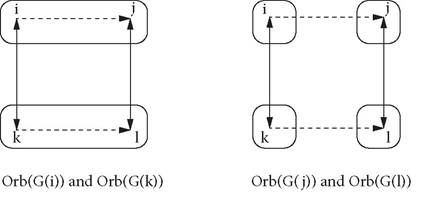
Figure 14.2. The left diagram represents the partition oflogical space accordingto both i and k (the partition according to Orb(G(i)) and Orb(G(k))), and the right diagram according to j and l (Orb(G(j)) and Orb(G(l))).
in section 13.4.1, I am doubtful that this notion plays a particularly interesting theoretical role, so I shall set it aside.
Let us summarize what we have done here. We have established that proponents of propositional vagueness ought to reject the notion that there is a basic layer of‘rock bottom' propositions that are completely unaffected by vagueness. This idea might be cashed out by the assumption that there is a set of fundamental or factual propositions, or a set of possible worlds that carve out a definite partition of logical space. We have proposed that we theorize instead with the notion of a precise proposition. The replacement carves logical space into a partition of precise propositions, albeit a partition whose boundaries are vague.
While these conclusions may sound radical and metaphysically revisionary, it is of interest to note that we were led to these conclusions primarily by epistemological considerations. In section 14.2, we argued that, since we can't know the cutoffs concerning what the fundamental propositions entail, these cutoffs bear all the hallmarks of vagueness. Similarly, in section 12.2, we argued that the propositions of physics are not precise due to the epistemic possibility that the propositions of physics correspond to less fundamental phenomena. Whether one wishes to classify these conclusions as deeply metaphysical is a matter of taste; I will not attempt to adjudicate that matter here.