Game theory I: Two-person zero-sum games
It would be interesting and important if we could make more precise the sort of argument Hobbes offered, so that we could say just why it is that the advantages of civil society over the state of nature ought to appeal to anyone.
It would be especially interesting if we could do this in a way that was not open to the sorts of objections I have made against Hobbes. To do this, we should first need to show why it was a reasonable strategy to enter into negotiations with other people in the state of nature, in order to gain certain important advantages. Then we would need to show what sort of agreements rational people would come to in those circumstances. As the American philosopher Robert Nozick put it:A theory of a state of nature that begins with fundamental general descriptions of morally permissible and impermissible actions, and of deeply based reasons why some persons in any society would violate those moral constraints, and goes on to describe how a state would arise from that state of nature will serve our explanatory purposes, even if no actual state ever arose in that way.
Unlike Hobbes, we would not be assuming that there are no moral principles that apply outside the state; we would not be relying on the fiction that we really did make a covenant; we need not be committed in advance to the particular form of absolute sovereign that Hobbes advocates, or to majority voting in the design of the state; and we could have a more plausible view than Hobbes' about when the state ceases to be advantageous and rebellion is in order.
Many recent philosophers, Nozick among them, have tried to refine the sort of argument Hobbes offered by making use of a very powerful modern theory about how rational people should deal with problems of this kind.
This mathematical theory has been put to use in many areas of the social sciences, including, most importantly, economics. It is called game theory because it was first applied to some simple games, but game theory can be a very serious matter.Game theory advances our understanding of rational decision making in the way that formal logic deepens our grasp of rational argument. That, in itself, gives it a philosophical interest over and above its importance for recent political theory. But game theory is not only of theoretical importance: nowadays it is used by corporations to make corporate decisions and by strategic planners working out how to conduct nuclear defense policy. Still, it remains easiest to explain the central ideas of game theory in terms of some (rather simple-minded) games.
For the purposes of game theory, a game is any setup in which there are people—called, naturally enough, “players”—who are choosing strategies for their dealings with each other, in a way that determines what each of them gets as a payoff. Thus, in chess there are two players; a strategy for each player consists of a (very complicated) set of rules about how he or she will react to any sequence of moves by the other player; and the payoff is a win, a draw, or a loss.
One way to represent a game that has two players, A and B, each with two strategies, is by drawing a matrix like this:
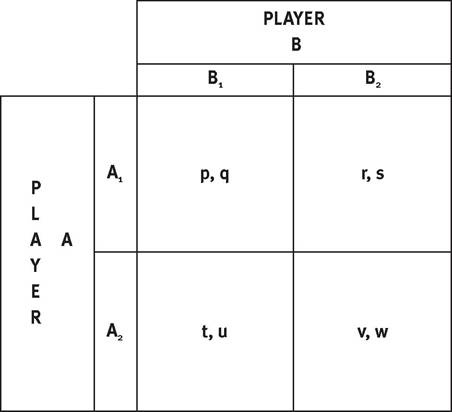
(Obviously this game is massively less complicated than chess!) Here, the pairs of values in the matrix represent what the players get as payoff if they adopt the strategies at the left of the row (for A) or the top of the column (for B). Thus, if A does A1 and B does B2, the payoffs are r for A and s for B.
Consider, for the sake of an example, this simple game.
We both, put a dollar on the table. Then you hide a marble behind your back, in either your right or your left hand. I now have to say either “left” or “right.” If I guess correctly, I get both dollars; if I guess wrong, you get them both. The matrix for this game looks like this: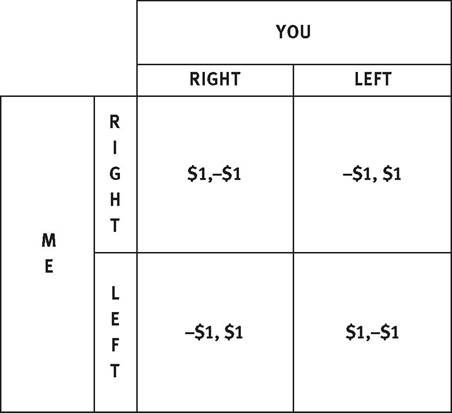
This simple game has a very important feature: if I win something, you lose it, and if you lose something, I win it. The total amount of payoff available is constant. For this reason games like this are usually known as zero-sum games: anything one player wins from the game the other loses, so that the sum of one player's losses (a negative amount) and the other's gains (a positive amount) will be zero. A zero-sum game is a game in which the players are most directly in competition; every cent or dollar or point I lose is a cent or dollar or point you win, and vice versa.
In zero-sum games, we only need to write one of the entries in the box, usually the amount won by the player with his or her name down the left-hand side of the matrix, since if it is a zero-sum game, every figure for one player's winnings implies an equal amount lost by the other. So we could just have written for the marble-guessing game:
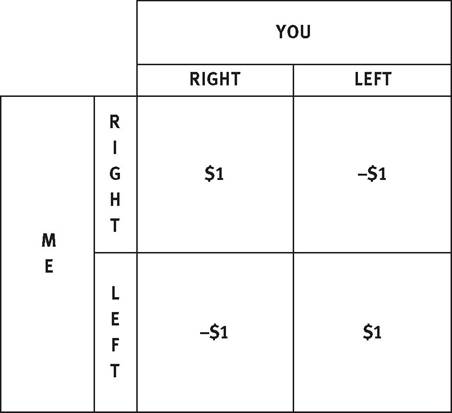
In games with more than two players, of course, even if there's a fixed pot of money or points to be handed out, what one person loses doesn't necessarily go to any particular other person; so we can't define a sum that one player wins as a positive value and what the another wins as a negative value. Only two-person games, then, can be zero-sum. (So when I talk about zero-sum games from now on, I usually won't bother to mention that they are two-person games.) As a result, with games where there are more than two players, the equivalent to being zero-sum—that is, to having a fixed pot—is being constant-sum: if you add up what goes to all the players, the total will be the same, no matter what strategies they adopt.
The phrase “zero-sum game” is often used loosely to refer to constant-sum games.Because the marble game is just a guessing game, there is really no question of choosing a strategy. Since I do not know where you will hide the marble, I might as well pick sides at random. (Though, of course, if we played often and I discovered a pattern in the way you hid the marble, I might adopt a strategy conforming to that pattern.) But there are games in which there is a distinct advantage in sticking to one of your available strategies.
Here is such a game. Each of us puts $1.50 on the table, so there is $3 available in prize money for the payoff. There are three marbles, two white and one blue. You write either “blue” or “white” secretly on a piece of paper. I am then allowed to remove either both of the white marbles or the blue one. If I remove the white marbles, you get the blue marble. But suppose I take the blue marble. Then, if you had written “white,” you get both the white marbles; and if you had written “blue,” I get all the marbles. The payoff each of us gets is a dollar back from the pot of $3 on the table for each marble we win. Since each marble ends up being won by somebody, this is a zero-sum game: every marble you don't get, I do. Now, you might think that I ought to take the blue marble in the
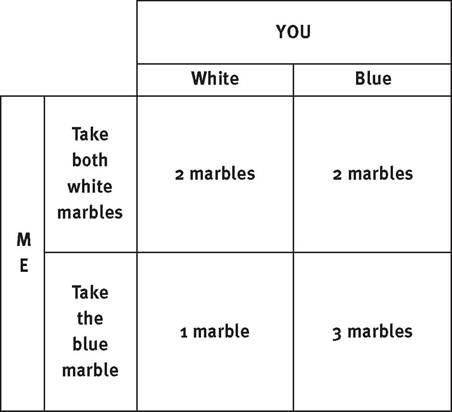
hope that you had written “blue.” But we are considering the game playing of rational people, and I should take your reasoning into account in deciding what to do. And from your point of view, it is clear what you should do. If you write “white,” the best that can happen is that you will get two marbles, because I take the blue marble, and the worst that can happen is that you get one marble, because I took the two white ones.
If you write “blue,” on the other hand, the best that can happen is that you get one marble, and the worst that can happen is that you get none at all. Since the best that can happen from your point of view if you choose “white” is better than the best that can happen if you choose “blue,” and the worst that can happen if you choose “white” is the same as the best that can happen if you choose “blue,” it seems obvious that, if you are reasonable, you will write “white.” Since that is so, I should take both the white marbles (assuming you are reasonable) and leave you with just the blue one. For if I took the blue marble, you would get both the white ones.The strategies in which you write “white” and I take the white marbles are called an equilibrium strategy pair, because if either of us unilaterally deviates from that strategy, we will be no better off than we would be if we had stuck to it. If you adopted your equilibrium strategy and wrote “white” but I deviated from my equilibrium strategy and took the blue marble, then instead of getting two white marbles (and two of the three available dollars) I would get only the blue marble (and only one dollar). I would actually be worse off. And if I chose my equilibrium strategy, and took the white balls, but you had deviated from equilibrium by writing “blue,” then you would get no more marbles than if you stuck with “white.” So you would be no better off. At equilibrium each of us is doing as well as we can expect, assuming the other person is rational.
In zero-sum games, if there is more than one pair of equilibrium strategies, then what each player gets is the same in each of them. In fact, if an equilibrium exists in the sort of game we have been considering, it is easy to find. The American mathematician and game theorist Morton Davis has explained very clearly some of the main points about equilibrium strategies.
We start by looking at the question from the point of view of one of the players, Michael, and we consider what follows from the assumption that Michael has to tell Marina in advance what strategy he has chosen.
Let's suppose that Michael's strategies are on the left of the matrix and correspond to rows, while Marina's are across the top and correspond to columns. Michael knows that, since Marina is rational, she will choose a strategy that minimizes his payoff. So he knows that Marina will choose the strategy corresponding to the minimum value of the row in the game matrix that Michael chooses. As Davis says, Michael should therefore “choose a strategy that yields [for him] the maximum of those minimum values; this value is called the maximin, and it is the very least that [Michael] can be sure of getting.”We can now consider what would happen if the situation was the other way round and Marina was deciding what strategy to choose if she had to tell Michael what she had chosen. Michael would choose for himself the row in the column Marina has picked that gave him the maximum, so her obvious choice is the column that minimizes this maximum. That outcome is called the “minimax.” When the minimax is the same matrix entry as the maximin, the payoff is called an “equilibrium point” and we call the players' strategies an “equilibrium strategy pair.”
Where there is an equilibrium point to a zero-sum game, there is a compelling reason for both players to opt for it: each player wants to maximize his or her gains and thus, since the game is zero-sum, to minimize the gains of the other player. Provided player A knows this fact about the other player, B, A has a reason to expect B to look for a strategy that maximizes the minimum B can get, whatever strategy A chooses; and, of course, vice versa. If there is a pair of strategies where both players maximize the minimum they can get, then each of them will want to stick with that pair of strategies.
In fact, a maximin strategy seems like a good idea in any zerosum game, whether it has an equilibrium or not. For in a zero-sum game you can assume your opponent is trying to minimize what you get and so maximize his or her own payoff. The maximin strategy minimizes the harm that your opponent can do you. As game theorists have often pointed out, the appeal of the maximin strategy in the zero-sum game lies in the fact that it offers security. If your opponent is irrational or takes risks, you might be able to do better than the maximin strategy: but the only way to do better is to risk something worse than the maximin strategy guarantees.
These simple ideas are at the basis of the theory of games. In order to apply the theory to any interesting problems, however, things have to be complicated a little. There are four main kinds of additional complexity in the full theory of games.
First of all, in the games I have been considering, the players consider only what are called pure strategies: strategies in which nothing is left to chance. With so-called mixed strategies, on the other hand, players do not decide among the options of getting A, B, C, and so on. Rather, each strategy corresponds to a (specified) chance of getting A plus a chance of getting B plus a chance of getting C, and so on, where, of course, all the chances add up to 1.
It might seem crazy to suggest that you would do better adopting a mixed strategy than adopting a pure one. “Surely,” someone could say, “making a rational decision will always be better than leaving things to chance.” But there are situations where the case for a mixed strategy is compelling.
Suppose, for example, that you are playing a modified version of the first marble-guessing game as part of an experiment in a computer science lab. When other people have played against the computer they have lost all the time, because it has correctly predicted which hand they will choose to put the marble in. You are not so easily caught out. You toss a coin and put the marble in your right hand if it turns up heads, and into your left if it turns up tails. Since the coin is a chance device, the computer cannot predict how it will turn out: it has to “guess” at random. So, unlike all the others, you win 50 percent of the time.
It turns out not only that there are good reasons for adopting mixed strategies on some occasions, but also that introducing mixed strategies allows the development of a very elegant mathematical theory of two-person zero-sum games. In particular, once you allow mixed strategies, there is always a solution to zero-sum games: a pair of strategies that maximize the minimum each player can expect to get by playing that strategy over and over again. So that is the first complication.
A second complication arises because not every situation can be seen as a game that has payoffs in dollars and cents, and if we are going to use the idea of a game to help us understand the process of coming to settle on a system of government, we shall want to have some measure of payoff that takes into account such things as security from attack, which are difficult, if not impossible, to measure in monetary terms. The way to do this is to use the notion of utility I mentioned in the last chapter. The entries in the payoff matrices are now not dollars but units of utility.
I mentioned in the last chapter that it is not very easy to make sense of the notion of interpersonal comparisons of utility, so that you might reasonably doubt that we can make sense of a zero-sum game in terms of utilities. After all, if we can't compare our utility values, how can we know that when I gain some utility you lose an equivalent amount?
This is a serious difficulty for an attempt to define the difference between constant-sum games and non-constant-sum games, where the payoffs in both are utilities. But, fortunately for us, it is a problem we can avoid. For, as I have said, even if we could make sense of the idea of other people getting as payoff an amount of utility equivalent to the amount I have lost, the “game” of political life is not one we would expect to be constant-sum. Furthermore, in the theory of two-person games, as it turns out, we can often avoid making comparisons between the amounts of utility the two players get from the various strategies; all we need to do, instead, is to consider whether each of them gets more from one strategy than another. And that is something you can do without interpersonal comparison of utilities. As we shall see later, however, some answers—and in particular, John Rawls' answer—to the question of the justification of political authority presuppose that interpersonal comparisons of utility are possible.
But two further kinds of complication, which are of importance in the application of game theory to political philosophy, are also necessary. These are
a) that we should consider games that are not zero-sum; and
b) that we should be able to consider, in particular, games with more than two players, which are called n-person games.
It is obvious why (b) is important; all real societies consist of more than two people. But to see why (a) is important, we can consider a very well known non-zero-sum two-person game.
6.5